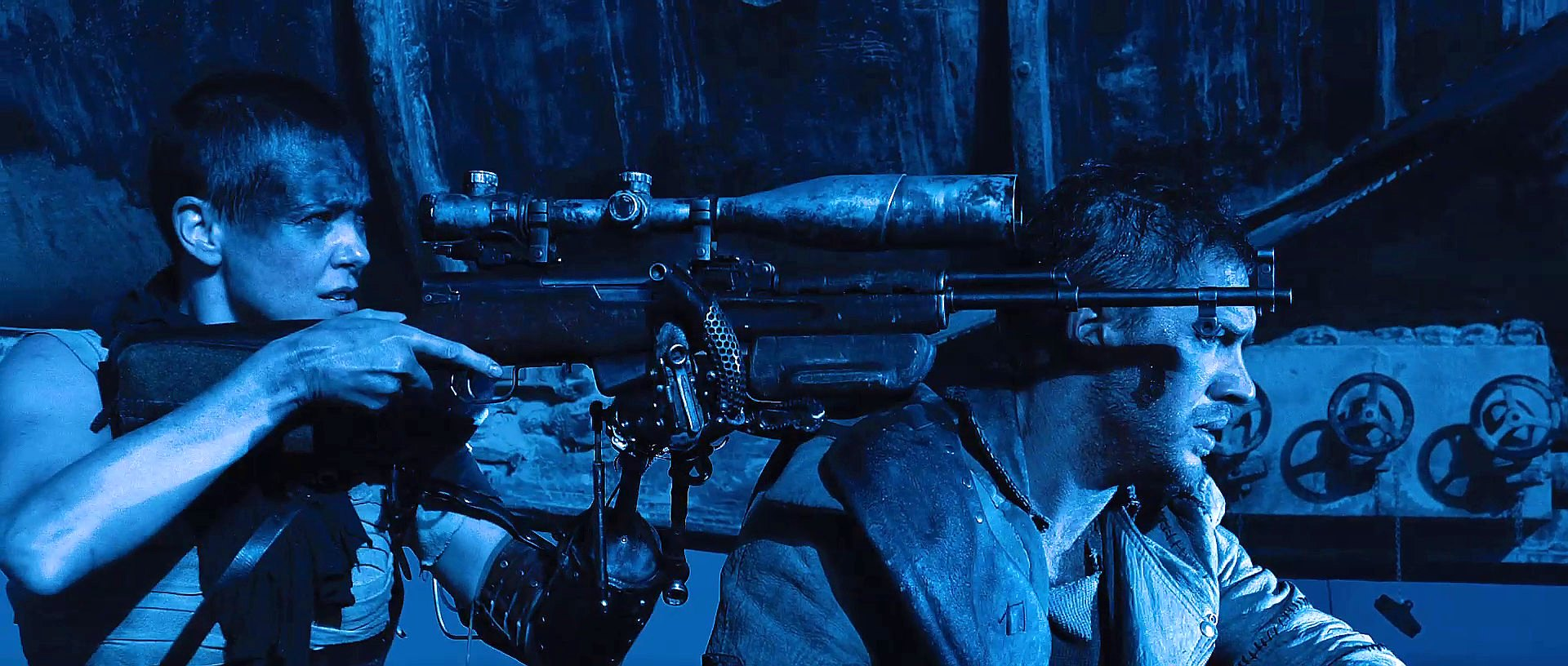
Sicario

Quebecois Denis Villeneuve, who made a big splash a few years back with a brutal film called Incendies, and followed it up with the equally brutal American film Prisoners, has brought us—well, hold on to your hats, here—a brutal film about cartels in America called Sicario. Don’t get me wrong, these are good movies, but brutality is their hallmark, and in particular, brutality at an intimate level.

Which may be why they don’t do boffo box office.

Prisoners featured Hugh Jackman, Jake Gyllenhaal, among a few big names, and grossed about $60M. Sicario has Emily Blunt, Benicio del Toro and Josh Brolin and probably won’t make quite that much.

By the way, I have the same reaction to Emily Blunt as I always do when I see she’s in a movie. It goes something like “I’m not going to like you in this role. You’re really not suited to be this character….Damn, that’s actually pretty good…”

Heh. I don’t know what that is. She looks so frail, physically, and while her features are not, say, Nicole-Kidman-delicate she looks like she could be feisty at most.  This particular role is more like Edge of Tomorrow’s veteran soldier, in that she plays a hard-bitten DEA officer who personally goes on raids with her team, only to find increasing levels of brutality.

See, he's going to eat her. Big Bad Wolf style.

Here we see Ms. Blunt misinterpreting del Toro when he says “We should stop for lunch.”

It is with this in mind that she’s drafted/volunteers/deceived into Josh Brolin’s DHS special task force which conducts missions on and over the border. Who Brolin is isn’t clear, and even less clear is the role that Benicio del Toro plays, except that they’re not exactly “by the book”. But they will stop at nothing to get the cartels under control, that is clear.

Well, nothing except for decriminalizing drugs and thereby dropping the price of them while simultaneously increasing availability, thus drying up the gangster’s resources. I mean, that couldn’t possibly work.

The face of a tax evader.

Al Capone says “Prohibition: It’s for the kiddies, see?”

Sorry, civil libertarianism aside: This movie raises the question of “How much are you really willing to do to stop the cartels?” Because the cartels themselves have literally no limits whatsoever. At the same time, Villeneuve does not present Brolin and del Toro (especially) as heroes. They are willing to do anything to get the cartels under control, including murder, foe or friend.

It’s very tense. There’s a point in the second act where it feels like the movie’s going off the rails and getting into details of Blunt’s character that don’t have any place in this action-oriented suspense film. Suffice to say: Nope, it all fits in, and not in any sort of subtle way. The level of paranoia, suspense, conspiracy, etc., just goes through the roof. And Blunt is really excellent.

I’m not sure how I feel about the end. It made sense, from Blunt’s character’s standpoint but maybe not so much for del Toro’s. The original one was much more brutal, and I suspect it was rejected because its perhaps more logical resolution did not resonate well with audiences.

Things are looking UP in Mexico!

The Mayor of Juarez objected that his city hadn’t looked like this since early September.

Anyway, I was sort of laughing because all three of the principles have worked together on different projects. Brolin and del Toro were rivals in No Country For Old Men, while Blunt and del Toro were sort-of love interests in The Wolf Man.

Another connection: The Coen brothers’ cinematographer, Roger Deakins, who also worked on No Country (and O! Brother, A Serious Man, Fargo, etc.) did the cinematography here, and it’s breathtaking. We saw this right after Wildlike, and I kept thinking: “This! This is how you shoot a movie!” But, of course, it’s hardly significant to point out that your little indie flick doesn’t compare to the work of a man who is possibly the greatest living cinematographer.

Anyway, it’s gorgeous, on top of being a supremely suspenseful film. The Boy and I both liked it, although The Boy thought the climactic action sequence with del Toro was too Hollywood, and that the movie had seemed like it was trying to be a more gritty, realistic affair. I don’t think I’d disagree: It was very Hollywood. Also very brutal.

As the movie notes up front, the Sicarii were Jewish terrorists who would stab Romans and Roman sympathizers with their daggers (sicae), and then fade away into the crowd. Which is kind of brutal.

Get the idea?

All she needs now is for an alien to jump out.

This looks so pleasant, I think I’ll take my next vacation in one of these cross-border tunnels.

The Prime Ministers 2: The Warriors and Peacemakers

We did not see the first in these documentaries based on Yehuda Avner’s book The Prime Ministers, and I am to blame for that. I am always on the lookout for critical bias, so I can spot when a movie is given a low ratings because of its overt Christianity, patriotism, and insufficiently leftist bias. And on the audience side, I can spot when a movie is given high ratings because, well, people like giant robots, superheroes and car chases more than I do, to say nothing of familiarity and predictability.

What I don’t always adjust for is anti-semitism.

I’m not sure when anti-semitism became such a factor in the critical world. It seems like it wasn’t too long ago that Jews enjoyed a protected status on the basis of a collective guilt over the Holocaust, but upon reflection, that was perhaps all bullshit, too. For the entirety of its existence, Israelis have had to justify Israel, when any objective analysis shows a strong interest in peace, a tolerance unparalleled in the Middle East, and a general productivity—one not based on having foreigners come and pay you billions to take your oil.

Nonetheless, the critics aren’t crazy about these films, where they couldn’t get enough of the morally ambiguous Shin Bet documentary The Gatekeepers. Sure enough, you’ll see criticisms of “one-sidedness”, “imbalance”, and generally not enough deference to the murderous regimes that have Israel’s destruction on the top of their to-do list, even if they’re too feckless to pull it off.

But also, because documentaries aren’t seen by a lot of people, and these documentaries in particular are not, it’s easy for a dozen people to come and drag a movie score down.

Ironically, perhaps, The Boy expressed enthusiasm because it wasn’t a very political movie. And this is true, at least as far as US politics go. The time covered is about from the Nixon resignation to the Clinton peace accords, or from the first term of prime minister Yitzhak Rabin in ’74 to his assassination in ’95.

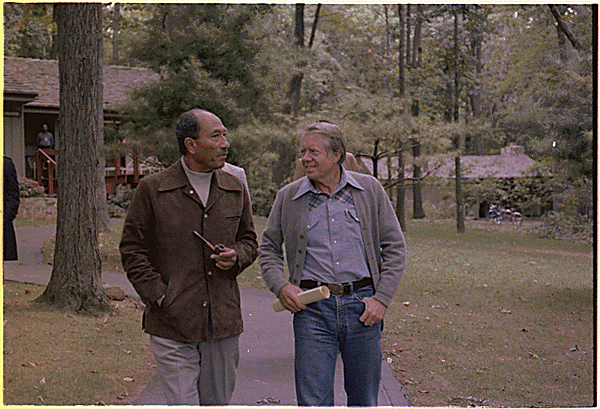
Yitzhak and Menachem in happier times.

“Muslims hate you? Muslims hate ME! We should hang out!”

Rabin was a solid leftist, tempered (as most Israeli PMs must be) with the understanding that a full embrace of that philosophy would result in their immediate destruction. But the Labor party loses big in ’77 to Menachem Begin’s more right-leaning Likud, which (even back then) the press liked to label as terrorists. (There’s really only one playbook, the world over, for communists.) But Begin kept Avner on, since Avner had the experience dealing with the United States and there was a common goal: Peace.

Avner doesn’t talk about political differences, then, but of the common goal and desire for peace.

Anyway, like most Israeli documentaries that are focused on particular moments in history, it’s pretty gripping. We get the Israeli-eye view of Nixon, the hapless Ford, the well-meaning but largely irrelevant Carter, and Reagan’s hand in the resolving Lebanese war and tempered support of Israel over their bombing of the Iraqi nuclear facility. (Clinton gets a mention with his Arafat talks but I don’t think GHW Bush came up at all.)

The Carter portion was interesting to me, because I remember the narrative at the time. Carter, hot off of brokering peace in the Middle East, was going to get the Beatles back together. But what seems to have actually happened is that Rabin seriously distrusted Carter, and when Begin went to negotiate peace, Carter wanted to roll back the Israeli borders to their pre-1967 locations. What this would mean is that Israel would be 12 miles wide at one point (from the border to the sea) and could be cut in half by an enemy in a matter of hours. Begin, a survivor of concentration camp and gulag both, would have none of it.

Where this gets interesting is that Sadat was genuinely interested in peace, though clearly beholden to the more belligerent aspects of his constituency, and the two of them (Begin and Sadat) met all over the surrounding areas (including Romania and Iran!) to try to work something out.

Wait till he finds out ribs are pork.

“What say we ditch the Jew and go get some ribs?”

The White House finally gets wind of the slow-moving talks and invites them up to Camp David, where Carter clearly favors Sadat over Begin, on a personal level if nothing else, and most of the famed accords amounted to nothing. Most, but not all. And just when it looked like they might reach an agreement Sadat was assassinated.

Another interesting moment is the war with Lebanon, in which Begin aimed for a 40km buffer zone—the Lebanese were letting the PLO shell their border towns—and ended up in Beirut.

I don’t know: it’s really all interesting. But for some reason our culture isn’t too interested in existential struggles of a small group of people who share many of our values, whether Israeli, Kurd, or whatever.

Rabin disbelieves Kissinger.

“There can never be trust between us as long as you insist I believe you’re hittin’ Jill St. John.”

Aram, Aram

It’s been almost a year since the last time I started a movie review with “Wow” and that was Whiplash, which walked away with three Oscars. I said it again after Aram Aram, though it will not get the attention as Whiplash, and perhaps isn’t as good, but is still both a really good example of filmmaking and an exceptional example of low-budget filmmaking overcoming its limitations.

It’s practically a hobby of mine, spotting the low budget techniques used in films, which I think started back with Sinister, when I noticed Fred Thompson in a role that probably took two hours to shoot, and Vincent D’Onofrio literally phoning (or Skype-ing) in his performance. Low budget productions can take a couple of routes:

They can get the big names for one-day shoots, and though that’s draining the presence of even a minor celebrity for even a small amount of time moves product.

They can lie. The celebrity thing is sort of a lie, because the big name goes on the box even if their role is minor. But back in the ’50s and ’60s, the Big Lie in horror was the promise of some truly horrific monster, which was sometimes just a still picture. In the ’70s and ’80s, the Big Lie was titillation: sex and gore suggested but seldom delivered.

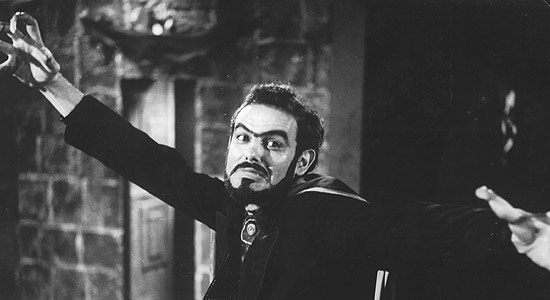
That's Equinox (1970).

You can hire cheap labor from Gigantia rather than use expensive, large American actors.

They can let their budget dictate the shape of their movie. Now, there are two ways of coming at this: The bad way, which was highlighted on “Project: Greenlight” a few years back, when they were directing a horror movie, and someone decided they needed to make it a creature feature. But the consensus from those in the know, including Wes Craven, was that they didn’t have the budget for a creature feature. (Creatures are expensive or they look like crap, which is why you got the occasional still picture or crickets climbing on postcards.) But it can be done in a good way, too: You make the movie for the budget you have, rather than trying to shoehorn any given screenplay into a budget.

The latter is important, because it leads to the rarest and most gutsy approach to independent film making: Dare the audience to care about the size of the budget. And that brings us to Aram Aram, a low budget movie that was probably made entirely by people fetching coffee and pulling cable on big budget productions, and which is probably better than most of those.

This may not have been shot in Beirut.

“What could possibly go wrong? We live in the Middle East!”

The story involves Aram, an Armenian 12-year-old boy who is brought to Los Angeles after his parents are killed in Beirut, and who must live with his grandfather, a humble shoe repairman. The boy is doing pretty well, all things considered, learning some English and (of course) some Spanish, but he’s courted by a local thug who is rabidly pro-Armenian-identity and who appears to be running a protection scam on the local Armenian businesses.

It’s an old story, of course. But we kept finding ourselves impressed by the execution. For example, it would be cliché for the grandfather to have been a crusty, angry old disciplinarian, but he’s actually pretty nice. He has his moments, of course—he just lost his daughter, after all—but most of the conflict between him and Aram seem to stem from him not really knowing what to do with a 12-year-old kid, and not really seeing the appeal of the thug life—and also finding the racism inherent in tribal agitation appalling.

This is supposed to be Little Armenia.

When everyone dresses like this, it’s hard to tell who the bad guys are.

I particularly liked how the camerawork changed from sequence to sequence: It’s not shaky-cam, except in the movie’s climactic chase scene; it’s occasionally static, though not in a “don’t know what to do/can’t afford to move it” kind of way; but mostly it’s given modest movements and location appropriate to the action and dialogue. Granted, this is mostly intimate, closer shots—which itself can belie a low budget, but it befits the story.

There’s a good use of soundtrack, both Armenian rap (I think) and a simple, but effective score by Katy Jarzebowski.

There’s a bit of deus ex machina at the end, perhaps. But it was not implausible, and it serves to give the story a reasonable, clean ending, rather than leaving things up in the air.

Mostly, though, the story gives us good, likable (or not) characters to root for. John Roohinian as Aram, and Levon Sharafyan as the grandfather, with Sevak Hakoyan as the thug turn in polished, pro-performances—and are not left hanging by the sort of sloppy editing that also is a hallmark of low-budget films.

The Boy and I came out really positive, thumbs up, after being somewhat reticent to see it in the first place. We were glad we did.

No, but it's good.

And we learned a valuable lesson about not being seduced by the high-speed world of shoe repair.

Victoria

A word that is often used derogatorily for movies is “gimmicky”, suggesting that some technique used by the artists in creating the film lacks legitimacy in one way or another, and that the film is lesser than it might be because of this crass attempt to fool the audience. In truth, however, the term typically reveals disdain for the execution, or (as I often maintain) is just being used as a rationalization for why a movie is “bad”. (Remember, movie critics are, by-and-large, regular moviegoers who get paid to justify things that are matters of taste.)

I mention this because all tricks of art are “gimmicks” when they’re new or unusual. The CGI in (the original) Tron is a gimmick, for example, but CGI today really doesn’t count as much of a gimmick. Sound in cinema was called a gimmick back in the day, but say what you will about The Jazz Singer, it barely exists without sound.

Mammy!

Blackface was also a gimmick, but by 1927 it was at the end of its life.

Last year had some gimmicky movies, too: For example, did you know Boyhood took 12 years to make? That was kind of a running gag around here for a while since the producers wanted everyone to know Boyhood took 12 years to make, so we all knew that. Maybe that’s part of why Patricia Arquette won an Oscar.

Another gimmicky flick last year was Birdman, which was one of my favorites. The gimmick wasn’t the magical realism (though you could argue that was a gimmick) but the fact that, apart from the bookends, the entire film was done in a continuous-seeming shot, a la Hitchcock’s Rope, another film panned by critics for its gimmicky nature.

And that brings us to Victoria, an East German flick that was genuinely shot in one continuous take over a period of about 2 hours and 15 minutes.

Kind of a generic title, though.

The gimmick’s right there on the label.

I had some reservations going in. And those actually seemed to be borne out, because the first really dramatic point moment happens about 40 minutes into the film. (We learn something about Victoria’s back story that is critical to the rest of the film.) Up until then, what we have is Victoria (a young Spanish girl) dancing in a club, then on the way out, hooking up with four slightly thuggish guys, and hanging out on a roof drinking and smoking. She has to go open a café, so the guy goes with her, and we have a kind of nice, if odd, love story.

I was sweating bullets by this point because sometimes filmmakers, and critics who love this kind of crap, will do something like set a camera down in front of the Empire State Building for 8 hours and call it “art“.

But, in fact, the movie goes in an entirely different direction at that point, becoming (of all things) a heist picture.

This is actually a real movie. And it’s a good movie. But I think it’s safe to say that the one-take thing is a gimmick. I didn’t mention the other, perhaps obvious reason for a gimmick: To get attention. And I think it’s safe to say that the one-take gimmick got director Sebastian Schipper the attention he wanted, as he will be making a movie in the US next year.

This is where my hypocrisy comes out because while I won’t criticize him for doing something that was obviously successful, I do think the problem with “one take” is that you’re robbing yourself of many of the most important tools of moviemaking. And Victoria is successful due to the (admittedly impressive) ways Schipper (an actor in Run Lola Run, which may have had an influence) worked around those limitations. But not without cost.

You don't expect to see so many pores in a movie.

Costs like: No makeup retouching.

Remember the 40 minute opener? Well, that was really necessary because he couldn’t use editing or montage to establish a relationship between Victoria and Sonne, her potential boyfriend. And Schipper really needed to establish Victoria’s character in order to explain her subsequent reactions to the heist. The 40 minutes is not unpleasant or anything, but it’s not exactly dense, either. How could it be? We’re listening to four guys talk over each other in slurry German and broken English—we may have had an easier time of it than actual Germans, who probably didn’t get subtitles. The dialogue is noticeably improvised, not for being unnatural but for being too natural, i.e., banal.

On the flipside, much like Boyhood, which manages to use the weight of the actual change of the actors over 12 years to add to its dramatic punch, after that initial calm, the next hour-and-a-half of screen time is intense and by the end, you really feel like you’ve gone through something. It’s more of a evolved dramatic experience than, say, Clerks, which sort of looks like it could’ve been filmed in 100 minutes. (And I’m not knocking Clerks, 20 years of camera technology have had an impact on the low budget film.)

Where the director had traditional movie facilities available to him, he used them to their fullest. In particular, the soundtrack is very effective. While there’s no time-compressing montage, he fades out the dialogue in places to a similar effect. He manages a half-dozen really excellent shots, which had to be challenging under the circumstances. I’d say the guy’s got some chops.

The acting is quite good. You sort of get the sense that he picked up these guys in Berlin and filmed them, though the movie is too well choreographed for that. We like the characters Sonne and Victoria (Frederick Lau and Laia Costa, respectively) as well as Sonne’s mates, Boxer, Blinker and Fuß. (That’s “Fuss”.)

The Boy and I both liked, we both found it interesting, and we both admired the technique in making it. We didn’t, however, think it was a great film, and further we feel that any film needs to stand on its own merits, not its technical impressiveness…or gimmickry.

Victoria in Berlin. No angels to be found.

Victoria shown here having some doubts about he she spent the last two hours.

Shaun The Sheep

It’s easy to overlook, when viewing Rotten Tomatoes scores, that the percentage rating is based on the number of critics (or audience members) who gave a “fresh” rating. It’s possible, then, at least theoretically, for a movie to have a 100% rating but be rated, say, as a 7/10. I don’t know if that happens, but it does produce some oddities. They’ve proclaimed Shaun The Sheep the best reviewed movie of the summer with a 99% rating, but it’s aggregate rating is 8.2/10, which means in their “top movies” list, it appears below Fury Road, Inside Out and Selma.

The thing about Shaun The Sheep, though, is that it’s utterly unobjectionable. Much like the more popular (but still underrated) Paddington, here is a cute, fun family movie that you’d have to have a heart of stone to grump at. So maybe it doesn’t redefine your concept of what going to the movies means, but it’s a very good time indeed.

This is the story of a man and his dog and his sheep who start out in life full of enthusiasm (for sheep-related activities like growing and shearing wool, apparently) but over time get worn down by the routine grind of it all. And so, as our movie opens, the sheep decide they’d like a day off. A miscalculation leads to their benign holiday turning into an adventure, as the man (who doesn’t have a name, but is just known as The Farmer, for this is a sheep’s-eye movie) ends up in the big city with no clue who he is and a surprising new fancy, hip career.

The Baby Sheep is still a baby, too.

Sheep only live about ten years, but The Farmer looks like he’s from the ’80s. Cartoon time strikes again!

This is a silent picture. Not that there aren’t plenty of sound effects but there is no dialogue as such, only utterances akin to Simglish or Peanuts Grownup Language. More than that, though, this takes the silent movie’s approach to plot, to characterization, to action and reminds us that, behind all the words, our experiences tend to be universal and very basic and simple after all.

It’s one of those movies that, despite it of necessity having to have a happy ending, you are concerned for the fates of its characters, both in terms of their physical safety and their emotional conflicts.

Sheep are immortal!

It’s like The Farmer and The Dog are the only ones who really got old.

The Boy, upon seeing this, noted that he was not a fan of slapstick, but that, nonetheless, he really enjoyed this. (We had to take special steps to see it, so poorly was it distributed and received in America.) I tend to be like-minded, in the sense that I do not care for the sort of slapstick that is—well, you might call it torture porn, heh. That is, where the characters are made to suffer physical pain which the audience is encouraged and expected to enjoy.

Of course, The Barbarienne loved it, and I’m sure The Flower would have as well, but she’s been so busy sewing these days that she opted to stay home and finish a project she was on rather than come with us.

As always, with Aardman pictures, I want to grab Americans, shake them and ask what is wrong with them: the movie registered a paltry $20M at the box office, placing it below Minions, Home, the latest Spongebob, Hotel Transylvania 2, Pixels—honestly, people, if you keep encouraging Adam Sandler, he’s just going to keep going no matter how disappointed you are in his flicks—all of which have mediocre-to-bad reception from audiences and critics alike.

Maybe they need to break down and have Bradley Cooper baa-ing for them next time. I don’t know. I do know that you’ll like this movie if you see it, though.

Don't be this guy.

Unless you’re this guy.

Labyrinth of Lies

Apparently—and this may be news to some of you—there was some trouble in Germany back in the middle of the 20th century. As The Boy likes to joke, “But then this guy called Hitler straightened everything out.”

Heh.

We see a lot of WWII and Holocaust themed movies. A lot.

This year had been light so far, with only four: Unbroken, Above and Beyond, The Shop On Main Street revival and Phoenix. (Rosenwald was noteworthy for being a story about a Jewish philanthropist that barely mentioned those “German troubles”.) Even so, there’s always a new angle: The war and the Holocaust contained all of human nature, good and bad, so the stories are virtually infinite, and a cabal of Jewish financiers are making sure they continue to be told.

That sounds sort of sinister, and I’m sure it’s viewed that way amongst the anti-semitic crowd, but I think it’s a good and smart thing to do: To the limits of your power, make sure the world never forgets. (Sadly, from headlines, it seems as though the world is absolutely determined to do just that.)

Which dovetails quite neatly with this film, Labyrinth of Lies. I had not been aware that in Germany by 1958, the whole Holocaust thing had been swept under the rug. I have heard that the Japanese walk around wondering why the Chinese hate them and why America unleashed Godzilla upon them completely unprovoked, but I did not know that Germany was following the same path when a lawyer launched a trial against Germans who had worked in the camps.

The German version of The Watchtower is not a big mover.

“A. Hitler? Never heard of him.”

That lawyer was, if I’m not mistaken, a crusty old lawyer named Fritz Bauer. He’s not in this film.

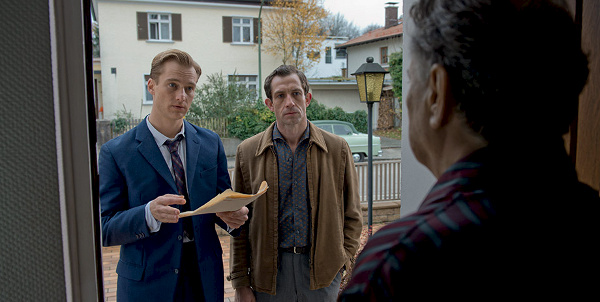
Instead, we have the tale of the young, idealistic (and entirely fictional) Johann Radmann whose righteous commitment to the law and justice leads him down a rabbit hole whereupon he realizes that virtually everyone older than he is was a Nazi.

This is good, taut thriller material. Radmann is a great metaphor for the collective consciousness of young postwar Germany, and by making the story fictional, they can put in all kinds of spills and thrills, and love stories, and stories of betrayal and corruption, that wouldn’t really exist in such a neat narrative form in real life.

Alexander Fehling (Erased, Inglorius Basterds) plays the lead convincingly with the lovely Friederike Becht (The Reader, Hannah Arendt) providing him a much needed anchor to sanity. The rest of the cast does admirably well, too, from Radmann’s secretary to his reluctant companion and crusty truth-seeking journalist pal, though I do not see enough German movies to have recognized them.

The electricity just crackles.

This constitutes foreplay in Germany.

Truly fine score, editing, direction. Solid work all around. The Boy liked it, though not as much as I did. I’m always impressed by the ability some directors have to make a legal procedural exciting. Also, I favor stories about obsession.

I do wonder, though, just because it seems so surreal. At one point, Radmann is grilling random people if they know what Auschwitz is. They do not. Or they say “It’s a camp. The Russians, the Americans, the French, they all had them…” If it’s true, that Germany was on the verge of forgetting what had happened, than the actual heroism this movie fictionalizes is nothing short of astounding.

This film will probably end up in my top ten for the year.

Must. Get. To. Bathroom.

I do question the historical accuracy of the Mengele chase scene, however.

Jafar Panahi’s Taxi

Back in 2010, a Persian filmmaker named Jafar Panahi was sentenced to 6 years in prison and banned from making movies for 20 years. (Panahi was 50, so it wasn’t quite a lifetime ban.) Subsequently, and possibly due to international outcry, his sentence was commuted to house arrest, and then a sort of freedom—as long as he didn’t leave the country.

Since then, he has made three films: This Is Not A FilmClosed Curtains and, most recently, Taxi. The first is a documentary about his life under the restrictions placed on him by the Iranian “republic”. The second is the story of a screenwriter who has shut himself off from the world.

Here’s the thing about this kind of rebelliousness: As unsympathetic as I am toward those who are fighting against various nebulous oppressions in the free world, I am equally inspired by those like Panahi (and China’s Ai Weiwei) who ply their art against actual dictatorships. For all the caterwauling under the Bush administration about oppression, no artist was actually jailed, nor their families rousted. It happened once under the Obama administration, of course, to silence from who howled at Bush for eight years, but even this was a nakedly political move, and less about a threat to the country than a threat to 2012’s electoral results.

So, you gotta start by giving props: There are artists out there who genuinely put their lives on the line—and the lives of their families!—to fight genuine injustice.

Tehran, apparently, has no stoplights, FYI.

I mean, it’s not like anyone would be thrown into jail for making a movie Muslims objected to in THIS country.

This doesn’t necessarily mean you’ll get a good movie, of course: Art doesn’t flourish under extreme oppression.

That said, The Boy and I really enjoyed Taxi. The premise is that Jafar Panahi, banned from movie making, now drives a taxi. But he has a dashcam—and anti-theft device, ostensibly—so that when he drives around Tehran picking people up, he can film them telling him their stories.

But there’s a bold tweaking of long Mullah noses here, since he immediately lampshades what he’s doing. The first two people he picks up have a fierce debate about the severity of punishments. (Tehranians apparently share cabs routinely, so there are often strangers in the car together. We saw this in Tales, too.) But the third person he picks up knows him, overhears the debate and says something like, “You didn’t think I’d recognize you, but I do. And I know you’re making a movie because those two people had the same argument you made in Crimson Gold!”

This guy is an odd little fellow who makes his living delivering bootleg video to people. In a cute turn, his first customer is a guy who’s ordered all kinds of trash cinema, but upon recognizing Panahi asks for help with getting the classics. Much to his chagrin, our video bootlegger says as his closing line “I’ll have season 5 of “The Big Bang Theory” next week.”

Heh

That's hardcore.

Hustling “Big Bang Theory” on the Streets of Iran.

.Sort of like Tales, we get a series of vignettes reflecting on Iranian life in general, but we also get a sense of what it’s like to be singled out by the regime. Some of this was shown, animated, in The Green Wave but it’s interesting to hear people talk about their “interrogators”. The last part of the movie concerns Panahi’s niece, a cute (if somewhat spoiled) aspiring filmmaker. She accompanies him as he tries to return a purse to some old ladies who have gone to a sacred spring because if they don’t drop these fish in the spring at exactly noon, they’ll die before the year is up.

She won some awards for this.

Walking that fine line between cute, precocious and obnoxious.

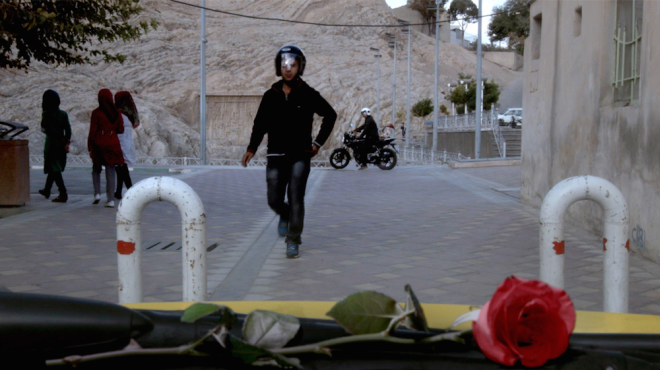
In the end, he’s targeted by what looked to me to be kin of the motorcycle thugs of The Green Wave, pretending to rob him. But they mention not being able to find the flash drive, which would be the thing that actually contained the film we were watching. Doubtless staged but still rather effective.

What’s interesting about this is how cheerful Panahi seems to be. He seems to have nothing but warmth for his characters—admittedly easier when those characters are essentially your creation—even when they are rather presumptuous or obnoxious. And while he’s presenting a critique of current Iranian culture, it’s a fairly mild one. Not that he’s not pointing out serious things, just that he’s doing it in a gentle way.

But tyrants can’t stand criticism, so guys like Panahi have to be silenced. It’s cheering when they refuse to be.

It’s not a great movie, but it is a very good one, and quite entertaining given the constraints (entirely filmed from 2-3 cameras in the car). I hope it all works out for Mr. Panahi and the Iranians.

For all of us.

I have my doubts, though.

Coming Home

In the late ’80s and early ’90s, director Zhang Yimou and actress Li Gong brought “serious” Chinese cinema to the forefront of international awareness with such films as Ju Dou and Raise The Red Lantern. I think this was taken by some as a sort of rebuttal to the chop-socky action flicks that came out Hong Kong and essentially defined Chinese film as the world had known it throughout the ’70s and ’80s. This is one reason why the later Zhang Yimou films with Zhang Ziyi (no relation) like Hero and House of Flying Daggers are so delightful: They embrace the martial arts mythos of studios like the Shaw Brothers and Golden Harvest.

The Western equivalent is almost like the distinction between the Batman serials of the ’40s and the campy TV show, and Christopher Nolan’s “Dark Knight” trilogy, except that there was often truly great (if highly stylized) art in those chop-socky films.

But Zhang and Li are together again, nearly 25 years after Lantern with a serious story and one that, surprisingly, reflects rather poorly on the Cultural Revolution so beloved at the time by intellectuals. I guess the Party decided that the Revolution was bad after Mao’s death, so it’s okay to trash—but don’t expect any reflection on the creation and authorization of social and government structures that make things like mass imprisonment and slaughter possible. (It’s never the power that’s the problem, only that the right people have it, amirite?)

The story is this: Lu (Chen Daoming of Hero) has been imprisoned in a reeducation camp for a really long time (we’re not given a precise timeline, and his imprisonment seems to have been only part of his punishment) when he suddenly escapes. Various representatives of the Party scrutinize his wife, Feng (Li), letting her know to contact or aid him in any way would mean dire things. Meanwhile, their daughter Dan Dan (newcomer Zhang Huiwen, no relation,) is up for a big role in a Communist ballet. 

Not as catchy, right?

Springtime for Mao.

Dan Dan is angry at her father, whom she does not remember, so long has he been gone, and whom she only knows as an Enemy of the State, because his antics jeopardize her shot at the lead in this (truly horrifying looking) ballet. But Feng is so passionately in love with Lu, even after so many years apart, she prepares to meet him, to bring him food and to help him evade capture. Dan Dan is lured into betraying her parents on the promise of getting that lead role, and in the ensuing scuffle, not only is Lu recaptured, but Feng is injured trying to reach him. (And Dan Dan doesn’t get the part. Rotten commies.)

This is all prologue to the main act, which is Lu’s subsequent return from imprisonment four years later—the “coming home” of the title. Because when he returns home, he discovers his beloved Feng has a sort of amnesia and doesn’t even recognize him.

Heartbreaking.

The movie is really about Lu’s struggle to reunite his family.

The performances are tremendous, as you might expect. The camera work is—well, it’s subdued if you’re coming from the opulent Hero and House of Flying Daggers—but it is subtly effective. The music is marvellous with a traditional (Western) score.

That's racist, isn't it?

Then they discover a box of verbose fortune cookies.

Not to tell tales out of school, but The Boy, typically stone-faced, was sniffling a bit at the end of this one. That gives you a sense of how effective it is as a drama.

Usually, when we see a film, we know right away whether or not it is going to make our list of great movies. (Sometimes movies kind of grow on you or sneak up on you.) And while we have seen many fine films this year, the list of truly great ones has been very short. The Boy’s list, for example, includes American SniperMommy, I think Wild Tales is on there. You might note that these are all 2014 movies, but he says “I saw them in 2015, so that’s the list they go on.”

His list of best films actually from this year is very short: Fury Road, Meet The Patels, 5 to 7, and now Coming Home. I can’t disagree. It’s a shame it only got a highly limited release: We barely managed to see it before it closed.

This will definitely claim some Oscar nominations.

Gong Li and Zhang Huiwen at a premiere for "Coming Home"

But they’ll look like this, not the impoverished Chinese peasants of the movie.

This Is Happening

Cloris Leachman, whom Betty White refers to as “young lady”, actually showed up at the theater for the premiere of this low budget road-trip comedy about a slackadaisical millennial and his good-for-nothing sister who end up chasing grandma up to Seattle as she struggles to return her stuffed dog to a golf course, in honor of the last promise she made it.

Or something.

We didn’t go to this showing, and if we had, we would’ve taken a powder before the Q&A. We’re about the movies, man, not the machine!

It’s always different watching a movie when the people involved in making it are sitting there with you. For every fun movie with low expectations, like Expecting Amish, where the crew being there enhances things, you’ll get five The Graves, where you’re squirming in your seat because, wow, how could anyone have thought this idea was one they wanted to immortalize on film?

I can imagine worse fates.

It’s not as awkward as this (deliberately) awkward sex scene, probably.

I don’t like seeing bad movies. I hate having to say “Wow, this was a bad movie.” I don’t mind saying “I didn’t like that”—and there’s a huge gulf between “Well, I recognize Scorcese’s genius, but it doesn’t appeal to me” and “That’s just bad and I question the taste and sanity of those who thought otherwise.” Having that kind of reaction in a theater where actual human beings who made actual creative decisions you can’t fathom? It’s not pleasant.

This happened, too.

Unless, I guess, you’re ripping Chevy Chase on Carson.

Fortunately, This is Happening is not squirm-inducing bad. It’s watchable enough and has a few (if forced) laughs—and as a freshman effort from writer/director Ryan Jaffe, I wouldn’t say “ban this man from filmmaking!”—but it’s not what you would call tight. It wants so hard to get to its zany emotional breakthrough, it cuts a lot of corners.

The premise is that loser Philip is roped by his loser father into going to Palm Springs to bully his loser grandmother into a loser old-folks home. Loser sister tags along for the ride because she’s got it in her head to pull off a drug deal to turn her life around. After getting grandma high, sister lets slip Phil’s real reason for being there, and rather than Grandma just telling him to go pound sand—when she has no compunction doing that generally to everyone—she flees with her car and stuffed dog to Seattle.

Sure it is. And it's Palm Springs, too.

It’s medicinal.

Along the way, they bond to various degrees and we get a little bit of backstory to explain their loserness.

This is low budget film, Ms. Leachman notwithstanding. Judd Nelson and Rene Aburjonois do the classic “Shoot for a day close to where I live” thing that puts names on a video box (or these days, an “on demand” capsule). I suppose that’s necessary commercially but the movie would’ve been better without wasting precious minutes on superfluous characters.

They’re supposedly going to Seattle, though that’s apparently much closer to Travel Town and the L.A. Zoo than I thought. (Heh.) I don’t mind that sort of thing—I presume most people won’t notice or care—but at points it go to be surreal. In fact, the way the brother and sister kept crossing paths with grandma, The Boy and I were trying to work out if there was something mystical going on. There’s 1,200 miles of The Grapevine between Palm Springs and Seattle and this almost plays out like an extended chase scene.

All this is trivial stuff, though. Ultimately a movie like this rises and falls on its character development and dialogue, and we just didn’t buy it. Swearing grannies is kind of old hat and doesn’t have the shock value it might have 20 years ago. Meanwhile, there’s an awful lot of shenanigans knocking the wind out of the dramatic sails.

At the end of the second act, Rene and Judd have a little talk about trees dying, then Judd says something like “That’s a metaphor, right? I hate metaphors.” And Rene says “I was just talking about trees.” And I thought: “That’s this movie: It’s trying to do something very obvious but also trying to signal that it knows how obvious it is.”

Not Palm Springs.

This is probably Judd’s house. Or maybe Rene’s.

Occasionally, though, there are flashes of really fine filmmaking. A good number of scenes take place inside this tiny bedroom where the brother and sister spent time as children. The blocking in those shots is really quite good: It feels claustrophobic, and regressive (in the sense of regressing to childhood).

The principals do well: I don’t know James Wolk, and I didn’t recognize Mickey Sumner (from Frances Ha). Wolk and Sumner pretty much carry the film, though obviously with some assists from Leachman.

It was just a bit disappointing overall: It never gelled in the sort of powerful way it might have.

Rifftrax: The Miami Connection

Unlike its spiritual predecessor, Mystery Science Theater 300, Rifftrax does its comedic riffing against a number of big budget franchises, like Transformers, Harry Potter, Avengers, etc. Now, without looking too deeply into it, I suspect that their theatrical performances, when they go into big (or at least bigger) budget territory, it’s for movies that flopped—and that they can get the rights to without eating up all potential profits. Last year’s Godzilla and Anaconda, for example.

What I note about these, however, is that I don’t like them nearly as much as when the thing being lampooned was a sincerely meant effort to achieve something other than filling a slot on SyFy. So, after Sharknado 2, it was great to see The Miami Connection: An ’80s era martial-arts rock-band drug-war movie full of heart and ridiculousness.

Love the pink.

It may be the most ’80s thing to make it off VHS.

Now, we should note that these theatrical shows start with an educational film, and these are usually the highlight of the evening. Educational stuff is just so ripe for riffing, and Measurement Man is just a wonder of awkward filmmaking clearly geared toward giving apathetic teachers a smoke break. You see fewer crotch shots in porn, frankly.

But Miami Connection is marvellous in its lack of awareness. The toughs seem to stand around yelling a lot without actually doing anything. They patiently wait their turn to attack the good guys. And the battles all look like not well-rehearsed martial arts demonstrations. (Because that’s what they are: The star, writer, and re-shoot director was a well-known Tae Kwon Do teacher in the area.)

As a black belt in that particular time period, I kept thinking, “Oh, my God. Is that what we looked like?” Then I remembered that, no, we moved a lot faster and actually hit each other. (Also, we didn’t do the goofy Tae Kwon Do thing where you stand on one leg and just keep kicking over and over again.)

Anti-Ninja Propaganda

This IS how our band looked, though.

Our heroes sing songs about being anti-ninja. They all live together in a tiny apartment and seldom wear shirts. One has a backstory about a missing dad. There’s probably an anti-drug message in there somewhere, but to be honest, that whole thread disappears after the opening scene, along with all the guns.

For a low budget movie, it has a huge cast, with dozens of locals filling in as various gangs. The sounds is badly overdubbed—but clearly and loudly overdubbed, which is way better than what you often get in these films.

It’s just the perfect level of lunacy for a riffing. We loved it.

It's amazing.

I could post shots from this movie all day.

Meet The Patels

As I’ve often observed, sometimes the best movies out are documentaries. Sometimes that’s because the fictional movies that are out are trash, but other times it’s just because the documentaries tell the more compelling stories, have a deeper resonance, or have a humanity that is missing from the slicker Hollywood glitzathons that crowd the summer and winter marquees. Sometimes they’re just plain funnier, too.

But it’s rare to find a documentary that does all of the above: Deal with a serious issue in a serious way that resonates deeply and keeps you laughing the whole time. Meet The Patels is such a rara avis.

A documentary with cartoon parts. Why not?

“Rara avis” means “check out the beak on THIS guy”.

It is the story of Ravi Patel and his sister Geeta, who live together in L.A. trying to make their way in showbiz. You’ve probably seen Ravi as “generic Indian Dr. #2” in something or other, and his sister has worked behind the scenes on numerous projects as well. Ravi is nearly 30, however, and he is unmarried.

At the beginning of the film, we learn he has just broken up with his girlfriend of two years because she’s not an Indian. He’s been secretly dating her because he knows his parents wouldn’t approve. And more than just not an Indian, she’s not a Patel. And what we learn is that “Patel” is a very large group of people from a part of Indian, themselves divided and stratified into different levels of Patel, and his ideal mate should come from a particular strata of Patel.

The happy couple.

There is no “ginger” strata for the Patels, though.

Ravi and his sister are quintessentially American but like many first-generation Americans, their roots exert a strong pull over them. (It reminded me of 2006’s The Namesake in that regard.) Ravi wants his children to have the Patel experiences he had, of going to India, or of travelling in America and meeting other Patels on the road.

In the course of the movie, which takes place in the year 2008, we see him try to let the Patel network—and there is an extensive Patel network in North America, apparently—fix him up through “biodata sheets”. He tries online Indian dating. There’s even a Patel convention, where Patels all over North America congregate for the purpose of matrimony.

Meet & Greet & Marry

Apparently, marrying someone with the same last name has different connotations for Indians.

But he also misses his ex-girlfriend like crazy.

It’s really a very serious subject, on a number of levels. On one level, immigrants to the New World always want to preserve the Old. (This is generally a lost battle but every new group fights it.) On another level, Ravi and Geeta’s parents were an arranged marriage, of sorts, with women lining up to meet Mr. Patel on a trip from India, and Mrs. Patel (12th in line) being the one who caught his eye.

They’ve been married for 35 years at the time of the movie and are happy. Meanwhile Ravi and Geeta aren’t even married. And the lack of grandchildren seems to be the one thing missing from the elder Patels’ life.

Arranged marriages were unthinkable in my youth, and it still is common practice to mock the grandparent who desperately wants grandchildren—but we are talking about survival of a genetic line, something that’s becoming a more and more serious problem in the developed world. So perhaps it’s not so unusual to see other points-of-view being treated with a bit more respect (see also Learning To Drive).

As American as the Patel children are, there’s a deep respect and humility in the way they approach the topic. They come off as very likable and sympathetic. You want them to be happy; you want their parents to be happy.

But with all the seriousness of the subject, the movie is almost non-stop laughs. The Patel kids are funny. The Patel parents are funny, often unintentionally, as parents are—with their quaint notions of frugality and what is important in life. Things like having a family, or marrying someone with light skin. (This is a big deal in India: Dark skin is grossly unfashionable.)

The Tanning Booth

Indian mothers have nightmares about this.

It’s hard for me to think of a film I enjoyed more this year, and The Boy concurred that it was one of the best. At a breezy 88 minutes, it doesn’t drag on, and there are even some stingers in the credits that are funny (such as Ravi’s chance to turn the camera on Geeta after she comes home from a date).

Strongly recommended!

Wildlike

Young Mackenzie’s father dies so her basket-case of a mother sends her up to Alaska to live with her uncle. When that turns out to be the sort of wise decision you’d expect from a drug addict mother, Mackenzie ends up running away. Sure, you’ve seen it a million times before, but this time it’s Alaska!

And that matters.

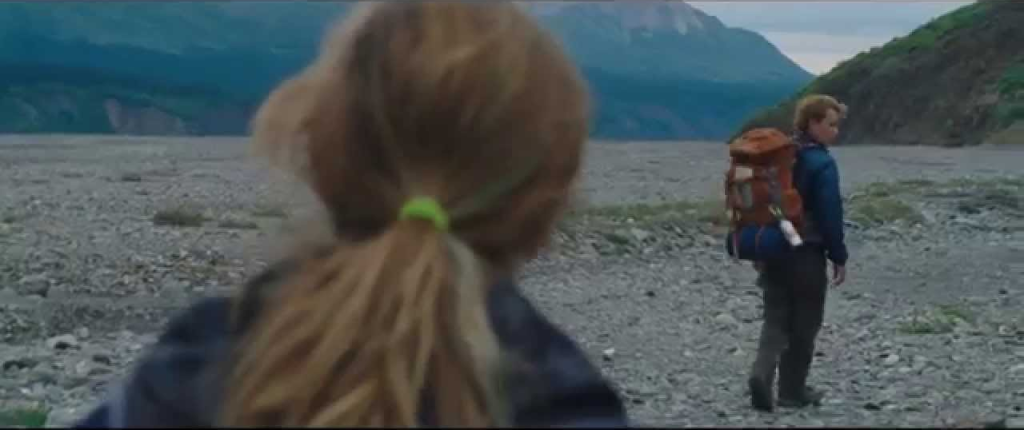
The film quality overall isn't as good as this still.

Life on the mean streets of Alaska.

In this case, Mackenzie ends up encountering and re-encountering Rene Bartlett, a lone hiker who finds he has a problem when this unruly teenager latches on to him. So what we have here, in a manner of speaking, is a road picture. But with bears.

Written and directed by Frank Hall Green (in his sophomore feature, assuming 2009’s Once a Child of God is a real thing), Wildlike is a nice little film that touches on some serious subjects without going very deeply into any of them.

I have mixed feelings about the ending. The movie sets up a…something…but then delivers…nothing. But without straying into lurid pulp resolutions—and this movie tries hard to be realistic—it’s hard to know what the something really could’ve been, given the characters as we’ve come to know them over the past 90 minutes.

Fine acting from veteran Bruce Greenwood (Star Trek Into Darkness, Flight, The Place Beyond The Pines) as the guy Mackenzie latches onto in desperation, Brian Geraghty  (also from Flight) as creepy Uncle Uncle, and relative newcomer Ella Purnell, who previously has played younger versions of older people like Teen Maleficent (in Maleficent) and Young Ruth in Never Let Me Go. Greenwood and Purnell basically have to carry the movie and they do well.

This is more representative of the actual film quality.

“I’m just gonna go get some cigarettes. Be back in three months.”

The writing is pretty good, too: Green clearly knows how pedophiles work and the interaction between Mackenzie and Uncle have a disturbing verisimilitude to them.

One thing that killed me, though, was the photography. Alaska is arguably the most beautiful state in the country, and there is occasionally a well-framed shot with some nice color. More than occasionally, the set up is there: Some natural beauty just waiting to be put on screen. But the quality is just crap. It’s blurry if there’s any motion, the colors are almost always washed out, the depth isn’t there. I actually began to wince about 2/3rds into the film.

The Boy didn’t really notice, though. And we both liked it. It’s worth checking out.

Goodnight Mommy

While we do enjoy foreign films—sometimes they’re the best things out, and there will usually be a couple of them in our yearly top tens—there is the fact that, not being part of the culture, you miss out on some references, and on the zeitgeist, if you will, that a particular movie is released into. The flipside of that is, occasionally, you may be reading something into a scene that wasn’t intended by the auteurs.

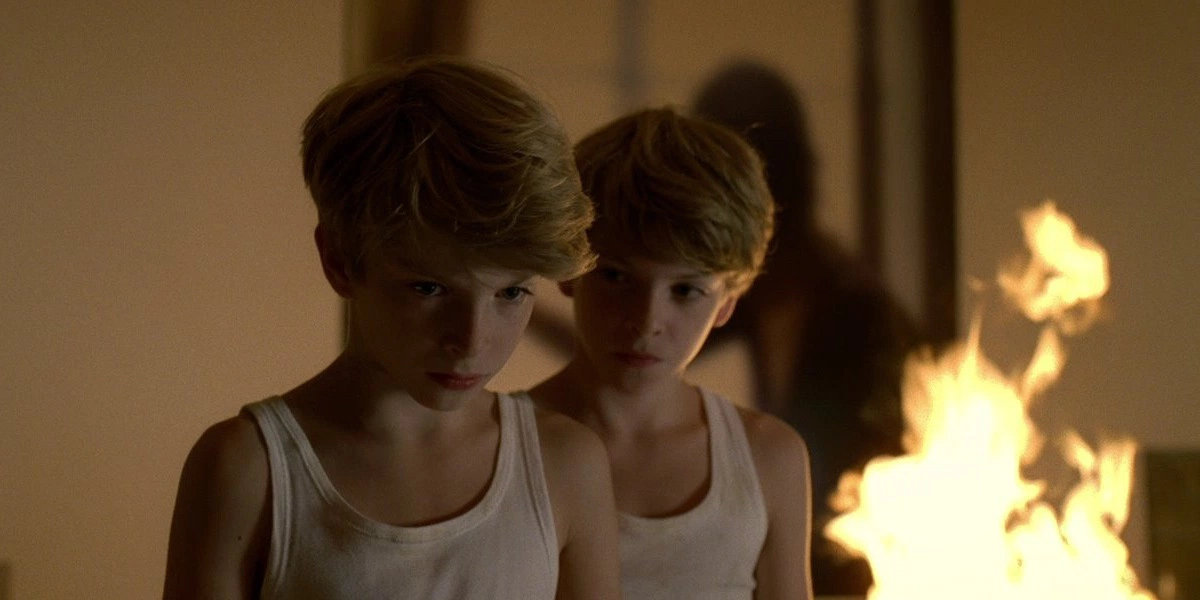
For example, in the Austrian psychodrama/horror Goodnight, Mommy, there is this exchange, after the titular “Mommy” finds a lighter tucked away in the top bunk of her sons’ bed.

Mommy: Why is there a lighter up here?

Son: I wanted to burn some books.

It got a big laugh. At least from and, I think, some others in the theater. Something about Austrians who like to burn books. But I really don’t know if they meant for there to be a laugh there or not. It’s sort of odd to think that it was deliberate, but hard to figure out any way that wasn’t meant sort of sarcastically.

Heh. Nazi humor.

Just getting in some practice before the weekend rally!

Apart from that, and an opener featuring archive footage of the Von Trapp singing a lullaby, there wasn’t anything overt I noticed about Goodnight, Mommy, which is the story of twins who are spooked when their mother comes home from the hospital, with her face wrapped in bandages (cosmetic surgery) and who seems to be an alien bent on sucking their souls from their bodies.

Or not. It’s hard to say, really.

She’s certainly acting odd, though. The Boys devise various schemes to uncover her true identity and locate their real mom, which take on increasingly more intrusive and even shocking tactics.

A perfectly normal game of Austrian hide-and-seek.

Odd, you say? Odd how?

Familial horror can go wrong in so many ways. We’ve seen good ones in recent years, like Mama and The Orphan, and some disasters, like Come and Play. But this film steers well clear of the more exploitative approaches to give a kind of mystery that’s mostly satisfactorily resolved. Things like: Why the surgery? Why live in such an isolated place? Why does the mother have such a harsh relationship with one of the boys? And so on.

The Boy really liked it. I figured it out in the first act, so I was less impressed by the climax. We both agreed that what was nice about it is that the movie didn’t cheat. If it’s going to spring a twist and/or turn on you, it needs to be able to back it up, not just randomly say, “Aha! It was a dream all along!” (Not the case here, by the way.) That drives both of us nuts. The down side, of course, is that occasionally some member of your audience is going to figure it out from the clues.

But it’s better to be self-spoiled than to feel cheated. We both rated the film positively. There’s not much violence, though what there has a very real and shocking feel to it. A solid horror.

Let's start a real flame war.

“Moviegique? Obviously an impostor. The real Moviegique was much funnier.”

Mission Impossible: Rogue Nation

When, you might, ask did the Mission Impossible franchise get to be so good? The first movie was, essentially, “Let’s take this spy property we have and put a star in it and get in on that crazy Bond money!” at a time when Bond was seen to be sagging. (And really, we got a bunch of these, like Bourne and XXX.) Brian De Palma directed the first one, and it is the least De Palma of all the De Palmas. Not a bad movie, but not really capturing the “Mission Impossible” TV show spirit. (Or so I’m told. I’ve never seen it.)

Then there was the Woo film. Unlike De Palma, you’d never mistake MI:2 for being directed by anyone else. What with the doves and all.

It's Mission Impossible 2

Sure, it’s a John Woo movie, but WHICH John Woo movie? Face/Off? Broken Arrow?

Then J.J. Abrams did one, turning out something as typically fun and forgettable as he has since then with his big budget Star Trek movies and, doubtless, the upcoming Star Wars Disney film. But Abrams brought back the ensemble feel of the original series, which was sorely lacking, by adding in Simon Pegg as Benji. (Ving Rhames, the world’s least likely computer hacker, has been in all five flicks.)  Then Brad Bird took the franchise and made a genuinely good film with Ghost Protocol, bringing in Jeremy Renner as the—well, I’m not really sure what he is. The suit, I guess? He’s the guy who has some sort of rules he has to follow, unlike the rest of them.

Nothing says entertainment like “rogue government agency”, amirite?

Anyway, in this chapter, the team is fighting an evil super-genius named Solomon Lane (Sean Harris, ’71, Serena, Prometheus) who uses terrorist tactics to cause world crises, enrich himself and usher in a potentially worse world order than the one we have. Which I think we’re all pretty much against. Solomon’s weak link is sexy super-double-agent Ilsa Faust (Rebecca Ferguson, from one of the recent Hercules movies, apparently) who seems to fall in love with Our Hero at first sight. (That’s not really what happens, fret not.)

STOP TESTING OUR LOVE!

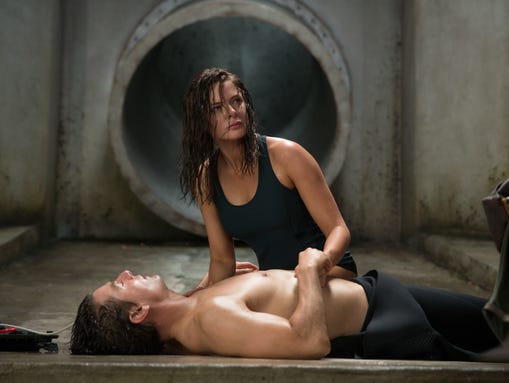
Ilsa Faust tests her newfound relationship with Ethan by playfully peppering him with bullets.

This movie still follows most of the Bond formula—travel to some part of the world, do some stunts, do some chicks, lather, rinse, repeat—minus the chicks, plus some teamwork. Success or failure hinges on the quality of the stunts and cinematography, and the chemistry between the players. All of these are quite good here. Sort of amusingly, the McGuffin is basically 9 billion dollars that Solomon can use for his terrorist activities.

Meanwhile, in Washington DC, the President gives Iran 150 billion. It’s tough to beat reality.

Iran's gonna have nukes. That doesn't worry me because I've seen enough post-apocalyptic movies to find my way around.

“What do you mean I could’ve just called 202-456-1111?”

That aside, Cruise is starting to show his age, but it’s actually a good thing. He had a tendency to be too pretty but now, in his early ’50s, he’s starting to look just a little weathered. He seems to be in great shape and he doesn’t do the run-duck thing that looks like a geriatric hunch on older stars like Harrison Ford and Liam Neeson. He’s still swimming and running and sliding and all that stuff, and he seems to be bringing some more depth and warmth to even these action-heavy roles lately.

Ferguson is a standout. Rumor is she’s going to be entering the Marvel Cinematic Universe in the future perhaps as the occasionally female Captain Marvel. Whatever they get her for is going to work for them, because she kills at the toughest job in the movie: Keeping it from being emotionally flat. Her backstory is the most strained aspect of the film and she makes it looks easy. They don’t overplay the romantic angle, which is also good.

It's Tough Love, Is What I'm Saying.

Here, Ilsa tests Ethan’s love for her by drowning him.

Pegg is always good sidekick material. (He’s good as a lead, too. He’s just good.) Renner plays his part well and Alec Baldwin (as head of the CIA) seems likely to keep parlaying his “officious political weasel” type into fun parts. Ving Rhames is sullen. I don’t mean his character; a buddy of mine just had an encounter with him. He’s apparently playing to type.

Ving Rhames Screen Test for Jerry Maguire 2: You had me at goodbye.

Wait, I can do this! I can do this! “Let me show you the money!” Aw, damn.

The Boy, who had been up all night (it was the night after Knott’s, and he never sleeps after the Haunt), was really pleasantly surprised by this, as was I. We’re probably harder on action flicks than most, and were wiped out, and this kept us interested the whole way through.

Black Mass

If you’re of a certain age, you remember having this kind of epiphany seeing Johnny Depp in the early ’90s, maybe watching Edward ScissorhandsBenny & JoonWhat’s Eating Gilbert Grape? or Ed Wood, and thinking, “Hey, this guy can act!” Then, when The Pirates of the Caribbean came out, it was “Ha! Ha! He’s doing Keith Richards!” And it worked in a quirky way, enough to make Keith Richards appearance in a later sequel amusing, even as the schtick began to wear a bit thin. Then maybe you saw the “Wonka” movie and it was…”Oh, he’s doing Carol Channing. Huh.”

Then we were in this situation where a guy who had basically made his name in indie films while avoiding the easy bucks as a teen heartthrob seemed to be drifting along for ten years in big budget films of varying levels of mediocrity. And all through it, you still sort of like Depp because he gives less an impression of coasting so much as misfiring. He’s at least trying new things, and seems to be aware of the dangers of becoming a parody of himself.

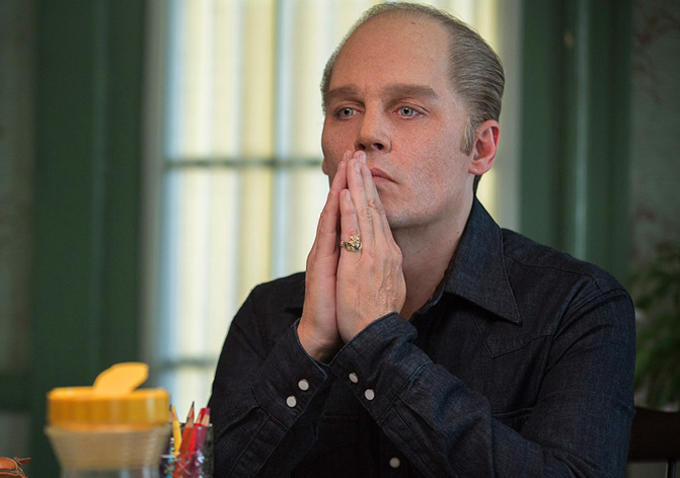
Actual haircut as seen on actual male, ca 1984.

And who could forget when he filled in for Nancy McKeon in the controversial 10th season of “Facts of Life”?

So, for those who care about such things, Black Mass is a breath of fresh air, not only the strongest entry yet from actor-turned-director Scott Cooper (Crazy Heart, Out of the Furnace), but a reminder that Depp really can act. The first thing you may wonder is “Who’s he doing this time?” And the good news is: nobody. You could say his performance is informed by Jack Nicholson, who played a character based on Bulger in Martin Scorsese’s The Departed, but it’s mostly pure Depp playing the sort of complicated guy who killed without compunction but was finally arrested in Santa Monica living with a woman who loved cat calendars. (Not depicted in the film.)

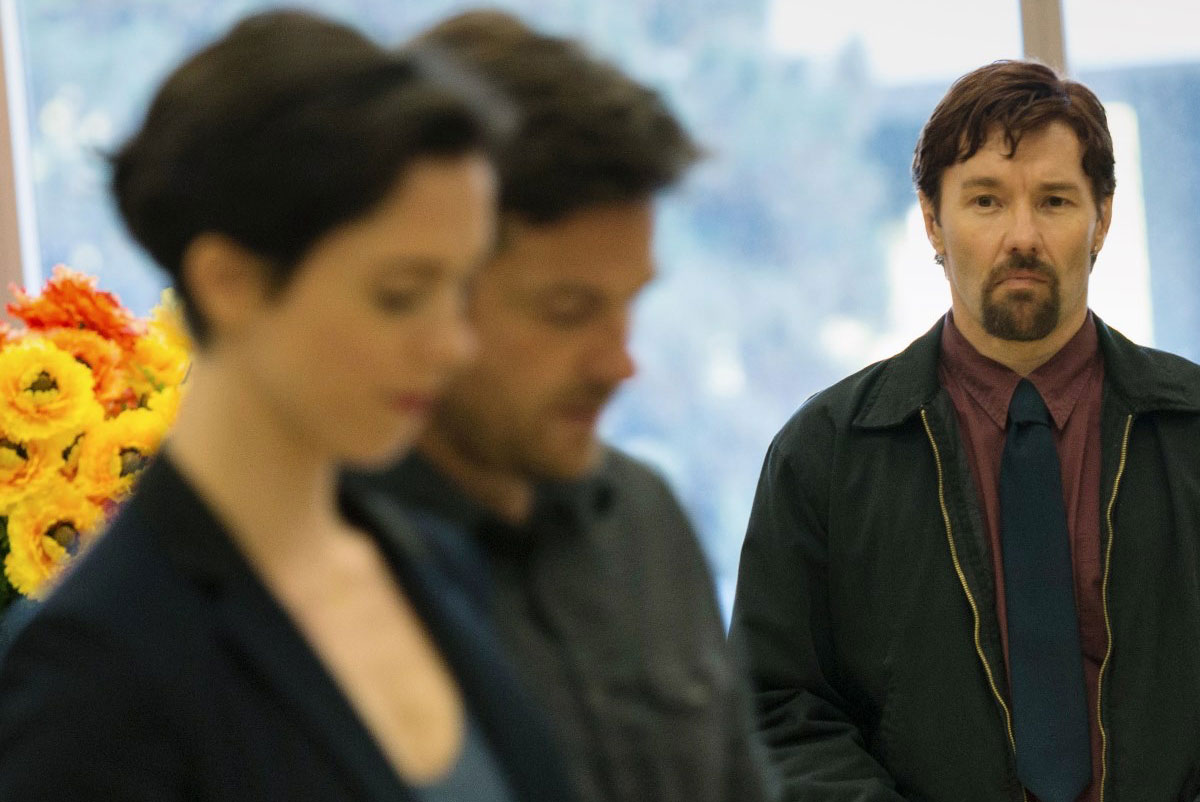
Our story begins in the ’70s, with Whitey is a low-level thug but Southie neighborhood hero, who has a fan in the FBI, John Connolly (Joel Edgerton, Animal Kingdom, and who recently wrote and directed the psychodrama, The Gift). Connolly has this idea that Whitey can bring down the mafia, and all the mafia has to do is look the other way when he’s, you know, extorting, racketeering and murdering. The FBI head (Kevin Bacon, Death Warrant, Friday the 13th) draws a line at the murdering part, though, which is how hapless Brian Halloran (played by Peter Sarsgaard, The Orphan, An Education, Green Lantern, Robot and Frank) gets sucked into the scheme—covering for Bulger when revealing him would mean jeopardizing legitimate arrests.

Well, it all ends in tears, of course, as these lives of crime do. Tears and bullets to the back of the head. And in the end, you’ve learned precisely nothing about anything, except that some men are so close to evil as to make no nevermind, and that all men are ultimately corruptible, except possibly Benedict Cumberbatch, who plays Bulger’s brother, a highly successful politician and university dean, who seems to have kept his nose clean despite considerable pressure to help his brother out.

Cumberbatch and Depp, together again for the first time!

And you thought YOUR thanksgivings were awkward.

So, first of all, this is a gangster flick. If you don’t like gangster flicks, you won’t like this: It’s violent, often brutally so; There aren’t a lot of sympathetic characters. There’s no Elliot Ness, for example. The characters themselves are not drawn in sharp detail. Whitey is shown having certain feelings and reactions to events, but you get no explanations or excuses. Same for the FBI agents who supported him (except  Halloran whose participation was the result of peer pressure).

On the bright side, this means you get a minimum of BS. The moviemakers aren’t trying to spell things out for you. There’s a lot here you can fill in. For whatever reason, South Boston is a hotbed of white, Irish, funny-talking crime.

On the other hand, it means the movie can’t really reach greatness because there is no character arc, no moment of understanding, no element of human drama that we can all relate to. Like all gangsters, White continued his crime spree until it became impossible for him to do so any more.

Depp pauses to remember when he had scissors for hands.

It’s a metaphor for Depp’s career, maybe?

Nonetheless, it makes for a good show.

Solid direction. Good performances all around. Not a lot of women but they do what they can with the limited roles: Dakota Johnson (of the Hollywood Griffith/Johnsons, also 50 Shades of whatever, and—perhaps coincidentally—21 Jump Street) plays baby-mama to Bulger’s son, and has a tense moment of domestic strife that might lead to tears, or a bullet to the back of the head; Julianne Nicholson (“Ally McBeal”, “Law and Order: Criminal Intent”) plays the smarter-than-her-husband John Connolly who also has a tense moment of domestic strife that certainly leads to tears but might also lead to a bullet to the back of the head; and Juno Temple (Horns, Killer Joe) who has a tense moment of domestic strife that—well, she probably wishes she got a bullet to the back of the head.

After seeing The Untouchables, The Boy once opined that he liked gangster movies. After The Departed, Goodfellas and the Godfather movies, he modified that to saying he had a theoretical liking of gangster movies. I’m not a fan of gangster movies at all (though I too like The Untouchables). But we both liked this.

I really wondered if Damon had put on a few pounds to take a minor role in this film. I'm a dork.

This is Jesse Plemons, not “Fat Matt Damon Who Can Actually Act” as some (me) have suggested.

The Gift

We just saw Joel Edgerton as the none-too-bright FBI agent in Black Mass, and here he is all grown up and writing/directing features of his own! In this case, the creepy psychodrama, The Gift, about Simon and Robyn (Jason Bateman and Rebecca Hall), a married couple who find themselves terrorized by the husband’s not-quite-right high school friend, Gordo (Edgerton).

Shop-stalking. Or is it stalk-shopping?

What about this DOESN’T scream “well-adjusted individual”?

Every year when The Flower, The Boy and I go to Knott’s Halloween Haunt, we leave a few hours early and catch a movie first. This way we don’t have to stress the traffic, which is increasingly bad here in Southern California. And, if we can, we see a horror flick or something horror-themed, to prime the pumps as it were. On the other hand, Shaun the Sheep was playing, and it was the best reviewed movie of the summer! But we hadn’t even heard of The Gift, and it had a whopping 93% critical score on Rotten Tomatoes, as well as an intriguing 79% audience score. So, in we went.

Critic/audience splits are an interest of mine. In the most obvious and boring cases, they’re due the banal political tendencies of the critical class. You don’t have to guess that the split on Obvious Child is due to a pro-abortion spin, or that the split for Heaven is for Real is due to the Christian subject matter. When the critical class is cool on American Sniper and Gran Torino, but right up there with the audience for Million Dollar Baby, it’s not hard to figure out where the discrepancies lie.

But the more interesting ones come from other artifacts of being really into movies. Like the masses aren’t going to share the passion for movie history, like in Hugo. And in some cases, you’ll see critics praising something because it’s different. Because when you go to a ton of movies, it’s nice to see something that isn’t the same as everything else.

"Two tickets seee--voooo-playyyyy!"

Sing to the tune of Alouette: “I like French films, pretentious, boring French films…”

Which brings us to The Gift. On the surface, it looks like a standard issue stalker-terrorizes-happy-couple film, which isn’t my favorite, frankly, but if you’re going in expecting that, you could be easily disappointed by this movie. While our “happy couple” Simon and Robyn have the kind of life and lifestyle that adorns magazine covers, they’re having trouble conceiving, and Robyn is depressed, in a way that goes deeper than conception difficulties. Meanwhile, Simon is, for lack of a better word, an asshole.

He’s not awful, at least not all the time. But he certainly has some tendencies.  Most of the time he’s able to keep those tendencies in check, but they slip out, particularly when Robyn’s issues come to the forefront. That is, he’s okay with run-of-the-mill emotional chick stuff, but he loses it pretty fast when things get heavy, like the perfect life they’re aspiring to demands that they be perfect in all respects, and her lack of perfection endangers that.

That's from Cuckoo's Nest but Bateman doesn't have any of Nicholson's menace, which is fine for this film.

You’re not gonna pull that crap today, are ya? Not today!

First time I recall seeing Jason Bateman was in a short-lived, ahead of its time sitcom called It’s Your Move, in which he played a sociopathic teenager named Matt whose manipulations of his mother were threatened by her new love interest. When Robyn begins to look at why Gordo has chosen to terrorize them, and finds a dark history where her dream husband wasn’t so dreamy, I had this sudden flash of I guess this is how Matt turned out. Heh. Bateman generally plays likeable everyman types, so I wasn’t sure if he was just a well-hidden sociopath or just a rather messed up overly ambitious guy.

But there’s nothing really simple about this movie. It eschews slashing for psychological scarring. There’s some messy sort of justice, perhaps, here, but nothing very neat. You keep guessing all the way to the end, and even then you’re not 100% sure. There’s a lot of debate over what really went down, which is kind of cool on the one hand, but if you were going in for some bunny boiling, you’d be disappointed.

Ultimately, this is a solid, but low-key, suspense/mystery. Fine acting from the three principles and the supporting cast, especially Alison Tolman and Adam Lazarre-White as the neighbors. And it’s worth noting that there’s some really fine directing here, too, from Edgerton. The Boy and The Flower both approved.

Heh.

“You know, I just have a good feeling about how this is all going to turn out!”

Psycho (TCM Presents)

“So, anything good playing tonight?”
“Psycho.”
“I’m in.”

It seems as though TCM has learned that there’s some cash in replaying old films under their brand. I didn’t hear about it until recently (I have a cable box but it’s not plugged in) or I would have gone to see Double Indemnity, and I might have gone to see the Jaws 40th. But Psycho (on the really big screen) was not to be missed, and so The Boy, The Flower didn’t. The Flower shares my (and Alfred Hitchcock’s) opinion that Psycho is a comedy. And as Beetlejuice said, “It keeps getting funnier every single time I see it!

Michael Keaton at the height of his powers.

Of course, he was talking about The Exorcist, which isn’t really very funny at all.

The thing about Psycho is that it’s not Hitch’s most watchable film, but imagine for a moment, if you will, being a moviegoer in 1960 and knowing nothing about this film going in. You’re expecting a suspense thriller, in the vein of Dial M for Murder or Strangers on a Train. And there’s Janet Leigh doing a little impromptu embezzlement (or is it just outright theft?) and you’re sure that the bag of money is going to be the McGuffin. You’re pretty sure what’s going on.

Then, bam! First act closer and you no longer have any idea what’s going on. But you’re pretty sure you saw gallons of blood and possibly a nipple. And you were already reeling from seeing a toilet literally being flushed ON SCREEN.

Of course, the most shocking thing in Psycho was the presence of a toilet that was actually flushed. Another Hitchcock first!

That’s the contract of the guy who negotiated for the studio: “We think this pic’s gonna bomb, so forgo your salary and you can have a share of the profits.”

Hitch completely subverted the expectations and made probably the only big box office a slasher has ever made. There are other horror films that rank high on the all-time box office, including Jaws and The Exorcist which are in the top 10, but the slasher films that followed, like Wait Until Dark (which is not strictly a slasher, but both followed and set up quite a few of the conventions), Halloween, and every other film produced between 1979 and 1989, when they made money, made not due to boffo box office, but more due to very low budgets and greater than zero box office.

It’s nigh impossible not to be spoiled, so quickly and firmly did Psycho take hold of the imagination. It’s a shame, since it would be so much better if you went in blind. But since Psycho relies heavily on shock for its greatness, it also loses something on repeated viewings. At the same time, the kids and I were pointing out all kinds of stuff we hadn’t noticed before. When Marion steps up to the Bates Motel office and looks up at the house, you can really see Mother Bates walk past the window, very clearly. As The Boy pointed out: Hitchcock didn’t cheat. (Actually, he did cheat, because he was deathly afraid people would figure it out, but it’s hard to see, at least in retrospect.)

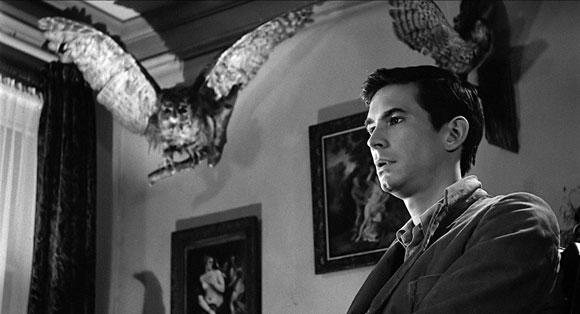
The awkward supper shared between Norman and Marion in the room full of stuffed birds just doesn’t come across on TV like it does in a theater. On TV, it looks weird. On the big screen, it’s menacing.

We all go a little mad sometimes.

I wonder what Hitch’s NEXT movie will be about?

And the scene where Detective Arbogast climbs the stairs and meets Mother is done in one amazing shot that it’s hard to figure out how they pulled it off. Now, you can see this clip online—hell, you can see the whole move as well as all the iconic clips online—but the murder shown isn’t the one we saw. The one online is not a single shot, and it cuts from straight on to overhead when Mother appears, but in the presentation we saw in the theater, the camera actually swoops backward up the stairs and overhead, no cuts. We all kind of gasped at that, but maybe it was because something had been restored or re-edited for this anniversary. (Or perhaps the 50th anniversary, although I’m pretty sure that’s the last one we saw, in preparation for The Flower seeing Hitchcock with us.)

Of course, the famous Psycho murder music by Bernard Hermann overshadows the fact that the whole score is awesome. It gives you suspense, like you’d expect, but then shifts seamlessly into horror. There’s also a remarkable sympathy to the film, in between all the stabby notes. It’s generally agreed that Hitch wanted to have the shower scene be music-free, though according to some legends (perhaps started by musicians), the scene without music tested and got laughs instead of shrieks. The more likely truth is that he heard the score Hermann prepared and realized he had a better movie on his hands with it.

This is one of those movies you can go over and over and see something new. If you’re a movie lover, it’s a must-see. And if you’ve never seen it, somehow, what’s wrong with you?

It's true: For years, if you Googled "Pointy Breasts" my blog came up.

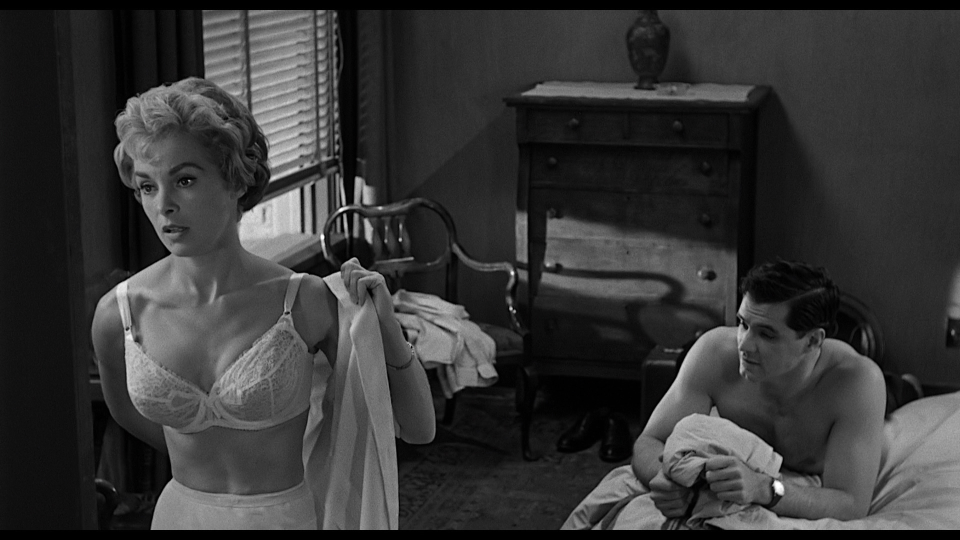
Fun fact: By far the biggest hit on my original blog was a picture of Janet Leigh in a bra.


Tales

Our favorite theater shut down again though at least this time it is only a temporary remodeling thing, and on the last night we went in to see Tales, another Persian film from our friends at Daricheh Cinema. And by “friends”, I mean, “People whom we’ve never met and who probably wouldn’t like us, but who seem like they might be in the audience at any given showing.” Daricheh doesn’t do politics as far as I can tell—probably wise—but each film (well, okay, not City of Mice 2, which felt sort of subversive to me) tends to remind that me Iran and Afghanistan are possibly the only countries in the world that actually looked better in the ’70s.

I'm joking of course. The Miss Iran pageant ended in 1978.

Miss Iran lineup 1978 (left) vs. Miss Iran lineup 2015 (right). Fun fact: It’s actually the SAME women.

But more depressingly, Iranian movies tend to remind me that the face of totalitarianism is always and everywhere the same: An uncaring bureaucrat ignoring your plea for justice, sanity or anything that might keep him in his office an extra ten minutes. It’s the sort of thing that reminds you that even if the Green Revolution had succeeded, there’d still be some horrible bureaucracy grinding people down.)

Tales is set up by having a filmmaker go through Tehran with his video camera recording various people’s stories. The problem with vignette movies, though, is that they tend to lack punch. Last year’s Wild Tales is a notable exception, and Tales manages to achieve a sense of momentum that eluded The Place Beyond The Pines, but the mind wants a connection between the stories—and that largely isn’t there.

This is still a very watchable film, because the vignettes are intriguing, and care went into the acting and filming, despite the whole cinema verité veneer. We start with a taxicab driver who picks up a filmmaker. This is interesting because you’re sort of expecting the movie to follow the filmmaker, but instead it follows the cab driver, who next picks up a woman with a sick child who tries to solicit herself to him. He’s appalled, but increasingly so as it becomes apparent the two know each other.

Desperate woman, sick child.

You might think an upside of theocracy would be women not having to debase themselves in desperation. Nope.

We then follow the cabbie to his home: His mother is somewhat sickly and his brother is in jail (we don’t know for what). But from there, I think, we end up following the mother to some bureau of something or other, where she’s trying to get the brother released. They’ve given her the old “Fill out form 1234.5” but once she’s done it, they say, “No, fill out ABCDE.F”. A man who is apparently familiar with the bureaucracy offers to help her—

But then we follow him in to the head manager’s office. Turns out old guy is a lifelong public servant who’s recently been ripped off due to being transferred out of network for an emergency surgery—the Persian and American health systems apparently being based off each other—and in order to get his money back, he’ll have to literally drop trou and submit to a most invasive medical examination in the presence of yet more bureaucrats. Meanwhile the head bureaucrat is juggling golf dates and his mistress and his wife and really has no interest, leaving the old guy to take the subway home, where he overhears what sounds like depraved sexual talk from a couple—

Who turn out to be brother and sister, working out a scheme to pretend she’s been kidnapped to get money out of their parents…

And so it goes.

Woman In A Van In Tehran (Tales)

Then there’s this young lady, who helps wayward women, and has one of the weirder flirting sessions I’ve seen. A half-conscious girl mumbles in the seat behind her.

You can’t say the movie isn’t exactly what it says in the title. It’s a bunch of different tales. The filmmaker comes back in the middle, during a labor protest, and at the end, but he’s actually not a big part of it. At the same time, there is a powerful statement there: A guy making a movie about real people in Tehran has to work in secret, and has to accept that his work may be buried, and he may in fact be captured or killed for daring to show things that are not approved of.

As I said, quite watchable, but not packing the dramatic heat of a single story film, and the thread that ties things together is more coincidental than strongly thematic or dramatic—that is, this isn’t a story of how women fare, or the evils of theocracy, or something like that, and it’s also not a story of people whose stories all converge on a common point. (Or if it is about any of those things, I missed it, which is always possible, especially when dealing with foreign films.)

The (largely Persian) audience applauded appreciatively, and I liked it more than The Boy, who was also looking for some common theme.

Learning To Drive

We don’t often stay in our demographic, The Boy and I. Early on The Boy established that he prefers good movies, and beyond that he was unconcerned. If anything, the sort of superhero/action/shoot-em-up type films are regarded with considerable suspicion (which is part of what makes his love of Fury Road so endearing). Give him characters, an interesting plot with suspense, don’t rely to heavily on the shock twist ending! and he’ll come along for the ride.

In this case, it brought us to Learning to Drive, the tepidly received (68%/68% RT) film from director Isabel Coexit (My Life Without MeThe Secret Life of Words) and writer Sarah Kernochan (Somersby, 9 1/2 Weeks). This is the story of Wendy (Patricia Clarkson, The Station Agent, Lars and the Real Girl) whose faithless husband (Jake Weber, famous for “Medium” but I remember him from his caddish role in “Mind of the Married Man”) finally leaves her for good. Her college-age daughter (Grace Gummer, Frances Ha) is doing some sort of back-to-earth thing upstate and the newly, reluctantly liberated Wendy no longer has the means to visit her because she can’t drive.

Now, “can’t drive”. There’s a phrase no one would self-apply where I come from.

Sam Elliot, The Stranger

But then, there’s a lot about New York I don’t understand.

Fortuitously, her husband breaks up with her in a public restaurant which, if I may interject here—what the hell is that? You want to avoid a scene? Seriously? “I’m going to split with my wife of 20-odd years and the mother of my child, of course I don’t want a scene.” Sometimes, you know, you got a scene comin‘ is all I’m saying. Anyway, the fortuitous aspect of this is that they have to take a cab home, and that cab happens to belong to the wise Sikh Darwan (Ben Kingsley, Gandhi, Iron Man 3) who happens to give driving lessons when he’s not being a cabbie.

It’s a kind of brilliant idea, in its own patriarchal way: Darwan, as a driving instructor, is somewhat stern with hard rules about serious things, but he’s patient, attentive, polite and supportive. So, of course there’s an attraction. But the movie throws a curve ball in the form of instantaneous arranged marriages which we are conditioned to think are wrong even as our own culture is strewn with heartbreak and divorce. This adds an interesting dimension.

Where this movie shines: The acting, sure, but especially relationship between Wendy and Darwan. Darwan is wise, but the movie holds back from sanctifying him. The stress of meeting his new bride shows cracks in his normally cool demeanor. And then there’s the ending, which I wasn’t entirely sold on but gave Wendy a chance to complete her character arc. These are strong enough that The Boy and I would warmly recommend it: It is the point of the movie and it’s done well.

Ben Kinglsey and Patricia Clarkson brave Manhattan traffic in Learning To Drive.

This is from the scene where they chase Joe Biden around, running into every Dunkin’ Donuts and 7-11 ahead of him.

Where it’s weakest is in its half-hearted salute to various clichés. Wendy has a sister, Debbie (Samantha Bee, who does some fine voice work) who actually utters the words, “Why do you think they call it a job?” after declaring oral sex off limits. They share a cackle and a “Men! Can you believe those guys?”-moment which is just awful, as is a later scene with Debbie leading to an awkward sex scene between Wendy and a Tantric sex partner.

This is particularly awkward because where the movie really falls down is in communicating the passage of time. Here, it’s common to do driving lessons in the course of a couple of weeks. Even at once every two weeks, ten lessons is only three months. Even if she doesn’t start them right away, she’s in the middle of a painful divorce. Since when is that a good time to be “getting back on the horse”, as it were, especially with a guy she’s mildly bemused by at best?

We were able to overlook this stuff, though, because the core of the movie is solid, sensitive, and it offers an interesting angle on the whole love, romance, marriage theme. We were glad we checked it out.

Samantha Bee and Patricia Clarkson prepare to gripe about men and sex.

This scene is the “What about that airplane food?” of the female-empowering movie.

Rififi (60th Anniversary Edition)

It says something about the French that a word for “rough and tumble” or “tough guy” could sound like the dance number in an American musical, but that shouldn’t put you off Rififi, which is a fine caper flick made 60 years ago, long before Americans had nipples. See, the thing about this film that could maybe ruin it for you is the lavish praise heaped on it. Which is a shame, because it’s good. Really, really good.

Music Man "Shipoopi"

Rififi, Rififi, Rififi, the guy that’s hard to get!

But what seems to have attracted the attention of the film critics is its “brutality”, and of course it’s tame by today’s standards, and didn’t strike me as particularly more brutal than the gangster flicks of America ca. 1940, from which it is heavily derived. It’s also got a drug-addicted character and the aforementioned nipples which, granted, is pretty edgy by 1955 standards. Although I can appreciate a film as a historical document, that’s separate from being able to enjoy it with modern eyes. And Rififi is more interesting, at least to me, in the latter sense.

o/~Singin' in the bathtub, gettin' nice and clean~\o

Robert Manuel and Christa Sylvain sharing a moment of ablutionary bliss.

Connecticut born Julius Dassin directed a number of classic American noir films like Night and the CityThe Naked City and the lesser known and probably non-existent And The Naked City Night, before being driven out of Hollywood for being a commie. He fled to France and changed his name to Jules, thereafter directing Topkapi, Never on Sunday, and this, perhaps his best film.

The story is classic noir: Tony has just been sprung from prison, where he spent seven hard years because some dame ratted him out, see? And his old pals are all glad to see him, knowing he could’ve turned them in to save his own skin, but they got this one last job, see? Well, Tony don’t want none of that, but then he goes to find the dame what ratted him out, and after extracting his revenge (by delivering a fairly mild beating), decides he’s gotta pay the bills somehow, so yeah, they’ll do the heist.

But they’ll do it his way. Going for the whole enchilada. Going for the whole enchilada, however, means bringing in a new guy—an expert safecracker whose only weakness is…women. See?

You’ve seen it a thousand times before. Dozens of those times in French. I defy you to be surprised at any point by the plot. But that’s okay. It all works. And it works for the obvious reasons: Acting, writing, camerawork and lighting. The acting is good: Our little gallic buddies pull off rififi pretty well. Well, Tony (Jean Servais, The Longest Day, Les Miserables) does, anyway. The other characters have more of an insouciance to them than a real toughness. In fact, the gang’s real trouble comes from crossing paths with a much tougher, more brutal gang of thieves.

But they’re likable characters, even though thieves, thanks to the writing. The plot is tight. Most of it greases the tracks to the heist, the rest sets up their characters, so we can care about their fates. The only really unneeded part of the film is the song/dance number which explains what “Rififi” means. (Apparently, the author of the trashy crime novel the movie was based on had made it up.) I understand the director had the regrets about including it. It’s kind of charming.

The move was successful enough for the song to warrant a non-literal translation to English. You know, instead of just doing a word-for-word translation, they try to capture the spirit of it, while making it rhyme and have good meter in English.

Rififi chanteuse

Yes, this actually takes up about 3 minutes of the movie.

Besides the solid blocking and lighting—though certainly not The Third Man quality, but what is?—there are two sequences that raise this movie from enjoyable caper flick to masterpiece: The heist itself, which lasts for at least twenty minutes, and is done without dialogue or music; a final desperate driving sequence at the end of the movie, also without dialogue.  Worth the price of the ticket alone, as they say.

The movie was banned in several countries for being a blueprint on how to commit a heist. Government officials aren’t very bright. But then again, neither are thieves who take their cues from movies.

The Boy was on the fence as to whether he liked this better than The Third Man. (On the one hand, every shot in The Third Man is a masterpiece. On the other: zither music.) When we went to see this, the “film broke” and interrupted us right at the end of the second act. And if you end the movie at the second act, it’s a happy ending! The characters achieved their goals and all lived happily ever after.

We actually came home and watched the third act on the television, which we don’t care for, but we had to see how it ended.. The third act is, as you might expect, dark. Real dark.

Johnny Got His Gun

How dark? “You’ll take me to Chuck E Cheese if you know what’s good for you”-dark.

Anyway, great caper flick, worth checking out if you’re not allergic to French or dubs. We always do subtitles but I suspect the dub is pretty good, given the classic status of the film.

The Second Mother

The artists of the free world have, more-or-less, been on a rampage of vicious criticism of that world since the height of the Cold War. As an American, it’s not hard to see in the movies, music, television, visual arts, and so on, scathing criticisms of American life and culture. In fact, it’s hard not to see such things, and celebrations of American life tend to be insincere mockery, especially of post-war America, when we went from the Heroes of the World to its greatest villains in less time than it took to actually Save the World.

What seems to be unique to American culture—or if not unique then relatively uncommon in others—is the constant barrage of messaging about how bad we are relative to other cultures. Europeans are supposedly socially and politically superior—more sophisticated—and former and current Communist block countries tend to be regarded well based on how closely they hew to their socialist pasts. Meanwhile, third world countries are at least granted a certain authenticity.

Foreign films can be so enlightening in this regard.

I love you THIIIIIS much!

Coffin Joe describes how much better Brazil is than America.

I refer you to my review for Le nom de gens as a classic example: A recent French film with a relationship which is edgy because, I don’t know, they’re not both pure-blooded French or something. It’s just a thing you’d never see in a film here, not for decades. Because, honestly, who cares?

Which brings us to The Second Mother. Originally Que Horas Ela Volta?, which I’m going to guess means “When Is She Coming Back?” or “When Does She Return?”, this is the story of a maid who fled her poor rural village—the back story reminds me of the ominous references made in Salt of the Earth to some trouble in Brazil a while back—to work as a maid for a wealthy family in Sao Paolo. She has a daughter (and abusive husband) back home, and she sends money to support her daughter, but she’s less and less able to get back. When the movie opens, mother and daughter have not spoken for several years.

But daughter shows up in the city because she wants to apply for college, the selfsame college that wealthy family’s son—the one that Val, our heroine, has raised and spent more time with than either of his parents, and more than she’s spent with her own child—wishes to attend. And while Val is meek, unassuming and as visible or invisible as her employing family needs, Jessica acts more like an obnoxious visiting cousin—a combination of her indifference/hostility toward a class-based society, the chip she carries from being neglected by her mother her whole life, and the fact that she’s a young, pretty girl.

The circle of laundry: You get clothes dirty. Your mom/maid cleans them.

The Ramones And Led Zeppelin are apparently the hot bands in Brazil these days.

She makes life hard for her mother, who finds herself constantly making excuses for her daughter’s presumptuous—primarily to the matron of the family, who is uncomfortable with her live-in servant having a life, and severely threatened by the presence of a young female who immediately commands more attention from her husband and son than she does. Karine Teles does a fine job as the bitchy, overbearing, self-important mother who begins to realize what she’s sacrificed by having her son raised by another woman.

The boys, father and son, act like idiots: The father more than the son, as he mistakes (as old men apparently must) an appreciation for his artwork and general positive, high energy femininity as romantic interest. The son is sort of shiftless, a pot smoking boy with no ambitions, and he’s definitely attracted to the somewhat older, ambitious-even-if-those-ambitions-are-vague Jessica.

Well directed and written by Anna Muylaert, who blocks some great shots visually highlighting the class distinctions. Way less creepy than some other films in this genre, like the grotesque (but popular) Down and Out In Beverly Hills. I was actually highly suspicious of this film going in, as its Rotten Tomatoes score is insanely high: 95% from critics, and 97% from audiences. This puts it in the same category as the nigh-unwatchable Gloria (although the audience scores on Gloria weren’t that high as I recall). It’s gentle and treats its characters like human beings.

I swear it looks like she's making the window dirtier.

It’s almost like they’re on the outside looking in. Almost exactly like that.

At the same time, it didn’t really resonate with The Boy and I because: American. As much as humanity seems to thirst for second-class citizens—people who you’re just better than just because—America has always been about fighting that kind of entitlement, which is why we’ve had such luminaries as the bastard Alexander Hamilton and Latin-school dropout (at age 10!) Benjamin Franklin. We really had a hard time imagining why Val shouldn’t be proud that her daughter didn’t adopt a second-class status. Movies like this remind that many of the places that are “better” than America still cling to these illiberal class social structures

Nice ending, though.

Fun flame war topic: Are Korean girls hotter than Brazilian girls?

I couldn’t find a still of the great kitchen/dining room shots, so enjoy this unrelated photo from the upcoming, unrelated Korean movie, The Second Mother.

Mad Max: Fury Road Redux

We see 120-150+ movies a year in the theater, and even so this represents maybe 20% of the films released in a given year, which means we’re highly particular about what films we see more than once. When you hear of people going to see the original Star Wars dozens of times, what you may not realize is what the hell else were they going to do?  I mean, in 1977,Roger Moore was James Bond, the 6th highest grossing movie of the year was a cheesy “Chariots of the Gods?” level documentary on Noah’s Ark, and we were seeing the emergence of the first Jaws knockoffs (Orca and The Deep, and we all know the two best things about The Deep).

Flotation devices throughout history.

PG used to be a different world, kids!

So, after you’d played all the Space Wars you could ($10 of quarters would buy you a full hour of play), realized the only thing on TV was the rerun of that Happy Days episode you never liked—and the Fonz was going to be amazing in his upcoming dramatic role in Heroeswhat else were you going to do?

I’m speaking hypothetically of course. I only saw it twice—the second time fully 9 months after it came out!—and didn’t like it either time. But you get the point: You used to check the theater listings to see if anything new had come out, only to see freakin’ Star Wars was still playing. These days seeing any movie twice means missing out on an opportunity to see a different good movie.

But as indicated in my original review, Fury Road was an instant candidate for re-watching. It’s jam-packed with lovingly crafted details that you could point out, especially on a second view when you’re not worried about missing the action. I won’t rehash my original review, but instead I’m going to make an entirely different point about how this film should probably sweep the acting Oscars.

Now, the acting Oscars are ham-handed affairs, typically. a Dustin Hoffman will win for acting autistic through Rain Man, but not a Tom Cruise, whose character has to undergo a subtle change into someone whom the audience doesn’t actively hate; or Marlee Matlin will win for her histrionics in Children of a Lesser God versus a Sigourney Weaver who has to keep her desperation in check before doing battle with the Alien Queen. The latter being more on-point as an example where a fine actress plies her trade in the spaces between the action—a much greater challenge (as far as demonstrating craft goes) than delivering a soliloquy.

Ripley with Newt and gun.

They say women are good at multitasking.

I still maintain that the words are the worst part of Fury Road, and the movie wisely eschews them for the most part. The character development then—and there’s a fair amount of it—is largely done without speaking, and often in split-second cuts. But it works!

The best examples of this are between Max and Furiosa. Furiosa is the lead character and she goes from seeing Max as an enemy, as a hostile traveling companion, as an ally, as a hero, and finally as a friend, and even a potential lover—with the transitions that are most certainly there but there without any room for slop. And there’s a kinship between Max and Furiosa: they’re driven by the same demons, but also bound by a sense of right and wrong. Thing is, they can’t possibly know that about the other without seeing it in action.

Charlize, Tom, Gun

The most romantic scene in Hollywood history?

And this is where action movies usually fail dramatically. First, they generally don’t care. There are black hats and there are white hats, and all right thinking people know to feel bad when a white gets hurt and good when a black hat does. (I remember watching High Noon and thinking, Well, okay, but what exactly are the bad guys gonna do? Raise taxes?) Second, it’shard: Charlize Theron has two seconds to give us an expression that covers surprise, appreciation and a wary respect when Max risks himself early on to keep the bad guys off his tail.

But Max’s initial responses could be driven by calculation toward his best chances of survival, so their relationship has to progress in the sort of painstaking tiny steps you never saw in a Nicholas Sparks flick. In most movies, this is done with words. But words don’t mean squat in a post-apocalyptic situation. You have to see the action that shows what side you’re on. Not only are words are cheap, they’re tough to hear over the engine’s roar.

I missed a bunch of these reaction shots first time through, as I did a bunch of very cool details. In the scene following the porcupine cars attacking the war rig, it ends up festooned with the wreckage on its lower carriage.  I missed some big stuff, too, such as when the one breeder jumped ship, she hadn’t actually turned coat, it was more of a double-agenting thing. In fact, a lot like the previous two Mad Max films, I found even the words seemed less affected than they did the first time around. (Part of that is the Australian thing. They have all that kinda cutesy slang even non-apocalyptically speaking. But you get used to it after a while.)

The level of attention to detail here is worthy of a Pixar film, and Mad Max: Fury Road not only holds up, it pays off extra dividends on repeated viewings.

Immortan Joe

And, guess who just threw his hat into the 2016 Presidential Candidate ring? “Shiny and Chrome ’16!”

No Escape

What’s a guy to do? You stick a big, fat anti-West message in your suspense/thriller, and still you’re accused of being racist, xenophobic, and just an all around jerk. Well, my heart goes out to John Erick Dowdle and Drew Dowdle, makers of fine fare such as Quarantine and Devil, who’ve crafted a solid potboiler about fleeing from a foreign city during a revolution, but made the mistake of not making the heroes Swahili and setting it in Seattle.

Hand to God, the first guy out of the theater after us said, “It was good! It was racist, but it was good.”

I wanted to stop him and say, “Hey, here’s a movie about Cambodian revolution, where one group of Cambodians is, by and large, killing another group of Cambodians (and also all the Americans), where the good guys and the bad guys are all freakin’ Cambodians—how is any of this racist?” But he was on his way to the bathroom, and these conversations never go well anyway.

It’s racist because it…uh…shows non-white people in a negative light. We’re gonna pretend that far worse didn’t happen in Cambodia not long ago. We’re gonna pretend that it’s any different from Les Miserable, for that matter.

‘cause it makes us feel good.

Oh, by the way, they don’t actually say it’s Cambodia, but Cambodia was convinced enough to ban the film. And, hell, their goal is to follow the river into Vietnam. I guess it could be Laos. But it was Cambodia.

Nonsense aside, this is, as I said, a solid film, in the mold of The Warriors, Blackhawk Down, ’71, or any of the multitude of non-Asian-based “trapped in a hostile foreign city” movies. The twist is, instead of a band of soldiers, we have poor sap Owen Wilson and his hapless family who arrive in The Unnamed Southeast Asian City six hours after a bloody uprising has occurred. Especially unfortunate for Owen and Co., the impetus for the uprising is centered around his new boss, who is in some sort of public utilities business.

This is one of The Boy’s (and my) favorite genres of films. Outnumbered, angry mobs at every turn, not knowing who to trust, and the movie starts out with a bang by putting the wife and kids in jeopardy.

It’s really a good gimmick, putting a family into the mix. I feel like we’ve seen it before but I can’t place where.

This movie has quite a few really excellent aspects: The suspense is pretty strong, especially at first. The characterization (despite what you may have read) is also very good, and is shored up by excellent acting from Wilson, Lake Bell (In A World), and the two cute little girls who round out their family. When the movie takes a break from the action, it fills the pauses with some effective drama and even realistic family moments. (Like your post-toddler having to go to the bathroom and being too embarrassed to go in her pants, because she’s not a baby! Oh, but if anyone moves, you’ll all get hacked to death.)

There are some missteps. Early on, when the family is contemplating jumping from one building roof to a nearby one, there’s an extra standing around who appears to have as his only purpose being murdered so as to show how dangerous things are.

The biggest misstep comes at the end of the second act, though, with Pierce Brosnan. Now, Brosnan shows up early on, and he’s obviously A Serious Dude, and Brosnan is certainly up to portraying a grizzled (yet handsome) mercenary/operative/super-spy/whatever. But tonally, his appearance deflates the real dread the film had managed to create. His character is too Hollywood, as The Boy put it.

His appearance signals what kind of movie we’re in and how it’s going to turn out. It didn’t ruin it for me, and The Boy was quick to say that he really enjoyed it—he just wanted more with all the potential that was there. We’ve talked a lot about that extra layer of polish and love you see in some movies (whether it’s The Third Man or City of Mice 2), and he felt that extra something was missing here. Left out in haste, perhaps.

I would still rate this higher than the 72% audience RT score, but the 40% score is just embarrassing to the critical establishment. Learn the difference between racism and justified xenophobia, guys.

Rosenwald

America’s full of rags-to-riches stories, or in this case, not-quite-rags-to-amazing-riches stories, and I seldom get tired of them. But Rosenwald, the story of Julius Rosenwald, son of Jewish Immigrants who parlayed a modest life as a clothier into mega-riches as the CEO of Sears Roebuck is only partly about that.

It’s tremendously fun to listen to how Rosenwald made bank in Men’s clothes and then seized an opportunity to invest in Sears, ultimately becoming the CEO through a process that was a 19th century version of creating Amazon.com. His people came from peddlers, who had to place all their wares on a blanket every town they went to. The idea of creating what came to be known as “the wish book"—the Sears catalogue—and then demanding that products were delivered as promised, and quickly, bears a remarkable resemblance to Bezos’ empire, only with roller skates and conveyer belts instead of drones and computers.

Sears’ IPO—the movie seems to claim this was one of the first IPOs, which seems unlikely since the very first one was Bank of North America in 1782 and Sears IPOed in 1906—made Rosenwald a billionaire, which brings us to the next phase of his life, and the movie.

In the second part of the movie, we learn of Rosenwald’s philanthropy, which was shrewd, effective, and humble in a way one can hardly imagine today. He was not interested in personal glory; many of his projects were given his name, but by affection, not officially. In fact, he seemed positively chagrined at the notion that he might raise money for the Museum of Science and Industry in Chicago while calling it The Rosenwald Institute. And so, it was never officially called that, but if you Google it, well, that’s another story.

This part of the film is also fairly good, and gets at the theme of the movie, which is Rosenwald’s contributions to the black community. In a time when racial tensions were possibly at their highest (pre-WWII), Rosenwald’s foundation built thousands of schools. Well, correction: Rosenwald contributed a third of the funds, a third of the funds had to be raised locally, and the remaining third had to come from somewhere else, presumably the surrounding white communities or state and local governments.

But then, rather brilliantly, with money in hand, the community literally built its own school, made it their own, and made it a focal point for community activities. Rosenwald actually suggested buying the buildings from the Sears catalogues, but Tuskegee University architect Robert Taylor insisted on this approach, and the two of them seemed to have a felicitous influence on each other.

There’s a digression here into Tuskegee University which is amazing. (Tuskegee, not the digression) Taylor designed TU to be self-sufficient, given that they couldn’t count on help from the outside world. So, not just construction and cleaning, but gardening, plumbing—everything!—was done by the students in addition to their academic and artistic efforts. That to me sounds like a perfect school. (In fact, I had that very idea for a school when I was in college.)

But, here’s the thing: The last third of the movie is just wall-to-wall digressions and tangentially related stories of people who Rosenwald’s fund influenced. Worse than that, they commit the crime of just listing off bunches of names of people. I wouldn’t dispute the greatness of the people on this list, particularly the ones they highlighted (e.g., Marian Anderson), and there are some moving stories told.

Still, it’s not exactly keeping the eye on the ball, narrative wise. Rosenwald died in ‘32, meaning that the last third of the movie deals heavily in stuff that happened long after Rosenwald—who cleverly sunsetted his foundation in ’48 so it didn’t become a monstrosity like Ford, Rockefeller, etcetera—had shuffled off his mortal coil.

The Flower didn’t mind this aspect so much, perhaps because the stories are not without interest. The Boy absolutely hated it. He felt lectured to, and he’s not crazy about lectures.

I had a slightly different take. Emotionally somewhere between The Flower and The Boy, I was more intrigued by the movie’s absolute failure to address the elephants in the room. And there’s a herd of elephants.

It’s perhaps unkind to note that the world all the commentators (John Lewis, Maya Angelou) are waxing on is gone, and they either helped it on its way or silently watched it go. I hate to get all judgy here, but a world where everyone is encouraged to achieve and advance on the same playing field is far preferable to what we have now: A world where everyone is encouraged to fail and beatify their failures by blaming others.

You can’t help but know that the teachers of the Rosenwald school would’ve slapped a kid upside the head for claiming grammar was a microagression. They were suffering macroagressions—lynchings, often deadly segregation, alienation from the general culture—and they overcame them.

Maybe that’s not fair. Rosenwald was a great man, and he did great things. But there’s a distinct break in what he did and where we are right now as a country, and the movie’s nod toward that is to be dedicated to #blacklivesmatter. Somehow it’s hard to believe that he’d be for a movement that promotes the random killing of police officers.

On The Scale:

1. Subject matter: Worthy, historical, and necessary.

2. Technique: Adequate to telling the story. Photos and historians for the earlier stuff, filmed footage where available. Music a mix of classic jazz, ragtime and "It’s A Wonderful World”.

3. Bias: Yes. And it’s the sort of bias you see a lot: The unchallenged assumption among the Left that The Good Guys Are Always On The Left.

They call Rosenwald “progressive” at a time when eugenics was the Great Hope for progressives. And what did he do? Well, he facilitated traditional education, emphasizing practical skills, self reliance and other things that today would probably be called Hebrewsplaining.

Hell, the whole thing was a classic libertarian example of private charity, with zero handouts—even the artists had to produce to get something—working with communities and churches, with the larger government only peripherally involved at best.

A lot of times I suspect the documentaries we see are funded to make sure the Holocaust is never forgotten, nor the history of Israel, and I suspect that this one was funded to try to improve relations between Jews and Blacks, which would be a good thing. Maybe in that context, the last third makes more sense.

The End of the Tour

Restricting my fiction reading, as I largely do, to things written prior to 1950, there is nothing I can say about The End of the Tour’s representation of David Foster Wallace. I was aware of the Infinite Jest craze, and have read recently that it’s one of people’s favorite books to have pretended to read. I will say the movie’s a pretty good buddy flick, though.

The story is that Wallace (Jason Segel) has just hit it big with Jest and frustrated writer David Lipsky (Jesse Eisenberg)—himself having just published a little read book but also little sold and talked about book—cons his boss at Rolling Stone (Ron Livingston, Office Space) into letting him interview the lauded author. (As if Rolling Stone was interested in heady things like, you know, reading.)

As it turns out, Wallace is a bit of a weirdo, a kind of fragile shut-in in some ways, possessed of amazingly keen insight on the one hand, and completely oblivious on the other. It was interesting to see this so close to seeing the Marlon Brando documentary, because there’s an awareness here of how the media-packaged personality David Foster Wallace is not the real David Foster Wallace.

Basically, you have two guys who are part of the media machine: One who has this sudden fame and glory and is made uncomfortable by that, and one who wants that fame and glory more than anything. The awkward product (Wallace) and the uneasy producer (Lipsky). Unlike Brando, however, we’re not given any background to help understand why Wallace gets depressed—suicidal—as he does, and the interview is filled with these “don’t look into this or that” demands by Wallace, which Lipsky, as a guy both admires and wants to be admired by Wallace acquiesces to.

It’s a journalistic transgression, but since the whole selling point of the interview is to dig up dirt on Wallace’s alleged heroin addiction from the ‘80s, ethics are nowhere to be seen at a professional level.

Wallace’s character, as portrayed, is interesting because he’s a sort of lazy hedonist. He eats junk food for breakfast, lunch and dinner. He doesn’t own a TV because, he says, he would do nothing but watch it all day long if he did. And when he gets in front of a TV, that turns out to be true, nearly to the point of missing a tour event.

He’s aware of some other issues, too, enough to avoid them. Such as parlaying his fame into easy sexual conquests. He has enough awareness to realize that would just make him sadder and lonelier than he is. But he’s honest enough about wanting to do it anyway.

He’s aware that his practice of shielding himself from his past failures by dismissing successful things as popular tripe backfires in the face of his own success.

He relates his depression to the American ideal of doing something about it. And he feels like that was his big mistake, because there’s nothing he can do about it. That really stuck out to me. It may be a strange thing to observe about someone who is considered one of the great wordsmiths of my generation, but his whole outlook was essentially juvenile.

The junk food, the TV, the lack of commitment to relationships, the “sour grapes” attitude toward the success of others, and the notion that because everything doesn’t always work out, you’re not even going to try—these are childish things.

It’s hard not to like these guys, though, even when they’re being petty, jealous and awkward. They’re trying. Wallace struggled along enough to where Lipsky could be surprised when he finally did kill himself.

Good performances. Joan Cusack has a good turn as the Minnesotan “handler” for Wallace. A low-key but not dull story. I liked the direction by James Ponsoldt (The Spectacular Now) but I didn’t object to his portrayal of Lipsky as some did.

And it’ll take a lot less time than actually reading Infinite Jest. Though less time than pretending to read it.

Kahlil Gibran’s The Prophet

This is one of those movies where the trailers made me nervous. The story is about a poet who is locked up for committing the crime of poetry, and the poems are like the musical numbers of a musical—you have to like the music to like the movie, pretty much. It’s not really even poetry, so much as poetic prose. (You know, there’s no meter, rhyme, or any of the traditional hallmarks of poetry.)

It’s not so much that this is a good movie—it is—it’s that it’s surprisingly good at what it’s trying to do, which isn’t easy. The story is very simple: After 12 years of imprisonment, Mustafa is being freed from his cabin prison on Orphalese, on the condition he go home and never return to Orphalese. The catch, if it’s not obvious from the start, is that the authorities don’t plan to let him go so much as they plan to get him to the water’s edge and kill him—unless he denounces his own words.

The movie, then, is basically the walk from the cabin to the water, escorted by an officious sergeant, where at each point along the way he is greeted by worshipful villagers, all of whom he treats as at least his equal, stopping to share one of his “poems” with them.

The poems are all done in different styles of animation, abstractions of the ideas being presented, by different directors even. Including one by comic animation genius, Bill Plympton, who plays it utterly straight while still being thoroughly recognizable.

The shocking aspect of this is revealed in the 20-point split between audiences and critics: Namely, Gibran’s poems are deeply, deeply conservative, at least as presented here. What do we learn from The Prophet?

  • No work is beneath you. The meanest of work is worthy of dignity and gives dignity to the man who does it.
  • Monogamy is vital. Don’t be fooled by the allure of those who would take you away from your true love.
  • As a parent, you are the bow from which the arrows that are your children are launched. This was a fascinating poem, and true, I thought. It allowed that it was okay to try to emulate your children, but not to try to force them to emulate you. 
  • You are greater than the earthly powers that try to imprison you.

None of which fits into the current leftist worldview dominating this country. Mike Rowe has made legions of enemies just by suggesting the same thing about work. Monogamy is mocked in the popular culture. And you can’t really create the workers of the future out of your children if you can’t make them believe all the right things.

Ultimately, though, this is just a beautifully poetic film of beautiful poetry. The story of Mustafa’s relationship with the mute little girl Almitra is as touching as it is predictable. But that’s sort of the way of this movie: It say true, simple things well, and the real surprise is that you’re surprised to be hearing it.

But then you probably won’t hear of it because won’t get a wide release. It only opened slightly bigger than the Jewish sex documentary, The Lost Key (which we saw the following week).

Salma Hayek produces—she was the impetus in getting this made, perhaps due to her Lebanese roots—and voices Kamila, Almitra’s mother. Almitra is voiced by Quvenzhané Wallis (Beasts of the Southern Wild). Liam Neeson is Mustafa. The great Frank Langella plays the evil military leader, Pasha. John Krasinski (Away We Go) plays the lovesick Halim. Alfred Molina is the Sergeant.

We were actually looking to see it again, we liked it so much. And The Boy wanted to take his girlfriend. And when we did see it, one of the guys who works at the theater was there for his second viewing.

So, yeah. Well done, Ms. Hayek!

The Lost Key

A lot of people don’t know this, but the Jewish scriptures, the Torah and the Talmud, talk a lot about sex. You don’t have to think about it for very long to realize: Of course they would: They are the guiding knowledge for the oldest extant religion on earth. Sex probably would come up some time in the past 5,000 years. I think I first heard about this in the ‘90s, when I ran across some story about a man being required by rabbinical decree to have sex with his wife (whom he’d been neglecting) at least three times a week.

It’s one thing to acknowledge this, of course, and another thing to make a movie about it and send it around the art houses of Los Angeles. We’re pretty closed-minded out here. This is one of those movies made to be buried in obscurity. Seriously, this has 20 ratings on IMDB, with one 45+ age woman giving it 10, and the average being 4.2. On Rotten Tomatoes, it’s got a total of two critic ratings, one positive, one negative, and is 0 for 5 with the audience.

Oy.

The Boy and I really enjoyed it. But then, I don’t think we felt threatened or ordered around as I imagine some folks must have felt.

The premise of the film is that there is a higher purpose for sexual intimacy beyond pleasure, and outside of procreation, which is a physical and spiritual oneness, a transcendence beyond the mere carnal. This is perhaps unique to Western religions (though surely not Eastern), but there’s a catch.

There were several times where I leaned over to The Boy and whispered “homophobia!” and “transphobia!” and “gender roles!” in humor, but of course you’re not going to dig up ancient Jewish traditions and have them be just groovy with the perversity of modern society.

So, this is about a man and a woman. And more than that, the man has to be A Man and the woman has to be A Woman. There has to be a lot of “preparation” prior to “intimacy”. There aren’t prohibitions on activities per se, except for a few (which are never mentioned), but the “main event” is to be the Main Event, with none of your onanism or fancy acrobatics.

I enjoyed the subversiveness of it. In this tradition, to achieve transcendence (essentially) through intimacy, is to be completely naked, in the dark, in a room dedicated to the purpose, with the man on top and the woman on the bottom. This is so that each is facing their “source”, Man being drawn from the earth and Woman from the Man.

The dark is so that you’re not distracted by looking.

This stuff is revealed in a series of interviews between Rabbi Manis Friedman and various couples, of varying degrees of conviction regarding the whole process. I confess my favorite was the most dubious of couples. The rabbi says “No TVs in the bedroom” and they say “We have a TV in the bedroom. We use it to watch porn during sex.”

And so it goes, with each suggested prohibition. But the Rabbi never says “you can’t”, he just says that “you won’t achieve this oneness that way”.

It’s like you’re inviting God in, but most people are probably a bit conflicted and confused about the relationship between God and sex. So much so, most people probably never think of sex beyond the pleasure and procreation (and mostly in terms of avoiding procreation).

Another nugget that might make a lot of people uncomfortable: When you’re married, you’ve married your soul mate. When you divorce, you’re divorcing your soul mate. But then, should you remarry, that person is just as much your soul mate as your first spouse.

I don’t consider Rabbi Friedman infallible, and I actually always have this split reaction when someone talks about spiritual “events”: Might be a good thing, might be a bad thing, depending on where it comes from, you know?

I guess some people were also confused thinking this was a “how to”, but I don’t think it was meant that way at all. I think it was meant more as a “Well, this is possible, did you even know?” You know how some people get irritated when they hear a Christian say “Did you know Jesus died for your sins?” Well, imagine the level of resentment they’d feel if they heard “Did you know you’re missing out on the greatest act of sex?”

Heh.

Well, look truth is truth, and it’s not something you should resent, even if you didn’t know it. So maybe keep an open mind, and enjoy an interesting look at life.

The director Ricardo Adler is a man who seems to have found something more meaningful in these teachings, motivating him to make the film. (Co-directors Ricardo Kora, Belen Orsini.)

Oh, yeah, the three point scale:

1. Subject matter? Hell, yeah, it’s interesting. It’s sex. Sex is supposed to sell!

2. Technique? Run of the mill. Interviews, dialogues, none of those floating, freeze-framed, 3Dized photographs the documentary directors love so well these days, but this isn’t really a historical documentary.

3. Bias? Sure. It’s biased that the whole premise isn’t complete nonsense and that there might be something tucked away in those old Jewish scrolls.

It might’ve been more interesting to hear a number of rabbis debating the best way to achieve this heightened state (and this would be a good prequel to that), but for what it was, it was good.

And easily the most transgressive film I’ve seen in a while.

Listen To Me Marlon

When he was alive, Marlon Brando used to tape record himself talking. (No word on whether he continued this in death.) Writer/director Steven Riley and co-writer Peter Ettedgui have fashioned a fascinating documentary about a man some would call the greatest film actor of the 20th century, using primarily his own words. (The words that are not his are those of interviewers, and Bertolucci when we get to Tango, but there is no other narration, except for the occasional title card.)

Brando was an interesting guy with a severely dysfunctional background, and the looks and talent to turn that background into a supremely dysfunctional life. This isn’t a movie with a lot of biographical detail. We hear of two of Brando’s children, but he had at least, well, double-digits. Five from his three wives, three from his housekeeper, three others by different women.

We do learn that his mother, whom he adored, was a drunk, and his father, who he hated, was a rambling man. He struck out on his own as a teen and fled to New York City where he was cared for by one of the teachers at The Conservatory (?); Stella Adler, I think. No mention of any other sort of relationship with her, it’s described her as more of a maternal, selfless thing, which Brando was unused to.

My dad had a theory that The Method, for all the often good results it had, was very, very hard on a person. (Recall Laurence Olivier’s advice to Dustin Hoffman on the set of the Marathon Man: “Why don’t you try acting?”) Of course, selection bias is strongly in play here (Heath Ledger, Philip Seymour Hoffman) and we’re dealing with actors to begin with, but if you needed an example, Brando would probably be a good one.

It’s rather compelling, and a little humorous, just because it’s almost like listening to Brando’s Colonel Kurtz, from Apocalypse Now for 90 minutes. (Brando’s ranting actually was improvised for that movie.) He was not without insight, perhaps the greatest of which was that the famous Brando was not him. You get the sense that with a little more to draw on in terms of familial or community support, he might’ve been okay, even happy.

But if he’d had any of that, would he have been the same Brando that ran away from home and lived on the street, and gave himself to his art?

On the three point scale:

1. Material. Interesting enough. Ultimately, I suppose books and movies get made of boring actors, but Brando is a worthy topic both for generational significance and sheer oddness.

2. Style. Very sparse. You get some filmed images, and footage of his old estate, as well as from the movies he worked on, as he discusses the various problems (there were always problems) associated with them. But this is largely an auditory experience.

3. Bias. There must be some bias at play here, just by virtue of having sifted through hundreds or thousands of hours of tape and selecting the interesting tidbits, but I think it’s not just forgivable but necessary.

Not a by-the-numbers biography at all. You may not know anything more about his life coming out than you did going in. But you’ll have some sympathy for the man.

Doctor Zhivago (50th Anniversary Edition)

Ask me if I want to go see a three hour movie. (Go on, Peter Jackson, ask me.) The answer is likely to be “maaaaaaaaaybe”. Now, tell me it’s by David Lean, the great director of Lawrence of Arabia. I’ll have my popcorn in hand before you finish rolling your “r”s, which you should do, if you’re saying “David Lean, the great director of Lawrence of Arabia”.

Dr. Zhivago is, in fact, 3 hours and 20 minutes, and longer if you factor in the intermission and the overture, but much like Lawrence, it leaves you wanting more. But before we get into that, let’s just recap the plot: The eponymous Zhivago is orphaned at a young age and taken in by some family friends who have a daughter his age. Zhivago and the daughter fall in love and get married, and live happily ever after, in the manner of all protagonists of Russian novels.

The happy couple!

Nyet! But seriously, things are going all right, at least for their little family, and then there’s a bit of trouble in the form of World War I and the October Revolution. In the tumult, Zhivago ends up manning a hospital full of injured with the help of Lara, a nurse he has crossed path with several times previously, and who is now married to a fanatical revolutionary.

Zhivago and Lara fall in love, though they never consummate, and Zhivago goes back home to find his family property divided “fairly” amongst the survivors of his family and a bunch of poor people who see a good opportunity for revenge. To make matters worse, Zhivago is a poet, and his poetry is on the outs with The Party, so he has to flee into the country—where his path crosses again with Lara.

One of the reasons I’d never seen this film before is because it just sounds boring to me. Much like Lawrence, really. Even now! But there’s something magical about Lean, and I can’t quite put my finger on it. The cinematography and blocking is flawless, of course—this is a great movie to look at, with its snow palaces and shadowy street scenes. The characters are interesting, sure, even for three or more hours. The story hangs together better than most modern ones, maybe: Instead of a series of things that just happen, every cause and effect here seems thoughtful, even when essentially random from the characters’ perspectives.

There isn’t a ton of suspense in the thriller sense of it. This sort of movie can make Hitchcockian suspense seem practically gimmicky. But you care about the characters’ fates, and that creates its own tension. Zhivago is a good man, even a pure man, which is an odd thing to say to one in a love triangle. Perhaps because he is not a womanizer, just a man blindsided by love. He doesn’t seem entirely earthly.

“Did somebody call for an emergency poet?”

Sometimes you see a movie that everyone loves and agree with them about all the great aspects of it but still personally just don’t like it. Sometimes there’s a movie like this, where you agree with everyone about all the great aspects, love it—but still don’t understand why.

The acting was different back then, I note. I don’t want to say it’s stagey, but it’s bigger than modern acting. There’s a scene where the Moscow police/army storm through a Commie protest and mow everyone down. Lean doesn’t show the violence, he shows Zhivago’s reaction to it, and it’s bigger than you’d see today. Not, like, Shatner big, but still: big.

Overall, it’s an amazing film, perhaps not quite up to Lawrence but still a classic. Of course, it got very mixed reviews at the time, and there’s no need to speculate why. Lean and Pasternak do what Zhivago is accused of in the movie: They tell a story about human beings in a time of great revolution. And there’s nothing Romantic about the Revolution.

The movie is bookended by Zhivago’s half-brother, a party apparatchik, trying to locate Zhivago’s daughter. He tells the story partly to a younger comrade (who notes pointedly that, if the younger generation doesn’t appreciate Zhivago’s poetry, it’s because they weren’t allowed to by the State). The possible niece works in a mine or factory or something that falls short of a worker’s paradise, and is scared of her would-be uncle who, as a Party Leader, is extremely powerful and dangerous. As he says, “nothing ordered by the Party is beneath the dignity of any man.”

He fights in World War I with the purpose of making Russia fail. And succeeds. And counts it as his greatest work.

Lara’s husband, insane as he is, articulates the the Revolutionary ideal: “The private life is dead for a man with any manhood.” Then in the same breath, when it’s pointed out to him that he burned the wrong village, he says “A village betrayed us, a village is burned. The point is made.”

They still look like this, but they pretend to smile now because it fools people. (Tom Courtenay won Best Supporting Actor and looks like the prototype for Indy’s antagonist in “Raiders”.)

Then, after serving in the war, when Zhivago comes home, his home has been #occupied. All of Moscow is, really, and of course, everyone is sick and starving and feeding off resentment of the rich. Zhivago, as a man who writes love poems, is a threat. When they escape to the country, they find their old house unused and boarded up, but with a sign threatening terrible things to them should they dare to use it. And already the Party has spies everywhere.

We don’t actually witness Lara’s fate, but we hear she may have ended up in the gulags.

So, yeah, I don’t wonder that critics judged it harshly, in an era when the New York Times was decades away from admitting Duranty lied. It’s a deeply Romantic film at every level and breathes with an understanding that the joyless worker state of Communism is death to Romance.

It was fun to see all these people in their prime that I knew as a child primarily in middle age and late life. Omar Sharif is quite handsome and earnest in a way that keeps things from getting sleazy. I’d always thought of Geraldine Chaplin as okay-looking, but she is heart-breakingly sweet here. Until 2006’s Away From Her, I’d always thought of Julie Christie as unremarkable looking, but it’s hard not to fall in love with her here.

I don’t think frame captures do her justice but here’s a classic shot.

Rod Steiger does a great job as the epitome of the old world corruption. I imagined Alec Guinness standing there, delivering his lines with the perfect combination of menace and party-toadying, thinking “I’m going to be remembered for swinging around a flashlight-sword.”

The music, by Maurice Jarré, is near perfect. About the only thing that I wasn’t sold on was the creepy music he used for Lara’s (Christie) affair with Komarovsky (Steiger). But I wasn’t clear on that whole thing. It was creepy, and I’m not saying Jarré was wrong, or anything, but maybe the relationship needed a little less elision in the movie itself.

Still, here’s the key thing: The Boy and I? We would sit down and watch it again in a heartbeat.

If you have a chance to see it in a theater—it’s making the rounds for its 50th anniversary restoration—by all means, do so.

Fun fact: This is entirely fake. Filmed in Spain in 100 degree weather, with the cast wearing fur coats and being trapped inside enclosed rooms to preserve the illusion/continuity. The actors nearly passed out at times.

Phoenix

We were not exactly clamoring to go see Christian Petzold’s latest flick, Phoenix, not having been huge fans of Barbara, but it was an intriguing, almost Danielle Steele/Harold Robbins/Judith Krantz plotline, which we thought would be interesting in the hands of such a restrained director.

Our protagonist, Nelly, is driven into Berlin after being shot in the face in a concentration camp. Her friend, Lene, puts her up and helps through extensive reconstructive surgery. Nelly, a Jew, is obsessed with finding her gentile husband Johnny, from whom she was separated (along with all her gentile friends) when dragged off to the camp.

Lene is against it. Johnny betrayed Nelly, she says, and is agitating to get her money (as her widower). Nelly, who’s suffering from an identity crisis, can’t let it go, though, and hunts Johnny down. When she finds him, he doesn’t recognize her, but he does think she looks enough like her former self to be useful in a scam to get Nelly’s money.

And there’s your movie.

It’s positively lurid, isn’t it? And the book it was based on was filmed before as Return from the Ashes with Maximilian Schell, Samantha Eggar and Herbert Lom. But that movie was a thriller. This movie…is not.

That’s an observation, not a critique. Much like Barbara, scenes that might have been played as a edge-of-your-seat suspense are played super straight. Everything is played super straight. I could say Petzold lacks showmanship, but that’s not really the case: There are some breathtakingly good shots and the final scene is powerful—it really knocked the Boy’s socks off—without any orchestral score playing, without any big reactions, without straying from the basically austere style of the whole film.

There’s something to be said for not going the whole made-for-TV-miniseries route, after all, but you should know going in it is a movie with a whole lot of tension, where the payout is internal to the characters. It doesn’t even answer the big questions. You’re left to decide the sincerity of Johnny’s feelings toward Nelly, Lene’s feelings toward Nelly, all of her friends feeling towards them. Sometimes that can piss me off, but didn’t here.

Fine Teutonic acting from Nina Hoss and Ronald Zehrfeld, both of Barbara, with great supporting subtext from Nina Kuzendorf, of Woman in Gold.

Best of Enemies

In 1968, a desperate ABC network, unable to compete with the gavel-to-gavel coverage of the Democrat and Republican national conventions—and let us pause for a moment to consider how a network (back when there were only three networks dominating 90% of the American population) needed to beef up its political cred to increase its revenue—came up with an idea to have a conservative, William F. Buckley, and a degenerate, Gore Vidal, act as proxies for the Rs and the Ds respectively.

Seriously, I was pleased that the documentary identified Vidal as a liberal. But, really, he was a degenerate. He may or may not have said that you should never say “No” to only two things, sex and appearing on television, but the movie makes clear that his goal in going on TV was not to debate the issues, but to destroy Buckley personally.

Which got boffo ratings and destroyed TV debate forever—and if we’re being honest, didn’t do any favors for debate in general. Vidal, of course, wasn’t the only one to do this—it is a hallmark of the Left, at least since Marx, if not going back to the French Revolution.

Never once does the documentary suggest that there’s anything wrong with this. In fact, I’m sort of guessing that the makers of this film figure that Vidal was right to do so, and his gotcha moment against Buckley vindicated his tactics. To me, it looked like the moment damaged both of them.

But, hey, what do I know? It’s not nice to call someone a “queer"—and they had John McWhorter to tell us how, in modern times, that might even be considered "hate speech"—but I’m not sure why it’s less hateful to call a former WWII infantryman a "crypto Nazi”.

That’s as bizarre to me as the tendency of the Left—on extreme display here—to demonize their opponents by smearing them as closeted homosexuals.

Anyway, it’s entertaining, though there are four topics here, and they’re all given rather short-shrift: The character of political debate in our society, the changing role of television and television news, the actual debates, and the impact of the debates on two men. On the three point documentary scale:

1. Topic. Reasonably important and certainly interesting, I think the movie might have been better served if they’d kept it entirely personal, though that might have been difficult to pull off.

2. Presentation. The movie is competent, technically, but The Boy thought that the supporting talking heads didn’t really add anything—i.e., that they were all fluff. I mention this because The Boy didn’t know any of them or their political leanings.

3. Bias. This is is the sort of film that the Left says is unbiased and the Right says, “you say it’s unbiased because, like a fish swimming in water: that bias surrounds you at all times, so you don’t see it.”

Am I exaggerating? Well, I’ll give the film some credit: When Vidal caricatured Buckley on the Jack Paar show (with Paar mugging along), they allowed that Buckley disarmed Paar by going on his show and not being the ridiculous joke that Gore made him out to be (echoed in our modern, feeble fashion with Jon Stewart’s lazy failure to nail John Yoo.) But it never points out the degeneracy and destructiveness of this whole “Left creates a caricature of Right and claims victory when it can plant that caricature in people’s mind, true or not.”

You could argue that it wasn’t the film’s job to point that out, that it should be left to the good wit of the audience, except that the only conservative voice they could find was Buckley’s brother, and he’s bought into the notion of America as an Empire—straight out of Noam Chomsky, whom they also had on to opine.

Who else did they have? Brooke “liberals in the media are TOO fair” Gladstone of NPR; Ginia “TV’s gotten so conservative since the ‘70s!” Bellafante of the New York Times; Sam Tanenhaus, who wrote “The Death of Conservatism” and refers to conservatism as an “insurgency”, and whose understanding of conservatism is so profound, he regards George W Bush as an extreme conservative ideologue; Dick “Sure, why not?” Cavett; Andrew “That’s Not Palin’s Baby” Sullivan; Frank “Dan Rather did nothing Wrong” Rich; Todd “President of Students for a Democratic Society” Gitlin; and on and on.

The late, lamented Chris Hitchens is here, with little to say, except “Yes, they hated each other for real.” While he has a soft place in a lot of right wingers’ hearts, he was a liberal who simply recognized the threat of Islam.

They had on Buckley’s caretaker, I think she was.

You know who they didn’t have on? A single person from National Review, the magazine Buckley founded. Buckley takes exception early on—foreshadowing!—to Gore and the Left’s (ultimately successful) attempt to make National Socialism into a right wing phenomenon. These guys couldn’t be bothered to have on, say, Jonah Goldberg, author of Liberal Fascism, to give a rebuttal.

Swimming in it. They spend time on the grotesque flop that was Myra Breckinridge and the presumably less grotesque but even more forgotten The Best Man. We learn about Vidal’s history as an author, beginning with Williwaw, through his ’80s books on American History. It spends no time at all on God and Man At Yale, and little on any of Buckley’s ’60s books.

Swimming. In. It. The only narrative about Vietnam is the media created one about America having lost in Vietnam, and the only greater tragedy being that it might have won.

I have mentioned it was an enjoyable film, right? It was. If you don’t agree with the Conventional Wisdom,  you are used, I’m sure, to seeing the bias, so this stuff doesn’t bother you so much as it is just business-as-usual.

I haven’t seen Robert Gordon’s previous work, but Morgan Neville won for the entertaining (if overrated) 20 Feet From Stardom which also suffered from the desire to create a narrative the audience is already well familiar with.

So, yeah. Gird your loins, because this is one of those movies that needs a rebuttal, but go ahead and see it anyway.

(See, even as I publish this, I keep thinking of rebuttals. Vidal attacks Buckley on the topic of, yes, income inequality, which has resurfaced yet again in the past years. Buckley notes that Vidal is a great beneficiary of income inequality, which they-who-make-the-argument always seem to be, don’t they?)

Insidious: Chapter 3

One place where Rotten Tomatoes really has to be taken with a grain of salt is horror movies. Insidious: Chapter 3 originally had thumbs-down worthy ratings, prompting a certain amount of trepidation about seeing it. (The critical rating has crept up to a marginally positive 60% as of now.) But not a large amount, since we liked the first two quite a bit, and the second one was quite negatively received by critics (though audiences received pretty much all three the same, hovering right around 60%).

And while it’s fair to say that this is an uneven movie, it’s uneven because it uses a relatively fresh device, that of the “Further"—what might have been called the Astral Plane in former times—as a way to ratchet up suspense and bring a little movement into what can be an otherwise static formula.

For this movie, a prequel to the first two, we have once again the wonderful Lin Shaye as our ghostbusting medium. Here, though, she’s afraid and depressed over her deceased husband, and out of the ghostbusting biz even when ridiculously cute and wholesome Quinn Brenner (Stefanie Scott of Disney’s "A.N.T. Farm”) comes to her looking for help in getting into communication with her dead mom.

Elise (Shay) gives it a shot, but can’t really commune with the dead since she had a run-in with the demon from the first two Insidious movies. This actually makes sense in the context of the other two movies, but where this movie is strongest is mostly where it doesn’t worry too much about the other two. Okay, with an exception for where it serves as an origin story, of sorts, for the Ghostbusters Biz featured in the previous films with Elise, Tucker (Angus Sampson) and Specs (writer/director Leigh Whannell).

Anyway, the disaffected Quinn plans to run off to college to escape her overwhelmed, widowed father (Dermot Mulroney, The Grey, J. Edgar, Zodiac) who relies on her to raise his son, but of course the capricious spirits of The Further get in the way.

There are about three points in this movie where I actually uttered noise in shock. Two of those times, I lost the popcorn I was holding. (It was in a tiny tray, but still, The Boy ended up wearing it one of those times.) This movie does a lot of shocks, and does them well.

There’s also a bit of good horror, a fair amount of suspense and even some mystery along with some new characters who, while fairly stock, are also reasonably developed.

As The Boy is fond of saying these days, somewhat sarcastically, “It may not have redefined what horror is, but it was pretty damn good!” Although he usually swears more colorfully. We have a lot of theories for why moviegoers and critics are so tough on horror films, but mostly we just take to ignoring them.

Very solid freshman effort from Whannell.

Trainwreck

Judd Apatow movies have the distinct and perhaps dubious honor of being among the raunchiest mainstream movies while also being the most subversive. Where 40 Year Old Virgin challenged male promiscuity, and Knocked Up suggested that maybe getting and staying together for the sake of a child is not such a bad thing, we now have Trainwreck, which challenges that holiest of grails: Female promiscuity.

Some time ago, rather than rein in the men who are dogs, a loud, connected and unimpeachable group of women decided they should “get to be” dogs, too, hence this story of a woman who finds her life of drunken hookups unsatisfying is controversial.

I mean, not to sane people, of course, but to…well, they’re out there in the media. You can find them without even looking too hard.

Amy Schumer stars, and she wrote it, sort of by cribbing the opening of Shallow Hal, reversing typical rom-com tropes, and mixing in a bunch of her trademark humor which, yes, is reminiscent of Sarah Silverman and Janeane Garofalo. (In fact, I was frequently reminded of a Garofalo bit where she’s kicking the guy out of her apartment post-coitus.)

There’s a lot of what typically makes Apatow films enjoyable: Frequent humor delivered with a sure hand, not frantically or desperately, and a supporting cast which doubles both as humor relief pitchers and dramatic backstops. So, while the cute love story between Amy and Aaron (Bill Hader) would be an okay chick flick (like Bridesmaids chick flick, not Beaches chick flick), this movie transcends that with:

  • Aaron’s best friend being a very sensitive (and passionate about Cleveland!) LeBron James.
  • Amy’s former boyfriend being the phenomenally thick and musclebound Steven (wrestler John Cena), unable to talk dirty, and possibly a little “confused” sexually.
  • Amy’s dog of a father, played by Colin Quinn, having MS and being both wildly offensive and lovably human.
  • Amy’s sister Kim, played by Brie Larson (Short Term 12, The Spectacular Now), who’s generally the nice one, but who has unresolved resentment toward dad.
  • Vanessa Bayer as the work friend. I’ve never seen her before, but she was quite appealing.
  • Dave Attell as the homeless guy who begs outside of Amy’s apartment. Attell may have adlibbed all his stuff, it sounds so…Attell-y.
  • Randall Park (Kim Jong Un in The Interview) and “Delocated”’s Jon Glaser play Amy’s dorky co-workers at S’NUFF magazine.
  • Mike Birbiglia (Cedar Rapids) and Evan Brinkman have the sort of thankless task of being Kim’s husband and stepson (respectively), who must be dorky and unlovable when Amy has one point of view, and then endearing when she reforms.
  • There’s an awesome running gag about an arty film called “Dogwatcher” featuring a morose, chain-smoking Daniel Radcliffe as the guy walking seven dogs, and a troubled Marissa Tomei as the woman who wants to give him one more dog.
  • Tilda Swinton as the evil boss and Ezra Miller as the odd intern. Swinton and Miller were the contentious mother and son of the grisly We Need To Talk About Kevin.

Actually, we’ve seen so much of Miller, we were going nuts trying to remember where. The Boy and I both thought maybe he was part of The Wolf Pack but he had an important role as “8612” in The Stanford Prison Experiment, The Perks of Being A Wallflower, Kevin and, hell, going back a ways, City Island.

It doesn’t all work. Arguably LeBron James makes the movie, with his earnest Aaron’s BFF performance, but then he’s gone from the last third of the movie. (He shot all his scenes in one week.) And there’s an intervention that features a randy Chris Evert, Matthew Broderick and Marv Alpert that broke the suspension of disbelief for me.

I mean, I guess the one-on-one basketball between Hader and James was stretching it. But the intervention seemed sort of pointless.

100 year old Norman Lloyd is in it. That was nice.

Raunchy, though. A lot of mid-coitus humor. A lot of post-coitus humor. A lot of pre-coitus humor. A lot of humor in non-coital situations referencing coitus or other sex acts.

As for Schumer, she’s not model thin, and that works pretty well for her, although she’s not looking great next to the cheerleaders. Literally. I mean, her body looks fine but cheerleaders are top-notch athletes and she doesn’t come close. Which is played for a pretty good, if overlong, gag.

Her face, on the other hand? Well, I’ll grant that Fox News has some great makeup people, but the Amy of 2015 looks a bit haggard compared to the one of 2010. I don’t know if that’s due to her fair complexion, or if they wanted to, to some degree, not over glamourize her, but she doesn’t quite pull of the “only four years older than Brie Larson” thing.

She is likeable, and a fine actress (as comedians often are)—her interactions with and about her father being truly fine, emotionally moving work (and apparently based on her real life situation with her father).

Anyway, by this point, you should probably know if you like this sort of thing, this Apatow humor, with the condoms and the bodily fluids and what-not. If you do, this is a reasonably good example of same.

The Outrageous Sophie Tucker

In truth, the trailers for The Outrageous Sophie Tucker were particularly uninspiring. It looks cheap. It sounds cheap. And, of course, it is cheap—it’s a documentary, after all—but most documentaries try in the trailers to draw you into the story or the mystique so that you overlook the cheap. These trailers are more of a ta-dah!

You know: “Sophie Tucker: Ta-dah!”

And that’s really how the movie itself is. So I can sort of see where the critics tended to give it mixed reviews (currently at 72% on RT) while still siding with the regular viewers (at 92%). The critical detractions are mostly of the “It could’ve been so much better!” And there were certain things that I didn’t care for:

  • They built up a song, “The Angle Worm Wiggle”, and the dance for which Tucker was apparently arrested for, and then neither showed it, nor played it, nor anything, really.
  • Tucker played in blackface, and they have a story with her grand-niece calling her on it, with Tucker having some story about having to and getting out of it by “forgetting” it. Consider that a personal peccadillo. I prefer we just admit nobody (nobody white, anyway) thought anything of it and leave it at that.
  • Dumb story outright stating Hoover was a cross-dresser. The idea that he was a cross-dresser and gay is only slightly less preposterous than the idea it was an open secret in Hollywood.
  • They use the same technique for suggesting Hoover was gay to suggest Tucker was gay, mainly, “Hung out with a member of the same sex for decades.” We used to call those “friends”.
  • Tucker’s son comes off as a loser. I’ve mentioned here many times that hagiographies are acceptable—it isn’t necessary to dwell on a person’s failings to make a good documentary. But Tucker abandoned her boy as a youngster and there’s no mention of how this might have played into his future womanizing and incompetencies.
  • The recent practice of animating still photos is weird and creepy. I’m sure it’s compelling for the producers, though, given the static nature of a lot of this stuff.
  • The movie ends with producer Lloyd Ecker choking up about Tucker’s death. I get this: A lot of work went into this project, and the person feels like a friend or family member. At the same time, dude, you weren’t a friend, you were some guy who read her memoir and scrap albums. It’s an odd choice to make your emotional response to the 30-year-old death of an 80-year-old woman who lived a great life the centerpiece of a scene.
These are pretty minor points. If there’s a major flaw with the film is that it absolutely sparkles when it shows clips of Tucker and yet it shows very few clips. And there, it seems to me, is the real magic that the filmmakers didn’t quite bring out.
How does a fat, homely Jewish woman sing-talking about how sexy she is become an international star? That’s amazing. (Carol Channing is in this, and she has the audacity to claim that Tucker was beautiful when younger—but the pictures do not bear that out.) And by the time she appears in a movie (the flop vehicle Honkey Tonk), she’s 43 years old! According to the movie, the near 60-year-old Sophie Tucker was a pin-up for some soldiers. (One of the best stories of the movie involves a GI who wanted to play the banned “My Yiddishe in Momma” in Berlin.)
Well, one thing movie illustrates well is that Tucker was a true professional with a grasp on publicity, to say nothing of a love of people that great performers have. She always made her commitments. She did her own books. She kept a record of everyone she met and wrote them notes when she came into town. She did product promotions for just about everything.
She had no problem singing “I Don’t Want To Be Thin”:

Those slender-waisted women
They make me laugh
My goodness
Men like to see a little fore and aft

I don’t want to reduce
Furthermore, what’s the use?
When the men follow me around
Like Mary’s lamb

The girls who talk of dieting
Gee, they get on my nerves
If you want to keep your husband straight
Show him a lot of curves

There’s some great back-and-forth with her pianist, too:

“Keep your mind on your music”
“I can’t when you’re around”
“Look where I am not”
“I can’t see that far.”

By the way, her weight, according to that song, is 163, which is about the weight of the average American woman. But she could sing that and then sing:

Nobody loves a fat girl
But, oh, how a fat girl can love
Nobody seems to want me
I’m just a truck on the highway of love

She had stage presence. And she had it up to her final performance at the age of 79, when cancer struck her down. Whatever its flaws, this turned out to be a really enjoyable film. On the three-point scale:

1. Subject matter. Interesting, for sure.
2. Presentation. Fairly typical. Nothing especially noteworthy, good or bad.
3. Spin. The aforementioned hagiographic aspects mixed with some dubious sensational elements. Nothing egregious.

Worth checking out.

The Eckers (producers of the film) wrote a fictional memoir of Sophie Tucker which is available for purchase in the foyer, $27.50. $10-$20 for web extras.

Tangerine

Should you ever wonder how “in touch” with America film critics are, you could look at the reviews for Tangerine—about a transexual crack whore who’s searching L.A., looking to throw down with his pimp, who cheated with (of all things) a real woman—and read the phrases “old-fashioned comedy” and “future direction for the movies”, and you would wonder no more. (Although that latter phrase may have to do with the production than the content, in fairness.)

And I’m already having trouble with pronouns.

Let me get this out of the way and say, yes, this is a good movie. The acting is good. There’s an actual story. There’s laughs. There’s a character arc. The plot develops and resolves in a fairly interesting way. For being shot entirely on iPhone 5ses and costing $130K, it still looks better than you-know-what.

But this is what is euphemistically called “gritty”. Gritty in a way that writer/director Sean Baker and co-writer Chris Bergoch tipped their hand with on their previous joint effort, Starlet (which features a hardcore sex scene/porn shoot).

So, yeah, this movie is about Sin-dee, who went to jail, taking the fall for pimp Chester over some drugs, only to come out and find Chester (who proposed right before the jailing incident) was having a thing with Dinah, an actual woman. Sin-dee runs all around the worst parts of Los Angeles, hunting down this woman and finding her in cheap motel shared by a half-dozen whore and their johns.

Sin-dee’s companion for some of this journey is Alexandra, who seems relatively level-headed, though also the one who let slip the whole “Your boyfriend is cheating on you” thing.

Sin-dee finds Dinah, as I said, and kidnaps her, roughing her up, and dragging her across the city by her hair. The two sort of bond over Dinah’s crack in the bathroom of a club where Alexandra has paid to sing Christmas tunes.

Oh, this all takes place on Christmas Eve day which, in L.A. is pretty much the same as every other day, although the poorly clothed Dinah does end up suffering from the desert night by the end.

The third major player in our drama is an Armenian cab driver, Razmik, who cheats on his beautiful wife, though only with transexual hookers. At one point, he throws out a pretty (too pretty, if we’re talking L.A. streetwalkers, frankly) whore when he finds out she doesn’t have the equipment he’s interested in.

Razmik’s got a thing for Sin-dee and ends up trolling the streets on the night before Christmas. The movie climaxes when these two stories come crashing together at a donut shop on Sunset and Highland.

So, there’s your capsule. And, as I said, it’s fine as a movie. Per se. But there were parts I found problematic.

For example, I can’t think of any other circumstance where a man would be allowed to abuse a woman for a good twenty minutes and have it be played for laughs. Sin-dee kidnaps Dinah, which he can do because, as a man, he has superior strength, hormones or no. Although the movie is generally empathetic toward its characters, it felt somewhat mean toward Dinah, whose major sin seems to have been doing what whores do with their pimps, and being a woman.

Another thing that sort of bugged me: the pretty hooker is so obviously female, I couldn’t figure out how a seasoned patron like Razmik could’ve been fooled—in broad daylight! (I’ve known a number of transexuals who thought they could pass, but I think people are just being polite.)

It’s a strange, seedy world. If you don’t mind some pretty graphic sex, gender bending and non-stop gutter language and life, you might like this.

Ant-Man

It’s interesting to note that DC’s Atom first appeared in October 1961, and Marvel’s Ant-Man January of 1962, which shows, I think, that much like movie studios, comic book companies are more about the “me-too” than being original. I always liked The Atom, while Ant-Man would be the sort of thing that (as a kid) I would point to as dumb.

The two are virtually interchangeable in terms of powers, except Ant-Man can command the mighty power of ants. Which is especially dumb, but in that classic comic way of “Gentlemen, we’ve conquered the problem of ant communication and control and, oh, by-the-way also figured out how to decrease the size and alter the density of arbitrary objects.”

No connection between the two, but the same scientist is always good at doing All The Things.

Where the concept is not dumb is that shrinking things down and seeing ordinary items at a ginormous scale is cool for bored comic book artists. This sort of thing is usually disastrous in cinema, resulting in the bulk of Bert I. Gordon’s (Beginning of the End, Village of the Giants) oeuvre.

It’s so dodgy cinematically, because of composition issues completely destroying the suspension of disbelief, that it can induce eye rolling in a good film, and stand out as a particularly bad element of a bad film—like the little French dudes in Willow. (Remember them?)

Add to this the fact that the mastermind behind this as a movie project was no less than Edgar Wright (the Cornetto trilogy), and he dropped out mid-production due to “creative differences”, mixed in with unencouraging trailers—well, we were very cool on the prospect of seeing it.

And yet! It’s good! And it’s kind of nice that, even though the world is at risk (because it has to be, right?), the movie by-and-large has an intimate feel. It is, essentially, a caper flick—something the villain actually notes toward the end.

And departure or no, the film is still full of Wright-goodness, such as Ant-Man’s gang-that-couldn’t-shoot-straight pals, especially Michael Peña’s can’t-get-to-the-point gunsel.

But really, this movie was going to rise and fall—however good the script—on how the shrinking was done. Done poorly, even the best script wouldn’t have survived. This movie uses a mix of macro photography (like Microcosmos) on the one hand, but on the other does a lot of gags where our hero shrinks down and immediately grows back. (This is his primary fighting style, in fact.)

In essence, they normalize it. Almost every other shrink/grow film I can think of spends inordinate time on the gee-whiz factor of it all. “Look how small/big I am!” This hurts because, typically, the effects are cheesy to begin with: Back in the day, Universal Studios had a giant hand (and maybe pencil) so you could have your picture taken “tiny sized”, and that wasn’t much worse than what they used in their movies. But it also hurts because nothing happens while you’re gazing around in wonder. (And you can’t really do much without ruining the shot, at least pre-CGI.)

Here, the small stuff is all done in montage, and in action scenes. It was a wise choice. As was switching from Ant-Man’s perspective to a more normal one, for comedic value.

Fine cast. Paul Rudd handles it easily. Bobby Cannavale plays new boyfriend to ex-wife Judy Greer. Some amazing CGI done to make Michael Douglas look 30 years younger. Evangeline Lily is the new love interest. I particularly liked Corey Stoll as the villain. It’s kind of a hack role—the apprentice to Douglas’ mad scientist who turns evil—but he really nails it, brings some nuance, and gets that love-to-hate thing that makes for a good baddie.

The Boy, who was particularly reticent to see it, liked it a lot, commenting on the modest scale. (The shortest of all Marvel Cinematic Universe Movies, they tell me, it’s just short of 2 hours.)

I still might seek out the original script to see what Wright had in mind, but Peyton Reed (Yes Man) did not fumble here.

The Stanford Prison Experiment

“Say, what’s the independent variable in this study?” I burst out into laughter and didn’t stop giggling for 2 minutes. Because the Stanford Prison Experiment might be many things, but none of those things even approximates science.

This is the sixth film treatment of The Experiment, I think, counting documentaries, and it’s easy to see why: It’s a compelling story of upper middle class white people who turn into the worst sort of authoritarians (and victims) in a matter of hours.

Or, maybe it’s not. The problem is, there is no independent variable, no control, not really much in the way of parameters. If you look at it this way, what you have is nine guys who are playacting at being powerless, and three guys who take turns in eight hour shifts tormenting them, playacting at being Strother Martin.

The ringleader actually said this in real life. They called him “John Wayne” but he was doing Strother Martin, maybe in True Grit or Liberty Valance. He suddenly develops a southern accent and sees what he can get away with.

And it turns out, that was quite a bit. And with eight-hour shifts with nothing to do but screw with a bunch of other guys’ heads, the real miracle is that nobody was killed.

The story is that Dr. Zimbardo, a psychologist (natch) at Stanford, puts together this experiment where he pays these mild-mannered college-age males $15/day for no apparent reason. I mean, seriously, there’s no reason given for the experiment, which he assures his girlfriend will be “boring”. But there’s no description of what it is he’s trying to figure out in the first place.

He assures us that just as his subjects got caught up in the experiment, so did he—so seductive are the trappings of power, and the…trappings of powerlessness, I guess.

Keep repeating, “It’s just a movie.” Because, really, it’s just a movie.

Billy Crudup (Public Enemies, Watchmen) sells it as the obsessed professor, as do the boys, all of whom are famous enough that you’ve seen them in bunches of stuff (like Me & Earl and Wallflower) but not so famous (and with ‘70s hair and clothing styles) that you immediately go, “That’s Shia Labeouf!” (Sad that I had to go there to think of someone “too famous” for a role like this.

Some of the changes from the real thing are interesting. In real life, the doctor’s girlfriend (played here by Olivia Thirby, whom I’ve quite liked in Dredd, 5 to 7, and Being Flynn) is the one who essentially ended the experiment by pointing out the ethical problems with it. Here she makes her big speech, but the doctor ends it a few hours later after a particularly humiliating incident.

I don’t know that really added anything to the drama. It might’ve been cooler to have them hashing them out while the incident was going on.

Another thing I thought funny: In the real experiment, they moved the “prison” to a different floor in anticipation of a possible “break”, but in the movie they didn’t. I presume this was budget constraints, but it might have been a desire to keep the sort of locked-up feel going. (I think they may have actually gone outside in the real experiment, too, which they didn’t here.) It might’ve been more interesting to see them move the prisoners about.

It works overall, though, and what actually happened is totes not important here.

One thing that felt cheesy—whether or not it reflects the reality—was that there were precisely two black people in the movie, both “behind the cameras” of the experiment. One was a Black Panther-esque militant with a huge chip on his shoulder and a desire to see the white boys punished, while the other was a “good black” who was the most bothered by the ethical implications. We were only short Morgan Freeman coming in and healing them all at the end with a soothing monologue.

Anyway, don’t take it too seriously: It’s a good vehicle for drama, mostly worthy of its 80%s RT scores. Or, I guess you could take it super seriously, and let its searing truths sear their way into your soul, leaving sear marks, as some critics seem to. De gusti.

But there’s more science in Ghostbusters.

Runoff

Here’s a sort of old-fashioned story of a husband and wife living in the country, running a farm supplies company, with a couple of kids, and a the sort of serious debt problems that seem to be endemic to farmers. (Although, come to think of it, my great-grandfather ran a farm and never had any financial problems that I know of. I think he ended up with a lot of money and property, actually.)

Anyway, the story is that the family’s being squeezed, and the big question is will they/won’t they take this dodgy job for the big cash wad money. A simple, classic story that you don’t get much of these days, and with enough of its own voice to keep it interesting.

I particularly liked, for example, the husband/wife relationship. Betty and Frank are 20 years married, and still very much in love (and impossibly good looking, ‘cause, why not?), and Frank’s main “mistreatment” of Betty is trying to shield her from their financial problems. Betty’s his business partner as well as wife, but she gave up going out and selling to raise the boys, and to help out she ends up going out trying to drum up new business.

It’s cool that she’s not even mad about Frank hiding it from her. She just pitches in.

She’d probably be less sanguine about his health problems, which he’s also hiding from her, and which she finds out a little bit about toward the end of the movie. (She never really does find it all out, just that it’s going to be expensive.)

Betty’s also the bridge between the old-fashioned work-with-your-hands Frank and the more artistically inclined son.

Yeah, it’s really Betty’s movie. But the characterizations are strong enough that, by the end of the movie, you’re really fearing for her soul. And for that alone, along with the wonderful photography of the beautiful, treacherous countryside, this movie is worth seeing.

It’s weakest in the suspense department. The Boy spotted this and said, “I thought they over-used tension”. Yes, there’s a big difference between tension and suspense. Joel Siegel once said—I forget of which movie—that two hours of suspense is exciting, but two hours of tension just gives you a headache.

Runoff hasn’t nearly that level of problem. The tension isn’t ratcheted up too high. These are stoic farm folk; there’s not much in the way of histrionics. But where writer/director Kimberly Levin (in her debut feature) has a near perfect grasp of the characters, the scenery and even the basics of plot, she seems to shy away from what could have been truly suspenseful scenes. The climax of the movie is so matter-of-fact as to rob the movie of some of its power.

The climax also suffers from a certain improbability, as if our smart, tough heroine suddenly ran out of ideas.

Apart from these details, though, I really liked the conclusion and the way Frank and Betty each resolved the moral dilemma presented to them. It was unexpected. It shouldn’t have been, and the simple surprising nature of it is kind of a testament to how powerful character drama can be if you’re not constantly serving a simplistic message of political correctness. (A strength shared with the similarly surprising Mississippi Grind.)

I’m not saying how because: Spoilers. But the fact that the audience rates this at 92% on RT while critics only give it an 82% might be precisely because of this willingness to serve the story and its characters over “acceptable” messages.

Neal Huff (who had small roles in Wes Anderson’s The Grand Budapest Hotel and Moonrise Kingdom) does a fine job as the husband, but the movie really belongs to the amazing Joanne Kelly (who features regularly on something called “Warehouse 13”). Shout out to Alex Shaffer, whom we haven’t seen since Win Win, and who was just as believable here—like, you don’t even think he’s acting, but he’s much different here than in the wrestling picture.

This is one of those situations where we saw this on the only screen playing it in America—which is a shame. This kind of movie is a good antidote/counter-balance for the superhero flick.

Mississippi Grind

We had not heard from the writing/directing team of Anna Boden and Ryan Fleck since 2010’s It’s Kind of a Funny Story, but when Mississippi Grind popped up out of nowhere, we took our chance to see it. (It ran for one week, one late showing every day, but perhaps that’s for Oscar consideration. It’s actual release date is listed as being in September.)

The story is simple enough: Gambler on the brink Gerry (Ben Mendelsohn, The Place Beyond The Pines, Killing Them Softly) meets devil-may-care Curtis (Ryan Reynolds, Woman In Gold, Green Lantern, Adventureland) and they hit it off. Gerry, who’s a very good poker player, though uptight, has a very good night, and (in the way of gamblers) associates Curtis with good luck.

There is a genre of film about magical people: The sort of folks who come into our lives and seem to make everything better, interesting, more lively, just by being around. In a traditional narrative, this is typically centered around a character arc like, to take a very literal example, Mary Poppins helping to bring Mr. Banks around. Or, presumably, Bagger Vance, though I didn’t see that one.

They don’t have to be literally magic, of course. There’s a much exploited sitcom cliché where a visiting uncle or aunt provides the necessary arc. The recent Judy Moody movie has this plot in the form of Aunt Heather Graham, for a non-literally magic example.

The beauty of this film is that it teases that genre. You think Gerry’s gonna have his life turned around by Curtis, so successful he is when the two are together. And Curtis is the sort of guy who gambles for fun—so, naturally, caring not about the money, he wins all the time. Gerry on the other hand, gambles to solve his problems—which he then creates more of by gambling more.

But the problem with that genre is that it gives short-shrift to the magical person. They’re not really real. They can’t be real, because real people have complicated, messy lives, and showing that is not part of the genre.

So when our boys go on their road trip down the mighty Mississip’, and their close quarters reveal an insight into Curtis’ life, and his issues, it’s quite a refreshing turn.

We might have just had a good character study here, a buddy picture, a road flick, and Reynolds and Mendelsohn have enough chemistry to have pulled something like that off, but in addition to that, we also have the most suspenseful film of the year. Sure, normally you think of suspense in a thriller or action flick, but here the stakes are infinitely higher: Are these guys gonna pull their heads out of their asses and get their lives together?

You just don’t know. The last act is so full of moments where the story could end. They literally could’ve stopped it anywhere from the beginning of the third act: Ending at any of the sequences would’ve had a different impact. And you really don’t know if you’re going to get one of these bleak stories where everyone ends up dead, or a silly happy one where they all end up millionaires.

I’m not used to being surprised in movies—even though I’m actually pretty easy to surprise if you’re not hard-wired into a genre, like with the superhero stuff—but I did not see the ending coming. Not because it was out of the blue, but because each character had to make a pivotal decision that could’ve gone any number of ways.

That’s quality writing, right there. You’re rooting for the characters, who are deeply, deeply flawed, in borderline criminal ways, and the movie leads you up to an understanding how they work, such that you care how they choose, even though the two main choices (continue down a destructive road, or get your life together) are both in character.

We were on the edge of our seats, no joke.

Anyway, this is supposed to get a real release in September. I hope it does well. It would be worthy of writing/acting Oscars.

Also? Great music. Just great. But you were expecting that, I hope.

Cartel Land

Sometimes you just know you’ve got a good one on your hands. Something about the topic and presentation screams professionalism, high quality, riveting subject matter—just the right mix for a can’t-miss experience. And sometimes, you’re just flat out wrong.

Fortunately, that’s not the case with Cartel Land, a documentary produced by Kathryn Bigelow (Zero Dark Thirty, The Hurt Locker) and directed by Matthew Heineman, which is just good enough to make me consider watching Escape Fire, his earlier documentary on the health system in America.

I mean, it might not be the one-sided glop of, say, Michael Moore’s Sicko.

Cartel Land is about two different parts of the world: The Arizona Border in the USA and the Michoacan province in Mexico, both of which are being terrorized by the titular cartels. The bulk of the movie concerns a doctor who raises a vigilante army to free his country from the drug cartels; this is the more interesting of the stories.

The American side is interesting in its own way. In the tony Pasadena theater where I watched it, the rednecks patrolling the border at night were the source of much amusement. Not our sorts of people, those gun-toting, minority-harassing, trailer-dwellers.

I didn’t feel the movie had that tone. Oh, they showed the one guy who was down there because we gotta keep America white, or whatever, but however outré this impromptu border patrol is, there’s no doubt they’re dealing with some bad hombres. And dealing with them because our feckless, sclerotic bureaucracies don’t care to.

But if there’s apathy on the American side, the Mexican side is just a—spoiler alert—dispiriting voyage into sheer corruption. Our doctor is sincere, no doubt. He’s also successful. But success attracts power, both from the cartels and the government—who are, in essence the same thing—and soon a noble movement to save the people becomes a cartel itself.

Our doctor has some ethical problems of his own, too, pedestrian though they are, and it’s a very hard thing to lead a movement that absolutely requires, above all things, a strict code of honor when your own hands aren’t clean.

It’s not a pick-me-up of a film.

But it is interesting: How do you end systemic corruption? There have been corrupt times in many societies, and many societies have pulled out of the spiral to enjoy glorious golden ages—even if they weren’t aware they were living in them.  But you have to have a code, and you have to follow the code, even at the expense of your friends or yourself.

Fascinatingly, there’s an incident on the Mexican side that is, for lack of a better word, murder. The vigilantes stop a guy who has tattoos indicating membership in a cartel. So they interrogate him, then they kill him. (The doctor gives the order; we don’t actually see this.) If they don’t, they know he’ll get 50 of his closest friends to come and kill them.

That’s sub-optimal, to say the least. And not really conducive to a code of honor. But it’s an interest look into genuine powerlessness. (And, as a side note, American media is a happily compliant contributor to the corruption.)

Worth watching twice.

Infinitely Polar Bear

Movies involving mental illness are a dodgy bet at best, tending either to the bleak or to a fake Hollywood gloss that treats it as a metaphor, and there’s nothing in particular in first time writer/director Maya Forbes’ previous writing career (“Larry Sanders”, Monsters vs. Aliens) suggests an ability to handle such a delicate subject in a way that works.

Miracles and blessings, Infinitely Polar Bear is a fine film, avoiding the bathos of the zanier members of the “nuts” genre (like The Dream Team) and the sheer crushing depression found in the more serious entries (examples of which elude me, as I try to avoid them).

There’s something wonderfully banal in Infinitely’s set up: Maggie (Zoe Saldana) meets and falls in love with Cameron (Mark Ruffalo), who at the front of their whirlwind romance, mentions his mental problems to her. But of course she has no clue what that really means until ten years later, when they have two kids and no money, and they can’t stay in their beautiful country home because Cameron can’t hold a job, what with running around half-dressed in the front yard.

After an extended stay in the spin bin for Cameron, and the public school system discovering that the girls don’t live in the right district to go to the good school that Maggie has enrolled them in (rather than the awful one the government school system requires), Maggie decides she’s going to go to get an MBA so she can provide for the family. But this requires the fragile Cameron to take of the girls.

And there’s your plot. It’s a rocky road of course—how could it not be?—but there’s so much sympathy for all the characters, and neither attempts to minimize the severity of the situation nor a grief porn-y type wallowing in it.

You end up liking everybody and rooting for everybody.

And the movie avoids all the easy paths it could have taken: Maggie could be a superheroine who doesn’t have to sacrifice anything, or she could’ve been completely unsympathetic when contrasted with the “fun” Cameron. (Props to Saldana for her great performance.) Cameron could’ve been harmless crazy, like a Robin Williams character, but his downs are down and he can be mean, and he’s childish in both positive and negative ways. (Props to Ruffalo for his great performance.)

The movie could’ve made a big deal about the mixed-race marriage—which was a much bigger deal back in the ‘70s, when the movie takes place—rather than just having a some awkward moments. There’s a scene where Maggie doesn’t get a job that I think was dead on for the time and place.

It surprises me not at all that it’s based on Maya Forbes’ life. It felt very real, and underscores perhaps the usual problem for crazy person movies: Insanity is a vehicle for humor or drama, as opposed to a real thing that some folks have to deal with in their lives.

The Boy really liked this one.

Absolute Rest

Sometimes you gotta go in blind. And if, like us, you’re considering the case of an enterprising Persian distributor, traveling the country looking for outlets for his movies, you’re almost always going in blind.

In this case, the movie was called Absolute Rest, and I still have no idea why, unless it is meant to refer to death. But it was (yet another) excellent rebuttal to the notion that low budget movies have to be bad.  (A notion, I confess, that nobody is forwarding, but leaps unbidden into my mind when I consider Sharknado.)

The story concerns Samira, a 30ish mother who returns to Tehran after, I think, a sort of self-imposed exile in her hometown, following trouble with her truculent, ne’er-do-well husband. No spoilers but the opening sequence has her being hit by a car in that manner that suggests finality, and the entire movie is a build-up to that point.

We see Samira arrive at the airport, we see her fight with her husband (Hamed?) who takes their child and runs off to her sister’s. (He promptly abandons the child there and we actually never see him again.) A recurring theme of this movie is people asking why she came back, knowing it would infuriate him, and her retorting that Tehran is probably big enough for the two of them. (Tehran has a population of over 8 million, about the size and density of New York City.) However, the reason she came back it seems, is that Hamed spread horrible lies about her in her home village, and she couldn’t escape that, whereas his powers to ruin her reputation would be greatly limited in Tehran.

However, when you know all the same people, and a person is dedicated to destroying you, they can do a pretty good job. She first finds a crappy, smelly apartment and enlists a friend (Saber?) to help her clean it and fix it up.

This is culturally kind of interesting, because there’s an old lady living there already, and the two of them do their repairs and cleaning up while she’s still living there, and with tremendous respect for her. There’s no eviction or any actual talk of what they’ll do when the time comes.

Thing is, though, Saber is also Hamed’s friend. Saber lets Hamed crash with him in his room, which is actually at his menial job—the sort of job that Hamed derides, while leeching off Saber.

Meanwhile, Davoud and Rezvan (real life husband and wife Reza Attaran and Farideh Farimarzi) have been graciously holding her stuff from before she moved and agree to let her crash at their place for a while. Rezvan and Samira are long-time friends, it seems.

Rezvan is an archetypal nagging wife, looking for some attention from Davoud, who is more interested in Samira. And this is another kind of interesting theme running throughout the movie: Everyone wants Samira, but nobody actually makes any moves, and Samira has other things on her mind, like becoming self-sufficient.

Davoud makes a living installing illegal satellite dishes and hatches a plan with Samira to buy a bunch of black market receivers to box up as genuine Chinese receivers and resell at a nice profit. Yes, this is where Iran is as a nation: It bootlegs Chinese electronics. I was really curious as to where these worse-than-Chinese electronics were coming from, and I think it’s…Iran.

She goes to yet another (male) friend, a…uh…toilet magnate who gives her a loan. And also avers how he has an apartment she can stay in rent free. This is kind of interesting, too: She simply demurs, taking the loan and declining the apartment, but without either of them saying a word as to the implications.

And so she goes along, trying to make her way, but bringing a fair amount of disruption with her, all of which is amplified by the truly worthless Hamed, who sets about whispering in Rezvan’s ear, vandalizing stuff, and possibly ratting out Samira and Davoud to the cops.

It’s nicely done, if low key. The characters are strongly drawn and well acted. The story is well written, but I wasn’t sure about the end. Was a message meant? Was no-message meant? Is this the work of Iranian censors?

Back in the days of the Hays office, American filmmakers followed some tropes that were, for lack of a better word: odd. A fallen man would be shamed, but a fallen woman would find death in some form, for example. In some cases, fallen might mean “fell in love out of her race”, too. Looking at some of this stuff makes you wonder, if you don’t know the back story.

So maybe that was what was going on here. Nonetheless, it was a fine film done on a very low budget, and (going back to Sharknado, sorry) it exudes caring.

City of Mice 2

The second of the Persian movies we saw, courtesy of Daricheh Cinema, who brought us A Girl Walks Home Alone At Night, illustrates the perils and pleasures of going into a movie completely blind. Apparently, City of Mice was a movie from about 30 years ago, which in turn was based on a TV show, about a bunch of mice who live in a city and in fear of their arch-nemesis, an evil creature who is largely referred to as, roughly, “He Who Is Not Named”.

Actually, the construction is somewhat more awkward (at least in English) and used in a number of roles, to mean “cat”, both a specific cat, minions of said specific cat, all cats and kittens, and possibly things that look like cats.

It’s quite cute, clever puppet show with some nice musical numbers, and way better than Sharknado 2. I don’t mean to keep harping on that point, but every movie we’ve seen since Sharknado 2 has been better, regardless of the budget, and a reminder that “low budget” doesn’t have to mean “crap”.

I don’t have any idea what the budget was here, but it wasn’t huge, and the puppet technology isn’t quite at the level of “The Muppet Show” in 1978, but a whole lot of care was put into this and it shows. The little mouse city is charmingly crafted, somewhat reminiscent of Ernest and Celestine, and the lighting and camerawork is careful and well thought out.

I won’t bring Sharknado up again. Even if Sharknado 3 is the top Twitter trend right now.

Anyway, although it’s aimed a children, much like the muppets, it’s got enough clever parts to hold the interest of adults, and I imagine for adults in their 30s, there’s a special nostalgia in seeing all the old characters again—who, if I’m not mistaken, were also made 30 years older, and whose kids are now fighting the evil cat. (Confirmed: My 28-year-old Persian co-worker saw this and loved it, having watched the show as a kid.)

I liked thinking that they were the grownup versions of the former characters, anyway; I hope it’s true. I can’t quite tell from the trailer for the original, though it’s easy to see how much better they’ve gotten at puppetry.

Also, because it’s not American, whatever “political correctness” they may have is lost on me. I would’ve thought, for example, that the underlying message was a bit subversive for the Mullahs—the kids disobey authority constantly, and there’s no mention of Allah or Islam—but now that I think about it, if it’s like A Girl Walks Home Alone At Night, it was shot here in the states, rather than back in Iran.

Anyway, it’s kind of refreshing seeing the nagging busybody wife villain (not unlike Absolute Rest), the kids fighting evil with slingshots and scratchy gas. Oh, and also burning and blowing up their enemies.

It was a hard movie not to smile along with, even if it wasn’t the sort of thing we’d normally pick.

The Third Man (1949)

I think we can say, safely and not unkindly, after 65 years, that whatever the merits of zither music, it is not really a suitable instrument for expressing the suspense and tragedy of a classic film noir. Although, in fairness, this is my third viewing of The Third Man and the first on the big screen, and the zither is actually the least annoying that I can remember it.

I recall being driven to distraction on my first viewing. As The Boy, viewing the film for the first time put it, it’s too whimsical. Which is a shame, because otherwise this is a near perfect film.

But perhaps that’s just a #confessyourunpopularopinion moment for me.

I’ve heard it claimed that this is not a noir movie, and the zither music is proof of that, which is an interesting, if completely bonkers, theory.

The story is that hack pulp writer Holly (Joseph Cotten, Citizen Kane, Shadow of a Doubt) has flown to Vienna because old pal Harry has offered him some sort of employment which, apparently, Holly can’t find in post-WWII America.

And this is one of those movies, by the way, where you begin to speculate on these kinds of details. Was it because Holly’s a bit of a goldbricker? Is it because Harry represents an adventurous, exciting life? Is it something they just overlooked in their shoddy plotting? Everything seems so well  put together, it’s hard to consider writer Graham Greene (The End of the Affair, The Quiet American) just “overlooking” something. And this is one of the few movies based on his works that he actually wrote the screenplay for.

Anyway, Holly shows up and Harry’s dead. Hit by a car. His own driver even and purely accidental don’tcha know. He died instantly, after which he said nice things about Holly. And three—no, two—men carried him to the side of the road. In other words, everyone’s acting suspicious and Holly begins to obsess about the third man, even as he uncovers his old pal Harry’s roguish-or-possibly-murderous schemes.

Alida Valli (Eyes Without A Face, Suspiria) is the femme fatale, and while there’s some tension between her and Holly, he’s pretty hapless compared to the dashing Harry. Greene fought with director Carol Reed (Oliver!, Night Train To Munich) over the the romantic fate of these two, with Reed ultimately winning out—though I think Greene went to his grave thinking it was a mistake.

The movie is beautifully shot, with cinematographer Robert Krasker rightfully winning an Oscar against legends All About Eve and Sunset Blvd. Even so, the movie really makes it shift from solid noir to timeless classic when Orson Welles makes his grand entrance—an iconic movie moment if there ever was one—and the photography and Welles’ performance meld to create a sublime aesthetic.

Handsome, charming, seductive, and so much smarter than everyone else, we simultaneously see how he manipulates the other characters and begin to take a different view of those characters, based on their relationships to him.

Meanwhile, the shadows are growing longer, the lighting is getting more stark, the dutch angles are getting…dutcher.

The movie ends with a chase through the sewers of Vienna that is quick-cut after quick-cut (something that can drive me nuts when done poorly) where every shot is beautifully and perfectly composed, even if it’s visible for 2 seconds or less. Honestly, the last 30 minutes of this film is better than the best of most other movies, and easily better than all the CGI e’er made.

It was the number one film in the UK for 1949—and try to imagine what that world must have been like, if you can in a world where you have to go back to 1996’s Trainspotting to find a non-cartoon at #1 Box Office in the UK—and remains the BFI’s number one British film.

The Boy was impressed.

Jimmy’s Hall

I could describe Ken Loach’s (The Wind That Shakes The Barley) latest movie as “Irish Footloose if Kevin Bacon was a communist” but I think I’d be underselling the subtlety of the ‘80s dance classic.

OK, look, I didn’t really want to see this film. We’re in the middle of a summer drought where the E ticket movies (Terminator: Genisys, Ted 2) are unappealing and the indie/foreign flicks can’t seem to muster good reviews, so we were down to this or Amy, the Amy Winehouse documentary. It has great reviews but it’s over 2 hours long which I sort of suspect means it’s stuffed with music. (I don’t really like documentaries padded with music; they tend to be musically frustrating, because you don’t get the full song, and frustrating as movie experiences because everything stops while the music is playing.)

Critical acceptance was warm (76%) while audiences were decidedly cooler (60%) and for exactly the reasons you might imagine: This is a movie about the poor communist Irish laborers who just want to dance (and subvert—but mostly dance) who end up being bullied by the Church and the richies.

This philosophically childish muddle simultaneously denies the prominence of Communism in the importance of the eponymous hall—focusing on endless dancing, Irish culture preservation, and the Jazz that Jimmy brought back from his exile in America—but frames the entire battle as one of the pure Irish workers versus the evil English landlords. Seriously, Steinbeck called from the grave to say, “Present a little bit of the other perspective, maybe?”

And I’m sympathetic to the Irish. I am Irish. Sorta. As far as I know. (There are some issues down at the adoption agency…)

But beyond the un-nuanced take on the topic, it’s just not very interesting overall. The pacing is off. The story doesn’t go into any real depth, even for the protagonists. It feels like there’s so much history being crammed into the sub-2-hour film that all of it gets short shrift.

I mean, basically, you gotcher message crammed in (Irish good/English bad, Atheists good/Church bad, Communists good/Everyone else bad) and that’s about it. There’s a priceless speech where Jimmy describes his Utopia: It’s old-school, laissez-faire America, of course—the freedom to be left alone—which describes exactly nothing about Communism.

And in all the struggles with the Church, not a single layperson is shown having, y’know, a spiritual crisis. Nary a one. They’re all oppressed by the Church and would all of course be happy to live without any of its services, if only they could be freed of its evil. (I’ve known a lot of ex-Catholics; most of them still held Catholic ideals to some degree or another.)

I don’t know. For what it was, it could’ve been a lot shorter and done the same job. I feel like something more was desired, but sacrificed on the altar of message.

Riiftrax: Sharknado 2

The guys at Rifftrax have hit their 200th riff track this weekend, surpassing the amount of riffing done by Mystery Science Theater 3000, and we trundled down to see the second film in The Crappening, the 2015 slate of four films, starting with The Room and closing out with Miami Connection and Santa Claus vs. The Ice Cream Bunny.

Sharknado is one of those dumb Internet things, that would be barely worth a second look, except for the hyper-attention it got and the sort-of communal watching experience provided by Twitter which, even with all that, did not deserve even the “let’s all goof on it” attention it got. And, hyper-attention notwithstanding, it apparently did no better than an average SyFy channel monster-fest. Perfect riffing material, right?

Well, no. At least not for me. Don’t get me wrong: Mike, Kevin and Bill do yeoman’s work here, by-and-large. We laughed. We had a good time. The only serious problem, technically, with this riffing was that the sound mix was bad. Like almost every other aspect of Sharknado 2: The Second One, the sound is half-assed. It’s poorly mixed, in such a way that it was often hard to hear what people were saying, and the riffing sometimes got lost in the noise.

Bad sound was such an issue in MST3K that “good audio” was one of the key points of a good riffing movie on a list made by, I think, Joel in later years. But unlike the muffled ambient sound or poor overdubs of something like Manos: The Hands of Fate, this just feels neglectful.

In fact, all of Sharknado 2 could be summed up as “They just didn’t care,” a riff used during the classic MST3K episode “Attack of the the (sic) Eye Creatures”. But it’s more likely that the “Eye Creatures” creators did care but lacked the budget and skill to make a watchable film. This film is more a pure cynical calculation done on a spreadsheet in the bowels of NBCUniversal that answers “It doesn’t matter what’s in this. We can sell the rights for $X, and with $Y for budget, we’ll make Z% profit.”

And that trickles all the way down from the top to almost every corner of this looks-like-it-was-shot-on-a-cell-phone film. In the opening of the film, there’s an airplane-in-distress sequence where the pilot is Robert Hayes. Although I barely recognized him, I guess that’s worth a smile. But then you’re kind of doing that through the whole movie: Is that somebody? Or somebody who used to be somebody?

But it can’t keep your mind off, for example, the visible makeup, because the lighting is so bad. Or the sparing, awful special effects, which often look like somebody ran a blur filter on the frame. Or the constant, weather-free-except-for-sharks-and-flood effects of the Sharknado itself. (It never rains but floods figure big.)

You can justify some of this as being the natural effect of a low-budget, but I would point out the doubtless lower budget Big-Ass Spider or this year’s Zombeavers. The former is constrained by the SyFy formula as much as Sharknado, but it looks like people cared. Zombeavers manages to be very entertaining and also highly skillful at balancing an extremely dumb concept with humor and horror.

And I recognize that these are largely people past their primes but I don’t know if I were in the business of selling my face that I would agree to be in something like this. I don’t know who Ian Ziering is, really, and had even less idea about Mark McGrath. Tara Reid at 38 needed a much gentler treatment. Vivica Fox looked decent, partly due to her skin I imagine, and partly due to fighting the trend of starving yourself thin so that when you hit 50 look like a drumhead. Kari Wuhrer also looked good, and actually professional.

The guys even commented on that: Something like “Stop that. Nobody else is acting…” I thought Bill Corbett said something about Wuhrer being in a worse movie (maybe the Eddie Murphy disaster “Meet Dave” with Corbett co-wrote) but I couldn’t quite make it out. And she wasn’t in that, so maybe he was talking about someone else. (Wuhrer was in Anaconda, of course.)

There’s probably a master’s degree or doctorate in characterizing “riffs”, but I want to do a quick categorization to explain why, movie aside, the riffs here didn’t entirely work for me.

1. You can riff on overall quality. This is standard audience-level riffing, where you turn to your friend and say “This sucks.” It’s easy and the sort of thing that makes you think you could riff, too, given a chance. There’s actually a good example of this here where Ian Ziering is flying around in the tornado, able to kill sharks as he flies by. I think it’s Mike who says, “You know guys, this movie is kind of dumb.”

2. You can point out plot flaws. Murphy does a long riff here pointing out the complete stupidity of the idea that sharks could be tossed about in a weather event and not only not be killed but be so completely unaffected that their sole purpose would be to bite you. But here, as with everything in comedy, timing and brevity is everything. In episode #305 of MST3K, “Stranded In Space”, one of the characters must abandon the hero because he spills his medicine, and he can’t live without it. Crow comments: “Note to myself, pack more life-saving liquid.”

3. You can draw physical environment references. Something looks like something else. Penises and boobs are always popular, though they mostly avoid that obvious stuff.

4. You can draw cultural references, which is a big source of jokes. As it turns out Jared Fogle, of Subway fame, is in this, with the FBI raiding his house only three days earlier, apparently looking for child porn. So, when he shows up on screen, they say, “We had a joke for this on Monday” which is better than any actual joke.

5. You can make fun of the actors. I think this is the trickiest thing to do well. It’s best when there’s an idiosyncratic element at play, like when Adrianna Miles can’t pronounce “werewolf” in the movie Werewolf, or pretty much all of Tommy Wiseau. Ed Wood. Even Joe Don Baker. Or if there’s an element of the movie that the actor just doesn’t fit, like being lusted after by all the other characters inexplicably, or being really out of shape and yet still an action star.

So, here we have a lot of riffing on Tara Reid. A whole lot. I get that she’s had plastic surgery. I get that she’s sort of rough looking (and the lighting, makeup and camera work don’t help). I get that she doesn’t seem to be able to (or care to) act. And as someone who bashes this whole movie for its cynicism, I can relate to the idea that not trying is particularly mock-worthy.

But it stops being funny after a while, and for me, in fairly short order. It just feels mean.

I don’t want to rag on it because it is funny, and Reid’s not on screen much, but when she is, the laughs for me (and my companions) mostly stopped. Although we enjoyed it, it’s not one I’d select for repeated viewing, especially with all the gems in the Rifftrax/MST3K catalogue.

Magic Mike XXL

The Boy wanted to go see a movie, but we’ve been in a sort of curious summer drought. The tentpoles don’t automatically appeal to us, and sometimes turn one or both of us right off. Bad reviews for Terminator:Genisys are foreboding and he couldn’t be dragged to Jurassic World, I think finding the first one only passable. (We hate that they’re using CGI in the sequels rather than actually cloning dinosaurs, as they did in the original.)

The Overnight has pretty strong critical reviews (81%) but it looks like a movie about swinging, and that kind of thing gives me the hives, and I remembering that the audience for this sort of thing is self-selecting, the 68% rating is doubtless much higher than I, a person who self-selects away from this sort of thing, would rate it. I saw my share of these kinds of movies in the ‘80s and, well, yuk.

So, instead, we saw a wholesome family movie, namely Magic Mike XXL.

Heh.

Magic Mike XXL starts three years after the last one ended (three years ago!) which Tatum running his (minor) furniture concern, with one employee he can’t afford health care for, and the former “Kings of Tampa” (Orlando? Miami? Some Florida city) on the skids after having been abandoned by Dallas (Matthew McConaughey) and The Kid (Alex Pettyfer in the original).

Old guy Tarzan (55-year-old wrestler Kevin Nash, who looks a lot better with his natural white hair) lures Mike back for a “last hurrah”, a road trip where the boys break out and find their true inner voices as a stripper.

Longtime Soderberg first AD (who 1ADed the first movie) takes the helm as writer Reid Carolin breathes a little new life into his characters as they strip their way to the Championships in Myrtle Beach.

It’s not great. It’s not terrible. It’s a lot less bro than the first one. There’s a huge amount of time spent on the actual stripping routines, and the addition of Jada Pinkett Smith cranks up the pander level to 11, as our boys make it their mission in life to make women feel good about themselves.

It’s actually sleazier than the first one and, like the first one, not always in a good way.

Double-standards abound. Flip the character genders and…it’s not even possible.

Anyway, we didn’t hate it. It was more or less what we expected. Drags a bit for the hetero male crowd. Our only eye candy is a nearly 60 Andie MacDowell and a mid-40s Jada Pinkett Smith. They both look good (although Smith wears some unflattering clothes). But the women in the audience hooted and hollered, so…there you go.

A Borrowed Identity

Where Palestinian films tend to be of one sort—here’s a story about how the Jews are to blame for everything and that makes it okay to blow up buses and cafés—Israeli films are much broader, and when they address the issue of the conflict with Palestinian arabs, you really don’t know what side they’re going to come down on.

Waltz with Bashir, for example, struck me as very anti-Israeli. It’s not about yet another arab aggression but about how some Israelis suffered ethical lapses during, you know, war. (An astute observer might note that, well, duh, and that individual lapses, or even organizational lapses don’t invalidate the larger issues in the war. For example, FDR interning Japanese-looking Americans doesn’t suddenly make the Nazis and Japs good guys.) Then there was Walk on Water, The Gatekeepers, Cannon Fodder (which is floating around streaming services as Battle of the Undead).

I think it’s safe to say that Israel has a healthy leftist coalition dedicated to its destruction.

Point is, when you go to an Israeli movie about Palestine/Israeli relations, you don’t really know what you’re going to get, which makes a movie like A Borrowed Identity a genuine pleasure.

Our protagonist is Eyad, a Palestinian boy living in Israel in the mid-‘80s whose father is a fruit-picker/activist/possible terrorist. When confronted, Eyad’s father tells him “terrorist” is a word made-up by Israelis for “warriors"—though when asked, he denies being any such thing. High-schooler Eyad (early ’90s) is naturally appalled at the notion of going to the Best School in Israel since, of course, it’s predominately Jewish.

Here we get a little racism—though, more accurately, it’s tribalism—as Eyad is subject to a variety of outsider treatment, including abuse from Jewish Jocks (a category that hardly exists here in the USA). He finds a friend in Yonatan, a boy he hangs out with as part of a community service program (requirement for school), and as one would expect, falls in love with a girl, Nomi, though they must keep their relationship on the down-low.

The tribalism ebbs and flows, on the one hand, with Eyad and Yonatan trading barbs as good friends can, and on the other, while on the other, Eyad can’t get a job above dishwasher as an arab. The borrowed identity in question is Yonatan’s, which opens the lofty door of waiter to the young man.

You can probably see the big issues that must be dealt with: How does Eyad go back to his arab neighborhood? And if he does, how does he get a job worthy of the considerable cost to his parents? What does he do with a Jewish girlfriend? What about her parents? What happens when Yonatan and/or his mother find out he’s stolen his identity?

It takes a sensitive touch, and director Eran Riklis is up to the task, which would not have been apparent to me from the last film of his we say, Zaytoun. Don’t get me wrong—we really enjoyed Zaytoun (The Boy may even have preferred it), but it was a much less sophisticated take on a similar topic. Screenwriter Sayed Kashua doubtless deserves considerable credit, too.

The kids are mostly newcomers (to us, anyway) with Razi Gabareen and Tawfeek Barhom as young and old Eyad, respectively, Michael Moshonov as Yonatan, and the lovely Daniel Kitsis as Nomi. (I believe "Daniel” is correct, not “Danielle” or “Daniela”.) They provide a strong core dynamic, and wrestle with much bigger problems than you’ll find in your average teen movie, and while relatively mature, not overly so.

The resemblance between Barhom and Moshonov is an important part of the story, what with the whole borrowed identity thing, but I thought it was interesting that Yonatan’s mother, played by Yaël Abecassis (Live and Become) and French Lebanese actress Laëtitia Eïdo also look somewhat similar—and both took a strong maternal interest in Eyad. Surely not a coincidence.

Ali Suliman (Lone Survivor, Zaytoun) rounds out the major adult roles as Eyad’s oddly quixotic father. If the film has a weakness, it’s that the story raises a huge question about Eyad’s relationship with his parents, especially with Salah (Suliman), which is never addressed.

The Boy really liked this as well, though he was appalled at the Israeli arabs cheering Palestinian rocket attacks during Desert Storm.

Me and Earl and the Dying Girl

Is the teen cancer novel a thing these days? Last year we saw (the excellent) Fault In Our Stars, and this year we have Me and Earl and the Dying Girl, the tale of a friendship formed under duress when a boy’s mom forcing him to visit a little known classmate who has leukemia.

One more and we got ourselves a trend. Or at least, that’s how they do it in the media.

Anyway, this movie/story hasn’t got much in common with Stars, except in having cancer as a central element, and a desire to not be one of those stories. (Where “those” is some sort of clichéd cancer film, I guess.) The main character is Greg, a kid who surfs through school casually, fearfully avoiding being noticed by any of the groups, while cultivating superficial amiability amongst them all.

His dad is a sociology professor of some sort—apparently this doesn’t involve much works, so he hangs around the house making exotic and often foul dishes. His mom is a “concerned” person, who believes that her son should, I don’t know, do stuff about things. Greg’s super-antipathetic to the idea, but nagging wins and he ends up heading over to Rachel’s house, where desperate mom, Denise takes an instant shine to the glib, reasonably charming young boy.

Rachel’s not so big on the whole idea, but she understands the whole mom nag thing, so as a favor to Greg, she agrees to spend some time with him.

Obviously, a friendship forms, and becomes the basis for the movie, otherwise, y’know: No movie.

But the journey is the thing, and it’s done very well here in this script by Jesse Andrews, based on his novel. One might even suspect that it’s autobiographical, which is high praise for both screenwriter and director Alfonso Gomez-Rejon (The Town That Dreaded Sundown, “Glee”, “American Horror Story”). And it really is Greg’s journey.

The titular Earl in the story is a black boy from the wrong side of the tracks who grows up with Greg making movies which (in a very Michael Gondry/“Home Movies” style) are based on existing movies, with joke titles. “A Box of ‘lips Now”, as explained, is about a couple of guys fighting in Vietnam when they come across a box of tulips and decide they don’t want to fight any more.

Heh.

Lotta movie jokes. “2PM Cowboy”. “My Dinner with André The Giant”. “Hairy, Old and Mod”. “A Death In Tennis”.

Really auteur stuff. Lotta foreign, arty things from the ’60s and ’70s, which is backed up by a combination of Greg’s weird Dad, and a too-hip-for-school History Teacher who has “RESPECT THE RESEARCH” possibly tattooed on the back of his neck.

Anyway, Greg does not call Earl his friend. He calls him his co-worked or collaborator. Greg has no friends, at least that he’ll admit to, but obviously that comes to a crashing head when he starts to really like Rachel. Not just like, but care and sacrifice for her. To the extent that he’s either with her or thinking about a movie he’s been pressured into making by hot girl Madison.

The whole “hot girl” dynamic thing is pretty funny and on the nose, too. Overall, The Boy and I sided with the audience’s 90+% over the critics’ 80ish.

Thomas Mann (Hansel and Gretel, The Stanford Prison Experiment) plays the lead convincingly, and is someone we’ll be seeing a lot more of. I mean, literally, he’s in six or seven upcoming movies in the next year. Olivia Cooke (Ouija, The Quiet Ones) breaks out of the horror ghetto to play The Dying Girl with great sensitivity, although in no ways does she look ugly when she loses her hair.

Amongst the high school cliques that Greg has identified and loosely affiliated with, she’s a JAP—though he has a different term for Jewish American Princess—though I wondered if the presence of an actual Asian girl was a sort of comic nod to that.

Newcomer RJ Cyler plays Earl, the voice of reason. Former “Walking Dead” jerk Jon Bernthal (Fury) continues to remind us that that was just a role and he’s really a fine actor capable of all kinds of range.

Terrific performances from Nick Offerman (an icon now as the macho libertarian Ron Swanson on “Parks and Rec”) as Greg’s Dad, the shiftless Sociology professor and Connie Britton (“American Horror Story”, This Is Where I Leave You) as Greg’s Mom.

Especially great performance by Molly Shannon, whom I don’t think I’ve thought of since her 1999 Catholic schoolgirl movie Superstar. Here she plays the emotionally fragile, incredibly lonely single mother of Rachel, right on the line of comic (at least to teen children) and tragic (because, wow, incredibly tragic). There’s a lot of depth there.

Check it out.

Inside Out

It’s been two years since the under-rated Monsters University, the last Pixar film to be released until Inside Out, and it’s good to finally have a new one. (In theory, we also get Pixar’s The Good Dinosaur this year around Thanksgiving.) This latest film is directed by Pete Docter, who also directed Up and Monsters Inc, as well as being one of the writers of the original Toy Story and Toy Story 2.

To top it all off, Inside Out is the highest ranked Pixar movie on IMDB and the second highest animated film overall (behind Miyazaki’s Spirited Away), though that’ll probably settle in the coming months, and was the second highest ranked Pixar movie on Rotten Tomatoes (behind Toy Story 2), though it has already settled there into sixth place (behind the Toy Story trilogy, Finding Nemo and Up).

That’s a lot of hype to live up to.

The Boy was not blown away, however, at least in part because he has very high standards for Pixar films. But there may be other reasons, as well.

The story is a sort of coming-of-age: An 11-year-old girl named Riley has lead a largely joyful life in Minnesota, when her parents relocate the family to San Francisco in a fairly disastrous (for a kid) move. She struggles with her loss, her loneliness, and the pressure to stay upbeat through all this while, you know, being a pre-teen.

The twist is classic Pixar: Most of the movie’s focus is inside Riley’s head, where little entities representing five emotions (joy, sadness, fear, anger and disgust) themselves struggle over who gets to control Riley’s outward state, with Joy (Amy Poehler) being the main driver and Sadness (Phyllis Smith) being the misunderstood outcast.

This is similar to the premise of the not-well-remembered Fox sitcom “Herman’s Head"—but Toy Story was hardly the first to posit a universe where toys were alive. (It was a common cartoon subject back in the ‘30s.) Furthermore, much like Toy Story, there’s no way this premise holds up under serious scrutiny, just from a philosophical level. (I mean, think about it: The vast majority of toys are unloved in a landfill, which would make for an entirely different movie.)

It is, however, an amazingly well-constructed aesthetic representation of things that’s useful for telling a story.

Here, our Emotion-people are looking out for Riley, but they’re not really aware of how anything works, or what’s going on. The way it seems to work is that the five big guys sit in headquarters determining how Riley reacts, which in turn creates memories.

Memories have various purposes: Most are put in to long term storage, but some are used to create "islands” which are focal points of Riley’s personality. There’s a family island, a friendship island, an honesty island, a hockey island (she’s from Minnesota, she plays hockey), and so on.

A few memories are “core” memories, and these apparently determine who Riley is, emotionally. Under Joy’s watchful hand, those memories are all happy. The story really gets going when Sadness starts going around touching all the memories, including some core ones. In the struggle to reclaim them, Joy and Sadness end up getting sucked out of HQ into long-term memory.

And the movie becomes a road trip at that point, with Joy and Sadness wandering around Riley’s mind, encountering people, getting lost in abstract thought, riding the train of thought, avoiding the memory dumb (where memories go to die).

Actually, it’s a lot like Toy Story in structure, when you think about it. Which is not a bad thing.

Inside Out plays to virtually all Pixar’s strengths. It’s gorgeous, of course, occasionally bordering on the photorealistic. I had a jarring moment when we switched from inside Riley’s head to out, where she’s playing hockey. Although Pixar stays well away from the uncanny valley by keeping the faces of their humans sufficiently cartoon-y, there’s a moment in the hockey game were you don’t see faces that looks for a moment like video of a real game.

But the fantastic premise allows them to make arbitrarily beautiful things. The Emotions themselves are fuzzy around the edges. The memories glow in vibrant colors. The “abstract thought” sequence allows them to play with perspective.

The bar is so high for Pixar here, you’d be disappointed if it were anything less than dazzling.

What’s more Pixar was founded on emotion. Lasseter rejected the “tough, edgy” Toy Story premise that (IIRC) Katzenberg tried to foist on him, and went for a story about toys with human frailties and feelings. So a movie that directly deals with feelings and expression is square in their wheelhouse.

And the road trip allows them to make so many funny and poignant moments which hit parents probably harder than kids. Growing up is kind of a loss for parents, after all: You have these things that depend on you and bring you joy (and frustration, of course) and you get attached to their whimsy, their little joys, and you want to protect them from all the bad stuff.

Which, of course, you can’t. And really shouldn’t. And that’s really what this movie is about.

And that brings me back to The Boy, and the other reason I think he didn’t like this as much as I did. He has no experience with this. Parts of it must seem silly and sentimental to him, and he is fundamentally unsentimental (as I was at his age).

Do I think it’s a bit overhyped? Yeah, probably. For various reasons, we saw it without The Flower and The Barbarienne, though, and I’ll happily go see it again.

The Wolfpack

Okay, so a couple of weeks ago, I told you how much better your life is because you don’t live in a Russian landfill. This week, I’m going to tell you how great a parent you are, because you didn’t keep your wife and seven children locked up in a small lower East Side apartment for 20-odd years.

This is The Wolfpack, the tale of six boys who grow up in an apartment, and whose only encounter with the outside world is a window on the 16th floor and movies. Lots and lots of movies that they watch incessantly and re-enact.

It’s hard to understand how these things happen, but they do. Or, maybe they don’t. There’s some question as to whether or this story is real. I will review it as though it is.

In this case, the story is that a young woman from the midwest is travelling around Peru and falls in love with an Incan hiking guide. They move back to New York City with an eye toward heading to the socialist paradises of Scandinavia and Finland, where all Incans must ultimately feel most at home.

Dad, Oscar by name, finds the denizens of the lower East Side, where they live on welfare in public housing, not to his liking, and not the sort of people he wants to raise his children around. This ultimately translates into never letting any of them out of doors, except maybe closely supervised walks with no interaction, anywhere from bi-monthly to bi-annually.

Dad’s also got a Hindu thing going, where he wants to have 10 kids by his wife. The first is a girl with Turner Syndrome, though the movie really doesn’t discuss this much. I think that’s probably a mistake, as having a handicapped child can be kind of spooky, and stressful in a way that might explain Oscar’s protectiveness toward the boys.

All of the kids are named after avatars of Hindu gods, like “Bhagavan”, “Krsna”, and they all have super-long black hair and totally Incan noses.

They’re also wildly creative, or perhaps recreative, re-enacting scenes from their favorite movies, especially Reservoir Dogs and Pulp Fiction. Oh, and the various of the recent Batman movies. They make props from garbage, though they do a really good job of painting them.

The first two acts here are dark and weird, because this is a dark situation. The last act involves the oldest son emerging from the apartment (and then getting arrested, since he chose to visit banks and grocery stores wearing a hand-crafted Michael-Myers-from-Halloween mask). In remarkably felicitious—yes, even suspicious—timing, director Crystal Moselle is there for the big moments of their lives: Going out to a real movie for the first time, seeing Central Park for the first time, estranged mother calling grandmother for the first time.

Although, as noted by one of the sons, one couldn’t be completely free of the fear their childhood imparted to them, they do seem to manage to launch—and come to think of it, in ways a lot of parents of some children with normal upbringings might be jealous of.

Three-point scale:

1. Assuming it’s genuine, this is (of course) an interesting topic. It raises so many questions it can’t possibly hope to answer. The family reportedly lived entirely on various handouts. It wouldn’t be possible for this to occur without those handouts. The parents couldn’t have had seven children; or the mom couldn’t have stayed home to take care of them.

2. It’s all on hand-held camera, which is appropriate here. The best shots (visually) are at the end, when they’re being set up by the son with film-directing aspirations for his project. I think the subject matter could’ve been a bit more detail-oriented, which would’ve answered a lot more questions. Like, at one point, they’re assaulted by SWAT agents—the camera’s not there for that—because of their prop guns. It all works out, but why not interview the SWAT guy?

3. Bias? Well, if things are as they seem, it’s actually pretty neutral. The temptation to paint Oscar as a devil would have to be extreme, and he merely seems wrong, stubborn and maybe a little bit crazy here.

It’s a fine example of documentary-making, regardless of veracity. And while there were quite a few parts that made me go “Hmmmm…”, I felt it might be because the director sort of fell into the job, and she was interested in the people. It may never have occurred to her to go interview other people in the story.

And that’s the most suspicious part. Can you really live on the 16th floor of a building for 20 years with nobody taking an interest in you? On the other side, is it possible that these six distinct looking Incan-Americans have been wandering around New York City and nobody saw this film or heard about it and said, “What? Those guys? I see ‘em running around the neighborhood all the time.”

So. Grain of salt and all that, it’s still a good story.

Balls Out

The sports parody movie has taken a beating in recent years. Actually, most parodies have, being locked into themselves being weak parodies of the Zucker-Abrahams-Zucker classic film Airplane! Which tells you something about that film, which owes no small part of its success to being different from anything else at the time.

Dying, Ed Wynn noted, is easy. Comedy on the other hand is hard, so not-negative reviews for Intramural (retitled as Balls Out by some clever PR wag, no doubt) tempted The Boy in to the only showings for this film, which played for one week, last showing every night.

As far as I know, it only played in that theater for that week. Anywhere. In the world. (You can get it on Amazon, at least.)

It was made and starred people I’ve never heard of, though a few of them have been around for a while, and some were or are “Saturday Night Live” regulars. (I can’t imagine that carries much cachet these days but what do I know?)

The ominousness continues as the film opens with the Orion logo. I’ve been seeing that logo more and more lately, so I can only assume the once great/once bankrupt company…well, had its logo purchased by some distribution company.

The premise is that, during the final game of a freshman Intramural flag football league, our heroes, the Panthers succeed in a last minute play to win the game—at the cost of one of their players being paralyzed from the penis down. Yes. Right from there.

It’s four years later after the credits roll and down-on-his luck fifth-year senior Caleb wants to reassemble the Panthers (who haven’t spoken since that game, apparently) for a last chance at glory before going on to his horrible, horrible life of wealth with his rich, monstrous girlfriend and her overbearing dad.

Yeah, look, the more I explain the plot, the dumber it’s going to sound. ‘cause it is dumb.

But look, there were a lot of ways to go, here. They could’ve played it mostly straight with some wacky situations, somewhere past Dodgeball land into, say, The Replacements or Major League, or they could’ve gone for full-on Airplane! style absurd. The former probably would’ve been boring, and the latter would’ve been an atrocity, if modern attempts are any guide.

So, where they sit is in this realm of silliness that has enough story structure to hang on to—the hero meets the girl of his dreams and the villain uses his fiancee to create the necessary 2nd act nadir—and never goes into the surreal. At one point, their scrappy coach tells them (in the words of FDR) “Anyone can piss on the floor. It takes a real man to shit on the ceiling. And that’s NOT a metaphor!”

So, at one point, they actually try it. It’s not a high water mark for the film, but it sort of makes sense in the scheme of things.

There is some cleverness here. Scrappy coach—the wheelchair bound victim of the first game injury—explains everything in terms of sports movies early on, and there’s a montage of an entire movie with all the characters going through those steps. At that point, I thought, well, crap, now we’ve seen the whole movie—except that instead the narrative uses an entirely different set of sports movie clichés.

I dunno. It won us over. It just kept throwing joke after joke, without reaction takes (which are murder when a joke fails), and without apology. “Just keep up with us,” it seems to say, “and we’ll get to something you like.” It’s so low-budget and earnest, you end up kind of rooting for it like an underdog sports team.

So, maybe only half the jokes land. There are a lot of jokes. The characterization is cartoonish, but you still kind of care about the characters.

There were only two guys in the theater beside us, a couple of dude-bros (in the parlance of our time) who were laughing hysterically at most of it. So, not for everyone, for sure, but definitely for those guys.

Pirates of Penzance (2015, Mike Leigh)

And he’s hardly ever sick at seaaaaa!

Ha! Fooled you, that’s not a line from Pirates of Penzance but H.M.S. Pinafore, which we all know, of course, from Sideshow Bob singing it in the classic 5th Season “The Simpson’s” episode, “Cape Feare”. Or, you know, from some other source, if you’re the sort of person who’s into 19th century light opera. (Maybe “The Brady Bunch”. Weren’t Carol and Mike Gilbert and Sullivan fans?)

Welp. My music education had a lot of heavy opera in it but no light opera, so this was my first crack at G&S, which is also director Mike Leigh’s (Vera Drake, Mr. Turner and, significantly, Topsy-Turvy) first crack at it, if I’m not mistaken.

There’s a lot good here: The source material, for example. Being 19th century, a lot of its cleverness is hard to pick up on. Rhyming, e.g., “strategy” with “sat a gee” (meaning “rode a horse”, apparently) is the sort of thing you’re not likely to pick up and understand just from hearing it. (Seriously, check out all the footnotes in the Wiki article.)

That’s from the Major General’s classic song, sung by Andrew Shore who sounded like he was struggling with it, honestly. I may be misinterpreting that, since the song is supposed to sound a bit like he’s struggling for rhymes. He sails through the rest of the opera masterfully, though. (Other reviews praise his performance, so I may be wrong. You can hear it here.)

The talent is top notch, which I guess shouldn’t be a surprise, given it’s the English National Opera. It’s not unkind to say that the singing and playing were better than the recent show in L.A., but fair to note that this wasn’t a one-off (i.e., this English crew played a number of shows and have possibly done the material before). At the same time, live music is much different (and better) as an experience, especially live unamplified music.

I particularly liked Rebecca de Pont Davies as the closest thing this good-natured show has to a heel: The conniving 47-year-old Ruth, who attempts to use the poor 21-year-old Frederic’s sense of duty to trap him into marriage, and later to force him back into the pirate crew. Somehow Davies manages to do the whole thing bug-eyed.

But, really, they’re all good. My only complaint is the same one I had at the L.A. opera, namely that operatic singing makes it hard to understand what’s going on, and it’s sometimes just too much for me. I concede that I would probably like the (horrors!) Papp version with Linda Rondstadt and Kevin Kline.

The sets are very spare. Abstract, mostly, even as the costumes are very traditional. I had no problem with that. I also didn’t have any problem with Leigh’s direction, either in terms of how it was staged or in how it was presented filmed. In terms of the former, it was simple and straightforward, without a lot of elaborate dance numbers, e.g., or fancy flourishes.

In terms of the latter, I absolutely hate when the camera guy swooshes and swoops and does extreme close-ups for a performance meant to be seen on stage. You can’t tell what’s going on, and you have no idea what the live audience is meant to be seeing, and they’re the ones the production was largely made for.

So, overall, a good time. And the material definitely stays with you long afterwards.

Testament of Youth

I had sort of relegated Testament of Youth to “last ditch” territory. You know, where you’re hard up for a film to see, and you’ve seen everything else (or ruled everything else out). It’s not that the feature debut of seasoned TV director James Kent (“EastEnders”, “Marchlands”) was poorly received, it’s that it was received with a polite clap, and words like “competent”.

For a period piece about World War I England, that filtered through to me as “boring”.

But it’s not boring at all. It is deeply sad, as World War I movies tend to be. But neither ineffectively nor cheaply so, and both The Boy and I were quite pleasantly surprised at how good it was, and how it managed to create suspense out of foregone conclusions (it’s WWI, which has a death rate that gives George R. R. Martin the shakes), and likable characters from not necessarily likable templates.

Indeed, the story it tells is, from the outset, not one that appeals to me. Our heroine is the real life Vera Brittain (Alicia Vikander, Ex Machina, A Royal Affair) who observes the fate of her brother, her fianceé, her rebuked-but-oh-so-English-dignified suitor as they are rerouted from their privileged lives at Oxford to decidedly less privileged environs in trenches.

The real-life Brittain (understandably) became a pacifist after her experiences, but the understandability of that doesn’t really deflect from the whole obsession with pacifism that led to the disastrous consequences of World War II.

However, Kent and screenwriter Towhidi (Calendar Girls) stay out of the political, except at the very end, where we can completely understand and empathize with Brittain’s motives, because they’ve given us a chance to experience her story.

Anyway, when we first meet Brittain, she’s a spoiled little brat, in that Upper Middle Class white woman way that seems to produce the majority of feminist leaders. Her angst stems from not being allowed to go to Oxford (or Somerville, which is the female version of Oxford but on the same campus, I think).

Her father allows her to sit for the test, which requires an essay written in Latin, for which she is unprepared. (The implication is that she’s an auto-didact, but perhaps only in Latin.)

She gets in anyway, of course, but her plans are derailed a bit when a minor Archduke is assassinated far, far away.

The first thing she does is bully her parents (Emily Watson, The Book Thief, Anna Karenina) and especially her father (Dominic West, 300, John Carter) into letting her brother (Taron Egerton, Kingsman) go. Dad’s reluctant, not really believing all this “the war will be over in a few months” talk.

Her tune changes, of course, when talking about her beau (Kit Harrington, who actually looks more the age he’s playing here than he does on “Game of Thrones” because he’s so clean-shaven) who also insists on going to war.

What salvages this story is that Brittain herself goes to war, in the only way she can, as a volunteer nurse. First in England, but finally on the French front. Apart from her jealousy when her beau is on leave—realizing that he has a bond with his troop mates she can never share—she becomes a realized human being at this point, and the war stops being about her, and more about the soldiers fighting it. (Though a trip back home to visit her increasingly grief-addled mother shows a characteristic lack of patience for anyone not exactly where she is in her understanding of life, the universe and everything.)

Then it kind of hits you: These people—the real people—they’re all between about 18-23 during the events depicted. And despite being the sort of effete-seeming upper class that was so popular to lampoon in my youth, they had a toughness, a sense of responsibility and a maturity we don’t expect today out of our 30-somethings.

And there’s a whole lot of death they experienced.

It’s very well done. Very human. Interesting. Moving. And overall better than the generally polite accolades it’s being given.

Spy

I’m not a big fan of the Fat Man Falls Down genre, as I’ve mentioned over the years. My favorite fat guy actor/comedian was John Candy and I never remember him falling down. I’m sure he must have, but mostly I remember him for his combination of everyman haplessness and everyman decency.

As you might imagine, then, I’ve got an even stronger aversion to Fat Woman Falls Down, even as a concept. Double-standards, sure. But I’ve got room for all kinds of standards, double, triple, quadruple, 50 shades of, whatever.

Spy has a 95% critical rating on RT and an 85% rating from the audience, though, and that’s just rare as hen’s teeth for any kind of comedy. And for spy comedies? I guess they’re not universally bad, but they probably hit less often than horror films.

Still, Paul Feig is a funny dude, and Melissa McCarthy reasonably so, as well as being a charming actress, so off we went, with a certain amount of trepidation.

The short version? It works. They don’t do the fat-schtick slapstick too much and Feig for sure gives his character a sense of dignity-while-suffering-indignities that McCarthy is more than equal to the task of pulling off. And there are a lot of other very good things about it, which largely offset the not-so-good things, at least in terms of a summer popcorn flick.

The premise, which may not be obvious from the trailers, is that support crew person Susan “Coop” Cooper (McCarthy) ends up going into the field when—get this—the security records for CIA’s field agents are all compromised. (Couldn’t ever happen, right? What a larf!) She has to avenge/take over for her field agent (Jude Law) whom, naturally, she’s in love with, but who also degrades her.

So, what works: They don’t, for the most part, make “Coop” (McCarthy) into a magical super-spy. This falls apart at the end of second act where she sees things as though she’s still at her computer. I thought maybe I missed the explanation for this, but if so, so did the kids.

By the way, the idea of having a set of eyes watching the surrounding environment alerting you so that you can do all those super-human spy tricks is the only realistic explanation for the those sorts of heroic antics I’ve ever heard. I rather liked that.

When Coop goes into the field, she’s given remarkably unromantic cover stories (Divorced mom, cat-ady, Beaches fan) and spy “gadgets” (hemorrhoid pads, stool softeners, Beaches watch). It’s hit-and-miss joke time, with all but one of the items never coming back.

The circumstances of the plot force her to be more engaged than she’s supposed to be. That worked well. At one point, she’s in a position to compromise the mission, and she uses her friend instead of trying to go it alone. That also worked well.

There’s a lot of swearing. It sort of works at first. It wore me out halfway through.

The plot twists are pretty standard but not really the point.

Then there’s the action. And, here’s the thing: McCarthy is really fat. (They’ve surrounded her with women who are freakishly thin, too, which I thought might have been…I dunno…some sort of statement.) Now, I’ve talked about “body types wrong for the part” here before, from both angles (ha!) but it’s egregious here.

McCarthy waddles. She’s in several pursuit-on-foot sequences and even though they play a lot of them for laughs, it’s obvious she’s just not suited to the action. The kids didn’t notice, and you might not either, but her stunt double is probably 50 pounds lighter than she is. She did better in The Heat, I thought, though that may have been lower demands and more careful editing.

It’s not just weight, either: She’s 44. You can point to guys like Keanu Reeves or Jason Statham, but: a) They’re guys; b) They make their living staying in shape. Even much older guys, like Stallone and Schwarzenegger, can pull a lot of this stuff off because they’ve worked hard their whole lives at it. (And the guys who don’t, like Harrison Ford, end up looking goofy in action movies as they get older, too.)

The glamor scenes are a bit off, too, in that regard. The makeovers don’t work so well, making me wonder if they should’ve called in Lisa from Lee Lee’s.

It feels a little pander-y to me. And there’s a whole, I dunno, universe continuity problem because, you know, in the real world McCarthy wouldn’t seem extraordinarily large. But this is Hollywood-land where everyone is super lean, and “fat” is, like, America Ferrera or Whitney Thompson.

But these are quibbles with a largely entertaining movie.

Jason Statham is hilarious. Steals the show as a parody of his super-intense persona. Jude Law does a great job as the spy who doesn’t love her. Allison Janney is typically perfect as the boss with no sense of humor. Miranda Hart, as the pal, did not annoy me as much as she doubtless could.

Rose Byrne reprises her role from Bridesmaids as the beautiful-but-bitchy whatever. (That’s some kind of weird chick dynamic right there.) Rounding out the Fieg-chick-cicrle is Jamie Denbo (from The Heat). The Flower was excited to see “Firefly” alumnus Morena Baccarin as the perfect sweet-and-capable girl spy.

Bobby Cannavale does a really fine job with what’s probably the most clichéd character in the film. (I guess stereotyping men is still cool. And Italians.)

Anyway, the kids both liked it, and more than I did. The Boy’s expectations were quite low and this well exceeded them. I got that same sort of feeling I get from a lot of mainstream films: I’m enjoying this now and I’ll forget it as soon as I walk out of the theater.

Love & Mercy

Many years ago, in the early days of the blog, I mentioned one of Bill Maher’s dumbest bits. “I’m not promoting drug use,” he’d say, “but it hasn’t hurt my record collection any.” To which I always wanted to retort, “Yeah, those latest albums from Jimi Hendrix, Janis Joplin, Sid Vicious, et al, are just great aren’t they?”

I can’t say Brian Wilson’s psychosis was brought on or got out of control because he took LSD, but I’m guessing a drug that’s actually designed to simulate insanity isn’t the best thing to take for someone who is already inclined that way.

Anyway, it was cool to see this movie so shortly after The Wrecking Crew, since they feature fairly prominently here.

My aversion to musical biopics aside, this is a particularly good and different one. The story is split between the ‘60s, as we watch Brian Wilson’s genius blossom into amazing music and spiral into insanity, and the late ’80s/early ’90s, where the shell of Brian Wilson falls in love with a cadillac salesgirl who ultimately ends up saving his life from a Svengali/Mengele psychiatrist.

The performances are great. Paul Dano (Being Flynn, Looper, 12 Years A Slave) plays younger Brian and actually takes the bold step of putting on some weight, besides seeming to have utterly absorbed Wilson’s personality. John Cusack is his usual slender self, and I felt like he had the easier, if weirder, role as the more burnt-out Wilson. Paul Giamatti is as only Paul Giamatti can be, as the evil Dr. Landy.

The hero of the story, though, perhaps oddly, is Melinda, who finds herself immediately attracted to the romantic oddball who wants to buy a Cadillac, and just so happens to be a titan of ’60s pop music. Elizabeth Banks does a sensitive, wonderful job here.

The Flower loves “Wouldn’t It Be Nice?” because it’s so upbeat. I was kind of glad she didn’t come with us to see this, since the story isn’t, overall, a happy one.

But is interesting. The movie gives us little tastes of Wilson’s life, with big chunks missing and implied, which rather adds to the feeling that it’s been a sort of fractured life. Forgoing the usual rags-to-riches clichés, we start with the Beach Boys at their popular height, the cruel pettiness of the Wilsons’ father, the bold experimentation that led to Pet Sounds which, I’m told, is particularly significant in the rock genre. (In The Wrecking Crew, someone mentions that Beatles’ producer George Martin was trying to emulate Pet Sounds on Sgt. Pepper’s Lonely Heart’s Club Band.)

So you get—sort of refreshingly really—Wilson the artist straining against The Beach Boys as a product, and not really being understood, even as he’s making songs that are iconic today. This is a common struggle in the biopic but it has some authenticity here.

Meanwhile, the “modern” Brian has kids he’s not allowed to see, and a dead brother who still kind of haunts him, and a “doctor” who’s driving him to produce,

Anyway, it is very good, dramatically speaking. I have no confidence that it’s anything like a fair representation of the man’s life, which is my usual problem with musical biopics.

The Boy, who has no knowledge of or interest in the music also liked it a great deal.

Unfriended

I went to see, on the recommendation of the white deer of the Internet, Darcysport, this horror movie based on cyberspace relationships: Unfriended. Horror recommendations are kind of important, because you can’t trust audiences or critics, quite frankly, but specific individuals can give you a good insight. A Darcysport recommendation tells me: It’s not gonna be too gory, and the social-media is probably not social-media beyond my comprehension.

Unfriended has a higher critic rating than audience rating, and I may be wrong but I suspect the movie drops 20 points of popularity overall because of its central conceit.

The story is about five friends, on the anniversary of the suicide of a sixth, who are being haunted, stalked and—no spoilers here—killed. This is one of the standard horror plots to emerge in the ‘80s, along with “kids go to a cabin in the woods” and “kids are stalked by supernatural force”, understanding of course that the Venn diagram of these movies has a lot of overlap. (Exercise for the reader: Name a horror film about kids who go to a cabin in the woods where they are stalked by a supernatural force that is the revenant of a school friend who died.)

But the conceit here is that we’re witnessing the entire proceedings through the laptop of the main character, and the haunting primarily takes the form of making their computers act up.

So, yeah, I thin that’s for 20 points off the top, right there: For people above a certain age, their computers always act up in spooky ways and they just turn them off and wait for their kids or grandkids to fix them.

But, you know, saying “pull the plug” or “take out the battery” isn’t really much different from saying “leave the house” or “take the next plane to Sheboygan”. There’s always a contrivance, like the doors slam shut, or (in this case) the ghost’s assurance that you’ll die if you leave the Skype chat. You either buy in or you don’t—which, by the way, is why aggregate horror movie scores are so unreliable: A substantial number of people think it lessens them to buy in. (Arguably true of me and superhero movies these days, for that matter. But I’m honest about it, I think.)

So, do I want to see a raft of horror movies that consist of people Skyping? No, I do not. Was this a clever trick for a low-budget (6 figures low, perhaps) flick, and is it done reasonably effectively? Yes, it was.

The Boy also liked it. And, for instance, had no technological complaint.

There are a couple of oddities here. At one point, the lead gets the idea of using ChatRoulette to call for help, the boogen having cut off all other avenues. Since Chatroulette is primarily known for guys displaying their genitals, this was kind of a funny moment at an unlikely time.

Actually, the whole movie is an ad for a variety of online services: Gmail, Skype, YouTube, ChatRoulette (sorta), Facebook and so on. That should’ve covered their budget right there. It’s inconceivable to me that considerable discussions weren’t had with Google and Microsoft.

Another oddity is how truly awful everyone involved seems to be. For high school kids, they’ve got a ton of skeletons in their respective closets. But I guess that’s what happens when you’re in your mid- to late-20s and still in high school. (Of course, having adults pushing 30 star as high school kids isn’t the least bit odd, .)

Anyway, the movie gets in, gets out, and doesn’t belabor the point. Worth a look-see.

Furious 7

Around the fifth movie of the “Fast and Furious” franchise, I started hearing what amounted to reluctant praise from the critical set. I can’t remember who, but one critic described it as a series of (if I recall correctly): punching people, car chases, butts, repeat. But at the end of this said, again rather sheepishly, that he found that he enjoyed it.

Well, I can get behind that. If you’re in the mood for fight/chase/butts, then a movie that delivers on that promise is just the ticket and no shame to be had there. Unless, of course, you find it to be beneath you to be in the mood for F/C/B. At which point, you should probably just get over yourself.

I didn’t see any of those movies because I’m just not that into cars. My reluctance carried over into 5 and 6, but the buzz on Furious 7 is just crazy good. 85% from filmgoers on Rotten Tomatoes doesn’t mean too much because you gotta figure the audience is self-selecting, i.e., the people who go see these movies are the sorts of people who generally like these movies.

But 80%+ from critics? That puts it comfortably ahead of Avengers 2 and Kingsman, and within striking distance of arty fare like When Marnie Was There and Far From The Madding Crowd.

We’d been on a tremendous streak, seeing in order: The Wrecking Crew, Fight Club, The Farewell Party, Kingsman and Something Better To Come. Five movies we really liked or loved right in a row, and we were hoping to extend the streak into six.

And. Well. OK. It’s overhyped. In fact, I sort of think that the high score has something to do with the death of Paul Walker. Oh, not a lot. It’s not crazy ahead of Fast 5, which is in the mid-70s. But enough to make it seem like it’s going to cross genre boundaries and win a lot of non-fans over.

It’s not. Not that it’s not good. It reminds me of ‘80s action movies, where plot holes are papered over by action scenes and you just have to go with it. The action is good and there’s a story where our heroes are being chased down by Jason Statham for their actions in F&F6. James Wan (of Saw, Insidious, The Conjuring) has a sure hand at the sort of big-budget CGI set pieces that are all the rage these days, which is perhaps a bit surprising, but bodes well for his upcoming Aquaman picture. Or at least as well as any movie about Aquaman can.

He also manages to punctuate the action scenes with some pretty solid, if fundamentally a little goofy, emotional points. (How goofy? Amnesia goofy!)

Anyway, if you don’t like this sort of thing, the fact that this is a pretty good example of the genre isn’t going to change your mind.

The plot…no, really, the plot….is that in order to find Evil Statham, they need to use a super-duper computer program that hacks into all cameras (a la The Dark Knight), and they can’t do that without rescuing super-cute computer hacker Nathalie Emmanuel (“Game of Thrones”). This basically follows the standard Bond formula, with each clue leading them to new global locations where they wreck up the place with their cars.

You know, you do have to hand them that: Sure we’ve seen James Bond globetrot to fight espionage, but have we ever seen him do it with six of his closest buddies in a variety of tricked out sports cars? Usually he gets just one or two, and then some super skis or a jet pack or maybe a helicopter.

Thing is, everywhere they go on their super-secret missions, Statham shows up (in whatever souped-up car he’s managed to bring with him!) to give them a hard time. Which, I don’t know, made me wonder if maybe they shouldn’t have just used whatever intelligence tools Statham was using.

I actually kind of figured this was going to lead to an “your old pal is a mole” plot but while that would’ve made sense, it would’ve been super-cheesey. Kurt Russell plays the spook who extorts them into capturing Emmanuel and there’s a scene that’s right out of Escape From New York where Snake Pliskin (Russell) pretends to make a hand-off and then betrays The President of the United States.

I was glad they didn’t do that; the movie wasn’t making so much sense that that would’ve helped anyway. (In order to have the mole plot make sense, somebody would have had to notice that Statham was able to pop up wherever they went.)

There’s another WTF-type moment where The Rock, completely out of the loop for most of the movie, drives a car into a flying thing. There’s no justification for how he knew where to be, and even less to explain how he managed to time this, but by that time my cerebellum just assumed I’d been smoking a joint and was in a deep, apathetic groove.

Ronda Rousey is in this, for those of you who are into Ronda Rousey. She fights Michelle Rodriguez, which is cute. Rousey looks odd in a too tight evening gown with too tight underwear on underneath, all of which looks like it was made with sparkly spandex or something. She also looks like she would crush Rodriguez in a real fight. (And Rodriguez is a convincing Hollywood tough chick. Her stunt doubles are considerably more plausible than she is here, though.) At 5’7" and 135 pounds, that gives you a sense of how tiny Hollywood people are.

Speaking of odd-looking, Vin Diesel looks weird when he’s just standing there. You ever notice that? The Rock might too but he’s clever or lucky enough to just be in action scenes, or lying down. But Diesel looks, literally muscle-bound, as in bound by muscles. And I bring this up because the end of the movie is rather emotional, and he has to stand there and let it wash over him while his traps try to rise up and consume his head.

Then there’s the whole Paul Walker issue. He and Diesel were the stars of the first movie all the way back in 2001. But then Diesel’s career took off and he opted to not be in #2. (Paul Walker commented on that in an interesting way, I thought.) And then neither of them were in three (the studio thought Walker too old, if rumors are true), until Diesel convinced Universal to give up the rights to Riddick in exchange for a cameo.

That one kind of killed the franchise, although star Lucas Black appears here, which is nice for him and perhaps also for longtime F&F fans. By 2009, though, both Walker and Diesel had probably gotten a sense that there careers weren’t going to outstrip a successful franchise and the movies came back, less about street racing then action/spy stuff.

But since Walker died halfway through this, the script had to be rewritten and he is a very peripheral character here. And because they recycle both dialogue and shots from the other movies—that is, actually digitally insert him into this—there are some very weird moments, the weirdest being at the end.

Said ending, by the way, really doesn’t work. But to explain, I need to spoil. So if you don’t want spoilers, stop reading.

There’s a happy ending to this. I thought maybe they’d kill Walker’s character, but instead they have him reunited with Jordana Brewster and his kid, and all the other characters are watching them play on the beach.

But it’s seriously melancholy. They don’t act at all like he survived. They act like he’s dead and they’re watching a ghost. It makes no literal sense whatsoever. It’s basically a meta-moment.

I’m not really criticizing. What else are you going to do? Killing him would’ve been kind of cheap, like using a real tragedy to make a fake tragedy. And if they’d all been happy-go-lucky, well that would’ve felt weird, too.

So it’s a no-win. Wan handles it as well as anyone could, I guess. And Brewster, who mostly deals with body doubles. It’s not exactly Aftermath, you know? They managed to salvage the film in a respectful way, but it’s not unharmed.

Something Better To Come

At least you don’t live in a dump outside of Moscow. There, I’ve just given you a riposte for anybody who complains about having it rough.

If you need more details, you can watch Polish director Hanna Polak’s moving documentary Something Better To Come, which is about people who actually do live in Svalka, a landfill less than fifteen miles from the heart of Moscow.

Live. And breed.

Which, I hasten to add is less of a horror-movie CHUD thing and more a Jurassic Park style “life finds a way” thing. Over the course of 14 years (2 years better than that boy movie!) Polak follows the life of Yulia, a 10 year old girl (at first) whose father died, with the resultant effect being that she and her mother lost their apartment.

This, by the way, doesn’t appear to be a “can’t make the rent” thing but more of a “the state viewed the apartment as his, and it would take a while for them to apportion a new kvartira for us.” It seems as though the USSR went from a hellish vision of Communism to a hellish fusion of Socialism and Fascism.

Complete with the “Oh, we mustn’t let the news get out that we have children living in our dumps”. Polak doesn’t spend a lot of time on it, but occasionally she gets rousted by Junkyard Goons who order her to stop filming.

And in this giant wasteland, the residents provide a service: They are essentially recyclers, finding useful bits of electronics, metals, or anything valuable. They are, naturally, prohibited from selling these things—which reminds me of nothing so much as the laws that were enacted here to require trash separation, pitched as a recycling thing but more meant to prevent the indigent from fishing valuable things out of the trash and possibly finding some self-sufficiency.

In Svalka, the residents are paid in Vodka for the efforts, primarily, which is good because there are a lot of alcoholics among the grownups and the kids need to follow in those footsteps, I guess.

Besides scavenging, the Svalkans also demonstrate considerable creativity setting up places to live—places which are periodically knocked down on the apparent order of the Junkyard’s owner.

The movie’s not really political in that sense. We don’t really see much about the whys and wherefores. Yulia’s mom is an alcoholic. A variety of pictures about the dad, positive and negative, are painted over the years which might all have been true, at various points.

We do see amazing amounts of filth, meals cooked from discarded food, lots and lots of drinking, death and despair.

On the three-point-scale:

1. Well, obviously this is an interesting topic: The survival of people at the bottom rung of society that seems pathological invested in keeping them down.

2. The presentation is very much on the phone cam level. It’s good enough to see what’s going on, and overall adequate to the task, but this is a case where something dressy would feel utterly false. You know, like those reality shows where people are trying to “survive”, and you’re thinking “But there’s a camera crew right there! There’s gotta be a craft services table within 15 yards!”

3. Slant? Well, that’s interesting. I can’t say that the director didn’t help Yulia navigate byzantine Russian bureaucracies at any point to try to help her get out of Skalva, and if she did, would that be something to complain about? If there were things Polak saw that she couldn’t record, and still feel human, are we to kvetch?

Honestly, I was just happy, thrilled even, that the movie provides some semblance of hope—not necessarily for the denizens of Svalka, because there’s damn little hope there—but for Yulia herself, even if Polak was the one who had to help provide it. It doesn’t take from the story, but it also doesn’t punish the audience for getting invested, so it can veer in to what they call “poverty porn” these days.

The Boy was also moved. This was the sixth and final film in our streak of “way above average” films.

The Shop On Main Street

Every now and again you get a chance to see something unusual, whether it’s a forgotten old film, or an impossible indie film from out of nowhere, or just a screening of a film with the cast and crew. For reasons I can’t explain, our local theater aired a single showing of the Academy Award winning 1965 Czech flick The Shop On Main Street, replete with a discussion afterwards by Ivan Passer (Cutter’s Way, Creator), a Czech director who emigrated to our fair country to ply his trade.

We didn’t stay for that. My schedule rearranging required me to rush off as soon as the end credits started.

The hero of our story is a carpenter named Tono, who’s fallen on lean times because he’s not a party man. And by “party man”, I mean “Nazi”. His brother (or is it brother-in-law? the subtitles have both him and his wife referring to him as brother-in-law) is the head of the local Czech Nazi club, and has not hooked up Tono with any work like, say, building the big ol’ monument to Czech fascism in the town square.

Tono is not especially noble, really. His main objection to fascism is that he’s not a joiner and he doesn’t like being told what to do, and he kind of thinks they’re all jackasses. He’s decent, however, and that’s sort of a serious liability at this point in WWII Czechoslovakia.

Unfortunately, Tono is also what we might call today a “low information voter”, who probably wouldn’t vote, to boot. So, when his wife nags him into reconnecting with brother-in-law, and a drunken night results in him being put in possession of a shop formerly owned by a Jewish widow, he doesn’t really think through the implications.

And there are oh-so-many implications.

The first thing that comes up is that the 78-year-old widow (her husband died in WWI) doesn’t understand why he’s there. She’s sort of deaf (or pretending) and can’t see well enough (or pretending) to read the contract, and she’s also sort of daft (or pretending). So, since he isn’t a bully, he just pretends he’s her helper instead.

And, actually, he is her helper, cleaning and fixing up the place while she orders him around and shoos him from behind the counter. Occasionally he’ll give him a very small amount of money—not nearly enough to satisfy his wife.
Which brings up the second point: Rather than helping him out, his dear brother and fellow party members basically have played him for a chump. Sure, he got a shop for free, but what shop is it? The button shop. A notions store. Something that makes no money.

However, his decency does not go unnoticed by the Jewish community who essentially pays him for not throwing the old widow out of her shop and home. And so, for a moment, the wife is happy.

The remarkable thing about this is, it’s essentially a humorous slice-of-life type picture, only with the spectre of Nazi-ism hanging over it all.

Of course, it stops being funny when the Nazis move to the forefront. Here again we see Tono with no real concept of what he’s dealing with, and worried about the money he might have to forgo, and then further worried that he’s been played for an even bigger chump, by being set up to be a “jew lover"—a fate worse than being an actual Jews, he’s been reassured many times.

There’s a genuineness to it, this willingness of the filmmakers to show the struggle a person might really go through if put into Tono’s position. (I’m guessing the Communists had managed to divorce themselves sufficiently from the Fascists at this point that they didn’t see an anti-Nazi movie as a threat.) It’s at turns harrowing and heartbreaking.

This occasionally turns up on TCM, I think, or you can buy the Criterion discs, but it doesn’t appear to be online anywhere. Well worth watching. (100/94 on RT, with a rather small critic/audience sampling.)

Kingsman: The Secret Service

The children were particularly reluctant to view this film, Kingsman: The Secret Service, so much so that I thought I might have to go alone. (Which, honestly: No problem.) But The Boy had kind of been stung by missing John Wick, and perhaps taking a sort of sympathetic approach, agreed to go with me.

For various reasons, we actually went on his birthday, and The Flower came, too.

The ads had put the both of them off this one, looking like a dumb spy/action caper flick, apparently. I had heard a lot of good things about it, and while the RT for critics is only 74%, for the audience it’s climbed all the way up to the mid-80s, or what you might call Furious 7 territory.

And, as it turns out, it’s a very fine film indeed. In fact, of director Matthew Vaughn’s five films (X-Men: First Class, Kick-Ass, Stardust and Layer Cake, all co-written with the rather super-heroine-y Jane Goldman), this is my favorite and, I think, the most memorable.

It’s a standard enough premise: A young man (relative newcomer Taron Egerton) gets invited to be part of a super-elite spy group, on the basis of his father having laid down his life years before for one of said members of the spy group, played by Mr. Colin Firth. (It’s a very Firth-y film, ladies.)

We get a little Hogwart’s/Dr. X’s School stuff at the front and, naturally, a back-end where the action turns more serious. The “serious” plot running through this is that an evil tech genius (a lisping Samuel L. Jackson) has some plan for world domination involving cell phones and centered around solving the Global Warming problem once and for all.

It’s preposterous, but in a knowing, charming way that deliberately pokes at the grim Bond reboot and even the superhero movies. It’s also unabashedly critical of “elites” which, I think, is what turned off some of the critics. But whatever you think of environmentalism, it is probably the best vehicle for a would-be sympathetic super-villain to gain world control.

On top of top-notch action and cloak-and-dagger antics, there are a lot of nice little touches in the film. In the comic book, terrorists start by capturing Mark Hamill, apparently. In the movie, the terrorists capture an environmental scientist, which makes more sense for the plot—but he’s played by Mark Hamill!

Sofia Boutella plays the best heavy I can recall in years, which is kind of a feat, since she probably weighs 110 pounds and is a double amputee (in the film)—with those super-fast blade legs that actually have blades attached. It’s very cool.

At no point do the proceedings take themselves any more seriously than they must, which makes for some nice dramatic twists: There are things that happen that, tonally, you just don’t expect. But we don’t expect them because we don’t see them much anymore: Movies either go super-serious and heavy or completely farcical.

Michael Caine plays the head of Kingsman. Samantha Womack (best known around casa ‘strom as the chick in the 1997 Mars-Needs-Women flick Breeders, which is primarily noteworthy for being worse than the 1986 film of the same title and theme, and for the lurid death of its other female lead) plays mom. Sophie Cookson as Hermione. Edward Holcroft as Malfoy.

One scene here made me uncomfortable, I have to admit. There’s a mass slaughter inside a church. In the comic book, I think it’s a mass wedding, but here it’s a Westboro-baptist-style hate-fest. A good character committing an atrocity is really necessary for the plot and dramatic arc for this to happen, and it has to be fairly intense and graphic to work. (And I saw this before the recent church shooting in Charleston—although this church is so far from that one, it probably wouldn’t resonate that deeply agains that atrocity.)

So, dramatically, you have a problem: If you shoot up a nursery school, for example, the audience isn’t going to like it, regardless of the context. You have to find something the audience can kinda/sorta get behind—almost to the point where it’s like a George Carlin/Dennis Leary stand-up bit about “people who should be killed”. But you’re constrained from candy-coating it, too.

I don’t have a great answer to this, dramatically, except maybe if the massacre had been in a den of plotting terrorists, i.e., people planning right at the moment to do real harm. But as far as I know, the most notorious of groups—The Westboro Baptists—have been as awful as you can be without physically causing harm to others.

As such, I felt like I was being asked to go along with the wholesale slaughter of people who have loathsome ideas, and their children. To find it just a little bit “okay”.

I’m not really good at demonizing groups of people.

That aside, it was a really remarkable and memorable film, that takes a lot of the popular spy/hero tropes and has fun with them in a distinctive fashion. (The fourth out of our six-film-streak.)

The Farewell Party

An elderly tinkerer who struggles to keep his friends fighting for life finds himself building a “death machine” to facilitate euthanasia in Mita Tova, literally “Good Death” but playing here under the much cheerier title “The Farewell Party”. This is one of those movies that could only be Israeli, or perhaps American, of the Harold and Maude vintage.

This is also a rare movie in that the trailer perfectly gives the tone—and sadly a great many of the best jokes, though they still work in a different context in the film.

The story concerns our hero, the tinkerer, who phones a dear friend pretending to be God, and telling her while she’s got a straight ticket into heaven, they’re currently all booked up, so would she please do the chemo and fight a little longer?

Cute, right? But at the same time, he’s got a dear friend in the hospital in utter agony. They can’t or won’t give the friend the pain meds he needs, and he’s begging for death. The sick man’s wife is shaming our hero into killing his friend—but our tinkerer’s wife is the exact opposite, loathe to, as she puts it, murder.

Well, what else can you call it?

He ends up creating a machine in the manner of Kevorkian, though still on the fence. His wife ends up having an episode that puts her in the hospital, and it’s actually the sound of his friend suffering ni the neighboring room that convinces him to do it. This is really where the movie launches: Because everyone knows they did it. And before they know what’s going on, they’re fielding all kinds of requests for other people, some with incentives, and some with threats.

Worse still, it’s apparent that our tinkerer’s wife has a serious form of dementia or Alzheimer’s, and she’s now terrified of him. She doesn’t trust him not to kill her.

It’s funny. Very funny. And also tragic. Very tragic. Poignant. Heartbreaking. And funny. As in the Yiddish tradition, “If you want to make God laugh, tell him your plans.” Really, nobody does this better than the Israelis, and nobody today draws rich characters so easily, even if the directors here are relative newcomers.

We’ve seen many of the actors before, in Gett, in The Band’s Visit, in Spielberg’s Munich, and many others, but they seem “new” here. There’s a great sincerity and depth that plays out without really any background detail given. You just know these are old friends, they’ve been through a lot (as one has been at that age), they’ve been through it together, and that carries some clout, as The Boy likes to say.

It fits with the whole theme, really. Who are they? They’re us. They’re facing the dilemmas we are facing, or will face, or force our loved ones to face. This is a really fine film that raises the big questions without forgetting life is about love and laughter and friendship. (It was also third in our six film streak, with The Wrecking Crew and Fight Club preceding it.)

Fight Club (1999)

The first rule of Fight Club is: You do not talk about Fight Club. The second rule of Fight Club is you DO NOT talk about Fight Club. Third rule of Fight Club: Someone yells stop, goes limp, taps out, the fight is over. Fourth rule: only two guys to a fight. Fifth rule: one fight at a time, fellas. Sixth rule: no shirts, no shoes. Seventh rule: Fights will go on as long as they have to.

And the eighth and final rule: If this is your first night at Fight Club, you have to fight.

The Flower and The Boy and I went to check out a revival of David Fincher’s greatest film, and even though The Flower had been spoiled (she knows the twist in The Sixth Sense, too, which she’s never seen), we all had a great time.

Fight Club is a fascinating film; to me the novel is of a piece with American Psycho and similar anti-consumer treatises that emerged from the amazing prosperity of the ‘80s and ’90s. As such it does not, in a lot of ways, make much sense. For example, there’s a real limit to how much damage you can do to financial records by blowing up buildings. Even in the ’80s, those things were backed up, to say nothing of 1999.

And, more importantly, the “heroes” of such stories tend to be victims of consumerism. In Fight Club, the narrator constantly talks about what he’s bought, but the closest the movie comes to explaining why he buys all that stuff is just that, well, he does. But conspicuous consumerism is about impressing others and The Narrator seems to have literally no friends or family or girlfriend.

Still, it’s a thing. People buy stuff to buy stuff and it can make them very unhappy even while they do it. The idea that Tyler Durden puts into the Narrator’s head: That he’s the victim of a variety of societal traps is dopey, although preaching to Fight Club that they’d been raised to believe they’d all be rich and famous rock stars or actors or whatever probably has resonance to kids today. (It had, and has none with me.)

You are not a beautiful and unique snowflake.

Fight Club is one of those movies I laugh practically non-stop through. It’s wall-to-wall black comedy of a Swiftian sort, and chock full of quotable lines:

Advertising has us chasing cars and clothes, working jobs we hate so we can buy shit we don’t need. 

When it hits on truth, it hits on it in a big way.

The things you own end up owning you.

And it proceeds in fashion from a profound and sensible statement like the above to “so let’s blow a lot of stuff up and pee in soup” in a kind of dizzying, insane logic that just fits the whole tone of the movie well.

It also holds up on each viewing, as you see things you missed or didn’t really grasp the first time. Notably, the inserted frames (a frame or 2 at maybe a dozen points) are much more conspicuous now. I’m not sure if that’s because we’re used to quick flashes these days, or because it’s digital and not film, or both.

Interestingly, the CGI, which was always stylized and not meant to be literal (for the most part) is very conspicuous. It’s not horrible or anything, but it’s not far removed from the Star Wars title crawl in terms of seeming antiquated.

I’ve always felt that Fincher’s subsequent film, The Panic Room, was so (unfairly) poorly received because it was just a straight-up thriller with none of the pretensions of Fight Club. But his ’90s streak: Se7en, The Game, Fight Club and Panic Room is one of my favorite movie streaks in film history. I really don’t think any of his subsequent movies are as entertaining as these, though the first two thirds of Gone Girl measure up.

On a long enough timeline, the survival rate for everyone drops to zero.

The Wrecking Crew

“The lesson to take away from this movie, kids,” I said to The Flower and The Boy, “is that Rock ‘n’ Roll is an utter fraud.”

The movie in question is The Wrecking Crew, a documentary about the wildly talented studio musicians who played on a vast number rock music’s greatest hits from the ’50s to the ’70s. The Monkees and The Partridge Family, obviously. Sonny and Cher and Nancy Sinatra, yeah, why not. Also: The Beach Boys, Simon and Garfunkel, Phil Spector, Herb Alpert and on and on.

But it wasn’t just rock music: They played on everything. They weren’t rock musicians, actually, they were just musicians who didn’t feel it was beneath them to play rock. (And I knew guys who felt it was, and ended up in computers.) And they contributed to whatever they were playing. One of the high points of the movie, musically, is when they have bass players playing the bass line they invented for a song, and then play the song over it and you’re like “Holy cow! That makes that song!”

Carol Kaye, who was one of the few women in the crew, still handles the bass with world class professionalism, does an easy demo of “Let The Sun Shine In”.

When the ’70s gave way to the singer-songwriter and a demand for “authenticity”, the jobs dried up, but for a while, these guys worked day-and-night, day-after-day, for big, big bucks. Even at high prices, the fact they could knock out a perfect track in one take made it economical to use them—and you got a better product—than a bunch of kids struggling for a hundred takes to get something usable out.

Much fun. The kids, who know almost nothing about this enjoyed it.

On the scale:

1. Good subject. If not staggeringly important, interesting and inspiring in its way, and chock full of great stories. I mean, you could probably get enough great stories out of a couple of dozen musicians who’d worked professionally for three decades.

2. Technique. Good, simple, respectful. The editing is reasonably tight, though the whole thing is rather unfocused. If I had to guess, I’d bet there’s just a ton of material here, and this is almost a highlight reel.

3. Slant. The director is Danny Tedesco, son of one of the crew, Tommy Tedesco, who managed to find a balance between work and life, if the stories are to be believed. We get different life stories from different musicians, naturally reflecting a variety of career arcs and outcomes. So, no hard-hitting journalism, and maybe a bit of hagiography, but that doesn’t particularly matter here.

So, yeah, unfocused, as I mentioned, and The Kids (and a bunch of other people I talked to about it) agreed about that, but also that it was fun enough on its own for that not to be too bad a thing. Definitely worth checking out.

Time-wise, it’s interesting to note that some of the interviews here are quite old: I kept saying “Oh, that guy’s dead” and “that guy has Alzheimer’s now” and so on. Apparently, the movie was held in limbo while Tedesco struggled…to get all the rights to the music.

Which is how screwed up copyright is right now: A documentary using tiny snippets of 30-60 year old songs can be held up for a decade.

Fun correlation: The real people here are featured prominently in the Brian Wilson biopic Love and Mercy.

I’ll See You In My Dreams

I feel like I should post a “trigger warning” up front here for I’ll See You In My Dreams, but I can’t do that without a spoiler so let me just say: As you might expect in any movie involving the retired set, there will be some death. One death you might not be expecting might be especially…traumatic.

Anyway, this is a film about Carol (Blythe Danner), a septuagenarian widow whose husband died 20 years ago, and how she never really recovered from that. She lives her life in a quiet routine, not inactive, exactly, but sort-of routine-as-shield.

Her life starts to change when a rat appearing in her house forces her to sleep outside (which you can do in Studio City, where the movie takes place), and she wakes to a new pool guy, Lloyd, with whom she strikes up a friendship. Lloyd is a youngish man who gave up on his musical dreams in Austin to move back in with his Mom in L.A.

Meanwhile, while shopping for vitamins for the vague purpose of “not wanting to be missing anything”, a tall, handsome stranger tells her she doesn’t need them, since she’s perfect the way she is. Said stranger being none other than The Stranger himself, Sam Elliot.

And, hey, if your heart doesn’t flutter when Sam Elliot tells you you’re perfect, even if you’re a guy, your problem isn’t that you’re not gay, it’s that you’re dead. Seriously, he plays this as a perfect alpha male, charmed and charming, assertive but not obnoxious. It’s not an easy gig. Unless you’re Sam Elliot.

There’s a comical scene when Carol’s cronies (played by Rhea Perlman, June Squibb and Mary Kay Place) talk her into a nice 40 Year Old Virgin-style speed-dating riff. Some of these actors are going to look familiar (like “Barney Miller”’s Max Gail, who’s been working constantly since then but whom I don’t see often) and a lot of them—not just here, but throughout the movie—seem like maybe they were just natives pulled off the actual location.

And not in a bad way, either. Just a kind of cool, natural-seeming thing.

So, throughout the movie, we get a picture of Carol, from her friends, from her daughter (played by Malin Akerman of Watchmen), and through Bill’s (Elliot) eyes. Elliot just has to be charming, and Danner’s co-stars get to be fun, believable characters (which they do well), but Danner has to be subtly broken in a kind of terrible way while still being relatable and empathetic.

I’d say she did a great job. The other guy who has a similar role is the pool guy, played by Martin Starr (of “Freaks and Geeks” and last seen playing himself in This Is The End). He’s also broken in a not very appealing way, but manages to be empathetic.

It’s not really chock-full of wisdom. I liked the rat, which was pretty obviously a metaphor but not a super ham-handed one, and I like it when writers do something like that can work believably as a real thing.

I enjoyed it. The Boy, on the other hand, was unimpressed. It didn’t grip him, he said, which is fair enough. It’s not really meant to be a gripping film. It was also, you know, about old people, of which he’s not one, and low-key, which when he’s slightly under the weather (as he was) can make him that much harder to grab.

I thought it was particularly poignant, if inside baseball, that the picture on the mantle of Carol in  younger days, with her husband and daughter was actually of her late husband (Bruce Paltrow, d. 2002) and Gwynneth.

Writer/director Brett Haley and co-writer Marc Basch have made a nice little movie/showcase for the perennially lovely Ms. Danner. Worth checking out.

When Marnie Was There

This latest film in the “last of Studio Ghibli” films is from the director of The Secret World of Arriety, the delightful film of a young woman’s encounter with tiny people, Hiromasa Yonebayashi and has much of the same poignancy and subtlety—the kind that you’re almost surprised to encounter in what might be a very pedestrian or even boring story.

Almost surprised, of course, because it’s Ghibli, which means it follows an aesthetic logic that transcends traditional storytelling rules.

The story is about an orphan girl, Anna, who is sent out to the country to live with some friends of her foster mother, because she has asthma and that’s what doctors did to kids with asthma long ago: Sent them other places.

She’s an irritable, moody girl, self-involved and prickly. Not like Spirited Away’s Chihiro, really, who was just kind of a brat, but more feeling like life is kicking her when she’s down—something we might be willing to grant an asthmatic orphan. While unable to make friends at school, or perhaps more accurately, she’s unwilling to make friends and more likely to alienate the ones who try to befriend her, she finds an instant fast friend in the form of Marnie, a beautiful blonde girl who lives in the mansion across the marsh.

Now, I’ve been around the block a few times, cinematically speaking, and I can honestly say, I had pretty much resolved the entire plot in my head within the first 15-20 minutes. And yet despite that the measured plot reveal was just so, enough to genuinely move me by the end of the film. Perhaps because the details, which are really unknowable early on, end up being rich and deep when they’re finally revealed.

It’s based on an English book by Joan Robinson, but if it’s like any of their other adaptations, it probably bears resemblance only in tone and atmosphere, with very broad story points hit. I could see being annoyed if you were a fan of the book, but I actually think I prefer that to “Well, here’s an adaptation that’s only going to screw up the most imporant points.” Or, especially, “Well, this is based on the world the author created, only with more explosions.” (*kaff*Peter Jackson*kaff*)

The Boy really liked it. The Flower loved it, though she wants to see it again dubbed (we saw it subtitled) because she wants to look more at the artistry of it. It’s funny, but to my eye, the Ghibli stuff gets prettier and more sophisticated each time out in terms of background and general movements, while maintaining the traditional half-animation for the characters.

Part ghost story, part love story, part tragedy, Yonnebayashi has done a truly fine job and given Ghibli a good closing note, if this truly is to be their last film.

Mad Max: Fury Road

The Flower had been coy about going to see a movie on her birthday. She wondered whether there would be anything good out (apparently Avengers 2 wasn’t going to cut it and Marnie hadn’t opened locally yet). I tentatively suggested Mad Max: Fury Road, about which she was dubious until I dropped the CGI-bomb.

As in, Mad Max’s special effects are not primarily CGI but actual cars and what-not.

I actually didn’t think that would sell it, but it did, in a big way. Then my concern was that the movie wouldn’t live up to the hype in her own head.

But it did. In a big way.

How good is Fury Road? Very, very good. The Boy put it in his top 5 of the year-to-date. (Keep in mind that three of the other four—American Sniper, Mommy and Wild Tales are actually from last year—but he goes by the year he sees them, not the “official” year. For the curious, the fifth and most recent of the top 5 is the deeply romantic 5 to 7, which will probably drop a bit lower as the year wears on.)

Fury Road on the other hand is not just good in comparison to other things, but just plain good. Even if you didn’t like any of the three previous entries in the series, you might like this. There’s less graphic violence, for example. And maybe because he spent the past two decades directing family films like Babe and Happy Feet, director George Miller has a sure hand had creating emotion and drama without a lot of words.

In fact, if this movie has a weak point, it’s the few words that are actually spoken. It’s virtually a silent film—could’ve just about have been, in fact.

The story is that Max is captured by an evil warlord who keeps women for breeding (and milking!) purposes, in attempt to have a son who isn’t a hideous defective mutant. Max spends the first half of the movie providing blood for (anemic?) Nux (Nicholas Hoult, Warm Bodies, X-Men: Days of Future Past), the son of the warlord Immortan Joe (played by Hugh Keays-Bearns, who was the villain in the first Mad Max).

I want to point out now, as I feel I always must, that the first Mad Max isn’t post-apocalyptic. It’s just an Australian version of Death Wish, and it’s only apocalyptic in the sense that all those revenge movies of ‘70s gave a sense of apocalyptic doom and civilizational collapse. It’s not until Mad Max 2, known in The States as The Road Warrior, that the collapse has actually occurred. (And then of course, Beyond Thunderdome, where an emergent civilization, Bartertown, begins to take hold.)

Speaking of The Road Warrior, hailed in its time and for years after as the greatest action film ever made, Fury Road may actually be better. But perhaps better for the series as a whole, it’s different.

Anyway, Max (Thomas Hardy, who spent his last movie in a car, too) finds himself with a bunch of the breeding women trying to escape, but in true Max style, he’s not too interested in getting involved. It’s only through the machinations of Imperator Furiosa (Charlize Theron) that he ends up going on this road trip.

Now, we can’t really pretend that the Maxian apocalyptic world makes sense. As The Old Man was fond of pointing out, if you were driving cars along in the Australian desert, your problem wouldn’t be gas, it would be tires. But within the confines of its own rules (Apocalypse, but with cars) it all works. And it works because considerable care went into playing within those rules.

For example, the breeding women? They’re near useless. They’re gorgeous, soft, pale, scantily clad, and they can’t do a damn thing. Predictably, at times they debate the wisdom of leaving their comfortable lives for the crazy, wild world outside, where they’ll have to work and scrabble like everyone else. But they do have heart, or at least some do. (This doesn’t make them useful but it makes them likable.)

Furiosa fights Max but she can’t really harm him much unless she grabs some sort of a weapon. This is refreshing given the current nonsense regarding women fighting men, with little sub-100 pound women beating up hulking giants. (Just as a reference, consider that trans-sexual that’s going around smashing up women in MMA in his weight class!)

I suppose I should talk, at least briefly, about the whole Eve Ensler thing. (Because everything must be political, apparently.) George Miller apparently had Ensler, whose sole claim to fame seems to be pedophilia-endorsing “The Vagina Monologues”, consult on the film, and this resulted in—I guess—the Vuvalini, a sort-of Amazonian tribe of motorcycle women.

But, here’s the thing: the name never comes up that we recalled (and I was listening for it). And the whole premise—i.e., that some women might get fed up of the abuse they’d been fed (especially in Road Warrior and here) and form their own group? It’s not that far-fetched. They’re largely older women, too, which would make sense.

And to me, the irony is that it’s in the running for Least Feminist Movie Ever. (Apocalyptic movies almost can’t be feminist if they’re going to make sense. Feminism is a by-product of civilization.) The Vuvalini come off reminiscent of pioneer women, nothing even slightly edgy or radical there. There are traditional male roles, female roles, a couple of classic boy-meets-girl stories woven in, and so on. And it’s a world where a bourgeois lifestyle would be paradise.

So unless the idea is to boycott everything that certain people touch, I’m not getting the point here.

Another common criticism is “The movie isn’t about Max!” Well, none of the movies are about Max, after the first one. The first movie is Max’s character arc. It defines him. The second movie is about a struggle over gas he doesn’t want to get involved in. The third about Tina Turner. So, I don’t find that complaint interesting, especially given how silly most franchises get in trying to make all their movies about one character going through arc after arc, unable to learn from anything, like it’s an episodic sitcom.

Anyway, the action is gripping in a way that I don’t get out of the superhero stuff. The character development is economic but strong. It’s got style coming out its ears. And it confirms a belief I have regarding CGI: It can be a lot more effective if it’s used sparingly, as-needed. The scenes of the Australian Outback are breathtaking (as seen in Tracks, e.g.) and the CGI is used to create just the right amount of sci-fi/fantasy vibe.

The kids really dug all the little touches, like the swamp where the Ravens—a tribe that navigated the toxic marsh on stilts—lurked. The cult. The chrome. The tree. And there are just tons of these little details everywhere. It’s one they’ve both indicated strongly they wish to see again.

And I won’t mind joining them.

Iris

My stepfather quipped, when I mentioned we had seen Albert Maysles’ (Grey Gardens, Gimme Shelter) new film, Iris, “I didn’t know you guys were fans of big costume jewelry.”

Heh.

Iris Apfel is a 93-year-old woman who is known as a fashion icon, and in particular for wearing shall-we-say striking clothing accessorized with copious quantities of large costume jewelry. She, with her now 100-year-old husband, Carl, started an interior design business after The War which emphasized uniqueness. So, where most designers would decorate from the stock at hand, Iris would travel the world finding unique fabrics, tchochkes, and furniture so that your living room wouldn’t look like everyone else’s.

Needless to say, this appeals to a client base that is very wealthy. Iris even did the White House from—I think it was—the Trumans to, I dunno, maybe even the current guy. (There’s a cute scene in the trailer where Carl starts to talk about having trouble with Jackie, and Iris hushes him. She warns that the White House doesn’t like it when you talk about them.)

Needless to say, we aren’t really big fashion folk. (The Flower wasn’t there.) But in my experience, people don’t really make documentaries about ordinary people—if there even is such a thing. And certainly, if Viviane Maier taught us anything, it’s that extraordinary people lurk under ordinary surfaces.

Using the three point system:

1. Subject matter is…well, interesting. Iris is an interesting woman who’s had a long, successful life. She was not an attractive woman, but she had style, and she cultivated it into an amazing career. It’s touching and amazing how she and her husband are after 70 years!

2. The presentation is very straightforward. Veteran director Albert Maysles, who died in March at the age of 88, was certainly capable of of a variety of approaches—he directed the Stones’ classic “Gimme Shelter"—but the choice he made here was to follow Iris around today on a schedule which makes almost everyone else in the world look like a slacker. There’s enough backstory to get a sense of Iris’ past, but it’s oddly—for a movie about a nonagenarian—not about her past at all. It’s about her present! On the one hand, you might wish for more background material, but on the other, as a living human, she’s probably more interesting than just history can capture.

3. Slant? Well, probably. One of the gags (seen in the trailer) is someone suggesting she did the movie because she thought the director was cute. She runs with that, pronouncing him a lady-killer. And that’s kind of a recurring theme: She’s all about fashion, but she’s never mean. And she doesn’t ever come off as pretentious (which I totally would, if I wore feather boas and big bracelets).

So, maybe there’s a slant there, but as I always say, when we’re dealing with biographies, a little hagiography can be okay.

Speaking of things Iris can pull of but I couldn’t, the woman has been shopping for almost 90 years now (she relates her first shopping adventure) and has a impressive "collection” of baubles, bangles and what-not. If I had that much stuff, I’d probably end up on “Hoarders”. But that’s fair. It’s all junk when you get down to it—all of the things of life, really—and what matters is what you make of it.

Avengers 2: Age of Ultron

Things have not improved in the past three years—and by “things” I mean my attitude toward superhero movies—and by the past three years, I mean since the last Avengers movie.

The Boy and The Flower really liked it. And later, when asked, The Flower said “Then Dad spent the whole ride home sandbagging us.”

Heh.

I did, I confess. I said it was good (and it was) and then spent the ride home pointing out all the things wrong with it. I can’t deny that Joss Whedon manages an ensemble better than most, maybe anyone.

So, quick review: This is pretty much what you’d expect if you saw the first one, though you don’t really need to, if you can jump into the tropes quick enough. The battles are chaotic, and to my eye suffer from fidelity to their comic book origin. (But, I’m old, so factor that in.) In other words, a great comic book panel can (and sometimes must) cram too much action into the plausible time being represented, but I think it just looks like fwaaaaahhshsh on screen.

It’s not as funny as the first one. I think there’s less dialogue which suggests they’re less worried about people following the plot. (A fair assumption this late in the superhero movie game.) It hangs together well, though, and there are some reasonably clever handlings of the predictable “twists”.

You can’t really ask for much more. And, as I said, the kids liked it. I did, too, but there were a few things that put me off a bit.

First, the CGI is just awful. I’m sure it’s state-of-the-art, and I’m sure it wasn’t cheap, but it was so obvious from scene one. I mean, it’s CGI of outrageous things so, I guess it’s always obvious, but the composition—the places where they overlay the live action on to the CGI and vice-versa just leapt out at me.

It got better later on. But it was kind of eye-roll inducing for me.

Second, with the exaggerated superheroics, it becomes increasingly ridiculous to have heroes like Hawkeye and Black Widow along for the ride. They would be smashed. At one point Whedon lampshades the issue: "The city is flying! We’re fighting an army of robots! And I have a bow and arrow! None of this makes sense!“

It really doesn’t. Even less sensible is a moment in the movie where one of the characters reveals a secret life with family which he brings the whole team to meet. You know, when the super-powerful-hero-hating villain wants them all dead. I guess this was necessary for dramatic reasons, and isn’t any less logical than the sort of comic book science which treats AI as something that needs to be woken up, and which, once woken up, becomes virtually omnipotent and omniscient.

But again, irked me. These movies are built on the ability to find and attack individuals all over the world. Why would anyone take the risk shown?

The third act cavalry bit was also goofy, but again, provided a dramatic hook. A good one.

So, I don’t know. I’m being churlish. It’s good, it’s just that the tropes are wearing thin on me.

Ultron struck me as a "could be anyone” role, in this case “anyone” is James Spader. Paul Bettany does a good job having a little more to work with as Vision.

Oh, the stuff about sexism is just stupid and wrong. Black Widow gets kidnapped, sure, but from there she alerts the rest of the gang to the Big Bad’s evil plans and thus saves the day by being saved. Also, she’s not paste in the first five minutes, which she (and Hawkeye) would be were any of it real.

There are five females in this movie: Black Widow (who saves the day), the superpowered Scarlet Witch (Elizabeth Olsen, who also saves the day), and the kickass SHIELD agent played by Cobie Smulders, who is as impossibly composed as Hawkeye and Black Widow under the most impossibly stressful situations, i.e., constantly being faced down by godlike beings.

The other two are Hayley Atwell in a flashback and Linda Cardellini as an impossibly dutiful wife.

So, yeah, dumb to even discuss it.

Good sort of film if you’re interested.

The Connection

The Connection is about the French Connection, done from the French perspective instead of the New York perspective. And the funny thing about it is that the actual title, in French, is La French. Well, you couldn’t call a movie The French here. Wouldn’t mean anything. And you can’t call it The French Connection because, well, you know.

So, The Connection it is. “The French” is the name of the organization providing the drugs to the New York mob and in French, everyone says their name as “The French”. Not “le Français”.

What we have here is a mob story, in French, which means: a) It’s going to be hard to follow, because mob stories are especially hard to follow (at least for me); b) The villains are going to be Italians, all played by French guys, speaking flawless French.

OK, I can’t really support (b) here: I have no idea if that’s true of French mob movies, or if their French is flawless. That said, writer/director Cedric Jimenez and co-writer Audrey Diwan don’t do themselves a lot of favors with the pacing of this film.

One of my oft-noted pet peeves: This movie is very loosely based on real events, at which point—when you’ve already tossed fidelity to the wind—I think you need to juice it up a bit. As The Boy said, it was “too real”. Many outcomes seemed pre-determined and lacking suspense. (And while it’s historical, certainly The Boy wasn’t aware of any of the history.)

Fine acting across the board, good characterizations, big name French stars, tight editing (even if the pacing is somewhat lax), the style is spot on for the late ‘70s, and the music is good without being obnoxious, though at one point the mafia kingpin loses it over Kim Wilde’s “Cambodia”. (No idea what that was about.)

And—I guess this is the French part—at one point, our hero has a breakdown in a phone booth when his wife leaves him, and there’s a big dramatic moment that, you know, you won’t find in The French Connection. The odd part to me was that his family was never at risk. I’ve never seen that in a mob movie. That’s how the mob gets you: Threatens to kill you, and if that doesn’t work, threatens to kill your family.

It’s so weird that this guy tools around Marseille on a scooter while pursuing the most vicious drug dealers of the day. The denouement was also weird. Almost “Crime doesn’t pay. Isn’t that sad?”

So, a lot of missed opportunities, we felt. It’s not bad. It’s just not as good as you want it to be. Jean Dujardin (The Artist) as the hero, Celine Salette (Rust and Bone) as his wife, Gilles Lelouche (Point Blank) as the drug lord, Benoit Magimel (For A Woman), Guillaume Gouix (Midnight in Paris), Moussa Maasrki (Point Blank), and Dominic Gould as John Cusack. (Really! Sorta confusing, actually.)

And, of course, I have my standard reaction to these sorts of films: “And drugs were never seen in the land again.” Because the stupidity behind all this stuff is that fighting the laws of economics like fighting the laws of physics. But you know: We get some movies out of it.

The Spongebob Squarepants Movie: Sponge Out Of Water

The Flower had planned an evening with The Barbarienne where they sat and watched Spirited Away while eating Chinese food (there’s a lot of eating of Chinese-looking food in Spirited Away) but ended up making last minute changes, so I took the Barb out for a consolation movie (with popcorn).

It’s been about 16 years since “Spongebob” first premiered which means a few parents out there could be taking their kids to see something they enjoyed as children. It’s been about ten years since the first movie came out and years since there was a new episode, so you can’t really accuse anyone of milking the franchise, either.

That said, it’s not great. It’s not bad. It doesn’t quite rise to the level of good, nowhere near the best of the series nor does it reach the committed lunacy of the first movie, having only Antonio Banderas instead of David Hasselhoff as its big name star. On the other hand, the first movie had Scarlett Johansson, Jeffrey Tambor and Alec Baldwin as voices, whereas this movie’s almost a “Who’s Who” of voice actors, so point for the newer one, there.

The plot, heh, is that during a near successful attempt to steal the Krabby Patty formuler, while Plankton and Spongebob fight over control of the bottle containing the recipe, it vanishes. Without the recipe, no more Krabby Patty’s can be made, and Bikini Bottom slips instantly into a post-apocalyptic wasteland. Instantly.

“Welcome to the apocalypse, Mr. Squidward. I hope you like leather.”

There are quite a few moments like this, where the sheer absurdity of the situation is both given free reign and still clever enough to get a laugh. There are long stretches of absences of such moments, as well.

There’s a thing that animators do with their successful characters: They put them into other situations. I used to really enjoy that. Chuck Jones did, for example, Nude Duck Descending A Staircase, which I might like better than the original. Of course, “The Simpsons” made a practice out of it, and that was cute for a while.

Now they all do it. No matter how minor the character, it can be mashed into something better for, I guess, a laugh.

Here, one of the (ultimately irrelevant) plotlines has Spongebob and Plankton time-travelling through a whole bunch of groovy psychedelic imagery. I don’t know: For me, the moment where seeing Mr. Squarepants in a variety of different palettes and styles was amusing has long past—if it ever was a thing. (I think the artistic style of the show is adequate, but not particularly striking.)

Does any of this matter? No, it does not. I may feel like the concept and creators long ago ran out of steam, but The Barb cares not. She loved it. At one point she did say “That movie ruined my childhood,” which is an odd thing for a nine-year-old to say. And I think she was just repeating what she hears on the Internet since she couldn’t provide any more details and (as I said) loved it.

So, some chuckles. Not horrible. A little like an extended version of a later episode of the show. Oh, the third act, the characters are CGI, and that’s mostly well done.

The Barb says “Check it out”.

Ex Machina

This was one of those movies with EXTREME buzz, which then cooled off, weeks before I saw it.

And that’s good.

Because Ex Machina is a good movie, but not a great one. In fact, while we both agreed it didn’t suck, The Boy said he preferred the thematically-similar Spanish film Eva to this. I don’t object to that sentiment at all.

The story is that of a young man (Domnhall Gleeson, Harry Potter, Unbroken) who visits a secret laboratory where and odd, manipulative super-genius (Oscar Isaac) wants to use him to test his artificial intelligence. Said artificial intelligence taking the form of the lovely Alicia Vikander (Son of a Gun, A Royal Affair, Anna Karenina) in CGI makeup that’s a dead rip-off of that in Eva.

Her name is Eva, too.

But where that movie played on paternal instincts, this one goes straight for the groin—er, heart, as Eva involves Caleb (Gleeson) in the shadowy underpinnings of the spooky lab and Nathan’s (Isaac) ultimate plan for her.

So, yeah, it’s Island of Doctor Moreau.

I mean, seriously, this isn’t as blatant as the gushing over Under The Skin, but it really is just a standard mad scientist/haunted castle scenario, dressed up in Mac/iPhone styling.

First of all, though, it does not suck. And it’s to be commended for that.

Second of all, it avoids most of the really terrible pitfalls of this genre of Mad Science/Old Dark House movies.

Thirdly, Isaac really does a good job as the mad scientist.

Fourth, the remaining cast is certainly up to the task. Vikander and Gleeson are appropriately vulnerable. Sonoya Mizuno is suitably exotic and mysterious.

Fifth, the ending, while overlong, mostly works.

So, with all this goodness, why weren’t we blown away? Well, I think, first of all, it really is just a restyled ‘50s horror movie plot which, even if The Boy didn’t recognize it, was full of unanswered questions and plot holes. One point, which we didn’t agree on, was the implication of Nathan working on “classified” stuff. I got the impression he meant government-classified, in which case the whole setting seemed preposterous.

The setting is that Nathan is completely alone out in the Alaskan wilderness, by the way. I pointed out to The Boy that, at work, it will take a team of people to perform a relatively trivial task. (It’s not always true, but generally speaking “cowboy coders” started vanishing in the ’90s.) But in this case, Nathan’s conquering both Artificial Intelligence and robotics literally by himself. One presumes he gets shipments of supplies from somewhere but it’s never discussed.

And that’s a plot point. In fact, the whole point of the plot is whether or not Eva is alive in a meaningful sense. When we find out Nathan is reusing stuff, we simultaneously have to ask why since there’s no reason to do so, and then later there’s a strong implication that, no, he doesn’t really re-use much of anything. I can’t explain it without spoilers but it doesn’t make a lick of sense.

There’s a lot of stuff like that which, if you gave it a moment’s thought as an engineer, wouldn’t fly. But, you know, the mad scientist stuff never made any sense either. It still works, basically. There are a few surprises, just because you expect a major screwup at some point.

The ending’s a bit too long.

Good acting all around. Vikander is a great choice for the ‘bot. She’s lovely, of course, but she’s not a sexpot, and as a result she comes across more vulnerable than anything, which is important to the story. As Mike Nelson quipped on Twitter: “Saw the film Ex Machina, a contemplative take on Artificial Intelligence and how it’s affecting our – look, the robot chick isn’t THAT hot.”

Heh. No, she’s not. It’s not a role like Under The Skin.

So, the broad strokes? Typical goofiness. The details? Fun, clever and lively. Worth a look.

5 Flights Up

We were going to go see Iris, the documentary about the fashion maven, but got there late, and figured, well, 5 Flights Up was just starting, and if nothing else, it would give us a chance to work on our Morgan Freeman impressions.

And well, yes, that was true. This movie did give us that chance. Mine was definitely improved. The Boy’s still sucks, however.

It’s not bad. It’s not really good, either. The Boy described it thus (paraphrasing): “Take St. Vincent. Nice, but forgettable movie. But it works because it’s focused. This one really wasn’t.” I happened to like St. Vincent more than he did, but he’s right. 5 Flights Up serves up interracial marriage, young love, stress over old pets, real estate stress, stress over growing old, and just feels like the tip of the iceberg.

This is the hazard of adapting novels, right? You have to leave stuff out, but you loved the book—that’s why you’re filming it, presumably—so you hate to leave stuff out, so you get an overstuffed movie. Heroic Measures by Jill Ciment, the book the movie is based on, is merely 209 pages, but at the standard one-page-per-minute book-to-screenplay formula, that would be a movie coming in at three-and-a-half hours.

And that’s before Peter Jackson adds the subplot where the elf princess and goblin king get it on.

Also…the interracial thing? Well, that’s just not something they’re gonna give up easily in Hollywood, is it? “We got married while it was still illegal in 30 states!” Diane Keaton says to Morgan Freeman. Let’s do some math, shall we?

Well, they’ve been married 40 years. 2015 – 40 = 1975. Supreme Court ruling legalizing interracial marriage in all states? 1967.

Anyway, I’m guessing that perhaps the book, published in 2009, is meant to take place in the early 2000s. Or they just added that in because it’s never wrong to remind people that there’s been racism in America in our lifetimes! As long as you’re a Boomer, anyway.

Kind of ticked me off. They could’ve set the movie earlier. Diane Keaton is a little young to have been married in 1965, but they could’ve said they’d been married for 50 years instead of 40. (I think the 30-state thing would still would’ve been untrue but it would’ve been closer.)

Anyway, we get one dirty look from an old neighbor when they move in, a traumatic encounter of “I’m marrying a black guy” with the young Diane Keaton character, and that’s about it. Just like we get one modeling session and one art show, and a contemporary follow-up scene, and that’s it for the art.

That was really confusing, too, actually. They have a million dollar apartment because they moved into it when Brooklyn was down-and-out. But are they hard-pressed for money? Are they not? On the one hand, they drop $10,000 on a pet operation. On the other hand, when negotiating for a house, Morgan Freeman’s all Mr.-Realist-Can’t-Sell-For-$950K-When-We-Have-A-$960K-offer.

It’s weird. The whole real estate thing is weird. The movie takes place over a couple of days. I get that things move fast in New York, but economics is economics. At one point, it looks like they’re going to buy a house for $930K and the realtor tells them they have to sell their own place for $950K for that to work.

Huh?

And then we have Freeman saying “We’re not rich!”

Probably the most enjoyable thing about this film, apart from Keaton and Freeman (and their younger counterparts, who are quite good) is the parade of NYC freaks that march through the open houses they have. But then, if the movie is telling us that New York is full of insufferable rich people, we’re not really given a huge basis on which to exclude Freeman and Keaton’s characters from that set.

Claire van der Boom and Korey Jackson play young Ruth and Alex. Sterling Jeris has a nice role as a young Brooklynite with a crazy mother. Cynthia Nixon is the realtor, who’s supposed to be insufferable, I think, but for whom I sort of felt sorry at the end.

Written by Charlie Peters (Blame It On Rio, My Father The Hero). Directed by Richard Loncrain (of the broody ‘70s horror The Haunting of Julia and the HBO Winston Churchill biography “The Gathering Storm”).

Totally gratuitous—even grating—Morgan Freeman narration. I realize it’s mandatory to have Freeman narrate if he’s in  your film (and sometimes even when he’s not) but the voice over was gratuitous, clunky and cluttered up what might have been emotionally stronger scenes.

But the old folks liked it well enough.

Kung Fu Killer

One of the easiest ways to get The Boy to a movie, regardless of time or film is to say “Oh, hey, looks like our last chance to see…"—and it really doesn’t matter how you finish that sentence, he’s up for it.

In this case, I finished the sentence with Kung Fu Killer, Teddy Chan’s chop-socky martial arts festival about a serial-killer who specializes in killing only the masters of various branches of martial arts.

Which, you know, seems like a dangerous theme compared to, say, taking out fat chicks or senior citizens. Add to that he apparently has to kill them by beating them at their own game. Although, in fairness, some of them are retired. Or disabled. Or just not very good, apparently.

The Boy and I agreed that, while we enjoyed this film, it was not nearly "batshit” enough. The closing fight is wonderfully over the top, with the last men standing duking it out in the middle of a busy roadway, trucks full of convenient construction related items and occasionally bamboo fighting staffs. There’s also a great battle early on that takes place on top of a giant replica of the human skeleton.

And, the action is good overall, but I think we figure once you break out the wires—you know, when you signal that physics don’t really apply—then why not just go whole hog?

So, fun, for sure. Worth a look, if you’re into the fighting flicks at all. Better than most of the action movies we’ll see this year, at least in terms of the actual action parts.

Noble

An Irish girl with a beautiful singing voice loses her family and suffers all kinds of vicissitudes at the hands of men and nuns, only to grow up and save children in Vietnam. Such is the true story behind Noble, a moving tale of accomplishing things you have no business doing.

One could argue that it’s difficult to screw up a movie about a heroic tale, but not if one has been to the movies very often. Writer/director/relative newcomer Stephen Bradley has done a fine job of splitting Noble’s story into two parts: Her life up until she has the dream to help Vietnam, and the first three months of her journey into Vietnam.

Noble is an amazing character, too. Defiant of authority, self-possessed at a ridiculously young age, and blessed with a beautiful singing voice she breaks out at times more mild-mannered folks might consider it inappropriate—and usually to great positive effect on her cause—it seems inevitable that she would fall afoul of the world’s worst characters. And she does.

From a basically evil truant officer, to countless nuns—I reminded The Boy there was a time when nuns were played as heroes onscreen, as I don’t think he’s ever seen that in a movie—to thuggish men (so many thuggish men), it definitely seems as though the world tried its best to grind Christina down.

But the funny thing is she has a faith in God. And it’s a most interesting faith in God. One could almost say she treats Him as an equal. She makes demands. She expresses disappointments. At one point, she literally says “You lead. I’ll follow,” and walks randomly through Ho Chi Minh city. In a lifetime full of disappointment, she believes fervently that God has an amazing plan for her (and apparently random walk actually works out).

Lotsa feels. Lotsa baby-related feels.

There were things that annoyed me. Like when she arrives in Vietnam, a fellow Irishman tells her to visit it all before Americans move in and develop everything. I’ve become rather appalled by this love of poverty first worlders have when third worlders have it. (But, in fairness, said Irishman turns out to be there for some pedophilia so, you know, not exactly a ringing endorsement.)

The struggle to get this facility built that Noble wants is the MacGuffin here, and she naturally meets all kinds of resistance from a stodgy politburo and virtually all the oil companies. What kills me is that it turns out she’s trying to raise $20,000, which is less than about $40,000 in today’s dollars.

Which a) is a pretty damn small amount of money, like petty cash for an oil company; b) is the sort of money we routinely raise in the Internet age.

Anyway, good character, played at different ages by three different actresses: The brand new Gloria Cramer Curtis plays lovable orphan Christina, Sarah Greene (“Penny Dreadful”) plays the feisty young mother Christina, and Deirdre O’Kane (who worked with the director on the zomcom Boy Eats Girl) plays middled-aged/motivated Christina.

Not likely to get a big release here—it opened with 175 screens—worth a look-see, especially if you’re in the mood for an inspirational story.

The 100-Year-Old Man Who Climbed Out A Window And Disappeared

A boy whose unusual proclivities toward blowing things up take him on a life journey through many great world events. This is the premise of writer/director Felix Herngren’s film The 100-Year-Old Man Who Climbed Out A Window And Disappeared, which is as whimsical as its title suggests.

Though the title doesn’t really suggest the blackness of the comedy here, unless you realize the original original title of Hundraåringen som klev ut genom fönstret och försvann, which is Swedish for “All Old People Must Die”.

I kid the Swedes. The English title is, in fact, a faithful translation of the Swedish. Unlike some other films.

But it is Swedish, and as we know, Swedes can be a morose bunch, which makes the light-hearted tone of this film—notwithstanding the body count which is easily in the double-digits—a pleasant surprise.

The movie begins with our hero, Allan Karlsson escaping his old age home moments before his 100th birthday. From there he takes a bus—but when he gets on the bus, he finds himself in possession of a suitcase. The suitcase becomes the MacGuffin for the modern part of the story, as the gangsters who stuffed said suitcase full of money attempt to retrieve it from him.

He drifts from location to location, road-trip style, picking up companions along the way who end up sucked into his adventure. The first companion is a guy who’s just about the age to go into an old folks home and doesn’t want to, and you begin to think maybe the movie will make a serious statement about, say, treatment of old folks.

But then body count clicks up a notch and you realize: Nope. If there’s a message here, it’s roughly equivalent to “Life Is Just A Bowl Of Cherries”. Death is swift, sudden and often stupid.

Along the way, the two pick up a middle-aged man who’s been in school his whole life, but has failed to finish any of his innumerable degrees, a woman who cares for an elephant stolen from a circus, and a thug who’s thuggishness is apparently cured by a devastating blow to the head.

Meanwhile, in flashbacks, we see Allan’s life, Forrest Gump-style (without all the crappy music), as he loses his father to the burgeoning Russian revolution, spends time in an insane asylum, fights in the Spanish Revolution for the Communists but ends up nearly killing but also saving Francisco Franco, builds skyscrapers in New York, helps Oppenheimer finish The Bomb at Trinity, spends quality time in Stalin’s gulag with Herbert Einstein, and then acts as a double-agent throughout the Cold War, shuttling crap intel in both directions.

It is through Allan we see that the Soviets tore down the Berlin wall because of a mistaken recording of Reagan insisting that a wall in the White House not be torn down. Reverse psychology, I guess.

Goofy and hugely disrespectful of popular history, which I much prefer to the quasi-self-seriousness/pander-to-popular-history of Gump, for example. And rather than CGI Allan into a bunch of stock footage, they recreated historical scenes with cheap sets and actors. (Though they did Photoshop him into a bunch of historical photos for promos, including Ellen Degeneres’ recent Oscar selfie.)

The reviews on this are not strong; apparently, it’s a Swedish tradition to not like Swedish films. The audience laughed fairly raucously in the theater I saw it at, and even gave a warm round of applause at the end.

Anyway, enjoyable nonsense, and probably in the top 5 of comedies you’ll see this year with a double-digit body count and a flying decapitated head.

Sidenote: Mia Skäringer, the film’s elephant caretaker is a stand-up comedian who makes me wish I understood Swedish. Then I would understand why she was in a bikini and sneakers in her show.

Felix and Meira

Sometimes you get critics and audiences agreeing on a modest, yet award-winning film, about a provocative subject, and discover yet that they’re all wrong. Not a one has a lick of sense or the faintest idea of aesthetics in general much less moviemaking.

Felix and Meira isn’t really one of those films, but it was disappointing.

The premise is that Meira, a young mother and wife in an orthodox Jewish community, feels oppressed by the culture she’s in and attracted to Felix, a ne’er-do-well Quebecois with time and money, but no grounding whatsoever.

And that’s not a bad premise. The trailers tease all kinds of possibilities. Meira likes music, but the music she likes is forbidden, or maybe it’s all music except what the men sing. I don’t know, and the movie doesn’t illuminate.

Which is probably the main issue here. The movie doesn’t really illuminate much. Writer/director Maxime Giroux directs with modesty—which is good—but so much modesty that, at times, you don’t really know what’s going on.

For example, as much as I think movie sex is generally awkward and misplaced, the issue of sex between Felix and Meira is pretty damn important here. Meira crosses various boundaries at times, but they’re all pretty minor. The issue of sex would, I think, be pretty cataclysmic to a young woman who has (presumably) only ever known the touch of her husband. The movie punts on it. There’s a scene that might have ended in sex, but just as well might not have, given Felix’s general deference toward Meira. And Meira seems no different after than before.

We get why Felix is into Meira: He’s a middle-aged man and she’s young and beautiful and has an identity. (Ironically, his pursuit of her will necessarily destroy that identity, which idea isn’t really illuminated, either.)

We get why Meira is into Felix: He’s not orthodox. She can dance and listen to music and wear pants and take birth control and otherwise enjoy all the pleasures of life in Canada in…I’m guessing…the ‘60s. (Not that any of this actually relates specifically to Felix. He’s just the guy who’s willing to support her in her non-Jewishness.)

But ultimately, Meira will go whichever way the wind blows. She’ll never stand up for herself. If Felix gets her it’s because he pursued her. If her husband gets her back, it’s because he took her back from Felix.

And, one suspects, as unhappy as she is in her little Orthodox community, she isn’t really likely to find happiness outside of it either. The movie sort of suggests that as well. Though I’ve heard some say that the ending was supposed to be a romantic, happy ending, and I didn’t get that at all.

Some would say this is “subtle” but I don’t think that’s the right word. Some might say “murky” but murkiness can only be employed to hide something. The Boy and I felt more like stuff was just left out to avoid having to tell the story.

Fine acting by people you don’t know, except if you read this blog and recall 2012’s great overlooked film Fill The Void, which also stars Hadas Yaron (Meira) as a young Jewish woman in a marriage-conundrum. She’s a fine actress, and is able to bring sympathy to a role which doesn’t really lend itself to much.

I mean, really, she’s toying with destroying her family and ruining her husband, with the vaguest of apprehensions. She never expresses any feeling for him, which seems pretty cold. But it’s hard to say, because the movie, as I mentioned, illuminates little.

But, hey, no long, boring expository speeches either, so it’s got that going for it.

You probably don’t want to think about the fact that Meira is probably 19 or 20, either, while Felix is in his 40s. That might kill the romantic buzz and make it seem more exploitative.

Critics and audiences agree though, both giving it around 75% approval. So what do we know?

Rifftrax Presents: The Room

This may come as a shock to you but I have never seen Tommy Wiseau’s 2003 cult classic The Room. And while this is clearly a film that stands on its own, I was pleased to see it from the safety of a “Rifftrax” event.

It’s probably less shocking that The Room shares a lot of qualities of Plan 9 From Outer Space, for better and worse. For example, it is idiosyncratic as hell. You’re not going to forget seeing it. Wiseau is not as, let’s say, erudite as Ed Wood was. I don’t think we’ll be seeing him pen a bunch of erotica a la Mr. Wood, Jr., even of the non-transvestite variety.

But he has a unique way with words that, naturally, all the characters share.

He has, for his time, the equivalent level of special effects, though. Apart from the titular Room, the movie has scenes on a rooftop, in an alley, and other locales that I think are just green screens. The rooftop definitely is and is positively hard on the eyes. The other locales aren’t great either.

It kind of has the effect of a ‘90s-era full-motion-video cut scene from a game.

And then there’s the sex scenes. Oh, good lord. I’ve never seen a riffed-on movie that had sex scenes—certainly not long ones with nudity. I may never recover from “hipdick”. (Though, if we’re being fair—and why would we be?—"hipdick" is a staple of  ’90s era softcore.) I understand the initial sex scene was twice as long in Wiseau’s preferred cut, and the secondary sex scene was actually made up of stuff not used in the first sex scene.

Well, look, Wiseau’s at least 40 in this, and his poor co-starlet is, like, 22, so, y’know, if you’re going to write, produce, direct and (most importantly) star in your very own film, you might want to take your sweet damn time about it, too, damn the poor suffering viewers. And, I guess the members of the crew who wandered into the open set. (Yes, the set was open. Never have an open set for sex scenes.)

Anyway, boffo effort from Mike Nelson, Kevin Murphy and Bill Corbett: The trick of riffing a movie like The Room is that it’s simultaneously too easy—anyone can point out the obvious flaws—and too hard—because The Room really does speak for itself, on so many levels.

The boys are savvy enough to back off for long periods and let the natural laughs flow, and then when they step up to take a swing at one of the juicy meatballs Wiseau serves over the plate, they usually knock it out of the park. Although there’s one moment where Corbett points out an incongruity and then points out the absurdity of noticing a technical flaw—heh, it stuck with me even though I can’t recall what he was talking about.

I laughed harder at the Santa Claus one but this is still a magical ride. A strange, magical ride.

Hercules vs. Vampires

And now for something completely different: An opera based on the 1964 Mario Bava “classic” Hercules In The Haunted World or Hercules with/at/in the Center Of The Earth, or just Sword and Sandal, if you saw it on Australian television.

This inspired bit of lunacy was playing at the Dorothy Chandler pavilion, and it was very nice, I must confess, to hear live music and singing—with no electronic amplification whatsoever!—once again. (I mean, apart from when I’m playing.) A lot of you younger people may not realize that truly “acoustic” music is a thing, as even stuff like MTV’s “Unplugged” are recorded and mixed and messed with in all sorts of ways.

It’s just not the same as being there with 27 instruments and 8 singers and everyone having to project in a 3,000 seat theater.

It was short, which was a good way to introduce The Boy to live opera. And Hercules is actually not a horrible movie at all. Bava knew how to compose shots and there’s some editing that’s tight enough to seem positively modern.

Like, pre-‘90s, if someone said “I’m going to see the Oracle”, there’d be this sequence where they left the room, hiked up the hill, walked in the temple, then saw the Oracle. In this movie, there are a couple of scenes where someone says “I’ll see about that!” and then, boom, they’re wherever they need to be. (Low budget? Sure! Still: modern!)

The effects are all practical, of course, and some of them come off as just goofy (particularly a cliff dive in Hades) but a lot of them are quite striking.

Now, the opera: Without a doubt, Patrick Morganelli’s score is marvellous. It’s very effective and it occurs to me that if I were going to try to score a movie these days, I’d probably start by scoring an old movie like this. It’s just wonderfully rich and evocative, and serves to give some depth to what might otherwise be a completely campy affair.

The singing? Well…the singing is…operatic. So…I dunno. For my ear, the vibrato on the male singers especially tends to be too wide for me to enjoy. It can be pretty severe on the female side as well, although the alto (Lacy Jo Benter, I believe) was just sublime.

Now, the whole concept—Hercules goes to Hell to retrieve an artifact that will allow his love to come out of the Christopher-Lee-induced-funk that she’s in, meets an assortment of evil spirits, titans and spectral fluids, and along the way his sidekick Lycos picks up a new girlfriend, who happens to be Hades’ daughter, who gets revenge by ravaging the land*, and then must defeat the Big Bad and his vampire minions—is suitably goofy for opera. (Opera is generally not great literature.)

I actually watched the movie after the fact (currently available on Amazon), sans singing, but with one of those ’60s/’70s era dubs that sounds sort of like one guy is doing all the voices. They trimmed about ten minutes from the 1:16 runtime, which created some, em, plot holes (but why be churlish? Opera is not about plot!). It particularly highlighted how effective a score—complete with spooky choral moanings at appropriate points—can be.

The weakness with the premise is that an opera’s greatness stems from its arias—the melodic, non-plot-advancing expository stuff—and there’s little room for such things in most movies. Maybe a James Bond movie where the villain lectures, or maybe one of those Atlas Shrugged flicks. The closest we get to that is Christopher Lee’s final reveal, and it’s not quite as marvellous as I wanted it to be.

Nonetheless, highly enjoyable, and enjoyed all ’round. And, if I may say, a brilliant way to get new audiences into the opera house.

(*ravaging not pictured)

5 to 7

My son, one day you’ll meet the woman of your dreams. She’ll be beautiful, your heart’s desire, your every waking moment will be filled with thoughts of her, and how happy the two of you could be.

Of course, by that time, you’ll be married.

Anyway, as I’ve previously outlined that there is a scale of wimpy young male actors (Cera, Eisenberg, Yelchin, Le Beouf, Gordon-Levitt) which seem to be considered for roles about, well, wimps. Gordon-Levitt has been playing, convincingly, more tough guy roles of late, so it barely makes sense to include him any more.  But another guy who has been breaking out of the mold is Anton Yelchin, who plays Chekov in the Star Trek reboots, and played an action hero and romantic lead in the mysteriously buried Odd Thomas.

In 5 to 7, though, Yelchin is a full-blown romantic lead in what is the most romantic movie in recent memory, written and directed by longtime producer (“Mad About You”) Victor Levin. And he must play this role across from long-necked Bond Girl Bérénice Marlohe (Skyfall).

The premise is this: While walking down the street, Brian spies Arielle smoking on the sidewalk (Yelchin and Marlohe, respectively) and decides he has to meet her. She’s receptive, teasing, flirty and when she finishes smoking tells him he can find her smoking there every week at that time.

They strike up a relationship in which Marlohe (being French) casually mentions being married, and how this shouldn’t be an impediment to her relationship with Yelchin. In fact, the French have a phrase for just this, “cinq à sept” (pronounced “sahnk-ah-set”), “5 to 7”: In other words, those hours after work but before you’re expected at home, when it is most opportune to visit one’s mistress.

Of course the French have a phrase for it.

Brian balks at the notion of having a relationship with a married woman. But come on. Bérénice Marlohe?

The Least Flattering Picture of Bérénice Marlohe On The Internet

Anyway, morals are great, but with ‘em, we ain’t got a picture. And Brian is soon sharing a hotel room and precious bodily essences with Arielle. This is mostly done quite tastefully, thank God and Victor Levin.

Also, if everybody stuck to their morals, well, there wouldn’t be the opportunity to show why said morals exist, and the harm they’re meant to prevent.

The critic/audience split is rather severe here with audiences preferring the movie by a wide margin (66%/86%), and I suspect this is in part due to the earnest and straightforward nature of the story, which seems familiar. But there’s also an underlying belief in doing the right thing, even when it’s the hardest thing in the world to do, and a sincere and unapologetic belief in love that maybe seems unsophisticated to a worldly wise filmgoer.

The Boy was wowed by it, which sort of surprised me. I mean, I rather liked it, but he was enthusiastic. Likable characters in difficult situations is his thing.

Glenn Close and Frank Langella steal a few scenes as Brian’s mother and father. (Of course, Brian’s supposed to be 23 which would make him a very late in life baby to those two, indeed. But who cares? It’s Frank Langella and Glenn Close!)

The Clouds of Sils Maria

The original title of this movie was probably Maloja Snake, after the clouds of Sils Maria that come whirling into the valley in a most reptilian fashion under certain weather conditions. (This is a real phenomenon with disappointingly few videos available online about it, though an old documentary about them in black-and-white that’s featured in this movie is available.)

The Clouds of Sils Maria probably has the most beautiful movie shots of Switzerland since Force Majeure. Which would be the last movie we saw that took place in Switzerland, come to think of it.

Anyway, this is a movie whose trailer is an utter lie; a movie that I loved; and a movie that I would only recommend to a few people.

First of all, the trailer makes it seem like a psychodrama. In fact, The Boy actually said “I’m in the mood for a psychodrama.” And I said, “Really?” because psychodramas are usually the ickiest sorts of films. And he said, “Yeah,” and looked at me like I was his crazy old father.

But the movie isn’t a psychodrama at all: Every “high drama” line from the trailer is actually not dialogue but lines from a play (“Maloja Snake”) that our main character, Maria (Juliette Binoche), is rehearsing. She’s doing the lines with her assistant Valentine (Kristen Stewart) who, not being an actress, tends to deliver them in a rather banal way, which is why Binoche seems so unhinged in the trailer relative to Stewart.

And while I’ve done my share of Stewart bashing, this makes two movies in a row where she’s actually acted, and she does a terrific job here with a much harder role, basically carrying the film along with Binoche.

But the trailer makes it seem like Valentine is the manipulative character being described, which she is not. Valentine is actually the voice of reason. She’s a bridge between the brittle, high-strung world of the actress who, while skilled, also traded heavily on her sexuality—and the girl who’s poised to be her replacement, Jo-Ann (played with convincing cruelty by Chloe Grace Moretz).

The premise is that Maria’s first role was as this vicious sociopath, Sigrid, who manipulates an older woman, Helena, grows tired of her and abandons her (to suicide, apparently, though this becomes a bone of contention later on). Now, it’s 20-25 years later—and the movie is ambiguous here because Binoche is comfortably over 30 years past the 18-year-old she was supposed to have been—and a new director wants to take the play on and have Maria play the Helena.

Because, as he says, Sigrid and Helena are the same woman. Well, Maria completely rejects this. And the ensuing struggle is why I love this film.

But, it is about actors, and process, and art, and I know how some of y’all feel about that.

Basically, Maria identifies with the horrible, horrible Sigrid. She identifies so strongly with her, she can’t identify with Helena, her victim. At the same time, Helena is at heart just an older version of Sigrid.

I can’t emphasize enough how awful a play this would be to actually watch. But as a metaphor for an actress trying to come to grips with her self-identity? It works well.

Stewart and Binoche have a compelling chemistry, and it’s hard not to sympathize with the level-headed Valentine as she tries to help Maria navigate the new world of Internet fame, to understand that, yes, even Big Budget Superhero/Sci-Fi flicks can have emotional depth, and to possibly look beyond the understanding of “Maloja Snake” Maria seems to have evolved at the age of 18 and never advanced beyond.

The climax of the film is one of the more unusual ones I’ve seen. It’s essentially a negative event, which I shan’t describe because it would be a serious spoiler. But it’s aesthetically quite pleasing. The movie practically could’ve ended there, but we need to see what happens to Maria, and that is very subject to interpretation.

Writer/director Olivier Assayes has created a beautiful and fascinating film that plays at a very high aesthetic level.

And, once again: Kristen Stewart plays the level-headed, grounded, rooted-in-modern-culture-but-not-lost-in-it girl who both loves Jo-Ann as an actress and has a certain disgust for her antics which are remarkably similar to Stewart’s real-life antics. Just as the whole movie is an examination of the actress’s meta-role, the movie itself acts as a sort of meta-commentary on the actual people playing the actresses.

Ow, I think I hurt myself with that one. But you get the idea. Obviously not for everyone but we found it compelling.

Tangerines

The last of the five films nominated for the foreign language Oscar, Tangerines has the distinction of being least liked by the critics (only a 70% RT, while the other four are in the 90%s!) and just being edged out by Wild Tales for being most popular among audiences.

Tangerines is the story of the Abkhazian War (yes, that was a thing) in the ‘90s, where Georgians fought the Russians for control of Abkhazia. Well, “Abkhazian separatists”, which I think is pretty much like “Crimean separatists”.

Any, our hero is an Estonian crate-maker named Ivo, who lives alone after his family fled back to Estonia at the beginning of the war. He’s making crates for his neighbor, Margus, a tangerine farmer. Margus is fretting because his tangerines are ready for gathering, but there’s no one left in the village but the two of them, and they need to fill 250 crates.

The mystery is why Ivo and Margus stayed behind, although Margus at least has the lure of a tangerine crop ready to be harvested.

A skirmish in the abandoned village leaves Ivo with two wounded soldiers, one Georgian and the other Chechen. (Chechen mercenaries fought for the Russians—this is right before the First Chechen War in 1994.) He nurses them back to health, all while they’re spitting and cursing and swearing to kill the other.

But they do have a code of honor in common, so they behave themselves while recuperating under Ivo’s roof.

So, what we have here, if you haven’t guessed, is the classic setup for an anti-war film: As you might guess, the two learn that they don’t really have the animosity for each other that the people they’re fighting for have cultivated in them. But it’s done well here, and it’s never a bad lesson. (Even if it is a rather futile lesson.)

Well directed by a guy you’ve never heard of and well acted by guys you’ve never heard of. It’s only real shortcoming is that it doesn’t last long enough for the reconciliation-of-sorts between the Georgian and the Chechen to fully resonate, so it seems sort of innocent—even childlike.

But we didn’t mind that, particularly. I kind of felt that the two had bonded just by virtue of being honor-bound not to kill each other, as well as a few other things.

Way more watchable than Ida or Timbuktu, and not as bleak as Leviathan. Wild Tales was more fun, of course.

I never did figure out what Estonians were doing nearly 3,000 miles away from Estonia in Abkhazia though.

Bonus points for being largely comprehensible to my one-year-of-Russian ears.

Woman In Gold

We’re in one of those odd times again. Large splits between audiences and critics for not obvious reasons. At which point, you just gotta make like Mr. Goodsen and say “What the hell”. In this case, we have a movie critics disdained but audiences adored. A 53%/87% split, which is worthy of a Christian-themed film.

This is the (sigh) based-on-a-true-story of Maria Altmann who sued Austria for the return of artwork stolen by the Nazis. Helen Mirren plays Altmann and, well, who can really ever get enough Helen Mirren? Ryan Reynolds is the good-guy lawyer and grandson of Arnold Schoenberg, and he’s awfully good. I mean, his character, not his acting. (Not that his acting is bad. But the point is Schoenberg’s a Good Guy.)

Altmann approaches Schoenberg to get him to take the case, and (of course) he becomes obsessed with this. And really, why not? It’s a rather grievous injustice, and after being stonewalled by the Austrians (duh), Schoenberg discovers their deception. Which, of course, they deny, and cling to the painting which they claim has become part of Austrian consciousness.

She’s the “Woman in Gold” by the way because “Portrait of Adele Bloch-Bauer I” kind of gives the game away vis-a-vis the semitic nature of the subject.

Anyway, we get legal wranglings, loopholes, and goddamned American Justice—which more surprisingly is followed by genuine Austrian justice. Interspersed with this are flashbacks of Altmann’s story, which help give the painting its meaning.

And, can we be honest? This is an awful painting. Just gaudiness heaped on poor technique.

I kid. I wouldn’t judge a painting without seeing it in person. (Whatever it is that makes artworks great does not survive electronic reproduction.)

Anyway, it’s a decent enough survival story and a decent enough story of justice, we both thought, allowing for some personal prejudice because it’s the sort of story we like. (The Boy, in particular, has a fondness for justice being achieved through clever application of the law, as in Amazing Grace.)

Now, if you haven’t seen it, you might want to stop reading, because there was one aspect of the movie I thought totally catastrophic, and nearly ruined the film for me. I haven’t seen anyone else mention it, so it could just be a Blake thing. But if I call your attention to it, you might not be able to watch the film without being distracted. So go see it first.

I’ll put the thing that drove me nuts in the comments.

Child 44

It was easy to figure out why the critics would hate Child 44, what with its depiction of life in the USSR under Stalin.

Spoilers: Life under Stalin wasn’t great.

In fact, Child 44 shows us starvation, orphans, war, summary executions of parents in front of their children, torture, rampant politics, rampant abuse of power, extortion of homosexuals, and perhaps worst of all McCarthyism (heh). Not the sort of namby-pamby McCarthyism that McCarthy practiced, either: The kind of McCarthyism that was both trumped up and resulted in fatalities.

But while audiences liked it twice as much as critics, they still didn’t like it that much, and that’s a more interesting question. With just over 50% on RT, The Boy was disinclined to see it, but my curiosity was piqued.

The story is roughly based on that of Citizen X, the child serial killer that could not possibly exist in the Worker’s Paradise (and so ran amok for years, racking up dozens of kills). Tom Hardy plays Leo, a cop, though the police here are just an extension of the Party apparatus, and they do a lot more exterminating “traitors” than they do solving crime.

When his godson is murdered, it falls to him to tell the child’s family that he was hit by a train. (Because, as noted, murder is impossible.) While this is going on, he’s given the task of investigating his wife, Raisa (Noomi Rapace, looking exotic, as usual), and her potential treason. When it’s made clear that his choice is to throw her to the wolves or suffer serious consequences—well, of course he doesn’t throw her to the wolves, and they end up shipped off to Volsk.

Now, one of the really good parts of this movie is the relationship between Leo and Raisa. It is not at all what it seems, but it’s the logical consequence of life in a police state, even if poor dumb Leo doesn’t understand those consequences at first.

Leo himself is an interesting character. He goes from being a starving Ukrainian orphan to tool-of-the-state with just a brief step in-between for “war hero”.

In Volsk, the more traditional mystery aspects of the story heat up, as it turns out children have been murdered in Volsk, too—in fact, all up and down the rail line. Leo’s new boss, General Mikhail (Gary Oldman), is paranoid and uninterested at first, but ultimately is won over. Soon they’re all taking risks to try to solve the mystery even as the State appears at every corner to crush them.

There’s a lot of unpleasantness along the way, and I can see that turning people off. And it’s not flawless: There are a lot of threads here, and it takes a good 30 minutes or so for Swedish (!) director Daniel Espinosa (Safe House) to pull those threads taut.

The only other person I know who saw it liked it but was less than thrilled. He didn’t care for Tom Hardy’s performance which he described as “being Marlon Brando for 2 hours”. Also, some of the actors spoke with Russian accents, and some with British, which bugged him. (I don’t even notice that sort of thing, really.)

I thought the action scenes were hit-and-miss, but they usually are. And I thought the ending was too neat to be plausible—but this is the first book in a series, and if the ending had been realistic (everyone gets a bullet to the head!) that would both be really depressing and rule out sequels.

So, we liked, but not for everyone. Certainly not for anyone who wants to maintain the illusion that life in the USSR was on a par with life in the US.

Bonus points for self-waterboarding.

1915

One of the least well-kept world secrets is the Turkish genocide of the Armenians. It seems to be only a secret to world leaders, although the Pope recently acknowledged it, this being the 100th anniversary, and the Turks responded by recalling their ambassador to the Vatican.

So, yeah, they’re probably trying to avoid being known as the ones who gave Hitler all his Swell Ideas™. The blame for the intellectual underpinning should probably go to Ernst Rüdin, but the Turks were an important example of a genocide that had gone well for the genocidal. Well, with some caveats that would become the inspiring force behind the word “genocide”.

Which brings us to this odd little film, 1915. This is the story of Simon (played by Simon Akbarian, whom we just saw in Gett), a playwright/theater owner who is coming out a seven-year retirement with his wife, Angela (Angela Sarafyan, Marion Cotillard’s sick sister in last years The Immigrant) to put on a play about the genocide that is being protested by both Turks and Armenians.

The Turks, we’ve already covered. Why the Armenians? Well, at the end of his play, Angela abandons her mother and child to run off with a Turkish colonel, and the Armenians aren’t happy about that.

Meanwhile, Simon and Angela have their own tragedy, which they’re using the play to work through. Simon’s got some Method/hypnosis thing he’s running on Angela, where she becomes the person she’s playing from 100 years. And this sort of goofy device is a way to get her character to face up to what happened in 1915, and the modern day Angela to face up to her own tragedy.

We also got a possibly haunted theater that’s on the ropes financially, mysterious threatening phone calls, and a transvestite reporter wandering around asking questions.

This is a movie that takes a lot of chances, and they don’t all pay off. The haunted thing doesn’t go anywhere. The threatening phone calls are pretty irrelevant. I didn’t get the whole thing with the brother and the reporter. The theater being on the ropes financially was all right if unnecssary. The attempt at magical realism isn’t entirely successful, nor is the mapping between the personal tragedy and the genocide.

And yet. The main thrust of the story (“You have to acknowledge the past to move forward”) ultimately does work. The Boy, while liking this, sort of missed the point: He thought the Big Reveal was the uncovering of the Angela’s mystery which, since we both saw it coming about 15 minutes into the movie, wasn’t really a big reveal.

I liked it more because, at the climax of the movie, I saw the point not as revealing things we all know happened, but admitting that we survive today because people in the past chose to survive, even if we look back disdainfully on the context of those choices. (This is a similar sentiment to what we see in The Last of the Unjust.)

We do that a lot: We scorn our ancestors as if our life choices were so much harder and we navigate them so much better.

Very low budget but with some nice camerawork, especially inside the Los Angeles Theater, where most of the action takes place. The small cast is rounded out by Jim Piddock (A Mighty Wind), Sam Page (lots of popular TV shows like “Mad Men” and “Gossip Girl”), Debra Cristofferson (whom I remember best as one of Nathan Lane and Lee Evans’ dates in Mousehunt, but she’s been a ton of stuff), young Sunny Suljic (a Bosnian actor!), and the lovely Courtney Halverson.

Creepy brother is played by Nikolai Kinski who, as creepy as he is, is only a fraction as creepy as his dad. Thank God.

Anyway, game effort. Some of the rough spots may be off-putting but I ultimately found it moving and effective.

While We’re Young

One thing is for sure: Critics love them some Noah Baumbach. Especially, it seems, since The Squid and The Whale, his semi-auto-biographical tale of kids who react badly to their parents’ divorce. What is less certain, however, is whether Generation X will age more gracefully than the Boomers did.

I don’t know that this genre started in 1980 with the Bruce Dern/Ann-Margaret starrer Middle Age Crazy (co-written by Jerry Lee Lewis!). Certainly earlier films showed the ravages of middle age, including my beloved Heaven Can Wait, when Gene Tierney tells the roguish Don Ameche that she no longer worries about his dalliances, since he’s spread out into middle age. And it seems like Cary Grant and Jimmy Stewart and even John Wayne were always suffering some sort of indignity due to age.

But these were not movies about middle age. They were about life, and aging as part of that. It wasn’t an “oh, my God, we’ve lost our youth” thing. But it turns out that Don Ameche’s Henry Van Cleve was charming precisely because he was such an oddity: A silly, unserious person who could get away with it due to fortunate circumstances and considerable charm.

We’re all Henry Van Cleve now (sans the charm). We’re not serious. We don’t settle down. A shocking number of us don’t even work. And this is why you can’t remake Heaven Can Wait, but you can make movies like Middle Age Crazy, where old age is seen as a personal insult.

And it’s a peculiarity of the modern coming-of-middle-age film that many of the tropes that used to be reserved for movies about young people are revisited. Which brings us to While We’re Young.

In this movie, Ben Stiller (Josh) and Naomi Watts (Cornelia) are a 44 and 43-years-old (respectively) childless couple living in Manhattan. He makes documentaries—he’s been working on one for ten years—while she produces documentaries for her father (played by Charles Grodin). Their friends have just had a baby, and this causes some distance between the pair, as babies are fairly time-consuming.

What a thing to find out in your 40s, right?

They end up falling in without a young married couple, Jamie (played by Adam Driver of Tracks, Frances Ha, Inside Llewyn Davis, This Is Where I Leave You—I’m putting all these credits in for Driver because I did not “know” him despite his distinctive looks) and Darby (Amanda Seyfried). He’s a cocky Millennial hipster who makes silly little semi-improvised “documentaries”, and she’s a sweet maker of artisanal ice cream.

And so begins the fish-out-of-water/old-person-out-of-touch experiences as Josh and Cornelia try to navigate the youthful world of hip-hop, fedoras and street foods. Which they do pretty well, actually. Some of Baumbach’s cleverest stuff is in the contrast between the old and young: Where our Gen Xers embrace iTunes, Netflix and all the conveniences of the digital age, Gen Y has LPs, VHS tapes, and ironic consumption of ‘70s, ’80s and even early ’90s culture. (Their experiments with trying to co-opt the casual vulgarity of the younger couple are not so successful. The language is unusually salty for a film of this genre.)

As entranced as they are by the vitality of the young couple, the Josh and Cornelia reveal their foolishness by never looking past the surface. Instead of seeing what Darby and Jamie really are, they see themselves 20 years ago. They don’t see Darby’s longing to be treated better by Jamie; that the bad language is not all fun-and-games, for example. They live with Tipper (yes, Tipper! and doubtless named after that Tipper), who acts as Jamie’s sound girl, but whose relationship with Jamie seems a little murky, but Josh and Cornelia are “cool” about it.

The willful blindness leaves them open for Jamie’s predations.

Which, frankly, aren’t that bad. A lot of times, these movies get really, really gross. Jamie is a hipster douchebag, manipulative and hypocritical, and the movie rather touchingly (and convincingly) posits that his worst crime is convincing Josh that he’s genuine.

The prime problem here—and one suspects a certain degree of autobiography—is a kind of creative block that Josh has, one borne of integrity and a commitment to quality, but also in no small part due to pride and stubbornness. Cornelia suffers from this directly—in her case, finding out too late, like so many Gen Xers, that the biological clock is real and remorseless—as does their marriage as a whole.

Baumbach refuses to condemn anyone, and dodges or handles artfully the most common tropes of this genre, but there’s no getting around the fact that neither Josh nor Jamie, our main characters, are particularly likable. Josh grows on us and becomes more sympathetic by the end and, after a fashion, the movie petitions for sympathy for Jamie as well. But by that point, you’re an hour-and-a-half into a 97 minute movie.

It’s not bad. It’s not great. I liked it better than Squid or Baumbach’s recent Frances Ha. The Boy tended to occur. Maybe extra points for managing a typically icky subject fairly well, though.

Bonus appearance by renowned sex offender Peter Yarrow as the weird and unpleasant guy who Josh interviews for endless hours to make his documentary.

Kumiko, The Treasure Thief

A woman follows a map to find a video tape, and another map, buried under a rock. The tape of is of Fargo. After analyzing the movie, she decides to embark on an adventure to find the money Steve Buscemi buried in the final act of that film. This is the story of Kumiko, The Treasure Thief, based on the urban legend which was inspired by the real story of a Japanese tourist foolish enough to come to Minnesota in the winter.

What’s particularly uncanny about this film is how much it is like Buzzard, that low-budget flick we saw a few weeks ago: Kumiko is a misfit. She’s an “office girl”, but at 29, she’s too old for that job, which she’s not very good at, doesn’t do well, and is additionally too antisocial to even enjoy on a human level.

She’s a depressive who avoids calls from her nagging mother, and who really only comes to life at all in pursuit of this mysterious treasure.

Which would be cool if she weren’t insane. This is where Kumiko departs from Buzzard: Buzzard’s hero is phenomenally dumb and unethical, and most of the humor comes from Napoleon Dynamite-esque antics. Kumiko has fewer laughs, and they’re entirely based on the absurdity that comes with insanity.

Which, you know: Mixed feelings. It’s hard not to laugh at her actions, but it’s hard to feel good about laughing about them, either.

The Boy and I liked it all right. It wasn’t boring, just sad. It just hit my pet peeve about “based on a true story” movies: It wasn’t, really. It was a fanciful imagining, about a legend that arose due to a translation difficulty. The people who were involved have actively denied the whole Fargo thing. (The real Kumiko had been to Minnesota, apparently, and had an old boyfriend there.)

So it seems like these movies tend to hew to some reality at the expense of good storytelling, but then throw reality to the wind when it doesn’t matter so much. Foxcatcher is another example of that: Lots of changes to the fact that didn’t make for better drama.

Good acting from director David Zellner, who co-wrote with brother Nathan. Rinko Kikuchi (Pacific Rim, Brothers Bloom) is suitably pathetic—is that the right word, or is it bathetic?—as Kumiko. She basically carries the film. Well made and shot overall.

I can’t blame it much for not being the movie I wanted it to be. But if I see another film about someone who contributes nothing to life and has no ambition, I’m going to call it a trend and write a lengthy article for a glossy magazine about it.

Salt of the Earth

Let’s launch this one with the three point documentary scale, because I want to get that out of the way and then go on a bit of a mini-rant. Our subject today is Wim Wender’s and Juliano Ribeiro Salgado’s documentary of Juliano’s father, Sebastião Salgado, the brilliant Brazilian photographer.

Subject matter: Good. Salgado (I’ll refer to the subject as Salgado and his son as Juliano) is an interesting character and highly talented photographer, who has photographed Very Important Things from the four corners of the earth.

Treatment: Near flawless. The Boy felt it may have leaned too heavily on Salgado’s work, and it is odd to see a movie that’s about 80% still pictures. The Viviane Maier movie, by contrast, used a lot of film footage as well as her pictures, but the aesthetics here are unimpeachable. Wenders, too, teases the medium by taking gorgeously composed but relatively static shots of Salgado, and where Salgado works exclusively in black-and-white, Wenders manages to make some breathtaking compositions with color and movement. But you’ve got to be “in the mood” for something that is primarily driven by aesthetics, almost not at all the supposed subject of the film. (Note, though, that this isn’t called Salgado but Salt of the Earth, Wenders’ appellation for the people who are Salagdo’s subjects.)

Slant: Well, pro-Salgado, obviously. Which, as I often point out, is fine. But this is where my mini-rant is going to take off, because Salgado is thoroughly steeped in, dare I say it, the M word. M meaning Marxism. He is so thoroughly a creature of the Left that he walks around with these presuppositions that Wenders isn’t going to challenge (probably also well steeped in such things), but which have caused him both considerable misery and made for what I thought was a completely unremarked upon ironic twist.

So, here’s a guy chasing the horrors of the world—he’s in Kosovo, he’s in Rwanda, he’s in Mali—and (apparently surprisingly) after two decades of taking pictures of people starving and being butchered in a variety of horrible ways, he begins to take a slightly less than rosy view of humanity.

Nota Bene, none of his adventures included what we might call “the free West”: US, Canada, Western Europe. In fact, he refers consistently about the universality of the inhumanities he’s witnessed, by saying “even in Europe!”

Not so fast, my Brazilian buckaroo. Yugoslavia was Communist, and if not precisely Soviet, certainly not representative free markets, free speech, or really, free-anything. But of course Salgado’s not free (heh) to entertain the possibility that there is something uniquely positive about Western thoughts and processes.

Now, after decades of seeing people starving, Salgado inherits his father’s farm. Naturally, he decides to retire it and restore the rain forest. Because, you know, what kind of person would think of feeding those starving people he witnessed for decades?

This is not an entirely fair criticism, of course. Popular belief notwithstanding, there really aren’t food shortages, not in the global sense. America—hell, possibly California with one or two other states—by itself could feed the world. The problems are entirely political and intentionally genocidal. But, N.B. again that he seems to be a promulgator of these sorts of ideas.

I wouldn’t even bring this stuff up—it would hardly be relevant, except his success among the bien pensants can, in large part, be attributed to his being one of them. This does not take away from his artistry, but one does marvel at a guy who, for four decades, in a world controlled by the people he agrees with, takes pictures of monstrosities and finds no connection.

Here is a man, in other words, praised for “raising social awareness” of issues that virtually all resolved in the worst possible ways. Giving you a sense both of what it means to “raise social awareness”, and the commitment to solving problems of big institutions like the U.N.

Blah-blah-blah. Anyway, it is a good movie, and if you don’t mind seeing lots of pictures of starving and mutilated people, it’s well worth watching.

Wild Tales

I was somewhat leery going into the Argentine film and Academy Award nominee Wild Tales, a series of vignettes that center on a theme of revenge. Vignette movies: meh. Argentine vignette movies? Meh-to-the-nth-degree, as they conjure memories of cheesy, sleazy, pretentious european “art” films of the ‘70s. (The Giorgio Moroder interlude in the third vignette felt almost like the movie was mocking me.)

Oh, well, Pedro Almodovar is attached, so there’s that.

shudder

As it turns out, this is really good. Way better than the Oscar winner, Ida. And since it grabs you by the lapels from the teaser, I’m not sure what it says about the whole “Academy only watches first five minutes of foreign films” theory.

It’s not for everybody. First of all, it’s dark—very dark—humor. And it’s unsettling in more than one place. Writer/director Damián Szifron never takes the easy way out. Where the custom for vengeance tales is to be cathartic, where you identify with the vengeful one and never with his victims, it’s always a mixed bag here, to say the least. You can’t even always tell villain from victim for that matter.

There are six stories:

  • A strange coincidence on a plane with dark implications.
  • A mobster walks into a diner where the sole people working are a waitress whose father he drove to death, and a chef with a checkered past.
  • A jerk on the road taunts another jerk on a lonely mountain road as he passes him, only to get a flat a few miles later.
  • A demolitions expert who is constantly being harassed by predatory towing companies.
  • A rich couple whose adult son is seeking to escape the consequences of his hit-and-run, who discover the depth (and cost) of corruption.
  • A bride at a reception who discovers her groom has been unfaithful.

One of the problems with vignette movies is that they tend to stuff a few weak stories in with the strong ones, or they just feel like watching random TV programs because nothing ties the stories together.

These six stories are all pretty strong, have a similar tone, and the whole question of vengeance, both as a visceral reaction and as a moral (or immoral) acts as a kind of emotional tie. For a movie about vengeance, it’s remarkably non-judgmental, and it’s hard to say how the stories are going to turn out. (Except the last one, the end of which I thought was pretty inevitable. This isn’t bad, necessarily: It shows the consistency of the story telling.)

It’s very funny, if you like this sort of humor, which I do. And, as I said, there’s an unsettling toying with the audience, which is used to “picking a side” in movies about vengeance. (That’s why we go see vengeance movies, after all: To enjoy injustices being “corrected”.) So you might feel one way about a character, then revise that, then revise it again.

It’s not a “vicarious thrill” type of revenge, in other words.

If there’s a weakness to this, it’s that we do end up with a kind of ironic distance from our protagonists, which limits the emotional impact to a kind of queasiness and uncertainty. This is not what you’d call a “warm” picture.

Anyway, The Boy and I were very glad to have had a chance to see it. Very entertaining.

It Follows

Here’s a cinematic oddity: A horror movie gets a small theatrical release simultaneous with a pay-per-view launch, but its limited release is so successful, the distributors pull the PPV and give it a wide release! The jury’s out on whether this was worth it, though I gotta think that going from $50K/day box office to $500K/day has to be worth something. Like, $450K/day. (Up to about $10M now!)

What’s it about? Well, the premise is simple enough: There’s a boogen wandering around with an itchin’ to kill a girl. Why? Because she had sex!

Heh.

This is not the ‘80s era “virgin lives” trope, which actually wasn’t as much a thing as it was made out to be in retrospect. Rather, this is the monster-as-venereal-disease trope of the ’70s—indeed David Cronenberg cut his teeth on this theme with flicks like Shivers and Rabid. In this case, having sex with a cursed person transfers the curse to you, and tags you with a supernatural GPS the boogen uses to…

Walk

Ever

So

Slowly

Toward

You

So, sort of like a zombie movie where there’s only one zombie.

Speaking of the ’70s, this movie sort of takes place in it. There are no cell phones, no computers, no social media, only CRT TVs, a lot of big cars, porn magazines, and kids watching black-and-white horror movies with Peter Graves far into the night. Also, parents and adults only on the periphery.

And then one character has a pink clamshell e-reader (which she’s using to read Dostoyefsky’s The Idiot) of a sort I’ve never seen before.

Which, I believe, is the director’s way of saying, “Chill. It’s a campfire story. Who cares when it takes place?”

The music, which is occasionally overbearing, is also sometimes very effective, recalling classic ’70s horror movies, especially Phantasm, which is a good choice since it’s not as on-the-nose as an homage to Halloween, Friday the 13th or Nightmare on Elm Street would have been.

The opening shot reminded me of Halloween, though: The peaceful suburban street where something terrible is going on, even though no one sees what it is. Actually, the whole “unstoppable boogen” has a John Carpenter feel to it. And the main characters’ house is sort of a downscale Nightmare on Elm Street house.

Writer/director David Robert Mitchell brings to this mix of familiar elements some more idiosyncratic touches. For example, the movie takes place in-and-around Detroit. As such, he has a wide range of atmospheres to draw on: The kids live in a decent, if not affluent suburb around 12-mile. At one point, they go to the lake (Michigan). But around these nice settings, we also have the post-apocalyptic Packard Plant, the beautiful-but-ominous-looking-at-night Water Works Park, and the poignant street-by-street travel that shows Detroit’s transition between glory, ruin and abandonment.

With buckets of atmosphere to spare, Mitchell adds to it by having a creature that can look like anyone, and then constantly plays with middle-range shots to increase the sense of paranoia. Is that It? No? Who’s that?

On top of that, the creature can only be seen by its intended victim, meaning your pals can’t easily watch out for you.

Primarily a movie like this lives-or-dies on suspense, of which we are particularly fond, but which we also can easily lose if the movie breaks its own rules. The way It Follows works is by twisting expectations about how it’s going to work. At least, I expected It to be a particular type of creature, and when it wasn’t I was fairly surprised.

And having set the rules, the movie by-and-large doesn’t break them, although I don’t know if the math would work out as far as walking everywhere. I thought about this in terms of my own life and realized I’d never see the thing. It would follow me to work in the morning, but by the time it could get there, I’d be on the way home.

Heh. Californians.

There’s a very nice touch here where the kids come up with a cockamamie Scooby Doo scheme to defeat the monster that fails horribly. I really liked that. In any other movie, that stupid idea would’ve worked.

So, we all liked it. I think I liked it the most, though The Flower was also pleased. The Boy had a problem—he has my problem, where he can’t tell people apart, especially in movies—in that he thought that the teaser at the beginning was actually the ending of the film. Once he realized that the buxom, leggy brunette killed at the start was not the lithe blonde heroine, he reevaluated the movie more positively.

“I hate it when they show the ending first!”
“Uh…”

Anyway, glad we got to see it, especially in the theater. Note that even though this movie is rated R, it’s actually for sex and not violence. There’s very little violence in the movie. Mostly it has what you might call prophylactic sex.

Seymour: An Introduction

I had not heard of Seymour Bernstein before, but Ethan Hawke was so impressed by him that he went and made this documentary about the octogenarian piano player. So it’s kind of a musical version of Supermensch.

It’s fun: Bernstein and his pupils have many nice stories both personal and historical, an interesting history, a cool view on life and art, and a passion for teaching it. He’s sort of the anti-Fletcher, although I can’t say The Boy and I didn’t have fun whispering “NOT my tempo!” and “Wait, this is where he throws a grand piano at his head.”

Some good music, as you would expect. Cool hanging out in the New York Steinway & Sons basement. The pianos sounded good, too. (The last time I played new Steinways they sounded mediocre and played like crap.)

1) Subject matter: Good, interesting, arty.

2) Treatment: Competent. Not super flashy. I remember a slight feeling that there were a few too many long “beats” between parts of the movie, but really very slight.

3) Reverential. Some critics had a problem with this but really, how else you gonna do this sort of thing? Shep Gordon and Roger Ebert are easily more contentious characters, although maybe Bernstein is some sort of toxic quantity in the New York Art circle.

We liked it. Probably won’t change your life like it seems to have Hawke’s, but you could do worse.

Cinderella

Speaking of movies with simple stories that win just by being sincere, I followed up Paddington with Cindarella, or perhaps Disney Presents Kenneth Branagh’s Cindarella, as Branagh has directed this yet-another-adaptation of the Grimm fairy tale. Having “missed” the last Jack Ryan movie and his rendering of MacBeth, the last Branagh-helmed movie I saw was Thor.

And this has some things in common with that.

To the extent that the Thor movie worked, it worked because Branagh fully embraced the comic book milieu. He didn’t try to hip it up, make it edgy or cool: He just let the comic book speak for itself. In Cindarella, the material is Disney’s classic 1950 film—moreso than the Grimm original (a la Into The Woods)—and Branagh plays it straight.

First of all, the movie opens with a solid 10-15 minutes of Cinderella’s life with her parents—both at first, then just her father—in by far the most heartbreaking rendition of the tale I’ve seen. Most interpretations tend to gloss over the happy portion of Cinderella’s childhood. Here, the audience gets to feel her fairytale beginning and share the loss with her.

The Barbarienne will not be seeing this film, at least for a while. (The other kids wouldn’t have had a problem, but the Barb is very emotional and deeply affected by this stuff.)

So, yeah, put that in, take out the musical numbers, tone down the talking mice, and give the prince and Cinderella a chance to meet briefly before the ball—make it, in fact, the impetus for the ball, and that’s your movie.

It is perhaps the least surprising movie of the past few years, including a bunch of cookie cutter superhero and horror flicks, except that it surprises by being so wonderfully square. Cinderella is good and pure, and the handsome prince “Prince” is simply charming. In a way, it makes sense having a guy who does Shakespeare do this sort of thing, because he’s used to interpreting already existing material, and knows that the interpretation can succeed on its own merits, regardless of how old the story.

The only part that felt a teeny bit off was the Fairy Godmother. She’s oddly zany. The movie breaks up the serious moments with comedy, particularly involving the mice, but the actual transformation ends up feeling almost out of place. On some level, though, it works for being so startling (even as you know it must be coming).

And it has a charm to it, as well. It’s almost as if the Cinderella’s mantra: “Be courageous and kind” was translated into the making of the movie. And that’s a good thing.

Lily James (of the upcoming Pride and Prejudice and Zombies) is suitably beautiful and sweet for the role. Hayley Atwell (Captain America) is radiant as Ella’s mother, and Ben Chaplin (The Thin Red Line, The Truth About Cats and Dogs) is wonderfully warm as her father. Helena Bonham Carter as the Fairy Godmother has apparently not recovered from her quirky Burton period. (Nah, that’s not fair. She’s fine, particularly as the narrator.)

I did not recognize Cate Blanchett as the Evil Stepmother, which as bad as I am with faces I largely attribute to her almost unrelenting evil. There are a few moments, briefly, where she struggles with human emotions, but they always lose out to the evil. Great performance.

The cast is pretty high-powered even past this. Richard Madden (Rob Stark of “Game of Thrones”), Nonso Anozie (Xaro of “Game of Thrones”), Stellan Skarsgård (not from “Game of Thrones”, yet), Derek Jacobi, cameo by Rob Brydon, etc.

Great score by Patrick Doyle. Great script by Chris Weitz.

Like Sunday, Like Rain

I think of Frank Whaley as the guy, along with Jon Cryer, who filled in the “nerd gap” created in the ‘80s when Michael Anthony-Hall buffed up and Robert Downey, Jr. got strung out, but that’s probably not fair. Anyway, he’s not in the film Like Sunday, Like Rain but he did write and direct this sweet little tale of a precocious rich boy who ends up with a beautiful young girl from the wrong side of the state as a nanny.

Eleanor leaves her loser musician boyfriend Dennis, who manages to cost her her job by having a tantrum at the restaurant where she waits tables. Penniless and homeless (she was living with Dennis) a quick call home makes it clear she’s not welcome back there and not happy with her sister’s new job (as a stripper, is implied).

Meanwhile, super-genius Reggie daydreams through his AP Calculus classes (he’s got the material down at least as well as the teacher) and lugs his cello around between his rich kids’ school and the ridiculously opulent house where his mother browbeats a bunch of Latin American women into coddling Reggie.

Mom insists, and requires the help to insist, that Reggie take the car she has constantly waiting for him, but Reggie is smarter than she is, and has arrangements with the help vis a vis getting them to go along with him.

When Eleanor replaces a suddenly absent nanny, it’s not exactly love at first sight. As pretty as she is, he’s not the sort of kid who would just fall head-over-heels at first sight. (Reggie’s a lot like an old man, in a lot of ways.) But in their time together, where she’s his sole caretaker, they have a lot of time to get to know each other.

So, yes, what we have here is basically a love story. And it’s to his credit that Whaley does this effortlessly, without ever going into sleaze. (It’s probably unrealistically pure, really.) Both characters are aware of their differences, and there’s always a proper distance between them, such that the occasions where they do touch are especially significant. Although Reggie’s friend likes to refer to her as “hot”, the beautiful Eleanor is never vampy.

Reggie, especially early on, borders on unlikably smartass-y, but that’s another line delicately walked by Whaley. He’s smarter than just about anyone ever, a master of music, math, and many other things (though not swimming). He’s right about circumventing his mother’s wishes at every turn: Although largely unsympathetic, we get a little sense of what she’s going through, raising this son she cannot relate to. Her misguided attempts to shoehorn him into normalcy are somewhat touching, even while terribly uninvolved and superficial.

Anyway, good little flick. Frank should be proud. Released in merely two theaters, but still ahead of Eva and Buzzard for box office.

Besides the writing and directing, the acting is quite good, being carried by Leighton Meester (Eleanor) and newcomer Julian Shatkin (Reggie). They get the chemistry just right: Eleanor can see Reggie is the kind of guy who would treat her as she deserves to be treated—to say nothing of being wealthy beyond what her destitute poor white trash mind can imagine—but never once do we see a flicker of predatoriness. She could probably exploit him, manipulate him, wrap him around her little finger and set herself up for life.

Well, maybe: Reggie is very smart, and he’s aware of where he stands in a lot of ways. It is his moments of vulnerability, even though carefully controlled, that make us like him and feel for him.

Debra Messing is surprisingly dowdy and (less surprisingly) unlikable as Reggie’s mom. Billie Joe Armstrong, a musician of some sort, is also really unlikable as Eleanor’s musician boyfriend.

This sort of material is difficult to do well, but it’s done well here. I doubt it will get a wider opening, so check it out via Netflix/Amazon/whatever..

Paddington

You know there’s something odd going on when a kiddie movie about a talking teddy bear gets a 98 from critics on Rotten Tomatoes. And sure enough, there is: Paddington is really, really good. The trailer is somewhat unfortunate, as it highlights a physical comedy scene which is probably one of the more clichéd elements of the film. (The film features a lot of physical comedy but most of it has some originality to it.)

The main thing, though, is that Paddington never phones anything in. Each scene is loaded with jokes, big and small, so that the occasional miss is swamped by other jokes and general good-naturedness. A terribly pedestrian fish-out-of-water story featuring a gentle wife, nervous husband, peer-conscious teen girl and parentally restrained adventurous young boy is thus saved.

The plot, such as it is, concerns Paddington travelling to London from Darkest Peru, where (40 years earlier) The Explorer had assured his Aunt and Uncle that he would always be welcome. Of course, it’s 40 years earlier from the original 1958 publication date, so The Explorer looks like something out of H.G. Wells’ time, not the ‘70s.

Once in London, he takes up with the Browns, who agree to house him long enough to find The Explorer. But there’s a mystery afoot! There’s no record of any trip to Darkest Peru at the London Explorer’s Club.

Meanwhile, a mysterious and sinister taxidermist is seeking Paddington out for her own nefarious—and come to think of it, self-explanatory—reasons.

Much like the trailer, nothing in this review would actually compel me to go to see this film. But it succeeds by doing things very well. Despite having a ridiculously cute protagonist, it largely avoids trying to coast on said cuteness. This has a salutary effect on Paddington as a character: It gives him a kind of dignity he wouldn’t get from being a prop.

There’s also a decidedly unapologetic pro-English thing going on here, which is nice. Although Paddington has trouble at the train station, in most cases, the English people he meets are extremely helpful and polite to him. And they never once raise the issue of him being, you know, a talking bear. Wouldn’t be cricket.

Good comedy redirection, that.

The always appealing Sally Hawkins (Godzilla, Great Expectations, Submarine) and rather Firth-y Hugh Bonneville (from that “Abbey” show; I don’t know how I know the guy) are delightful as the Browns. Julie Walters (Brave, all those Potter flicks) plays the grandma character. A bit of stunt casting with Michael Gambon and Imelda Staunton (both late of the Potter flicks, too, come to think of it) as Paddington’s aunt and uncle.

Pete Capaldi, Jim Broadbent—you know, this had a hell of a cast, come to think of it.

Nicole Kidman, whose face has very nearly returned to normal, is perfect as the evil taxidermist. Really, she gets it just right.

Written and directed by Paul King, whom my only exposure to is commercials for his bizarre comedy series “The Mighty Boosh”. (And maybe I should watch that show given it was also the breeding ground of Richard Ayoade, who directed Submarine.) Presumably co-writer Hamish McColl, of various Mr. Bean movies, is responsible for much of the slapstick.

Hell, I thought Nick Urata’s (Crazy Stupid Love, What Maise Knew) score was a standout.

But at this point, I’ve probably oversold it. It’s good, very good even. Take a few points off if you don’t like physical comedy and it’s still really good. The Barb loved it, and The Boy, who had no interest, ended up in taking his girlfriend to see it, both reporting back positively (if not wildly enthusiastically).

Run All Night

Liam Neeson is getting tired. No, I’m not referring to his recent announcement that he’s going to give up action films in a couple of years. I’m referring to the fact that in his latest action film—at least the latest one this month—he looks a lot more convincing when he’s hobbling around injured or drunk than when he’s springing into deadly action.

In fact, part of the problem with Run All Night is that Neeson seems positively crippled by his past as a hitman for some sort of New York-based Irish mob, but not so crippled that he can’t instantly shake off the alcohol and stiffness when he needs to. Which, of course, he needs to pretty suddenly here.

Point being, I guess, that he’s no John Wick, and the believability of Reeves’ transition from retired hitman to no-longer-retired hitman benefits from 10+ years of age difference and character not supposedly having hit the skids years earlier.

Director Jaume Collet-Serra did such a fine job with Orphan, but since then he turned out (for Neeson) the weak-ish Unknown and the stronger (but still flawed) Non-Stop, and this is, well, more of the same.

It’s got some strong points. Besides Neeson, we have Ed Harris, Bruce McGill, Vincent D’Onofrio and a surprise appearance from Nick Nolte. So, there’s some acting there, even if the plot hasn’t really changed since Bogart and McCrea did it in Dead End.

Joel Kinnamon (who was in both the Robocop and Girl With The Dragon Tattoo remakes) is appealing as Neeson’s good-guy son who wants nothing to do with him, as is Genesis Rodriguez (Big Hero 6, Tusk) as his wife.

I couldn’t quite figure out what Common (SelmaNow You See Me) was doing here. I mean, he’s good as the hitman who so despises Neeson that he jumps on the chance to kill him for free. But he was really just a rather transparent plot device.

Serra directs with buckets of style. At times, I thought, too much. I still don’t know if I liked the scene transitions, which we basically the camera moving from one place in the city to another (by passing through or over all the streets it would take to get there). The lighting during some of the action scenes was too dark, so it could be hard to tell what was going on.

Action films have many of the same weaknesses as superhero films, in that the action scenes are simply set pieces that end because, well, it’s time. There were two or three action scenes that bugged me on that level. At one point, Neeson is cornered by McGill. He’s sitting in a corner of a bathroom, back against the wall, and McGill draws his gun. Before he can draw it, Neeson jumps from his sitting (and even leaning back) position to tackle him.

Try that some time. You don’t even have to be a 62-year-old long-time alcoholic. You can be a teen gymnast, and you won’t be able to shift your weight that fast from that position.

I was expecting, at least, a courtesy distraction. Somebody bumping into McGill from behind. But no, it’s just a straight on attack when McGill is supposedly pumped on adrenaline (they’ve been fighting for a while).

Another one is when Neeson and Kinnamon are trapped in the projects by a fleet of police, including a helicopter. They just sorta…get away. They go into what looks like a small, closed-off building, but somehow emerge 500 feet away, presumably because they know the projects better than the cops do.

Stuff like this destroys suspension of disbelief, at least for me. The Boy wasn’t too impressed either.

We didn’t hate it, or anything. As he said, it was fine: But like Taken 2 or Non-Stop (or Unknown, when I reminded him of that one). There are even quite a few good parts. We just don’t think we’ll be remembering it.

What We Do In The Shadows

This was an unexpected surprise. The guys behind the TV show “Flight of the Conchords” filmed this, um, documentary, about four vampires sharing a flat in Wellington. The four vampires range in personality, from the effete European royal, the old Vlad-The-Impaler type, the really old Nosferatu style, and the brash young (180 years or so) thug.

Despite being sworn to vampiric secrecy, the lads have decided to do this documentary about their lives, which is complicated when one of their torment-the-humans dinner parties results in a new human being turned. Being a thoroughly modern human, he likes to run around and tell people he’s a vampire which is both strictly against the code and unwise given the high propensity of vampire hunters in New Zealand, apparently.

This all comes to a head at the grand ball where all the vampires (and zombies!) get together for what looks like a casual mixer.

It’s very, very funny. It has the feel of a Chris Guest mockumentary, like Best in Show, plus all the sort of goofy off-the-cuff feeling humor that comes from being vampires/roommates.

It’ll probably make about $5-6M worldwide. It’s not getting much of a release, but it probably didn’t have much of a budget, either.

It does use what it has well, in the style of the best shot-on-video horror flicks, like when two of the guys start fighting and have a very sissy bat fight, or the various mirror gags.

It’s a little less dry than a typical Guest mockumentary, so I might recommend it even to those who don’t usually like that style of humor.

Well, hell, it’s the funniest new movie I’ve seen all year. Taika Waititi (who played The Green Lantern’s sidekick, and was an occasional Conchord director) is the heartbroken European vampire, Viago. Conchord mastermind Jemaine Clement (whom I’ve mentioned is the only thing I can remember about Rio and Rio 2) plays the vulgar Vlad. Jonathan Brugh is the young buck, Deacon. Cori Gonzales-Maceur is the new convert.

IT Consultant Stu Rutherford plays IT Consultant Stu, the human that everyone loves so much they only want to kill him a little bit. Experienced boogeyman Ben Fransham (30 Days of Night, The Ferryman, Gar on the TV series “Legend of the Seeker”) plays Petyr, the 2,000 year old vampire.

Written and directed by Waititi and Clement.

Deli Man

It’s not that this documentary about Deli’s is great: It’s not. It’s that it’s delicious.

This is the story of the delicatessen, also of “deli men” men (and women) who have been in the business for generations, and also of a particular Deli Man, Ziggy Gruber, who’s been in the business since he was eight, taking over where his grandfather left off.

The history is rather interesting, and I did not know it: The deli is, like all great food things, an American invention. It was a mash-up of a variety of Jewish traditions from all over Europe, especially Eastern Europe, combined with some old-fashioned American awesomeness. Like the giant sandwich thing. And Sephardic Jews settling in Norte Mexico (Texas!) in the 1500s(!) to escape the Inquisition. (Are flour tortillas just the American version of unleavened bread?) And the “Kosher is great, but maybe a little ham would be nice once in a while?”

Ziggy is a great central character, too: A world class chef, he gave up working in a three-star Michelin restaurant to carry on the tradition and the care he takes making food, and the love he has for his employees, are all just wonderful to see. Even as he struggles with his wait, and his love life (involving a Roman Catholic health-nut acupuncturist).

In between the various bits, we get interviews with deli men all across the country, and learn about their dwindling numbers. From 1,500 kosher delis just in the 5 boroughs of New York in the ‘30s to only about 150 nationwide today.

It’s just fun. And watching them make this food was great. In fact, we knew we were going to get hungry, so we planned a trip to one of our local delis right after. I realized I’d been remiss as a father since neither The Boy nor The Flower had ever been to a deli before.

It was great. It wasn’t cheap, though.

Which brings up part of the problem, I suppose: Deli food is labor intensive and a lot of it is protein-intensive as well, none of which adds up to cheap. Also, as the movie points out, while genuine Italian Bistros are also on the decline, there’s no place for new deli people to come from. (Somehow all the Jews are missing from Eastern Europe. Someone should delve into that mystery.)

Anyway, as I say, it’s not a great documentary, but I got no complaints. It’s not pretentious, and doesn’t try to be more than it is, and comes in at about 90 minutes. And makes you hungry. I always get a sandwich when I go to the deli but this food made me consider trying some of the other dishes. (Ziggy makes some kind of stuffed chop that looks amazing and they never said what it was! OK, that’s a complaint.)

Written and directed by Erik Anjou, whose only other work I know is as the writer of 976-Evil II (a friend of mine had a small role in that), and the writer/director of the 1993 erotic thriller (and weren’t they all?) The Cool Surface. Which itself is most famous for Teri Hatcher going topless. (They’re real. Whether they’re spectacular, I’ll leave as an exercise for the reader.)

On Blake’s Documentary Scale:

1. Subject matter: Fun. Maybe not important the way war crimes and criminal justice is, but certainly well above who’s the best at a video game.

2. Delivery: Good in the details, a little weak overall, maybe. But I’m not sold on that. I liked each aspect of the film, and I don’t think I would’ve enjoyed a film just about Ziggy or just about the history of the deli as much. So, I guess I’m saying: I agree with those who claim it’s somewhat unfocused but I would challenge them to do it better.

3. Slant. Who cares? It’s food. Food is good. People making food are good. People celebrating their heritage with food are the best.

Check it out. But have a nosh handy.

Still Alice

So, here’s a perfectly fine movie about Early Onset Alzheimers—I think, pretty soon, every actress will have to have a dementia/Alzheimer’s based role, sort of like cancer in the ‘80s—which earned Julianne Moore an Oscar, and which, more or less, annoyed me.

Moore plays a distinguished linguist teaching at Columbia, while her cancer researching husband—he’s trying to cure it, I think, not cause—researches cancer at the ivy league school when suddenly she loses her marbles. And, unlike regular Alzheimer’s, Early Onset really is pretty sudden.

The movie chronicles her descent into mindlessness.

She has two perfect kids, and Kristen Stewart, who—if I gather this correctly—trades her sexual favors and her dad’s money for a chance to perform on stage in dubious venues in L.A. That’s the real stretch in this movie: Casting Stewart as an actress, amirite? Heyooo!

Actually, she’s pretty good in this, which isn’t something I say lightly.

Anyway, it all plays out in a really predictable fashion, with the Alzheimer’s putting a crimp in her and hubby’s lifestyle, and the discussions about what to do when she’s really lost it, complete with her leaving herself a suicide plan. Although it’s sort of more like a murder attempt, really.

Of course, I’ve seen this movie before. A lot. I became annoyed with this rendition, however, because Alec and Julianne are playing this ultimate “elite” fantasy couple, and I felt like the movie was expecting us to be extra-sympathetic because they had this perfect life. And wasn’t it so ironic that a linguist, of all people, should lose her facility with words?

And then, to top it all off, she and daughter Stewart end up bonding over the plays the latter might possibly be in, and (natch) pick “Angels In America”. Because “we all lost someone”. How perfect.

Obviously, I’m not the target audience. (That would be The Academy.) And it’s fine. Really.

But when we learn Moore’s backstory (her mother and sister killed in car crash 35 years ago, father an alcoholic, dead for 15 years) and that her condition is congenital and her father may have had it, I thought maybe there’d be some sympathy for this guy who didn’t have the perfect life, and who may have drunk himself to death in reaction to his condition but, no, it’s just a footnote.

And then there’s the whole husband-having-his-golden-chance thing. At a critical moment, he’s offered a spot at the Mayo clinic. Obviously, she doesn’t want to leave since she’s having trouble hanging on to the few things she does remember. And I’m thinking, “Well, the Mayo clinic? Maybe they, I dunno, have some ideas?”

I think, on reflection, I found their relationship amazingly unsatisfying. I guess I can’t fault it for realism, in the sense of “Well, some 30-years-married husbands would just let this roll off their backs.” That probably happens. Doesn’t make for great narrative, I think.

Maybe I’m just a sourpuss: This has a whopping 90/86 on RT, so you’ll probably like it. I can think, offhand, of similar movies I liked as well if not more: Away From HerTickling Leo, and probably my recent favorite of the genre, Still Mine, to say nothing of any of the documentaries.

This is probably the highest grossing Alzheimer’s/dementia movie, though, having taken in over $15M, dwarfing its nearest competitor (Away From Her which I suspect is the next nearest competitor made only about $5M.)

Moore didn’t really deserve the Oscar for this, but I guess the common wisdom is that she didn’t actually win it for this.

Buzzard

One of the things you look for when you visit theaters in the triple-digits in a year is different. So it came to pass that when this little film Buzzard popped up, we picked it for a weeknight outing.

And it is definitely different.

It’s almost Napoleon Dynamite-ish in its low-key humor, low-key characters and overall low ambitions, but it turns dark and loses its focus in the third act, which makes for a, well, different experience. One that is interesting to be sure—mesmerizing at points, even—but not exactly great.

Our protagonist is Marty Jackitansky (Russian, not Polish), slacker extraordinaire, who “works” at a bank, taking three hour lunch breaks and complaining about what a crappy job it is. He actually never works. The closest he comes is when his boss gives him a stack of checks that never made it to their intended recipients, with the assignment to find those people and their correct addresses.

After a few abortive attempts to connect with these people, he lights on a brilliant idea: What if, instead mailing the checks to the payees, he just deposits them in his own account?

Up until that point, we have a weird, begrudging respect for Marty, as he engages in his hobby in taking advantage of The System. Like, he closes down his bank account so that he can re-open it and get the $50 promotion. (And it may not have been the first time he’s done this.) He does this unapologetically in front of the account manager, while even informing him that he’s on the third hour of his lunch at another branch of the same bank.

His hobby, meanwhile, is calling up the companies that make the food products he likes and telling them he received bad product so that they’ll send him coupons for replacements.

But when he decides to deposit the checks, we realize Marty isn’t really so much brash as he is stupid. Ultimately, he risks trouble with the law for what amounts to, maybe a month’s worth of paychecks (at a job he barely has to show up for).

When he realizes he’s made a mistake, he becomes paranoid. He crashes at his friend’s place. (I can’t swear to it but it looked like he had a comic book collection that might have been worth a lot more than the checks, too, as well as some collector’s edition Nightmare on Elm Street posters.) But even there, he’s sure the cops are hunting him down.

So, he’s both too dim to realize he might get in trouble for the checks, and to realize the cops aren’t going to set out a dragnet for a couple of $50 checks.

The movie probably reaches its height, dramatically speaking, when he goes out—sure that the cops are watching him—and ends up getting ripped off by a convenience store clerk, whom he’s helpless against because he’s on the lam!

From there, the movie wanders, as Marty wanders. He heads to Detroit (his home?), at each step consuming all the resources available to him and never thinking about the next step on his journey. And the further along he goes, the more apparent it is that he is dumb. He’s so fixated on these checks that as he commits more and more grievous crimes along the way, they never register with him.

The final scene commits a possibly unforgivable crime of magical realism. OK, that’s just my way of saying “I didn’t get it.” But there’s a not-possible image and I can’t tell if it’s supposed to be metaphorical, a reflection of Marty’s paranoia, or just a “Well, we got end it somehow” thing.

Anyway, interesting, which is not nothing. Not for everyone, especially people who aren’t into that low-key flat-affect sort of comedy/drama. Joshua Burge is utterly convincing as Marty. Writer/director Joshua Potrykus is equally convincing as his dweebish pal.

I’m guessing the movie was meant to take place in Low-Budget-1990. Low-Budget-1990 is like regular 1990 in that it has all the trappings of 1990, like no cell phones, Nintendo Power Gloves, big CRTs and Freddy Krueger, but no one going around trying to actually create 1990 in terms of automobiles, cityscapes, or (say) tearing off posters of The Matrix that are on the wall.

In fact, on reflection, it almost seems like a juvenile fantasy. The Nintendo Power Glove refashioned in a Krueger-esque way. The signing over of checks, which is the sort of thing you’d do with your mom when your grandma wrote you a check when you didn’t have a bank account. The Bugles on the treadmill. (Heh.)

Buzzard just kind of takes that to the logical conclusion parents struggle to keep their kids away from.

Anyway, we liked it. Looking forward to more from Mr. Potrykus.

These Final Hours

Apocalyptic movies are an odd breed. They’re sort of like “Usher” movies, without the cheat: In an apocalyptic movie, you know the world is going to end from the get-go, with no pretense of hope.

Which leaves precisely two avenues of exploration, thematically: The nihilistic one, where nothing matters and all life is a lie; or that what one does matters, in and of itself, regardless of whether the world is coming to an end.

In These Final Hours, we see a massive meteorite fly overhead in the opening credits, and when the movie starts, we see our protagonist, James, having sex with a girl. After which, the two talk, and he explains that he can’t face the end of the world sober. (It’s going to hurt, apparently.) He starts drinking and doing coke, and tries to get her high, which she refuses. She tells him to go to his girlfriend.

Our hero.

The movie flashes back to this scene a couple of times, revealing more and more about it, and making the hero seem more and more dubious a character.

Our movie begins as he heads to a wild bacchanalia whereupon he will drink and drug and sex until the world ends. A detour leads him to a situation where a couple of major league creeps have decided they’ll spend the rest of the world abusing a little girl. And as bad as our hero is, he’s not that bad.

This leads to him being stuck with the girl, who’s trying to get back to her father so they can be together at the end of the world.

Anyway, there’s your tension, because Our Man, while not a complete scumbag, really, really doesn’t want to face the end of the world, and only a vestige of his humanity keeps him from just abandoning his charge to her (short) fate.

In other words: Road picture!

Apocalyptic movies are in some ways much easier to do than post-apocalyptic movies: You only have to imagine the end of the world, not a new world that comes after it. But you do have to create drama and suspense out of a scenario that, no matter what, ends with pretty much everything and everyone being destroyed. (Barring a few exceptions like When Worlds Collide.)

And so it is here: Writer/director Zack Hilditch creates a scenario where the audience can care, very much, about what James (Nathan Philips, Wolf Creek, Dying Breed) does with his final moments. Angourie Rice plays the girl looking for her father (and quite convincingly). Jessica De Gouw (“Arrow”, “Dracula”) plays Jame’s side piece.

We really enjoyed it, insofar as one “enjoys" an apocalyptic film.