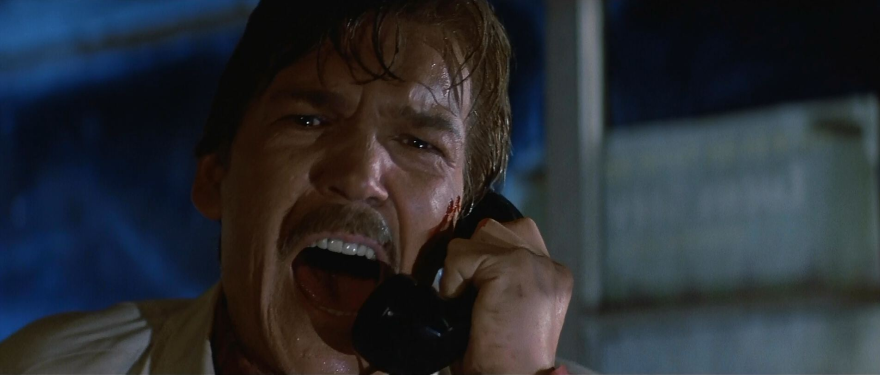
Orson Welles’ follow-up to Citizen Kane is the touching, tragic tale of an American family that rose to riches and prominence in the 19th century—only to lose it all in the wake of the burgeoning automobile industry.
Well, sort of. A funny thing happened on the way to the bijou (and there is an actual theater called “The Bijou” in this movie): War broke out. And not just any war, but World War II. More about that in a moment. (Stay tuned! for breaking World War II news!)
The second book of Booth Tarkington’s trilogy, which was awarded the Pulitzer Prize, had been filmed previously, as a 70 minute 1925 silent picture which was chopped down to 33 minutes.
Orson Welles recorded a version of this story as an hourlong radio special featuring his Mercury Players. But he wanted to give it proper cinematic treatment. The Tarkingtons were family friends, and the character of Eugene (Joseph Cotton) Welles claimed was based on his own father, also an inventor, who died when Welles was 15.
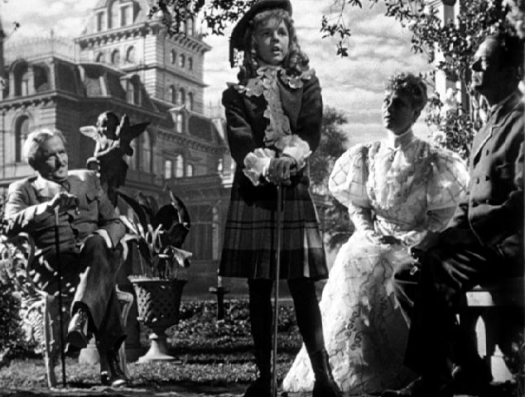
This little turd is going to get his come-uppance, and it’s not going to be fun at all.
The movie goes like this: We get an opening narration with a fashion montage. This shows Joseph Cotton going through the fashions of the years in comical form, with stovepipe hats giving way to big derbies giving way to little derbies, and culminating with the tradition of serenading, as the the young Eugene Morgan (Cotton) goes to woo Isabel Amber (Dolores Costello) and, perhaps because he’s had a bit of liquid courage, trips in her front yard, smashing his bass and fleeing in failure.
Because of this, Isabel marries Wilbur Minafer and (according to town gossip) can now be expected to spoil her children, because she doesn’t really love Wilbur like she loved Eugene.
Enter George Minafer, Isabel’s only son, who is a complete terror. After a childhood vignette, he goes off to college, and comes back more or less as awful as when he went, though at least somewhat more dignified.
When he returns, he meets Lucy Morgan, the only daughter of Eugene, a recent widower. And what is very clear is that Isabel and Eugene love each other just as they did twenty years ago. There’s no impropriety. They simply dance together as George finds himself captivated by Lucy.
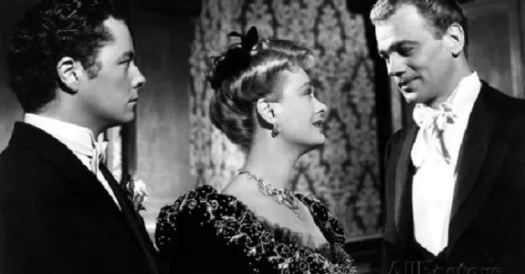
“Hey, you’re not supposed to look at not-dad like that! You’re only supposed to look at ME like that!”
The first act ends with the death of Wilbur, revealing that the family wealth is gone, and Eugene and Isabel are in love—something which is somehow scandalous in 1905 Indianapolis, and which provides the contentious bone for the tragedy which unfolds.
It’s a great movie, often considered one of the best ever made, and that’s with an hour of critical dramatic moments cut, and certain scenes re-shot to make them less dramatic and brightly lit—all done while Welles was filming a wartime propaganda documentary in Brazil which never got finished because the main subject, one “Mr. Alligator”, apparently a great fisherman and legendary swimmer, drowned as Welles was filming him. (Well, that’s one story. The other one is that Welles offered him a year’s salary to go out against his better judgment and he was swept overboard and later found in the belly of a shark.)
Wells’ passion for Tarkington’s story extended back to his radio days and, unfortunately, came to fruition right as war broke out. RKO decided to do an advance screening in Pomona (“But will it play in Pomona?”) for a bunch of teenagers who were there to see The Fleet’s In, a 90-minute frothy, forgettable screwball musical comedy featuring Dorothy Lamour, Betty Hutton, William Holden and teen heartthrob (?) Tommy Dorsey. The idea of putting a broody, 150 minute, noir-drama in front of them after this was dumb, and dumb things resulted.
People laughed and hooted and walked out and derided RKO for showing it. “People don’t want to see things like this!” Well, look, RKO’s got a bottom line and a lot of trouble, so they need to hack things up and brighten them and make them all cheery and definitely not noir and also burn all the other footage so Welles can never recreate it. (This reminds me a bit of Playtime. I get why you’d have to repossess “Tatitown” but not why you wouldn’t preserve it and rent it out to make money back as opposed to bulldozing it.)
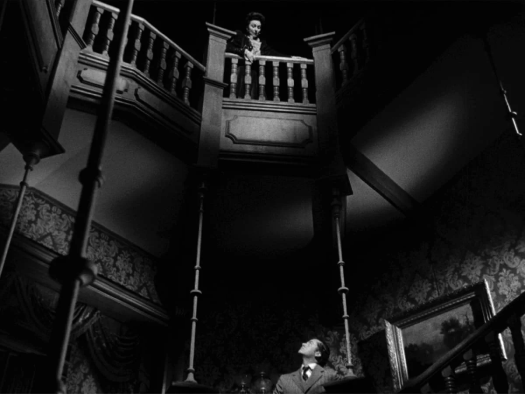
Aunt Fanny about to start some.
But, here’s the thing: Even being butchered, the elements of this film are so outstanding it towers over the average release (and not just today, which is almost too low a bar to measure, but going back decades). Like my recent re-viewing of Doctor Zhivago, the blending of technology and aesthetics makes a cineaste weep for art that will never be.
Unlike today, where the camera is compulsively swooshed around like Michael Bay’s hands during a pitch meeting, the thoughtfulness of each sequence, each shot, communicates something about the story, the characters, the characters’ inter-relationships, and so on.
Roger Corman had a rule: find legitimate, motivated excuses for moving the camera but always look for ways to move it. He said this was because you had to engage the eyeball to get the viewer engaged. Other low-budget film directors didn’t move the camera because they weren’t able to do so quickly, they didn’t have the money, or they were lazy or untalented. Setting the camera down for lengthy periods signals “no budget” or possibly “Kevin Smith”. Now, however, camera motion is like a bunch of presets that are used, rather carelessly but for much the same reason: The filmmakers want to look like they have a bigger aesthetic budget than they actually do. If you start noticing how clichéd modern movie tropes are—just in terms of the visual language—you might never enjoy another new film again.
Ambersons is Citizen Kane without the showiness and gimmickry, and in the service of a much more relatable story with great characters.
George is superficially awful, and his obsession with propriety drives much of the misery in the story, but the same attitude that causes him to expect to be treated deferentially and to prefer “being” over “doing” also makes it impossible for him to abandon his Aunt Fanny in her hour of need—literally at his own physical peril. Tim Holt plays the role that would’ve been Orson’s (but Welles was mistakenly trying to get America to recognize him as a director, not an actor—his biggest mistake, he would later claim). Perhaps Welles would’ve been better, but Holt pulls off this difficult role quite easily.
Aunt Fanny. What a character. Neurotic, sure. At times, evil, I think, though we could certainly debate the point, as she seems genuinely regretful that she inflames George to drive a wedge between Isabel and Eugene, depriving them of a happiness they longed for over decades. (She even claims she didn’t know she was doing it. That is left as an exercise for the viewer.) Fanny is played by Agnes Moorehead, who became an icon as the mother-in-law-from-Hell on “Bewitched,” and in this role—leading to her first of four Oscar nominations—she is an utter powerhouse.
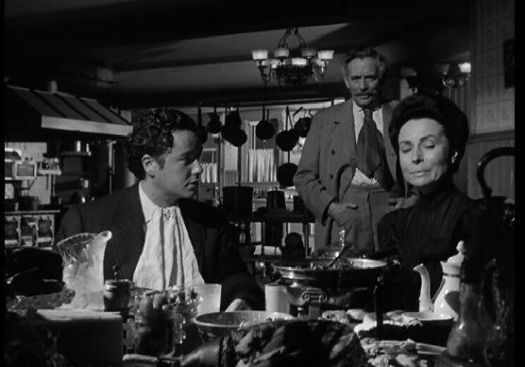
George (Tim Holt) and Uncle Jack (Ray Collins) about to take their teasing too far.
Seriously, when she’s on-screen, it’s hard to watch anything else, as she seethes with jealousy, anger, grief—all because her prettier sister-in-law has captured Eugene’s eye, and he preferred to leave town rather than live without her. (Fanny hoped and hopes, he will choose her by default.) The archetypal spinster aunt, Orson had Moorehead go through Fanny’s breakdown scene for a solid day before shooting the scene that was so intense Moorehead herself nearly had a breakdown. But when people asked her later if she felt Welles was cruel, she said she found it exhilarating, and was unable to sleep for a week after. This was the scene that was ultimately chopped up because it was too intense, per RKO chief George Schafer.
Speaking of sacrificing yourself for art, this role was one of Dolores Costello’s last, as the beautiful and charismatic Isabel, whose love for George is nearly oedipal. Costello was a silent movie actress, Lou Costello (of “Abbot and”) named himself after her, and she was the grandmother of Drew Barrymore. But the makeup used in the silent era was very caustic, and by 1942, her skin was falling apart. At 39, she manages to pull of virginal teen, besotted MILF, and sickly, broken-hearted elder woman.
Cotton, as Eugene, has what I would consider one of the easiest roles, but he does an excellent job. In particular, as one of the inventors of the automobile, he handles George’s extremely rude rant about the evil of automobiles and how they shouldn’t have been invented, by agreeing with him. He sees the potential for trouble and he may live to regret his choice to contribute. This whole section of the film is astoundingly topical.
Anne Baxter is radiant. Cotton had seen her in the stage version of “Philadelphia Story” before Hepburn kicked her out, and liked her so much he hired her to be beautiful here. But she’s also really good, because almost never quite know exactly what’s going on beneath the surface. She has to be in love with George while recognizing what a jerk she is, and she has a tremendous scene where she has to pretend to not care about him.
At 90 minutes, I genuinely thought it could be an hour longer without wearing out its welcome, but I’m not a teenager in 1942 watching as part of a double-feature with “The Fleet’s In”.
Welles’ original screenplay is still available, and Alfonse Arau attempted to shoot in 2001 with Madeline Stowe, Bruce Greenwood, John Rhys Meyers, Jennifer Tilly and Gretchen Mol. It went about as well as you’d imagine.
Not a huge hit, obviously, but RKO got a LOT of mileage out of the sets for YEARS, and the Amberson Mansion classed up a lot of cheapies like “Cat People”, and is probably most famous for being the old Granville House in “It’s A Wonderful Life”.
Welles, of course, never really recovered and spent the rest of his life chasing funds and failing to complete projects, and still managed to leave behind some of the greatest movies ever made, and some of the greatest Hollywood stories.