Return of the Living Dead

It was another good fortnight-and-a-half at ‘casa ‘gique, starting with the indie/arty/actorly Everything’s Going To Be Great, where a theater kid born into a theater family struggles with convincing people he’s heterosexual and ultimately learns he’s not the center of the universe, and ending with the taut Persian thriller Tatami, about a Persian judoku who is doing well in a competition, so the Iranian government calls up and tells her to fake an injury—because she might have to go up against an Israeli and they have to boycott Zionists and since they can’t, they have to pretend they’re not, and, my God, what a bunch of whiny-ass bitches running that country.

We bookended this with two ’90s(ish) movies, Shall we Dance? and In The Mood For Love from Japan and China respectively.

And what was between the bookends? The glorious year of 1984(ish). We started with Tsui Hark’s Shanghai Blues, went to a double-feature of Return of the Living Dead and Repo Man, then followed up with the 40(ish) anniversary of This Is Spinal Tap.

With the exception of Tap, none of these ’80s films are (generally) regarded as classics—more cult classics, than anything. Shanghai Blues strikes me as under-rated: It’s a romcom, almost a screwball comedy with a kind of kung-fu sensibility to the physical humor (think a less frenetic, less violent Jackie Chan). It, like the other three movies, has a surprisingly light, almost casual regard for things which would be ponderously heavy today. These films touch lightly on promiscuity, homelessness, pedophilia, assault, sexual assault, PTSD, dismemberment, death—in ways you really can’t anymore.

I gots things to say about all of ’em, but tonight, let’s just talk about the movie Simon Pegg called “a piss take” on the zombie genre.
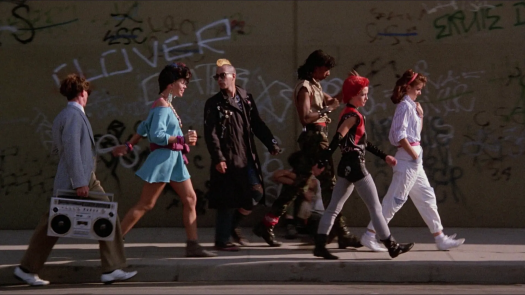
Standard first level opponents of an ’80s side-scroller fighting game.

Back From The Dead—And Ready To Party

George Romero and John Russo had different ideas about how to proceed with their unexpectedly successful flick, Night of the Living Dead. They decided to go their separate ways, distinguishing their products with “…of the Dead” (Romero) and “…of the Living Dead” (Russo). Richard P. Rubinstein (Romero’s producer on Dawn of the Dead) actually tried to get the “Living Dead” removed anyway but since Russo had co-written NotLD, the WGA sided with him.

Russo did the novelization of the ’68 movie and wrote a follow-up novel called Return of the Living Dead which served as the basis for the first screenplay. He hired Dan O’Bannon (scriptwriter of Alien, Blue Thunder, Total Recall and many more) to write and direct, and O’Bannon rejected the original script for seeming too much like a continuation of Romero’s work (the third installation of which would beat this to theaters by about a month in the summer of ’85).

So, O’Bannon created a world where Night of the Living Dead had been a documentary—an exposé of an army snafu that had resulted in zombies, and Romero had been forced to make changes to various elements to cover up the truth.

This serves as a springboard for a lot of the movie’s comedy.

And this is a funny movie.
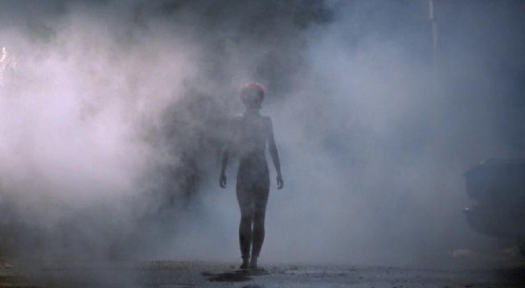
Jewel Shepard (Casey) turned down the role of Trash, alleging she’d had enough of being naked. She also alleges that the movie would’ve gotten an X if she’d done the movie since Linnea Quigley had “nothing much sexual about her”. (Quigley got her start in 1978’s softcore “Fairy Tales”, so Shepherd’s opinion was not widely shared.)

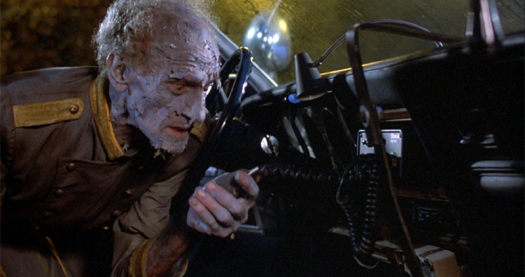
Freddie goes to his new job at the UNEEDA Medical Supply company and his supervisor Frank is there to show him the ropes—possibly the dumbest categorization system ever—and Frank gets to talking about how NotLD was a real thing and he knows this because the barrels containing trioxin—the substance that animates the dead—is down in the basement.

The barrel contains the gas and a corpse (later nicknamed “Tarman”) and wouldn’t you know it, Frank smacks the barrel confidently only to release the gas and animate all the little bits and bobs in the warehouse. Including the pinned butterflies and bisected dogs.

They call their boss Burt for help, and a number of gags ensue where they try to follow the NotLD formula, only to discover it doesn’t work. The zombies aren’t slow, they aren’t dumb, they’re just dead—and hungry.

Burt gets the idea of going next door to Resurrection Mortuary and asking Ernie if they can borrow his ovens. (Yes, Burt and Ernie.) They destroy the animated bits and pieces by burning it.

And the ash goes into the air, rain comes down and floods the nearby cemetery with trioxin.
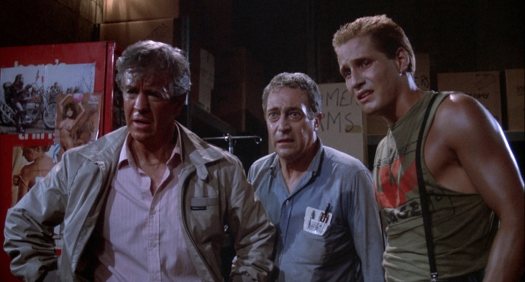
Burt (Clu Gulager), Frank (James Karen), and Freddie (Thom Mathews). Dan O’Bannon wanted Leslie Nielsen for Burt.

Stereotyping

Freddie’s friends are hanging out in the cemetery waiting for him (because apparently he always knows where the party is), and they’re a melange of ’80s stereotypes: Freddie’s girlfriend is (inexplicably) a preppy. There’s a party girl, a suit guy, a death metal guy, a slutty punk girl, and so on. They’re slight exaggerations of the types, perhaps, but in real life, they didn’t hang out together, generally.

They’re fodder, amusingly. The movie is powered by the three old guys.

Even as fodder, though, they have a more real feeling than most main characters in modern flicks. None of them like the death metal guy, Suicide, who bitches that they only call him when they need a ride. When Trash (slutty punk girl) is throwing herself at him in the cemetery, he throws her off saying “Have some respect for the dead.”

This is after expressing her sexual frustration by stripping her clothes off and dancing naked on the tombstone, in an iconic scene for Linnea Quigley.

The tone is much like that of Evil Dead 2 in that it’s very comical in parts, and very horrifying in others. There are a lot of subtle gags, too, like an eye chart that reads “Burt is a slave driver and a cheap son of a bitch who’s going bald”, or the pictures of Eva Braun and Hitler up in Ernie’s mortuary. (How did Ernie get so good at running a crematorium oven?)
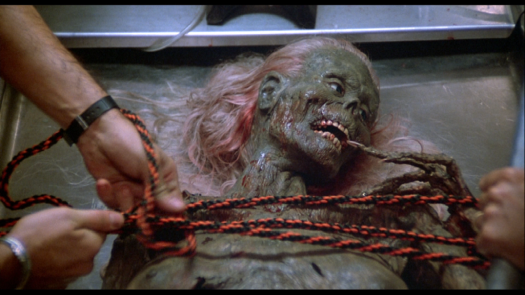
This is where we learn it hurts to be dead, and only the brains of the living helps.

Legacy and Nostalgia

RotLD is a very entertaining movie even today, but it didn’t have much of an impact. The sequel, by Ken Wiederhorn (Meatballs Part II, Shock Waves) is an odd remake of the original, with members of the original cast back in new roles. Brian Yuzna (Society, Re-Animator) directed the third installment, and it has a cult following, but it’s completely serious. Grim, even.

Zombies went back to their slow-moving unintelligent selves. I don’t think this movie actually introduced the brain-eating-zombie trope but I can’t prove it. (I also don’t think “I’m here to kick ass and chew gum” was original to Roddy Piper but I can’t prove that.) And, for the record, Messiah of Evil had running (well-dressed) undead years earlier.

So it just stands as a good, fun horror comedy.

We saw this, as mentioned, as a double-feature with Repo Man at Quentin Tarantino’s New Beverly Theater which actually uses a project to project 35mm prints in all their glories (and flaws). Lately, I’ve been overwhelmed by how much better films look than digital—like, even a trashy older film shot on film creates an effect that is largely absent from digital.

But I didn’t think showing them from a print on a projector was such a big deal. It struck me as the same pretentiousness seen in people who insist on playing vinyl records. (I’m not one of those “Nobody can hear the difference” because I wouldn’t presume. I’m more “The people who are claiming to hear the different largely aren’t.”)

Well, color me pretentious, because I felt the projection on these (low-budget, throwaway!) old movies really added something to the viewing experience—scratches and all, because there are scratches on the RotLD print.

The New Beverly also leads with contemporary trailers and ads, which made the whole experience a lot like going to the theater 40 years ago. Down to the guy in front of me in the packed theater being a foot taller and having an enormous head!

I’ve never been a big nostalgia guy but, wow, what a time machine.

Do You Wanna Party?

In sum, old movies are better. Or they may not be better but they are definitely a safer bet, when you realize how cultural filters work.

But these ’80s kids are punks and slackers. I worry for our future.
“Send more paramedics.”

Mission: Impossible 8 – The Final Reckoning

We saw a lot of good and interesting movies this past fortnight-and-a-half. Bring Her Back, a melancholy horror from the makers of Talk To The Hand, er Talk To Me, the romantic Lost In Starlight, the 25th anniversary of Dogma (about which I have much to say), the 30th anniversary of Eat Drink Man Woman, Wes Anderson’s Wesandersony The Phoenician Scheme, the French Kung-Fu Giant Penis Farce Zenithal, and the picaresque coming-of-age apocalyptic survival horror 28 Years Later.

I can recommend all of them to people who like those sorts of things.

But I shan’t review them today. Today I want to talk about changes in the movie biz, vis a vis how relates to your nearly 29-year-old correspondent. If we go back 45 years ago (there will be no math), we might find your humble moviegique didn’t just see the top 20 movies, he saw 90% of all the movies that were released.

I didn’t see them all in the theater, admittedly. I wasn’t so adamantly anti-watching-movies-on-TV back then, and it wouldn’t have been an option to see them in the theater once they’d past their second run.

In 2010, I still saw most of the top 20. By 2020, I’d seen two of the top 20. And there’s about a 1% chance I’ll see the ones I “missed”. (That’s if they become classics and start showing up in revivals in a decade, and I’m still alive and living near lots of movie theaters.)

In other words, whatever mojo Hollywood had for me, it lost it over five years ago. Yaboi Zack is on a year-plus long rant against “birthday party clowns” (as he calls them): People who gained fame and fortune by bashing popular culture and now can’t do anything else. They can’t admit when something is good.

Of course, simply redirecting my entertainment dollars to stuff I like allows me to avoid having to grouse constantly. But I do think it’s important to call out when things are good. Not because Hollywood is getting better (his thesis). It’s not, at least in any way that matters: Any industry stays centralized and powerful because of the virtuous cycle of talent attracting money creating power which attracts more talent and more money and more power. My thesis is that Hollywood’s degraded to the vicious version of the cycle: They lost talent, they lost money, they lost power, and this is accelerating.

Hollywood is Carthage. It’s Detroit. It’s Joe Biden.

That doesn’t mean it has no lucid moments, of course.

This brings me to Mission Impossible: The Final Reckoning.

Tom Cruise with long hair and bangs gives me Neal Breen vibes.

Cruise Control (I Just Made That Up!)

The decline of Hollywood is interesting. After Dogma, I pointed out to the Boy that while it has an eighth grade theology and a fair amount of clunkers and it presaged and probably created the uber-nerd model of dialogue and humorous references, it was still better than most movies today for two reasons: First, it never loses sight of its goal, which is to be entertainment. Second, it’s chock full of characters that are real and different. (And this is kind of funny, because everyone in a Kevin Smith movie talks like Kevin Smith and more or less has his point of view, and in Dogma, most of them aren’t even supposed to be mortal humans.)

Mission: Impossible – The Final Reckoning—the movie series that has to use a hyphen for its sequels, because it’s got a colon in its base name—never loses sight of its goal (entertainment), and additionally uses its history and creativity (!) to fill itself with new and past characters that are more than just plot devices or representation tokens.

All while being pretty damn “representative”.

When you order Angela Bassett on Temu.

President Angela Basset gives Ethan (Cruise, duh) this (final?) mission. Apparently he acquired the MacGuffin in the previous film (which I didn’t see) that will allow him to stop the evil, omnipotent AI that plans to wipe out humanity because (duh) it figures that’s the best way to end global strife or something. But since it ostensibly also could grant control over the evil, omnipotent AI, every government and rogue agency in the world wants it, too.

The AI isn’t much of a presence in this film—it’s basically manipulating humans, including Ethan—which is kind of a shame on the one hand, but actually one of the many good choices the movie makes. Why? Because there’s already a ton of plot here. Don’t want the plot gettin’ in the way of the story, as Joe Bob Briggs would say. (I think it’s the reverse, but that’s a semantic argument, I think.) The AI is basically represented by Esai Morales’ Gabriel, who fulfills the very important concept that The Villain Has To Be Someone You Can Punch In The Nose.

Before the AI can carry out its plan, it needs to do two things: Take control of all the world’s nuclear arsenal, which it’s about 80% of the way there when this movie starts, and hole up in a super-secret-protected bunker which has a sophisticated computer setup and all the world’s digitized knowledge. (Furry porn will survive the apocalypse! Yay?)

So the deal is that Ethan has to escape U.S. capture (or convince the President) to let him go rogue one last time, find a way to get to the AI’s source code, which is on the bottom of the ocean in highly contested waters—all the powers of the earth are on edge and aggressively patrolling their spheres—and be there in the split second when the AI has control of everything but before it can transfer itself to the bunker.

The actors on realizing they’re doing a shoot in Svalbard, where the residents fly to Iceland to get warm.


What’s It All About, Ethan?

None of this makes a lick of sense, and that’s okay.

Seriously, you could find good ways to rationalize all these things and it would still be nonsense and you just spent 15 minutes of your action movie babbling things nobody understands anyway.

The point is, we’re selling this plotline with a bunch of competing deadline clocks. How long can Ethan hold his breath? Can Benji (Simon Pegg) stay conscious long enough to walk the distaff half of the crew through writing a .BAT file? Is the latent attraction Grace (Hayley Atwell) has for Ethan required to get her killed?

There’s so much action in this movie, several sequences are just left out. An early scene, played for laughs, has Ethan thrashing baddies while Grace watches, horrified. We only see her expressions, and when Ethan reappears on screen, he’s comically disarrayed with blood all over him. They had just discussed the need to use violence as a last resort and when she looks at Cruise questioningly he just says “They threatened you!”

Which is true, but nonetheless amusing. There’s a later scene where three of the characters have to run from an exploding bomb to a shelter and…yeah, not there. This surprised me at first, but it makes sense. Nobody’s going to come out of this complaining: “Hey, how did those relatively minor characters make it?”

Pom Klementieff (Guardian of the Galaxy’s Mantis) speaks only French in this film.

The references to past entries are judicious. I know there are fanatics of this series, but I’ve seen 1, 2, 4, 5 and now 8. I may have some of those numbers wrong, even. And what’s more, I’d be temped to say my favorite (even now) is John Woo’s #2 entry, which is widely regarded as the worst. An interviewer tried to bait Cruise into trashing Woo, and of course he handled it like a pro, talking about how much he enjoyed working with the Hong Kong action master, whom I think he was responsible for bringing aboard.

Point is, it’s fine. I’m sure it’s chock full of Easter Eggs for the real fanatic. I did not feel like I’d missed out on much having missed some of the movies and only ever watching any of them precisely once.

So, the baseline for an M:I movie is to have stunts that still manage to wow the audience in an age of CGI. This movie delivers that in spades. It knows what it’s doing. The hacks of the action biz think the key is to constantly amp everything up. Ultimately, however, this just numbs the viewer. M:I 8 ends with a fight on a biplane—positively James Bond ca. 1970.

In fact, in a very early scene, Grace and Ethan are captured, and we all know how this has to go: Ethan doesn’t care what you do to him, but he’s very sensitive to the harm done to others. (Hacks say it’s hard to write for Superman, not realizing that all action heroes are Superman.) While this movie does a good job of making it seem like Ethan might die, it also imperils a lot of other interesting characters we also don’t want to see die!

The essence of action is caring. Weird but true!

Blocking? In an action flick?! Seriously, the camerawork is terrific: Not frantically moving around like they’re afraid you’ll be bored, and willing to use the visual language.

Above and Beyond

Beyond the baseline action, we have Cruise, who has turned Action Man into Acting Man, both here and in Top Gun: Maverick. We have Ving Rhames back—the only one to go all the way back to the first movie. And when Ethan, who has killed many, many men, has to reflect on whether he’s been a force for good or evil over three decades, the occasional insertion of shots from previous movies resonates without feeling like a crutch.

A minor character from the first re-appears here and is both a major plot point and a fully developed character which reinforces the point: Action Man is a force for good. There are casualties, but that’s more the roll of the dice. There’s a callback to the Jon Voight Jim Phelps from the first movie, too, but it doesn’t go the way you might expect.

This is really a kind of road picture, and when Ethan meets someone, neither he nor you knows whether that person is going to support the mission or betray it. And perhaps even more interestingly, you don’t know why. Everyone has their own backstory, and we’re not privy to it. There’s something hugely artistically validating about this overweening idea of all of us being individuals making our own choices for own reasons.

Wow. Storytelling. How does it work?

This may point to the problem with Hollywood generally: Where it began with working class adventurers and evolved into artists sincerely trying to understand and depict the human condition, now it views itself as the focus and all of us supporting players in its own “heroic” journey. I am confident Mr. Cruise understands the audience is the point, the raison d’être, of art.

I found myself impressed. It’s a good movie. It earns its two hour, fifty minute runtime, which is about the nicest thing I could say of any 170 minute film.

“I can’t keep jumping out of planes! I’m gonna be 63 in two weeks!”

P.S. For a geriatric action hero, Cruise is way more convincing than Liam Neeson and Harrison Ford were at his age.