Dr. Strangelove or: How I Learned to Stop Worrying and Love the Bomb (1964)

The Flower, who now towers over many adults, has a very particular sensibility with regard to film. Unlike The Boy, she has to be rather motivated to go to the movies, since time away from her desk means time away from whatever art she’s doing (and she’s doing a lot). She’s far more inclined to see classics than new films because, well, why risk it? Her favorite movie growing up was Gran Torino (which many thought was odd for a child) but recently, she has come to adore Silence of the Lambs. In fact, we debate as to the relative merits of Lambs versus its Best Picture Oscar-contender that year, Beauty and the Beast (which has to be the greatest match-up since Star Wars went up against—and lost to—Annie Hall).

Somewhat less probably, she has come to be something of a Stanley Kubrick fan, loving both The Shining and A Clockwork Orange: In this case, I think Kubrick’s aesthetic sense wins her over more than the particular narratives, but since our theater was having a Kubrick month, I figured I’d soon find out.

Dr. Strangelove is probably a good place to start, I figured. I actually have never “got” the hubbub about this film. I mean, I can see it raising a ruckus in 1964, but does it really hold up? I was honestly unsure whether I’d seen the whole thing, so this would be a good chance for me to revisit it (or just visit it), too.

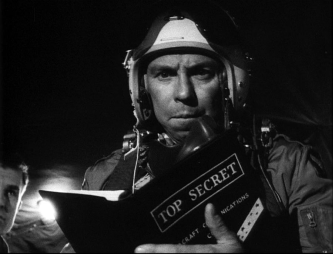
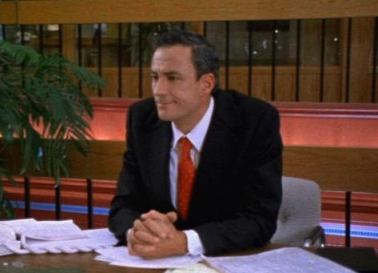
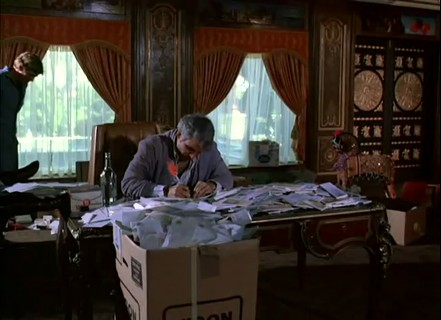
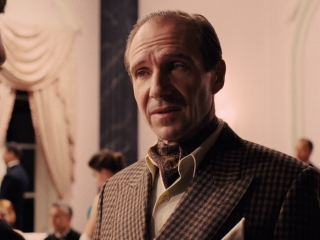
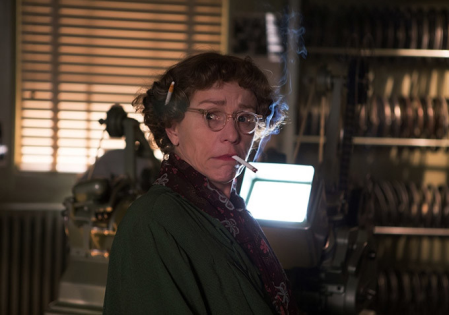
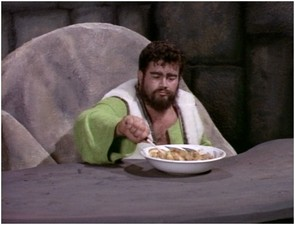
All, of course, played by Peter Sellers

President Muffley, the eponymous Dr. Strangelove, and Captain Mandrake

Welp, hadn’t seen it, except for a few iconic scenes. You know the ones.

And it is really, really good. Is it his best movie, as often listed? I don’t think so: It’s overrated in that sense. His greatest movies, I would argue, are ones where the narrative serves the aesthetic, not where the aesthetic is subordinated by the narrative. I mean, let’s face it, The Shining (1980) has virtually no narrative at all not shared by hundreds, if not thousands of not just worse but utterly forgettable films. (Guy with axe wants to chop up his family?) A Clockwork Orange (1971), for all its sci-fi dystopianism isn’t much more than an inverted revenge flick. 2001 has a story, I’m told, but nobody really knows what it is.

Never seen it.

But I think it’s foreshadowed here in this deleted scene when George C. Scott says, “My God! It’s full of pies!”

Point is, if you like Kubrick, you like his style. If you look at IMDB and compare to Rotten Tomatoes, you’ll see that they rate his movies entirely differently—except that both have this one as #1—which I think reveals that when you’re dealing with that sort of artistic excellence, it’s difficult to really say that this is better than that. And I suspect as the Boomers die off, this film will sink in prominence, somewhat.

Although, frankly, as I was watching it, and laughing, I thought about how uncomfortable I’d feel if I were watching it in 1964. Holy crap. Sidney Lumet’s Fail-Safe was released the same year—but later, at Kubrick’s insistencelawsuit, apparently—and apparently everyone laughed at it. Fail-Safe is not a funny movie; it’s a serious version of this movie.

But, again, if I were watching it in 1964, I’d have laughed, too. Because the alternative is too horrible to contemplate.

Iconic! R.I.P. Mr. Adam!

The late Ken Adam got a LOT of work in the ’60s.

Anyway, this is not a subtle film. Dr. Strangelove, played by Peter Sellers, just for obvious example. (And mustn’t he have been kept on a tight leash to work with the notoriously fastidious Kubrick?) Then there’s the guy who starts all the trouble, General Jack D. Ripper played by Sterling Hayden. And George C. Scott as the general who’s fond of young women, Buck Turgidson. Colonel Bat Guano. Major King Kong.  I mean, really.

Despite all this ham-handedness, the movie somehow works. I can’t really explain it. Maybe Kubrick’s deadly earnest camerawork pulls the whole thing out of fatuous camp and into a more elevated satire. I don’t know, but we all liked it: The Boy, The Flower and I, and (I’d like to think) Slim Pickens’ daughter, who was there in the theater with us.

Best Pickens performance? "The Howling"

As, I like to think, was Mr. Pickens, at least in spirit.

Jaws (1975)

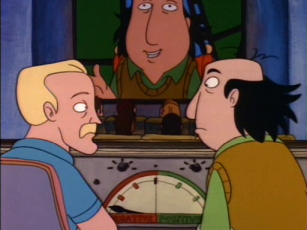
It will probably not come as a surprise to you, dear reader that I was not a fan of the summer smash blockbuster that, with Star Wars, changed movies forever. After all, I wasn’t a fan of Star Wars and I thought Raiders of the Lost Ark got too silly when Indy rode on top of the Nazi submarine as it crossed the Atlantic. And all those Spielberg-produced ’80s kid-oriented movies struck me as piles of mediocrity. This may be why I liked “The Critic” TV show so much: I am Jay Sherman.

o/~I like French films, pretentious boring French films...~\o

“I’m worse than Hitler?” “No, just less cuddly.”

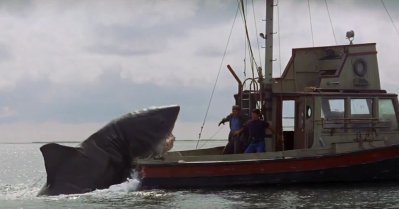
That aside, in retrospect, the reason I may not have cared for Jaws is that it was described to me as being “so scary”, like it’s a horror film. And as a horror film, it’s not really…well, it’s not a horror movie at all. It’s not really trying to scare you, except at moments in the build-up, and the scares are more roller-coaster than “spooky boo”. It never tries to build up an existential chill, there’s no sense of nihilism, the atmosphere is actually pretty bright and cheerful, where men with a purpose are off to tackle a man-eating beast.

It’s an action-adventure! And as such, it works really well. I took the kids to see it, and we all really enjoyed it.

I was actually sort of meh on seeing it but, as I pointed out, taking it for what it is, it’s really quite good. It’s also not a movie about a shark, which to reference The Shallows review, I will reiterate that most shark movies get that wrong: The idea that it’s about a shark, and therefore it’s the shark that has to be more interesting. This is why 99% of Jaws ripoffs (including its own sequels) are so bad.

Menace! No, wait, threat!

Hitchhiking sharks: Threat or Menace?

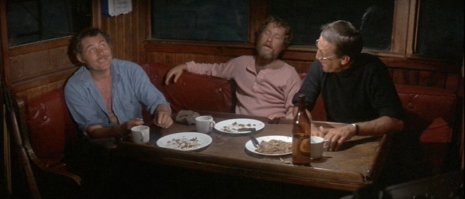
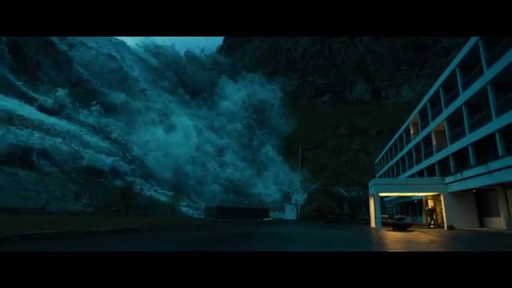
The screenplay, from novelist Peter Benchley and longtime funnyman Carl Gottlieb (the guy who gave The Jerk (1979) its shape and who plays “Meadows” in this movie) gives us a bunch of strong characters to like, or enjoy disliking. Sure, there’s Quint, Brody and Hooper, the three men after the man-eating lionshark, and Shaw, Scheider and Dreyfuss were at the top of their game. But there’s also lovable Murray Hamilton as the Vaughn, the man who launched the “sure, some people might get eaten, but what about the tourist revenue?” trope. Lorraine Gray is the patient but loving wife, hitting all the beats you can see echoed in (the not dissimilar Scandi disaster movie) The Wave (Bølgen).

What's the deal with places named "Amity"?

“Think of the T-shirt sales!”

There is just a lot of love here, and it oozes with the sincere conviction of youth (Spielberg was 29 when he made this). The movie greatly benefits, by Spielberg’s own admission (I think) from the fact that Bruce The Shark was a very unreliable robot, and in places where he would’ve used the shark, he had to excite the audience by proxy. Suggesting the shark’s size and ferocity.

As such, this movie holds up shockingly well. It is only in the final scenes that it looks its age. Bruce is not a very convincing shark, even if he is a method actor. Also, sharks don’t behave that way. But you need a big finale, and you get a big finale. (This is the same problem faced by the otherwise sensible The Shallows.)

Anyway, great fun, and a good reminder that seeing it on TV, you’re not really seeing it. We’ve been going to a lot of these “throwback” shows, and a lot of times you say “Well, that was way better than I thought it would be.” The theater gives you a chance to fully focus on the screen and a truly immersive experience.

So, check it out: But whenever possible, check it out on the Big Screen.

Even the shark's a bro.

Trigger warning: There’s a LOT of bro-ing in this flick.

Hunt for the Wilderpeople

This is probably the biggest summer surprise out of New Zealand since What We Do In The Shadows, which is not all that surprising, since it’s from the same guy, writer/director Taika Waititi (who also played Viago in the vampire “documentary”). What’s more surprising, perhaps, is that it’s a traditional movie that is far richer than the excellent Shadows.

I was jokingly referring to it as “Live Action Up“, because the main character is a fat Asian (close enough) kid in a baseball cap, but whereas Up‘s protagonist was a (literal) Boy Scout, our hero here is a ne’er-do-well, who loiters, litters, spits, and does all kinds of reprehensible things on his pathway to adult criminal hood.

But, yeah, he looks like a Maori Eric Cartman in that get up.

Sorry. I meant “big-boned”.

This, as explained by the social worker who delivers him to the farm owned by Hec (Sam Neill, Jurassic ParkThe Dish) and Bella (Rima Te Wiata, Housebound). When Ricky (Dennison) decides to run away, and to be sullen, and to cause trouble, it is the earthy Bella who wins him over, while Hec seems to have little use for him.

These are great scenes, both touching and hilarious, but the movie really kicks into high gear when Hec and Ricky find themselves in the New Zealand outback, running from the law, through a series of unfortunate misunderstandings that result in the beleaguered Hec being sought after as a pederast.

This shot could be from almost any scene in the second half of the movie.

Here, though, he’s being confronted with accusations of YouTube commentary.

This is a great, straight-up adventure film, to be sure, of the sort we don’t get much any more. On top of that, it has real emotional depth with great performances from the three principles, backed by a comical portrayal of a social-worker-turned-Tommy-Lee-Jones-in-the-Fugitive, among many others.

You can’t help but like New Zealanders while watching this. And that’s really a good thing for a film. A lot of European films (and probably most American films) are awash in varying degrees of self-loathing. I think the most American-loving films in the past 20 years (if not the past 70) are foreign films like The World’s Fastest Indian and even the Persian Jimmy Vestvood: American Hero.

And it does this while presenting addled hippies, paranoid survivalists, overzealous civil servants and what must be the equivalent of rednecks for New Zealand.

Seriously!

Loveable.

Interesting thing: Ricky carries a rifle for most of the film. This is not presented as a remarkable thing, nor is the gun cast in any sort of mystical evil shadow, as is the style in this country. He does good with it. He does bad with it. Nobody blames the gun for anything.

Anyway, The Boy and I loved it. It may rank as our favorite film of the summer. I see some rumors that Waititi may turn his attention to the next Thor movie to which I say, “Well, good for him, and I guess, good for comic book fans.” But, damn, I’d like to see him keeping on doing what he’s been doing.

Nah. You can't use a colander: The holes let the signal through!

Which is: Teaching people how to defend from government mind control rays.

The Shallows

There are now two good shark movies: Jaws and this one.

Take THAT, Bruce.

That’s right. I went there.

Jaume Collet-Serra (Run All NightNon-StopOrphanUnknown) has done what was previously attempted by dozens of others in myriad ways: They’ve tried making the sharks smarter (Deep Blue Sea), bigger (Mako), multiple headed (2-Headed Shark Attack, 3-Headed Shark Attack), crossed with pirahnas (Pirahna Sharks), crossed with octopi (the Sharktopus franchise), undead (the Ghost Shark franchise, Zombie Sharks), cyborg (Robosharks), land-borne (Avalanche Sharks, Sand Sharks, that great SNL sketch), airborne (Sky Sharks, the Sharknado series) and mall-borne (Bait 3D). They even tried making ’em black-and-white (1936’s White Death, which I think is the only real shark movie prior to Jaws). All of these focus on the sharks, of course, and it must be a reasonably profitable approach or they wouldn’t keep doing it, right?

But the thing that makes Jaws work are the men fighting the shark. We care what happens to them and, whatever their flaws, we like them and want them to survive. Well, maybe not, since many of the dozens of movies since then have clearly been rooting for the sharks.

Collet-Serra and screenwriter Anthony Jaswinski change this up by giving us a mano-a-mano, girl against fish approach: Blake Lively is a young woman unable to get over her mother’s death, and so journeys to the sort of hidden cove in a Latin American country (where, in another sort of movie, she’d be terrorized by the locals, possibly sacrificed or maybe eaten). Her mother apparently visited this site while pregnant with her, as an avid surfer, and now Nancy (our heroine’s improbable name) is going out to do the same.

I can't.

In a mismatched bikini, if you can imagine that.

It doesn’t seem like such a wild thing but Dad (Bret Cullin) doesn’t agree, especially with Nancy having dropped out of med school. Mom was a fighter, you see, if not exactly a survivor. We call this foreshadowing.

Anyway, before you can say “We’re gonna need a bigger surfboard”, Nancy finds herself in hostile shallow water with an insanely aggressive Great White. Most of this plays out like a survival picture, a la 127 Hours, with Nancy coming up with various clever possible ways out of predicament, even as she fights dehydration, hunger, injury and existential ennui. (Just kidding: There is no ennui when you’re the #1 person of interest to a shark.)

Nomnomnomnom

The existential shark: “What’s the point of clinging to that rock? How do you even know that rock is really there? Or that I am?”

The shark, of course, must behave improbably, which is the weak link in all shark movies, but this one, for the most part, doesn’t seem super-intelligent, super-powered or super-aggressive. Just enough of all those to be reasonably threatening. The ending is absurd, but I was okay with it. There were only a couple of ways it could end, and a big movie ending was probably better than a lower-key, more realistic ending.

Blake Lively plays her role convincingly: Her character is resourceful but not fearless, smart but not perfect, etc. She’s in a bikini for a lot of the proceedings, and Collet-Serra does a good job not leering, as directors sometimes do with beautiful, scantily-clad leading ladies. (I’m not against leering per se, but it can certainly undermine a movie. The survival genre has to be pretty anhedonic or it works against the dynamic of the film.)

But, this doesn’t suck, is the main thing. You got one person (basically), one shark, and a neat little gripping drama/adventure out of it, with enough horror to provide some thrills. Critics, interestingly, have aggregately rated this higher than audiences (76% to 64%), but I suspect that’s because a goodly portion of the 36% who didn’t like this film wanted a shark with more heads, or more teeth, or who were maybe Nazis or…

Holy crap. Nazi sharks. Hasn’t been done yet.

I’ll be right back. I’ve gotta go register this with the WGA!

OK, I'm going to make mine Libertarian sharks. They just want to leave you alone (after they eat you).

Dammit. Too slow. Airborne Nazi Sharks.

Finding Dory

I have to confess that before the movie started, there was a trailer that made me laugh harder than I’ve laughed in a theater for quite some time. A feral child with strange powers. Concerned adults. Mysterious monsters. And then I realized I was watching a gritty reboot of Pete’s Dragon. I didn’t stop laughing until after Finding Dory started.

Since not that many people have seen it, and many have forgotten it, the ’70s movie Pete’s Dragon was a dopey musical with Helen Reddy, Mickey Rooney, and a really poorly integrated animated dragon that was more goofy than anything. I mean, it wasn’t even slightly scary. Or exciting. Or noteworthy, for that matter. It was just the sort of sub-level “family friendly” product Disney was putting out back then. Don’t let people tell you they’re remaking a classic. It’s not: It was mostly (in the ’70s) just a sad reminder that the once cutting-edge technologically and artistically company had more-or-less given up and decided to live off the reputation of their founder.

Hardcore.

Nailed it. I swear, we’re one green light away from “The Apple Dumpling Gang” erotic thriller reboot.

This isn’t as severe a digression as it seems because if we’ve learned anything about Lasseter’s tenure as head of Disney animation, it’s that he’s done them a world of good. The last three big animated pictures, TangledFrozen and Zootopia have all shifted directions late into their production, and this has been all to their credit, as well as being the sort of thing that wouldn’t be allowed under the penny-pinching Eisner days.

But, if we’re being honest, we have to concede that Pixar has suffered. Now, maybe it would’ve anyway. Cars 2 was fundamentally backwards. And while BraveMonsters University and Inside Out are good, I’m not sure they stand, as a set, at the level of the company’s previous work, before you even factor in The Good Dinosaur. And now we have Finding Dory.

Old school, there are a bunch.

The two great modern celebrity cartoon characters: Genie and Dory.

Sequels are always dicey, but historically only for other companies. I maintain, still, that the only great movie trilogy is Toy Story. And the reason it works, and why I haven’t been afraid of Pixar doing sequels, is that they seem to wait for the right idea. They’re as far away from “Let’s get the next movie out ASAP” as you can get, with over a decade passing between Toy Story 2 and Toy Story 3. (Though, this was partly due to limitations imposed by their contract with Disney.)

Finding Dory, however, does none of the things you expect a sequel to do: Yes, the three principles are back (Marlon, Dory and Nemo) but the familiar characters are left after the first 10 minutes or so of the film, and not revisited again until the denouement. Any other company would’ve given us 20 minutes of sea turtles and seagulls and sharks—the sharks aren’t back at all in this—and all those other characters that gave us a laugh. (This is how sequels dilute their own franchise.)

'cause there are so many: Ice Age, Minions, almost every Disney sequel of the '90s...

Not that I’d name names.

Tonally, this film is entirely different, too: Nemo was measured. Mellow in parts, punctuated with terrific moments of action. This suited Marlon’s character as the neurotic who’s in constant fear by contrasting him with the scope and serenity of the (let’s face it, entirely fictional and fantastically benign) ocean.

Dory, on the other hand, is almost entirely action. It’s fast-paced, occasionally frenetic, and very claustrophobic, since it is set almost entirely at the Morro Bay Aquarium. (By the way, the Morro Bay Aquarium, as envisioned here, does not exist. There is an aquarium in Morro Bay, but it is primarily a seal rescue, generally hard up for cash, and a sort of sad affair relative to the shiny Sea World-esque Aquarium in this movie. However, such a super-duper aquarium is planned for the area, which is kind of interesting.) Besides being fast-paced, it’s also very cartoonish. Our fishy heroes sometimes seem like they’re spending more time out of the water than in it.

It's a rehab place for seals and such.

These guys look like they could be from the ACTUAL Morro Bay aquarium.

Well, that’s the other sequel dilemma, isn’t it? Do you recycle all the characters? Do you remake it in the same tone? Don’t you run the risk of feeling like you’ve cloned yourself, poorly? I mean, this is what gets Cars 2, after all: They decided to recycle the specific “Lightning McQueen won’t let ‘Mater be ‘Mater” storyline, instead of the larger “Sometimes being a self-involved jackass hurts people you love” concept.

So, yeah: Dory is different. I believe in the first movie, the whole thing about Dory’s short-term memory loss was just a gag. But they’ve developed it here into its own thing: Rather than being a member of a fish species with a short memory, Dory is (essentially) brain-injured, kind of like Leonard in Memento. They don’t put it that way, of course. She’s just different and has trouble remembering. And so she got lost and has never found her way home.

It works, basically. Andrew Stanton returns to write and direct after the disastrously marketed John Carter and he definitely reminds us that Pixar can bring out both the jokes and the feels with the facility of true artists. The star of the new movie is a grouchy, anti-social octopus played by Ed O’Neill, but there are also a couple of lovable, dysfunctional white critters (a beluga whale and a white dolphin, respectively), Dory’s parents, and so on. They are humanized in ways you’d wish live action films would bother to humanize their characters.

But of course, you know it ain't gonna work out that way.

An octopus with a scheme to be left alone.

So, we enjoyed it. We were surprised when we didn’t expect to be surprised. It wasn’t porridge, as the Boy likes to say.

But was it great? I don’t think so. Better than most of the animated films to come out this year? Yeah, probably, though not better than Zootopia, I think. Note that it may be the #1 box office movie of the year. It is currently, I mean, and it may stay that way. (There’s a new Star Wars due out at the end of the year, I think, and we all know how those freaks buy tickets like they’re putting money in the collection plate. No, I can’t really back any of this up. I just feel like poking Star Wars fans.) So, why does a movie that rates better (for both audience and critics) do $100M less at the box office (and growing)?

Because it’s a sequel to a beloved franchise.

Just keep that in mind the next time you think Hollywood’s gone nuts with the sequels, reboots and remakes: They are handsomely rewarded for doing so.

Unless it’s Ghostbusters.

Kick it when it's down, I say.

Marlin and Nemo on their way to see “Ghostbusters (2016)”.

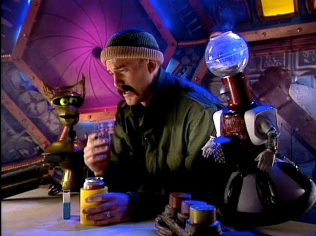
Rifftrax Presents: The Mystery Science Theater 300 Reunion

There are several ways to look at this reunion of MST3K originals (plus new guy, Jonah Ray), and all of them are pretty damn good.

First, it’s Rifftrax’s 10th Anniversary, and after 200 riffed movies, it’s just so cool these guys have carried the torch for so long. They have their own voice, their own style, and they’ve really been at the forefront of riffing since MST3K’s cancellation 15 years ago. I thought it was fitting and proper that they celebrate both their anniversary and the past in one show. They’re not just funny, they’re small businessmen negotiating a lot of tricky rights issues. That they’ve lasted this long is a minor miracle and a testament not just to their creativity but to their organization.

Ask Sinbad.

Seriously: Being funny can be easier than being a good businessman.

Second, the tag team approach was cool. We got to see Bridget and Mary Jo work together (a first for me). We got to see the Mads (Trace and Frank) again. They’ve been doing live shows for some time now, and they were brilliant. Jonah and Joel riffed together as well, and while you can tell Jonah is new, he’s not in over his head. He’s going to do well in the new show.

Wait, that's not how it works.

TBH they could’ve improved Ghostbusters by 78%.

Third, there’s a nostalgia factor, particularly in the final segments when they all riffed together. It’s not quite there like I presume it will be for the new show, because so much of the original MST3K was the sets, the props, the sketches, and so on. But it was still something to see them all on stage at once.

I kid. I hope.

Most reunion shots, you think everybody hates everybody else. Here, only a few people hate each other.

Fourth, how can you not love these guys? I’m rooting for all of them. I hope Rifftrax continues to flourish and that the new MST3K takes off. (I really do miss the robots and dumb sketches and musical numbers and all of it. It just fits in with the whole “let’s put on a show” ethos.) But I also feel like, genuinely, whatever awkwardness there may be, they’re all rooting for each other, too! For example, Frank said he was hurt he wasn’t invited to be part of the new series and that’s a perfectly understandable sentiment: But he also said that’s he rooting for it, and I believe that.  And you can find that kind of good will between them, very consistently.

Fifth, how is it as a riff-fest? It’s really damn good! Short subjects are often The Boy’s favorite parts of the show, and this was back-to-back shorts that are hilarious in the way that only finely aged infomercials can be, whether about traffic safety or the latest in appliances. Everyone got to be in the spotlight and everyone used the spotlight well.

Anyway, it was darn good stuff just for what it was, never mind all the additional layers. And remember: Corn is grass!

And again.

Thanks for teaching us how to laugh…and love…again.

My Love, Don’t Cross That River

If you’ve read any of my takes on French films, you’re familiar with that point where I describe something that happens and say, “I know, so French, right?” Because there’s always that moment when there’s a scene—typically a sex scene—that you just wouldn’t see in an American film (or films of most other nationalities). Korean films often have that moment, too, but it’s not from any particular event. It’s just when awareness dawns that you’re seeing something not quite like you’d see from another nationality.

And so graphic.

The sex scene in THIS movie was a real shock.

My Love, Don’t Cross That River is a Korean documentary, and I had that moment somewhere in the first act, when I realized there wasn’t going to be any narrator, nor any interviewer per se. This evokes so strongly to me movies like Kim Ki Duk’s Spring Summer Winter Fall and Spring, and 9-Iron, and even sections of The Wailing and various version of The Housemaid, that I just had that “This is so Korean” moment. (I probably don’t have enough knowledge of Korean films to make that call, though.)

This is the story of an elderly nonagenarian couple who have been together for over 75 years, but not really their whole story, just the last few months of it. Because it’s also a story of the 98-year-old husband dying. (And sort of weirdly, with the doctors saying they have medicine for his cough, but it won’t help him because he’s old. Maybe that’s a real thing, but it smacks of socialized medicine rationing to me.) We get their past life through the ripples, like occasional reminiscences and their children (who are full of the angst of middle age) and, for example, a very touching segment about buying clothes for the children who didn’t make it.

And do you want to live forever?

Do you want to build a snowman?

While clearly this edited for a particular effect, and with some very effective music that kind of sneaks up on you, it still has a very clean overall feel. I always feel dumb writing about a movie that itself has very little dialog, so let’s get right to the scale:

1. Subject matter. Is it important? I don’t know if “important” is the right word. Like a lot of great documentaries, it’s supremely personal but in such a way that it reflects on humanity generally. The last moments before death-do-us-part, especially after such a long relationship, have a kind of significance our little motions in life do not, and it’s kind of an illustration of that.

2. Style. Professional, but very spare, in that Korean way I was mentioning. We don’t leave the here and now. That means you really have to be interested in these people, and for their general humanity and the sort of interest one has for someone who’s lived nearly a century.

3. Bias. Bias is the wrong way to look at this, though I noticed that some of the few critics who didn’t like it looked at it exactly that way. They objected to the presence of the documentarian, or accused him of romanticizing or sentimentalizing his subjects. I didn’t see it that way. It is kind of a celebration of marriage and staying together, but only if you want to take it that way. There’s a lot of history between these two people and we barely see it at all, and it probably wasn’t all good. So, the bias then, is in not showing that, I guess.

I watched with much the same enchantment I did as Spring, Summer, Winter, Fall…and Spring: It is what it is, in that most Buddhist sense of things. Any evaluation you put on it has an effect of changing what it is, and it’s something that should be taken exactly as is. Those people did those things and acted in those ways. And that is all.

The Boy liked it but was not enamored of the Korean-ness I’ve been talking about.

Spouses, am I right?

Literally crossing the river exactly like I asked you NOT to.

Septembers of Shiraz

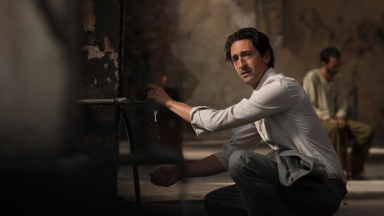
I predicted, when I first saw the trailer for the new Salma Hayek/Adrien Brody film that the Rotten Tomatoes score would be low with few reviews, and sure enough, only ten critics bothered to review the film and it has a very low (30%) critical score. How did I know? Septembers of Shiraz is the story of a successful Jewish family that has to flee the Iranian Revolution in 1979, and who suffers at the hands of the Iranian Revolutionary Guard much in the way that the Jews suffered in pre-Holocaust Germany, and the current narrative requires a serious downplaying of the similarities between Muslim regimes and the Nazis. In order to erase the “never” from “never again”, we have to first erase the “never” from “never forget”.

COINCIDENCE!

The Aryans—I mean, Iranians!—have never even heard of Hitler!

Isaac (Brody) is a successful gem cutter in Tehran with a nice business, who’s watching the revolution unfold onscreen with trepidation. His wife Farnez (Hayek) would rather he ignore all this TV news stuff, right up until his business is sacked by his faithless employees, and he is sent to a torture prison.

The cant these “revolutionaries” use had a canny resemblance to that from Che Guevara’s pals in Andy Garcia’s criminally neglected The Lost City which is not surprising, really, since this is part and parcel of the propaganda the Soviets used to destroy Western Civilization. It’s identical to the cant of the various identity groups active in the news today: They steal Isaac’s stuff for “justice”. They’re sure he was in league with the corrupt regime of the Shah. They try to wring a confession out of him, but there isn’t one to be had.

As with all these sorts of revolutions (and almost all revolutions), revenge is the biggest purpose of the thugs that ride around doing violence in the name of the new regime. Having identified success in the old regime as proof of criminality, the rebels define the failures of their own lives as the result of unidentified oppression caused by the hated groups.

Water is for believers of the prophet Mohammed.

Like The Jews who drink all their water!

The contrast in the success of this propaganda is seen in Habibeh (the great Shoreh Aghdashloo, Stoning of Soraya M. and who gets to be head of the Federation in the upcoming Star Trek Beyond) and her son Muezzin (relative newcomer Ben Youcef, who does a fine job here). Habibeh has taken to heart some of the messages of the revolution: Why should some people have so much and others have so little? Never mind that Isaac and Farnez didn’t start out rich. Never mind that they rescued Habibeh and Muezzin from the streets. Never mind that Muezzin’s the exact sort of loser that revolutionaries target, and the exact sort of loser who would use the strife as an excuse to steal from his benefactor. Never mind that he would go so far as to try to find a way to absolutely destroy Isaac.

But Habibeh is his mother, and she can be forgiven for thinking better of him than he deserves. And Farnez is haughty. Perhaps more importantly, and relevant to today, Farnez lives in a bubble where she is protected from certain strains of thought, and they’re so outrageous and obviously wrong that she tends to laugh at them when Farnez expresses them. This obviously doesn’t help her case much. But Habibeh comes to see her son more clearly as he expects to be able to use his newfound fundamentalism to order her around. By that time, of course, it’s too late. And this is arguably allegorical for all of Iran.

Still looks great.

Salma Hayek: Puttin’ the “hot” in “haughty”.

Tremendous performances all around, naturally. Brody won an Oscar for his breakout role as a persecuted Jew in The Pianist, and ten years has, if anything, enriched his ability to excite the sympathies. And while we’ve seen Hayek be proud before—something she’s excelled at over the years—there is a moment in this film where she realizes her own culpability for her situation (talking to Habibeh) which is excellent. And so on. On the basis of the acting alone, this is a good movie. (And I haven’t even mentioned all the players, like the torturer, who was chillingly brilliant.)

But the story is solid as well: It’s a classic tale of injustice and wrongful persecution, such as audiences love, except when Muslims are the bad guys and Jews are the victims, apparently. The ending has some solid moments of suspense, although I felt that perhaps director Wayne Blair (The Sapphires, on the strength of which we saw this film) and first-time screenwriter Hannah Weg  may have been trying to avoid sensationalism by being less cinematic than the actual events warranted and that Dalia Sofer’s novel describes.

Nonetheless, while not the masterpiece that producer Hayek’s last overlooked film was (Kahlil Gibran’s The Prophet), it’s still a fine piece of moviemaking. And all the carping from Muslims who don’t want to acknowledge that the Revolution purged non-Muslims from Iran, and all the Leftists who think the movie is a Jewish plot to incite the USA into war against Iran can’t change that.

Baghead redux.

Meanwhile, the head of the Iranian Revolutionary Hospitality Board wonders why tourism is down.

Eye In the Sky

I had to drag The Boy to see this on the last day it was playing. He had seen a review snippet—I think played up by the movie people itself—from the New York Times where it said the movie raised important questions about drone warfare. Well, The Boy doesn’t cotton to that sort of thing, so he was worried he would hate it. As it turns out, the movie raises, literally, no new questions about warfare whatsoever. The simple premise here is the classic one: How many innocents is it okay to kill in the service of taking out an important target? In this case, the situation is very much more black-and-white: American and British military have located a terrorist in a house and, thanks to drones, they can directly see two splodey-dopes putting on their C4-filled vests.

Straight to Hell, probably.

“Hang on. Let’s see where this is going.”

Jackpot, right? They take out this house, they save lots of lives in the immediate future, to say nothing of the further mischief their primary targets (the ones arming the splodey-dopes, obviously) will almost certainly cause.

Here’s the catch, though: Just outside the house, a little girl is selling bread. And she will almost certainly die if they hit the house.

I mean, that outfit is HORRIBLE.

Pictured: Victim of Western Aggression.

So, yeah, nothing new here. The question goes up and down the chain of command over and over as, naturally, the political types are more concerned about the optics of a dead child than the actuality of lots of dead people. The exception being the American Secretary of State who’s all “Why are you bothering me with this crap? Blow ’em up!” I’m afraid that’s more a stereotype than reality in the John Kerry era, though it’s clearly meant derogatorily.

It’s a very good movie, though. The Boy concurred, though he said he was pulling his hair out at all the vacillating. He particularly found the drone operators despicable. His point being that they joined the military, and when they joined the military, that constituted an agreement to kill people (even if it made them uncomfortable). There’s not a lot of moral ambiguity here: It’s a cinch a lot more innocent people will die, including children, but it does require a level of responsibility that I suspect isn’t easy to adopt. At the same time, you really accepted that responsibility when you signed up, right?

R.I.P. :-(

“I only signed up because I thought I’d get to meet Alan Rickman!”

Great to see the late Alan Rickman, as always. Helen Mirren’s still a fine actress. Overall, the acting is quite good, if a little over-sensitive. If you really wanted to raise issues regarding drone warfare, you’d make the soldiers indifferent to the killing. I mean, that’s the argument, right? That people are too detached from the killing, so they do it casually? This actually reveals the opposite: You’re close to your target and you’re not in a firefight, and it begins to feel a lot like murder under those circumstances.

Directed by Gavin Hood (Ender’s GameTsotsi) and written by Guy Hibbert, it’s pretty much an hour-and-a-half of suspense and tension, to say nothing of frustration. The Boy was glad we went to see it, after all.

Just like Rickman!

She looks fierce, but underneath you know she’s rockin’ the lingerie.

The Music of Strangers: Yo-Yo Ma and the Silk Road Ensemble

The Flower recently discovered “cultural appropriation” with an (shall we say) appropriate level of outrage. Quoth the Flower, “It’s so stupid!” OK, maybe not the most articulate of responses, but when she calms down, she points out that all cultures steal from other cultures. Which is undeniably true and, until relatively recently, uncontroversial. So, it was nice to see this movie about the Silk Road Ensemble, Yo-Yo Ma’s group of great world musicians that go around playing a mixture of Western music and the music of other cultures on a mixture of instruments.

He's had their food, but apparently they have a WHOLE COUNTRY!

Here, Ma visits the mysterious country of “Cheye-Na”.

It didn’t grab The Boy; he’s not, as I’ve observed before, particularly musical (somehow). He said it wasn’t bad but since he doesn’t really relate to music all that well, he had a hard time staying focused. Of course, I loved it. It encapsulates, to me, all the greatest things about music. One of the recurring pieces throughout is Bach’s Suite Number 1 for Cello in G-major, which Ma is famous for playing, and which is played in various forms throughout, from solo cello, to accompanied, to (at the end) a backdrop to an old man playing a Chinese melody over it on the flute.

You can (and should if you like music) check out Silk Road Ensemble on YouTube. They do everything from Persian traditionals to modern Argentinian art music. That latter video features Cristina Pato, a Galician bagpiper/pop star (in Galicia before she got bored of that life) who brings a lot of energy to the proceedings and keeps things grounded. (Any music that involves someone whoopin’ and hollerin’ can’t be too stuffy.) Actually, it’s chock full of great musicians playing exotic (to our ears) instruments, but Pato stood out for me because I had totally forgotten that the Galician gaita (bagpipes) was a thing.

The Scottish dress up some of their more fetching girls as if they were bagpipers, but I never saw one play.

This guy’s not even in the band. He just picked up whatever and started following the hot chick.

Anyway, not a lot of dialogue here. It’s mostly about the music, and the narrative (such as it is) is Yo-Yo Ma’s journey from “a guy who’s always played classical music because that’s just what he did” to “a guy who has rediscovered the joy of music by breaking out of the mold and playing all kinds of things with all kinds of people, and who can now appreciate the music of his youth.”

Kind of a cool thing. On the three point scale:

  1. Subject matter: Well, it’s music, which isn’t as universal as musicians like to think, but pretty important to those of us who dig it. It’s also Yo-Yo Ma’s story, as mentioned, but lightly. You don’t want to go for a biography if you’re not into (and open to) music.
  2. Execution:  Well done. Again, music heavy. But there are some nice visuals to go along with the music.
  3. Bias: Well, not a lot of time is spent on “cultural appropriation”. I tend to think that’s a good thing. The very name “Silk Road” should conjure up enough of a rebuttal for those who insist on arguing the point.

Good fun. Worth checking out.

They're handy that way.

Here, they take a break before finishing the garage.

The Witness

I sometimes ask myself, “Why is the New York Times allowed to exist?” And I don’t mean: “Why doesn’t the government ban the paper?” because that’s not how I roll. But why is it that this roiling cesspool of lies continues to be supported after decades of outright lies, propaganda and just plain bad reporting. This is the paper that gave us Walter Duranty, for crying out loud. This is the paper that constantly warns of the dire threat of weather, whether warming or cooling, as this great roundup from American Thinker shows. (Notice how many other “respectable” journalistic institutions get in on the act that also still exist.)

So many to choose from!

Another great false headline from the Times.

It was a “fact” of the world that I grew up in that Americans were apathetic, unhelpful and cowardly, and this concept was constantly reinforced with the story of Kitty Genovese, a woman who was raped and murdered in front of 38 eyewitnesses, all of whom did nothing as she died alone in the street. This story was as well-known as it was bullshit, a fact baldly confessed to in the new documentary The Witness, by Ms. Genovese’s younger brother, who himself believed the story (and who changed his life as a result). Somebody asked me “What’s in it for them? Why lie about this?” Because they got to dictate the narrative for decades about how horrible Americans were, and that is the mission. (Americans/freedom/capitalism bad, Russians/authority/communism good.)

We are treated to an interview with the mastermind behind the scheme, who proudly confesses to the lie because it changed the world. (In case you were wondering why journalists lie all the time; they see it as their job.) We get to see Mike Wallace, who made hay on Genovese’s corpse, with his stupid, silly grin, saying “Well, it was the Times! Of course no one checked up on it!” Social science dissertations were written with this story as its centerpiece. It’s a journalist’s dream come true.

The Times should die.

Victimized twice, really.

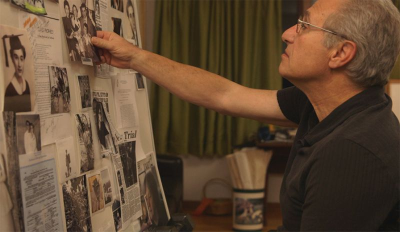
The project seems to have begun 10 years ago, and details the efforts of William Genovese to find out the truth of what happened to his beloved sister. The impetus for the story came from, ironically, the New York Times which essentially rebutted its own story 35 years after the fact. And in this film, he quickly debunks the story by interviewing all the people in the neighborhood who are still living, most of whom (at best) heard a scream and saw nothing. (But who were so disgusted they never tried to correct the record. After all, when it’s the media lying about you, where do you go? Especially in 1964!) And so an entire community is libeled.

He doesn’t connect these dots, but at least two witnesses called the cops, even though the cops had no record of this. I think it’s pretty clear that the police either decided “those people” (Italians, I guess?) were just “doing them”, or that the police sent to investigate blew it off. Either way, at least one person who called was told they were on their way. They never arrived.

Where's the string?

He does connect a lot of dots, though.

If that were all this was about, it would be a passable documentary but, in fact, this is just the beginning of the film. The rest of the film is about William, Kitty and (to a lesser extent) the murderer. This raises the proceedings to much higher levels. First we see William, who signed up for Vietnam because he wasn’t going to be like those bystanders who watched his sister get murdered, come to grips with how that affected his life. Then we see him discovering his sister, whom he only knew by the limited way she presented herself to her family. He interviews old friends and lovers and comes away with a different picture than he started with.

Finally, he tries to get an interview with her murderer. This request is rejected. The murderer feels exploited, and that if not for all the press, he’d have gotten out by now, apparently overlooking his escape a few years after his capture where he raped and killed another woman and took hostages. Instead, we get an interview with his son, who is now a preacher. He also was greatly affected by the events of that night, and he’s completely nuts about the subject. He’s been carrying around this notion that these Genoveses were related to the Genovese crime family, and Kitty was, essentially, a hit. He’s completely agnostic to his father’s other numerous crimes and variety of conflicting confessions/alibis/narratives.

It’s a fairly morose and somewhat morbid topic, but first-time director James Solomon keeps the proceedings tight and personal, without being lurid.

On the three-point scale:

  1. Subject matter: Obviously important. Like I said, this was the narrative that permeated life in the ’70s. That it was all a lie matters. A lot. Also, the examination of how crimes can affect people long after the spotlight turns off also matters a lot.
  2. Presentation: Good. The camera stays with William most of the time as it is, in a very real way, his story. He did the hard work of tracking people down 40-50 years later.
  3. Bias: It was more neutral than I would’ve been, at least at the macro level. On the micro level, we naturally grow to sympathize with William, but this isn’t really a story with “two sides”. A murder was committed, people were affected.

We had to travel to Santa Monica to see it late at night and we had no regrets.

Seriously. The Times. Make it go away.

An actual witness. Or perhaps “witness”.


Miracles from Heaven

Miracles from Heaven answers one of the most important questions of our time: How little Jesus has to be in a movie for film critics to hate it? And the answer is: Very, very little indeed.

Barely exaggerating.

“Those fence posts form a cross! That’s too religious!”

With a 40-point split on Rotten Tomatoes between critics and audiences (44/83), critics hated this movie more (relatively) than Heaven Is For Real, and yet of all the Christian-themed movies we’ve seen recently (including God’s Not Dead and Risen but not Machine Gun Preacher, which I still maintain is a genuine classic) this is both the least Jesus-y and the most successful dramatically. Like, God’s Not Dead has the form of a series of parables which are, yes, rather ham-handed, but also not meant to be taken literally. Risen has third act problems, as noted in that review. And Heaven is for Real goes wayward in the middle of the second act.

But here’s a movie that has a classic story arc, beautifully staged and masterfully acted, which builds to its third act resolution in a compelling way (despite one knowing, pretty much, how it must end) and the criticisms are the same: ham-handed, preaching to the choir, etc. It’s almost like they’re not actually watching these things.

See...didn't watch it...is what I'm saying.

I got suspicious when one critic wrote “I normally love James Garner, but he’s just not convincing as a mother of three.”

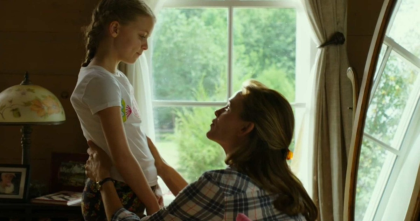
The story is simple enough: Religious family from Texas, successful but over-extended credit-wise as the father opens a giant new veterinary clinic, find themselves in an existential crisis when one of their three daughters presents with a rare and ultimately fatal digestive disorder. The movie primarily focuses on the mother (Jennifer Garner) as she struggles to find a cure for her daughter, draining the family’s resources, and her well of faith.

She’s driven from her church by a small coterie of “well meaning” people who take the (sorta) Jehovah’s Witness line that, if something is wrong, it must be because somebody sinned (like the parents or even the little girl), though she’s ultimately wrestling with that timeless (adolescent) question: Why does God allow bad things to happen?

If I were to describe this movie, I’d almost say it was a “road trip” movie, except that the road is a spiritual one. As Christy (Garner) flies from back and forth from Texas to Boston (where the best doctor is), she’s constantly meeting people who add a little something to the journey. These moments are effectively edited into a montage at the end of the film that says “God works mostly through the actions of all of us, not miracles.”

The Trumps of the Sea, they're called.

Even Beluga Whales, and those guys are jerks.

Yes, there’s a miraculous cure. There’s conversion of an unbeliever. There are a couple of scenes in a church, although one is an example of the worst sort of busybodying that goes on in a church. The sick little girl mentions Jesus as a source of strength, and gives a crucifix to another sick little girl whose parents are not believers. And the miraculous cure, per the girl herself, comes through a vision of heaven similar to what we saw in Heaven is for Real.

The movie gives you an out if you don’t choose to believe it, even. But as I noted in Heaven is for Real, we can’t really talk about these things rationally. Critics react to a crucifix in much the same way vampires do. (Things that make you go “Hmmmm.”) But to get hung up on those things rather than come away with the idea that when we listen to God (or, if you prefer, our consciences, our inner voices, or whatever), we tend to do the right thing—even when it’s not easy, it puts us at jeopardy, and even when nobody in the world would call us on it—and that results in the best sort of miracles.

Eh. Not my best gag.

A film critic attending the premiere of this movie.

Of all the four Jesus-themed movies we’ve seen, this was both the best and the least objectionable, unless you’re allergic to crosses. I had to double-check with The Boy, because the movie is chock-full of really accurate interactions with a nigh-useless medical community with which I am quite familiar and tend to be moved by, and he gave it his most enthusiastic thumbs up as well, particularly singling out Eugenio Derbez (who is playing, I kid you not, Speedy Gonzales in an upcoming film) as the doctor who cares but realizes when things are out of his hands.

It was also amusing to see John Carroll Lynch as a preacher since we had just seen him in a decidedly different role in The Invitation.

Check it out, folks.

I love a happy ending.

The actual Beam family. Isn’t that cool?

The Fallen Idol

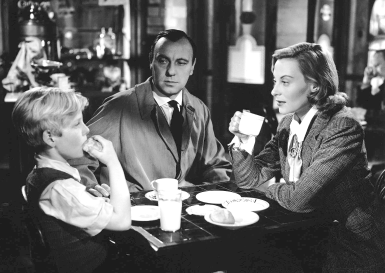
In the year prior to filming his magnum opus The Third Man, director Carol Reed took on an interesting little tale of a boy, the son of the French Ambassador in London, who has a sort of hero-worship relationship with the embassy’s English butler, Baines (Ralph Richardson Doctor Zhivago, Time Bandits). The boy, Phillipe (Bobby Henrey, who had only one other role, and just turned 77) is pretty lonely and bored in the embassy with his mother being quite ill for an extended period and his father being away most of the time. Baine’s wife (stage actress Sonia Dresdel, Sorry, Wrong Number) is the worst sort of termagant, prickly to her husband and downright mean to Phillipe.

But what she does to the snake!!

See, I’m so classy I say “termagant” instead of “bitch”.

The movie begins as we learn that Phillipe’s mother is heading home soon, but the embassy is going to be mostly closed for a while: Just he and the Baines and a small support crew are manning the place. The antics between Baines and Phillipe are amusing, and practically set up the film as a family film, until Phillipe (who wanders around in London alone a lot, as small children do in the ’40s) stumbles across Baines in a café, where the butler is having an emotional breakup with his “niece”.

And French!

“Yes, Philippe, nieces ARE hot!”

The theme of the movie is “secrets”.

Well, despite being sworn to secrecy, Phillipe ends up accidentally spilling the beans to Mrs. Baines, who then swears him to another secret (not to tell that she knows), and a plot to humiliate her husband ends up with a dead Mrs. Baines. And suddenly, the movie shifts from cheerful to full-on noir, as Baines is (naturally) suspected of his wife’s murder. It’s a classic noir set of twists: The police, perfectly willing to ascribe her death an accident, stumble across a piece of very incriminating evidence. Phillipe, confused by the numerous secrets he must keep, ends up implicating Baines rather than helping him, as he wants to. (Phillipe is convinced, through Baines idle tall tale telling, that Baines has killed before.)

Not just the tone of the movie changes: The last half is full of long shadows and stark contrasts, like they flipped the “noir” switch and everything changed. There are shots very reminiscent of the (yet to be filmed) Third Man. Ultimately, it has that sort of quirky murder mystery feel, where things are serious right up until they aren’t any more (like with Dial M for Murder or numerous other films of the era where whimsy and murder live side-by-side).

It's on like Orson Welles on frozen peas.

When they start breaking out the dutch angles, it’s on!

Graham Greene (writer of The Third Man) wrote the screenplay based on his own short story.

Amusing bit early on: Baines is telling Phillipe of confronting black tribesmen on one of his African adventures. I forget what term he uses but it’s not the preferred nomenclature today. But when Phillipe asks him why he came back, Baines said tells him it was time to get married. And when Phillipe asks him whether they have women in Africa, Baines says yes, but points out that they’re all the wrong color. Philippe doesn’t comprehend.

It’s a cute exchange, interpretable in a number of ways perfectly acceptable to our exquisite modern sensibilities, but I couldn’t help but wonder if that exchange was partly why I’d never even heard of this great movie. Maybe not. It’s terribly English through-and-through, so perhaps it’s never been well-regarded on this side of the pond. But it’s a must see for fans of The Third Man.

Really! You could do that in 1947!

Also, the seen with the hooker at the police station was cute.

Cash Only

In a desperate moment, a sleazy Albanian landlord crosses the mob and ends up in a mad scramble to beg, borrow, steal or grift thousands of dollars to save the life of his kidnapped daughter. And it all plays out on the mean streets of post-apocalyptic Detroit. Well, it’s not really post-apocalyptic, it’s just Detroit. But just like filmmakers in the ’70s epitomized New York City and Los Angeles as unbroken seas of pornography and sleaze, they can’t resist portraying the ruins of Detroit.

It's practically "Miracle on 34th Street", relatively speaking.

One of the less gritty moments in “Cash Only”.

Writer/star Nickola Shreli, a second-generation Detroit native himself, plays Elvis Martini. When our story opens Elvis is setting his apartment building on fire for the insurance money, not realizing his wife is in it. Flash forward a couple of years, and Elvis is now a single-dad grappling with his guilt and barely hanging on to his (new) building, populated with a motley assortment of people voted Most Likely Not To Pay The Rent. (He also seems to have a house nearby that he rents out to a prolific pot farmer.)

The problems of the landlord are many, and Elvis’ problems are multiplied on top of that. The pot grower uses a lot of electricity, but is unsympathetic to the cost to Elvis, for example. Meanwhile, Elvis is collecting sex as the rent for another unit: The one occupied by his cousin and his cousin’s hot wife. (I was never actually clear on whether the cousin knew this was going on or not.) Another tenant, a non-Albanian woman is gaming the system to stay as long as she can without paying any rent.

Family.

It’s not a great situation, no matter how hot she is.

The last proves to be the biggest problem as Elvis gets into her apartment while she’s gone, boxes up her stuff and kicks her out. He also takes a bundle of money he finds as back rent, never considering the possibility that the money doesn’t really belong to the tenant, but to, say, the tenant’s pimp or (hypothetically) the Albanian mob.

The good work done here is manifold: Shreli and director Malik Bader give us a (highly) flawed but not entirely unsympathetic character. Elvis is far from admirable. He is short-sighted, greedy, violent and god-forsaken. (One of his creditors is the nearby parochial school.) But he’s also tough, resourceful and has a good (if blackened) heart. Elvis’ hard life makes for compelling viewing, even on the shoestring budget. And the climax of the movie is gripping and harrowing, moreso than many other (far more expensive) films. The denouement is sort of phoned in, in a way that reminds me of Roger Corman’s old maxim “monster’s dead, movie’s over. Elvis makes such a mess out of his world, we needed to see the after-effects.

Still, it was darn good, if you’re in the mood for gritty Balkan fun.

Just look at that floor! Covered with grit!

Did I mention it was “gritty”?

The Invitation

We always keep a sharp eye out for the horror movies that actually get positive reviews, because they are rather few and far between. There is a lot of merit even in (some) of the badly reviewed ones, simply because if a horror movie succeeds, it often does so by shock, by making people uncomfortable, and by showing people things they don’t want to see. The latter is particularly problematic given that we’re talking about movies. And, ratings-wise, a movie that doesn’t so much try to shock with gore or continuous streams of violence, is often met with disinterest at the box office.

He looks laid back, doesn't he?

This movie features uncomfortable levels of facial hair, for instance.

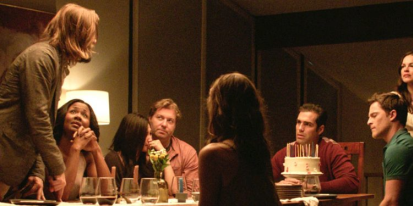
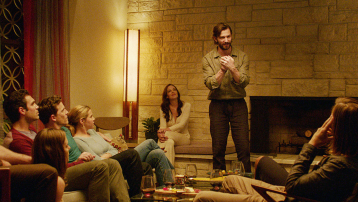
And this is the case with this overlooked film by Karyn Kusama (Aeon Flux, Jennifer’s Body), The Invitation, which is the story of a man, Will, invited to a party with all his old pals, whom he hasn’t seen in two years. The kicker is that the party is at the house where he used to live, and the invitation comes from his ex, Eden, who is living there with a new man. Will and Eden had a son, it seems, who died, and the resultant stress broke the two up.

But Eden ran off to parts south and found inner-peace through the teachings of some guru and now wants to reunite with her coterie, which is an almost stereotypically diverse (but not inaccurate) group of Southern Californians. (I mean, you gotcher black, yer asians, yer gay couple, etc.) Will, lacking enlightenment, is still haunted by memories of his son, and he’s frankly none too sure about this new cult Eden has joined. Besides she and her new man, they’ve also brought back the oddly menacing Pruitt (John Carroll Lynch, Fargo, Miracles From Heaven, and one of only three actors I recognized in this) and the seemingly unbalanced Sadie. As the evening wears on, Will becomes increasingly paranoid about Eden and her new pals. And there, in fact, is your movie.

It’s kind of funny: Back in the old days, people were constrained in their behavior by rather exacting rules about, for example, when you could talk to a stranger, whom you could talk to (especially regarding the sexes), and so on. But here, we see that we’re no less constrained, as Will’s growing discomfort about the nature and practices of this cult is something he isn’t really allowed to express. Challenging another’s beliefs, no matter how outré, is Just Not Done in Southern California.

A mortal sin.

“That cake was NOT gluten-free!”

Kusama has cited Rosemary’s Baby as an influence and it really shows here, positively. I knew, of course, that the movie had to end with something really terrible happening, but there are enough head fakes here that you’re not really sure who is going to be the culprit. Are the alarms in Will’s head the product of grief and rage over the loss of his wife and child that could push him over the edge—or is there something sinister (rather than merely kooky) going on?

It’s the sort of movie that couldn’t come out of the ’50s because of course the kooks were sinister (back then).

Faux Pas: Inviting 16 of the same people to your party.

Now, EVERYBODY looks like a kook.

Professional acting all around, from people (as I’ve said) who all looked vaguely familiar but whom I didn’t actually recognize. (TV actors mostly, I think.) Apart from Lynch, I also recognized Toby Huss as the cult leader, which is about as amusing as Norm Gunderson being a source of menace, since I know Huss mostly from his terrific mugging in Bedazzled and his voice work as Kahn and Cotton on “King of the Hill”. Huss was also a major serious character on the too-soon-canceled “Carnivalé”, but like Lynch and a lot of great character actors, it’s the character that sticks in your mind rather than the actor. I couldn’t pin down Mike Doyle (though he had a big role in Jersey Boys) but, as I said, everyone looked sorta familiar—which works really well for this kind of film.

We all liked it quite a bit. I especially appreciated the stinger, as that’s usually as poorly done as it is mandated, if you know what I mean. (“We gotta have a twist ending!” “Nothing we could do would make sense regarding the previous 90 minutes of film!” “Doesn’t matter! Put something in! Make ’em all…cannibals!”) But The Boy and The Flower both felt it kept them on the edge of their seats.

Full disclosure: I’ve been to this party. Obviously not under these exact circumstances, but I’ve been to a house in the Hollywood Hills at the invitation of a would be spiritual guru. It is a kind of otherworldly experience and one where someone (me, even) might take an axe and start chopping people up. So I’m a little bit biased. (I would bet the director has as well.) The kids, however, have not, and didn’t seem to suffer from that lack of personal history.

Anyway, low-budget but not cheap, professionally done top-to-bottom, and an entertaining thriller that might make you uncomfortable but isn’t going to gross you out.

Heh. Tupperware.

The Tupperware “seals in” the freshness.

The Lobster

When your mother tells you “It was the worst movie I’ve ever seen,” you almost have to go see it at that point, don’t you? My mom goes to the movies rather rarely, maybe five or six times a year, usually with some girls who have been her pals for 45 years. They seldom take my input about what to see, of course, because what would I know? One of the ladies wanted to see Puss in Boots because she likes the old nursery rhyme. And Ted because she likes teddy bears.

So I have no pity for them. I would have told them not to go see this, just from the reviews.

You see, when you read a lot of reviews saying “Well, if you’re willing to work for it…” People don’t go to the movies to work at things. And I think it’s not quite an apt way to put it for The Lobster, but the fact is, you’ll have to get around some potentially very uncomfortable things.

It's just not that kind of movie.

Here, for example, is some wallpaper for your desktop that NO ONE WOULD EVER USE.

David (Colin Farrell, In BrugesSaving Mr. Banks) lives in an alternate version of reality where people are not allowed to be single. They’re required to report to an island where they will have 45 days to find a suitable partner. If they fail to find a suitable partner within the allotted time, they are turned into the animal of their choice. Most people, including David’s brother who has already failed at this, will pick a dog or some lovable creature, but David wants to be a lobster.

OK, so, first things first, you have to be willing to accept this sort of oddball Spike Jonez/Michel Gondry type premise. Next, you have to deal with the fact that David isn’t particularly likable. Everyone in this dystopia has a pretty flat affect. They are cold and unsympathetic and completely insane by any real world standard. What’s more, being thrown into this life-or-death situation people don’t even associate particularly with their fellow travellers.

There is a little slipperiness here, narratively speaking: People introduce themselves by pronouncing their most salient identifying feature. And it is on this feature that the two parties must match up. Sorta.

Spoiler alert: SHE'S NOT NICE!

She seems nice.

This works better metaphorically than literally but it makes for some amusing behavior. For example, one guy gives himself nosebleeds because he’s interested in a girl whose salient feature is, you guessed it, nosebleeds. But at a later point, when David is trying desperately to hook up with “short-sighted woman” (Rachel Weisz, The Brothers BloomOz: The Great And Powerful, who narrates), he runs through item after item looking for something—anything at all—that they have in common. Since she’s willing and he’s willing, the requirement must either be placed on them either by external force or an internalization of an idea about love. The latter making more metaphorical sense.

And reminding me of dating sites, which use these quizzes to match people up, something I first ran into in the ’80s, but which probably goes back to video dating and earlier. And every one I have ever seen (granting I have never used such a service to procure a date) was a collection of trivialities that made me think, “There’s no way this wouldn’t result in the most fragile of relationships, except by mere luck.”

And here it is, literalized.

"No, I love it! I just can't make up my mind!"

“Wow! You like NOT being transmogrified into an animal, too?”

One’s time on the island can be extended by hunting down and tranquilizing escapees who decided at the last minute they didn’t want to be animals. And there’s a small resistance of single people out in the forest who turn out to be at least as crazy as everyone else in the world. They’re aggressively single, and to hook up with another person results in the most horrific punishments, even as they try to find ways to fight the system.

It works on so many levels. OK, it only works on one level: the surreal or metaphorical. But it works really well on that level. Initially, David figures he’s going to get out of this mess by hooking up with this complete sociopath—a great analogy to people deciding they’re not going to feel after a breakup, ’cause feeling hurts. Problem is, he’s not a sociopath, and she’s constantly testing him to see if he has any emotions or if he’s just hiding them.

We actually loved it.  But there are distasteful things involved: dead animals, completely emotionless sex, mild mutilation, and so on. So I guess that’s “work”. And in any case, we would really only very cautiously recommend it to others.

The Lord loves a working man.

John C. Reilly, on the other hand, is going to INSIST you watch it. And Wreck-It-Ralph 2. And his Adult Swim show. Seriously, this guy is a maniac.

Deadpool

I had been cool, to say the least, toward the comic comic-book-movie Deadpool. It looked like a crude, choppy mix of cheap humor, sex and violence. The trailers ran the gamut from “maybe that’ll be good” to “oh, that looks terrible.” The Boy concurred with my assessment, although he pointed out that Chris Hastings, author of the amusing (and very similar in tone) “Dr. McNinja” webcomic had signed on to write the Deadpool comic (though no credit on this film).

That said, The Boy took his girlfriend to see it, and enjoyed it. So months later, at the last possible moment, I saw it at the discount theater.

It is, in fact, a crude, choppy mix of heap humor, sex and violence—and that’s okay.

Maybe that's why nobody HAS great power.

We’re not going to be talking about “power” and “responsibility”, okay?

The story is that our anti-hero, Wade (Ryan Reynolds, Green Lantern, Mississippi Grind), is a miserable lout of a human, using his powers of violence to make a fast buck, but finds happiness in a relationship with Vanessa, a hooker-with-a-heart-of-something-or-other (Morena Baccarin, Firefly), only to discover that he has advanced cancer. His prospects are basically “get horrible, debilitating treatment, then die,” and in looking for a way out, he ends up in the clutches of some Mad Scientists.

The Mads agree to fix him up, in exchange for his soul—well, okay, in exchange for him working for them, but they really want to turn him into a mindless super-powered drone, but he thwarts them and escapes. So, the good news is he has super-regenerative powers, a la Wolverine, and can even grow limbs back, as well as the typically never explained super-acrobatic/strength/whatever-the-plot-needs powers that seem to come with it. Oh, and he doesn’t have cancer.

It's not even a real bill, just a picture with $$$$$ all over it.

And his treatment’s not covered by his HMO.

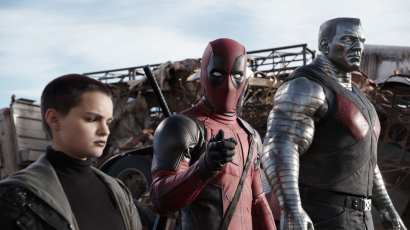
But, his face is messed up, and he’s so shallow, he figures Vanessa will be too. He then embarks on a mission to capture the Mads who did this to him and force them to fix his face. He hides from Vanessa, but she ends up getting captured anyway (’cause that’s what happens in these situations), and he has to have a big confrontation with the baddies at a ship graveyard full of dead aircraft carriers with only a couple of C-list X-Men to help him (Colossus and, I’m not making this up, Negasonic Teenage Warhead).

There’s a lot of meta-humor, with Wade talking to the camera, and demanding that he not be turned into a green glowing superhero (which superhero, I thought he was fine as, frankly, even if the movie was rough), and this works because, well, superhero movies have gotten so serious, it’s nice to see the air taken out of them a bit.

Is that a young Sinead O'Connor?

Pictured from left-to-right…oh, you can figure it out.

But what’s funny, to me, is that the movie works a lot better on an emotional level than most superhero movies these days. It’s a common theme here that the movies have to constantly escalate and escalate, such that on his rebooted outing Superman has to, basically, destroy Metropolis to save the world. There’s nothing to hang on to, to relate to.

Deadpool’s interests are aggressively personal. He wants his girlfriend and his face back, and so the movie plays out in most respects like a straight-up revenge story. Even with the constant breaking the fourth wall—which really ends up feeling more like he’s narrating rather than actually “breaking the fourth wall”—you actually care more about the characters and their struggles here than in in, say, Iron Man 3 or (I’m guessing) Batman vs. Superman.

It’s still a superhero movie, though, so, you know, you gotta be in the mood for that. It has the most graphic sex scenes in the costumed vigilante genre since HBO’s “Spawn” cartoons which are part played for laughs, but most certainly as a kind of Firefly fan-service. And the humor is much like the TV show “Archer”, though nobody’s going to be dropping in an analysis of “Animal Farm” or a reference to Thomas Elphinstone.

Eh, it’ll probably be my favorite superhero movie this year. Have I mentioned that I’m done with this genre, though?

I'd pay $6 to go see that.

This is a cool knife block, though.

Raising Arizona (1987)

Yodeling soundtrack. Big zooms. Hyper-emotional/hyper-stoic Holly Hunter. Nicolas Cage (nee Coppola). Characters setting events into motion they can’t predict. Crime not paying. Honesty not really paying either.

If the Coen Brothers surprised people with their versatility by following up their noir suspense drama Blood Simple with a wacky comedy, in retrospect you can see all the elements of the Coens’ oeuvre in both films, with a slight shift in tone being the difference. People even die pretty routinely in both, although it’s handled somewhat differently in the comic films.

“Why do you say you feel trapped…in a man’s body?”

sigh

30 years later and this joke is now a hate crime.

Is it funny? Gosh, yes. Though, if you’d asked me which of the four films I thought was the funniest between this, The Jerk (1979)Bill and Ted’s Excellent Adventure (1989) and Zoolander (2001)—all part of the “April Fools” series—I’d have said this one before rewatching it, whereas now I’d have to give it to The Jerk. With the caveat at the one’s mood can play havoc on how one receives humor and my mood may have been a bit off this day. (Although the boy concurred later on as to the comedic merits of the Martin film.)

I loved it back in the day, and I still do, though I don’t think I can rate it above O Brother, Where Art Thou and The Big Lebowski as critics have. But what I felt this time watching it was that the zooms which amused me so greatly 20 years ago had lost their novelty. As had the Coens particular style of filming people, which is sort of a self-mocking thing. (You’re close enough to both make fun of the characters and identify with them at some level.)

That baby is probably balding now.

They’re not bad people. Not bright people. But not bad.

Well, of course, it’s not novel any more: Besides the dozen films or so the Coens have made, they’ve also been very influential. So all that’s left is the movie. The loss of novelty, of course, is a big factor in aging comedy (and horror) generally, and that may be why critics tend to rate the Coen brothers’ older films more highly. When the novelty is gone, all that’s left is the movie.

Which, make no mistake, is still very good. H.I. (Cage) and Ed (Hunter) are lovable idiots, driven by their emotions to do dumb things—though with never a real grasp on the possible implications—and, actually, with the exception of Leonard Smalls (Randall “Tex” Cobb, who doesn’t seem to do any acting these days), the characters are mostly pretty decent with the worst of them not really meaning much harm.

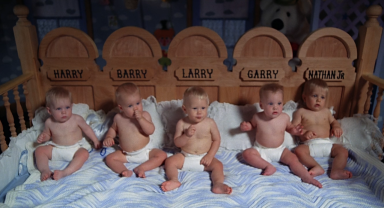
The babies are adorable. (All 20 of them.) There’s never been so much cute in a Coen brothers movie, and probably never will be again. Cage may have been difficult to work with, but he does some good physical comedy with the babies crawling around, and there are some good gags recalling the silent movie days when he’s trying to wrangle them all.

So, I don’t know. Even on reflection I like it better but I just didn’t find myself laughing very much. (Again, my incoming mood may have been the factor.) The Boy and The Flower both loved it, though.

Nathan, Jr. That doesn't rhyme.

It’s a lot of cute.

Dheepan

The Boy and I have never seen a Bollywood movie, and despite the very Indian title, Dheepan is actually a French film, not an Indian one, directed by Jacques Audiard (Rust and BoneA Prophet). The eponymous Dheepan is a member of the Sri Lankan Tamil Tigers, who sought to carve a Tamil nation out of eastern Sri Lanka, who were “finally” put down in 2009. This movie begins some unspecified but not too distant time after the end of the war, as Dheepan desperately flees the little island for France, using a woman and little girl who pretend to be his wife and daughter.

Cheap shot but France has it coming.

A dignified life awaits all new immigrants to France.

The “wife”, Yalini, wants to go to England. But refugees can’t be choosers—well, historically, anyway, they can now, apparently—and the end up in the crappiest drug-infested suburb of a French city, which is still about a million times better than Sri Lanka, even if the government isn’t trying to track you down and kill you. Dheepan gets a job as a caretaker of the slum while Yalini ends up cooking and cleaning for a vacant ex-soldier, whose primary purpose seems to be being a sort of front for the local drug kingpin.

It’s not exactly Green Card, but neither is it a cri de coeur about pure and helpless refugees. Audiard gives us a tale of very flawed people, very self-involved, who are not quick to form a family, even for the sake of a ruse, the failure of which could land them back in Sri Lanka. (Well, if France is anything like America, probably not, but they don’t know that.) At the same time, we do understand: Foreigners, who don’t speak the language (Yalini can speak English), and with a “daughter” who is expected to sit down in a French school and learn whatever it is French people learn.

I don't know what French people do with their lives.

“Apparently, the price of ‘fromage’ is up.”

They all have their moments of awfulness. And at times when you might think they’ve formed a bond, well, they might just surprise you by making a bolt for wherever, especially when the slums turn out to be the turf for a drug war. (And isn’t it telling how similar things are to the war torn country they left behind?)

The acting is quite good: All three principles are new to showbiz, as far as IMDB knows, but you wouldn’t know it. One suspects they may have a common culture behind them, too, as they have a certain chemistry which feels reel but almost businesslike, very much “strangers in a strange land”. Vincent Rottiers (Mood Indigo) was also very good as the drug lord.

Ultimately, you care about the characters, and you don’t really know what’s going to happen to them until the very end, which is a pretty gripping bit of action. Some people, in fact, argue that the final scene is a dream sequence, and we don’t really find out what happens (but I think the director has contradicted this). But, of course, if the filmmaker has convinced you that it matters, he’s done his job.

We had pretty much gone in blind, as reviews hadn’t emerged, but we were pleased. The Boy was quite impressed.

No, really!

And just when everything was going so well.

The Wailing

We had to journey out to Pasadena to see this Korean horror flick which has a 100% critical rating on RT and an audience score in the mid-80s, both of which are borderline astonishing for a horror film. And this is a remarkable film in a lot of ways, even though certain aspects of the film are lost to those of us not steeped in Korean culture. (There are clues about what’s going on, for example, to be found in the characters’ underwear, which were naturally missed by The Boy and myself.)

Boo!

Beware the Wedgie of the Undead!

Beyond cultural details, the film’s tone is extraordinary. It starts out with Our Hero, a lazy, incompetent cop, being a (peripheral) part of a horrible crime scene investigation. Peripheral, because he’s just not well-respected, and this seems deserved. He’s even kind of comical, and the movie has that tone of near whimsy which you can see in other “serious” Korean horror/thriller films, like The Host. But as we learn more, the nature of the crime is anything but whimsical: People are getting sick with this mysterious disease, one-by-one, throughout the village, and then hacking their families to death.

People suspect the new neighbor, a Japanese immigrant, in the sort of casual racism we can’t do in this country any more. I mean, it’s pretty much “He’s Japanese. He’s obviously the Devil.” To the point where they’re going to kill him for it. It’s a mistake to view this as one would an American film—like, the film makers are going to lecture us on the evils of racism. The big question actually becomes is he or isn’t he the Devil?

And who is the mysterious woman who shows up throwing rocks at the cops and intoning cryptic clues about the case? Maybe she’s the Devil, even if not Japanese.

It's a clue!

“Let she who is without–OW! Hey, cut it out!”

When the hero’s own daughter becomes infected, and possessed, the tone has completely shifted to serious. An exorcist is called in, and an exorcism performed. The fascinating thing to me was that I knew exactly what a Korean exorcism entails (basically making a lot of noise to irritate the evil spirit into leaving), which was weird. (I think I saw a TV segment years ago on Korean exorcisms, and they’re really memorable.) Anyway, decisions—and mistakes—are made, and the whole thing comes down to a question of religious faith.

This is, in itself, kind of funny, because the hero himself doesn’t see it as a religious test. He sees everything in terms of saving his daughter.

I ain't 'fraid of no—ooh, ribs!

Korean exorcism/BBQ.

Gripping, suspenseful, amusing (at first), and ultimately satisfying in a way horror movies usually aren’t, it’s hands down the best horror movie this year, and probably in a few years. We actually talked about it a lot on the (long) road home, trying to figure out The Big Picture. The protagonist’s weakness and incompetence early on made his subsequent breakdowns, when his daughter was sick/possessed, a lot more natural feeling. No laconic tough guy, here, so he could have a more range as a character than the typical horror hero. I mean, this is the general difficulty of horror: If you have a competent hero, the movie turns from horror into action or thriller. Helplessness is a key element of the genre. But utter helplessness is just boring.

So, this movie does an excellent job there. Another way it excels is in weaving the metaphorical with the literal without hitting you over the head with it. The mysterious woman is allegorical, but her role is not obvious. Although the photography is restrained, there are quite a few excellent shots and some great blocking. Even the title itself is a hint, though it doesn’t cross language barriers.

If you’re in the market for a Korean horror flick, you’ll be hard-pressed to do better.

Kidding! Don't bomb me!

Just because he’s Japanese doesn’t mean he’s—OH MY GOD! THE DEVIL!

Love & Friendship

The works of Jane Austen have been plundered more extensively, perhaps, than any other English language author—although one suspects that Tolkien will have his due before the century is out—and this latest movie is based on a novella she purportedly wrote at the age of nine.

Probably not Jane Austen.

Portrait of the artist as a third grader.

Ain’t nobody gonna do that with my nine-year-old scrawlings, that’s for sure. (Memo to self: Burn all old writings.)

This is the sixth film by Whit Stillman, and the first that I’ve seen, though we were pretty close to seeing Damsels In Distress until the reviews came out. There was a kind of Wes Anderson feel to the dialogue and characters in that film (or at seemed so from the trailer) but the mildly positive critical reviews (76%) couldn’t overcome the audience loathing (40%) and we stayed away.

So, whatever the success of that film, the same tone brought to turn of the 19th century England, seems somehow both very appropriate and very charming. And marking the first time Stillman has broken into the 8-digits of box office, reaching nearly $12 million dollars at the box office, sure to finish in the top 100 for the year.

I don’t know how they pick who gets to make movies.

Probably.

“Then it’s agreed: The first street urchin we run over shall direct our next film!”

That said, this is a very enjoyable film, if you like comedies of manners full of treachery and cutting wit, and aren’t too hung up on the plot. The story is that the recently widowed Lady Susan (Kate Beckinsale), finding herself without means, is trying to fix up her recalcitrant daughter with a wealthy, but unsuitable man while she slyly (but not so well hidden as she believes) cavorts with a married man.

Lady Susan is beautiful (and Beckinsale is perfect for the role, at 42, easily out glamor-ing the rest of the cast) but not actually charming (presuming you don’t want to sleep with her), and a terrific example of what is really the most destructive element of polite society. She’s so bare-faced in her lies, and so exploitative of others’ politeness, her character would actually make a highly successful politician.

If only.

It’s a telegram from a Mr. Trump about a “vice presidency”?

The movie ends rather abruptly (and happily, in that Austen way) and you can find yourself wondering, “Well, what was the point of all that?” And from a narrative standpoint, the story’s weakness comes from not really having a great protagonist. Our main character is Lady Susan, ultimately, and she’s utterly incapable of change.

Nonetheless, we had a good time. I enjoyed it quite a bit, and was a little bit surprised that The Boy was rather enthusiastic about it. But it was, overall, a clever tale cleverly told, brisk and, at 90 minutes, unlikely to wear out its welcome. Interestingly, while achieving near universal critical acclaim (one negative review on Rotten Tomatoes), the audience score has slowly dropped from the high 80% to a rather tepid 70%.

This may be in part due to the plot and narrative deficiencies, but may also be that the dialogue, which is the key element of the movie, obviously, can be rather hard to parse. It flows fast and is somewhat archaic, and having to parse out humor is never conducive to laughs.

But we managed. What surprised me was that my mother, who’s never been able to get through an Austen book (“boring”) and hates English stuff (because she can’t understand what they’re saying) really enjoyed this film. I think that may be because Lady Susan’s character is so truly awful, and some of us have a particular appreciation for that sort.

She's so cute!

The Monster.

Jimmy Vestvood: American Hero

I’m sure the people who described Maz Jobrani’s comedy Jimmy Vestvood: American Hero thought they were doing it a favor by comparing it to Sacha Baron Cohen’s Borat, but it was precisely that comparison that convinced me I didn’t want to see it. Personally, I’d compare it more to Peter Sellers—though, I guess people don’t know who he was any more.

No, you can't see it in this shot.

Sellers would SO be doing giant dick jokes today.

But there are some strong similarities between Vestvood and Sellers’ Inspector Clouseau: A bumbling incompetence combined with an inexplicable appeal to the ladies, for example. On the other hand, Jimmy doesn’t have Clouseau’s otherworldly detachment. In fact, his most endearing trait is his love of America, though it often goes awry.

The movie begins with Our Hero discovering that he has won the lottery to come to America and celebrating by dancing in the streets waving an American flag with all his friends. A series of mishaps results in the flag being—well, set on fire, and before you know it the whole footage ends up on Hank Shannity’s KOX News show.

Reminded me of Chaplin's "Modern Times", actually.

Yeah, it’s ham-handed. So is Fox.

The so-thinly-veiled-as-to-not-be-veiled-at-all references to Fox are among the weakest parts of the movie, descending into clapper humor, and missing a good comedic set-up at the end by making Shannity (Matthew Glave) an all-purpose villain rather than a misguided but gung-ho America booster, much like Jimmy.

The main plot involves evil arms manufacturer (John Heard, C.H.U.D.) hiring Jimmy to follow his hot, adulterous wife (an amusingly over-the-top Deanna Russo in a ridiculously over-the-top blond wig) to get pictures of her with her comically well-endowed lover. But this masks a super-secret double-plot involving…uh…drone drones.

Funny, though. And cute.

In a movie full of caricatures, Russo is the caricature-iest.

All this while Jimmy struggles to manage his Iranian-ness in America, fighting off the advances of his 6th or 7th cousin (Sheila Vand, A Girl Walks Home Alone At Night), and his jerk of a boss (Marshall Manesh A Girl Walks Home Alone At NightShirin In Love) who’s constantly hitting on his mother (Vida Ghahremani, The Stoning of Soraya M.)—and isn’t it funny that we know the Persian actors better than the American ones? (Well, the American ones are mostly TV guys and we don’t watch a lot of TV. We’re such hipsters.)

I always ask my Persian friends about these films, and in this case, the one who had seen it was kind of put off by the low budget. It is very low budget, and those seams do show at times. Also, the comedy is very hit-and-miss. But it is very good-natured overall—which perhaps distinguishes it from both Sellers and Cohen, who can be rather mean. And that may have to do with why it has played for months at our local theater when most Persian films are lucky to get a few days play, if any.

Directed by Jonathan Kesselman, who did The Hebrew Hammer a decade back, and has a sequel, The Hebrew Hammer vs. Hitler coming up soon.

Duh.

This is not a subtle film. Did I mention that it’s ham-handed?

Zootopia

There was, of course, no question, once the great reviews started coming in, that we would all go see Disney’s latest animated feature, Zootopia. In fact, with the Barbarienne around, reviews-be-damned, she and I, minimally would go see it. But we ended up going to see it on The Boy’s birthday, it being the best option of all available films we had not yet seen.

"Once In Paris" is legendary in our family.

These were the only other options.

It has been interesting to watch the Lasseter-ization of Disney. Beginning with Bolt, which he apparently steered out of its mediocrity, and culminating, in a lot of ways, with Frozen, which owes its incongruous villain to him encouraging the team to pursue what, ultimately, was a better (and, of course, wildly successful) storyline.

Zootopia is, in short, better. The characters are well-developed. They’re flawed, but likable. Cute but not cloying. There’s a message of diversity that only a Social Justice Warrior could hate—and, indeed, the few negative reviews there are for this film seem to revolve around the movie not addressing the delicate social-message sensibilities of the critic just so.

Damn fine work.

Look beyond the cute to all the characterization here.

Our heroes are a brave little rabbit cop and a cynical fox grifter who team up to solve the mystery of what’s causing various carnivores in the city to go feral. This is such an obvious set-up for ham-handed moralizing about differences of race and creed, that it’s easy to overlook that it’s also an amazing set-up for quality humor, such as the “Far Side” empire was essentially built on. The movie offers some (I thought predictable) twists and turns that keep one from comfortably indulging in a particular set of prejudices, and opts first to be funny and/or heart-warming.

This is good. Political movies suck and everyone hates them.

Full credit to directors Byron Howard (TangledBolt) and the great Rich Moore. Moore directed Wreck-It Ralph, but also directed many classic episodes of “The Simpsons”, “Futurama” and “The Critic”, while they were at their funniest. (OK, “The Critic” was always funny, but it only ran for 23 episodes.) I think we can declare the man’s talent to be Not-A-Fluke. I would guess the cast was heavily influenced by Moore, as it gives nice roles to Maurice LeMarche (who was central to “The Critic” and played a multitude of characters of “Futurama”), John DiMaggio (“Futurama”), and Kath Soucie (“The Critic”, “Futurama”).

Not the movie.

Sort of a cross between “Ralph’s” Candy World, New York and Tomorrowland.

The face actors are good, too. Even if Idris Elba counts as stunt casting, he’s good (in a role that might have gone to the late Michael Clarke Duncan a few years ago). Ginnifer Goodwin (currently reigning as Snow White in “Once Upon A Time”) is really wonderful as Officer Hopps, and Jason Bateman was basically born to play the grifter fox. (I mean, his first sitcom as a teen had him as a kid sociopathically manipulating his mom. It’s nearly typecasting.)

Besides the solid story and characters, and a decent plot, the movie is jam-packed with love. Every scene is an opportunity for some gag or another, in true Pixar fashion, giving every moment an additional layer for the attentive, the OCD and their beleaguered parents. The sheer impossibility of the situation—a city where all animals live together in relative harmony—makes for some many jokes just involving scale. And there are a ton of jokes riffing on the animal versions of Disney properties, much like the end credits of Pixar’s Cars.

No songs. Great score by Michael Giacchino (The IncrediblesUp).

Maybe not as Amazing as a near perfect RT score might have you believe. But great, nonetheless.

I'll be the fine print on the menu is funny, too.

Get some fresh-squeezed acacia in the lobby.

The Nice Guys

Shane Black was, once upon a time, one of the hottest writers in Hollywood, having penned the Lethal Weapon series of films—and the famously disastrous Last Action Hero which committed an error I call “the Buffy factor”. It may not have been the relative weakness of those late ’90s films that accounts for his absence: He was also in Burn, Hollywood, Burn: An Alan Smithee Film which is the sort of film nobody but vengeful executives would actually watch.

How ya gonna distribute it?

Literally, NOBODY else.

He wrote and directed the well regarded Robert Downey Jr./Val Kilmer buddy picture Kiss Kiss Bang Bang about a decade ago, and then, with no other directing experience, ended up writing and directing Iron Man 3 (which is one of the many movies that we saw, but which I apparently forgot to write up, perhaps because when you’ve seen one Iron Man, you’ve seen them all). I don’t know how Hollywood works. Although, maybe the key element there is Mr. Downey, Jr., who has a reputation as a faithful friend.

Anyway, Mr. Black is back with this (apparent) semi-remake of Kiss Kiss Bang BangThe Nice Guys. Set in 1977, it concerns hired goon Russell Crowe, and cowardly detective Ryan Gosling, thrown together on a runaway daughter case. Our story begins, as it must, with a dead woman on a car (Murielle Telio, in a brief but spectacular entrance) and the disreputable Holland March (Gosling) being hired by the dead girl’s grandmother, who believes she’s seen her granddaughter (a porn star) post-mortem.

What am I going on about?

Girls didn’t have breasts like this in 1977! (Picture of Gosling used instead because, you know: Family site.)

Gosling has taken the case, but primarily to milk the old woman for money—the lessons of private investigation he teaches to his daughter Angourie Rice (These Final Hours, whose American accent is impeccable, and who manages to be likable in a “sassy, precocious” kid role that might otherwise be awful)—but when the girl he’s tailing notices him, she hires a thug named Jackson Healy (Crowe) to beat him up.

It’s Black magic, if I may drop a Shalit-style pun here (and how are you going to stop me?).

It’s unassuming, clever (but not overly so), old-style mystery with a few head fakes and wholesome family values, despite all the porn references. Also a decent amount of suspense and action, but not really over-the-top. It feels like a throwback without the musty smell. It’s not exactly going to leave you pondering the Meaning of Life as you leave the theater, but that’s welcome in the same way the whole “we’re not trying to save the world” plot is, you know? At least it was to us.

And this scene actually has an effect later on!

Not an actual drug reference.

Full disclosure: The Flower, whose birthday it was when we saw this, enjoys old mystery shows like “Quincy”, “Rockford Files” and (to a lesser extent) “Murder, She Wrote”, but above all “Columbo”, so she may not be the barometer for your average fifteen-year-old. (Holy cow! She’s fifteen!)

But the Boy also really liked it, as did I—and I was inclined to be the most critical, much as The Old Man was about ’50s movies. In fact, while I was entertained, I also had the additional entertainment of “spot the anachronism”. For example, at a critical point, someone says “Call 9-1-1.” Nuh-uh. No 9-1-1 in 1977. Not in L.A. Also, the Comedy Club showed a double bill of Tim Allen and Elayne Boosler (misspelled as “Boozler”) and an area code of 323 (which didn’t exist yet) which, while Boosler was in town at the time, I think Allen was in jail. Then there was the “Pina Colada Song” which hadn’t been released.

She emailed me!

Ms. Boosler was VERY sweet when I asked her about it.

I’m not knocking it. These are minor details compared to the absurd plot. Which I’m also not knocking, except to the extent of its rather predictable villainy. The actual villains were cool: Keith David plays “Older Guy”, a heavy, which was kind of fun since his debut in the same approximate era (1982’s The Thing) he was also a tough guy. Kim Basinger, also of that era, plays a ruthless D.A. whose daughter is mixed up in the proceedings. She’s looking good, although there was something odd about the way they filmed her.

David Buckley’s score captures the era pretty well without getting obnoxious, as scores from the time often were. (So much cheap brass.)

As I said, we liked it, simple buddy cop movie though it was, and will look forward to Nice Guys 2: The ’80s, or whatever the sequel is called. If there is one. A bad sign for that is this movie’s inability to beat out the “juggernaut” that was the “Angry Birds” movie. That’s a shame. It felt way more personal than your average summer popcorn flick, and that’s a good thing.

Nobody's dressed well.

Pretty sure this whole thing is a remake of a Disney David Niven/Jodie Foster ’70s flick.

Weiner

It is utterly inconceivable, in this day and age, that a movie like Weiner would ever be made about a Republican. This is a remarkably intimate and sympathetic look at a guy who shot himself in the foot—twice—who might otherwise have gone on to win the White House. Certainly the mayorship of New York City was in his grasp. And from there, governor, senator and, yes, possibly President. Though, I guess the latter is far-fetched for anyone, even someone cozied up to the Clintons. Whether he could or couldn’t be President depends more on whether the Clinton Crime Family is actually called to account in the coming years than anything Weiner did or could have done.

The irony here being, he’s done nothing so grievous as the Clintons. Or Trump. Or Teddy Kennedy. Or Robert Byrd. Or any other Democrat heroes. What did he do? He talked dirty to a woman of low morals.

But, more importantly, he posted a public picture of his turgid genitals. Photo evidence trumps all. Then, after he was supposedly chastened, he took up with this aspiring porn star in a manner that could be easily reproduced digitally. And, my friends, he did not leave her to drown in a car where she would not be able to embarrass him later on.

I hope.

No explanation needed.

The movie starts by showing Mr. Weiner out on the floor of the Congress, lying in the de rigeur way of our elected officials: By highlighting one part of a bill to cast political opponents as being opposed to things that “no decent person” could possibly be against. This is fodder for the crowd, who desperately needs for their political enemies to be monsters, so they can avoid confronting the real monsters of the world.

Then all my lefty pals who get their news from the Daily Show come to me and say “Those dirty Republicans voted against giving money to veterans!” because, of course, they didn’t hear about the “mandatory abortion” clause on page 25.

God, I miss that guy.

It’s the sort of thing that drove Andrew Breitbart nuts.

It’s a story, by necessity, of a fairly reprehensible fellow, because, well, he’s a politician. But is he any more reprehensible than any of the other politicians? That’d be very hard to prove.

So, let’s take a step back and look at it as a picture of a human being, with aspirations, who (by all rights, at least based on what’s shown here) should be pretty happy with his lot in life. And yet. He’s tripped up by what can only be considered a philosophy of “truth as the last resort”. This kind of makes sense. Being truthful is a good thing. It’s a necessary thing, even, despite the various stratagems people work out to avoid it.

Weiner is kind of interesting, in the sense that he’s really one of these guys you think “Well, he’s really just upset that he got caught.” I think there’s some truth to that. At the same time, he doesn’t seem to be completely able to drown his conscience like an inconvenient lover as some others have done. He’s a true believer. He thinks he’s fighting the good fight. And he figures that takes precedence over his own ignominy.

Dachshund, I mean.

For no reason: A weiner dog

Whether it should or shouldn’t, whether it does or doesn’t is based more on the caprices of fate, and possibly some backroom engineering amongst the Vast Whatever Conspiracy. If you heard the story as I did (rather disinterestedly), Weiner’s mayoral bid was derailed by allegations of new bad behavior. But from the movie, it seems like the bad behavior was old, if not entirely revealed, and he was more done in by the opportunistic Vegas dealer he chose to consort with.

It’s tragic, in the sense that he’s there with Huma (right hand of the She-Devil Herself), who here is just a mother with two young children who is trying to keep her family together. But we don’t get a lot of insight into her, really. She’s enduring, as politician’s wives do, no matter how feminist they claim to be. Is it more opportunism? We can’t tell from this.

On the three-point scale:

  1. It’s an interesting topic. No question. And, though it’s a small (heh) story, it’s reflective of our culture in many ways.
  2. It’s well done, no question. Audio and visual is good and the editing is tight. No fat here.
  3. Bias. Minimally, as I said up top, this isn’t the sort of thing we’d see about a Republican, whose sexual peccadillos are always, always, always a reflection of their political beliefs. Is it further biased, say toward humanizing a sociopath (or a pair of sociopaths)? No way of knowing. I’d like to think not.

It’s been a bit overpraised, I’d say, garnering a whopping 95% from critics on RT, and with a lot of people saying it’s the best political documentary ever. Eh. I actually don’t think watching a guy live through humiliation on film is particularly great as politics. Weiner presumably didn’t censor it, and so that gives it a more real feel than you’d perhaps expect. On the other hand, this documentary undoubtedly started as a way to praise him, and these people were probably going to give him the kindest treatment he was ever going to get.

In any event, it’s not really political: It’s personal. And that both lessens its importance in some ways and increases it in others.

Dough

There is a conceit going back at least to the ’60s where someone is essentially poisoned with marijuana (typically via a brownie) and their life gets magically better. Because, like, they’re not so hung up, man. I’m sure this was done with alcohol in the ’30s and earlier—it probably has roots in an Ancient Roman Vaudeville routine.

Never gets new.

Why, yes, Soberus Stufficus ’tis just juice. [aside] Of the grape!

Although I never have been fond of it, this conceit is particularly dissonant in these days of marijuana legalization and the complications it seems to bring. (There’s a case in Colorado where a guy is claiming edible MJ sent him into a paranoid rage that made him kill his wife. And there’s these two kids sent to the hospital in Massachusetts from brownies. And these two fatalities.) I’m not a fan, as you might gather—though not, on principle, a fan of prohibition either.

Anyway, The Boy and I both watched this with the same viewpoint of “Well, it’s magical Hollywood marijuana that never makes anyone stupid or paranoid.” So, it didn’t bother us too much. The premise is this: Nat (Jonathan Pryce) is an old Jew in England who runs a bakery. Business is bad, and his apprentice is leaving him for a supermarket chain. His son, who decided to pursue law rather than baked goods, would like him to sell the place and retire on the money, but instead Nat gets a new apprentice—the son of his African cleaning lady, Ayyash.

Not really.

They’re the original odd couple!

Ayyash has different plans in mind. He wants to get his mom (and himself) out the state-supplied housing, and he can’t do that with bakery money. But the job provides him cover to deal drugs, and he ends up in a short time as a very successful weedmonger. The increased traffic brings in more business to the bakery as well, pleasing Nat.

Hilarity ensues when some reefer ends up in the dough by mistake, and demand for the cHappy Challah goes through the roof. (Because ganja makes everything better! And nobody’s ever allergic to it or made paranoid, or impaired while operating heavy machinery.) Meanwhile, Ayyash is learning the self-respect that comes from having a real trade, even if he is a bit squeamish at the thought of using the blood of goyim children in the bread. (Joking, of course, but he actually states this reservation up front and his mom slaps him. In real life, the odds she might also believe this would be pretty high?)

So, there’s your tension: Ayyash and Nat begrudgingly form a Muslin/Jew bond even as Ayyash is betraying him by poisoning his customers. Still, the proceedings are kept pretty light, and all resolve cheerfully with a silly caper.

Who could have foreseen this?

There are days and there are days.

Director John Goldschmidt hasn’t directed a movie since 1987’s Maschenka and went through the entire first decade without producing anything either (though with the Brits, especially, they’re busy doing stage work), but caveats aside it’s a fun enough film. Pryce is excellent, of course, and he has good chemistry with young Jerome Holder, so we can Buy The World A Coke And Ignore The Vastly Increasing Muslim Population That Threatens The Jews.

I mean, seriously: It’s hard to not notice that the moviemakers of the world seem determined to treat Muslim/Jew problems as if they were the same as black/white problems, delivering the same sort of “Can’t we all just get along?” message even as one of the main characters of the film sincerely believes the other uses blood to make his bread.

But, yes, get past the pro-pot message, and the moral equivalence message, and you’ll have yourself a good time. We did.*

*But, you know: Caveats.

But it's all in fun.

Then they become travelling kush salesmen.

Crush The Skull

It was a pleasure, particularly after seeing some less successful low-budget movies (South32, Timechasers) to see a movie that respected its budget and what it could do. So where Timechasers was too ambitious for a low budget film, and South32‘s creators seemed to “phone it in” on crucial plot and dialogue issues, Crush the Skull hits the sweet spot: A fun little caper—”It’s not a caper!” as they say in the movie—thriller that builds heavily on characterization and a fair sense of whimsy.

No, it doesn't.

Let’s just say it has “caper overtones”.

The whimsical tone is set up in the first scene, as we see a (by now) clichéd situation, where a mother tries to convince her far-too-savvy daughter that the dungeon they’re being kept in is like a game from “Survivor”. They go back-and-forth on it several times, even as the killer comes and does in the mother most gruesomely.

It’s a tricky tonal shift. You have to get the audience to care about the characters, even when the characters are semi-goofy and semi-idiots. But the “funhouse” nature of the film makes it work, along with writer/director Viet Ngueyen’s deft editing.

But it's there!

The sense of whimsy may not be apparent in all shots.

The story is that a couple (boyfriend/girlfriend) of thieves are going for “one last score” when Ollie’s (producer/co-writer Chris Dinh) better nature gets the best of him, and he ends up in jail. Girlfriend Blair (Katie Savoy) bails him out, but only at the cost of all their reserves, and then some, as provided by a Very Bad Loan Shark. So, they’re back in the saddle.

Blair’s dimwitted brother Connor (Chris Reidell) and his “crew” (a big dumb asian dude, Riley, played by Tim Chiou) are pulling a big job that the two now need to stay out of trouble, and that’s when things go bad. As it turns out, the target is a lair of a serial killer, and while they can get in, they can’t get out.

Although there’s about one hall and maybe two or three rooms (which I doubt are anywhere near the aboveground part of the house), the camera shifting, the darkness, the editing all conspire to make it seem like there’s a real maniac’s underground labyrinth, full of traps and remote-controlled doors and cameras and what-not.

Well, plus whoever's on the ground.

And then there were three.

It’s nicely done. And when the characters talk, even when they’re being goofy, we’re typically learning something about their character. And, while it’s silly, a lot of the reactions they have are the ones you or I or any regular person would have in a similar situation. So, the whole thing stays on the right side of “not taking itself too seriously” instead of “not respecting the time the audience is giving you”.

I think that’s my biggest beef with modern low budget flicks. 40 years ago, you needed something to make out to in the drive in, or to fill the time. Now there’s a near infinite list of choices, including incredible classics of cinema, and by far the scarcest resource people have to divvy up is time. I like it when a movie respects that and knows it has more to do than just get me in the door.

The Boy liked it a great deal. And even though it was only playing at 10PM, the Flower came, and also enjoyed it greatly.

It might be the lowest box office film we see this year, below even Wedding Doll, but it seems to have had no official release per BoxOfficeMojo.com, putting it in the South32 category.

We all have one.

In Real Estate, they call this a “bonus room”.

Rifftrax Presents: Timechasers

It’s time for Rifftrax! (Rifftrax!) And it’s not an easy job, they watch movies and they make up jokes about them. And tell those jokes to microphones. Or so the song goes. And this is true, except for the several times where they tell those jokes live to an audience (usually in Nashville).

As they did recently, revisiting a Mystery Science Theater 3000 “classic”: Timechasers.

Aw, yeah.

This time, it’s all for the ladies…

In Timechasers, a scientist with incredible luck (one assumes) and a remarkably small amount of imagination, invents a working time machine out of a small prop plane and a Commodore 64, but then can’t think of anything to do with it, except sell it to Evil Corp (a division of Destroido!) who then—through means that are never adequately explored—sells it as a weapon, creating a hellish future of…well, the remarkably contemporary looking warehouses and back alleys of Burlington, Vermont.

Scooby Doo

Destroido Corp, makers of “Grandma Moonbeams Cookies”!

We are, of course, sympathetic to the low budget filmmaker, who is often honing his craft at the same time he struggles with budgetary limitations. And if writer/director David Giancola never exactly “got good” at this movie thing, he did, apparently get better.

Here, however, we see a near Birdemic level of unsophistication, though without that movie’s sheer amateur incompetence. The acting is wooden, but it’s recognizable as acting. The plot is illogical, and much like Birdemic, tied into man’s inevitable destruction of the earth. There’s an attempt to try to incorporate the “multiple timelines” aspect of Back to the Future 2.

Look, that was ambitious and not very successful either, though lord knows it was a gratuitously abused plot device throughout Star Trek incarnations. (To the point where, I think, it was the entire powering device of Enterprise.) The real risk of these things is that: a) You confuse the audience; b) You can do whatever you want, no matter how magical, so the audience knows you’re cheating.

Makes perfect sense.

So, you’re saying in THAT timeline, Leah Thompson had big boobs?

But what about the riffs? Well, the riffs are good. Very good. That’s why we go to these things. They’re fun. But on the scale of Rifftrax, it’s not the best. There are a couple of places where it’s very hard to hear what’s going on, and because the sound in the film proper is out-of-sync, it makes a lot of dialog-based-jokes impossible. (The timing’s been pre-ruined by the movie.)

The Boy commented that he preferred MST3K-style movies, where the dialog leaves enough gaps to make quips without talking over the movie. And it’s true that Rifftrax uses a lot more “talking over” which allows for some funny bits on the one hand, but breaks the engagement with the film on the other.

And you do have to engage with the film somewhat. A lot of the best humor comes from expectations, or from someone pointing out an absurdity that you half-notice but can’t quite put your finger on. As in episode 305 of MST3K, “Stranded in Space”, where the guy helping out the hero drops his vial of the medicine he must have to survive and Crow says, “Note to myself: Pack more life-saving liquid.”

You have to be engaged enough in the actual movie to appreciate the absurdity.

Anyway, it’s good. This stuff always is. It’s just no Santa Claus.

Mike was a longshoreman named "Eddie".

Mike, Kevin and Bill wasting their youth.

Midnight Special

After writer/director Jeff Nichols’ first two features, Take Shelter and Mud, I was ready to go see his new film, Midnight Special, even if the reviews were somewhat weaker. The reviews are basically right: This isn’t as strong a film as the other two, but I was still very glad to have seen it.

They do nothing!!

Our theater did not supply the goggles, however.

There’s something about the Nichols aesthetic I find appealing. And even though this movie resolves, plot-wise, in a rather conventional way, the execution is rather non-conventional, for better and worse.

The story concerns young Alton (the very talented Jaden Lieberher, St. Vincent) who has been kidnapped, and is now the subject of a manhunt involving the US government and a bizarre religious cult out of Texas. The twist being that he’s been kidnapped by his father (Michael Shannon, Take ShelterMud) who’s trying to get him to a particular location, with the help of his mother (Kirsten Dunst, The Two Faces Of JanuaryMelancholia) and a pal (Joel Edgerton, Black MassThe Gift).

Yeah, no.

Just screams “ROAD TRIP FLICK!” don’t it?

So, very solid acting, indeed. Adam Driver, inheritor of the Darth Vader mask, looks a lot more at home as a science nerd here, as well.

It turns out that Alton tends to speak in tongues, and sometimes those tongues include “coordinates of top secret military things”, which is what has attracted the government’s attention. It also turns out that, when he’s exposed to the light, odd things happen. Hence the “midnight special” of the title, as Roy (Shannon) and Lucas (Edgerton) drive around at night and hole up in motel rooms during the day where they can cover up the windows.

The other element here is that Alton is sick. Dying even. Roy figures his only hope is to get to that location at the right time, though he has no idea what will happen when he gets there.

Heh. Violence is never the answer.

We can only hope it involves force choking this guy.

If this is starting to sound familiar to you then you’ve probably seen Starman or Escape to Witch Mountain or maybe Close Encounters of the Third Kind, all of which have plot similarities to this film. Where this film differs is that Alton is essentially a MacGuffin, with no particular insight to offer on the topic of being human. By contrast, Jeff Bridges’ Starman is also a MacGuffin, but he’s a running commentary on human nature as well.

Alton seems to literally be a child, with a child’s insights, and not a lot of those, really. He’s just different. He becomes more a test of “would you do what is right, given circumstances very aligned against you?” This provides a good showcase for the other actors and prevents the film from falling into cliché.

Of course, clichés exist for a reason: Because they’re usually successful at conveying what needs to be conveyed. And at the climax of the film, Nichols splits up Roy and Alton because, logically, Roy needs to distract the bad guys. That leaves Sarah (Dunst) and Alton with the final emotional scene, and us without a real main character.

Kirsten's aging nicely.

But WITH one of the all-time great “awkward family” photos.

One trick these movies sometimes use is a “Is he or isn’t he?”, like with the sub-par K-PAX. Nichols, rather nicely, leaves no doubt about what’s what, in a bravura conclusion that is satisfying, even if we don’t get our dramatic character arc.

The Boy did not like it as much as I did, but he did like it. It’s definitely more Take Shelter than Mud, but if you liked the former, you’ll probably enjoy this.

Well, all right, all right, all right.

Even if it is 100% McConnaughey free.

Kung Fu Hustle

Every year, despite my best efforts, there are a few films I forget to review. Not that you, dear reader, can’t live without my ramblings on any particular cinematic experience, but more that I presume, as always that you, dear reader, don’t actually exist, and this blog is merely my diary of moviegoing experiences. One that my children may one day stumble across and find amusing or fleetingly nostalgic. I don’t find out the film is missing until I later go to link it and realize…it’s not there. (Back in 2010, when I was working three jobs, I just gave up trying to keep up, and so even with far fewer movies in the queue, 2010 is full of holes.)

And so we come to Kung Fu Hustle, which we saw in February, and which I went to link to just now, only to find it missing.

And that cannot stand, man.

Sleepin' on the job.

So, instead it’ll have to sit.

Kung Fu Hustle was Steven Chow’s follow-up to his amazing sports-fu comedy Shaolin Soccer, and it essentially perfects the ideas introduced in that film, enough to where you would think it could launch a genre, except it’s too hard an act to follow.

This is the story of a very bad tong that takes over Shanghai in the 1940s and finds itself in trouble when a couple of thug wannabes (Chow and his doughy sidekick) end up causing trouble in a little slum on the outskirts of town. The resultant escalation reveals a number of unexpected super-powered kung-fu masters with comic and tragic consequences.

Old time chop-socky stars.

Major characters known only as “Landlord” and “Landlady”.

This is a very broad film. Early on, you’ll see scenes that are literal reimaginings of Wile E Coyote chasing the roadrunner. Later on, there is comically extreme violence, as a man’s head is literally pounded into an ever deepening hole in the floor. (He’s okay, though!) Enlightenment leads to a state akin to that of a superhero—or, if you’re a child of the ’90s, Neo in the Matrix. In fact, Woo-Ping Yuen, one of the stunt coordinators on this film, served the same role for the Matrix trilogy.

The "One", indeed.

Every one of those guys in the suit are Keanu Reeves.

It’s an odd experience, going from the absurd to the poetic in a matter of moments. In fact, it’s the very (objective) definition of “uneven”, which is usually a bad thing for a movie. But it all works, even when you think it shouldn’t, and for reasons I can’t really figure out.

There is a kind of fundamental truth underlying the proceedings. Our hero is, as a boy, someone with powerful heroic instincts that the world has taught him will get him nowhere, so he tries really hard to be a thug. But he’s no good at it. He can be an awful jerk and a bully, but he’s not really evil, and misery and misfortune follow him wherever he tries to take the path of villainy. This is a theme in Shaolin Soccer, as well, combined with a very pure sort of love story.

Comedy, action, romance, kung-fu, poetry…it really embodies the best elements of the chop-socky film. You could call it a “cult classic” but it was also very successful (for such a film), taking in over $17M in the US alone, and putting it at #10 on the top foreign film box office list. It may be too steeped in that Chinese cinematic tradition for some, but at the time I saw it in the theater, I had never sat through an entire Hong Kong action flick in my life, and I loved it.

So, you might, too.

Twoo wuv.

Love.

Bill and Ted’s Excellent Adventure (1989)

Be excellent to each other, advises Bill S. Preston, Esq., to the puppy-dog-ish head-bobbing affirmation of his pal Ted “Theodore” Logan, in this epitome of late ’80s culture which was very well received at the time, but turned me off because it looked like stupid drug-humor celebrating the vulgarity of the era. And while it is dopey, it’s neither vulgar, nor does a single drug make an appearance. In fact, it’s so remarkably benign it’s hard to believe it came from 1989.

Radical!

Gnarly!

The premise is that none-too-bright Bill and Ted, while strategizing on their plan to be the most awesome band ever—which only peripherally includes acquiring instruments and learning to play them—are unable to grasp or retain anything being taught in history class. Their only way not to flunk is to come up with the best final history presentation, and as you might imagine, the boys aren’t real good at book learnin’.

Fortunately for them, the future (strictly of San Dimas, I think) depends on the two of them passing, lest they be split up by Ted’s strict father, who wants to send Ted to military school. The future sends an emissary (in the form of George Carlin), to make sure they succeed, rather improbably by lending them a time machine with which they can travel through history and bring actual historical figures to the present, to get their opinion of San Dimas in 1988.

R.I.P.

George Carlin describes the size of the check they wrote him.

They start with a trial run, fetching Napoleon and bringing him back. Since they need a lot more (apparently), they entrust the little dictator to the care of Ted’s (or maybe Bill’s) little brother. This allows cross-cutting of Bill and Ted’s hijinks in the past to contrast with Napoleon’s in the present. It also sets up the third act, when all the characters of history are running amuck at the San Dimas mall and water park—named “Waterloo”, naturally. (San Dimas has a famou water park called “Raging Waters” but all the actual water park shots were filmed in Arizona, sort of amusingly.)

As I mentioned, this is a dumb movie. Most of the jokes are pretty dumb. But it works. I can’t exactly explain it. One reason, I think, is that it stays out of the gutter. The most vulgarity we get is a nasty belch from Napoleon after he pigs out on ice cream. Napoleon also provides the primary swearing for the film, yelling out “Merde!” repeatedly after flubbing in bowling. There’s not a lot of historical accuracy here, obviously, but the screenwriters clearly decided that Napoleon was a dick. (There is one use of the word “dick” and, sort of shockingly, “fag”, by the way. I don’t remember the context, but it wasn’t anything about homosexuals.)

Plays French guys, Italians, Jews, whatever you need.

Terry Camilleri: Working actor.

When Bill and Ted are trying to convince past Bill and Ted that they are them, as one does in a time travel movie, the answer to “Think of a number” is, of course, 69. There’s also a very modest down-blouse shot. Other than that, the only sexual part of the movie comes from Bill’s dad, who has married someone who seems to have been a classmate of Bill’s, a girl who really likes old guys. At one point, they kick Bill out of his own room so they can (presumably) have sex. Oh, and their secret number is 69, of course.

Meanwhile, Bill and Ted’s interaction with the distaff side, besides kidnapping Joan of Arc, is to rescue some princesses from unpleasant fianceés.

I don’t mention this to provide a catalogue for concerned parents: I’m just noting that, I didn’t go see it back then (in part) because I felt it would just be a big crude mess. This could actually be described as “corny”. Even sweet.

BIll's "mom" is played by working actress Amy Stotch, who was actually 30.

Probably the creepiest scene.

Having not seen this, I didn’t realize until now how closely this mirrors Wayne’s World. While not as loquacious Mike Meyer’s Wayne, Ted’s friendly puppy-dog-ish reactions to good and bad news could be considered direct rip-offs of Wayne. Of course, the way these things work, the movie could have been in development long before the firsrt “Wayne’s World” sketch aired, and Reeves may have never seen it before shooting. In any event, the future Neo nailed the part so well that he’d lament for years that “He played Ted” would be on his tombstone.

The MatrixThe Lake House and John Wick notwithstanding, this may be my favorite role of his. Alex Winter, who plays Bill, is also good, though he more-or-less vanishes from the movie scene after the cartoon series and sequel, and a few attempts to write and direct his own features. Although maybe “vanishes” is too strong a word: Maybe he just preferred to do his own thing and it just took years to get things done. He’s turned up as director for the Ben 10 cartoon series, and he’s behind the upcoming Frank Zappa documentary, which broke Kickstarter records and garnered the attention of “Mystery Science Theater 3000″‘s Joel Hodgson, who drew the attention of his record-breaking Kickstarter crowd toward the Zappa effort.

In any event, they’re actually talking about a sequel—a Bill and Ted 3—nearly 30 years later, and it’s a sequel I might actually see.

No, not like that, you perv. We didn't even use that term back then.

Happy endings for everyone!

Sing Street

The Boy has a girlfriend, as noted in previous reviews, with whom he goes to see certain films that he discerns my lack of interest in, like The Force Awakens or DeadpoolSing Street was one of those movies, surprisingly, since I hadn’t mentioned it one way or another. So, I guess he also just takes her to the movies because they want to go to the movies. I found myself by the theater with a couple of hours to kill, so I figured I’d check it out, too.

I was pretty much blind going in, and the first thing I noticed was that it starts with about half-a-dozen vanity plates, and I thought, “Jeez. This has as many production companies claiming credit as an Irish/French film.” Because European movies (and French and Irish films in particular) usually have a ridiculous number of financiers who insist on being seen at the front of the film. (Like the lottery commission or the official film board of the country.)

The next thing I noticed was that it was, in fact, Irish. The Boy had not mentioned that. The next thing I noticed was that it was a musical. (The Boy had mentioned that.) But the thing after that I noticed was that it was based in the ’80s—another detail The Boy did not see fit to mention. (The ’80s are kind of big around here. The kids like “The Regular Show” which is a very ’80s-oriented cartoon, and “Broforce”, which is a very ’80s-oriented computer game.)

Jeans & Pocket Tee, pretty much since...forever

These kids are way more ’80s than I ever was.

It’s very ’80s.

It’s also very good. Although I wasn’t a big fan of ’80s music, I appreciated that the movie’s original songs were very ’80s sounding. (Contrast with the awful Dirty Dancing “big finale” which throws the movie out of 1960 and into 1987.)

The premise is cute enough: An Irish lad from a breaking home gets transferred out of his tony school into a much worse school in a tough area. He’s taken with a local cutie from the girls’ home nearby and convinces her to star in a video his band is making.

Now, all he has to do is form a band. And write some original songs. And figure out how to make a video.

Good stuff.

I was more into Folk Rock, TBH.

I didn’t like the “frosted tips” thing OR Duran Duran.

Really good characterization, and performances by Aiden Gillen (“Game of Thrones”, my 2014 movie-of-the-year Calvary) and Maria Doyle Kennedy (“Downton Abbey”, Albert Nobbs) as the feuding parents, newcomer Ferdia Walsh-Peero as the sensitive-but-not-too-nerdy-to-be-believable boy wooing the gorgeous girl (Lucy Boynton, Miss Potter and the 2008 “Sense and Sensibility”), and especially Jack Reynor (Macbeth) as the loser-but-wiser older brother who guides his little brother along to…well, potential success, anyway.

Writer-director Jack Reynor also wrote and directed the well-received musicals Once and Begin Again, and he could probably go his whole life doing nothing but writing love stories centered around musicians without me objecting. He seems to have a real knack for blending good songs into the storyline in such a way that they act as characterization or even, as in the prom in this case, plot points.

Irony.

Gillen always plays such stand-up guys, it’s hard to believe he might have family problems.

The Boy has no particular affinity for this type of film (except insofar as he likes good movies, as he says) but he really enjoyed it and recommended it. So take that as a very hearty recommendation indeed.

South32

There is a saying that, if you can’t make up your mind, flip a coin. While the coin is up in the air, you’ll find yourself rooting for a particular outcome, and thus will know what you really want. The Boy has adopted this philosophy to a 20-sided die he carries around (because you don’t always have a coin) and he has applied it successfully to several difficult movie choices. So, a few weeks earlier, when this movie South32 (no space between “South” and “32”, at least some of the time), the Die of Fate had decided we should go see it. And it wasn’t easy. Things kept coming up. (Traffic, for example, ended up routing us to Remember, which led to us seeing First Monday In May.) Fortunately, the movie was playing all day for at least two weeks—which is a fairly long run for a film that none of us had ever heard of, starring nobody we knew, with no reviews anywhere, and still marked as “in production” on IMDB. (It’s still listed as “in production” on IMDB!)

Probably not the actual house. But if you have $6M to spare, it can be yours!

Scene of the crime. I mean, making this movie.

Sometimes, of course, there are “Academy screenings”, used to make a film eligible for a particular year’s Oscars. But those are usually once-a-day shows, sometimes for a single day, but never more than a week. Sometimes, there are vanity showings. Arena of the Street Fighter, perhaps, was screened because somebody paid the Laemmle for one Sunday morning show. Or, I suspect, Scream At The Devil, which got a few days of one or two night shows. (Scream at the Devil makes a good contrast with South32, as I’ll elaborate on in a bit.)

What I’m getting at, though, is that I have no explanation for South32, except that it was perhaps a vanity showing from a very rich (or very indulged) person. The movie indicates that it’s a movie about bullying, which was definitely part of the reason we saw it. (We love bullying!)

The story is this: Delilah nervously arrives at a Malibu home, where three former classmates want to apologize for how they treated her sister. Apparently, they bullied her into suicide. Delilah sees through them as, apparently what they’re really concerned with is that she’s trashed them on Facebook, and this has had a negative impact on their lives. But, in the course of their discussion, it becomes apparent that they’ve drugged Delilah—who’s apparently a moron, having accepted their offer of a drink—fade to black. But when the scene fades in again, the three of them have been brutally murdered, and Delilah remembers none of it.

In those first moments of optimism, especially going in to a movie more-or-less blind, there’s a sense of, “Well, this could go any number of ways.” It could be a mystery, or a slasher, or a ghost story…well, it’s probably not a romcom, right? I mean, the detective seems unreasonably attracted to the…

OH, MY GOD! IT’S AN EROTIC THRILLER!

Don't cross your legs at me, lady!

If only I’d seen the poster…

Now, if you weren’t going to the movies (or watching them on cable) about 20-30 years ago, you may not be familiar with the erotic thriller. It is a genre with its roots in film noir and hard-boiled detective stories that really kicked into high gear with the success of Fatal Attraction and Basic Instinct. It was a genre that took the thriller genre and added enough sex to be titillating in a pre-Internet world without the embarrassment of having to rent actual porn when you went to the video store. (Remember those?)

It was huge. It made Shannon Tweed the video queen. (For several years, an erotic thriller starring Tweed was like printing money. She was the #1 draw.) It was a draw for soap stars and, I suspect, actresses who wanted a turn as the femme fatale. (Basic Instinct made Sharon Stone a star.) Shari Shattuck (of Scream at the Devil) was the femme fatale in the third of the Body Chemistry series, for example.

It also was beaten to death. After all, you don’t need much more to make an erotic thriller than you do a porno. And so, many filmmakers made them with exactly that level of care, which is to say “none at all”. And even in their best cases, like Basic Instinct, they’re really not very good films. They generally make slasher films look like deep character studies by comparison, because at least in a slasher pic, the motivations (don’t get slashed!) are clear and understandable.

Time out.

You’ll sit here and think about what you did, missy.

But in the erotic thriller, the detective investigating a murderer has to fall for the suspect (and this is the predominant trope over Fatal Attraction‘s someone-has-an-affair-with-a-crazy-woman) hard enough to set aside not just his common sense, but his will to live. And, often, to sell this, the movie has to try to convince the audience that She’s Not The Real Killer.

But She’s Always The Real Killer.

So, all of the things we see Her do when no one’s around make no sense. They exist solely to convince the audience that she’s not the killer.

I’m talking about erotic thrillers generally and not South32 in particular because there’s no reason to talk about South32 in particular. It’s just like one of those movies from 25 years ago, except that it’s poorly lit, poorly edited and the actors are from the few remaining soap operas that weren’t canceled when most were a few years ago.

Oh, and there’s not much sex in it. Yes, it’s an erotic thriller without the sex.

No, that’s not fair: There is sex in it, but it’s pretty tame. One of the things the ET genre did was exploit non-romcom sex. It wasn’t all missionary with mellow music. (And, in movies, the sweetness of the sex reflects the trueness of the love. Ever notice that? The “nice couple” never gets really down-and-dirty when they’re alone.)

TV Standards are lax these days, is what I'm saying.

Did I get this from the movie or from Nickelodeon prime time?

But I guess it’s okay: If you really want to see sex, there are other ways, I’ve heard. The sex that’s here—the big scene between (“Days of our Lives”) Melissa Archer and Sean Kanan (“The Bold and the Beautiful”)—has both fully clothed quite apart from being completely unjustified in terms of observable attraction between the two. Poor Jessica Cameron supplies the other scenes, and the nudity, as she lies naked on the floor (dead) for quite some time.

The harsh lighting tends to make the actresses look fat. And everyone look old.

Another element of the erotic thriller, much like a “classic” episode of “Scooby Doo”, is the red herring. There’s one here. It exists solely for the purpose of being a red herring, though. (The trick in a good mystery is have the red herring be relevant to the story, not just something thrown in to distract the viewer, who isn’t going to be fooled.)

But that’s kind of emblematic of the whole film: The most interesting aspects of it are when it pretends to be something it’s not (but could’ve been). Except for the anti-bullying thing. That…well, that aspect of the story is really sad. I don’t mean “it makes you feel sad”. I mean, “you feel sad that anyone thought this was sufficiently convincing as a bullying scenario”. The deceased sister is tormented by a sorority. Tormented how? They give her ipecac as part of initiation.

“I threw up in front of everyone!”

Maybe it'll give me super powers.

No reason NOT to swallow the pill this hostile stranger is putting in my mouth, really.

Welcome to college, babe. There’s a stupid follow-up to this, but it’s really, really stupid. And even then, there’s no movie justification for the suicide. That is, you could see how someone might be driven to suicide, but we are shown nothing to back it up.

The acting was probably fine. It’s so hard to tell when the editing and writing is this random. I think the cast is pretty good looking, too, just not here. (We’re a far cry from Tweed and Shattuck.) And there were some good ideas that were toyed with, and apparently thrown out. It’s one of those movies that flaunts its low budget.

Which is why it makes a good contrast to Scream at the Devil. Far from a perfect film, it’s low budget done with extreme enthusiasm. You get the sense people cared at every step of the way. This movie feels like either they couldn’t decide what wanted, or they just gave up.

I asked the Boy if the Die of Fate had failed us, and he said no, because the film gave him a chance to analyze what makes a movie good and bad. But it’s probably the worst thing we’ve seen this year. Then again, they say the worst movies make for the best reviews, so…

SO much better.

It’s a rare thing when the cast looks so much better at the premier than in the movie…

Star Wars: The Force Awakens

I was almost entirely uninterested in seeing the new Star Wars movie. To be honest, my interest in the space opera began in 1980 when I saw The Empire Strikes Back—which won me over after my initial tepid reaction to the ’77 movie—and ended in 1983, when I saw Return of the Jedi. I did see the sequels (the Boy—who was 5-10 years old—was modestly interested in them), which I thought (I guess unlike most people) got progressively worse.

Toys! Toys! Toys!

The warning signs were there in ’83.

I had some vague hope that the second trilogy was so awful, we’d never see another Star Wars film, and it’s been a pretty blissful ten years, I gotta say. When J.J. Abrams was announced as the director, I figured that, like the Star Trek movies, the new Star Wars film would be pleasant (in the manner of a summer “blockbuster”) and utterly forgettable.

And that’s pretty much right. The Boy argued that it was enjoyable if you didn’t go in with a chip on your shoulder, which I didn’t. And the movie is enjoyable if you aggressively ignore all the stupid—I mean, like ’50s level low-budget space opera stupid—and/or you really need this to be a good movie. I think the latter explains the 90%ish Rotten Tomatoes score.

I mean, yeah, go ahead and enjoy it. But it’s not a good movie at all. It’s a professionally made muddle that’s so desperate to recapitulate stuff done (often poorly) in the original movies that it destroys all cohesiveness.

Also, the San Fernando Valley when the wind kicks up.

Pictured: The prequels.

Think I’m kidding?

The movie takes 30 years after the Empire is defeated, but it’s still able to field a giant army and an Even Bigger Death Star. I guess being defeated by a bunch of stone age teddy bears didn’t hurt their tax base at all. Maybe Princess Leia was wrong about star systems slipping through their fingers in the first movie.

Mostly all CGI.

On the other hand, their army is mostly CGI.

Years of training to be a pilot? Nah, our heroes Finn and Poe (Oscar Isaac, Ex MachinaInside Llewyn Davis) outmaneuver the Empire with ease, never having flown a tie fighter before.

Years of training to be a Jedi? Nah. Rey (Daisy Ridley, Only Yesterday) can do just about everything without so much as a by-your-leave from a Jedi master.

In this movie, stormtroopers are not clones, but men taken at birth to be turned into soulless servants of the state. Think Kurt Russell in Soldier. Only, unlike the completely at-sea, emotionally repressed Russell character, except that John Boyega (the stormtrooper) is pretty much groovy after his defection. Which, I guess explains why he walked away so easily in the first place. Bad brainwashing skills from the empire.

Learned Karate in a few weeks, guitar instantly.

Patron saint of the new generation: Ralph Macchio

And on and on it goes, compounded with Abrams’ continuing and apparently complete lack of understanding of the vastness of space. A weapon from solar system A is launched at the star in solar system B, and the effects are seen instantly. There’s no space-level scale that allows this to work. If the two systems are close enough to affect each other instantly, it’s close enough to be destroyed by its neighbor’s destruction.

The desire for immediacy—an obvious lack of faith in the power of suspense over spectacle—results in a very small feeling movie. In fact, the movies have been contracting since the first two, which at least had a semblance of mystery to suggest a much larger network of things behind them. Now we’ve seen it all, and none of it is very interesting.

Which is a shame, really, because a lot of good things had been done with the Star Wars property. I understand some of the novels are good, and develop the characters’ backstories quite well. Some of the games based around the universe really fleshed things out nicely. (Knights of the Old Republic developed a rich backstory that would’ve served better than the prequels that were actually made.) But Lucas, even more than Roddenberry, seems to have completely absorbed the notion that HE had created “Star Wars”—something that was never true, given the vast contributions of other writers, producers and the actors who (like Harrison Ford) came up with the best lines.

Alan Dean Foster got soooo much work in the '70s and '80s.

Trouble began when Star Wars (1977) became successful enough to ditch an apparently well-written, but low-budget story from a real writer.

And the contributions of the fans, which are the sole thing that powers phenomena such as this.

Well, what the hell. It made him billions. And he earned those billions. Gotta be tough to keep perspective when you’re that ridiculously successful.

And this movie is–well, it’s not the sheer torture of the prequels. If you don’t care, or if you really care a whole lot about “Star Wars”, you can have a good time. But it’s just a shadow of its former self.

Ugh.

And sooo much fan service.

Zoolander (2001)

The last of the Laemmle’s “April Fools” films was the most recent and also probably the weakest: Ben Stiller’s Zoolander. (The previous films were The Jerk (1979)Raising Arizona and Bill and Ted’s Excellent Adventure.) Stiller directed, starred in, and co-wrote this movie about a dumb but affable male model who becomes the lynchpin in a plan to assassinate the Malaysian Prime Minister.

Wake me up before you go-go.

This scene is still wonderful, though.

The original cut was 90 minutes, but this showing ran at least 15 minutes longer, and contained a lot more expository material which made things a bit more “logical” but also (it seemed to me) a bit less tight and funny. I can’t find any evidence of an “extended cut” (although there’s a lot of deleted material out there) so it’s possible I’m wrong about this and it just felt longer this time.

One of the things that I think was expanded was Will Ferrell’s “brainwashing” video, where he explains that bad people want to keep children in third world countries from having jobs. It’s a funny bit. It’s a little less funny when you realize that, without their jobs, children in those countries tend to be sold into sex slavery, but why let facts get in the way of a good gag/political message, right?

This, probably, is part of the reason Zoolander ages less well than the others: It has a message.

Owen Wilson is sort of a weak point, too. Not because he’s not enjoyable to watch, but because he’s the same character in every film. Even that’s not a problem per se—Wilson’s laid back, super groovy modern dude is a fun part of Wedding Crashers, Shanghai Noon and it almost saves Midnight In Paris. But while it’s a kind of spacey archetype, it’s not really a dumb one, which makes some of the “dumb gags” he has to do seem incongruous. (“The files are in the computer!”)

Nonetheless, it’s still funny. Will Ferrell is actually the straight man, here, and he’s pretty good at it. I miss him being funny.

The kids liked it. Not sure it’ll hold up another 20 years, though.

HE ONLY HAS ONE LOOK!

Not like “Blue Steel”. That’s immortal.

The First Monday In May

We were headed out to see South32, of all things, but realized we couldn’t make it to the theater on time. So we went to the closer theater to see Remember (or The Last Nazi Picture Show as I call it) and it was sold out! In the middle of the day! After having been out for over a month! So, we both had to see Remember at the next opportunity and figure out what to see that day, standing out there in front of the box office.

In other words, I had no intention of seeing The First Monday In May, a documentary about the travails of putting on a Big Fashion Exhibit at the Metropolitan—said preparations culminating in the famous Met Gala, which is sort of the ultimate cool-kids-lunch-table-in-the-cafeteria event, despite the glowing reviews. Because, honestly, it’s practically the epitome of things about-which-I-do-not-care. Even the potential for the draw of feminine pulchritude is greatly diminished because fashion models tend toward the repellant (and I’m not the target audience anyway).

I hate to be judgey but: Too thin.

Unlikely to grace the centerfold of a men’s magazine like that.

But the first thing the movie cleared up for me was the whole concept of fashion shows. If, like me, your exposure to fashion shows is periodically seeing “news” stories trumpeting the most bizarre fashions exhibited on the catwalk, you just sort of shrug and think, “Well, that’s stupid. Nobody’s going to wear that.”

Or Christmas.

Well, maybe to the Safeway. On Easter.

Which is obvious, if you think about it for even a second. So it makes sense that these shows aren’t about “clothes you wear” but a person who makes clothes attempting to make an artistic statement. Which, by the way, turns the prime joke in Zoolander—a line of clothing designed after homeless people, “Derelicte”—in on itself. That’s exactly the sort of thing a designer might do, but it would be to draw attention to the plight of the homeless, or somesuch. But I’d never thought about it because, again: Don’t care.

However, I do like stories of artistic struggle, and that’s ultimately what this is about. Our protagonist in this journey is Andrew Bolton, whom I swear turned up in the the last fashion movie we saw (which was Dior and I, and it’s not linked because apparently I forgot to review it) along with a lot of the other luminaries here (and why wouldn’t they?). Bolton’s issue is this: His first show was a huge smash with edgy fashion by a recently deceased (suicide) designer. All of his subsequent shows have been greeted with “Well, it’s good, but it’s no…”

No, really!

Our hero!

A common artistic problem, all the more aggravated by the fact that Bolton isn’t some guy working out of his garage. He works at the Met. He’s got bosses. He’s got money men. He’s got people with opinions. Like, everyone has a damned opinion!

And the number one opinion, boiled down, seems to be something like: “Hey, don’t overdo it.”

Heh. It’s impossible for me not to empathize with the guy. My favorite variant of this comes from Chinese film director Wong Kar-Wai (who directed the confusing 2046, as well as Grandmaster, but who is here because of his early work on Days of Being Wild) who counsels (paraphrased) “Don’t show too much. Because seeing too much is like seeing nothing.”

How very true and very Chinese. And how very squashing to the guy who wants to GO BIG.

Anyway, the theme of the exhibit is China, and how The West has interpreted China over the past 100 years or so. And there’s a certain amusement for this viewer in watching the wheels of political correctness spin so hard as to potentially come off and decapitate the audience (which probably wasn’t using that body part much anyway). Anna May Wong, inevitably, emerges as a central character in the exhibit, epitomizing as she did the American notion of the exotic Orient.

But what's not to love?

The great thing about Wong is that you can pretend you’re enjoying her ironically.

And while much clucking of tongue is done at her presumed horrid treatment by Hollywood (unlike the many caucasian actors starring in Chinese cinema 100 years ago, or today, even) one fashion designer confesses up front that he has no desire to see the authentic Chinese garb. He wants the stereotype and the dream and the glamor, and that’s what he’s going to run with.

And why not? Real Chinese clothes are going to be pretty awful, as most people’s clothes have been over the eons. Why wouldn’t you take an impression, an idea, a dream, and run with that? It’s culturally insensitive or something? It’s “appropriation”? Of course, that’s all nonsense, but it’s a nonsense generally subscribed to and promoted by the sorts of people who are in and around this industry. (What is PC, after all, but the ultimate fashion statement?)

Then there’s the whole Mao thing. There’s little uglier than Communist clothes, but they get a little pocket, just outside the room with all the Buddhas. Bolton wanted to put them in the room with the Buddha, bot Wong suggests that doing so would offend both the Buddhists and the Communists. It was one point where I felt Bolton was gratuitously trying for controversy, and I really thought he should’ve had the Mao pocket filled with skulls instead. That’d be sufficiently provocative and both literally and metaphorically true in terms of fashion and actual corpses generated.

But—and this to me was the oddest thing—he actually flew to Peking (I’m not calling it “Beijing”, not ever) to get the seal of approval from whatever functionaries the totalitarian government has there to approve, I guess, foreign representations of Chinese culture. And her (the bureaucrat’s) feedback was just as banal as you’d expect: You’re looking to the past, what about China’s wonderful present and future.

Ugh.

They're touchy.

Meditating on how not to offend the mass murderers.

The other fascinating thing was the actual gala itself, which Anna Wintour (She Who Wears Prada) puts on. There’s a little bit of time spent on her, which is probably off point, but I didn’t mind. She’s an interesting character. And, much like when I hear Paul Anka ranting, it makes me think “Well, I was never interested in her before…” I mean, seriously: You don’t throw a party for the most in-demand people in the world and raise tens of millions of dollars by being “nice”.

And she is good at it. She cuts down the size, lamenting the 600 or more at the previous gala. The people seem only to be useful for their status. Justin Bieber wanders around in his clueless way, for example. There’s probably too much of him. I mean, in the movie. (And life imitates art.)

Rihanna performs and, as The Boy commented, “the aristocracy is weird”. They are. They’re dressed in finery and surrounded by opulence, and the music they “dance” to is gutter stuff. It’s weirdly discordant. This isn’t meant as a comment on Rihanna’s music per se because, honestly, I don’t remember it much at all, except that it didn’t strike me as, you know, music. And it was followed on the soundtrack with Nat King Cole’s rendition of “Stardust”, which is so much more fitting of the tone of the exhibit and the whole movie that the “aristocracy” not only looks weird, they look degenerate.

Get down. No, lower.

Singin’ ’bout oppresion. And boo-tay.

A fascinating film on a lot of levels. And the final product, by Bolton, is truly a work of art.

Summing up on the three-point scale:

1. Subject matter. Superficially, rich people doing rich things, which isn’t super interesting. More centrally, though, about an artist’s struggle to create something big.

2. Treatment. Very professional. A few digressions (as with the Wintour stuff) don’t really detract from the proceedings, which is a neat trick. It’s only about 90 minutes, and only the very end seems a little dragged out.

3. Bias. Who knows? Did Wintour look more sympathetic than she should have? Is Bolton just self-indulgent? I don’t think so. And since both are pretty damn successful at what they do—and what they do brings dollars in to the museum—I’m going to say not.

Worth checking out.

Remember

We had to go see Remember the next day (after The First Monday In May) because, despite it being a pretty packed house for every show, it was going to close that week. The reviews were positive but far from unanimous (71% critic, 78% audience on Rotten Tomatoes), but the longer it hung around the more interesting it got to me. I was jokingly referring to it as “The Last Nazi Picture Show” because we are at the point where the youngest Nazis are in their ’90s, and hunting them becomes a sadder exercise than one generally wishes to see in a film.

But then I realized all the principles are actually already too young to have played significant roles in WWII, with Christopher Plummer and Martin Landau being teens (but under 18) by the war’s end, and the rest of the (older) cast being born during the war.

Heh.

Too young!

So I guess we can keep on making Nazi Movie Magic.

Anyway, this film is, believe it or not, a thriller. Obviously, it’s a drama as well, but while some found it depressing, I felt it really drove home the entertainment aspects of the story and didn’t get bogged down in the message. (Which, I guess, would be something like “Nazis are bad. I mean, like, really bad. You may think your boss sucks, but that’s just peanuts compared to Nazis.”)

The story is this: Christopher Plummer plays Zev. He lives in a home, and wakes up every morning wondering where his wife is. His wife has recently died, as he must be reminded, and he is done sitting shiva, finally. That’s when nursing home pal Max (Martin Landau) reminds him that they made a deal. You see, Zev and Max’s families were killed in the camps during World War II, and one of the camp guards by the name of Rudy Kurlander snuck into America on the basis of (apparently) “No, I wasn’t a Nazi. That was some other Rudy Kurlander.”

Honestly, I don’t think we had great records of who did what to whom. The Germans did a good job of destroying that stuff.

Max is too crippled to go himself, but he’s mapped out all four Rudy Kurlanders in America and Canada who might conceivably be the guy they want to exact their revenge on. And thus we go on a sort of road trip as nonagenarian, senile Zev goes out to murder a guy who wronged him 70 years ago. Only instead of buddying up with new folks he meets, he murders them. Sort of like a Jewish Terminator.

Nazis in Hollywood? Give 'em points off the net.

Here, he’s tracked down Kurlander to a lavish award ceremony in Los Angeles.

Actually, there’s not that much violence, especially for a revenge picture.

Which means, when there is, it tends to be very shocking.

As we’ve seen in recent years, there aren’t a lot of 80-something actors who can carry movies, but Christopher Plummer is one of them. The Man In The Chair—well, I guess he was still in his ’70s back then, and he had probably just turned 80 in Beginnersbut he actually carries those films less than this one, where he is on screen in (I think) every scene. (Martin Landau literally but not metaphorically phones in his performance, as he mostly guides Plummer’s character from the assisted living home.)

Lotta twists and turns. Lotta old, senile guys buying deadly weapons. (OK, only one old, senile guy buying one gun, but it seems like a lot.) Some Canada-Fu.

Mein Kampf is actually on my reading list.

Biggest twist: “Hey, I’ve never read this before, it’s actually pretty good!”

This is one of those movies where, when they get to the final scene, I thought, “How are they going to get out of this one?” Seeing an old man murder another old man for crimes committed 70 years ago strikes me as a bitter thing. But can he just let the guy go? I mean, I was prepared to like the movie almost regardless of what happened at the end, because it had been a good ride—and serious props to director Atom Egoyan, who was kind of a critic’s darling in the ’90s but less luminous in the ’00s, and freshman screenwriter Benjamin August for pulling it off.

The ending—it makes a lot of sense. Though it raises a lot of questions as well. Neither The Boy or I saw it coming. Because even as it is supported by the rest of the movie, it’s also sort of preposterous, or seems to be, at least on a literal level. As a metaphor and as art, it works perfectly.

We’d rank it among the best movies of the year so far.

Memento.

“Now…where was I?”

TCM Presents: On The Waterfront

“I coulda had class. I coulda been a contender. I coulda been somebody.”

The horror.

Brando laments life choices to Steiger.

The funny thing about that iconic monologue is how wonderfully well delivered and, in fact, how understatedly Brando delivers it. You’d think—or at least I had thought—that it was on a par with “STELLA!!” delivered with torn shirt and long-smoldering passion erupting to the surface. But it’s not: It’s just the realization of a man who suddenly sees how much his “friends” have asked of him, and how much he lost by doing what they said.

Which makes it the perfect cri de couer for Elia Kazan, who would be more or less buried by the time I started going to the movies due to his cooperation with the House UnAmerican Activities Committee, which we all know is the most shameful thing to ever happen in any government ever. Worse than Hitler. Way worse than Stalin or Mao, who (we can all agree) meant well.

But it’s fair to point out—necessary, even, to point out—that, while anyone might be seduced by the notion of “helping out workers”, as unions and leftists always claim as their motives, anyone should also be able to recognize when that ship has sailed and the organization has long stopped serving anything but itself. Corruption being what it is, of course, we see nothing, and we take down those who insist that 2 + 2 really is four, no matter how much we want to use a given bathroom.

Am I diffuse? Very well, then, I am diffuse. I contain multitudes, spread very thinly.

It's "soft" totalitarianism.

These guys TOTES care about what happens to Brando.

Politics aside, it’s a great story, brilliantly acted. Brando,  yes, obviously. Lee J. Cobb, the heavy of all heavies. Karl Malden as the sanctimonious priest who actually gets off his ass and down to the docks. Beautiful performance from Rod Steiger, whom I didn’t recognize because I only knew him as the old guy from the ’70s—and he wasn’t even that old back then, only in his ’50s, but he seemed to play old (rather than middle-aged) roles, like Max Von Sydow and Abe Vigoda. He really holds his own with Brando. Eva Marie Saint probably epitomizing the good girl/bad boy dynamic that fueled the whole Brando phenomenon.

A little long-in-the-tooth to play the school girl but still! Eva Marie Saint!

Excellence all around. The direction and cinematography is clean and unsentimental, without wandering into being cold or unsympathetic. Leonard Bernstein’s score is rather insistent but occasionally it’s brilliant. (It lost the Oscar to Dmitri Tiomkin’s score for The High and the Mighty, which I haven’t heard, but if you’re going to lose a music Oscar, losing to Tiomkin is hardly losing at all.)

I have never seen a Kazan movie prior to this. (Although I walked out on East of Eden as a teen. It was on a double bill with Rebel Without A Cause and since I had just read the book, I really didn’t want to see it shoehorned into James Dean’s “rebel” schtick. I might be able to watch it now.) It’s worth a look, even if you’re not really interested in unions, or the struggles of the masses, or what-have-you. I think I know why, too, beyond the obvious matters of craft.

When we are lectured today, as we often are, about the plight of the poor, and of the working class, it is by someone who not only isn’t part of this group, they’ve never been part of this group, and in fact they seek to elevate themselves above the rest of us—including those they claim to represent—by virtue of their putative virtue. Even if Kazan (whose parents fled the Ottoman Empire when he was quite young) and screenwriter Budd Schulberg didn’t have impoverished upbringings, the last thing you get from either is that they feel a distance between themselves and the “lower classes”.

Schulberg also had the same disillusionment with Communism as Kazan, including an outspoken resentment that nobody talked about all the people Stalin killed.

It’s heartfelt. And it has some basis in reality. And that comes out on-screen. Check it out.

You'll end up in a pigeon pie.

Don’t be a pigeon all your life.

Empire of Corpses

If The Boy and I disagreed on April, we really disagreed on this next animated film which was also a Steampunk future-past-type debut feature from Ryôtarô Makihara, Empire of Corpses. In this film, Victor Frankenstein’s success in reanimating corpses results in research on all other things being halted, hence Steampunk. Though, if we’re being honest (and why would we be?), it’s pretty loose about things. Our hero is John H. Watson—

Let me stop here for a second.

“Cultural appropriation” is back in the news again, and it’s always one of my favorite topics because it’s so amazingly stupid. (I imagine the people who yell loudest about it are those who steal all their movies and music by downloading it.)

And nobody appropriates Western European culture and makes hash out of it like the Japanese. In Miyazaki’s classic Kiki’s Delivery Service, Kiki lives…well, somewhere in Europe. The writing on the signs looks sort of Germanic script-like. Someplace (and some time) where kites and and dirigibles are popular. Who knows? Who cares?

Literally insulting. Not culturally insulting. Though that, too.

Pictured: A Japanese woman culturally appropriates a fork that has been loaded with insulting electronics.

This movie takes this to a T so, yes, the character’s name is John Watson, and lest you think it’s a different John Watson the Holmes’ doctor sidekick, he’s John H. Watson. You’ll also run into a blonde Thomas Edison, a Friday (whose code name is, no joke, “Noble Savage 007”), and a sober Ulysses S. Grant. There’s a computer (not called that) named “Babbage” and another one named “Paul Bunyan”. Two of the main characters are from The Brothers Karamazov, cohabiting with real-life historical adventurer Frederick Barnaby.

Also, we got a big-boobed blue-eyed blonde who also references a 19th century French novel, but I won’t reveal how for fear of spoilers. (Although, to be honest, I saw it coming without knowing of the novel.)

Unclear to the nth degree.

The Japanese, having no breasts of their own, are unclear on how they work.

Literary and historical characters intermingle with inappropriate-for-the-19th century technology and heaps of “magic science” that the Japanese love so well. Oh, and the “Noble Savage 007”? Well, we also have a Moneypenny and an M, so, you know, throw some Bond stuff in the hash, right?

The premise is that Victor Frankenstein created his monster in 1814 or so, and the usefulness of reanimated corpse slaves is so potent that all other technological research is abandoned. (Clearly, it’s not, since the world is full of late 19th century and steampunk inventions, but that’s what we’re told.) The catch is that the original reanimated corpse, who has no name and is just called The One, had an actual 21 gram soul while all subsequent attempts have produced soulless automatons. So, the movie’s MacGuffin is the original research notes of Frankenstein.

Our hero’s journey is to bring back his recently deceased chum, Friday, but with his soul (naturally), which I think was against the law. I wasn’t clear if it was any reanimation or this particular one or the whole soul thing, but the point is, Watson’s in trouble and now has to go work for the government—who send him off to find Dr. F’s notes.

If I could take notes like that, I would've stayed in college.

The green glowing thing in the back is the notes.

It’s very Japanese. Very animé. Amongst all the preposterous inventions and anachronisms, magic, straight-up, appears in the second act. This is where it sort of lost me. And even if it hadn’t lost me at that point, by the end, I could only vaguely figure out what was going on. The animé people literalize abstractions in such a way as to make action sequences out of what might be more cerebral things which worked okay for me in The Boy and The Beast (and of course Inside Out) but not so much here.

The Boy, on the other hand, thought it was The Best Thing. Ruling out the classics we’ve been seeing, he ruled it above all other films we’ve seen this year. He threatened to go see it again the next day (the only other day it was playing, and then only at 10PM, which he’s less keen on now that he’s a working man), and while he conceded there was a lot of inappropriate animé-ish stuff (big-boobed blonde, e.g.) he still loved it. And I know why.

As are steam-powered vacuum tubes.

For one thing, steam-powered computers are way cooler than ours.

His all-time favorite animé series is “Full Metal Alchemist” (and its remake/sequel/reboot) “Full Metal Alchemist: Brotherhood” which, by the way, also features a hash of western history and a magic-science thing. But that’s not the important thing: The main story concerns a boy’s quest to restore his little brother’s body, which he…uh…swapped out for a suit of armor during an alchemy accident where they were trying to bring their mother back to life. (Alchemy is magic here, and can do anything—except restore life, much like Corpses’ premise of being able to animate the dead but not really bring them back to life.)

But the heart of both movies is the quest to save a friend, at any cost, even when you have to carry that guy around and risk your life and so on.

The Boy has reasons for being moved by this sort of stuff, and it’s no less valid than, say, parents liking Inside Out more than their children. Certain things resonate with us, with our experiences, with our points-of-view, or just aesthetically, and that, perhaps above craft or narrative, is the transcendent aspect of art.

That said, I would only cautiously recommend it to someone in my age group, for the reasons mentioned. Younger folks, especially when more steeped in animé traditions, will see it on a different level.

Ew.

I see it more as a Home Brain Surgery Training video.

April and the Extraordinary World

The actual title of this French Steampunk animated film is April and the Twisted World, but this (along with “free” translations of things like “merde” to “darn!”) is probably a concession to getting in a younger audience in America and England. (Although if I put it into Google Translate, Avril et le monde truqué comes out April and the Fake World, truqé having both the noun and verb meaning of fake, from what I can tell.) Who knows? They got their PG rating, though, and a big enough release to gross around $150K, which will probably put them in the top half of releases this year.

STEAM SEASON!

I love Paris in the…wait, what season is it?

Directed by Christan Desmares (art director on Persepolis) and Frank Eknici (who wrote an episode of the French “Dragon Hunters” series, which The Boy was fond of back when he actually was a boy), based on the graphic novel by Jacques Tardi, and written by Eknici and Benjamin LeGrand (who wrote some of the graphic novels that Snowpiercer was based on!), April is about an alternate reality where a French scientist in search of The Ultimate Serum ends up being killed by a belligerent and reckless Napoleon III, who is succeeded by a more peace-minded Napoleon the IV, and whose successor (Napoleon V, duh) ends up ruling France in the early 20th century.

At the same time (conicidentally?! Outrageant!) all the scientists of the world start mysteriously vanishing, and Earth is stuck in a steam-based society, with the U.S.A. and France fighting over Canada. ’cause of all the forests, see?

But, look, you sort of have to assume everything else is going to go on exactly the same, and Americans aren’t going to, e.g., plant gazillions of trees for fuel in their vast plains (much like was done for the trees used in papermills), or you won’t get your dystopia. And this is a pretty dystopic world, with a smoky miasma floating around amongst and between the cool steam-powered versions of modern things that couldn’t (or wouldn’t) possibly be steam powered.

Seriously. You'll just look desperate.

Only God can make a tree. Don’t even bother planting.

Anyway, decades later, the son of the scientist killed by Napoleon III, Pops (played by Jean Rochefort of Tell No One) is working on his father’s formula, along with his children Paul (Olivier Gourmet, 2 Days, 1 Night, The Kid With A Bike) and Annette (Macha Grenon, The Barbarian Invasions) while his granddaughter April (Marion Cotillard, natch) hangs out with one of their failed experiments, a talking cat named Darwin (Philippe Katerine). In this future-past world, doing science without government permission (and not for the government) is a crime, and the family is split up when a Javert-ish police inspector named Pizoni (Bouli Lanners, Rust and Bone) tries to capture them before the mysterious scientist-kidnappers do, and put them to work making weapons of some sort.

In the fracas, Paul and Annette are captured by the mysterious scientist-kidnappers, while Pops and April escape the police, but are split up. Our story begins in earnest when, ten years later, a grown April is trying to complete her parents’ work while shoplifting and hiding her way through life, an embittered Pizoni on her trail.

From the start, it must be understood that this is an excuse to make some cool steampunk artwork. The silliness of the premise is mitigated by a certain self-awareness: This is a movie that doesn’t take itself too seriously, start to finish. The initial chase scene is both very live-action Hollywood and very cartoonish as well. It’s very apparent that a lot of love went into it, and it wins the viewer over pretty easily and quickly. In fact, in some ways, the most entertaining part of the film is what could be described as an escalation of steampunkiness. The contraptions get increasingly preposterous, which is really kind of fun.

O, Canada!

I think he’s pointing to Canada. Seriously.

The Boy actually saw this with his girlfriend, and he raved about it. “Can’t miss”, said he. I could not, however, coax The Flower into going. She didn’t care for the art style, and as mentioned previously, she prefers dubbed versions of foreign animation because otherwise she can’t focus on the visuals. So I went solo…and, well, I wasn’t as crazy about it as he was.

For me, the problems really start with the third act. The Big Reveal is possibly the least surprising thing ever. I mean, it sort of has to be: Anything surprising would also be unfounded. But it’s so telegraphed as to be sort of perfunctory, and the entire third act plays out as predictably as it possibly can, with a few fun notes (especially in the stinger). There’s an incongruity in the nature of the Big Bad(s) that combines massive competence with massive incompetence that just doesn’t make sense.

Also, artists don’t understand the difference between science and engineering, and seem to not understand that it’s far easier to draw a bridge than it is to build a bridge.

did enjoy it, overall. A lot of credit is to be given for attention to detail. And a lot of credit to the writers and Philippe Katerine for making a sassy talking animal you don’t want to strangle. (I don’t know, maybe it’s a French thing.) But 97/90% scores on Rotten Tomatoes (and The Boy) notwithstanding, I found it “merely” good—not great.

It's funny 'cause it's true.

Bonus point for celebrating “clean burning gasoline”, though.

Wedding Doll

A mildly brain-injured girl seeks independence from her mother, to pursue a marriage with her lover and a career in fashion design in Nitzan Gilady’s debut feature Wedding Doll. If you’re a longtime reader, you may recall that my oldest (referred to occasionally herein as “The Enigma”) is severely brain-injured, and an Israeli Film Fest film, Next To Her, very closely captured the nature of her brain injury. I have a particular sensitivity, shall we say, to movies that purport to portray brain-injured people. Hollywood, for example, tends to treat the handicapped the way they treated black people in the ’90s: As sources of magic or mysticism.

The late, lamented Michael Clarke Duncan

And if you were black AND brain-injured, you were basically Jesus.

This, of course, robs them of their humanity: The brain-injured, while often seeing the world radically differently than the rest of us, are still human beings with ambitions and foibles, and are often—as shown in this movie—deprived of the data needed to assess themselves, and living in a world that preys (naturally) on the weakest.

The lovely Moran Rosenblatt plays Hagit, a 25ish young woman who works at a local toilet paper factory where she crushes (not entirely unreciprocated) on the son of the owner, and obsesses over making dresses, particularly wedding dresses. When the owner of the factory decides to shut it down, Hagit sees this as an opportunity to ply her trade as a fashion designer in the Big City.

Struggling to wrangle this bundle of energy is her mother, Sara, played by Assi Levy. Sara is desperately lonely and isolated, her ex-husband having moved far away, and her son having seemed to take said husband’s side in the split. Hagit’s desire for independence means that she must be constantly vigilant, lest the cunning Hagit get away from her. And, of course, it’s no contest: Hagit does get away, all the time. (My favorite gag is when she wakes up before her mother in the morning and resets her alarm clock.)

Because kids like that will do just that.

True.

And smile while they scheme.

Also, she lies to her mother, who makes her promise not to leave the house while she’s gone. But she’s out with her “boyfriend” Omri (Roy Assaf, God’s NeighborsJaffa) at every opportunity. Omri is also a man of ambition: He wants to save the toilet paper factory. But his father has little faith in him, and while this is very much a movie about Hagit and Sara, Omri has multiple tests of character to face throughout.

To just say that it’s an unkind and unsafe world for the brain-injured would be trite, and the movie carefully treads between having the audience sympathize with Hagit while not letting us forget that, for all her ability, she still makes decisions like a child, and still is often unable to handle even very mild conflict in a safe fashion. Often, but not always.

I won’t spoil the ending, but I will say that the temptation for a storyteller to end a movie like this with some horrible tragedy is practically overwhelming, if we judge based on outcomes of similar stories, and Wedding Doll avoids that. It grants Hagit the dignity of being a real person, rather than just a plot device, and that’s a very good thing.

I liked it a great deal, and The Boy himself was not unmoved.

Risen

The other day, Ace was talking about this movie, which I had heard of but which wasn’t really on my radarRisen, A Tale of the Christ! It is the story of a Roman Centurion sent to investigate the disappearance of Jesus on Easter. I make no bones about being very sympathetic to Christianity and its goals (as I think any serious student of Western History must be)—and a good movie is a good movie, even if it does have God or Jesus or Religion in it.

So, with the critics snarking CSI: Jerusalem—which, frankly, would have been fine—The Boy and The Flower and I trundled off to see this latest critical anathema.

Guaranteed.

“Now he’ll NEVER get out!”

And, lo, it was good.

Well, we thought it was okay. It’s certainly better than its 53% Rotten Tomatoes critic score would have you believe, and maybe not quite as good as the 77% RT audience score. The Boy found fault with the editing and—although he swears this isn’t because he’s a bloody Roman sympathizer—the way the Romans were portrayed. Things were sloppy in Jerusalem according to this, and I pointed out that Jerusalem was where Rome sent the people it wanted to get rid of, but he wasn’t buying. The Flower had no strong feelings about it.

There is at least one distinctly great moment, where our hero is worshipping at shrine to Mars, but praying to Jesus and, in essence, trying to bribe him. Heh. It was a nice illustration of how differently the Romans (Greeks, Babylonians, Egyptians, etc.) worshipped from Christians or Jews.

Hey, this is going to be a little SPOILERY, if you care. But I can’t describe where I think it goes awry without revealing, you know, how it goes.

"You're weird!"

Well, at least it gets you out in the open air.

I liked it, but I thought they would’ve been better off going with Ace’s conception of it. Instead, I think they wanted to evangelize, and sacrificed the story for that. To elaborate: The first two acts concern Clavius (Joseph Fiennes, StrangerlandShakespeare in Love), the world-weary Roman soldier assigned by Pontius Pilate (Peter Firth, Pearl Harbor, The Hunt For Red October) to protect the body of Jesus (so that original rabble-rousing Jews for Jesus don’t dig it up and pretend he came back to life), who has to discover what happened to the body when it inevitably turns up missing.

In Ace’s conception, Clavius would not find out The Truth until about the climax of the film. That means that the movie itself plays as a straight mystery with a religious hook.

Another effective way to play this would’ve been as a sort of anti-horror movie, I think. Clavius could’ve been the worst of the Roman Empire instead of the best. Make him a complete hedonist, a proto-Aquinas, if you will, highly intelligent, able to see wisdom, but so given to pleasures of the flesh as to reject it. Then the climactic moment is coming across Jesus alive, and the complete shifting of his entire worldview—which is pretty much what a lot of the best horror is, although in horror, the message is nihilistic rather than uplifiting.

Instead, what they do is have Jesus show up at the end of Act 2, and Act 3 is Clavius tagging along with the rest of the apostles for the post-resurrection shenanigans. The third act is not bad, in and of itself, mind you. It is a sensitive portrayal of the stories in the New Testament, with kiwi Cliff Curtis (The Whale Rider, Sunshine) in what may be the most challenging role in theater, Yeshua. Things like the fishes and the leper are kept vague, to leave room for doubting. (Thomas literally says, when asked, “We doubted Him at first.” I was the only one who LOLed.)

It’s just that the third act is a different movie. Our character arc is—has to be—Clavius’. He’s the one who has to come to God. He’s the one who has to deal with Pilate and his pal Lucius (Tom Felton, continuing to distance himself from his life in the Potter universe). But he doesn’t, really. He just leaves and chases Jesus all the way to Galilee. There’s just no way to get your mojo back once you’ve switched from action film to, essentially, philosophy.

Leastwise, they didn’t pull it off here.

Good performances, though maybe a little too low key from Fiennes. Good music. Worse movies will be lavishly praised (and have been in the past six months) for espousing dissolution.

Malfoy!

“Stop yelling ‘EXPERIAMUS!’, boy. It’s not even real Latin.”

Look At Us Now, Mother

Last year 100 released films made over $20M. The next 100 made over $1.3 million. The next, made over $380K. When you get to the half-way point, you’re down to $150K. In other words, half the movies released make around $150K or less. And in my own hipster-ish, you-probably-haven’t-heard-of-it way, one of the things I like to do is keep track of the lowest box-office films I’ve seen in a year. When I find films in the bottom of the list that I could’ve seen but didn’t, I think, “Well, that’s probably for the best. I didn’t see Hayride 1 so how will I catch up on the plot of Hayride 2?” Other times, I regret the omission, as with last year’s Zombeavers, which is easily the best Beaver Zombie film out of Santa Clarita in 2015—no, of the decade.

Last year, the lowest BO movie we saw was Buzzard, not counting all the movies (and there were many) that simply don’t even rate an entry, because they had no “official” release, whatever that means. Like Scream At The Devil, or the Israeli Film Festival films, etc., where the auditoriums were perhaps rented by the producers.

I mention this because this film, Look At Us Now, Mother, is one of those I’d think likely to be in the running for “lowest box office”, except that I don’t think it actually has had an “official” release.

Sums up the movie.

“Mom” critiques her daughter’s distribution strategy here.

This is a documentary about a middle-aged Jewish woman who has had a long, combative life—well, okay, only with regard to her mother. She (documentarian Gayle Kirschenbaum) actually seems like a nice person, and her mother seems like a challenging person to live with. In fact, the trailers for this make momma seem like a bit of a monster, to a comical degree. And, as we see, Momma Kirschenbaum has definite strong opinions which she is eager to express in the least considerate words possible.

But, of course, there are only two basic ways a story like this can go: You can laugh along with the horror, or you can make it a cri de couer, agonizing over how hard a life you’ve had, and emphasize your own awesome fortitude and success in the face of adversity. The latter is fairly insufferable to watch. The former may make you uncomfortable, too, really.

Look At Us Now, Mother threads the needle between these two paths. At first, you think it’s going to be this sort of woe-is-me Baby Boomer tale of suffering, but midway through (at the latest) Kirschenbaum realizes that that’s a dead end. (And by saying “she realizes”, I don’t mean to suggest that this was some sort of spontaneous on-screen revelation, rather than careful editing, or perhaps crafting by co-writer Melissa Jo Peltier, who has a credit on the film and seems to run in the same “reality TV” circles as Gayle.)

Some women are like that.

One suspects Mildred saw a threat in Gayle.

So the last half of the movie, probably the bulk of it, is devoted to trying to handle the source of the problem at least well enough for Gayle and her mother to bond before Momma—Mildred, if you can believe that—goes to the Great Synagogue in the Sky. There’s some awfully laughable on-screen therapy, with no fewer than three different therapists trying to bully (in that noncommittal therapy way) Momma into admitting She Done Wrong, although there is one therapist who talks about The Nose Thing by referring to 20th century Jews-in-America history, which I thought was interesting.

The Nose Thing is that Gayle is Jewish, you see. And looks it. A fine-looking woman, but with the nose and the masses of kinky hair, you’d not mistake her for Icelandic. Which, you know, you’d think would be an advantage in a community that might not want their sons marrying shiksas. But her mother (who has the exact same nose) is constantly telling her she needs a nose job, and it was Kirschenbaum’s earlier documentary about her nose that led to this documentary.

I don't know the Hebrew.

It’s a great schnozz, if I may use the Yiddish.

And this, in turn (again assuming that we can trust the progression of the movie), leads to her learning about her parents lives. A baby dead of flu. A suicidal father. Long, hard—truly long and truly hard—days. In short, an appreciation of however rough “we” had it growing up, it was a piece of cake compared to our parents and grandparents. If there’s a therapeutic aspect of this movie, it’s that Gayle’s appreciation for her mother’s history gives Momma enough room to admit mistakes-were-made, and for both to move past it.

On the three point scale:

  1. Subject matter: LAUNM threads the needle here, as mentioned. If it had just been a litany of complaints, it would be the most trivial thing imaginable. As a thoughtful reflection on how getting beyond one’s self allows us to appreciate others, it’s top-quality documentary fodder.
  2. Style: Primitive, to say the least. It didn’t bother me or The Boy, but this is intimate stuff filmed on phones and handhelds throughout. I wasn’t expecting anything else, though.
  3. Slant: Well, you don’t really know. But Kirschenbaum doesn’t seem to have Munchausen-by-proxy, and she genuinely seems to minimize the “I was right!” aspect of things. By the end, you grow to have an affection for her mother, too, no matter how appalled you are by some of things she has said over the years.

It’s worth a watch. The Boy was also supportive. The filmmaker was there, but we didn’t stay to chat. Sorry, Gayle!

Born to Be Blue

Ethan Hawke’s an interesting kind of cat. You might see him in the it-took-twelve-years-to-make Boyhood, or in The Purge, or maybe fronting a documentary on his piano teacher. You just don’t know. Or you might, if you’re proximal to one of the 23 theaters it’s playing in, see him play legendary toothless Jazz trumpeter Chet Baker in Born To Be Blue.

Now, I tend to shy away from musical bios. I realized why as I was watching—and enjoying—this film: Most musical biopics want to cram the subject’s life into a 90-100 minute (or even 2.5 hour) space, and this tends to make the character seem a little bit cartoonish. Sometimes more than a little bit. What Born To Be Blue does, instead, is focus on one period of Baker’s life: The time after his release from prison (so he could be in the biopic about himself) which is immediately followed by his jaw-crushing pounding at the hands of heroin dealers or loan sharks or whatever, up to the time he had rehabilitated himself and played at Birdland.

What?

Leaving out legendary turn as Max Schreck in “Nosferatu”.

Now, I don’t know if any of this is true. Neither do I care. (And I’m not sure if that’s a contradiction, but as I say in The Jerk review, beware of critics bearing rationales.)  But it does make for a good movie, because we see his struggle with heroin addiction and general malaise while he tries to make good for the new love of his life, played by Carmen Ejogo (Away We Go, The Purge: Anarchy). There’s very little attempt to explain anything. Stuff just happens.

When the movie starts he’s shooting up with a girl after being dissed by Miles Davis, which leads to the breakup of his marriage and his heroine addiction—but then we find out (from Chet!) that that’s not true, and we’re watching Chet Baker play himself in the story of his life. His movie wife (Ejogo) is sort of flabbergasted how this Defoe-esque creature can have the sort of allure that allows him to treat women so badly and still have them follow him around—but then she ends up with him (and is the focus of the story, really). She asks him why he shoots up; he says because he likes to. Which is unilluminating to the point of being false, but the sort of thing a junkie (who doesn’t know why he shoots up either) would say.

Sweet, comic valentine.

Right before she goes from wondering “Why do women fall for him?” to “Why did I fall for him?”

When you get down to it, Chet’s not a real likable guy, and the great artistry here from writer/director Robert Budreau and Ethan Hawke, is that you kinda like him anyway. You’re rooting for him. You want a happily-ever-after for him, as we hope for all artists who seem to not be cut out for the material plane. Ejogo is also very good; she’s really the stand-in for the audience, on reflection. She’s rooting for Chet, too, treating him better than his actions might warrant, believing in him, and only wanting a modicum of what she gives back. (And generally forgiving him when he fails on that front.)

Callum Keith Rennie (Fifty Shades of Gray, Case 39) plays the producer who comes to believe in Chet again. Hardworking actor Tony Nappo (Saw V) has a nice turn as the probation officer who has to be hard-ass but is also really rooting for Baker.

The music is jazz. Modern jazz. Whatever they call it. Not the peppy, fun tunes of the 1900-1930s, but the drug-soaked, vanishes-up-its-own-ass kind of jazz that makes you want to throw a cymbal at someone’s head.

Right up its own ass.

And there it goes.

It’s not bad, though. Hawke does his own singing, which is whiskey-soaked, low-key stuff, but effective. The guy who doesn’t like musical biopics says “Check it out” as does The Boy.

Oh, one thing: This is a fairly sexually explicit film. There’s not any nudity in it, that I recall, but Ethan and Carmen have a fair amount of sex where the action is explicitly detailed. It is relevant to the plot—a metaphor for Chet getting his groove back, even—but be forewarned if you plan to take your ambitious eight-year-old trumpet-playing kid with you.

The Jerk (1979)

“I was born…a poor, black child.”

He actually fits in pretty well.

But life is good.

And so a career was made, and a line from a stand-up routine turned into what is now considered a classic comedy film. I saw this when it first came out lo, those many years ago, and while I liked it, I wasn’t a huge fan. The foul language and the crude sex stuff rankled. (What can I say? I was a child of delicate sensibilities who shouldn’t have been let into an R—now PG-13—movie.) At the same time, there were scenes that I adored, like Steve Martin and Bernadette Peters duet of “You Belong To Me”, which I had on a mix Betamax cassette along with assorted other music videos.

It was the ’80s. We used to do things like that. Think of it as a primitive “mash-up”.

So, I was genuinely and pleasantly surprised to find, decades later, that I possibly enjoyed the movie even more now than back then. This, by the way, is not something you can discover by watching on TV—it really has to be a focused, in-theater experience, if you’re going to compare apples-to-apples. (Movies are always better in theaters, but comedies, horror and epics are hugely affected by the transition to the small, easily-interrupted screen.)

The foul language still rankled a bit. (Mostly because it was humor-from-shock-value which, once the shock recedes, leaves only gratuitous vulgarity.) I was more sanguine about the sex stuff. Catlin Adams’ performance as the crude dominatrix is actually sort of under-rated, perhaps because Bernadette Peters is ridiculously cute and sexy and funny. But Adams’ is the harder role.

In the '70s, this was known as a "daring" outfit.

Lawdamercy, tho’.

A couple of things really stand out today about this film. First of all, it is casually racist. I mean, there’s no way this gets made today. Nobody would object to Navin being the uncoordinated white guy with a child’s palate, or M. Emmett Walsh as the crazy gunman, but the black family eating fried chicken and collard greens while singin’ the blues? The hispanic thugs with the low-rider? The Italian mafia? The cheap Jewish guy with the trophy wife?

Nobody thought a damned thing about it in 1979. Wild, huh?

Well, they were different times. It was much harder to make a living being a buzzkill. They didn’t even have Human Resource departments back then, and the “Personnel Office” would look at you like you were nuts if you complained about getting your feelings hurt. Even Jesse Jackson and Reverend Al were scraping by.

Not that these are the best gags in the thing. Only that, today, they’d be the most transgressive.

Great dog actors.

This unnamed border terrier steals every scene.

Actually, what stands out above all here is a genuine good-naturedness along with a sincere desire to make people laugh, in the purest sense, without regard for anything else. Even the most—if you can call it this—strident moment, is his exchange with the mafia, in which he clearly understands nothing of what they’re saying until:

Boss: “We’ll keep the eggplants out!”
Navin: “Ah good! We don’t want any vegetables.”
Con Man: “Na, na. The jungle bunnies!”
Navin: “Oh of course! They’ll eat the vegetables!”

When they finally make it clear what they mean, he beats them all up Bruce Lee style. But even this comes across as a sorta sweet thing, besides being funny (and completely unexplained).

Roger Ebert didn’t like this movie, by the way. It didn’t make him laugh because it’s just a series of gags, with no rhyme or reason behind the gags. This is an incorrect observation on his part: Some of the best gags arise organically from the story, such as the class action suit resulting in Navin having to pay off millions of former customers by writing them each a check individually. “Pay to the order of…Mrs. Wilbur Stark…One dollar and nine cents!” But when you’re paid to critique movies, you gotta come up with a rationale for your humorlessness. (I don’t have to come up with nothin’, as I am paid nothin’ and I assume no one is reading.)

It's a funny moment.

…and NINE CENTS!

Of course, this is the exactly sort of rationale I myself might make to justify my own humorlessness, mind you. But it doesn’t bear close scrutiny. The Marx Brothers movies are just a random series of gags, too, sometimes more-or-less coherently organized around a superfluous topic, and Ebert of course gives four stars to Duck Soup, which is perhaps the most random assortment of sketches with a slight coalescence around an anti-war (and anti-government, but nobody notices that) theme, endearing it to hippies in the ’60s.

Beware of critics bearing rationales, is what I’m saying.

Ebert also, naturally, takes a jab at Martin by saying everyone knows he’s hip and cool, and not a jerk, and thus the movie doesn’t work. And there is a moment, at the very beginning of the film, where Navin is sitting around with his black family, not having realized he’s adopted yet, where Martin forgets to be “The Jerk”, and (director Carl) Reiner catches this expression on his face which is nothing more than sincere joy. I sort of think it may have come from having engaged two big Broadway singers (Richard Ward and Mabel King) to be play his parents, as well as just genuinely being happy to enter this new chapter of his life.

More silly than jerky, really.

o/~I’m picking out a thermos for you~\o

But that tone carries through the whole show, no small thanks to Reiner and co-writer Carl Gottlieb (Jaws, Doctor Detroit), as well as frequent Martin collaborator Michael Elias (Serial, The Frisco Kid). You sometimes get that kind of vibe off the better comedies today: No mission, no agenda, just have-a-laugh-kid comedy, but even those go through the multiple layers of straining to make sure no protected group is offended type filtration. Today? Well, The Jerk has a keyword at IMDB of “neominstrelsy”, and it’s the only such entry.

I guess I should be glad we can still air it in a theater—and laugh at it in public.

Eddie The Eagle

The Boy and I are probably in the minority, but we actually came out of this one thinking, “The first candidate for top 10.” Also, “No way was that a true story.” With Eddie The Eagle, what relatively new director Dexter Fletcher and really new writers Sean Macauley and Simon Kelton have done is use one of the the great moments from the ’88 Olympics as a springboard to tell a perfect underdog story.

That “perfect” cuts both ways, of course: It allows a (completely fictional) redemption subplot involving Hugh Jackman and Christopher Walken—how can you go wrong there?—but it does make for moments where you’re feeling suspicious, as if you were being manipulated—like the all-too-perfect rejection of Eddie by the chair of the British Olympic Committee as being the wrong sort of person, and by the other skiers’ nasty hazing.

But, of course, you are being manipulated. You went to the movies, right?

Yeah, I know: That's figure skating. There is no "pefect" in jumping.

It’s a perfect 6.0!

Taron Egerton (Kingsman: The Secret Service) is a rather better looking than Eddie, though he does a good impression. Hugh Jackman has kinda been doing the “washed-up bitter has-been” thing since he put on the adamantine fingernails, and he’s quite good at it. Jo Hartley (“Not Safe For Work”) plays supportive mum, while Keith Allen (The Others, De-Lovely) plays recalcitrant father who often has to clean up after little Eddie’s disastrous Olympic sports training. (In a nice bit that’s also fictitious, I think, they have Eddie as a kid trying out all the summer sports first. Almost shamelessly, they have him in a leg brace while he’s doing it.)

Anyway, it made us laugh. It made us cheer. We were rooting for everyone, except the jerky head of the British Olympic Committee. (And isn’t that a lovely conceit? The worst problem with the BOC is that they’re a bit snobby, not that they’re thoroughly corrupt top-to-bottom, like all Olympic committees. Or do I presume to much?)

This is just one of those times I don’t have a ton to say about a film. It’s a lively, funny, heart-warming fantasy for the whole family. I also liked the score, by Matthew Margeson, who is usually credited as “additional music by” but landed himself a full movie on this one. So good for him.

Nothing revolutionary here, and not much that’s actually true, but fun and, as I said, a practically perfect example of the genre. If you like the sports movie, you’ll like this.

Shockingly few people remember when Eddie blew up the Death Star.

The target area is only two meters wide. It’s a small thermal exhaust port, right below the main port.

Hello, My Name Is Doris

Initially this was described to me as “Sally Field’s comeback” which, frankly, I hadn’t noticed she was gone. She was in that awful Spider-man reboot, and before that…I dunno…Soapdish? This movie was also described by a clever Laemmle employe as Gidget Gets Her Groove Back which is perhaps funnier than it is true.

The story is that Doris, a 60-something year-old woman, has recently lost her mother, whom she has taken care of her entire adult life—to the exclusion of having a life of her own. She has a crush on new co-worker, the 30-something Max Greenfield (They Came Together, “The New Girl”), and begins to stalk him in a manner that would be much less charming, presumably, if the sexes were reversed.

Not at all.

It’s not quite “Harold and Maude”.

Of course, Ms. Field has been on the other side of this sort of May-December romance, in Murphy’s Romance—though she was nearly 40 and James Garner only in his late 50s—and it was played entirely differently, as you can imagine.

Of course, except for a brief Oscar-winning stint with the unions, Sally has made her career on being sort of harmlessly cute, and it’s still a pretty winning act. And the basic gag (outside of the romance) is that Doris finds success when she spreads her wings, because in a world populated by hipsters, kitschy Long Island values and attitudes are considered sort of outré and transgressive.

In fact, the movie played with this rather expertly, and director Michael Showalter along with co-writer Laura Terruso (who herself directed a short called “Doris and the Intern” a few years ago) keep the proceedings sensitive and light. I might have enjoyed it more if they’d completely cut loose and had Doris get so caught up in the hipster world that she forgets her crush, but they kept it pretty real.

This plays out in Doris' head.

Not that there aren’t a FEW flights of fancy.

There’s a hoarding subplot: Doris’s mother was a hoarder, and Doris seems to have inherited that, much to the dismay of her brother (the great Stephen Root) and sister-in-law (“Reno 911” veteran Wendi McLendon-Covey), and this is handled in as Hollywood a fashion as you can imagine. (For example, Doris has tons of crap all over her place, but no vermin. Real hoarders have vermin. But I can’t imagine that plays well with the intended audience.)

There’s a ton of fun-poking at the hipster crowd, which is always great. I think my favorite moment was when Doris’ rival-for-young-dude’s-affections, Brooklyn (Beth Behrs, “2 Broke Girls”), invites her to her “Rooftop LGBT Knitting Circle.” She says, “I’m not a lesbian. But I feel like I can just be Brooklyn.” To which Doris replies, “Oh, honey, I feel the same way at Staples.”

Heh.

You've probably never heard of them.

Hipsters: Comedy’s greatest natural resource.

It all comes to a head when Doris abandons Tyne Daly and Caroline Aaron on Thanksgiving to be with her would-be beau.

But this isn’t a high-wire act; it’s just a cute story competently performed, and it’s fine for that, even if you’re not in the intended demographic. Lotta TV people in it, so if you’re into TV, you might see a lot of people you recognize. Speaking of comebacks, two small parts in the movie are played by Natasha Lyonne (Slums of Beverly HillsAmerican Pie) and Peter Gallagher (The IdolmakerSummer Lovers). I mean, I guess they get work and all that, but I haven’t seen them in ages, it seems like.

Bonus points to character actor Don Stark as the guy who gets the horrified look for trying to hit on a woman only 8 years older than he.

They're only a few months apart.

There have been times I would’ve sworn Tyne Daly was much older than Field.

Kung Fu Panda 3

The Boy and The Flower were both lukewarm on Kung Fu Panda 2, and completely uninterested in the third entry in the series, but The Barbarienne naturally just HAD to see it, so off we went. Interestingly, if you check out that old review of KFP2, you’ll see that the kids liked it without being terribly impressed, but over time—and I can barely believe it’s been five years; you’ll see I predicted a quick follow-up—they’ve both downgraded it in their memories. The Boy in particular refers to it as “porridge”, which is not entirely unfair, though it’s very beautiful porridge indeed.

Three. You can tell, because I just told you.

Quick! Which of the three movies is this from?

Another thing I predicted is that KFP3 would be exactly the same as KFP2. I’m happy to say that that’s not quite the case. Although it follows much of the same pattern, in the sense that Po starts out as a failure and finds success at the end, they didn’t quite put him at Square One, like they did with KFP2.

The premise is that Master Shi Fu (Dustin Hoffman again) needs to go off into a cave for 30 years to discover his self, which in turn will give him mastery over his qi. (OK, whatever.) Which means it’s up to the Dragon Warrior (Jack Black, of course) to teach at the kung fu school while Shi Fu is contemplating his navel or whatever. And, of course, Po isn’t up to the task of teaching.

This part is a bit of a stretch. The one disastrous attempt they show at him teaching the Five (Seth Rogen, David Cross, Angelina Jolie, Lucy Liu and Jackie Chan) doesn’t really make a whole lot of sense. In order to underscore his failure, the Five have to be reduced to incompetence as well, while training, like they’re robots doing exactly what he tells them (which is sort of ironic given the turn of the plot).

But, hey, we aren’t here to learn Kung Fu. We’re here for the fat jokes, and we get fat jokes aplenty.

Born this way.

So much jokes. So many fat.

This tenuous failure is okay because it’s all over pretty fast when two things happen at once: First, in the spirit world, Master Oogway (Randall Duk Kim) is defeated by his best frenemy Kai. Kai, a yak or water-buffalo or whatever, is a new character in the franchise (and, in a brilliant stroke, is voiced by J.K. Simmons). Kai likes to turn creatures into jade medallions that he can use to summon “jombies”, jade versions of the original kung fu masters whose chi he stole.

Not my temp!

Just before he throws a cymbal at Po’s head.

Second, Po’s dad (in another great voice choice, Bryan Cranston) shows up in Po’s village calling him “Lotus” and telling him about the secret village of pandas where all his people live. Selfsame village which taught a younger Oogway the ways of chi.

Soon, Po is lounging around his home town, learning the ways of the Panda: Mostly loafing, napping, eating, and rolling. One knows already how this must play out and it does play out in exactly that way, but if it lacks originality, it has a sincerity of presentation which is enjoyable enough. This does not, unlike the last one, feel like a complete retread.

It also doesn’t really have any of the darkness of the last one, which is good. The Barbarienne was never once scared, and she’s a little ‘fraidy cat. More importantly, for the general viewer, that “darkness” or “edginess” didn’t really add anything to the experience. That said, it made even less money than #2, which itself wasn’t a big hit, so we may be looking at the end of the franchise.

Which is fine.

The incredible number of celebrity voices get very little time, due both to their number and the fact that this isn’t a big dialogue movie, except when Po is rambling along in his Jack Blackish fashion. And they seem to have all come back for one or two lines, including Jean Claude van Damme, and the series further extends this by adding Al Roker and Willie Geist (of the “Today” show) for a line or two, and Kate Hudson, who does a good job as a “panda femme fatale”.

But, I want to call out James Hong, here, as Po’s adoptive father. In this movie he has to wrestle with his feelings about Po being reunited with his Panda father, and he does a wonderful job here. After over 60 years in the business, the guy could put another Annie under his belt for this one.

Anyway, don’t expect any great shocks, but it’s a good enough time for the whole family.

Adopted?!

Even adoptive dads.

City of Gold

We’d had such good luck with food documentaries in the past with—well, I guess only with Deli Man—that we thought we’d take a chance with City of Gold which is not only about food, but about our fair city.

Poseidon Tostada, actually.

Jonathan Gold and … what is that? Sushi? Some sort of crazy taco?

So let’s get the basics out of the way: Jonathan Gold is an interesting guy who writes about food for the L.A. Times, and particularly focuses on the sorts of restaurants critics had formerly eschewed, eating at taco trucks and little dives off the more fashionable parts of the city. He seems to have a good work ethic from the standpoint of visiting a restaurant many times repeatedly before writing on it, but less so from the standpoint of, say, meeting deadlines. This is something any writer can appreciate.

He also seems to see himself as having a mission: That of uniting the diverse elements of the city in a common love of food.

The thing is, either of these is sufficient for a documentary, and this one can’t seem to pick which story to tell. It switches between Gold’s history, the various restaurants he’s reviewing, his family life, and so on, with no particular focus or force. (I should point out that this doc very good RT scores, hovering around 90% for audiences and critics alike.) It doesn’t even manage the usual cheesy “and that’s why genocide is bad” sort of moralizing.

He does a lot of not writing.

Jonathan Gold nearly writing something.

For example, one of the last little vignettes in the movie is about his role in ’90s L.A. hip-hop. It’s a fine vignette, but you’re left wondering why are we getting this story now?

I don’t know. It didn’t really connect with us. It’s hard to dislike, actually, because even as sappy liberal “can’t we all get along” kumbaya-ism, it’s actually pretty relatable. We do all like food, after all, and cultures sort of advance via their food. As in, “sort of, but don’t push it.”

Three point scale:

  1. The material is interesting. Probably more than it should be. But it is true there is a huge variety of restaurants in this city, and it’s also true that some of the best are holes-in-the-wall. Gold himself is interesting, as is his wife, and his relationship with his wife and kids (who are adorable).
  2. Presentation. Technically fine, from the standpoint of visual and audio, with a good amount of the sorts of shots of the city that make it look a lot better than it will on any given day.
  3. Bias. The usual notions that worship diversity as an almost spiritual value, and the usual (but not bad) tendency toward hagiography.

I’m going to end this with a rant, but it’s not really related to the movie. We thought, in summary, it was okay, it just didn’t grab us—though it did occasionally make us hungry.

That's just how it is.

Look, it’s a movie about a guy who eats. So you get shots of him eating.

Now, my rant.

One thing that kind of pissed me off: This guy actually drives around San Gabriel Valley—they show him doing that repeatedly and many of his favorite restaurants are there. El Monte, Baldwin Park, Covina, and the like. But God forbid he should actually visit the San Fernando Valley, which is actually part of freakin’ L.A. city. A whopping two of Gold’s top 101 restaurants are in the Valley, in Studio City, which is a kind of ersatz Westwood, and as close to the edge of the Gold’s more fashionable roaming area as possible. 98% of the Valley goes unnoticed. As usual. (We’re like Queens or New Jersey if you’re familiar with how Manhattanites treat those areas.)

This, combined with the eating of crickets and a near complete lack of interest in Western cuisine makes me think he’s got a few cultural blinders, and a greater interest in the exotic. (He and his companion say we’re going to all have to eat bugs eventually. I’ve been hearing that since I was a kid.) Just once I’d like to see one of these documentaries give the SFV a little respect.

The Wave (Bølgen)

If you interview the people of Pompeii about whether they’re concerned re the volcano that blew up there a couple of thousand years ago, killing everyone, they tend to respond with “Well, the weather is really nice here.” Or so documentaries on Pompeii would have me believe. The people of the city of Geiranger, Norway, don’t really have that excuse, although it cannot be denied that this little fjord is absolutely gorgeous.

This is a real place, and the threat to it is real. In 1905—and again in 1936—a chunk of a nearby mountain fell into the ocean, creating a tsunami. Unlike earthquake caused tsunamis that travel across the sea for hours, these tsunamis take about 10 minutes—and the movie rather dramatically makes this a precise ten minutes which is a little unlikely—to hit the shore, and are big enough to wipe the town off the map.

Glub.

“Let’s go play by the shore, son. What could go wrong?”

As such, they have a warning system, sort of.

In classic disaster-movie fashion, our hero Kristian—one day away from moving to the big city for an oil job—spots an anomaly in the measuring devices used on the mountain, and goes from being obsessed (his usual mode) to panicky, getting him in hot water with his ridiculously beautiful wife Idun and his diffident teen son, Sondre. Fortunately, his little girl still loves him, and he ends up crashing with her in his empty old house while Idun and Sondre stay at local hotel (sea level: 1m, the captions ominously inform us).

Norwegian women. Why did the Vikings ever leave home?

I think we know who has the upper hand, aesthetically, in this relationship.

Well, it turns out he’s completely wrong and he moves to the big city the next day.

Ha! As if.

Naturally, that night—his warnings have at least encouraged his old team to take serious enough to do a round-the-clock-watch—the mountain collapses and the entire town of Gerainger must find its way up to 85m or higher, if they want to survive. In the next ten minutes. (Which, really, isn’t nearly enough time. A good disaster movie needs a little more lead. But, in this case, factual.)

What follows is a suspenseful (and occasionally horrific) set of events that test the various characters’ mettle. In true disaster/horror movie style, anyone can die at any time, and surviving the event doesn’t mean you’ll survive the aftermath. That said, this isn’t a “classic” disaster movie in the mold of Irwin Allen, where a large group of diverse characters are thrust together and learn to survive while learning that our differences are not so great. First of all, the diversity consists of a couple of Danes. (Everyone else is Norwegian, duh.) 

It works!

Norwegian CGI.

Not that there’s anything wrong with that. The movie comes in at a tight 100 minutes, with none of it wasted. The characters are well established, briefly, with tiny vignettes and incidents giving us something to hang our hats on. Idun, for example, establishes she’s a resourceful character early on while resolving a plumbing incident. Sondre stays at the hotel partly because he’s pissed at his dad, but also at least partly there’s a cute girl working the desk next his mom. There’s an implication that Kristian is materialistic and Idun is spiritualistic, though not gone into much. We get neighbors who like the family, and co-workers who like Kristian but find him a bit of a pain in the ass.

Just little bits here-and-there that make it possible for the viewer to hang his hat on. Similarly, choices are made, as they must be in this sort of film, and a decision to act heroically over here may result in a lot of deaths over there. The movie doesn’t hammer these home, staying focused on Kristian’s family for the most part, but their presence in the background fleshes things out in a way that suggests the filmmakers cared.

Fine performances from Kristofer Joner (who was the lead in that After Dark horror movie, Hidden!) and Ane Dahl Torp (Dead Snow) as Kristian and Idun, respectively, as well as for the two kids. Effective score by Magnus Beite (Escape, Ragnarok).

Overall, it’s a fine film. A nail-biter. You really don’t know who’s going to live or die. There’s a kind of shocking murder right in the heat of action. Perfectly understandable but shocking nonetheless.

The Boy and I both liked it, and are at a loss to explain the low audience rating (currently at 65% and falling!) for this. The critics rating is falling, too, but it’s currently at 80% which is closer to where we’d put it.

Honestly, the scenery alone makes it worth checking out.

Cold, but nice.

I don’t know if this is actually from the movie or just a shot of Gerainger, but it’s nice, isn’t it?

10 Cloverfield Lane

The Boy saw an ad for this movie a month or so ago and said, very animatedly, “There’s this new movie coming out with John Goodman trapped in a fallout shelter with two other people, who I can only assume he eats!” We’ve been looking forward to this movie ever since, even though the subsequent trailers made him a little leerier. (Less is more sometimes, trailer people!)

And so it came to pass that 10 Cloverfield Lane was “the movie where John Goodman eats people” with us and the Flower taking bets on how many people he would eat, and what manner their consumption would take place.

'cause he's like that.

If it were a Harlan Ellison story, they’d both end up eating her.

It’s not really a fat joke, though in the Goodman cycle of weight-gain and loss, he does seem to be on the heavier end of a cycle here, it’s that (around here) he’s a beloved actor of many big roles. Of course, Walter Sobchak, but also in Barton Fink, Inside Llewyn Davis, O Brother Where Art Thou? and Raising Arizona, Monsters Inc. and Monsters University, The Artist, The Emperor’s New Groove, Death Sentence, not to mention Serpunt from a “King of the Hill” episode and Robot Santa on “Futurama”. Hell, we’ll even throw in Revenge of the Nerds. (My kids are barely aware that “Roseanne” was a thing.)

The thing about Mr. Goodman is that he is both instantly recognizable (visually and aurally) and amazingly versatile as an actor. He can be lovable hardworking dude (Sully in Monsters, Inc.) or an utter maniac (the Cyclops in O Brother!), or he can switch between (Charlie Meadows in Barton Fink). And even when the maniac switch is toggled, there’s a lot of nuance there, like the brainless Coach Harris (Revenge of the Nerds) versus the cold-blooded killer of Death Sentence.

And this is a very, very important aspect of 10 Cloverfield Lane. The story—and I’m going to be vague here to avoid any sort of spoilers—is that Michelle (Mary Elizabeth Winstead, A Good Day To Die Hard, Scott Pilgrim vs. the World) wakes up in a bomb shelter owned and operated by Howard (Goodman). She doesn’t know quite how she got there, but she knows that Howard’s story doesn’t add up, and she’s dubious about his very sketchy end-of-the-world story.

As if that would make it LESS creepy!

“I thought you said Quentin Tarantino was gonna be here.”

Howard is not quite right, we can all see. For one thing, he built this extensive bomb shelter. And mightn’t someone that obsessed with the end of the world delude themselves into thinking it happened? His only backup for this story is the non-too-bright Emmet (John Gallagher Jr., Short Term 12, Pieces of April) who doesn’t seem to be someone who’s word you’d prefer to trust on such a big topic.

So, here we are. Two guys and a gal trapped in a small area at the end of the world. Sure, we’ve seen it a million times before, but we’ve never seen it with John Goodman.

There’s only a few ways a story like this can go. But what this movie does well is keep you off-balance. Certain things confirm Howard’s story. But even being right doesn’t mean you’re not crazy. So Michelle has to keep on her guard while not getting killed whether by Howard or the threats that may or may not be outdoors. It’s particularly refreshing to have a female lead in this situation whose actions are smart, resourceful and largely believable.

Die-Hard reference. But you knew that.

“Come out to the coast! We’ll get together! Have a few laughs!”

There’s a third act tonal shift that surprised the crap out of us. This is not the end, but imagine if Michelle found out Howard was lying about the end of the world, but that he did it because he loved her from afar, and the movie shifted into a romantic montage of them walking on the beach, playing at amusement parks, and getting married with Emmett as the best man.

That would be slightly more extreme than the tonal shift the movie actually takes.

It’s a little goofy. But as The Boy pointed out, if you don’t want to see the same things over and over again, you have to broaden your horizons about what’s acceptable. You have to be able to switch gears. I liked it, myself, but it was shocking.

Anyway, a very tight film overall. Really great performances from the three principles. Good directorial debut for Dan Trachtenberg. Nice score from Bear McCreary (“The Walking Dead”, “Agents of S.H.I.E.L.D.”). Definitely worth watching: The Boy and The Flower both gave it a thumbs up.

Looks like he lost some of the weight!

The wedding photos!

The 10 Commandments (1956)

You may not know this about me, but even as a child, I would avoid watching things on TV so that I would see them for the first time on the big screen. And so it came to pass that when TCM Presents featured The 10 Commandments, I told my children that I was going to see this for the first time, and they were welcome to come (or not) as they pleased. Because while it is a classic film, it’s also a four-hour experience! The movie itself is three hours and 39 minutes long—per Cecile B. DeMille’s wonderful “step out in front of the curtain to introduce the film” bit at the front—but with Ben Mankiewicz’ (mercifully brief) intro, the intermission, and outro, you’re splitting hairs.

It's long, is what I'm saying.

“Let my people go…to the bathroom!”

The Boy hesitated, if only briefly due to his experience with Laurence of Arabia and Dr. Zhivago. The Flower hesitated, then declined. The Boy had no regrets. The Flower, after I told her she would have loved this and that about the film, said she was sure she would have—she just didn’t know if she would’ve loved them four hours worth.

Fair enough.

I did, though. As did The Boy, though he didn’t find it quite as good as Zhivago or Laurence.

Remember those? They were a thing before CGI. And the '70s.

But those films lacked a literal “cast of thousands”.

Also, fair enough. If nothing else because DeMille was a creature of the silent era epic. Bogdanovich notes in Who The Devil Made It? that all of the directors he interviewed—the greatest in movie history—were of the silent era. But they were all journeymen of that era while DeMille was a master and a master of epics. What that means to the modern viewer is that the techniques used are rather stagey, relying on what are now called “practical effects”, as well as a cast of thousands where “thousands” means, literally, thousands of actual people rather than images rendered in post.

I have often said I do not find the “naturalism” of modern movie-making particularly noble or immersive: There is nothing “natural” about a movie (or play) and sometimes I think the conceit of naturalism belies an insecurity about being unable to reach the heights that older, better artists reached before you. (Similarly, I think that fear powers a lot of “abstract” art schools. I also note that the baroque era in music died with Bach, and suspect that is also because no one else could reach that level.)

Anyway, this is a delightful film. The most astounding thing to me is that this was a mainstream film, so acceptable and entrenched in culture that not only is it #6 on the all-time box office list, it has played every year on television since 1973. (My guess is that prior to 1973, Paramount figured there was more money in re-releasing in theaters it than in letting it play on TV.) I assume that it’s been grandfathered in at this point, or it would be considered too culturally insensitive to Egyptians.

Brynner? Russian. Hardwicke? English, of course. Heston? Illinois, back when that was part of the USA.

Which is silly, because there isn’t an Egyptian to be seen.

The story, largely non-Biblical, concerns Moses’ life in-between his babyhood and 30s—and what is it with Biblical characters having origin stories then not appearing for decades after? Who do they think they are? Superman? The contrivance, also featured in Spielberg’s Prince of Egypt (actually an uncredited remake of this), is that Moses was picked up by Pharaoh’s sister and raised as her own, alongside the legitimate Prince, Rameses.

This creates some tension when Moses turns out to be preferable in every way to Rameses and threatens to actually become Pharaoh himself over his snotty but damned good looking rival. This suits the vampy Nefertiri just fine since she prefers Moses, but her murderous actions set off the chain of events that lead to Moses finding out he’s not really Egyptian, to that whole series of plagues which ends with the firstborn of every house being killed.

As they say: that escalated quickly.

CB knew what was what.

So beautiful. So evil. So makes you think if you stare hard enough you can see through her top.

Funny—because it is straight text Bible that it was God His Own Self who hardens the Pharaoh’s heart but it’s hard to pass up a good femme fatale in favor of a faceless, enigmatic deity. It’s also great melodrama to have the Pharaoh and his reluctant queen chew the scenery and evil-up-the-joint, rather than deal with the devout, faithful Moses and his family.

The acting is wonderful. Yul Brynner kicks ass all up and down the screen. I’ve started putting my hands on my hips like he does on a daily basis just to try to get some of that awesomeness going. Anne Baxter is so wicked as the Queen, I was sure it was Yvonne DeCarlo. Because, of course, I have an image of DeCarlo as a “vamp”, get it? But DeCarlo played the faithful and much neglected Sephora, a modest beauty whose reluctance to play desert-girl games wins Moses’ heart.

Wow!

Wow. I wonder if she’s dreaming of landing a dopey monster-based sitcom?

A pre-Horror-icon-ification Vincent Price plays the Master Builder, and a mid-heroin-addiction John Carradine plays Moses’ right-hand-man and staff-wrangler, Aaron. John Derek, known to me primarily as the creepy old guy who married Bo, plays the dedicated Joshua, pining for the all-too-lovely Lillia. Lillia was played by Debra Paget, who would team up with Price on the Corman/Poe flicks Tales of Terror and The Haunted Palace before retiring from the increasingly vulgar movie-making world.

I’ve mentioned that I have not seen this movie, in all the opportunities available to me growing up, but I have seen it and heard it mocked in all that time. As such, I was especially pleased by Charlton Heston’s performance as Moses. His physical countenance, especially his very strong nose, doesn’t seem as out of place as one might think, and his acting is inspired. I think a lot of the negativity toward him came from his anti-Communist values, frankly. (I mean, he couldn’t touch the hem of Paul Scofield’s skirt when he did The Man For All Seasons but the role of Messiah is a different challenge.)

Heston could pitch a covenant!

Plus, you need a strong right arm if you’re gonna crush the calf with those tablets.

The other thing I’m familiar with was Billy Crystal’s mocking of Edward G. Robinson’s Dathan, which was pretty much perfect in every regard. I think Crystal was just playing on Robinson’s gangster persona, much like James Cagney got ribbed for his spectacular performance as George M. Cohan. But I was surprised at how good—and how evil—he was. And he not once says “Where’s your Messiah now?” in his best Capone sneer. Which, maybe that was a little disappointing.

Music by Elmer Bernstein. ’nuff said.

Gorgeous sets, mattes, design, and mostly great special effects. Some of the composite shots were weak, but that was always the case with composite shots. I found the staff-to-snake trick disappointing in its animation.

So many sexy colorful costumes filled with sexy dancing girls that cannot be even remotely close to actual textile/ethnic availabilities in Egypt in the 14th century BC. Just great.

Improbably, I couldn’t find a shot of the dancing girls, so enjoy Debra Paget (Lilia) as a dancing girl in “Indian Tomb” (1959).

Nominated for a bunch of Oscars which it lost, primarily to—I’m not making this up—Around The World in 80 Days, which is another film I’ve avoided seeing. But a record-breaking film in a lot of ways, and a damn fine way to end your movie career. The movie cost a whopping $13 million and DeMille took four years to make it, including shooting in Egypt. (Try that today, Mr. Jewish Hollywood guy.)

Definitely worth the four hours.

The Boy and The Beast

Our local theater chain, the Laemmle, which we adore for a variety of reasons (great bulk discounts, cheap but excellent popcorn, great staff) has one particular attribute with which we are not enthralled. To wit:

I drew The Flower’s attention to Only Yesterday on the (now Blade Runner-style video) ad boards in January, so we’ve been watching for its release. We were also watching for The Boy and The Beast, which was to be released at the same time. The Laemmle deals generally in subtitled films—they have shirts that say “Not afraid of subtitles”— but for these movies they had some dubbed showings in the day.

The Flower likes the dubbed versions. As an artist she likes to focus on the artistry, and she can’t do that if she’s reading subtitles. The listings indicated that Only Yesterday was only going to show for one week, while The Beast and The Boy was due for a longer run, so we went to see Only Yesterday first, figuring to hit Beast next weekend. But we then discovered that The Beast and The Boy was actually exiting that week as well—and it had a much abbreviated run in the theaters it was playing, so we ended up making a drive to Pasadena just to see it at all.

And it was good. Very good.

The animation version of a "still".

Pictured: A shot not from the movie.

Director Momoru Hosoda is definitely more something than Studio Ghibli. I don’t want to say “Japanese” because obviously Studio Ghibli is very (entirely!) Japanese—but let’s say that Hosoda’s tropes are more familiar as Japanese anime tropes than Miyazaki’s or Takahata’s. Maybe that’s because Ghibli has a far more feminine bent (as I discussed in my Only Yesterday review) and I am perhaps more familiar with male-oriented animé (although honestly not very familiar with it at all).

This isn’t necessarily a bad thing. Nobody will replace Ghibli, and I’m not sure that Hosoda can have the kind of impact on mainstream America that Hayazaki has had. But even Hayazaki has never crossed the $20M mark in America (while globally his films make hundreds of millions) which is perhaps due to American companies choking distribution or may be just due to their foreignness. The Boy and the Beast looks to make about $500K here, which puts it between Only Yesterday and Marnie.

The beasts call them "monkey points".

Here, Kyuta realizes the cruel hoax which is “net points.”

The cool thing here is that, much like Summer Wars, Momoru teases the idea of a very traditional animé-type story—one that you might roll your eyes at, like I wanted to with Summer Wars (before seeing it)—and then flips it on its head. The idea is that freshly orphaned Kyuta sees a life with a bunch of cold, grubby relatives, and runs away to live on the streets rather than with them, but finds himself quickly accosted by a foul-tempered bear-man named Kumatetsu.

It seems that beasts, unlike humans, can arise to godhood. And the beasts are ruled by a single leader—a wise and comical rabbit-man, in this case—until it’s time for this king to take its place among the gods. Before ascending, the rabbit-thing must pick his successor, who will be either Kumatetsu or a boar-man Iozen. Iozen is considered a great teacher, a wise and well-liked figure with a mild temper, while Kumatetsu has never been able to retain a student long enough to actually learn how to teach (a task which doesn’t much seem to interest him).

Obviously Kyuta is going to train with Kumatetsu and this is going to factor in, somehow, to the current king’s decision on who should be his successor. And, with this setup, you sort of figure the climax of the movie will be the battle between the Iozen and Kumatetsu, with Kyuta again being somehow a factor (perhaps by having taught the teacher, or somesuch).

Ha! As if!

Or perhaps they will just learn to use cutlery.

But the movie, besides being a charming and well-done example of this kind of traditional story, switches things up. For example, it’s most common to have the student beg to be taught by a reluctant master. In this case, the master is desperate and the student is ready to blow at any moment. Further, Kumatetsu is a terrible teacher, without the faintest idea of how to teach anything. Kyuta sort of has to trick Kumatetsu into learning things from him.

And Kumatetsu doesn’t really learn much from any of this, as far as I can tell. We don’t have any reason to believe that, despite Kyuta’s tremendous success, and the subsequent popularity of the bear-man, Kumatetsu will ever be able to teach well. What the two seem to learn is more emotional than that, but I shan’t spoil it. Also, as we learn early on, humans are not able to ascend because they have a darkness within them. In fact, much resistance is made in the beast world to Kyuta being taught at all. The third act is kind of a surprising twist based on this that I did not see coming.

I will go so far as to say the ending was so Japanese that it kind of lost me. It made a poetic and emotional sense but I’m stuck in a lot of Western narrative tropes about things making a more literal kind of sense, or at least being prepared for certain types of resolutions. The Boy and The Flower did not have this problem, naturally, and I will chalk it up to personal fault rather than movie fault.

They both liked it. I think we all agreed that Wolf Children was best of the three, but the kids may have preferred this to Summer Wars. Either way, it’s a very solid flick, and well worth the drive—even to Pasadena.

I dunno. That boar just looks so much like Liam Neeson.

Liam Neeson calms Ewan McGregor on the set of The Phantom Menace.

Colliding Dreams

When first released, this Israeli historical documentary had quite poor reviews, in the 50% range. However, having realized the anti-semitism bias that often turns up on Rotten Tomatoes (and other review sites), The Boy and I endeavored to see it anyway. Currently, the documentary is in the 90s for both critics and audiences which is, I suspect, due to its attempt to balanced.

Now, when it comes to “balance” and Israel, I tend to be suspicious. Because there is no balance there: The Israelis struggle with trying to find a way to co-exist with the Palestinians, who are dedicated to destroying them. This is definitionally impossible.

So, a “balanced” movie is going to be horribly imbalanced in terms of, you know, actual truth.

Nobody wants the Palestinians, least of all the other arabs.

Pictured: Balance

This movie makes for a pretty good history, for those who don’t know it. It covers the 19th and early 20th century questions of “Zionism” and the “Jewish Problem”, as we saw in It Is No Dream. It also covers the revolution and the Jewish takeover of Israel, if somewhat apologetically. It says the Jews had no choice, even if much of what they did—in particular, evicting the Palestinians—was suboptimal.

It’s enlightening to note that, prior to the revolution, Jews had been buying up land in Palestine (this is back when Jews were called Palestinians, and the people calling themselves Palestinians today were just called “arabs”, though the movie doesn’t mention that) and the arabs who were, essentially, serfs on the land didn’t care for this more peaceful form of settling. The Jews would modernize and thus displace the arabs, who naturally wanted to live their medieval lives forever. (Not to imply that is limited to arabs. Luddism was named in England, and flourished in Europe throughout the second millennium.)

It’s also interesting to note that this land was “originally” owned by the Turks, and by “originally,” I mean that they had more-or-less recently conquered it and were constantly squabbling over it. So the whole “you stole our land!” cry has a false echo to it. The movie doesn’t detail that, either, nor the treatment of Jews under the Sultan.

I'm also struggling for pithy commentary, obviously.

I’m struggling for screenshots. Can you tell?

It’s also a little light on the history of Israel’s existence after the War, in terms of various arab nations attempts to crush Israel. And, of course it never mentions that there are many religions in Israel, but only one in Palestine. We saw the war stuff covered much better in Above and Beyond, and the second Prime Minsters movie. (Waltz With Bashir was devoted to the Lebanon adventure; it is not without merit even featuring as it does the existential angst of post-War western European-based cultures.)

We’ve also seen a lot more depth in covering the various ethnicities of Israel, most recently in Rock in the Red Zone, but going back to Live and Become!

We see a lot of Jewish/Israeli stuff, is what I’m saying.

It’s not a bad overview, although heavy on the Rabin and light on the Begin. (The docudrama Rabin: The Last Day was playing at the same time this was, but again, I think Rabin is seriously overestimated.) And history stops with the ’90s, leaving the filmmakers free to ignore the upshot of the retreat from the “settlements” and the subsequent attacks (as featured in Red Zone).

This is how “balance” was mostly provided then: By almost completely eliding the crimes of the Palestinians and Muslims in Israel, most especially their devotion to destroying Israel and all the Jews therein. But, if you know that going in (and the high 90s critic review tips it), it works as a nice introduction to the history of Israel.

Heh.

“Now that we have our own country, all our troubles are over!”

Only Yesterday (1991)

About 25-30 years ago, Studio Ghibli, which I can only assume was created so that the animators could make the movies they wanted to make, started to create things that were outside the traditional material for animated films. What Bakshi did by animating his unique brand of anarchy and raunch, Ghibli did by animating deeply emotional and literal stories—i.e., stories that could’ve been just as well shot as live action.

And usually featuring women or girls in the main roles, which is something I realized watching this. Of Ghibli’s 21 films, 14* feature female leads. Three (Porco RossoPom Poco and The Cat Returns) feature animals as the main characters. Of the remaining four, one features a vignettes of a family (My Neighbors the Yamadas), and the remaining three (the aberrative Tales from Earthsea, the historical The Wind Rises, and the brother-sister team of Grave of the Fireflies) feature male leads.

But you don’t hear me whining that Ghibli is sexist. Because I have a real job.

Anyway, what we have here is a movie made over 25 years ago that never got released in the USA. And as I’m watching it, I’m thinking, “I can see why this never got released.”

Not that it’s not good. It’s very good.

I mean, they love to watch it. Not do it. It's nasty on the fingers.

Kids love safflower harvesting.

It’s a sweet, romantic memoir of a 27-year-old Japanese unmarried woman (an “old maid” in the parlance of the day) who goes out to visit the farm of her in-laws (by sister’s marriage) every year as an escape from her boring city life. And as she does her farm work, she reflects on her childhood, in particular when she turned eleven and all the things that occurred that year that have stayed with her her whole life. We basically get these vignettes of the past as she tells them to us (and others) as she contemplates the ennui of her current life.

The movie is a reflection of the ’60s as told from the ’80s (the source manga is about ten years older than the movie), and that means there’s a lot of stuff in there you don’t see in modern kidflicks. Like corporal punishment and smoking. So much smoking. OK, there’s actually not a lot of this kind of stuff. But it’s not really a kidflick, either.

Banana is still the king of fruits.

Can your heart stand the disappointment of subpar pineapple?

One of the vignettes is entirely about the onset of menses. This is a great vignette, and really appropriate for pretty young kids—I mean, it’s Judy Blume stuff, if Judy Blume weren’t icky—but you just don’t see this sort of thing in American cartoons. Or cartoons from anywhere but Japan, as far as I know. It’s kind of astounding that it got a release at all. But I guess if you’re John Lasseter and you’ve given Disney Frozen and Zootopia, you can do whatever you want.

The dub is amazing. I mean, at points, it looks like the characters were animated to speak in English originally. The lead is done by Daisy Ridley (of The Force Awakens), and the recently very hot Dev Patel (The Best Exotic Marigold Hotel) provides the love interest. Voice greats Grey Griffin and Tara Strong have parts, too, so that’s cool.

You're welcome.

NOT part of the menses vignette.

In sum, we have a low-key, mature, contemplative film of the sort you don’t get from any other studio but Ghibli. Maybe don’t take your five-year-old to see it (though there were some young kids in our showing who seemed to like it okay) but go see it yourself. You can even take a date!

*Though, in fairness, Princess Mononoke arguably isn’t the lead character in the movie of that name.

Summer Wars (2010)

The success of Mamoru Hosoda’s last animated feature, Wolf Children, though completely unremarked on by BoxOfficeMojo, seems to have been enough to give him something of a foothold in America, with his latest feature, The Boy and the Beast having been released last Friday (4 March). OK, it’s a limited release, which means not a lot of theaters—though, one hopes, more than the dribs and drabs for Wolf Children.

The other thing this has done, however, is make it possible to see theatrical presentations of his previous films, in this case Sama Wozu, or Summer Wars. Now, I think it’s pretty safe to say that the Japanese word for “summer” isn’t “sama”, nor the Japanese word for “wars”, “wozu”, but I have noticed that Japanese titles coming over here seem to be written like you’d imagine John Belushi’s “Samurai Film Producer” saying them.

It will kill you.

Cocaine’s a hell of a drug.

The kids were so enamored of Wolf Children, it seems possible that Hosoda could be the heir to Miyazaki Studio Ghibli has long been looking for. And rumor has it he was originally attached to direct Miayazaki’s Howl’s Moving Castle, so some consideration has been given by those worthies. And, if true, the fact that he didn’t direct Howl suggests artistic differences of the sort you’d expect when putting two strong creative visions together.

Anyway, the movie was only playing at 10PM, on a Thursday night—and downtown. The Flower has been trying to achieve more regular sleeping hours. (The kids, being homeschooled, all go through a period where they think it’s the most awesome thing in the world to stay up till 3AM, and then gradually learn that it’s generally not a good trade. The Flower has just come through that.) I used to take The Boy out to 10PM—or even midnight—shows occasionally on weekdays, but he didn’t have a job back then.

At the same time, well, he really loves going to the movies. And if it’s the promise of a good movie, that’s very likely going to win out over ordinary tiredness. So it came to pass that we drove down to the Wilshire district late on Thursday night to see this film.

And, lo, it is good.

Which was odd.

And fun for the whole family. Though there is some swearing.

Not as good as Wolf Children, which was occasionally sublime in the beauty of its narrative and artistry. But still, very, very good indeed.

I was a bit concerned, since part of the story takes place in a virtual reality, and the trailers sort of play that up. Hosoda got his start with Digimon, which is sets the cine-sense tingling, but as it turns out, very little of the story takes place there. It is somewhat alienating, I found, but Hosoda typically sets one important sequence there, then hurries back to the real world—often cutting back to it so we can see the impact on the characters.

The story is this: Super cute and popular girl Natsuki tricks super nerdy Kenji to coming with her to her family’s estate in the country to help out with her (great-?) grandmother’s 90th birthday. It’s a very old and large family, but the patriarch (great-grandfather, we can reasonably guess born around WWI) squandered the inheritance, leaving only the estate. (Though the children and grand-children seem to be reasonably prosperous businessmen.)

The tentacle thing is an honest-to-god Japanese tradition.

Is there a bigger cliché in animé? If so, it probably involves tentacles.

Of course, nerdy guy jumps at the chance, only to find out that Natsuki has an ulterior motive, and that he’s thrust into the family life of this boisterous, opinionated, matriarchy whose non-distaff side passes the time regaling each other with stories of 16th century battles.

Which, frankly, could be movie enough. However, Kenji’s arrival is marked by a crisis in OZ, a virtual reality that is Second Life, Facebook, Twitter, your phone service, GPS, municipal service systems, banking services, email, online gaming and just about everything else you can think of rolled into one. It is the sort of thing that various would-be moguls have tried (and so far failed) to create.

What happens is that an AI of unknown origin has somehow been released into OZ and begins stealing accounts. And on stealing accounts, it gains the powers granted to those accounts. Because administration itself is done via OZ and the first thing “Love Machine” (heh) does is lock out the admin accounts, it cannot be stopped unless defeated in combat—a feat which becomes increasingly difficult as it accrues power, but which may be within the realm of possibility for the mysterious King Kazma, an anthropomorphized rabbit avatar that regularly wins OZ’s combat games.

Those teeth, tho'.

o/~I’m just a love machine. And I won’t for nobody at all…~\o

Of course, this is dumb on every conceivable level, technologically speaking, but it’s actually not much worse than any other AI based film, and it basically works because the movie spends about zero time trying to sell it. Like John Belushi talking about the Nazis bombing Pearl Harbor, they’re on a roll, and the audience just goes with it. (Wow, two Belushi references in one review! What are the odds?) It also works because the movie doesn’t bury itself in the virtual stuff, as mentioned previously.

When things start to go wrong, the matriarch of the clan uses her real world powers—basically, the massive networking capabilities of an old lady from a very distinguished family—to help. Ultimately, everyone (except for that one guy, you know the one) in the family comes together to use their skills to defeat the threat which takes a decidedly physically menacing turn.

It’s just a very nice film. It doesn’t have the mysterious beauty of Wolf Children, which relied more on traditional magic than techno-magic, as the computer based films do, but even with OZ, it’s the sort of film you could take your grandma to see. The Boy and I were very pleased, and didn’t even regret it the next day when we had to go to work.

The Flower also claims not to have regretted her choice to stay home. And she did watch and enjoy the film dubbed later. So there’s that.

This is another Japanese tradition.

Here we see the film’s hero with the brother of his ersatz girlfriend, whom The Boy and I both thought was a girl until about halfway through.

13 Hours

I am not exactly a Michael Bay fan. I love the Team America: World Police song (even though I’d never even considered going to see Pearl Harbor). I liked Armageddon‘s over-the-top comic-book-ness, and (as if often noted) The Rock is actually a pretty good movie. Granted, The Island was a trial to sit through, but that doesn’t stop me from wanting to see Pain and Gain.

What 13 Hours does, from a moviegoer’s perspective, is remind us that Bay probably just makes the kinds of films he wants to make, even if that’s not the sort of film that’s likely to garner awards or critical praise—which, on the flip side means he’s kind of immune to them trashing him for political reasons, as with this film, which has a 51/87 Rotten Tomatoes split—worthy of a Christian film! (Risen, right now, has a 52/78 split, and the newly released Miracles From Heaven has a 54/84 split. Man, critics hate Jesus, don’t they? Jesus and soldiers.)

I was going to say "And Jesus isn't crazy about them, either" but, you know.

Seen here: Kenneth Turan and a soldier.

Despite the audience approval, however, this wasn’t a big hit, which is interesting. It’s easily his best film. It’s as apolitical as it can be, which perhaps isn’t very apolitical, given the election year. But no names are named, other than the victims. If this had occurred under a Republican President, I would have expected to see clips at the end of the President and Secretary of State lying about this being about a video, and using that lie to get the President re-elected. The closest we come to that is characters commenting that the news reports (about protests and a video) are wrong.

Which is fine.

Part of being a soldier, even a mercenary—which topic I’ll come back to—means not just that you are laying down your life in a good cause but that you are laying down your life in the hands of people who may capriciously dispose of it. Soldiers, I think, generally know this. As a society becomes more decadent, this calculus must become increasingly challenging, leading either to an enervated armed force (as under Carter) or a military coup.

Some religious nuts/slavers riddled with disease show up.

And then this happens.

Which brings us to the events of September 11, 2012, as portrayed in this film. And, scanning the published reviews of this film, I see no one objecting to the accuracy of the portrayal, which includes dialogue and action that was recorded. (The whole thing was being watched from a distance, I think from Tripoli.) Mostly the complaints are “the wrong sorts of people will enjoy this” and “not enough emphasis on the US sucking.” And, of course, the people cavilling over whether or not a “stand down” order was given are morons: Of course a “stand down” was given—you couldn’t otherwise expect these guys to not help.

And by “these guys” I mean, “the men and women of the armed forces”. Because that’s the ethos. And it remains even when you’re retired and “mercenary” as shown here.

This is, as I’ve mentioned, a good movie, and easily Bay’s best. As you’d expect, the action sequences are top-notch. They are occasionally confusing, but this is deliberate: Half the time our protagonists don’t know what’s going on, particularly when natives are involved. Some are friendly, some are not. How can you tell the difference? Well, you have to ask. (I’ve forgotten what they said, but they said it a lot: Something like “17 Feb?“, to which the natives would reply “17 Feb!“)

Wouldn't it have to?

I’m assuming the answer varied based on who was asking.

It’s surreal, on the one hand, to ask your enemies if they’re your enemies, sure. It’s even more surreal that it apparently works to some degree. It’s even more surreal when your friendlies can call your enemies on the phone. Says the guy making the call to an on-edge soldier, “I’m a good guy. But I know the bad guys.” This surreal aspect gives the action a kind of Apocalypse Now feel at points.

One complaint: On a couple of occasions, some folks are shot and fly backwards through the air. That was weird in a movie that’s otherwise very true-to-life. (In case you’re unaware: That doesn’t happen. It can’t happen. If bullets had that kind of force, the person shooting them would also have to fly back through the air. Newton’s 3rd Law.)

Beyond the action scenes, we get genuine character development. Not so much for the late Chris Stevens and Sean Smith because they’re in this completely unsafe embassy—excuse me, “embassy outpost”—and not part of the main crew. Their two bodyguards (two!) get more time and development, because they at least make it back to the super-secret CIA installation, that’s surrounded by high walls and guards, and from which caucasian men and women occasionally emerge to roam around the city. (That’s good spying!)

The actual victims.

Left-to-right: Chris Stevens, Tyrone Woods, Sean Smith and Glenn Doherty.

Again, I’ve seen some complaints that there’s no character development here, but it looks like most of the complaints are “I don’t know anyone like this” and “These aren’t the sort of people I’d associate with” and “These guys are nothing like Woody Allen!” But just because they’re not neurotic doesn’t mean they don’t struggle. They struggle because they’re far away from home—and voluntarily, in the sense they’re no longer in the military, though finances are significant here. They struggle because they have instincts that are countermanded by their bosses. (One has to conclude that Stevens and Smith—the latter being an IT guy/EVE Online guru just there to install a network!—might have been saved if not for the orders of the CIA base chief.)

But this movie underscores the sort of character we saw in American Sniper: They have families, lives, interests, who are smart and often funny, but for all their individuality, they react to danger with heroics rather than self-preservation. I’m not great at placing names with faces, so I had some real tension about which were going to live or die.

I’ve heard Michael Bay felt he was the right guy to do this movie, because in using so many military consultants on his movies, he’s grown to have an understanding of the military mindset, and a genuine empathy for the soldiers. I believe that’s true, and the movie reflects this. And one of the ways it reflects (and respects) this mindset is by not wallowing in grief or despair over tragic events. Heroes keep going.

13 Hours does not rise to the level of Blackhawk Down or even American Sniper but it’s fine storytelling, while hewing pretty closely to the truth. The Boy and I were both misty-eyed by the end, as we sometimes are in these military films.

What?! I had to take ONE shot, didn't I?

Meanwhile, at the “Hillary for President” Headquarters

Miller’s Crossing (1990)

I’m praying to ya! Look in your haaaaaaaht!

It’s amazing how fast the Coen brothers shot out of the gate, when you think about it. From Blood Simple to Raising Arizona, a noir black comedy to, well, whatever you’d call Arizona—a zany crime caper, maybe?—their third film is one of the great gangster films. Some say it’s their best film, but I think it’s fair to say you can find someone (and probably a lot of someones) who would say that about each of their films.

Me? I say “Hats”.

Nothin' up mah sleeve! Presto!

Especially when Gabriel Byrne pulls a rabbit outta his.

This movie has a lot of hats. They’re constantly being put on, taken off, blown away, misplaced, left behind as evidence, and (if we stretch the definition of “hats” to include “toupees”) capriciously stolen. At one point, there’s this exchange:

Verna: What’re you chewin’ over?
Tom Reagan: Dream I had once. I was walkin’ in the woods, I don’t know why. Wind came up and blew me hat off.
Verna: And you chased it, right? You ran and ran, finally caught up to it and you picked it up. But it wasn’t a hat anymore and it changed into something else, something wonderful.
Tom Reagan: Nah, it stayed a hat and no, I didn’t chase it. Nothing more foolish than a man chasin’ his hat.

To say nothing of a mob boss’s favorite expression of pique: “Don’t give me the high hat.”

The Coens are basically daring us to make something out of the hats. Sort of like they’re daring us to believe we understand what’s really going on (cf. A Serious Man). Crossing is kind of a classic noir in that while the shape of the story itself is very clear, the catalyst is a mystery. And, as we discover in the third act, the motivations of the characters are perhaps not what we thought they were either.

Those Crazy Coens!

Leo thinks he’s figured it out. But Tom, who did everything, looks confused.

In fact, it is not possible to know what Tom Reagan really intended at any point during the proceedings after his split with Leo. My feeling is that even Tom didn’t know what was going on. Was it all a mastermind scheme? Well, nothing’s more foolish than a man chasin’ his hat, right? We could speculate based on a reading of Dashiell Hammet’s The Glass Key, which this is strongly influenced by, but it would be only hat chasin’: “Nobody knows anybody. Not that well.”

The other thing this movie is about? Ethics. The opening speech where Italian capo Johnny Caspar complains to Leo about not being able to make an honest life out of fixing fights anymore is, of course, funny to an audience, but it’s the whole woop and warf of the movie. Leo wants to start a gang war over his no-good girlfriend’s no-good brother, and Tom balks, because “you do things for a reason”.

The reasons for doing things, and for believing that doing those things will have the desired effect is big here. Everyone’s talking about reasons, or not caring what other people’s reasons are, or misunderstanding reasons. The whole shebang is kicked into high gear because Leo things Caspar killed one of his men as a prelude to defying Leo’s power. Meanwhile, Caspar’s sanity is based on being able to know and trust his men, knowing that they have “character” and “ethics”. And this tragic weakness turns out to be very easy to disrupt.

It's quite the ethical conundrum.

You start double-crossing, and where does it end?

The most straightforward gang in the movie is run by a guy named Lazarre. He’s a bookmaker, and Tom’s got a bit of a gambling problem. Tom repeatedly rejects any attempts by Leo (or anyone else) to pay off the debt he owes Lazarre, to the point of getting the crap beaten out of him by a couple of toughs. But Tom respects this: He knows the rules of the game, and it’s only fair he should pay the cost. In one of the great exchanges, after being beaten:

Tom: Tell Lazarre: No hard feelings.

Thug: Jesus, Tom. He knows.

The best performances throughout. Your first thought is “They’re all so young”, but they’re not really. They were all in their 30s by this point. It’s just that they’ve gotten older in the past quarter-century, as have we all. Gabriel Byrne plays Tom, and his lazy-eyed, low-key performances makes him the perfect straight man to a bunch of classic Coen characters. Albert Finney is Leo, the lovable murderous Irish gangsters, for whom one scene with a Thompson would’ve been reason enough to take the role. Steve Buscemi has a small role as the weaselly gay lover of the toughest guy in the movie, the Dane (played by the late J.E. Freeman). Marcia Gay Harden (her first major feature role) is lovely as the moll, the only female in the movie (with the exception of a brief, fun cameo from Frances McDormand) and the source of all the trouble.

Nor did Scrooge, or he would've handled those damnable ghosts!

Tom Jones never got to fire a Thompson.

Probably the two standout performances are by John Turturro and Jon Polito. Turturro is the brother of Verna (Harden), and he is, really, the Evil Guy. It’s his machinations that lead to the confrontation between Leo and Caspar, and only his sister—about whom he viciously gossips—keeps him alive. Yet, he’s so craven and pathetic, you can see why Tom has trouble killing him. Even though, scorpion-like, he immediately repays the kindness with a vicious stinging.

Jon Polito is Johnny Caspar who, despite being only in his late 30s, looks like he could possibly be a peer and threat to Leo. The role was originally meant to go to someone closer to Finney’s age, but Caspar looks a bit older than his years, and has the chops to be both a comic figure and a brutal murderer. It’s really a tour-de-force performance, and Polito’s roles with the Coens have been so great and memorable, I was surprised he didn’t turn up in Hail, Caesar! (Robert Trebor—who does a fine job in the role—plays the producer of the Jesus picture, and when he walked in I thought “Hey, that should be Jon Polito!”)

But I don’t claim to understand the Coens or their relationships with actors. Buscemi hasn’t been in a Coen movie since Lebowski, and Turturro since O Brother. Even Mrs. Joel Coen, Frances McDormand, has had just one major role since O Brother (in Burn After Reading), as well as a minor bit in Hail Caesar! So, yeah, I dunno. Maybe it’s a concern about getting stale.

Well, at least they’re still working with Carter Burwell, whose work here is fabulous. This is pre-Roger Deakins, however, so we get Barry Sonnenfeld as the cinematographer. Which reminds us that Sonnenfeld might have made a much bigger mark on movies if he’d stayed shooting rather than going into directing and producing. (But, hey, maybe Men In Black 3 will really hit it out of the park. Wait, it came out four years ago?)

This is one of those movies, because it’s a gangster movie, recommendation engines will say “If you like this, you’ll also enjoy Goodfellas and Scarface.” Don’t be fooled. This is a Coen Brothers movie, and your feeling toward them will determine your feeling toward this. I believe the Boy nominated this as his favorite gangster movie, supplanting The Untouchables, which he said had somewhat diminished on repeated viewings.

What?

Marcia Gay Harden at her hardeningist.

Creed

A new Rocky movie. I checked out of the Rocky series about the time Mr. T checked in. (Not that I didn’t enjoy Rocky III, but I felt the character was veering in a cartoonish direction.) And the thing about the latter day Rockys (V and Balboa) is that they felt a little desperate to me. I mean, from the trailers.

Carl Weathers carried the '70s well into the '80s.

Granted, Apollo had a kind of comic book thing going the whole time.

At the same time, I think Stallone got a raw deal in a lot of ways. While he went for the commercial stuff (and back then, it was pretty much go for the big BO or be declared washed up—we forget, sometimes, how truly edgy Johnny Depp’s career path was), I think he was largely shut out because of his politics (or perceived politics), like Charlton Heston or John Milius. That is, once the big box office fell off, it was easy to ostracize him. (But what do I know?) I’ll never forget watching some talk show where critic/evil person Jeffrey Lyons mocked Stallone because his pet project was to play Edgar Allan Poe. I think he could’ve done it, frankly, and well, and it’s not like there’s a glut of movies about Poe.

That water under the ’80s bridge, the thing about Creed is that it doesn’t feel desperate. Stallone is Rocky, now 40 years later, being approached by the illegitimate son of Apollo Creed, Adonis. Doni, as he’s called, can’t get trained back in L.A. but figures he can sort of guilt Rocky into doing it. So, off to Philadelphia we go, where widowed, orphan, last survivor Rocky runs a restaurant (called “Adrian’s”) and hobbles along in his 70 year old body.

Stallone is actually quite fit—I don’t think he ever let himself go like Arnie—but he does a convincing not-quite-healthy-but-doesn’t-want-to-admit it.

Gonna...coast...now....

Walking up the stairs this time.

The movie itself is basically an urban update of the original. Michael B. Jordan (Chronicle, Johnny Storm in the recent, tragic Fantastic 4 reboot) has teamed up with his Fruitvale Station director Ryan Coogler to tell the (once again) improbable story of a 30-year-old fighter who gets a shot at the belt because the champ’s manager thinks he’ll be easy pickings. (Remember the difference in your fighting venues: Boxing is rigged, wrestling is staged, movies are fake.) But Doni’s willing to sacrifice and train his heart out to win, while wooing his increasingly deaf musician girlfriend (Tessa Thompson) and teaching Rocky how to live—and love—again.

It’s not as good as the original, of course, but it is remarkably good in its own right, and worthy of respect for the balance it achieves. The training montages don’t rouse the blood like the original, although the occasional callback to Conti’s score are a definite thrill for the old timers. The boxing captures a lot of the feel of Stallone’s boxing sequences: They make you feel the hits, so that you don’t mind the slowness. (Well, okay, maybe most people don’t notice it, but everything is considerably slowed down so that the audience can actually see it. Real boxers are fast, except maybe George Foreman in his 40s.) Interestingly, they went for “light heavyweight” rather than Rocky’s heavyweight category: Maybe the muscle-bound figures of yore are passé.

Still, he's no Carl Weathers in the looks department, much less BIlly Dee.

Cute couple.

The love story is nice. The backstory with a tender but, shall-we-say conflicted Mrs. Creed (Phylicia Rashad!) gives us a good launching point, even if it mostly drops away. And ol’ Rocky himself has his own struggle and character arc. There’s a lot going on. It all feels well-rounded, which may be why it doesn’t have, say, quite the intensity of the original. But again, that’s kind of a nitpick. It’s a good movie, and a very nice conclusion (if it is!) to the series—which, cartoonish-ness and all, still stands as one of the better movie series, taken in toto.

The Boy was very pleased with it (he has yet to see the original) and felt Stallone was certainly Oscar-worthy, even when compared to the not-nominated Tom Hardy as Mad Max.

Worth checking out, if you like boxing pix.

'cause it's fake.

Lots fewer injuries in movie fights.


The Witch

We always like to go see the horror movies that create a critical buzz, because that’s a fairly rare event. So we were eager to see Robert Eggers’ debut feature, The Witch: A New England Folk-Tale. There’s a huge split on the Tomatometer, with critics giving it around 90% and audiences rating it in the 50s, but this is no deterrent: While it’s generally wrong to blame the audience for not liking movies, it’s a pretty good idea in the horror genre, where the audiences are, by-and-large, stupid.

Heh.

I’m only sort-of kidding, though. It may well be a localized stupidity, restricted to that showing in the theater, but a big part of the horror crowd is just there to be scared or, often enough, not to be scared, and to announce this to the audience. In other words, there’s a fair amount of social positioning in a horror movie.

It’s hard to imagine much dumber.

No joke.

Please, Jesus, don’t let Loud-Scoffing-Guy be in this showing.

Anyway, this movie is not designed for the horror crowd, so I suppose a lot of the blame should go to the marketing department, since they’ll pitch it to dumb teenagers, and it’s more of an arty, spooky kind of film than a shock-fest, which is all the general audience generally wants. Though, interestingly perhaps, this genre of film used to be quite common back in the ’60s and ’70s: Lots of movies about witches, witch hunters, inquisitors, and general supernatural creepiness that are more atmospheric than shock-schlock, and really more history-with-horror-overtones than outright horror. (I think the costumes and settings must’ve been very cheap and accessible in England and Europe back in that bygone era.)

And so we come to The Witch, a lovingly crafted low-budget entry into the “Oh, crap, Satan is amongst us (or is he?)” genre that gets a lot of its steam from giving us a taste of the tenuous hold early settlers had on New England.

The story concerns a family whose patriarch (Ralph Ineson, “Game of the Thrones”, UK’s ” The Office”) has a religious quarrel with the town elders, insisting quite earnestly that they’ve all got the Bible wrong (he seems to have Calvinist-like views), and being thrown out by said elders. This is, more or less, how we got Rhode Island. One kind of fun thing about this movie is how much the various incidents hew to various historical incidents: Obviously, we’re not talking about Rhode Island in this movie, and I don’t think it’s derived from any single incident, but if you know anything about witch scares, you’ll find that Eggers has drawn heavily from known incidents to build his film.

Out of the frying pan.

Escaped from Westeros into Rhode Island.

And the reason it works—if you let it, because (like all horror) you do have to buy in—is that you can see how things that might be minor or even laughable today are a much bigger deal when you can’t just drive down to the Wal-Mart (or Whole Foods, if you prefer). Curdled milk nothing to get hysterical over? Well, that curdling means nobody gets milk that day. Mutant egg? Sort of funny and freaky when a dozen cost 69 cents, but not so much when it means a potential problem with the chickens.

We won’t even go into the whole “Your nubile daughter is being eyed by your pubescent son because, honestly, who else can he look at?” Times was hard. They were even harder if your religious principles required you to piss everyone else off.

Needless to say, our family does not fare well on their own. Besides a bunch of agricultural mishaps, nobody much wants to trade with them. So they can perhaps be forgiven when a sudden tragedy makes them look askance at their big, black, foul-tempered billy goat. As you might imagine, things escalate from there, with accusations being cast to and fro, and strange occurrences multiplying.

Location.

And the Lord saith: Location, location, location.

Two very positive things for me in this movie were: First, the occult incidents only ever happened when one person (or the twins) were around, giving the film two possible major ways to go, i.e., there’s a witch/it’s all hysteria; Second, the ending resolves the question unambiguously, rather than try for a dumb mysterious “or was it?” The ending itself felt very old school, almost hokey, but again, I liked it, and it was straight out of historical recordings.

I may have enjoyed the movie a bit more because I recently finished reading Extraordinary Delusions and the Madness of Crowds which had a big section on witch scares, but The Boy enjoyed it, I think, at least as much. It’s not gory, not shocky, not flashy—it’s really a spooky, atmospheric historical flick with some horror effects. (The third act and denouement are rather intense, though.)

We felt a lot of love went into this: For example, the characters all had English accents and spoke in a way that sounded appropriate. In fact, I was sure some of the dialog had been lifted from genuine testimony (Arthur Miller did that in spades for “The Crucible”, lifting entire trial scenes). In fact, I was so sure some of the dialogue had been lifted, I suspected that it probably wasn’t quite true to the time and place, but more likely collected from disparate places and times, enough to where a real specialist in the period would scoff. Obviously not going to be a problem for the average moviegoer—much less than just understanding what’s being said. But I’ll take missing words here and there over a casual modern patter, dude. (I did spot a set of breast implants, though! I’ll leave it as an exercise to the viewer as to where.)

Maybe don't look so satanic, goats!

Not on this perfectly innocent goat, of course.

The camerawork is very nice, too, and the lighting, which I understand was mostly natural. That doesn’t always work, in my opinion, but I liked it here. (I suspect some post-processing was done to color correct, of course.)

The acting is spot on, with Inerson being both the stern patriarch, loving father and concerned Christian. Kate Dickie (crazy eagle-lady from “Game of Thrones”, Prometheus) also does wonderfully as she tries to hang on to her sanity while her family (and life) falls apart. Harvey Scrimshaw was good as the elder son. And the twins were convincingly annoying. The angelic newcomer Anya Taylor-Joy (a model, I think) is perfectly cast as the girl trying to convince everyone she loves Jesus and isn’t a witch.

I guess that’s a big part of the “feeling the love”: When modern movies are made about deeply religious folk, especially pigheaded ones like the patriarch here, we’re invited to laugh and mock. But here you get the impression that Eggers has a vast amount of sympathy for his characters. He gets how hard life was and how fragile the systems to support it were. As a result, the audience feels for them, too, and really gets the sense of what it is to be in their shoes.

And that, my friends, is what going to the movies is about.

Black Philip made me do it!

This lovely silhouette, suitable for clickbait, is from the poster, not the movie.

Hail, Caesar!

On Oscar night, I took the kids to the movies because, really, who can watch that thing any more? I guess the lady-folk like the dresses, but even then, I’m thinking it’s an older generation (like my mom hangs out all day in an Oscar-stupor, while having seen exactly one of the movies nominated, Creed). I don’t recall, early in my youth, it being such a fiasco but that may have been because there were so many fewer options back then: Fewer movies, fewer awards to hand out, fewer alternatives for entertainment. Hard to believe it wasn’t just as ridiculous when Brando had the Indian-for-Hire accept his award.

Though, there was a time—right around the same time as the Littlefeather nonsense—when Oscar had to worry about a culture less dignified than itself (though a culture it helped create). I’m speaking of the streaker that ran behind David Niven in the mid-’70s, when streaking was (yes!) a national hobby, of sorts. Niven, after being a bit flustered, delivers the joke that I’m sure was prepared well in advance. (That’s how inevitable a streaker would be.)

A propos of this is the latest Coen brothers movie Hail, Caesar! which gleefully points out that, in truth, Hollywood’s always been goofy, dysfunctional and, quite frankly, none too bright.

Best part of the movie.

Not that I’m naming names.

This is the a rare Coen brothers movie in that the protagonist is a genuine hero. In most of the Coens’ movies, the main characters are varying degrees of likable, and highly varying degrees of competence. Like we could consider The Dude a hero—I won’t say “hero”, ’cause what’s a hero?—but he’s mostly tossed along by the story. He doesn’t act, he reacts. There’s Raising Arizona, where H.I. acts to get his wife a baby, but of course, that’s a criminal act that leads all sorts of mayhem. Llewellyn, of No Country for Old Men, is certainly bold, but he, too, is carried along by events in he doesn’t really understand (after his initial critical act). The only other movie I can think of that really matches is Miller’s Crossing, but I’m not convinced Tom knows what’s going on, and his ending dialogue with his boss (Albert Finney) sort of suggests he was winging it.

In fact, I’ve come to the conclusion in recent years, the Coens’ oeuvre could be summed up with the old Yiddish proverb: “We plan, God laughs.” From Larry Gopnick (A Serious Man) to Abby (Blood Simple), good guys and bad, nobody really knows what’s going on. Maybe it’s because, as Charlie says to Barton (Barton Fink), we just don’t listen! But whatever the cause, the only exceptions to this rule I can think of is the heroic (but still rather clueless) Marge Gunderson (Fargo), the disreputable Rooster Cogburn (in that most un-Coen of movies, True Grit), and now Eddie Mannix.

Josh Brolin (No Country For Old Men) plays Eddie (based on real-life Hollywood “fixer” Edgar Mannix) running Capitol Pictures (which hired egghead playwright Barton Fink to do some “wrestling pictures” with Wallace Beery) whose days are filled with trying to preserve the “good girl” image of the dissolute DeAnna Moran (Scarlett Johannson, The Man Who Wasn’t There, channelling Esther Williams and Loretta Young), trying to find a lead for respectable filmmaker Laurence Laurentz (Ralph Fiennes, who looks like he hasn’t changed clothes since The Grand Budapest Hotel) said to be channelling Vicente Minnelli, but with some sort of Noel Coward-esque thing going on, being forced to fill that role with a singing cowboy who does rope tricks and stunt riding  (Alden Ehrenreich, who does a great job in a mashup of All The Singing Cowboys), while managing the religious sensitivities surrounding his latest Jesus picture, the titular Hail, Caesar! (Asked to comment on the theological content, one of the holy men says he doesn’t see how the star could leap from one chariot to the next like he does, suggesting a little Ben Hur homage.) Meanwhile, he’s dodging bitchy gossip column twins Thora and Thessaly Thacker, both played by Tilda Swinton (Burn After Reading), who appear to be “if Hedda Hopper had a twin sister relationship like Dear Abby and Ann Landers.” Or, “If Hedda Hopper and Louella Parsons were twins,” if you prefer to keep it strictly Hollywood.

And a purple tux, but don't pester me with details.

I guess he wore a bowtie in “Budapest”, not a cravat.

As chaotic as things are, the stuff hits the fan when the lead of Hail, Caesar! Baird Whitlock (George Clooney, O Brother! Where Art Thou, Burn After Reading, Intolerable Cruelty)—who seems to be channelling a bit of Charlton Heston, Kirk Douglas, and frankly, a lot of George Clooney—is kidnapped. I have said it before, and I’ll say it again: It’s fine with me if Mr. Clooney works exclusively with the Coens for the rest of his career. And I’m not just saying that because Brolin slaps the crap out of him.

Eddie’s job is to handle all these threads, while retrieving Baird, not letting the Thackers find out, and doing it before the final scene of Hail, Caesar! has to be shot. Meanwhile, he’s fielding a serious offer from Lockheed to run their Burbank installation—a job that would pay better and have regular hours, as well as be much easier and less stressful. And it would allow him to retire in ten years. (In this movie, Mannix is portrayed as a squarely middle-class patriarch who doesn’t spend enough time at home with his wife and kids, and goes to confession every morning to tell his priest that.)

Now, much like O Brother! was an excuse to showcase old timey music, Hail is an excuse to revive some old Hollywood stories and set pieces. And this by itself is just a lot of fun. Channing Tatum doing an On The Town-style dance number a la Gene Kelly? Adorable Veronica Osorio  as a Carmen Miranda-esque counterpart to the singing cowboy, as two of the most straightforward people in town. Frances McDormand channelling Margaret Booth and nearly being strangled by her Moviola.

Light in the loafers?

A little more frou-frou than Kelly ever seemed.

Everything seems so familiar, just slightly off. The gates of Capitol Pictures remind of the Paramount gates, but when the actors are walking in, they turn left, and all of a sudden, the studio looks like Warner Bros., with rows and rows of sound stages backed by the Santa Monica Mountains. The cowboy picture looks like it’s shot where all the cowboy pictures were shot (Vasquez Rocks?). The Carmen Miranda homage was named Carlotta Valdez—not an actress, not even a real character, just a sort of MacGuffin from Vertigo. Even the opening scene, where Mannix saves a young starlet from ruining her career by letting a guy take cheesecake pix of her, rings enough bells to send out the whole fire brigade. It’s even shot on actual 35MM film, though there’s some obvious CGI with the overhead shots of the studio, shrouded in smog.

Anyway, as you can imagine, there was nothing about this I didn’t like. But The Boy and The Flower laughed to beat the band, too. So I don’t get the rancor that some seem to have about this film. Critics on RT have given this a quite respectable 83%, but audiences have it below 50%! The only criticism of it that strikes home to me is that today’s stars are really shabby compared to yesterday’s. That is, Channing Tatum is athletic and game, but he’s no Gene Kelly. Scarlett Johansson is pretty enough (though she looks a little ragged here) but the charm of those old Busby Berkeley numbers is that the smiles—somehow—looked genuine.

Might've been right after the baby.

Of course, even kinda ragged, ScarJo looks pretty good.

I was happy that they seemed decent people, if not particularly bright, and I thought this was deliberate, since we’re essentially going behind-the-scenes at the sausage factory. Really only Toby, Carlotta and Laurentz came off with real glamour. The former two may be because they’re young and relatively unknown. (The latter because, well, it’s Ralph Fiennes. And also perhaps because he’s not emulating an icon.)

But I think to complain about this is to complain about the state of the world. And whose fault is that, you blogging, tweeting, slacktivist Adam-Sandler-movie-watching MoFos?

Now I’m going into overtime to discuss one other aspect of the film that’s slightly spoiler-y, so if you want to avoid even the mildest of spoilers, now’s your chance.

This is, I believe, her 9th Coen appearance.

Frances McDormand is watching.

OK, the kidnappers, our villains, were screenwriting communists. A buddy of mine, on seeing the film, felt the Coen’s chickened out by not making them specifically the actual blacklisted screenwriters, but I disagree. Here is a group of people who are doing exactly what it was said they were doing by the Left’s favorite ’50s American bete noir, McCarthy, and what’s shown is that: a) They’re not very bright; b) The actors who tend to parrot what they say are even dumber (Baird); c) A healthy amount of self-interest is involved in the venture. (Writers want more money, and they always, always, always want more credit.)

Not that this is a political statement per se. But, as I said earlier, the most prevalent thread running through the Coens’ movies is a complete and utter failure of the principals to understand what is going on. Not just events they’re thrust into, as with The Dude, but the events that they cause or think they’re causing, as with Llewyn Davis’ reckless sexuality. It’s a little hard to see them endorsing a central planning form of government, but maybe they’ve never thought of it in those terms.

And really, who cares? This is a good, fun movie, that is extra-entertaining for lovers of the Golden Age of Hollywood.

I have no opinion.

Eddie has been good to you. Be good to Eddie.

Embrace of the Serpent

It’s so odd: Almost every year, foreign language films are among the best we see. But usually, we’re seeing films from the previous calendar year or even earlier—like the remarkable Mommy, which finished in The Boy’s top films for 2015, even though it was a 2014 film because, as he says, “I saw it in [expletive deleted] 2015, so it’s a 2015 film.”

He has a point.

But this year, we saw every single foreign film nominee prior to the ceremony (which we don’t watch, because we’re at the movies, duh), and with the exception of Mustang, they were most noteworthy in the level of disappointment they produced. Embrace of the Serpent continued that trend, meaning four out of the five nominees didn’t even make our “good” list—although The Boy is conflicted about Son of Saul, because he admires so much of the technique.

Mostly it looks muddy.

The actual movie never looks this good.

A Colombian film, Serpent aspires to, but doesn’t attain the level of Son of Saul. It’s shot in black-and-white—which was a smart choice, because the expense and expertise to do the Amazon justice in color would be staggering—but the lighting is poor, perhaps “natural”, so we don’t get the great composition out of this we might hope for. Often you can’t see one of the characters, and not in a cool way, but just in a “couldn’t-afford/didn’t-care-enough to light it properly” way.

The story runs on two parallel tracks: In the Amazon, a German explorer who has some sort of terminal disease is brought to a virulently racist native, Karamakate who angrily agrees to help him find a magic plant that will cure him. About 30 years later, another western explorer following the first one’s diary, finds the much older, possibly senile, but still racist Karamakate who (once again) agrees to help him find the magic plant.

I guess.

Racist, but the good kind of racist.

It’s like a racist, low-key Medicine Man.

This is a popular Green conceit of course: The Brazilian forest contains infinite treasures and solutions to all our problems, so we must never go anywhere near it.

The other big element here is the rubber barons—yes, rubber—who enslaved Colombians to get at those sweet, sweet rubber tree plants, which at least is a kind of exploitation we don’t see much of in the U.S.A. In the first story, our three protagonists travel through the jungle to find Karamakate’s lost tribe (he thought they were all dead, but they apparently just moved and didn’t leave a forwarding address) and along the way meet a variety of horrible situations which they invariably make worse. Often horribly, horribly worse. Like lots of dead kids worse. (The more modern duo doesn’t fare much better.) This means that the story, while having various points of interest, tends to lose said interest as our trio bumbles through those storylines.

Not mine.

Lotta crotch shots, too, if that’s your thing.

Now, besides being a miracle drug, the magic plant is also a rubber-plant enhancer, and also one of those mind-expanding hallucinogens the artistic community loves so well.

See if you can figure out what the problem with this is going to be, in terms of third acts. Think of every hallucinogen-oriented movie you’ve ever seen, and also 2001.

Figured it out? The end of the movie almost has to be an acid trip. Because what else justifies the labors of the Hero except spiritual enlightenment? You can’t have the plant used for purifying the Devil Rubber, and you can’t have it curing cancer, because that would help Whitey. And the problem with cinematic acid trips—much like real acid trips—is that they’re stupid. And boring to watch, to boot. Whatever chemical deception hallucinogens play on those who take them, they don’t really work on a (sober) movie audience, and so even if you’ve built up a good movie, the end is gonna be, well, stupid.

They all look alike.

It might have looked something like this.

If this movie had any slack to by the end, the hero kills it by making it his mission to deny the rest of the world access to The Magic Plant. He’s not even internally consistent: Early on, when the German explorer tries to fetch back a compass so that the tribe who stole it won’t lose their native ways of navigation, Karamakate chides him for trying to control the tribe’s access to information. But I guess that’s only bad if you’re not Karamakate, who will decide for the whole world who gets what.

The vignette-ish nature of the film is such that, if you’re game (and we were), you try at each plot point to give the movie a chance, and this movie disappoints at almost every turn. You could argue that the filmmakers weren’t siding with Karamakate, of course, just revealing a mindset, but I don’t think that’s easy to support. At the point when you might think that Karamakate is the main character, and his character arc is learning to be generous toward his fellow man, the movie sorta flips and suggests it’s really about the westerner in both time periods, who may be meant to the literal reincarnation of the same person.

Disappointing year for foreign films, frankly.

A War

Kathryn Bigelow’s multiple-Academy Award winning 2008 film The Hurt Locker has been very influential on the modern war film. Focusing less on action, but also keeping the characters human (instead of, say, caricatured, as in the modern anti-war film), Hurt Locker showed possible to tell a compelling story and make it more compelling for its human aspect. But it also highlighted some of the challenges with doing so, as Locker’s foundering third act tended to lose the audience.

Which brings us to the Danish film A War, an entry in this year’s foreign language Oscar category.

I kid the Danes.

Here, a group of Danes convene to try to remember which war they were in.

One hates to repeat one’s self but, like many of this year’s contenders, this movie is good—and a slog. Writer/director Tobias Lindhome has two other credits we’ve seen recently: The Hunt (which he wrote) and A Hijacking (which he wrote and directed). Not surprisingly, this movie is a lot more like A Hijacking than The Hunt. (Thomas Vinterberg, who directed The Hunt directed the largely neglected Far From The Madding Crowd this year.)

Not surprisingly, but unfortunately.

There seems to be a trend among some filmmakers lately whereby they indicate lengthiness and slow-paced-ness but actually having long scenes of nothing happening. It’s not totally ineffective, mind you, but there’s a limit to how much nothing I want to watch. Toward the end of this movie, for example, there’s a one or two minute shot of seagulls flying away. That’s almost Birdemic territory right there.

It works for a while here, but then starts to work against things, as the proceedings get more suspenseful, the actual filming stays at the same pace as it was at the beginning.

The story concerns a Danish commander in Afghanistan who  ends up breaking the rules of engagement in order to save one of his men. The arc of the movie concerns his hands-on approach in Iraq, his family back home, and his response to the challenges that arise as a result of his dubious call.

Always getting in the way of bombs.

Natives! Amirite?

Good stuff, right? Plenty of room for suspense, for characters you care about, even for some action one the one side, and moral dilemmas on the other. And the movie does, indeed, deliver all that.

And yet.

In order to invest, to fully invest, the audience needs to know what’s what. And that’s where the movie falls short. In an attempt to (I suspect) keep the focus on the personal drama, we’re not given enough information to know what the role of this Danish group is, what role the commander has, the extent to which he actually succeeds in that role, and so on. The Boy is particularly sensitive to this, as he is interested in martial matters, but I think even hoplophobes are going to find certain questions gone begging.

I'd say "cheap things" but the movie does earn it.

Of course, certain things just work, emotionally.

The setup is that the Danes go out and mingle with the natives. Pedersen (our protagonist) is the commander of the base, but he goes out anyway, and in particular, he goes out so that one of his shell-shocked troops doesn’t have to. (No Patton here.) This becomes an issue later on when his second-in-command suggests that the base itself was suffering because he was playing soldier when they really needed coordination and intel.

A situation which may well be true and is in fact entirely concordant with the fateful event that provides the story its impetus, but which we also are given no information about.

There’s another weird thing: The squad is “forced” by a local to help his daughter, who’s been badly burned. Later, said family shows up at the base saying “Hey, the bad guys heard you helped us and now insist that dad go fight with them or they’ll kill us all.” The Danish crew assures them that they’ll take care of the bad guys (the Taliban, actually). The family says “The Taliban come at night. You come in the day. They’re going to come tonight and kill us.” The Danes say “You can’t stay here. Go home and get killed and we’ll avenge your deaths tomorrow.”

Not really on that last one, but they might have well as done. Nobody argues that the Taliban isn’t coming at night. There’s no reason to believe this family won’t be killed. OK, maybe rules prohibit you from letting them stay on the base (we’re never told, we’re just told “we can’t”, even though this guy is the CO), but maybe they could set up a little camp a short distance away. Or—and this is a wild idea—maybe you set up an ambush for the baddies that night, and kill them rather than letting them terrorize the people you’re supposed to protect.

I’m sure—well, I’m not sure, but I could be convinced that there were reasons for all of this. The movie doesn’t give us reasons. War is hard. There are rules of engagement, and…yeah. Those are things.

The actual crux of the movie is rules of engagement, and not whether or not Pedersen violated them (because he did), but from the audience’s perspective, whether that violation was warranted. We know he does it to save a soldier’s life, but we also know—or are led to believe by the immediate cessation of attack after Pedersen makes the call—that it was the right call. But the movie never gives us that. It only gives us a big pile of evidence against our protagonist, and virtually none about whether he’s really just a living example of the Peter Principle or whether Dane ROEs are as dumb as America’s can be.

Stringent RoE

“Ask them again to stop killing us, and this time say PLEASE!”

I think it’s important because art, in order to be art, has to allow for contributions from the audience, and when the audience has so little data—I mean, we know Pedersen’s not a bad guy, in any traditional sense of the word, but we don’t know if he’s competent—it becomes very hard to contribute much. Especially given the moral ambiguity of “Should I lie and get off scott-free even though it goes against every fiber of my being?”

Obviously, people have different notions here but The Boy and I needed to know, because otherwise the soldiers become just victims of circumstance. I’d hate—but wouldn’t be surprised—to think that was the director’s aim.

This was the penultimate entry in the “shockingly disappointing foreign language Oscar” category, following Theeb and Son of Saul and preceding Embrace of the Serpent. (And excluding the excellent Mustang.)

The Maltese Falcon (1941)

“When you’re slapped, you’ll take it and like it.”

Love Lorre's Perm.

And when I grab your waist, you’ll dance.

Aw, man. Bogie beatin’ on poor little Peter Lorre. Worth the price of admission alone.

And, once I get past the disappointment I feel every time Mary Astor walks into the room to meet Bogie for the first time—there’s just not enough femme in that fatale—I find myself loving the heck out of this proto-noir. Bogie, Astor, Lorre and Sydney Greenstreet in his Oscar-nominated film debut. John Huston’s directorial debut. And I loved the book.

Also, it’s one of Bogey’s best performances. He’s positively sadistic at times—but then you realize virtually everyone is lying to him, except the cops, and they’re harassing him.

Meanwhile—and The Flower was quick to point this out—Astor’s performance, looks aside, is pitch perfect in a rather challenging role. Yeah, I would’ve liked to see Veronica Lake walk into that office, but could she have pulled off the near sociopathic melodramatics Astor did? Maybe not.

Mmmm. Veronica Lake.

Who noticed?

Pictured: Not Mary Astor. But could she act?

Interestingly enough, circumstances necessitated that The Boy see it on a different day from The Flower and I (he took his girl), and the convoluted proto-noir plot lost him at a couple of points. Particularly when Captain Jacoby shows up with the Falcon moments before his death. Who is he? Why did he show up at Spade’s place? Etc.

Well, we just don’t know, dude. That’s actually not resolved until the final act, which is only a about 10-15 minutes off, but it is a kind of WTF moment. Such moments ended up being fundamental to noir, as in The Big Sleep where Hawks removes all the explanation and there’s one guy nobody (even Raymond Chandler) could figure out who killed (although I hear the original release, shown only overseas, had an explanation for that).

The story, if you don’t know it, is that a woman shows up at the Spade and Archer detective agency looking for her lost sister. Archer goes on a stakeout and winds up dead. Then it’s discovered that the woman was lying, and she and several others are actually in pursuit of a 17th century gold statuette (Hello, Oscar!) that the woman has (tenuous) possession of. Spade embarks on a quest to find the dingus (as he calls it) and discover what happened to his partner.

Guess we'll never know.

Wonder how that window would look if it just said “Samuel Spade” on it.

The Flower actually objected to Ben Mankiewicz’ reveal—i.e., that The Maltese Falcon is about, y’know, the Maltese Falcon and not a wandering daughter case—but, that seems a mite precious. I dunno.

The third filmed version of this book in the decade after it was written (in 1929) in case you thought Hollywood hashing over the same ideas again and again was a new thing. Sydney Greenstreet’s first role, and (obviously therefore) the first teaming up of Bogie, Greenstreet and Lorre. (The next team-up would be Casablanca.)

Frequently listed in “Top N Film” lists, as the book (sort of surprisingly, given how pulpy it is) is in “Top 20th Century Novel” lists.

Some things never change.

And I love how the cops look more like thugs than the thugs do.

The 2016 Oscar Nominated Shorts: Animated

We didn’t go see last year’s Oscar-nominated animated shorts; I couldn’t get The Boy interested. This year, however, he lead the way, suggesting that, perhaps, his schedule had something to do with his reluctance last year. (Last year we only saw 13 movies in January and February!) This year’s schedule consisted of ten shorts that, overall, range from the not very bad to the not very good. Well, okay, that’s not entirely fair: Let me say that while they were generally entertaining, there wasn’t a lot of what we would call great work—but neither was much of it awful. In other words, we found ourselves neither “blown away” by any of it (with perhaps one exception), nor grossly put-off by any of it.

Damning with faint praise out of the way, there were ten films, all of which were basically appropriate for children, except for one which was shown last so you could vacate the theater, as needed.

The ten shorts were:

Hindusim is interesting.

This isn’t sacrilegious, I hope.

“Sanjay’s Super Team”: A cute short found at the front of Pixar’s The Good Dinosaur, which we had just seen. I thought it was a charming story—about an Americanized east Indian Boy who swaps in his father’s dieties for his favorite superheroes—and the stylized animation was effective and appropriate. This was The Flower’s favorite, she said, due to the colors used which were extremely vivid. (There may have been some Pixar bias involved.)

Funny short, though.

The world of tomorrow will be full of poorly-drawn wonders.

“The World of Tomorrow”: Reminding me of nothing so much as 2014’s “The Missing Scarf”, this is a simple stick-figure drawn sci-fi story that is weirdly dark. In it, a little girl is confronted by herself from the future. Not even herself, but the nth clone of herself, who details the weird direction the world has taken in terms of cloning, consciousness, and time travel in the future—to a child who seems to be about five years old.

Poignant.

The bear story inside the Bear Story.

“Bear Story”: One of The Boy’s favorites, done in a deceptively crude stop-motion style, then in a more sophisticated story-within-a-story stop-motion style. This is about a (anthropomorphized) bear who has constructed a marvellous nickelodeon-type device that he lets people on the street peep through for change. The story-within-a-story is about a bear who’s living his (anthropomorphized) life in an apartment with his family until he’s dragged off by circus goons.

Great stuff.

Brostronauts.

“We Can’t Live Without Cosmos”: A story that was the favorite of both myself and The Boy, and sort of surprisingly sentimental for something coming from Russia. Two pals, excelling in the space program, have nothing but absolute love of space and the space program—and each other. It was almost weird to see something so pure, so genuinely good-natured and so philanthropic (in the sense of “loving man”) in a movie theater.

Yowch.

Disemboweling is involved. Not at this exact moment, mind you.

“Prologue”: The final of the five nominated films, and the last one shown, this is the story of, as The Boy put it, some guys who decide to conquer the world by stripping down naked and walking in opposite directions until they’ve attacked everything in their path. This is not an accurate summary, but it’s a funny one. It is, essentially, six minutes of four soldiers murdering each other. Two of the soldiers are naked—presumably the Spartans (who are fighting Athenians) but of course they didn’t actually fight naked. (I’ve heard some groups fought naked, but I would need severe convincing of this. I have heard—and I find it plausible—that people are very averse to being stabbed, even more than being shot, which makes fighting naked something it’d be hard to find volunteers for.)

I suspect “Prologue” will win. It’s very dramatically animated by the mad genius who has been struggling with the “unfinished classic” The Thief and The Cobbler for over fifty years. It’s also gross and violent while being anti-war—and has penises and entrails. (I guess you could say I don’t think much of the Academy.)

The “honorable mention” five:

Grammatically speaking.

You mean you “If you WERE God”.

“If I Was God”: This was weird, both in its uneven animation and its sort of banal story. A kid fantasizes in junior high school biology about—honestly, I forget what. There was a mean girl, a girl he liked, frog entrails. I don’t know.

Must've been the first one. No trailers at the front of these things.

Looks cute.

“Taking Flight”: I think we just flat out missed this one.

Anthropomorphization is tricky.

Owls are villainous, potentially.

“The Short Story of a Fox and a Mouse”: A fable about saving your food rather than eating it, I guess. The kids were rather underwhelmed with the quality of the animation on this one. It looked like it had the potential to be good but was perhaps too low-budget. For me, though, the point of a fable is the moral of the story, which should be clever, or at least comprehensible, where this one really wasn’t.

Better than you'd expect a story about a traffic light to be.

The Loneliest Stoplight: The Salad Days

“The Loneliest Stoplight”: A Plymptoon! You gotta admire a guy like Bill Plympton, who turned down Disney’s Aladdin. Well, I don’t know, maybe you don’t: He turned down a multi-million dollar deal because he didn’t want Disney to own his ideas. I think it’s fair to say, though, that Disney wasn’t going to be using many of the ideas he’s made his career on, like infidelity, smoking LOTS of cigarettes, or even (as in this case) Patton Oswalt as a traffic light in the middle of nowhere. This is the sort of thing where you see it and go “OK, I don’t think I care where this is going.” But the guy knows what he’s doing and by the end, you find yourself rooting for the little stoplight and his well-meaning ambitions. (The Flower said, “That’s Ratatouille!”)

It’s interesting to note that Khalil Gibran’s The Prophet, which Plympton did a segment of, was completely snubbed this year. I guess I’m not surprised, especially from the organization that nominated Anomalisa.

Weak year.

Same guys who did the fox and mouse thing.

The last film (before “Prologue”) was “Catch It”, which was also rather weak. It was basically a variation on Blue Sky’s Scrat (not nominated or even short-listed) which itself is just a variant of the Coyote and Road Runner .

So, I think we’d at least agree that of the ten films they were considering, the nominated five were the best. But there wasn’t a lot here to knock our socks off.

The Good Dinosaur

It was The Barbarienne’s birthday—she turned ten—and she leapt at the opportunity to see the latest Pixar flick, The Good Dinosaur. The Boy and I had been wary because—while the movie has good reviews (77/68) RT, they’re not great reviews and certainly not Pixar level reviews. (Inside Out, for example, has a whopping 98/89.) This produced a great deal of anxiety for The Flower, for whom Pixar has been a Great Golden God all her life, up until Cars 2. For her, a so-so movie would be a terrible blow.

Well, The Barbariennte loved it (but she also loved Cars 2), and The Boy actually liked it better than Inside Out, which doesn’t surprise me. (I couldn’t have related to Inside Out as a 20-year-old childless young man.) And The Flower? Well, she was relieved; for her, the magic was back.

I sure don't remember it.

I don’t think this scene is actually in the movie.

That said, to the extent that it was gone, the magic isn’t really back. The Good Dinosaur is a rather less artistically successful, sparser Finding Nemo.

Almost all Pixar movies are basically a house of cards: The implications of Toy Story, for example, are quite horrifying, from the immortality of toys to the notion that Sid’s creative destruction makes him a bad person with poor future prospects. Cars, Wall-E, A Bug’s Life—all of these universes work in spite of (rather than because of) the premises of their construction. The combination of attention to detail, steady introduction of vibrant characters, and general cleverness has allowed them to get away with it.

But not here, at least not for me (and increasingly, The Boy, over time). The basic premise is lovely: The comet that wiped out the meteors, instead misses, and a few million years later our heroes are dinosaurs who are essentially farmers in the Old West. Our hero, Arlo, is the runtiest apatosaurus, having trouble making his mark in the family when a blunder gets his father killed, Lion King-style. Another mishap throws Arlo far away from home with his bete noir—which as it turns out is a human boy (who acts like a dog)—and there’s your picture.

So. Yeah. It’s a road picture, where Arlo meets people on his journey homes, and learns to love his little human fido.

Look at the horrified look on the dinosaur's face.

Does this seem…odd…to anyone else?

It’s enjoyable. If it were a Blue Sky picture, I’d have been pleasantly surprised, I suppose. But certain things really didn’t work for me.

First, the terrain is photoreal. Which is fine, but the dinosaur were very cartoonish, and the two mixed (I thought) poorly. You can judge for yourself from the above still, although it’s worse in motion. I don’t have a good solution for this problem, mind you: They managed in Nemo by backing off the realism a little bit, I think. Whatever, this looked fake. Which is a weird thing to say about a wholly CGI movie, I guess.

Second, the dinosaurs are farmers. Which, okay. But they’re dinosaurs. They didn’t evolve into bipedal reptilian humanoids. They’re still quadrupeds. But somehow they’re making bricks and building silos.

Get it? 'cause it's not popped?

Here, Arlo enjoys some primitive popcorn.

Third, humans are not dogs. I totally get what they were going for here: In this dinosaur-dominated story, humans never had the chance to evolve, or haven’t evolved yet, so they’re sorta dogs. But they’re dogs with opposable thumbs, the superiority of which is demonstrated on a number of occasions. Yet our heroes basically have hooves.

Fourth, Finding Nemo was about a neurotic who was worried about the world, and his journey to discover the world isn’t quite as dangerous as he thought, and also (of course) his son’s journey toward self-sufficiency. This is sort of about the latter, but it’s much less convincingly told.

Fifth, the nature of the story is to be rather violent, but the limitations of the genre and the PG-rating requires the violent to be rather…non-violent. So the fighting is bloodless, yet involves punctured wings and tyrannosaurus teeth. It was rather weird. There’s one point where Arlo saves a creature after a storm, and it’s immediately eaten by evil predatory pteranodons, and I thought to myself, “Wait, did we just witness a murder?” The Boy also commented on that scene.

Again, I didn’t hate it. But the delicate balancing act that typifies Pixar’s best work is missing here. The Boy’s opinion of it started high, but dropped rapidly over a few days. The Flower and The Barb enjoyed it, however, so I count that as a good thing.

I’m just not interested in seeing it again.

Dude.

I did enjoy Sam Elliot as The Stranger ‘saurus, who narrates the whole thing.

Boy and the World

What we have in this animated Brazilian Oscar nominee is a really dumb, typical environmental, somebody-do-something tirade wrapped in a very aesthetic, worthwhile story of a boy searching for his father in a hostile world that is populated by friendly people. The director has stated that he was making a documentary and it turned into an animated sci-fi cartoon just sorta natural-like, which is almost good news, because as an odd, dystopic sci-fi it works really well. The bad news aspect is about five minutes or so of live-action footage of industrial goings-on on earth which is badly misplaced and ridiculously trite to boot.

But that’s only five minutes, so let’s talk about the good stuff.

Part Blade Runner, part your 8 year old's art project.

Like this dystopic, but not far off, view of a Brazilian city.

Mom, Dad and Boy live on the farm. Things get rough (as they will, on the farm) so Dad goes to the big city to get a factory job. But Boy misses Dad, so he goes on a quest to find him, starting with a cotton farm. This is where I began to think this was sci-fi, since cotton farms don’t work that way, as far as I know, with giant trees cotton gets plucked from. (Cotton plants are low; that’s why picking cotton is so horrible. But maybe they gots different cotton down Brasil way.) From the cotton farm, he finds his way into the city and, I guess to what you’d call a cotton mill. His quest continues from there, taking some dark turns.

There were two dumb aspects to this: First, every person Boy runs into is good, unless they’re part of The System, which is, I don’t know, a thing full of riot cops (who, I guess, are not people) and movie stars (who make you want stuff you can’t afford, maybe). I didn’t mind this part of it: As science-fiction it works.

There's just no pleasing some people.

Though, how can you not love modern shipping? It’s AMAZING!

Then there’s the aforementioned dumb stuff, with actual “documentary” footage woven into the movie that includes real factories, American money, and other unrelated material. Being an artist of course means never having to explain this progression:

“Life is so horrible on the farm we gotta go get horrible factory jobs.”
“Our horrible factory jobs are so horrible.”
“Oh, no, we’re losing our horrible factory jobs!”

Nor even trying to understand it or apportion responsibility. There are faceless villains—people with money—and good-hearted peasants.

But, set that aside, and you have an interesting and entertaining movie that makes good use of its primitive aesthetic. The characters are largely stick figures. The landscapes take the simple line drawings to interesting places, however. There’s no real dialog: When words are spoken, they’re in Portuguese, but backwards, as I had to inform a few somewhat disgruntled moviegoers. There were signs in the movie, too, also in Portuguese, but upside-down mirror-image Portuguese.

Can't buy a good aesthetic.

Isn’t that nice? OK, I might be a little pissed if I were one of the 40,000 people who worked on “Inside Out”, but still.

I can’t imagine actual dialogue would’ve helped this movie in the least. It works, to the extent that it works, as an emotional cri de coeur. If it’s not obvious from what I’ve written so far, this isn’t really a kid’s movie. It’s melancholy and dark, with a sort of existential ennui pervading. There were some kids in the audience; they seemed restless and a little confused. I would’ve liked to take The Flower but she was busy starting a new art project, and those generally take precedence for her.

But The Boy and I liked it—just keep it in the sci-fi/fantasy realm in your head, and you’ll be fine.

NOTE: These guys aren't happy.

Watch some TV, maybe. It’ll make you happy, like these guys.

The Big Lebowski (Again!)

Maybe it’s because I was under the weather, having picked up this deadly virus from The Boy after sharing popcorn with him at Mockingjay—because, honestly, I’m so used to my kid drooling and wiping their noses on me when they’re sick, I figure I’m immune—or maybe it’s because it’s the 40th time I’ve seen it, but in this latest showing of The Big Lebowski I took The Flower to, I found myself noticing the seams and contrivances a lot.

I’ll probably only watch it 20 or 30 more times before I get tired of it. Heh.

It was especially cool to have seen this just before seeing The Maltese Falcon in the TCM series, as Lebowski is a ’40s film noir transported to the L.A. of the ’90s.

But apart from that, I don’t actually have a lot to say.

Careful, man, there's a beverage here!

Except: Yeah, well, that’s, like, your opinion, man.


The Lady in a Van

I had some serious reservations going into this Maggie Smith vehicle (heh), looking as it does like the most Oscar-bait-y of Oscar-bait films, and probably the sort of thing that trots out tired old British class warfare tropes and maybe even some typical anti-religious stuff. And, well, it sort of does all that, but not as much as you might think, and it manages to succeed because it so carefully treads the line between sentimentalism and cynicism, while giving us characters who are somehow relatable despite the severity of their flaws.

Our two principles are, of course, Dame Maggie Smith as “Miss Shepard”, the Lady who inconveniences the nouveau-bourgeoise by parking her shabby van in front of their houses, and Alex Jennings as modestly successful playwright Alan Bennett who finds his living space increasingly encroached upon by the itinerant ex-nun.

Really, they don't have much fun.

This picture could give you the completely wrong idea about the film.

The movie wisely never tries to give us a “And that’s why the Lady is a tramp” moment. We instead get moments of pointillism, her history revealed in fragments that in turn reveal a character who is abused by life in some ways, and who abuses life in her own fashion. The trigger moment happens in the film’s opening, when a (younger) Shepard is driving and gets into an accident. She then, apparently, lives the rest of her life incognito, on the run from the law.

Which is, of course, ridiculous, but apparently happened.

The movie uses a couple of fairly effective conceits: Bennett talks to himself, with Jennings literally appearing on screen in two places to represent the living Bennett vs. the writing Bennett; Also, the living Bennett will break the fourth wall to chide the writing Bennett for taking liberties with the story. The actual Bennett, who worked with director Nicholas Hytner on The Madness of King George and The History Boys, even makes a very meta-appearance at the end, watching as they film the final scene.

Hayley Mills

The actor and the playwright. Through the power of movie magic not seen since “The Parent Trap”, Jennings plays two aspects of the playwright’s personality.

There can be no doubts where the actual Bennett stands, of course, as he suggests that the poor were neglected in the ’70s and England—but even more now, somehow, proving, I guess, that no matter how much money is spent, it’s in no ways remediating of the populace in general, who are to be pilloried and shamed for not doing enough. However, Bennett is good enough a writer to leave those comments for interviews outside the movie.

There’s also no great self-congratulatory talk here. We don’t get any idea that Bennett likes Shepard, nor even that his actions are done out of anything more noble than severe English diffidence, bordering on cowardice. He comes into conflict with the social welfare system, and clearly doesn’t think much of it—which puts the actual Bennett in the awkward position of just bitching that we should “do more” about the poor, without any real concept of what that should be. And he particularly rejects the system’s notion of him as the “primary caregiver” of this woman.

In America, she’d probably have sued him (or some activists would have sued him on her behalf) after a few weeks in the driveway. Eminent domain and all.

Fabulous, Spectacular, Truly Classy Van

In America, every homeless person has an inner Trump.

Anyway, point is, Bennett has a lot of misanthropy to go around, from her, to his neighbors, to himself, and to the blackmailer (played by Jim Broadbent) that he changed from a vagrant to a cop—a change he didn’t break the fourth wall to tell us about. But he has a fair amount for himself as well, which somehow endeared him to me, just as Maggie Smith’s relentless lack of concern for whether people liked her, and her absolute rejection of the notion she was being helped by Bennett, made her more endearing.

At the same time, I can see why that might push the Rotten Tomatoes down into the 70s for audiences, where critics rate it in the 90s. I don’t know: I guess I felt the story worked hard to portray difficult people unapologetically and with dignity. That grants a lot of points in my book.

The Boy, however, also liked it quite a bit, and was also pleasantly surprised, so you might check it out.

Alas.

No Oscar for Dame Maggie, though.

The Hunger Games: Mockingjay Part 2

We dragged our butts to the discount theater to finally catch this final Hunger Games movie, finally laying to rest the ghost of Philip Seymour Hoffman. And by “we”, I mean The Boy and I, as The Flower could not be less concerned about the fate of Katniss and Co. She had dragged us to the previous premiere, but this was primarily due to wanting to see it with her friends, who are fans of the book. For her own tastes, she lost interest after the kids stopped killing each other.

Ok, honey, stare blankly into the camera for 5 minutes.

Good times.

I guess I don’t blame her much, although I’m not a fan of the plot, generally, and don’t think it makes much sense. The characters aren’t really great, though we can’t lay too much of that at the feet of the late Mr. Hoffman, the second anniversary of whose death we have just passed. Woody Harrelson (as Hamish) is required to read lines that were obviously Plutarch’s, so that’s weird. But the whole thing feels hollow, somehow.  Julianne Moore takes on a more sinister cast in this one, but it’s mostly due to assertions—there’s not a lot of time for the characters to breathe generally. In fact, everyone seems to have very little screen time here, as the main action takes place as an invasion of the Capital District, with a bunch of often previously unknown characters.

This is doubtless “realistic” relative to having the same troupe of people go through wildly divergent roles they’re not really suited for, but it doesn’t make for great dramatic weight.

Elizabeth Banks once again turns in a stellar job, though, even with the minimal amount of screen time she has. Her character, rather unexpectedly, evolves into one of the most memorable and deep characters in the four movies.

Way low key for Effie.

I don’t remember her dressing this conservatively, though.

And there’s not a lot unexpected here, down to the movie’s final “twist” and 30-minute overlong ending.

As much as I like Ms. Lawrence as an actress, Katniss herself is rather unpleasant. She’s a reluctant hero, which is fine, but everything she does is with this grim “let’s get it over with” attitude. Again, maybe that’s some sort of realism, but there’s no fun to be had. I also kept looking for some drama out of the love triangle, so central to the story, but it almost came out like The Notebook, where the character’s choice—the Big Choice of Her Life Which Should Be Validated—doesn’t seem to hinge on anything in particular.

It’s not even that we didn’t like it. The Boy liked it more than I, and felt that the action was reasonably competently done (though he doesn’t expect genuine competence out of Hollywood action scenes), but I’m really just sort of grousing about the story as they chose to portray it. I think—and the box office seems to agree—that the series peaked with the second film. And maybe they shouldn’t have made a fourth one.

But you’ll probably want to watch it if you’ve seen the first three. It’s not the deadly grind that Return of the King and especially Revenge of the Sith were. It just seems to plod along in its inevitability and offer little in the way of redemption or joy for our characters.

Wheee!

Archery is fun. Not that you’d know that from this.

Anomalisa

“What this world needs,” I was just slurring drunkenly over the bar where I don’t go because I don’t drink, “What this world needs is more stop-motion animated penises.” Fortunately, we have Anomalisa, filling the gap (heh) left by Ray Harryhausen, Rankin-Bass, Henry Selick, Aardman, Laika and others. And it’s fitting that it should be filled by Duke Johnson, one of the brains behind the crude, funny “Frankenhole”.

And, I suppose, it’s fitting that we have, as the other half of this phallic-phulphilling-phantasie Charlie Kaufman, writer of Being John Malkovich, The Eternal Sunshine of the Spotless Mind and “The Dana Carvey Show”. I don’t like any of those things so I knew I wasn’t going to like this going in—The Boy haled me to the early showing—but I thought if I could just lower my expectations enough I wouldn’t hate it.

Me, watching this.

I know how you feel, buddy.

Nope. Although “hate” isn’t really the right word. For Malkovich and Spotless, it was a sort of Woody Allen thing for me: I see the technique, and am somewhat entertained by certain aspects of the premise, or some of the jokes, but I become increasingly uncomfortable with the worldview which looks, to me, like we’re looking into someone’s special suitcase of crazy. Ed Wood’s Glen or Glenda?, or any of his writing, is like this, as is Melancholia.

It’s that point on the scale where you externalize your neuroses while pretending you’re looking objectively at the world. Like, Tim Burton’s got Daddy Issues—but he knows he’s got Daddy Issues, so even if he has to inject that into films inappropriately, he’s at least aware that that’s what he’s doing.

Anyway, I get that sort of feeling from Kaufman’s stuff. I note that after Michael Gondry started doing his own writing (Mood Indigo, Be Kind Rewind, The Science Of Sleep), a lot of the elements of whimsy and magical realism were still present, but not the creepy feeling.

This isn't respectful, is it.

We’ve actually seen The Penis at this point, but she hasn’t.

Anyway, back to the penises. David Thewlis (I thought it was Pierce Brosnan) plays Michael Stone, a successful Customer Service Guru delivering a speech in Cincinnati on the merits of his philosophy (“productivity went up 90%” is a common refrain in this film, although customer service has scant to do with productivity). He’s obsessed with this broken relationship—a woman he abandoned in Cincinnati in 1995—and is apparently looking to rekindle something with his old flame, despite a new wife and young child back home in Los Angeles.

By sheer happenstances, he stumbles across a girl named Lisa (Jennifer Jason Leigh, though I thought maybe Tina Majorino) and falls madly in love with her. That’s where one of the penises comes in. We get to see awkward, graphic stop-motion sex between the two. Yay.

So, the twist here is that apart from Michael and Lisa, all of the voices in the movie are done by veteran character actor Tom Noonan. I don’t mean “Tom Noonan does an amazing array of voices to populate the rest of the cast,” I mean, literally everyone else in the movie has the same voice. Most, or all perhaps, have the same face as well.

And I don't care.

Behold. Not sure who’s face.

Nobody notices this. Michael doesn’t even notice it per se. He knows there’s something about Lisa he likes, something anomalous about her. He loves her voice. She actually sings “Girls Just Wanna Have Fun” (although it was originally going to be “My Heart Will Go On”) at his request, shy and battered though she is.

So, there’s your hook. Seems like the sort of thing I might enjoy but, no. Besides the incipient feeling of creepiness that I had, I started (despite myself) wanting the movie to open up somehow into something different than what, by virtue of its Kaufmanity, it needed to be. (And, by the way, this is not meant as derogatory; if you like Kaufman’s work, this is going to be right-on-the-nose for you, as evinced by its amazingly positive reviews calling it “perfect” and “human” and its 91% critic rating on Rotten Tomatoes.)

Your options here are: 1) Michael’s crazy; 2) Michael’s is incipiently aware of a greater evil, like a Dark City thing. The latter leads to all sorts of interesting-from-an-action-movie-standpoint possibilities, though less chance at making a Dramatic Statement About Humanity. The former gives you two options: 1) He stays crazy; 2) He snaps out of it. Either can be done well, though the latter pulls you back into that dour, “Why? Why make this movie?” territory.

This was actually the best scene.

Me, leaving the theater.

I won’t spoil it by telling you which way Kaufman goes. And, in fairness, you maybe couldn’t guess it from his previous stories, which a mix of endings.

But I didn’t escape my distaste for it. The Boy felt it was huge wasted potential, much like Son of Saul. And I couldn’t drag The Flower to see it: She loves the medium and objected to it being used for such depressing purposes.

Good score by Carter Burwell. Technically nice stop-motion and interesting camerawork. Nominated for an Oscar, and likely to win, I suspect, based on how screwed up the Academy is.

No symbolism intended.

A nightmarish thing that goes nowhere and means nothing.

TCM Presents Butch Cassidy and the Sundance Kid (1969)

It can be hard to get The Flower to a movie these days. She has so many projects going, it becomes a challenge to get her out of the house for anything that would slow her down. But I insisted she come see Butch Cassidy and the Sundance Kid with The Boy and I, because I knew she would like it—and she’s already sold on next month’s TCM movie The Maltese Falcon.

This movie is kind of a marvel. It’s so 1969 it hurts at times. The anti-heroes, the promiscuity, the abuse of the zoom lens—though actually not as bad here as in many films of the day—oh, and the music. Good lord, the music. If you haven’t seen it in a while, besides the inexplicably wildly popular “Raindrops Keep Falling On My Head”, it also features—I am not making this up—a choir of white people scatting chorally. I mean…whoa. George Roy Hill, Katherine Ross, montages, including a campy turn-of-the-century tintype montage, Eastman Color…

Probably doesn't apply to the stills, though.

Love that glorious Eastman color…

Despite all this, it’s a good movie. From a distance, it’s oddly nihilistic, or given the time period, oddly light-hearted for a movie whose underlying premise is nihilistic.

Butch Cassidy and Sundance are buddies who are making a living robbing trains, along with their none-too-bright Hole-In-The-Wall Gang. Really, nobody in this movie is very bright, which makes for a lot of the comedy. Butch fancies himself as having vision, of course, which supplies a lot of comedy as well.

Anyway, their repeated hits on a particular wealthy man’s train line causes the two to flee from a group of dedicated hired guns, ultimately to Bolivia where they—well, they actually never meet these assassins. We never even see them close up; they act, rather as a sort of boogey man to motivate the characters.

Where's Waldo?

This is about as close as we get.

Why does it work? A lot of reasons: First, it never takes itself too seriously, which means that the nihilism (a prevalent theme of the late ’60s/early ’70s) doesn’t really come through; second, it’s glamorous, with Paul Newman, Robert Redford and Katherine Ross all in full flower; third, it’s quotable and funny; fourth, William Goldman spent eight years researching the story and then wrote…well, he wrote this, which can’t possibly be the truth, except in the broadest strokes.

Where it doesn’t work is the too-cute-by-half and too-long-by-half montage of the three principles on the set of Hello, Dolly. They were actually going to shoot on those sets but the studio nixed it because the Hello, Dolly sets were apparently Top Secret. The Eastman color is washed out, though not as bad as many films from the era. These days, a lot of the outdoor lighting looks so patently fake, like, “You’re standing in the dark, yet you’re both clearly illuminated from a source offscreen.” I don’t know why that jumped out at me, but it really did. Lighting is a bit smoother these days, probably due to post-production techniques.

One of approximately 300 pictures used.

See, they’re modern, but they’re dressed up Old Timey. It’s hilarious.

Also, it doesn’t really have any character arcs, or really any shape to the story. It wanders vignette to vignette, and you could probably scramble the sequences up in a lot of different ways without hurting the movie too much.

Its 1:50 runtime seemed longish back in the day, but nowadays breezes by. It lost the Best Picture Oscar to Midnight Cowboy, which probably tells you everything you need to know about 1970 and the Oscars.

I kid.

“Told you we should’ve had sex with each other, Butch.” “We did!” “On screen, I mean!”

The Peanuts Movie

I definitely had a negative reaction on hearing about the Peanuts movie. This was one of the big strips of my childhood, along with B.C., Wizard of Id and Garfield. Of course Bloom County, The Far Side and Calvin and Hobbes took over from there, but Peanuts had a fairly special place in my heart. My sister and I bore no small resemblance to Lucy and Linus, it was often noted.

Putting the simple drawings into a 3D CGI format seemed like a disastrous idea, and to be honest, my kids don’t like Peanuts (based on the TV shows) because it’s “depressing”. And it sort of is—certainly, it’s more melancholy than Garfield (though not as existentialist as Garfield Without Garfield), or any modern cartoon or strip.

But then, I'd like to think Lucas planned for Jar Jar to be the Evil Mastermind.

I’d like to think Jim Davis had this in mind all along.

But for all of modern pop culture’s fascination with “dark” things, Peanuts is probably the best indication that, nah, we just foolin’. Because the underlying message of Peanuts is that, you may—you must!—keep trying, and with failure after failure, you’ll finally discover that, well, you’ve failed again.

But you’ll also discover that life was in the trying.

Charlie Brown doesn’t win, in the material sense: He doesn’t win the baseball game, the hockey game, the football game, he doesn’t fly the kite, he doesn’t achieve scholastically, he’s not good with his hands, he’s not musical, he’s not graceful, and to him, The Girl is aspirational.

I never got the kite-eating tree thing. (Maybe in Schulz’ day they were much harder to fly.) But I loved the notion of a tree actually eating things.

But he does win, because he plays hard. He plays fair. He’s fundamentally decent and kind when all around him are cruel and petty. He does the right thing even when he knows it’s going to hurt, a lot, and he will be reviled for it. Which acts a rebuttal to Glaucon in Plato’s Republic, who demands to know who would behave justly knowing that unjustness gives greater rewards.

Is that pretentious? To bring in Plato when talking about Peanuts? I don’t think so. In fact, there’s an interesting book called The Gospel According To Peanuts that talks about all the Biblical references in the strip. And while Shulz probably didn’t read Republic and think “I’ll show you, Glaucon!” his melancholic worldview stands as convincing rebuttal nonetheless.

Because we like Charlie Brown. And for all his failures, Charlie Brown—I won’t say he likes himself, because that’s too strong—has some sort of inner strength that keeps him going, and on the straight-and-narrow.

Charlie Brown keeps trying after the rest of us have gone in to watch TV.

Surprisingly, perhaps, this movie really captures that. Oh, it’s not as dark as the strip—modern kids wouldn’t accept it, or at least modern movie executives wouldn’t. And in the end, Charlie Brown manages (momentarily, at least) to accomplish a few things that eluded him throughout the movie, including winning the affection of the Little Red-Haired Girl. The latter delivers the most clunky aspect of the film, which is the final exposition saying more-or-less what I’ve said here: That Charlie Brown is decent and pertinacious at every turn, and that is worthy in and of itself.

That’s about half the movie, delivered in an animation style that exploits CGI by forcing it into flat 90-degree angles and maintaining Shulz’ characteristic expressions. There’s no smoothness here, which is really great.

Don’t be fooled by the shading: Note the limited angles used for the characters.

The other half of the movie is about Snoopy vs. the Red Baron, with Snoopy engaging on an imaginary quest to rescue his French girlfriend, Fifi. This doesn’t work as well, at least not for me. And I’m not one of those who believe that Snoopy ruined Peanuts. If you’ve read all the ’50s stuff, you’ll come to appreciate the the ’60s era, with its flights-of-fancy—not just Snoopy, but the living “security blanket” and “kite-eating tree”—gave Sparky a chance to play creatively in great ways. These ways don’t really change the Charlie Brown story. Does it really matter that this was still called “Peanuts” and not “Snoopy and Pals”?

Nonetheless, I found my attention drifting during these parts. The CGI is a bit more florid, which maybe didn’t work as well for me. Note that Shulz did this stuff without a lot of artistic flourish, just like the rest of the strip. A few curlicues for barbed wire, some billows of smoke, stuff like that.

Some of my favorite aspects of the comic didn’t really translate well.

Whatever, it didn’t work great for me.

But the look is great, overall. The voice-acting is great—well, it’s kids, so it’s not always great, exactly, but it’s authentic feeling. Actually, it’s kind of uncanny how close Lucy and Linus sound to the TV originals. The visuals are a mix of dead-on Peanuts humor, and stuff that’s…not…which stand out a bit. Not bad, just very clearly not from the same source. The music is great, too. They kept some Guaraldi, and mixed in a bunch of other stuff, staying away from uber-pop.

The only thing I missed was the Biblical passage, which wasn’t really a thing in the TV/movie realm, except for the Christmas one. Interestingly, they used Violet, a little bit of Shermy (who looks a lot like Schroeder), Frieda (with her naturally curly hair), Franklin (the black kid), and non-Peppermint Patty, who were phased out by the ’60s.

The Barbarienne loved it, ranked it up there with Tangled or Frozen or whichever her favorite princess movie is. The Boy also really liked it, after expressing his initial reluctance toward seeing it. The Flower wanted to go see it, but she had spent the weekend testing for her high school diploma, so her eyes were tired of looking at screens.

It’s probably not for you if you’re a hardcore purist, but I think the presence of members of the Shulz family on the writing team had a big influence on keeping things pretty close to home.

Not nominated for an Oscar.

SWIDT?

Rats.

Son of Saul

This Hungarian film is probably going to win the Oscar, and it’s probably going to be win the Oscar because you sit there in a marvel of technique wondering “Why? Why tell this story?” Like Raging Bull: You have all the talent in the world and you use it to tell the story of a degenerate, moronic wife beater whose claim to fame was being too dumb to fall down. Which, you know, if you’re one of the millions of film fanatics who love that movie and think it’s the best ever (Roger Ebert, or maybe it was Siskel), you might take this guy’s opinion with a grain of salt.

It’s well shot—very well shot, in a claustrophobic style best represented by one of last year’s nominees, Mommy—a style which I hope doesn’t become too popular. It would be so easy to abuse, but it works well here because Saul is both imprisoned in a camp and a victim of his own obsessions. The acting is good too, pretty much carried by the guy playing Saul, whose name I’m not going to put in here because, let’s face it:  You won’t remember it and we’ll never hear from him again.

This is our first Holocaust film of the year!

Let’s just call him “Norm MacDonald”

There’s also suspense, drama, all sorts of pathos, and other signs of quality movie-making.

Saul is a sonderkommando, which was a guy in the Nazi concentration camp whose role was to trick the newcomers into thinking they were getting a shower rather than being gassed. Then having killed them, they had to stack the bodies up by the furnace. Once stacked, they had to be thrown into the fire. After being burned, they had to be wheeled out to the river and disposed of.

Those Nazis were not good guys. Whatever you say, Mr. Verhoeven.

The story is that one of the boys of a batch of Jews survives the gassing, and is promptly dispatched (by hand) by a Nazi officer, and Saul becomes obsessed with giving him a proper burial. And there’s your movie. Now, we see a lot of difficult to watch movies. A. Lot. And some of them are worth watching because of what you take away, just leave you wondering why the filmmakers bothered.

This is not a rabbi.

Norm looks for a rabbi.

You could get the idea from the various synopses that this is a movie about a man struggling to have some tiny amount of ethical, moral, cultural truth in what may be literally the worst possible scenario one could be in. It’s not that. If you go in expecting that, you’ll be disappointed. This is the sort of movie that exists to extinguish all hope. If you know that going in, you can have a good ol’ time.

Well, okay, not really. It is a good movie, though, just not one that I’d recommend. Interestingly enough, The Boy had the same reaction to this as I did, but bristled when I said “we didn’t like it” (when someone asked). I guess that’s too simplistic a way to look at it.

But if someone asks me “Will it win an Oscar?”, I’d say “signs point to yes”.

This would be more fun than watching the Oscars.

Norm is forced to watch the Oscars.

Best of Rifftrax: Starship Troopers

The riffing tradition has historically been one of mocking shall-we-say modest films, for a variety of reasons, not the least of which is that rights must be secured for most other films, and those rights can be very expensive. Rifftrax has really mainstreamed the major-movie-riff with things like Harry Potter and Lord of the Rings and, as previously reviewed here: Godzilla. If you recall that one, I actually found it a bit depressing—independent of the riffing, which was quite good.

Fortunately, Starship Troopers—which Rifftrax assures us CAN NEVER BE SEEN AGAIN! due to expense of licensing—is a much more enjoyable experience, though not without some problems. The main problem being hearing the guys riff during the big, splodey set pieces, of which there are quite a few. When the volume went up in the movie, it pretty much drowned out Bill, Mike and Kevin, alas.

POWPOWPOWPOW!

I assume they were hilarious, though.

But the thing about Starship Troopers is that it’s not a bad watch. Like (the lower budget) Anaconda, it’s what might be called “uneven”: The film is entertaining, albeit profoundly dumb in a way that outraged fans of the original Heinlein novel. It’s hard to remember now, but Troopers was on the downslope of once-wildly-popular Dutch director Paul Verhoeven’s Hollywood career, which rocketed from the modest Flesh + Blood to Robocop, Total Recall and the crazy influential Basic Instinct. He followed the last with the career-smashing Showgirls, taking out himself, screenwriter Joe Esterhaz and ingenue-turned-power-slut Elizabeth Berkley. In fact, Berkley was so tarnished by this role, you’d think subsequent escapee’s from children’s programming would be more circumspect about portraying themselves so grossly sexually but, nope, ain’t nobody learnin’ nothin’.

Anyway, the thing about Verhoeven is that he’s conflicted. Or, perhaps more accurately, subversive. I mean, this is the guy who’s latest film that I’ve seen, 2006’s Black Book, featured a love affair between a Jewish spy and a Nazi. I mean, most filmmakers take the easy way out and consider the Nazis the bad guys when it came to their occupation of foreign nations, but Verhoeven is really on the fence. Jews, Nazis, Dutch—there were bad people on all sides.

One of Futurama's Weakest Episodes was a take off on this.

Jews, Nazis, Dutch, Giant Brain Bugs—they all have their own perspectives.

And so, Robocop is this ultra-violent superhero movie with scatching attacks on American culture, and Starship Troopers is Verhoeven reading (or hearing about) the book and saying, “Well, this is fascism, straight up. But let’s make a dumb space opera for the vulgar Americans.” And he and screenwriter Edward Neumeier (also Robocop‘s scriptwriter) thought it would be a grand old time to satirize militarism without letting anyone else in on the joke. Well, except, presumably the costume designer who, as our riffers note, had to put Neil Patrick Harris in what was basically an SS uniform by the end of the show.

Anyway, the movie isn’t unwatchably bad, and the riffs (when you can hear them) were very funny for the most part. They beat the tar out of poor Denise Richards for her acting, probably too much. They mocked Dina Meyer’s character, on the flipside, which was pretty funny. (Although Dina Meyer was better, and her character more endearing than I recalled.) Apparently Meyer, Harris and Casper van Dien were strongly encouraging Rifftrax’s efforts here (I actually remember this from Twitter) which meant a cruel barb was often followed by a mouthed “Sorry” on stage. This was actually also kind of endearing.

Is it really her fault?

Don’t hate me because I’m beautiful, hate me because I’m horribly miscast—constantly.

Overall it was a very enjoyable time, though too long for any shorts at the front, which is a shame given how fun those can be. They came up with a new twist on the old “how do we not show the nudity?” gag that they used on Mystery Science Theater 3000, which I liked. We were quite pleased.

The next movie up for the “Best of” series was The Room, which we loved but you probably couldn’t pay us to see it again.


Mustang

I hate Turks. I just wanted to get that out of the way. No, I’ve never actually met a Turk that I know of, except in Western literature, where they have been universally reviled. I should probably add that it’s always Turkish men in the books. Turkish women don’t make a lot of appearances. And, after Mustang, I’m okay with Turkish women.

Turkish women at the bath.

Which is actually a pretty traditional double-standard.

If you’ve seen the trailer, you know that Mustang is the story of five sisters who are suddenly taken from a pretty liberal lifestyle to one of near imprisonment in their own home. What you don’t know is when this is or why this is. We’ve seen a number of films about the Iranian revolution, where this sort of thing happened on a national basis back in the ’70s, but nothing about Turkey. So I was curious about this film.

Which brings me back to hating Turks. Though, in fairness, they probably aren’t exceptional in this part of the world. As it turns out, Mustang is the story of a modern Turkish uncle that has taken in his five orphaned nieces. After a little anodyne horseplay with some boys at their school comes back to their grandmother as obscene behavior—bizarrely obscene over-the-top behavior—the uncle has a fit and starts erecting a prison around the house until he can get them all married off.

Water Play?

This is what they’re doing that gets them in trouble, the harlots.

The girls seems to be between about 11 and 17 in age. The story is told from the point-of-view of the youngest, feistiest one, who has the right idea by immediately calling out the witchy old gossip who lied to their grandmother.

And so these five beautiful young girls are systematically destroyed by the uncle, whose behavior seems somewhat comical at first, but becomes increasingly sinister as the movie wears on. This is well supported in terms of both how he reacts to each new outrage, and as his character is revealed over time.

Yeah.

Turkish Girls In Prison

The Boy and I both really liked it. Director Deniz Gamze Ergüven (who co-wrote with Alice Winocour) puts together a very plausible scenario she claims is based on her hometown, and I suspect the offense some Turks have taken to it are precisely because it’s right on the nose. On the other hand, it doesn’t change my opinion of Turks one way or the other, really: I’m just as shallow and ill-informed as I was before seeing this movie.

So, as a movie, it’s pretty darn good. A lot of suspense. The girls are lovely and the movie manages to flesh them all out in its hour-and-a-half-ish runtime. The ending may have been too good, but I’m not going to complain. This is a rare situation where we’ve seen all the foreign language Oscar nominees (except one, A War) before the actual ceremony, and it would probably be my pick. Maybe Labyrinth of Lies. Theeb, while also good, kind of petered out at the end. Don’t get me started on Son of Saul.

I’m going to go into spoiler territory now, so stop reading if you wish to be as pristine as a Turkish bride on her 11th birthday.

As most are.

If the sight of five girls upsets you, you’re deranged.

Seriously, very spoilerrific. Turn back now lest ye read stuff you don’t wanna.

The matter of the girls’ virginity is a big deal in this movie (and in Muslim culture, generally) but there’s a jarring moment when one of the girls confesses (to her sister) to having sex with her boyfriend. But it’s okay, she reassures her, because it’s anal sex, which preserves the virginity. This was sort of shocking as the girls really do seem very innocent—and the play that got them into trouble very much was.

Later, however, we learn that the uncle has been molesting the girls. We don’t get details since the story is told from the youngest sister’s point-of-view, but it all falls into place: The uncle is deathly worried about the girls’ virginity while at the same time raping them. So where does a young girl (without a lot of exposure to Western media) get the idea to get around the virginity problem by having anal sex?

Later, the middle girl has shockingly casual sex with a random guy. That also falls into place with the sexual abuse. So, in essence, the irony is that the guy most paranoid about the purity of the girls is the guy busy sullying them. Maybe not irony so much as “yeah, that’s how it goes”.

Anyway, check it out. Despite the dark moments, and the ridiculously medieval world, there’s a lot of positivity and optimism here.

So, there's that.

And at least one gets a happy ending.

The Revenant

A bear is murdered by an out-of-control furrier and comes back to life to stalk down his killer in The Revenant!

Nah. Can you imagine?

We have to admit though that when we heard Leonardo DiCaprio got raped by a bear (twice!) in this new film, we were rooting for the bear. Nothing personal, just that Ursine-Americans are rarely (and unfairly!) portrayed by the elite hairless apes in Hollywood.

Oh, Elinor. Fergus likes a bit of hair.

You know?

Anyway, The Revenant is Inarritu’s—he’s lucky if I get the number of “n”s and “r”s in his name right, so don’t be talkin’ to me about them funny foreign squiggles in his name—follow up to the 2014 Best Picture, Birdman, and it’s about as far as possible from that film, content-wise.

This is a bloody, brutal film with all kinds of violence, as well as a not soft-soaped view of life in the 1820s West. Animals are killed and skinned. People are killed and skinned, or at least scalped. Arrows hurt. Guns are inadequate to many of the tasks they’re called on to perform. Vegetarians are forced to eat raw liver! Well, okay, DiCaprio (a vegetarian) ate raw bison liver (for real, they say), but it’s unlikely that the real Hugh Glass was a vegetarian.

Because, you know, how freaking ridiculous would that be?

The bear doesn't call him afterwards.

He’s not even hungry. Just pissed.

And, look, I love Dances with Wolves as much as the next guy (unless the next guy is James Cameron) but I agree with the L.A. Weekly critic who refered to it as “a goofy fairy tale”. The Indians in this movie? They’re freakin’ scary. They’re not demonized: Some are good, some are bad—at least from particular perspectives which might easily shift—and at least one tribe is a candidate for the eponymous revenant, quite apart from Glass.

But they’re not candy-asses. If the Indians have been slandered by white, western culture, the worst slander has to be this notion that they were mystical, peace-loving earth-worshippers as opposed to tough-as-nails bastards living in a post-apocalyptic (at least to them) world.

The story, dressed up a bit from the true one, is that Glass and his half-breed son are on a pelt gathering trip that goes bad when they’re raided by some tribe (the Arikari) and must abandon their pelts in the hopes of getting to “civilization” alive. (And while I don’t question western civilization’s superiority in general to what was left of Indian culture in 1820, there’s not much to the fort they’re trying to escape to apart from high walls.)

He's practicing his fireman's carry.

This is from a flashback, actually.

A troublemaking furrier, Fitzgerald (played by Tom Hardy, whom I once again did not recognize) gets pissed off about not making the money for the furs, then even more pissed off when Glass is nearly eaten by the (now famous CGI) bear. Nearly eaten being the problem: Trying to bring him along slows the party down, and Fitzgerald contrives a way to kill Glass, deceptively roping a young man (Will Poulter, Maze Runner, The Voyage of the Dawn Treader) into his plot. The movie juices this up by having Fitzgerald kill Glass’ son.

This is all in the trailer by the way, and not really the point. The point is Glass’ amazing journey to get revenge.

The title, the trailers and all the buzz are focused around the revenge plot, but this is not, I repeat, not a revenge picture. It’s a survival picture. And it is amazing in that aspect: South Dakota—well, south Argentina, due to scheduling issues—is a barren, inhospitable land that is as strikingly beautiful as it is completely hostile. But I realized, probably an hour-and-a-half into this 2.5 hour film, that there was no way the act of revenge itself could live up to the struggle for survival.

Apparently.

Argentina is dotted with mountains of skulls.

And it doesn’t. I found it adequate. The Boy thought it was too Hollywood. I would concur with the “too Hollywood” notion if I could think of a single way to fix it. It was anti-climactic as it was, anything more realistic would’ve been even moreso. (Interesting note: The real Glass killed neither of his two companions. He forgave the first because he was so young. And the real villain, he forgave because he didn’t want to face the music for murder.)

Anyway, it’s beautiful. And Inarritu, while not doing the “all one shot” trick of Birdman, lets the camera float around the proceedings in a similar fashion, which (while occasionally feeling a bit pretentious) has one very salubrious effect: In today’s quick-cut world, directors tend to fail to communicate to the audience the actual space the action is taking place in. This makes it very hard to get invested in the action. Furthermore, because of the quick cuts, they can cheat about where things are—I’m thinking of Run All Night, from about a year ago, where this was egregiously done—and because they can, of course they do. In fact, I think, these days, they don’t really map things out to make sense, because they know they can just edit everything together.

I liked the score. Well, part of it. Sometimes it was just ambient tones, which worked in some places and not in others, I thought. (There are no less than three composers credited. I think they may have even been mixed together, post-facto.)

This is probably my favorite diCaprio role. I think it’s because he doesn’t talk much, and I find that when he talks, whatever airs he’s putting on (Boston accent, say) are a distraction. Hardy is fabulous. Domhnall Gleeson (Ex-Machina, Brooklyn, Calvary, etc.) is so good, you once again forget he was a Weaselly.

The bear was great. Oscar for him.

Actually, the bear was a nice bit of CGI. The scene could not have been done effectively any other way. At the same time, I don’t expect it to age well. There’s a fair amount of shock in it, and even so, you can see the “cracks”. Once the shock wears off, it may even look hokey. But again, it was very necessary.

That’s a brutal scene, by the way. It was impossible for me to not think of Timothy Treadwell.

Wrongest statement ever.

“The bears are my friends.”

The Boy and I liked it, but we weren’t really blown away. The ending was just not up to the sparsely-but-effectively drawn characters, the stunning scenery, and the otherwise gripping action.

Clerks (1994)

I’d been meaning to take the kids to see Clerks, so when it popped up last Thursday at one of our theaters, I did. So, how does a $27,500 shot-on-video static, talk-heavy movie hold up after over 20 years?

Solid. Very solid indeed.

Ooh! Seal Team Six!

To this day, whenever the topic comes up, I say “Ooh! Navy SEALs!” just like this guy.

Dante’s still whiny and Randall’s still a A-league jerk, but they’re distinctive characters with a distinctive voice. That voice is Kevin Smith’s, of course—every single character at every turn talks like him, but that’s not a bad thing. I mean, if you find it amusing, which I do.

As did the kids. The Flower found it very funny while The Boy was also impressed by the editing and—after a fashion—camerawork. Smith is rightfully chided (and chides himself rightfully) on his atypical-for-his-generation lack of fluency with the camera. In fact, there’s a great moment in the commentary track on Dogma where he says something to the effect of “Some filmmakers even use the camera near exclusively instead of relying on dialogue”, and everyone else laughs, so he follows up with “No, seriously!”

Of course, he holds the camera here for half-an-hour.

But this is a good shot: Tells us about the characters.

But that’s really more an issue for later films. In this one, this hard-scrabble pay-for-it-on-a-credit-card gonna-take-my-shot melodrama, we have a clear picture, clear sound, and some reasonably good (if static) shots, and almost no wasted time. It was nice to see right after 45 Years, actually, because it had so much that that far “better” (technically) film didn’t have. For example, both films have very representative soundtracks of their era, but you get whole songs in 45 Years while people are, sort of, emoting. Meanwhile, Clerks gives you a quick stinger and possibly some action (shoplifting, e.g.) or the song immediately gets pushed into the background again.

I’m reminded of another thing Kevin Smith said about brutally cutting down runtimes: That you do it for the audience, Paul Thomas Anderson. We could probably safely say that PT Anderson is a far more skilled director than Smith. And yet. Smith is trying to entertain the audience while Anderson “DGAF”, as the kids type into their phones these days.

If your job was that pointless...

I feel as though Smith had some run-ins with guidance counselors.

Anyway, the story here is that whiny loser Dante is browbeaten into going to open up the liquor store where he works on a day he is supposed to be off. While there, he is insulted, humiliated, nearly lynched, and tricked. He gets into a fight with his girlfriend over sexual histories, but also is conducting a clandestine (though currently non-sexual) relationship with a high-school ex.

In the mix of all these trivial hijinx, there’s a ton of humor, good “dialogue” (I mean, it’s Kevin Smith monologuing, but still), and genuine character establishment with real arcs for Dante, and even a lesser one for his pal Randall. It’s got a lot of heart.

It’s also got a ton of swearing, salty language, sexual dialogue that probably should make you blush—to the point where this no-violence no-nudity film originally was rated NC-17—that’s actually still pretty raunchy over 20 years later. I was pretty shocked when I saw it the first time, not just due to the explicitness of the language but because sexuality is treated so cavalierly, even moreso than in the awful, awful teen films of the ’80s (which tended to celebrate promiscuity, where this is more ambivalent about it).

This was foreshadowed by an earlier story of a party mixup.

The ill-fated Caitlyn.

The acting is not as bad as I remember. Brian O’Halloran doesn’t seem quite as whiny as I remember him—might be a big screen factor. And the Jersey twang of Marilyn Ghigliotti (as girlfriend Veronica) didn’t strike me as harsh as it did originally. Jason Mews and Smith, as Jay and Silent Bob, actually seem more amateurish than I remember, probably because they ended up doing five more movies (with a Clerks III in the works, I think). Jeff Anderson probably does the best with the sometimes awkward dialog (“Why are you upset at its destruction?”).

It’s not for everyone, of course, and it’s not really a classic, in the sense that (I don’t think) people will be watching this 55 years from now like they do Casablanca. But it is still very watchable.

Look at all that junk food.

Especially if you’re bored on the job.

45 Years

I really didn’t want to see this but you know what time of the year it is. That’s right. It’s the queer time of year when the grannies of the popcorn movies and the fetid sludge of Oscar-bait flicks combine to make an unholy goulash designed to punish two main groups of people:

  1. Those who don’t go to the movies very much.
  2. Those (like us) who go a lot.

There’s something to appall everyone this time of year. We see about 12 movies on average a month, The Boy and I, but January of 2015, we saw five. Just for example, this week, our “fresh” options are the lesbian movie, the transexual movie, and the communist writer movie. Oh, and the dysfunctional old couple movie. None of these were on my list, but we ended up at the dysfunctional old couple movie, 45 years, anyway.

I expected to really, really hate it. And, well, I didn’t like it. But I didn’t hate it. And I didn’t dislike it in the way that I thought I would. So, there’s that. And, at about an hour-and-a-half, it was only forty minutes longer than it needed to be, rather than ninety minutes longer.

Direction!

“You’re walking…you’re walking…you’re sort of annoyed…and walking some more…”

Basically, what we have here is a love triangle. Kate and Geoff have been married for, you guessed it, 45 years. They’re having a big party to celebrate, because on their 40th, Geoff had some health problems that interfered with any possible celebrations. Then, the other woman shows up.

Well, sort of. Geoff gets a letter that says they’ve found the body of his lover, who perished in the icy Alps 50 years ago. And he gets a little wonky about this. Kate gets wonkier. And there’s your movie.

Let it go.

I guess she is kind of intimidating.

I’m not really kidding. That’s the whole thing. There are details slowly—excruciatingly slowly—revealed. And then they are pointedly not talked about in that English fashion where Things Are Not Talked About. And there are long scenes of, well, nothing really. Kate walks across a field. Kate goes to the mall. Kate—she’s the lead character, in case you hadn’t guessed—looks meaningfully at the attic. Sometimes these long scenes end in some new fact, while other times, they seem to neither reveal any new plot points nor aspects of character nor even make a symbolic or thematic statement.

Like Kate walking the dog across the empty field in long shot. That’s a scene. Maybe 2-3 minutes long. Why? The only thing I could think was that they were establishing she was in pretty good shape, while Geoff was rather doddering. But they established that repeatedly, with virtually every scene involving the two of them. There’s another scene where she plays piano for 2-3 minutes. I guess that was to show…hell, I don’t know, a reconnection with the past, or something.

It's a staple.

In case you were wondering: Yes, there is Old People Sex in this.

I ended up not particularly liking either of them—I think Kate even less than Geoff—but that was refreshing in the sense that I expected to hate them both from the get-go.

So, this is an actor’s film. Highly feted Tom Courtenay (last seen by us in the much better Quartet) and even highly-er feted Charlotte Rampling (whom we last saw in Melancholia) apparently do some acting here. I mean, I don’t know what to say. I’m sure they were acting, in the sense that they haven’t actually been married for decades, but the acting isn’t the Award-winning Jumbo Ham-On-Rye style—and it’s also at the same time completely lacking in subtlety.

Director Andrew Haigh may have been going for the latter, but there’s a big difference between subtlety and ambiguity. In the end, we’re left with not really knowing how Geoff feels about things, which makes it impossible for us to assess Kate’s actions. There’s a lot that could’ve been done here, in terms of drama. For example, Kate and Geoff have never had children, and this past love may have been a hidden factor in that. But maybe not.

There’s even the fact that in the circumstances of her demise, the story Geoff tells sounds very close to one of a cheating girlfriend, or potentially so. Again, maybe, maybe not.

Sadly, no BAFTAs were to be had.

We’re not doing this to be popular. We’re doing this to win a BAFTA.

I don’t need things spoonfed to me, but I do need something to chew on while the camera is slowly following characters who aren’t really doing much of anything.

Maybe don’t try to make a feature film out of a short story next time? Or flesh it out a bit more? I dunno.

Brooklyn

A young Irish lass, finding no prospects in her native Wexford, is encouraged by her older sister to travel to America and make her way to the New World, where she finds loneliness and homesickness, but also opportunity and love. Wow, how classic a premise. And how traditionally forged is John (Is Anybody There?) Crowley’s love song to America, to Ireland, and to people in general. Not a hint of modern political sensibility to be found, and the film is so much the greater for it.

Saorsie Ronan (How I Live Now, The Grand Budapest Hotel, Hanna, The Secret World of Arrietty) turns in another wonderful performance as Eilis, the girl who’s sort of a cultural “middle child”. She’s pretty, but not pretty enough to land one of the rugby players which pass for the upper-crust of men in Wexford (and she’s not impressed by them anyway, it seems). She’s smart, but her older sister seems to have the only job for smart women in the county.

Though she's touched up a bit by this point.

Pictured: Hollywood’s idea of “not quite pretty enough”.

She works in a grocery store for a wicked woman who dishes out abuse, and makes sure to make her feel bad for leaving her sister to take care of her mother for the rest of her life, as she says.

But of course, it’s 1952, and the very journey to Ellis Island is rough, to say nothing of navigating the megalopolis that is NYC, though Eilis is pretty much confined to her boarding house, her department store job—where she is being reprimanded for her lack of personability as she fights off homesickness—and the Saturday night dance, where Tony shows up and takes an interest in her.

The sharp reader may note that “Tony” is not a classically Irish name, but common to another ethnicity Brooklyn is famous for. The sharp moviegoer may also note that Tony is played by Emory Cohen, which is not a classically Italian name. (But white people are allowed to cross ethnicity to other white people, I guess.)

And it’s very refreshing to note that virtually nothing is made of the whole Irish/Italian thing. That’s not exactly right: There’s some ethnic humor, for example. “We don’t like Irish people”, Tony’s young brother says at the dinner where Eilis first meets his family. But it’s clear that everyone is just looking out for their own: Tony’s parents approve of this serious young lady, while the boarding house lady (Julie Walters, being perfect of course) approves of Tony’s gentlemanly ways.

Even if the Italian is actually Jewish.

An Eytie and a Mick! How much more American can a love story be?

Making for some sort of familial conflict would’ve, I think, been both cheap and (Lord knows) it’s been played to death over the past 50 years. Other refreshing aspects of this film: a helpful priest who molests nary a soul, a wise traveller who assists Eilis on her journey over, the “mean girls” who are less mean than unserious (played by Eve Macklin and Emily Bett Rickards, the latter doubtless being best known as Felicity on the comic-book show “Arrow”), and basically an overall lack of misanthropy.

Most of the conflict in the film is not derived from people being crappy, shockingly, and the near polar opposite of that other film that takes place in the same place and time. Instead, the tension comes from people who different goals and ideals for young Eilis, and the general pull that “home” has on a new immigrant.

But we're keeping an eye on him anyway.

Molests no one, as far as we know.

It maintains interest by having you care, increasingly, about the characters. And, The Boy noted, there was a great deal of tension in the second act—more than you get from your average action film these days. This is very true, and it comes from wondering who, and under what circumstances, Eilis is going to hurt people she loves. Quite a touching story, really.

We loved it. The Boy said it was dangerous close to his top [whatever] list, except he felt that it lost a bit of urgency toward the end of the second act, which is exactly how I saw it, though I’d still probably put it in my top [whatever].

Screenplay by Nick Hornby based on Colm Toibin’s book. Lovely score by Michael Brook (Perks of Being a Wallflower, An Inconvenient Truth). I’m gonna guess this will be my favorite of Oscar nominated films, with Saorsie fighting it out (in my heard) with Brie Larson (Room) for best actress.

I sometimes feel with today’s young actors playing people from WWII era, that they’re like kids playing dress up. They’ll tend to look like they’re not used to wearing grownup clothes, and that they have no idea of the level of responsibility that people their age used to have—like a 21-year-old couple with two kids and a “career-path” they established five years previously—so they’re just reciting lines. The acting here, I’ve noted, is good, but I’d give a big nod to the writer and director, and the source material for really bringing an understanding of the time period forward.

Check it out!

We used to have standards.

Whatever you do, though, don’t cough going through Ellis Island.

Carol

We wanted to go see Brooklyn, but the showing we wanted to go was pre-empted for a showing of Trumbo.

Couldn’t pay me.

Carol wasn’t on my list of movies to see because Todd Haynes strikes me as creepy (as a director, I mean, I have no idea what the guy looks like) and because I mix him up with Todd Solondz, who also strikes as creepy (ibid). The Boy was seduced by the very high (90s) RT score, though and, well, there we were.

Carol is the story of a middle-aged lesbian in 1952-1953 who preys on a young, confused girl while using her former lover to run interference on her husband, who reacts by isolating her from her young daughter.

Cate Blanchett gets a pass, of course.

Nothing creepy here, amirite? Just two gals talkin’.

I mean, we can do this the way the movie sets it up: Carol sees Therese in a department store, falls in love, and is thwarted from pursuing her happiness by uptight ’50s morays, but factually, Carol is a terrible, terrible person who has no qualms destroying a lot of people’s lives, apparently.

I was reminded of High Noon, which is a movie I’ve referred to on many occasions. In High Noon, you know who the good guy is and who the bad guy is because the good guy wears a white hat and is Gary Cooper, while the bad guy wears a black hat and Jack Palance. To this day, I don’t know what it is that the Bad Guys were gonna do if Gary Cooper just, you know, left the town where nobody could be arsed enough to defend themselves from, well, whatever it was the Bad Guys were gonna do.

Palance won an Oscar for "City Slickers", tho'.

“First, we’re going to open a FABULOUS haberdashery that sells the BEST gloves!”

(And yes, Jack Palance was in Shane not High Noon, but my point stands, dammit!)

So, in this movie, we know the good guys because they’re the lesbians. And we know the bad guys, because they’re men. So this is a beautiful romance between two women that, I’m sure, we’re supposed to believe had a happily ever after waiting for them, if only society would just let people be who they were born to be, goshdarnit.

But, factually, again, what we know about Carol is that she married a guy late in life, she had an affair with a woman (whom she knew? groomed? from the age of 10), and then had a child with her husband, broke it off with lover #1, and then broke it off with her husband, while picking up on a woman maybe young enough to be her daughter. Whom she couldn’t restrain preying on for a week, say, while her husband is particularly pissed off at her and in custody of their daughter.

Choose any other combination of genders and orientations where this wouldn’t be regarded as completely sleazy. I defy you.

Alright, alright, alright!

Even when the age difference is MUCH smaller.

Apart from that, th0ugh, to paraphrase Mary Todd Lincoln, it was a great show.

I’m not kidding. The camerawork, the costumes, the hair, the recreation of 1952 New York City—meticulously done, beautifully shot, though without any really great blocking or visual tableaus that I can recall. It’s a sort of porn for a particular demographic that doesn’t include me. Carter Burwell’s score is wonderful. Honestly, I enjoyed the technique of the movie so much that it was only the jarring nature of the narrative that ruined it for me. It could’ve been pleasant enough fluff if it wasn’t constantly daring us to overlook Carol’s flaws.

But it’s Cate Blanchett, for whom seduction of men, women and hobbits is all very easy. Reminds me a bit of Kate Winslet, who has a penchant for playing awful, awful, awful women in Oscar bait movies.

It's quite a talent.

Cate easily out-acts her own physical beauty.

Sarah Paulson plays the discarded lover. Rooney Mara is the gal toy. There were some men, but who cares about them, really?

I guess it’s made $8M worldwide on a budget of $11-12M, but it’s hard for me to see how they put this together with just $12M, unless a lot of folks working for scale. (Compare it to Brooklyn, for example, which allegedly has the same budget, no really big names, fewer sets—and has made $20M so far.)

The Boy likened it to “clap humor”. It’s not actually a good narrative, but it’s a “correct” one. It will probably trounce Brooklyn, awards-wise.

Krampus

Hand to God, last Christmas season, I said to my kids, “I can’t believe nobody’s made a movie about the Krampus”. This actually isn’t true: There have been many films about the Krampus, including a Danish one made in the last decade that’s been on Shudder recently, whose name I forget, and a Finnish one called “Rare Exports”. But, you know, here in the real world, America, home of the Silent Night, Bloody Night franchise (!) and Christmas Evil, nobody had made a movie about Krampus.

Ho. Ho. Ho.

It probably goes without saying that these are NOT good movies.

Until now.

What’s the Krampus? Well, you know how, in America, if you’re a bad child, you get coal in your stocking from St. Nick? That was not sufficiently punishing for our Germanic and Austrian brethren, who thought Christmas would be enhanced by an actual demon that came around and punished children on a one-on-one basis.

Der Krampus, in other words.

The Boy and I almost had to go see this, especially given a ca. 60% RT, which is typically a good sign for a horror movie.

The premise is this: Young Max (about 10, I think) still believes in Santa Claus and is encouraged by his Austrian grandmother to write a letter to him. Meanwhile his alienated parents and too-hip sister go through holiday motions without any real cheer. They are descended upon by mom’s sister and her brood, a grotesquerie of rural caricatures, that set up a pretty fine metaphor for red-state/blue-state antagonism, all under one holiday roof. Anyway, Max’s letter is exposed, and in a fit of pique, he tears it up and casts it to the wind, where it spirals upward like an ad for a particularly ominous nanny.

Mary Poppins, you see?

“Never be cross or cruel. Never give us castor oil or gruel.”

Then the fun begins, ten little Indian style, as our Christmas movie takes on Night of the Living Dead proportions with the newly united family defending itself from demonic toys, CGI gingerbread men of a most offensive sort, creepy elves and of course the eponymous Krampus.

This could go wrong in so many ways. So, so many ways. And there are so few ways that it could’ve gone right, most of which would result in a much lesser movie than we ended up with.

The biggest surprise, and the thing that had us walking out of the theater smiling about, was that while being set up as a kind of malignant black comedy, it’s actually surprisingly benign. The upper-middle-class Engels and their lower-class in-laws rather quickly resolve their superficial differences and come together to form a united front.

Love the sweater!

And then you understand what a REAL enemy is.

Honestly, when the rednecks came in, they were so awful, we were kind of looking forward to them getting killed. But the dysfunction on the other side really wasn’t much better. It was quieter. It was surrounded by nicer stuff. But it was still there. So it was practically shocking to be rooting for the humans. (The movie even opens with a horrid massive shopping brawl, setting us up for something more misanthropic.)

So, what else was so great about this?

  • It wasn’t gory. I’ve got nothing against gore, of course, and it would’ve been appropriate for the misanthropic film we were expecting. Tonally, though, the suffering was kept to a minimum, which kept things fun and scary, rather than grim and nauseating.
  • There’s a heavy reliance on practical effects, like puppets and props. The gingerbread men—which you really couldn’t do any other way—were probably the weakest part because they were CGI, but mostly it was masks and props and so on.
  • The expository flashback was done stop-motion animation style, like Coraline or Corpse Bride. Again, a great and unexpected tonal choice.
  • Actual character arcs! For lots of characters! In a horror movie!
  • They didn’t screw up the ending. I thought they had written themselves into a hole by the end, and then there’s a fake-out, and then another fake-out. It was shocking how well this worked, again, tonally and narratively, they didn’t give up on the horror part, but there’s a non-nihilistic feel to it that’s almost optimistic.
You know, the guys who did all those stop-motion animation TV shows?

Eat your heart out Rankin-Bass!

Technically, of course, it’s competent. You’d expect that. But it’s very highly so: Adam Scott and Toni Collette are the stressed out Engel mom and dad, and presumably the big names, but the supporting cast is great character actors: David Koechner, Allison Tolman as the in-law parents, with the great Conchata Ferrell as obnoxious Aunt Dorothy. Emjay Anthony as Max and Krista Stadler as Omi (grandma) had some nice chemistry that gives the movie its warmth—which is kind of an odd thing to get in a horror movie but there it is.

Composer Douglas Pipes puts an evil spin on “Carol of the Bells” and “Silent Night” for his score.

The Boy really, really loved this film. We’re so used to seeing: bad horror movies, tonally bad movies (not just horror, but kid flicks, too), and movies with bad endings, it was so refreshing to see a movie that threaded a difficult path so expertly.

A very pleasant surprise, and while I will doubtless be shouted down for this, it earns a place alongside of Die Hard and Gremlins in the canon of holiday flicks.

You're a foul one, Mr. Grinch.

Merry Christmas…or else!

The Big Short

I was dubious, despite the positive reviews about this movie, The Big Short, which weaves a narrative about the guys who were smart enough to see the housing boom and profit from it. First, director Adam McKay (who co-wrote with Charles Randolph, The Life of David Gale) is best known for his work with Will Ferrell—Anchorman, Step Brothers, The Other Guys, and so on. No, wait, let’s kick it back—Zeroth: This is a movie coming from Hollywood which has made a dark magic of economics both in front of and behind the camera. The much lauded Margin Call, for example, is both murky and clumsy in attempt to moralize about something nobody involved seemed to understand.

You'd invest with Demi, wouldn't you?

Demi Moore sez, “And what was up with that dog business?”

Second (or, wait, third? no, second, we’re numbering from 0!), I saw the housing bubble as it was happening, and I’m no somebody-who-knows-about-economic-trickeries. I don’t even know who I should put in place of that somebody-who-knows-about-economic-trickeries.

I saw the dot-com bubble, too. I think it really hit home when AOL bought Warner Bros. My dad and I were working on the lot at the time, and we both said, upon hearing the news, “Surely you mean Time-Warner bought AOL, right?” Well, we had a good laugh when it turned out that AOL had, in fact, made the purchase. Keep in mind, this was in the late ’90s when it was announced, and Netscape—the killer of the private online service—had been invented in 1994.

But that required at least some marginal knowledge of things, I suppose. For the housing boom, my “keen insight” was derived from the fact that my house nearly quadrupled in value in 5-10 years, and the houses in my (modest) neighborhood were still being “bought” by people of modest means. Even while having purchased conservatively, I got to the point where I really couldn’t afford my own house. Obviously this couldn’t last.

In an unfashionable part of town.

This house went for a MILLION dollars in 2005.

But this was not obvious, apparently, on Wall Street in 2006. Or, maybe it was: This movie takes the tack that it wasn’t, and its protagonists are people trying to bet against the “sure thing”. Some might argue that it was well known, but not acknowledged, sort of like Wile E. Coyote being fine after running off the cliff until he looks down.

We’ll just leave the truth as an exercise for the reader.

Our main players are: Michael Burry (Christian Bale), a guy who’s made lots of money figuring out what everyone else isn’t seeing, and who spearheads the creation of credit default swaps against mortgage failures, which everyone on Wall Street is thrilled to sell him; Mark Baum (Steve Carell), a man haunted by the suicide of his brother and angered by the injustices in the world; and two “kids” Collins and Shipley (Finn Wittrock and Hamish Linklater) who goad survivalist ex-financier Ben Rickert (Brad Pitt) into helping them get in on the action. All narrated by Ryan Gosling as some sort of douchebag.

And only once does he say "I'm Batman!"

Obvious aesthetic differences aside, Bale really nails Burry.

These guys all get the idea to short the housing market when Wall Street is all gung ho, “real estate will  NEVER go down”, and they all put their butts on the line to get in, for various reasons. They all get a degree of validation, and no small sum of money, of course. But there’s more at play here: The premise that they all somehow believed in was that, if they were smart enough and managed to get through all the obstacles set up by the various cronies on Wall Street and government, they, too, could profit by winning at the game.

This was so painfully naive to me, I have to ask myself (a few days later): What’s wrong with me that I’m more cynical than big money financiers? I mean, there are two obvious issues: First is the cynical observation that these barriers exists precisely so we don’t all get to play; second is the more practical observation that, if all the finance companies are up to their ears in bad loans, how are they going to pay out when those loans go bad?

I honestly still don’t know, except it has something to do with lots and lots of taxpayer money.

Ahead of the curve! Woo!

Steve Carrell as Mark Baum, learning to be as cynical as I am.

It’s a fun movie, setting aside the awful corruption it reveals. Actually, not setting that aside for a moment: It likes to aim its righteous anger at Wall Street, but it does show—almost literally—a government watchdog getting into bed with a bankster. Am I being too subtle? A girl working in a Federal Watchdog Agency has sex with someone at a big bank (Chase Morgan?) she’s also trying to get a job from.

This does not stop the movie from suggesting MOAR REGULATION! Of course. We have only one solution to anything. Interestingly enough, the real Mark Burry suggests personal responsibility is a better route. Nutty right-winger.

Anyway, it is a fun movie, having all the necessary elements for suspense, character development, plot twists, a healthy dose of rage-inducing muckraking, and all the actors are just living their roles beautifully. Carrel has the most relatable character, being angry and disappointed and generally doing his Everyman schtick beautifully. There’s also a particular melancholy in Bale’s semi-asperger-y character which is well communicated. And Pitt, while not in a big role, is perfect as the spooky guru who sees the End Times nearer than any of us can be comfortable with.

"Fight Club" reference.

“What did I tell you about the things you own ending up owning you?”

Gosling breaks out of his laconic tough-guy roles to present the perfect picture of smarm. (Perhaps better, even, than Bale’s own turn in American Psycho.) I actually didn’t recognize him without his serious, sorta-crosseyed look he has. He could give Ryan Reynolds a run for his money.

McKay also doesn’t spare the audience: Important financial concepts are explained by Selena Gomez and Anthony Bourdain at the blackjack table and Margot Robbie in a bathtub.

Get it? You weren’t paying attention before. You find this stuff boring. Here’s some glitz to make it go down easier.

The Boy and I were pleasantly surprised. It is one of the few movies of the award season that isn’t, as @JulesLaLaLand puts it, dour.

She's not bad looking.

In closing, Margot Robbie in a bathtub because maybe I share the same opinion as Adam Mackay.

Youth

Speaking of movies I went into some trepidation, after the morning viewing of Hotel Transylvania 2, I went to an evening show with The Boy to see Paolo Sorrentino’s Youth. We had both loved The Great Beauty, the last film of his to reach our shores, but the critics were much cooler on this.

No, Really: Caine is going to read about a sale on ham!

The Big Action Sequence

Once again, we both loved it, though as The Boy commented rather pointedly, “I loved it; I wouldn’t recommend it to many people.” And sure enough, the Stepdad saw it:

“It was full of great technique.”

“Didn’t like it, huh.”

“No.”

It is, like Beauty, a poetic film. There is a story arc, but it’s almost pointillism, with little vignettes strung together to make a statement about life, or in this case, perhaps about youth. Michael Caine plays the lead, a great conductor named Fred Ballinger who is plagued by the fame of a work that sort of embarrasses him, struggling with late life apathy. When the Queen of England requests him to come conduct this work, Simple Songs, he refuses, though we don’t immediately learn why.

He’s staying at a Swiss spa for his annual meetup with an old friend, an aged, failing auteur, Mick Boyle (played by Harvey Keitel in the least aggressively sleazy role I can ever recall him in), who is there with a bunch of kid screenwriters working on his “testament”: The great film that will be his final, profound observations on life. Commiserating with Caine at the spa is a young Johnny Depp-ish actor Jimmy Tree (Paul Dano, Love & Mercy, Prisoners), a serious actor whose greatest fame came from playing a robot.

As one does.

This guy plays the most famous guy in the film. He has a giant tattoo of Karl Marx on his back.

So, there’s a kinship between Tree and Ballinger, and the movie is in part how they deal with this issue of being artists who are known for things they can no longer stand, for various reasons. (Hello, Ravel! Hello, Anthony Burgess! Hello, Loudon Wainwright! Etc.) Boyle, on the other hand, has come to the end of the life thinking everything he’s done is crap, and this is his chance to really make some art.

Ballinger’s daughter Lena (Rachel Weisz) is there with him, and we learn (in a rather unpleasant way) that she is married to Boyle’s son. And we learn, in bits and pieces, how Boyle and Ballinger were neither particularly good fathers nor good men.

Not used to this from Keitel.

But Keitel’s character has a touching, almost paternal relationship with his writers.

The story is advanced through directly expository or dramatic scenes, or occasional bits of whimsy which you might find pretentious. Hell, you might find the whole thing pretentious. These sorts of things work for you or they don’t, when at their best.

We felt the aesthetic sense of things, the character arcs did actually arc, and the acting is, of course, the best. (Rachel Weisz, always a fine actress, looks better than I can remember her ever looking, too.) Caine seems to be able to exploit his age without it consuming him, like it did Peter O’Toole in his final years. (Eastwood’s another one who seems to be able to pull this off.) Best role I’ve seen Keitel in ever. Relative youngster Dano holds his own with these heavyweights. Madalina Diana Ghenea has a Bo-Derek-In-10 kind of role as a naked Miss Universe that will probably land her a bunch more work.

And that's with her clothes on.

Real beauty pageant winners are never this overtly sexy, are they?

So, yeah, we liked it a lot, even loved it, but would recommend only cautiously.

Hotel Transylvania 2

As a parent, there are certain things one must do, one of which is see the sorts of movies one would rather not see, without squashing the enthusiasm of the young ‘uns who want to see them. Without much enthusiasm for the original Hotel Transylvania, it came to pass that a sequel was made (of course) and the Barbarienne was all abuzz to see it.

Like wacky kid. And hairy businessman.

Featuring all the characters you kinda-sorta remember from the first one.

It’s not great. It’s a stretch to even call it good, much like the original—but it actually won me over fairly quickly and I ended up liking to more than the original. The RT critics also liked it more, and the initial audience score was a whopping 88%—now down to a more plausible 69%, suggesting to me (for the umpteenth time) that studios buy blocks of positive movie reviews on all the review sites.

The plot this time is that Mavis and Johnny have a baby, which is handled with more sensitivity than you might expect, and Drac is excited at the prospect of baby Dennis going full-fledged vampire. Problem is, Dennis is a “slow fanger” and is reaching his fifth birthday, beyond which point, apparently, if he doesn’t have fangs, he’ll never have them and end up being a miserable, stinking human for the rest of his mortal life.

Maybe a little.

And he looks nothing like the boys in “Brave”, either.

This leads to a series of gag setups that ultimately bemoan the coddling of the modern child, which can only be considered scathingly ironic given the benign state of the monsters in the film.

That aside, a lot of the gags work, at least to some degree. There’s a lot less frantic talking and some nice montages (which I largely attribute to director Tartakovsky), and the material is much less gross than you might think. There might have been a stinky diaper bit in there somewhere, e.g., but I don’t recall it. At the end, I marveled at the absence of fart jokes.

None of it makes a lick of sense, of course. If you imagine the story teams at Pixar, Disney, Dreamworks and Laika slaving over the storyboards for years tackling logical problems, consistent character development, coherent story arcs—well, it takes a lot bigger imagination to do that here.

The ending seems to fly in the face of the entire rest of the film to that point, opting for a big action scene instead of a big emotional one. Probably a smart move, but not a very cohesive one. I didn’t hate it as much as I thought I would, but it was more of a sort of shrugging “oh, well” rather than an artistic argument being won.

Well, look, my expectations were quite low going in and they were exceeded. Good enough. The voice crew is largely the same bunch of SNL veterans as the last one, with Keegan Michael-Key replacing Cee Lo Green as the Mummy (who cares, really?), Jon Lovitz playing the Phantom rather than the Hunchback, and Dana Carvey joining in as Dana, the camp counselor. They’ve got some good lines but there’s not really enough room in this film for anyone to breathe and create a character.

It’s mostly just Sandler, Samberg, and Gomez playing off each other in a very traditional family comedy sort of way. Mel Brooks turns up as a Nosferatu-ish grandfather in a nice turn that doesn’t really go anywhere. And Sandler’s got his kids in voice roles, so they’ve got that going for them.

Blah-blah-blah!

Mel Brooks in the 2,000 Year Old Schtick

I think I saw it in the perfect mindset: With a really eager kid and very low expectations, and I can recommend it under the same circumstances for others. The Barbarienne loved it, natch.

Rifftrax Presents: Santa and the Ice Cream Bunny

This was the last entry in Rifftrax’s 2015 series (dubbed The Crappening) and by far the most bizarre. The actual “film” Santa and the Ice Cream Bunny appears to have been a video advertisement for a local Miami theme park, the plot of which is: Santa Claus’ sleigh breaks down on a Miami Beach. The reindeer abandon him because it’s too hot, and they’re faithless bitches, and poor old, sweaty, dirty-pantsed, shirtless Santa has to find another means off the beach. “The kids” come to try to help him; they all fail.

Y'know. As one does.

Santa airs out the ol’ pits.

It’s kind of a thin plot, so it’s actually used as a bookend for another story: In an earlier known version of the film, Santa tells the kids the story of “Thumbelina” while they sweat together on the beach trying to figure out how, oh, how to get him back to the North Pole in time. Mike, Kevin and Bill have riffed this previously. They found another version of this film where the inner story is that of “Jack and the Beanstalk”. I can’t imagine how “Thumbelina” must’ve gone but the “Jack and the Beanstalk” story is an amazing thing: The lowest budget production imaginable combined with a fashion sense that only the early ’70s could provide. (Apparently, all three and something called “Musical Mutiny” were filmed at the same park, Pirate’s World.)

The whole thing does not even rise to the level of “bad”. It’s just sort of astounding. I felt kind of bad for the kid playing Jack, since he was very gamely giving it his all: I would go so far as to say he was a good performer, given the constraints. The constraints are terminal, alas.

What?

This is the giant from the beanstalk. You can tell he’s giant because he’s sitting in a giant chair. A chair so giant, it dwarfs him.

Before the main feature, there were no fewer than three shorts, and these were just as bizarre in their own way. The first one was a very early short featuring two kids who come out on Christmas Eve to discover Santa doing his biz in the living room. Santa then proceeds to tell them a story (yes, it’s another story-within-a-story deal) about chimpanzees. And the message of this is that these chimpanzees (all of whom have been outfitted by humans and made to do human-like things) are just like us. Santa actually says something to the effect that the only difference between them and you is that they know they’re monkeys. Which, apart from being wrong on so many levels, raises the question of what sort of propaganda was this intended to be? Pro-Darwin? (It wouldn’t have been long after Scopes, so maybe?)

The next short was probably the most amateurish thing in a night of amateurish things: A telling of Ogden Nash’s “Custard The Dragon” with kids kinda-sorta acting the characters in the poem. Literally, your grandparents might have acted this out with your great-grandparents filming it, 80 years ago. I mean, it might be someone’s home movie. It’s a fine child’s poem, I suppose, but this is just a giant—who? why? how could they?—well, look you don’t even have to take my word for it. You can probably find it on YouTube (unriffed).

The third short was actually in the same vein as Santa and the Ice Cream Bunny: Essentially a commercial for Santa’s Village (a very modest franchised “theme park”), it at least tells a story. In this one, Santa’s shop foreman is running around the park trying to get his elves from wasting the day doing all the fun things at the park rather than working. And when I say “fun things”, I mean there was a puppet show, and they’re watching that. It was a very modest park.

Of the four movies that were part of The Crappening, I (by far) preferred Miami Connection, but I have to say that, by the end of this one, when the Ice Cream Bunny shows up, there were moments I was having trouble breathing from laughing so hard.

High Octane Nightmare Fuel

“Spawn of Hell! You Shall Not Pass!”

I invested in bringing back MST3K, and I think it would be great to see Bill, Kevin and Mike back on that show for guest appearances, Rifftrax is its own thing and I’m confident that the world is plenty big for two great riffing ventures. So support ’em all, I say!

Macbeth

So, true confession time: I loved this movie, but didn’t understand a word of it. Well, okay, maybe half the words. Or a third.

Macbeth is, of course, one of The Bard’s great plays, though one I’m hardly familiar with, which hasn’t always been a burden, and isn’t actually a burden here. Typically, it takes me about 20-30 minutes to get my “Elizabethan Ears”, and I’m enjoying the rhythms and humor of his writing just like a drunk peasant in the cheap seats 400 years ago. It took a lot longer here, for sure: The style of acting (delivering dialogue) is very modern, with everything done in a murmur (into a microphone post-production). Compounding this is the aggressively Scottish accents, almost at needs-subtitle levels (as seen in Angel’s Share).

Jump! For my sword!

Here he’s saying “eetfookinshiitewanka” or something.

It’s a very simple plot, though: Macbeth (Michael Fassbender) is a great Scottish warrior who is goaded into killing the King by his hot wife (Marion Cotillard), after which he gains the kingdom but quickly becomes undone by—well, whatever mechanism that causes humans to go off the rails after they commit egregious ethical breaches. (Shakespeare had a good grasp of it, whatever it is, eh what?) And since, I suspect, that’s the point of the thing, I won’t fault it for leaving so much out.

Sure, piss of Jesus. See how that works out for you.

Prelude to Hot Murder Sex In A Church. Possibly not a great way to start a reign.

But, man, it leaves a lot out, so be prepared. It’s under 2 hours and director Justin Kurzel uses a lot of that time for acting—er, emoting? Whatever they call it when they’re not talking. Lots of nice visuals. A story that makes George R. R. Martin look like the hack he is. (I keed! Probably!)

Martin's a hack!

Burn the whole family? Kids and all? Just a BIT over the line.

Fassbender (Frank, the young X-Men movies) is great. I always hold a grudge with Cotillard for that Edith Piaf mess, but she always wins me over anyway, dammit. She’s quite good here. Paddy Considine (Child 44, World’s End) is Banquo. David Thewlis (Harry Potter, War Horse) is Duncan. Sean Davis (Serena, Prometheus) is MacDuff. Lotta famous good actors.

Still, I gotta warn you again, there’s a LOT missing. I don’t even know the play and yet I was disappointed by the lack of “by the pricking of my thumbs, something wicked this way comes”. The handling of the ghosts and witches was kind of interesting: The witches are relatively minor players and seem quite corporeal other than their tendency to appear and disappear as the moment calls for it. The ghosts seem to be a manifestation of Macbeth’s conscience, except sometimes I think other characters can see them, too.

The Boy, who understood fewer words than I did, also liked it. I’m not sure what that says, except that a lot of art is communicated on a non-verbal level, even in Shakespeare.

By the pricking of my thumbs...

Needs moar witches, tho’.

The Girl In The Book

I had grave reservations (grave! I tells ya) about going to see Marya Cohen’s auteurial debut, The Girl In The Book: The trailers made it seem like one of these neo-Victorian cautionary tales (cf. An Education) where a woman’s life is ruined by some particularly compelling older man exploiting her youth and desire for attention from a sophisticated adult.  It happens, of course. It happens frequently enough that this used to be a staple of cautionary literature aimed at girls, and also, em, less cautionary material. But it’s icky on a lot of levels.

Critics rate it very highly, and audiences find it passable, to boot. A lot of bad signs.

This is one of those times when a reviewer takes their taste about a movie and then seeks to justify it retroactively. Having established this is not my kind of movie, I (and the Boy!) both ended up liking it. I’ll try to explain why, but you should take my explanations with a grain of salt.

Icky, right?

The downcast eyes: Sign of easy prey.

The story is split between Young Alice (Ana Mulvoy-Ten), latchkey child of privilege, who is being seduced by famous (foreign!) writer Milan (Michael Nyqvist), and adult Alice (Emily Van Camp), whose life is a shamble of overbearing older males and one-night-stands. Though, Amy Schumer notwithstanding, she doesn’t actually find this lifestyle enjoyable. It’s more a compulsion. And, of course, Alice draws a pretty straight line between her experiences with Milan and her dysfunction, though her already neglectful parents drive the nail into her emotional coffin at the climax of the film.

Her rape—and I believe that’s the correct word, even though her sexual abuse is apparently a single, “minor” incident—is not limited to the physical. The (apparent) hack Milan steals her emotional life for his book, then dissembles about the origin. Years later, old Alice and Milan are actually both living in its shadow. (But honestly, who gives a crap about Milan? Creep.)

Alice’s story follows the basic arc it must (from a narrative sense) of her life having an equilibrium (awful as it is), to being upset by an arrival (in this case, a special edition of the book that is essentially about her), to having her achievements validated and invalidated, until she hits rock-bottom and really screws up her life. The denouement has been criticized for being “pat”, and there’s truth in that, but considering the alternatives (drawing the movie out, making it ambiguous, or making it darker than it needed to be), I preferred Cohen’s choice to any I could think of.

Grown-up Alice.

Doesn’t she look “well-adjusted”?

So, why does it work? The acting is quite good, though I’m such a dunce that I was marveling out how well Van Camp was playing a 14-year-old along with her 30-year-old self. (I could not find a picture of them together, though!) So, Mulvoy-Ten is actually about the age of her character—which makes Nyqvist’s groping even creepier, I suppose—but manages to play the role with an unselfconscious innocence that has the bravado of the teen and a heart-breaking vulnerability. But Van Camp has the tougher role: It’s 15 years later and she hasn’t really come to grips with this event she feels dictates her life. There’s a serious risk of her coming off as, well, whiny.

And Van Camp does not. This is partly a testament to her acting—because her character is highly flawed in certain very unappealing ways—and partly a testament to Cohen’s tight writing. In a genre that tends to emphasize feelings, her script manages to make space for characters to express emotions without letting them use them as an excuse.

That’s going to be my justification for why I liked this: Alice ends up being someone you root for, and her various antagonists are not cartoonish, even when they kind of are (Michael Cristofer, as dad, is so overbearingly awful, you’d be tempted to disbelieve him if you didn’t know people like that). Van Camp/Mulvoy-Ten are ably supported by Cristofer, Talia Balsam (Martin’s daughter with Van Patten!) as mom, David Call as the boyfriend, Emmett, and especially Ali Ahn as Alice’s bestie, Sadie.

Not gonna happen here, tho'.

Rooting for normalcy.

Alice and Sadie’s relationship is really strong, in terms of its own arc, and it adds a lot to the film. Alice and Emmett’s relationship feels more like a MacGuffin than a real thing, but it kind of has to be: This is Alice’s journey and whether or not she can have a real relationship is a big part of the journey.

I didn’t know who any of these people were, except Nyqvist (The Girl With The Dragon Tattoo) and Call, who by sheer coincidence was in James White. I think that cast is TV people, mostly, but they were all very good.

It comes in at a brisk 80+ minutes, too, which we appreciated. Part of what makes these difficult-to-watch movies impossible-to-watch is wallowing in their own crapulence.  (“Crapulence” isn’t the best word for it, but how often do you get to write “Wallowing in their own crapulence”?) It can be almost torture porn when these things luxuriate over abuse or in the fallout thereof.

So, yeah, we liked it. It’s not an unqualified recommendation to hand out to strangers on the street, though I wouldn’t object to The Flower (or any girl young Alice’s age) seeing it. Forewarned and all that.

Unlike the awful one in "Learning to Drive".

One of the year’s best screen friendships.

Rock in the Red Zone

A documentarian goes to Sderot to examine the city’s odd role as a locus of contemporary Israeli music and discovers a rich cultural history not much explored in mainstream Israeli art, as well as a more recent tradition of constantly being bombed by Palestine. Directed by Laura Bialik, who hasn’t filmed much since Refusenik, about the Soviet mistreatment of Jews who wished to go to Israel, this film sort of explains her absence, and transforms the documentary into something more meaningful.

After a short visit in Sderot where she gets to know the local music scene, she returns home to Los Angeles, and yet finds herself drawn back to the Holy Land (as often happens). Part of the attraction may be the presence of famous local musician Avi Vaknan, of course, as when she decides to stay in Sderot, they share a rental. Ultimately the two get married. (The movie is somewhat coy about the progress of their relationship but it seems as though Avi and Laura initially could barely understand each other, and she shocked the traditional Avi by suggesting they share the place.)

And so, we get a personal element into what would’ve been a nice documentary about how small town musicians (almost an Israeli Muscle Shoals) make good. Which would have made a nice story even nicer. But for the Qassams.

People live here.

One of a multitude of shelters in Sderot.

Qassams are the rockets that Palestinians launch into Israel, primarily to kill civilians. (Even Palestine leaders admit and “condemn” this, though apparently do nothing to stop it.) These started in earnest after Ariel Sharon evacuated the Gaza strip in a bid for peace which, of course, only emboldened the Palestinians into greater evil. They just launch these little artisanal rockets at Sderot and the surrounding areas because, well, why the Hell wouldn’t you? You’re only going to kill Jews or people who live near Jews. Win-win.

Seriously, this stuff is so obviously evil, it could only be ignored by the UN.

Anyway, Sderot’s people are largely Sephardim, the Mediterranean Jews, who have different traditions from the Mizrahim (Jews local to the Middle East) and of course different from the Ashkenazi, who were from Europe. The Ashkenazi have generally dominated the government (and, it seems to me, the media as well), and the Sephardim can feel like second-class citizens, particularly in the poor town of Sderot which the Israeli government allows to be bombed year after year.

Life in Sderot consists of trying to go about your daily duties, but never farther than 15 seconds away from one of the many bomb shelters all over the city. This is a sort of surreal existence, as there’s a strange combination of pride, of poverty, of fear, of stubbornness, all mixed together to keep the population of Sderot in its home town. In fact, Avi Vaknan is shown as being very standoffish early on in the film, because he’s used to media people (like Laura) coming in and showing the empty hull of a Qassam alongside of the damage, and he believes (or wants to believe) Sderot is more than that.

Vaknan’s studio/school, Sderock is located in an underground bunker, and the movie treats us to the various musicians being groomed to take their place on the Israeli national stage. This was probably the original film: These kids coming from a place of poverty and frequent actual physical explosions, going along making their music, and making a splash in the world.

Again, people live here.

The entrance to Sderock.

That’s a good story, and there’s a lot of truth to it. One of the students was a little black girl—perhaps Beta Israel (Ethiopian) or Bilad el-Sudan—with a heartbreakingly beautiful voice who actually does go on to win a national competition. And there’s no doubt that the music that comes out of Sderot is an interesting mix of Middle Eastern, Sephardic and Western traditions.

Then you step back and realize that 3/4s of the population of Sderot has Post Traumatic Stress Disorder. Thousands of rockets fall every year. The number of casualties is relatively small, and the ruling elite decrees this as not a serious threat, in the same manner that you’ll see all over the Western world. (Your chances of being struck by lightning are greater than being killed by a terrorist, they proclaim smugly, and it’s true, as long as you’re not in the World Trade Center on 9/11.)

So, the movie, rather than being a few week or month review of a musical culture in an unlikely place, becomes a multi-year adventure: The story of Laura and Avi in Sderot, as they struggle with a culture that happens to include ubiquitous rocket attacks. Add to that that as a musician, Vaknan would be far better off in Tel Aviv, and at some level you suspect it’s sheer defiance—unwillingness to surrender—that keeps him in Sderot.

At the end of the movie, we learn that Qassams have increasing range, and as the range increases to more important places, people start to get upset. Finally, now, the rockets can actually reach Tel Aviv. I actually don’t think this is classism or racism per se: I think it’s that we learn to accept that bad things happen in Other Places—much like the world does with Israel generally—and we don’t wake up until the threat starts to get a little closer to home.

Yeah. No words.

Suburbs in Sderot

As the various murderous jihadis spread through Europe and America, more people begin to find their behavior—which has been standard operating procedure for jihadis in Israel for decades—less acceptable. Not the ruling elite, of course. The ruling elite will ignore it to the very end.

That’s actually more of a political statement than the movie, itself very fact driven despite its very personal story, makes. On the three point scale:

1) Subject matter: Interesting and important.

2) Presentation: Bialis has a nice flair for stepping back and not making the documentary about her, even when it kinda-sorta is.

2) Bias: A lot less than there should be, I think. There’s so little rancor shown—I mean, even people in Sderot are sympathetic to Palestinians! They actually debate the morality of the situation in their bunker. That seems more accommodating of evil than I care for.

Anyway, it’s a good and eye-opening documentary.

On Poppy Hill

Laura and Avik with their daughter.

Theeb

This is another movie that the critics were gaga about—97% on Rotten Tomatoes—while audiences were rather cooler (79%), and we sort of went in hoping we’d side with the critics on this one, as does occasionally happen. The good news is we did like it. The less good news is that we were more inclined toward the audience’s score than the critics’.

It’s also an arab movie. We don’t get a lot of arab movies except (perhaps ironically) at the Israel Film Fest.

The story is this: Young Theeb (means “wolf”) stows away on a journey with his older brother, acting as a guide for an Englishman and another arab on a mysterious mission during WWI. The beauty of filming in the desert of course being that one is never in danger of anything modern coming into frame. It’s all camels, wells and bedsheets, Lawrence of Arabia style—and Lord knows, I felt the absence of the amazing camerawork of that film here. You know that thing where Tarantino (et al) are trying to get filmmakers to use film again? This is a good example of why that’s not as frou-frou as it sounds. (Similar to Wildlike in that regard, though not as severely low budget.)

That said there is a massive special effects crew credited on this film, so what do I know?

It's dry.

This is not CGI. The desert actually sucks this much.

Anyway, this is really a “coming of age” story for Theeb as he learns that life in the desert is hard. I mean, he already knew that, I’m sure, but a lot of the thematic points are centered around killing: How to fire a rifle, how to kill a goat, how to survive a raid in the desert, and so on. In other words, this journey is a lot more than he bargains for.

It’s very good, very engaging, with convincing acting all around, and suitably harsh looking scenery. Early on the desert out there looks just like the desert we have here—ugly “low” desert rather than “high”, I guess—but there are some wonderful shots of narrow canyons and cracked earth, all sadly muted by digital “film” or maybe dulled in post-processing.

Well, maybe the English guy's uniform.

Also not CGI.

Anyway, besides being a nice coming-of-age film, it has the hallmarks of an old-time adventure film. There are camels, shootouts, bandits, desperados, a train, some Turks, a fistful of silver and so on, all in what is actually a rather leisurely paced 1:40. But it’s engaging. The actions reveal the characters quite nicely, even when their words aren’t necessarily to be trusted. And you learn that, out in the desert, loyalties shift with the sands.

And by desert, I mean Palm Springs. Heh.

So, we liked it, but not to the wild extreme of the critics. It’s another in our recent streak of “different” fare, to the point where we’re probably about ready to seem something more usual again.

Just like a kegger, but with goat and no beer.

Ready for some “normal”. Like a Bedouin kegger.

James White

Here is the latest effort from Martha Marcy May Marlene producer Josh Mond, who writes and directs this tale of the eponymous millennial man-child (played by Christopher Abbot of Martha and “Girls”) who is struggling to come to grips with life and reality while he cares for the mother who was the only parent he really knew.

This is a really engaging low-budget effort, on a par with Victoria, except more disciplined because, you know, not just one take. Our opening sequence is all done in a very tight shot of James’ face and while that opens up a bit later, it stays pretty intimate for the most part, throughout.

It's like a disease with Hollywood: Christmas must be depressing!

Another feel good holiday film!

And while we’ve seen plenty of movies about listless millennials, dissolutely going through their lives with no purpose, casual in their responsibilities as they are in sex, drug and alcohol use, this one is different: it shows a fine character underneath the poor grasp of life and other real-world situations.

When the movie opens (past the initial sequence) we find James at a gathering in his mother’s apartment, being scolded by her for being late, and we learn that it’s a sort of wake (or shiva, even though they’re not Jewish) for James’ father. This is his first time meeting his father’s other family: an asian woman and his young teen half-sister. I wasn’t clear on this but it almost seemed like he had only recently learned who his father was. In any event: “some guy who wasn’t around”.

He does some awkward things, socially, though protective of his mother who is letting this other family just run the occasion, and we see her not much later accusing him of using her illness (she beat cancer) to not get his act together. He moved back to take care of her four years ago, he says. She says two, which one hopes is correct, since James is supposed to be 21, and for him to have moved back when he was 17 seems a bit extreme. At the same time, we are definitely given reason to believe him over her later on. So, who knows?

Mother is played by Cynthia Nixon in a probably award-garnering turn which I hope doesn’t take away from Abbot’s movie-carrying performance. The two of them are the focus of the film, though rapper Scott Mescudi plays true-blue pal Nick very convincingly. Ron Livingston plays an editor who is a friend of, and apparently far more connected to, James’ father who tries to give James a job.

I really should stop making these terrible jokes.

It’s like “Sex and the City 3”! Only funnier.

Angel-faced Makenzie Leigh (“Gotham”, “The Slap”, a model previously known as Mak Weinman) plays Jayne, a girl James picks up in Mexico who ends up being more patient and dedicated than the circumstances of their meeting might suggest.

And yes, her hand is where you think it would be.

For some reason, this is the only still of her I can find from the film.

If there’s a narrative flaw here, it’s that we can’t really be sure how James is going to turn out, nor how the Jayne/James storyline is going to resolve. The film, which definitely has a loose, unscripted feel to it—though not a sloppy feel—does a really fine job in tying things up enough at the end that we don’t feel cheated. I just would’ve liked a little more something at the end. A little more Jayne could’ve given the audience a stronger signal.

Nonetheless, we did enjoy this, despite the rather intense material. There is a kind of “disease porn” out there, where movies, in an attempt to achieve “realism”, wallow in the various ungraceful or humiliating aspects of a disease, and I thought this avoided that well. There is some awful stuff, of course, but it all seems to feed into the narrative. Certainly a nod must go to editor Matthew Hannam (who has a ton of credits, none of which I recognize, probably because he’s Canadian) for keeping things moving at an interesting pace.

Anyway, good work all around, and if you’re not looking for escapist fun but rather intense drama, this is a good pick.

Room

A five-year-old lives in a small enclosed room with only a skylight to see into the world and has been told by his mother that room is the entire world, except for some vaguely defined outer space from which a man known only as “Old Nick” comes in periodically to bring them food and rape the mom while the child hides in the closet.

Yeah. No.

So, it’s a feel-good holiday film.

By the way, while I won’t say anything here that’s not in the trailer, we went into this mostly blind and it may be more enjoyable that way. So apart from “good film, highly emotionally charged, very tough to watch in spots” you might want to stop here if you prefer not knowing how things will turn. If you’ve seen the trailer or you’re worried about whether this might be a, um, triggering experience, read on.

Except for this stuff actually happening from time to time, there’s a pretty good movie hook, and one we’ve seen, at least in horror movies from the woman’s perspective—or the villain’s. This is the first time I can recall it being done from the perspective of a boy actually “born in captivity”, as it were.

The first half of this movie is definitely in the thriller/horror mold, as Ma (Brie Larson, Short Term 12, The Spectacular Now) tries to manage her sanity, keep Jack (Jacob Tremblay, Smurfs 2) safe, and ultimately plans an escape from Old Nick (Sean Bridgers, “Deadwood”, Jug Face). As the trailer makes clear, the escape does occur, and it’s quite a gripping scene as it is the child who ends up having to carry out the plan. This is where most such movies would end.

Life is complicated.

And it would be a HAPPY ending, even if your parents are Joan Allen and William Macy.

The second half of Room is the subsequent adaptation to life outside the room for mother, child and mother’s family. This is, I think, a less well-mined subject than the trapped-in-a-room scenario, and certainly it’s different in tone from the first half of the film. This gives the film an unusual rhythm, which the Boy and I both approved considering how the “beats” in a lot of films these days (mainstream or not) can be almost mechanical in their precision. That is, you know exactly when something is going to happen (and even what’s going to happen) before it happens.

So, in a way, you end up with two arcs: The more thriller-oriented arc followed by a heavy drama arc which doesn’t, thankfully, try to bring Old Nick back to stay on the horror track—though if that hasn’t been done, I suppose it will be shortly.

Great, great acting all around. Truly. Brie Larson continues to quietly tear up the screen whenever she’s on it. The young Trembly does an amazing job, for which some credit must certainly go to director Lenny Abrahamson (Frank) and doubtless screenwriter/novelist Emma Donaghue.

That's probably in poorer taste than usual.

“So you’re going to throw me up really hard and I’ll smash through the ceiling?”

The choice of Bridgers for Old Nick was also an excellent one, I think, because he’s not a big man, maybe 5’10” and quite slender of build, but (as an adult male) he could be seen as one who might overpower, intimidate and abuse a 17-year-old girl even if she’s not much shorter. Horror movies always go for the deformed hulking brutes with big frames, like Kathy Bates. (I kid!)

William Macy has a too short role as the alienated father while Joan Allen looks good, if a little odd, as the mom-who-never-gave-up-hope. You kind of expect great performances out of these two, and they get the publicity going and probably sell a few tickets, but I also really liked Canadian Tom McCamus as stepdad Leo, both in terms of his acting and the role the character played. As someone who wasn’t immediately affected by the kidnapping and subsequent trauma, he’s in a good position to make a connection with Jack, and he’s quite believable in this role. Wendy Crewson (The Santa Clause) has a tiny role as a TV talk-show host who…well, let’s just say her role is pivotal.

Stephen Rennicks supplies a great score that reminds at times of Thomas Newman and (other times) Danny Elfman.

There was a lot of sniffling in the theater during quite a few scenes of this film and not entirely (or even mostly) from delicate, feminine noses. It’s gut-wrenching, heart-wrenching, highly emotional stuff all around. The Boy and I liked it, quite a bit.

I went there.

Especially the shock twist where “Old Nick” turns out to be Tommy Wiseau.

Ibiza (29th Israel Film Festival)

Our final film of the seven we saw as part of the 29th Israel Film Festival was Ibiza which was…well, it’s basically an ’80s teen sex comedy. It’s about three post-service buddies: the smart, charming surfer dude; the nebbishy one with a hot girlfriend he desperately wants to cheat on; and the fat, gross, nerdy one who pines for the hot chick. (Ibiza itself is sort of a Mediterranean version of Fort Lauderdale in perpetual Spring Break mode, apparently.)

I didn't think so.

I don’t even need to tell you who’s who, do I?

The surfer dude, through his irresponsibility, gets his younger brother hurt in a surfing accident, and the surgery to fix is going to be expensive. He’s sworn off surfing, but goes for a championship on the hopes of winning money for the surgery. (He wins, but the championship offers no money, apparently.)

Because it’s an Israeli flick, he talks to God a lot and asks for signs, and his friends convince him that the site of a major party simultaneously hosting a big surfing competition with a prize of a 4kg gold brick (what?) is a sign from God that they should all go to Ibiza. This is another low budget film but since I’ve never been to Ibiza I have no idea if they actually went there or just used B-roll. Everyone had the same Israeli accents when speaking English, though (which they do a lot in the second half of the movie).

Would've been funnier, too.

He looks like Robert Hays in Airplane! just as Hays looked at the camera and said “Ain’t that a pisser?”

This movie hits on every trope of the ’80s teen sex romp: The disapproving father, the drug-induced hallucination (although this has a Hangover feel to it), the surfing competition against the snooty guy, the run-in with the prostitute, the run-in with the mobsters, the really hot chick (frighteningly thin model Dar Zozovski) who is into the homely fat guy (Maayan Bloom), the doofus ungrateful for the hot rich girlfriend who adores him, the requiem for the conservative father who can’t relax…

The only things that seemed influenced by modern comedies was a sort of What About Mary gross out semen scene, the aforementioned Hangover influenced hallucination scene, and the loser-fat-guy’s-slutty-mom trope. This trope actually does go back to the ’80s, at least, but this movie made it more…graphic.

It’s not unpleasant, or at least not any more so than your average raunchy comedy these days (which is to say: it’s a little unpleasant at times). But it’s positively weird in how all of these tropes are hit, often in rapid fire, often with little to no narrative support. Like, when Zozovski, by way of explaining her attraction to Bloom says, “I feel like I can really be myself around you,” not only have we seen no indication of this, the only interactions the two have had seem downright awkward.

Overall, an odd film. Bordering on “porridge”, perhaps, The Boy and I felt.

Uh huh.

Nerdy guy can’t settle down with her.

Man In the Wall (29th Israel Film Festival)

This was probably my favorite of the seven IFF movies we saw, a paranoid little psychodrama about a woman who wakes up to find her husband is missing. All of his stuff (phone, wallet, keys, etc) is still in the apartment, and she discovers her husband is missing when a neighbor wakes her up from a deep slumber to complain about their (leashed, unattended) dog taking a big poop on the front lawn.

She concludes that he took the dog out for a walk and something happened to him. A logical conclusion.

I was gonna look for my husband, but then I got high.

The only stills I can find for this one are all small and dark. And stoned.

Or is it? The interesting thing about this movie is that it starts as a simple mystery where our “heroine” Shir goes from increasingly sure that her husband is in trouble, to simply falling apart over the whole situation. Within a few minutes, she betrays a friend (and in her betrayal learns the friend lied to her), lies to police, reveals a violent history (her husband’s), hallucinates her dead mom, and on and on.

Also, each “chapter” is done largely in one continuous shot, making the whole thing feel like an updated Repulsion.

This is not a bad thing, and as the movie progressed, I started getting a “Telltale Heart” kind of vibe from it. I suspected the truth early on, and felt confident of it about halfway through the movie, but I think I really would’ve preferred a horror twist to the rather banal ending that we got.

What is up with the striped shirts?

It’s sort of a dark, gritty reboot of “Where’s Waldo?”

The Boy was also sort of dismayed by it. After a great build up with lots of good elements, it just sort of peters out.

This was our second-to-last IFF movie.

Fauda (29th Israel Film Festival)

The Israeli Defense Force has, for years, infiltrated Palestine for counter-terrorism purposes (which should be no surprise at all) with special troops called “Mista’arvim”. These are people who pose as Palestinians and work as what you might call double-agents. Or, in the case of this film, troops who pass for arab just long enough to accomplish some short mission.

This was an interesting “movie”. It was extremely tense: As we’ve seen in many Isareli (and Palestinian!) films, it is tough to beat the sort of paranoia that goes along with being a Jew in Palestine. Being a Palestine in Israel isn’t really an issue, it seems, unless you’re there to cause some sort of chaos.

I’m told “Fauda” is arabic for “chaos”, by the way.

What!? That's how they walk around in the Middle East!

Our hero and his team on their way to a relaxed BBQ party.

Fauda does a good job of humanizing the Palestinians without justifying them. The MacGuffin here is a Palestinian terrorist, The Panther, they all thought the lead had killed, but who has turned up on the eve of his brother’s wedding. The hero takes a team in disguised as pastry chefs, to try to spot this guy, but they’re found out and the whole thing turns ugly.

They don’t try to mitigate this. It’s a joyous occasion that they throw into bloodshed and chaos. But as the chief points out, it’s in the service of getting the Panther, who has murdered scores of Israelis. And every single person at that party regards him as a hero. That doesn’t make it palatable, of course.

Anyway, there’s all this great acting, great action scenes, great setups, drama galore and so on, and you’d think this was going to be the knock-out punch that Suicide was last year.

But when the credits rolled, The Boy and I were kind of “Huh.” We did not know this, but it turns out that “Fauda” is actually a TV series and we saw what are probably the first two episodes. So, great story, enjoyed it a lot, but felt it was missing a clean resolution and character/story arcs—because it was!

This is not actually in the movie, of course.

Also, when they pulled off his mask and it turned out to have been Old Mr. Jenkins, who was just terrorizing Jews so they wouldn’t find the pirate treasure…

So, that’s on the IFF and the theater (which extracted just the description). I do see now that—not in the description, which is all that’s mentioned on the theater websites, but in the category on the IFF site itself—it’s noted as a TV show.

Anyway, our viewing suffered hugely as a result of it not meeting our expectations—after all, jamming together episodes of a good or even great TV show does not a feature make—but if I were a TV watching guy, I’d probably watch this. The lead (Lior Raz) is one of the co-creators, and his partner and he were actual Mista’avrim.

Which is also kind of mind-blowing.

Infiltrating is easy considering how much Israelis and Palestinians look alike.

Here a Palestinian doctor is agreeing to protect the Panther. She’ll become a love interest to the married star later on in the series, unless I miss my guess.

Yona (29th Israeli Film Festival)

We followed up our film about the playwright Aloni with a biopic about an Israel poetess, Yona Wallach. This movie is sort of like an Israeli La Vie en Rose, except that I didn’t hate it.

As I gather it, Yona was a poet/lyricist from the ’60s to her death in the ’80s. Much like Edith Piaf, she seems to have been awful in most regards. Self-indulgent, dishonest, promiscuous, reckless, narcissistic, and possibly diagnosably insane. I felt like Naomi Levov (sometimes “Lvov”) as Yona pulled off what Marion Cotillard didn’t, in that Yona was still somehow not utterly repulsive despite her severe and tragic flaws.

Sexism, man. It's much easier when you can lock the windows.

Here she tries to get into the boys poets’ “No Girls Allowed” treehouse.

It is (as I mentioned with Aloni) impossible to tell whether an artist is any good from a film, and that includes this one. (This is also true of Tim Burton’s classic Ed Wood, and is probably irrelevant in most cases.) But she was a human, with ups and downs which create at least a somewhat interesting story.

There’s familial resistance, of course. And some sexism, at least at first. She may or may not have heard voices; it’s impossible to trust her on the matter of her own history. She lost her father, I think, during the War for Independence, and though she claims to have no memory of him, she’s also clearly lying.

At one point, she checks herself into a funny farm, but it’s not clear if she’s done so because of hearing a voice in her head, or because she wants a quiet place to write, or because she’s heard they’re treating people with this novel miracle drug, LSD, which is said to open your mind, and so on.

But it was worth a shot.

Turns out the spin bin isn’t the best place to contemplate art and life.

It’s also impossible to tell whether she loves the Polish (?) attendant who rescues her from the place, and who wants to marry her and raise children, until it’s clear that she’s going to abort the child she’s carrying.

It’s not really my kind of movie but I found it engaging. The Boy was rather unimpressed, and I think a little down on the festival at this point, given that the previous year had given us four out of four excellent films.

Once Upon A Time There Was A King (29th Israeli Film Festival)

Here’s one I liked a lot more than The Boy. Once Upon A Time There Was A King is a documentary on Nissim Aloni, luminary of the Israeli stage in the ’60s and ’70s. For me, it’s a little like Jodorowsky’s Dune or Ed Wood: It’s a study in obsessive creativity, a striving for something greater than, well, than may actually be possible in this world.

Aloni fought in the War for Independence and went to Paris for a while, catching the absurdist bug, and riding his “been to Paris” cred back in the homeland to try to get some plays put on. This leads him ultimately to start his own theater, which struggles and fails, as the avant-garde plays don’t always connect with the audience.

Playwright? Or Playwrong!

I’m not even sure this is from the movie. Pretty sure it’s Aloni, though, in the ’60s.

Aloni, naturally, is difficult to work with and around. He writes his play, then as the actors run through the lines he feverishly takes notes, and spends all night re-writing the play. And he’ll do this day after day after day, for months on end. This does not please the money people in any country, and Israel is no exception.

Well, actually, he has a big hit early on, then a flop, then another big hit and he ends up occupying at least a sentimental position in the fledgling country. But ultimately he’s destroyed by critics, then by producers.

Art is hard, man.

His big success, if I recall correctly, was a riff on “The Emperor’s New Clothes”, where the boy who (in the original story) calls out the emperor’s nudity ends up the new emperor, with his own “clothes”. This was followed up by, well, some other ones. I think “The Bride and the Butterfly Hunter” was his next hit but it was too late.

The movie spends some time on one called “Napoleon, Dead or Alive” about an assassin sent to slay Napoleon only to find hundreds of Napoleons. Fat Napoleon. Skinny Napoleon. Girl Napoleon. Whatever.

Sounds like a hoot and a holler. (And more than a little derivative of Ionescu’s Rhinoceros.) But it’s impossible to tell from excerpts whether or not these plays are any good. To say nothing of the language barrier making it impossible quite beyond that.

But, like I said, I’ve known playwrights and other wild dreamers, and I love stories of creativity, even if they don’t come to pass as their originators imagined they would. (Maybe especially then?) So I related to this a lot more than The Boy, who was not “grabbed” by it.

On the Moviegique documentary scale:

  1. Subject Matter: I think it’s important, but obviously the fate of a lowly playwright in a distant land may not seem that way to everyone.
  2. Treatment: The treatment was quite good. Beyond the talking heads and film footage of Aloni, there were occasional animations of excerpts of his work, and I found those enchanting.
  3. Bias: Probably. As I mention, the guy was a sort of cultural hero in Israel, and while this doesn’t lionize him, it’s maybe a little indulgent.

It may have a narrow interest band, but if you’re in that band, I think you’ll enjoy this. Even though The Boy wasn’t crazy about it, he did like Aloni’s categorization of bland, mass-market art: He’s been running around saying “Porridge! I don’t want any porridge!”

So hard to tell...

Some of the sequences are animated in a whimsical fashion. This may be one of them.

Peter The Third (29th Israel Film Festival)

This is the kind of movie we go the festival for: A bunch of old guys hang out in a coffee shop all day, when they learn that the waitress (after a breakup, I think) is sleeping in the restaurant till she gets her act together. One of the old guys, Peter offers to have her come stay with him, and before you know it, the two of them are elbows deep in meddling with each others’ lives.


Srsly.

It’s really hard to get good screenshots from the IFF movies. Don’t expect much.

Peter is an actor, a bit player for 20 or 30 years or more at the same theater, a widower, and estranged from his daughter. Alona, the waitress, works night and day, to what end we are not told till midway through, but she has talent as a writer she is not pursuing. Her love life is a mess, though she’s been pursued by the same guy for 15 years (since 7th grade!) she won’t give the time of day to.

She signs him up for a dating site. He hectors her about not writing. She comes home late, very close to having a drunken tryst in his apartment, which pisses him off, but they both get over it within a few hours. There’s something very Israeli/Jewish about how quickly they adopt a parent/child relationship and how pure that relationship is. (There isn’t the faintest suggestion of the least bit of romance between them—at least a suggestion of romance would probably be mandatory in an American or English film. Imagine it being Colin Firth and Kiera Knightly, you know?)

The story is powered along by an idea that the old guys have, as they’re all scraping by on whatever pensions they have: Peter should run for the Knesset (Israeli parliament) and get all the perks that those guys get! At first, they dismiss the idea because, essentially, it’s too much work. You need to have a platform, and collect signatures, etc.

But before long, they start to take the idea seriously, or at least as seriously as anyone in Israel seems to take politics. (Which, really, should be “very, very seriously indeed”, but you’d never know it from these movies.) The idea they come up with is a widow/widower party where old people should be allowed to go to a widow/widower camp and frolic for a week every year.

Another nice thing about this being an Israeli film is that I don’t have to fulminate on the proper uses of government. Heh. They have a tiny theocracy; things are very different there indeed.

Anyway, the journey is fun and full of colorful characters, and much like Galis, it is utterly benign and genial. There are no great evils here, just people trying (often poorly) to get along in life and deal with its myriad disappointments and struggles. The endings are happy when people rise above their petty squabbles, and not when they don’t. It’s really as simple as that.

The Boy and I enjoyed it.

I wasn't kidding.

I did warn you about it being hard to find good stills.

Galis: The Journey To Astra (29th Israeli Film Festival)

The Boy and I are always happy to see the Israeli Film Festival come to town, which we have attended regularly (and increasingly) for the past seven years. We pretty much have to go in blind, and usually there are one or two movies we miss just because they are sold out. So, possibly, we aren’t even seeing the best of the fest, but I think being sold out is more indicative of PR and awards than it is of quality, in Israel as it is in Los Angeles.

The hallmark of these films is that they are different, that they emphasize different aspects of filmmaking, and that they often feature the best of the Middle East but all on low budgets (by American standards). You don’t see much reliance on CGI or Hollywood tropes, and when you do, it’s disastrous. (Not speaking of the IFF here, but the worst Israeli movie we’ve seen, possibly ever, which was at the L.A. Horror Fest!)

Our first movie up was Galis: The Journey To Astra, which is its own beast. “Galis” is an Israeli TV show for kids about, I believe, a summer camp. From what I can tell, it’s about teenage intrigue: Romance, pranks, clueless camp counsellors and that sort of thing. There are elements of this show that are described in odd ways, like one episode capsule describes a character as “going on a quest to find his real mother”. There is a lot of language of mystery, suspense and fantasy used in describing the “TV Show” which, from the pictures, looks to be very standard summer camp fare.

Yet, Galis: The Journey To Astra, seems to go both fantasy and meta, as the lead character is, if I’m not mistaken, playing an actor who plays on the show and refers to himself as the “chosen one” and the center of the universe and what-not. But shortly after alienating every one of his friends, the Earth comes under a Flash Gordon style Eclipse and Our Hero is transported into a parallel world where everyone actually thinks he is the Chosen One.

(And then a step to the ri-i-i-ight!)

“It’s just a jump to the left…”

And, just his luck, it turns out his alternate/parallel self is an even bigger douche than he is, having run off and left his friends five years ago on a quest to kill the Big Bad, from which he never returns, and everyone thinks he’s a traitor.

Oh, the alternate world (which looks a lot like the deserts around Israel) is a dystopic world of vague time orientation and structure where the good guys are being killed by the bad guys, for no apparent reason and to no apparent end. Well, look, it’s a kiddie show. And the movie is cute and fun, but it don’t hang together like a swiss watch or nothin’. No Fury Road, as The Boy would say, though sort of more like a low budget, less mean Hunger Games.

The characterizations are nice, even if the acting comes off a bit rough at times. There’s a love triangle between the three lead actors, and a sort of frustrated romance between the two comic relief characters. (One of whom, Neveh Tzur, is the only one who’s really been on the series for its whole run. The others have less than a season under their belt, but it was the first season, so perhaps they ran off to make this right away.)

Sometimes she has a teeny-tiny bow, too!

She’s like Katniss, with a teeny-tiny crossbow!

So, yeah, the plotting is less than tight, and the low budget really puts a crimp in the dystopic/post-apocalyptic feel, given that there’s only a few baddies at any time, and only a few shots with more than a dozen actors on the good guy side. Ooh, and there’s the fact that a lot of the drama/tension feels exactly like it would if it were in a series about a summer camp, and not one about rebel fighters trying to save the world. Heh.

But our characters all get their character arcs, and it’s a very genial movie about the dangers of being seduced by fame, by narcissism, by revenge, and so on. That’s not a bad thing. We liked it.

Cool steam-powered guns, tho'.

These four guys got a hell of a workout. They must’ve been killed a dozen times each.

Bridge of Spies

I was trying to recall, coming out of the theater, the last time I saw a Steven Spielberg movie that I could say, “Yeah, I liked that,” without any reservations. I had forgotten Lincoln. I found both War Horse and TinTin rather bizarre. Crystal Skull was forgettable—I always thought the point of the Indiana Jones series was sort of to be stupid so I didn’t get the outrage. (I mean, sure, nuke the fridge and all that, but are we forgetting that in Raiders, Jones rides on top of a submarine as it crosses the Atlantic?)

I didn’t see Munich, because I really don’t care to see equivalences made between  Israel and terrorists. War of the Worlds was okay, I guess, but it doesn’t touch the hem of the original’s skirt. The Terminal was okay, I think, I don’t remember it very well. So I guess Catch Me If You Can and Minority Report, back in 2002, was the last time I just enjoyed a Spielberg film without qualification.

Until today. The Flower, The Boy and I went off to see this, because, well, it was at a reasonable time, and we figured we’d end up seeing it eventually. And we all liked it. So, yeah.

I mean, it’s not great or anything. But it’s solid. And it avoids a lot of the landmines you might expect.

I guess that's progress.

You can see every single drop of rain CLEARLY.

The story concerns Rudolph Abel, a spy caught at the height of the Cold War, and the insurance-lawyer-with-integrity who is plucked out of a hat to defend him, only to find that defending him is not what a frightened America wants. If that were all it were about, it would probably be a big pile of “meh”, but our lawyer-with-integrity manages to squeeze out a life sentence for his client rather than the death penalty, on the pragmatic grounds that an exchange might be necessary at some point in the future.

We already know this is going to happen by this point, and are not kept waiting even a moment before our hero loses his appeal before the Supreme Court and U-2 flyer Gary Powers is shot down over Russia. The rest of the movie concerns our lawyer-with-integrity negotiating an exchange, with the added wrinkle of negotiating not just for Powers but for a hapless grad student caught behind the Berlin Wall as it was going up. (Thanks, JFK!)

Not in THIS country, obviously. Look, it's complicated.

Apparently, walls just happen, with no one to hold accountable for them.

Let us stipulate that this movie excels, technically. We would expect no less from Spielberg and a budget of $40 million. The camera is in the right place. Several shots are brilliantly blocked. The whole thing looks fabulous, from the recreations of late ’50s America, to Berlin. It sounds fabulous, from the standpoint nice “natural” dialogue, sound design, and a restrained but effective score by one of my favorite Hollywood composers, Thomas Newman. It’s long, at about two-and-a-quarter hours, but it doesn’t feel excessively long.

The script was co-written by the Coen brothers, and actually contains a lift from The Big Lebowski (“You fucked it up!”) which is about the only really NSFW in the movie, though there are a lot of “goddamn”s. The acting is solid, with Tom Hanks in the lead, and a particularly sublime performance from Mark Rylance as Abel. I found Amy Ryan appealing as Mrs. Lawyer, but then I seem to find her appealing in every role, regardless of not being able to connect her to previous performances.

Gotta keep the plan simple.

The part where they swap the spy for Walter’s “whites” may not have been historically accurate.

There are a couple of nice Hitchcockian suspense moments, too. And I was glad to see that Julius and Ethel Rosenberg are denounced as traitors, not just because they were, but because that would’ve been the prevailing view of that character at that time. I wasn’t super crazy about the handling of the “duck and cover” stuff, because I was raised on the mockery of that—as though no mitigation could ever occur in any nuclear attack, regardless of where one was situated, and as though nihilism was a better option. But it wasn’t horrible, or even implausible the way it plays out.

It’s hard to use the word “glad” when seeing people shot at Checkpoint Charlie, or the imposing, brutalist architecture in the Soviet courts—to say nothing of the starving East Germans—but I was glad that history was not completely forsaken, as happens sometimes. The attempts to make a moral equivalency are weak indeed, as it should be, though there is an attempt to draw an equivalency between the honorable KGB spy and the rather harshly portrayed U-2 pilot—though perhaps not as harshly portrayed as the actual pilot was at the time.

Eh. It makes for a better movie to have Hanks and Rylance develop a kind of friendship, just as making Hanks a hapless lawyer whose name is pulled out of a hat rather than someone who worked with intelligence before makes a better movie, and this does not purport to be a documentary.

Then there’s this beautiful speech Hanks makes about the Constitution. He says “What makes us Americans?  One thing – the Constitution.” It is a thing of beauty, indeed, but also the height of irony coming from a guy consulting with the latest Constitution shredder on preserving and promoting his legacy.

Don’t let that get in your way, though. It is a good film, has a relatively small number of Spielbergian sins, and boasts the best production values in Hollywood on top of a solid plot.

It's fun!

Here Abel practices his twin hobbies of numismatics and cryptography!