The Internship

“OK, we need a new vehicle for Owen Wilson and Vince Vaughn. Ideas?”
“They could…put on dresses and hide out in a women’s fat farm!”
“OK, good start. Seems familiar but not too…”
“Or! We could send them to a women’s prison…or a convent!”
“OK, let’s give the drag thing a rest…anyone else got anything?”
“What if they…they’re garbage men! And they get involved with a femme fatale/murder mystery thing!”
“No good. We’ve already got Eddy Murphy and Martin Lawrence doing the Men At Work reboot. Anyone else?”
“How about we make them regular guys who get caught up in a world of technology they don’t understand. We’ll have them say things like ‘the world-wide webs’ and ‘electronic mail’?”
“And ‘The Google’! Hahahahah!”
“That’s great! Wait, let’s have them work at Google! That’s a freaky place! Total fish-out-of-water story!”
“Let’s have them work at Google as interns!
“Ooh, I bet we could get Google to put up some bucks, too…”

This has been my impression of how the brainstorming for the Wilson/Vaughn vehicle The Internship might have gone, although the truth is probably closer to: someone read a story about Google and thought it would make a funny story to have an ordinary, non-technical guy try to fit in there.

From there, getting the Wedding Crashers crew back together had to be pretty much a slam dunk.

This is probably exactly what you think it is: V&W doing their schtick for about two hours, and if you like that schtick, you’ll like this movie. It could hardly be any more predictable or by-the-numbers. The jokes are frequent enough and amusing enough that the time flies pretty well, but this is basically the same movie as Monsters University, without any of the depth or originality.

I mean, we all liked it okay. We laughed, and that’s the first job of a comedy. But it doesn’t quite feel like a movie. It’s hollow. It’s an amusing two hour commercial for Google.

The Spectacular Now

It’s possible that I am a traitor to my generation. At the time, I found a huge number of the popular teen films of my youth flat-out gross. Not just vulgar, crude and artless, but morally appalling. By the time Say Anything… closed out the ‘80s teen-flick-fest, I was just singularly unimpressed with the canon.

I still watched Ferris Beuller with my kids, but about the mid-’90s, the casual ease with which he lied to his parents started to make me really uncomfortable. (I didn’t have the kind of parents you needed to lie to to take a day off, and I am not that kind of parent, so I can’t relate to a lot of the teen angst, admittedly.)

What I’m getting at is that the modern flicks seem to be far better. Young actors, as I’ve noted, are leaps and bounds better than they were before the proliferation of cable created a crucible for them to hone their skills. Production values are phenomenal.

Also, since it’s (roughly) my generation who are the parents now, we’re more-or-less complete washouts. Less “square” and more burnt-out losers—actual drags on their children. And not in the abstract off-screen way of The Breakfast Club—although I guess all kids are Bender now—but in a more in-your-face Harry Dean Stanton way, where they’re stealing your paper route money for booze and crack and whatever.

(Have you noticed I’m digressing longer and longer before getting to the actual movie these days? I have. I assume it’s my transition into old age where I tell long, meandering stories that don’t go anywhere.)

Anyway, The Spectacular Now is the story of charming drunkard high school senior Sutter who breaks up with his fun-loving girlfriend, Cassidy, and ends up hooking up with bookish, unpopular Aimee.

Aimee is played by Shailene Woodly, who would not be out of place on a “top 100 hottest” list of a men’s magazine, but they have her without any makeup and her hair back in the early scenes so…sure, why not. (Acting plays a part here, too, snark aside.)

Miles Teller plays the likable buffoon, Sutter, who has a Live For The Now philosophy (hence, the title) and a lot of pent up anger toward his mom (Jennifer Jason Leigh, herself a starlet of ’80s teen flicks) regarding absentee dad (ultimately played by Kyle Chanlder, Zero Dark Thirty).

The movie follows Sutter and Aimee through their rather sweet relationship, which is marred only by Sutter’s alcoholism and adherence to his “live for the moment” philosophy. And if Sutter was originally using Aimee as a rebound, he becomes increasingly attached to her, as she sees in him the potential to do greater things.

There’s actually a very interesting perversion there, as Sutter has a job that he does well, but it’s actually a sign of irresponsibility, since he’s using it as a way to never have to do anything more challenging in his life. It’s not Molly Ringwald working at the record store in Pretty In Pink. It feels more like Glengarry Glen Ross.

Anyway, you have a substance-dependent and an enabler, and there’s not a lot of plausible ways to end this story happily. I understand the book ends unhappily, in fact. There are some scenes of near crushing despair toward the end of this movie, but it does at least allow for the possibility that our hero is not hopelessly screwed for the rest of his short, brutish and nasty life.

The Flower was okay with it, though hoping for something funnier and lighter-hearted, which I guess is one thing the teen movies of my youth had over these newer ones. The Boy liked it as did I.

The characters are likable and have some depth and their own arcs, and a lot happens in the space of 90 minutes. In a big picture sense, if the teen movies of the ’80s were all about people living in the now because their futures were bright (because they were bright, young and full of energy), this movie contrasts that with a picture of someone who really does live totally in the now.

And even though he’s a very decent fellow, he’s not wearing shades because his future’s so bright. It’s because he’s hungover.

The Heat

The post-summer days are often among the worst for dedicated moviegoers. Anything the studios thought had any promise was dropped in the summer. Pre-holiday fall is for movies they didn’t want cluttering up the summer docket but aren’t likely award winners. And horror flicks.

When I first started taking The Boy with me to the movies pretty much whenever I went, it was October 2006. We saw Pan’s Labyrinth, Flags of our Fathers and a great French film that I can’t remember the name of. (The Boy thinks it was Indigenes but that didn’t actually get released widely in the US until the following February.)

Anyway, it was a great fall. And memorable. ‘cause you gotta go back seven years to find one that good.

Mostly you have your choice of dregs or second runs of films you avoided seeing during the summer.

Which brings us to The Heat. From director Paul Feig (Bridesmaids) and “MadTV” writer Kate Dippold, we have a comedy buddy cop movie starring Sandra Bullock as the uptight one and Melissa McCarthy as the slovenly one who doesn’t play by the rules.

And, yeah, it’s exactly as clichéd as it sounds but that’s not a bad thing, necessarily, since it’s primarily as a vehicle for jokes. Of which there are many, and even some that land.

The term in the critical canon that probably best applies here is uneven. Not in terms of which jokes land and which ones don’t, but in terms of how seriously you’re supposed to take things. Sometimes it presents itself as quasi-realistic, in that movie sense, while other times it’s so absurd, you just can’t take it as more than riffing on a set of a movie.

“Hey, wouldn’t it be funny if stabbed her in the leg?”
“Yeah! Let’s do it!”

At the same time, it’s not an Airplane!-style movie, where the characters themselves are strictly gags. There are some tender moments. The girls, after hating each other, of course, finally bond, of course. They even lampshade it. Then later they bond again, for realsies. And then again at the end.

Lotta bonding.

I couldn’t drag The Flower to see it. The Boy went in with very low expectations and so was pleasantly surprised. (“I didn’t hate it.”) It was, more or less, exactly what I thought it would be.

And that’s okay.

It kind of reminds of Kevin Smith’s Cop Out. It’s not that uneven, but it still has that perfunctory paint-by-numbers feel, which in Smith’s case was meant as an homage to the ’80s buddy cop movie, while here is (as mentioned) just a device for joke delivery.

Like most of the summer’s flicks, it’s fine if you’re good with turning your brain off.

When Comedy Went To School

We were so looking forward to this new documentary about Catskill comedians, right up until it came out and the ratings (audience and critic) were so poor. The trailers are hilarious, which all these great old comedians doing one liners that are still funny, even when you’ve seen the trailer over and over again.

But it’s not unusual for a documentary to have stellar source material which it then handles poorly. It presents a problem for the reviewer and the careless reader when the reviewer must say “I hated that handicapped documentary” or (in the reverse) “That Nazi documentary was fabulous!”

But the ratings are pretty dead on. 2/3rds of the movie is centered around great material by classic comedians. But the remaining third, and the stuff that isn’t the comedy, is unfocused, weirdly self-important and, yes, schmaltzy.

It can’t really live up to its title. That could be because of the material, of course. Maybe Jewish comedians weren’t really very influential in post-War America. (Heh.) But it’s more likely that, beyond the low-hanging fruit of having great comedians-emeritus relate stories, the producers felt like they had to set the stage (why were Jews going to the Catskills in the first place?), then they wanted to talk about the culture surrounding the Catskills-type summer vacations, then they wanted to talk about the hotels and industry that rose, then they wanted to talk about how things changed in the ‘60s, and then they wanted to talk about how things are there today.

This mission creep, if you will, subjects the film to a few of the frailties common to the genre.

It’s instructive to consider the very first movie I reviewed on this blog six years ago: The King of Kong. This is a documentary about something supremely trivial (playing arcade games) but it’s so tightly focused that it becomes compelling, and the humanness emerges in such a way that you can’t help but become invested.

And it does so without the director (who’s gone on to work on high profile projects like directing Identity Thief and the new TV series “The Goldbergs”) trying to force you to care.

WCWTS meanders like an old man telling a story. And it suffers from the “Well, this one period of time was just the most awesome thing ever and now it’s gone” seen recently in Casting By and 20 Feet From Stardom. But, sort of weirdly, it’s doing the nostalgia thing on its own. Apart from a hotel heiress with a waning empire, you don’t really see the people interviewed (all of whom enjoyed popularity the likes of which cannot be appreciated today) talking it up.

Then there’s the ’60s which were a weird time for everyone, I guess (although my parents barely noticed them, apparently), but which really signalled the end of the Catskill era. Doing the math, that means the Golden Age was about 20 years long (the youth of, that’s right, the Baby Boomers).

Let’s turn over the camera to noted Catskill comedian Dick Gregory!

Wait, what?

So bizarre. There wasn’t enough to talk about so the civil rights movement has to make an appearance?

Another funny thing happens in the ’60s: The comedy changes, and the movie by-and-large stops being funny. It’s not entirely deliberate, I don’t think. It’s that the comedy of what’s essentially the post-Catskills era (Lenny Bruce, George Carlin, et al.) were less about straight-up joke telling and more about story telling and, of course, transgressing.

Transgressions, of course, are more dated than Groucho glasses in the world of comedy, and I thought it telling that my teenaged kids laughed at and enjoyed the old-school humor of Rodney Dangerfield, Henny Youngman, Jackie Mason and those guys than they did the later stuff. (And I did, too, even though my nostalgia factor is much higher for the later comedians.)

One of my tweeps, @Crevek, was watching Ralph Bakshi’s American Pop the other night and was hating on the post WWII parts. “It goes to hell in the ’60s,” I told him. And that’s a remarkably applicable statement to many things, including this movie, where the little focus it had scatters to the four winds, and its start talking about comedians who were never in the Catskills, TV shows (Seinfeld!) from the ’90s and, you know, whatever.

It’s not that the connections aren’t there, mind you. (You can learn about them from other great sources on the history of comedy at your local library! Or the Internet, I guess.) No, it’s just that the movie doesn’t make those connections effectively, or even at all sometimes.

As a result, this sub-90 minute film feels strangely long.

If you really want to get a sense of the thing, it’s probably epitomized by two things: The use of “Make ’em Laugh” to open the film (and punctuating stock footage rolls throughout), and to close the film—I am not kidding—"Send In The Clowns", with narrator Robert Klein lugubriously addressing “Mr. Sondheim” as to the presence and/or absence of said clowns.

I can’t believe someone wrote that. Someone said it. And someone filmed it. And then, someone edited the film, and left that stuff in.

Despite my numerous grievances aired here, we were glad to have seen it, but we probably would’ve been happier with a Catskills highlight reel.

The World’s End

Jason The Commenter (@BXGD) mentioned, when he saw The World’s End, that it’s best to go in not knowing anything about it, and there’s some truth to that. So if you like going in blind, you might want to stop reading after the next sentence, which is: My caveat to that is that if you’re familiar with the Simon Pegg/Nick Frost/Edgar Wright oeuvre (Shaun of the Dead, Hot Fuzz and “Spaced!”), you can’t be too surprised by what happens.

Nonetheless, the movie has a bravura first act ending which hooks you into the rest of the film. Then, as @JulesLaLaLand noted, it kind of falls apart at the end of the third act. (Shaun and Fuzz suffer similarly, though not nearly as badly, from this Need For The Big Finale syndrome.)

Anyway, the premise of “The World’s End” is that loser Simon Pegg gets his old teenage gang together for one night of epic pub crawling called “The Drunk Mile”. Wait, no, “Golden Mile.” (I think “Drunk Mile” would be both more honest and less gross.)

Of course, even as he wears the same clothes, hairstyle (sorta, he’s bald-y now), and drives the same car, his friends have moved on and had real lives. So the comedy aspect is tempered with a kind of poignancy of a life wasted.

But that all changes soon enough and the movie goes off in a completely different and amusing direction that keeps the second act popping.

I can’t really say much about it without spoiling it, but if “Shaun of the Dead” recalls classic Romero zombie movies and “Hot Fuzz” is basically a fun update of “The Wicker Man”, this movie strongly recalls—well, again I can’t say, or it’d spoil it.

But you’ll see it, if you look.

We enjoyed it but I was inclined to think it was the weakest of the so-called “trilogy” (Caveat: No actual narrative connection to Shaun or Fuzz)—but it’s the sort of movie I’ll watch again to see how I feel later on. I think I felt slightly let down by Fuzz after Shaun, but on multiple viewings I think it’s the strongest of the three. (Definitely best, and lowest-key, ending of the three.)

What I particularly enjoy is how the actors change characters from movie-to-movie. Nick was a gross loser in Shaun and a childlike naif in Fuzz and a no-nonsense businessman (though still somewhat idolizing Pegg) in World. And he doesn’t even consider himself a real actor. (How English!)

Similarly, Pegg plays a low-ambition retail manager in Shaun, a super-cop in Fuzz and a burnout in World. And basically I think they didn’t use much makeup, so he looks all of his 43 years and then some.

Even Edgar Wright, whose signature cuts and camera moves powered the hilarity in “Spaced!” and Shaun hearkens to these techniques here without leaning on them. These are not one-trick-ponies. They have a style but they’re not limited by it.

Bill Nighy has a fun voice-over only role.

Thing is, if you like these guys, of course you’re going to want to see it. And if you don’t, you won’t. But if you don’t know, it’s really hard to say if you will. There’s really nothing quite like the stuff these guys put together.

Thérèse

Oh, ennui! Where would French films be without it! Well, this movie’d be absolutely nowheresville. What movie, you ask? Well, the original title was Thérèse Desqueyroux, being the main character’s last name, but by the time it got to us, the last name had been dropped, and only the accute and grave accents remained: Thérèse.

I will not be honoring those accents for the rest of this post, however. Honestly, hard as I tried, I could not hear anything resembling “Theresa” when the characters spoke. Not “Teresa” or “Teraysa” or “Teress” or even “Tere”. The nearest I could approximate the pronunciation was something like “T” followed by the sound of rolling your tongue out of your mouth, like “T-huwaaa”.

What’s it about? Well, remember the beautiful, charming, quirky but adorable Audrey Tatou from Amelie? Yeah, she’s dead now. In her place is a 37-year-old woman who probably smokes too many Gaulois and isn’t entirely convincing as a 19-year-old. (Not to be catty but, as well documented here, I’m generally a fan of aging French actresses.)

Well, look, she’s an actress. And this character is the anti-Amelie: A woman who, for no apparent reason, indifferently marries a man for the good of their families. (Both families are wealthy with—and no, I don’t get this—acres of pine.)

All is well and good until her younger sister-in-law discovers love. Not really love, but some pretty intense lust. Thérèse (I lied, “Thérèse” is still in my copy-paste buffer, so I’ll use it for a while longer) is affected by observing this relationship, apparently never having experienced lust before.

When I say “affected”, I mean she decides to kill her husband.

The trailers set this up kind-of Anna Karenina style, with an abusive, domineering husband who drives his poor wife to drastic deeds but, no, in fact while perhaps being a bit of a boor, a rube, an unimaginative sort who’s more physical than the modern man, he’s not really a bad guy.

As the movie wears on, he sort of begins to take on the character of a clueless saint.

Whereas Therese is probably best described as a sociopath. Even that’s not quite right, though. It’s that she has a blunt or flat affect. There’s no malice apparent, even when she’s trying to kill her husband (in a truly awful way).

So. Yeah. The movie has basically set us up for a series of events which have an arc, but which have no purpose or meaning. We can’t ever find out Therese’s motivation, because she doesn’t know it. She doesn’t even seem to have one, really.

This is the last film of French director Claude Miller, though not regarded as one of his better films, it certainly shows skill and a sure hand. It avoids feeling completely flat by letting the characters grow and change, even if it is swamped in a near nihilism. The ending is almost upbeat, sorta. It’s not as bleak as one might expect from a movie that is otherwise pretty damn bleak.

The Boy was unimpressed, though he has an appreciation for French ennui and so did not hate it.

Tatou, in the final analysis, is quite good, even if she doesn’t look at all 19. Gilles Lellouche (Point Blank) also has a nice turn as the loutish husband.

Still, it’s weird to look at such a heavy drama and think, “Did she not know anything? Was there no way of finding out about the rest of the world and life and potential experiences? Could this drama have all been avoided with an issue of Cosmo?”

That was kind of the feeling I had, though.

The Patience Stone

Even though The Patience Stone has a dozen or so cast members listed in the credits, it is basically a one-woman show, and that one woman has a name I can’t even begin to pronounce. Golshifteh Farahani. Doesn’t exactly roll off this Yank’s tongue.

This is a movie in Afghani Persian (that’s a thing!) about a woman whose husband is in a coma after he got into a squabble with a compatriot over…I forget what, exactly, I think it may have been a slur leveled at the man’s mother.

And so it falls to the woman to care for him in the ruins of the little village where they lived, as various warring factions fight around her.

If there’s a takeaway from this film it’s that the Afghanis are barbarians, though that may not be the intended message. At one point, The Woman (as she is styled) must tell some soldiers that she is a whore in order to keep them from raping her. (Muslim “honor” would prevent them from sullying themselves with a whore.)

But most of the movie is just The Woman talking to her comatose husband, with whom it seems she had never previously spoken. And so she begins pouring out her feelings, and then finally confessions to him. The confessions become increasingly…confessiony, even though the general gist of the Big One at the end is pretty obvious right off the bat, at least to these jaded westerners.

The details are a bit surprising, though. Indeed, the whole movie presents a complex portrait of being a woman in a rural Muslim community. (I can’t recommend it.)

Ms. Farahani is up to the task though if you’re not into the heavy-acty kind of stuff, you’re not gonna enjoy this. On the other hand, if you have a hard time with let’s-call-it “woman with a grievance” type movies, it can be kind of refreshing to see actual patriarchal oppression.

So, of course, you probably haven’t heard of this movie, won’t hear of it, and certainly won’t see it, at least not while there are Christian Republicans #WarOnWomen-ing.

We liked it, though I think it was quite difficult for us to relate to, which meant the heaviness of The Woman’s oppression was hard to endure. It felt a lot longer than the 1:40 running time. We would recommend it, though.

Ain’t Them Bodies Saints

If you remade Bonnie and Clyde, only realistically, you’d probably end up with something like David Lowery’s (director of nothing you’ve ever heard of, ‘cept this, yet) new flick Ain’t Them Bodies Saints. Apparently connected somehow through funding with the similarly low-key, low-budget Drinking Bodies, this movie stars Casey Affleck and Rooney Mara as a couple separated after a bank heist.

Now, when I say “realistic Bonnie and Clyde” I mean: After a bank robbing spree, young lovers Bob and Ruth are captured by police. Bob takes the fall and Ruth pulls the damsel-in-distress routine, sorta, so Bob goes to jail and Ruth goes home to have their baby.

This movie is about Bob trying to get back to Ruth and the daughter he’s never met.

In other words, it’s basically all denouement. There’s a subplot of sorts, with some money that Bob’s hidden, but the real thing is his getting back to Ruth and their daughter, and so there’s never really a question of—well, of anything, really. This isn’t really a movie of suspense or mystery, it’s mostly just a dramatic acting workshop.

Which, you know, is a thing. And if it’s your thing, this is one of those things that is your thing.

It didn’t grab me, particularly. But that could’ve been my mood.

The acting is fine: Casey Affleck, Rooney Mara (whom I found more appealing in this than the Dragon Tattoo remake or Side Effects), Keith Carradine and especially Ben Foster, who plays a good-hearted sheriff who’s attracted to Mara’s character. Ben Foster and Nate Parker, who plays a friend to Casey Affleck’s character, struck me as the most interesting.

But, look, this is a low-key dramatic workshop. Even Bob’s struggle to get back to his wife and daughter seem almost perfunctory. There’s an intensity to Affleck’s demeanor (as always) but this is one of those movies that seems to regard as sorcery the sorts of camerawork and pacing that would give the intensity a Bigger Than Life feel. Lots of stretches without music, though as I recall it, the music there is is good.

Couldn’t quite place the time period. Early ’70s, I thought, though apparently the ambiguity was deliberate. So, there’s that.

The kids were not greatly impressed. Didn’t love it. Didn’t hate it. Interested but not enthused. I think this is the kind of movie most people are going to be “meh” about but some people are really going to adore it. I couldn’t even swear that I might not be one of those people, under different circumstances.

Monsters University

Look, if you’ve read this blog at all for very long, you know how I feel about Pixar. If we overlook the tragedy that is Cars 2, they have a flawless track record (and I’ll defend A Bug’s Life and Cars to the death). Brave was under-rated, I think partly because the misfire of Cars 2 allowed a lot of people room to attack them, and you know there was a pent up eagerness to do so.

So, look, I’m gonna gush.

Best. Prequel. Ever.

Don’t believe me? Can you think of a better one? You’re wrong. Or lying. Look, here’s a Telegraph article on the top 10 prequels of all time. It includes Prometheus and The Phantom Menace, besides being padded out with Batman Begins and Casino Royale (both reboots), Godfather II (not a sequel), and so on. X-Men: First Class was pretty good, granted.

Basically, though, prequels suck. The amount of retconning that must be done because they weren’t really thinking about what came before in the original film, combined with the awful tendency to repeat the things that made the original story good until they’re no longer good, and destroy the original film in the process is overwhelming.

And yet?

This one is great—and under-rated. The consensus seems to be that the first two thirds are good, if standard kiddie fare, in a college-movie template, with the third act rising hitting it out of the park. And the part about the third act is certainly true.  But the set up to the first two acts far exceeds “standard”.

And there are a couple of messages you just never see in kids’ movies.

The story is about young Mike Wazowski, an upbeat, chipper little monster that isn’t popular, but who gets it in his head that he’s going to become a scarer, the most impressive and important job in the Monster World. And he works hard and manages to get into the premiere university to train scarers, too!

But, wait: We know, for a fact, that he’s not a scarer. We’ve seen Monsters, Inc.! Already, you can see that there’s a potential retcon catastrophe in the making. How the hell do you make a good kid’s movie about failure?

There isn’t a lot of overlap between the characters in the original movie and this one. Only Mike, Sully and Randall have prominent roles and they’re substantially different. Mike is the hard-working, diligent student, clever and capable, though largely ignored, while Sully is a lazy, arrogant jerk who coasts by on his name and natural talent.

Randall’s not even a bad guy! He’s more a nerd who wants to be popular.

What we get in this movie is how they came to be the characters from the first movie.

Look, if this were made by Dreamworks (see Madagascar), we’d have seen the 2319! alerts a dozen times, the Academy Award Winning “If I Didn’t Have You” would feature prominently, they’d have figured out a way to get a Boo character in there somehow (ruining the original), and above all, the characters would be identical to how they were in the first film.

And I’m not (exactly) picking on Dreamworks, here: If animation has a weakness, it’s that the characters tend to be or become caricatures, fixed in amber. Even Pixar, with the Toy Story series, didn’t show a lot of character change.

It’s actually kind of disturbing to see Sully be a jerk with questionable ethics. And it even enhances the original to see Mike as the more admirable character whose bossiness stems from actually driving the lackadaisical Sully.

And then there’s the movie’s powerful message: If you want something more than anyone else in the world, and you work very hard at it, you still might not even have a chance at it because you just aren’t cut out for it.

This is the dialogue I had with the Barbarienne on the way to the movie:

“I think you can be anything you want to be.”
“No, I can’t.”
“You can’t?”
“OK, if I can, I’m going to fly.”

Which is kind of the point, in a nutshell. Almost all children’s movies assume that what you want is compatible with who you are, and when it’s not, well, that’s society’s fault (see Mulan).

This movie says, “Well, maybe you can’t live your dream, but that’s all right, because there is lots of good you can do.” (There’s also another message about college maybe not being the be-all end-all of achieving your dreams, which I’ve seen exactly never in a kiddie movie.)

It also has Pixar’s typical message of teamwork and group dynamic being critical to success. Not just lip service, as in most kid’s movies, but woven into the plot.

This may be a better movie than the first, though it’s definitely enhanced by knowing the original. If there are any weaknesses, relative to the first movie, it’s that the supporting characters aren’t quite as strong. (And, as I said, the original movie’s supporting characters aren’t in this at all.) It’s also probably not quite as funny.

The real standout new character in this is Dean Hardscrabble, a dragon/centipede voiced by Helen Mirren. Although she is the foil of the movie (in the time-honored tradition of college movies), she’s more interesting and deeper than Mr. Waternoose (James Coburn).

And so far, this is just about the story, which is really the thing. Of course, it’s technically breathtaking. The level of detail is staggering to contemplate. There’s a scene in the human world (reminiscent, at least to me, of Friday The 13th movies) that looks realer than most non-CGI movies. And they manage to portray humans in a way that’s just enough cartoon-like to avoid the Uncanny Valley.

But the things that might make you smile, if you have a chance to notice them, are things like Sully being thinner with darker spots and hair, and Mike being more elliptical than round, and a deeper green.

Well, look, I saw it with The Boy and The Flower at a late night show (‘cause they don’t like being bugged by the little kids), then again with The Barb a week or so later—and The Boy joined us to re-watch, and was maybe even more taken with it the second time.

We agreed we could see it a third time just to marvel at the technical artistry. But it’s not just that, either, because all Pixar films are like that (even Cars 2). It’s that there are so many little nods and echoes to the original without using the original as a crutch. The end of Monsters Inc is foreshadowed subtly here, such that  you could watch this and it wouldn’t be a spoiler, but you’d go “Oh, of course, that makes complete sense.”

It’s really one of those movies that, the more you think about it, the better it gets. Given the number of movies for grownups that practically require you to turn off your brain, it’s pretty cool to have a kid movie that makes you think.

In A World…

I know the name Lake Bell but I don’t really know why. I’ve never seen her in a movie or TV show that I recall. She’s been in quite a few, but none that I’ve seen. “ER” but long after I stopped watching. Never saw “Boston Legal” or “Miss Match” or What Happens In Vegas. Never even heard of most of the rest of it.

Saw an episode of “Children’s Hospital”, I think. Parts of one.

But, you know, that’s PR in this wacky biz they call “show”. She’s been working for over ten years, being the best friend in chick flicks or TV shows (I guess) and now she’s decided to break out and write, direct, produce and star in her very own movie In A World…

We really, really liked it. Maybe even loved. Certainly like-liked anyway.

Bell plays Carol, a voice-over actress who’s struggling to make it in the biz, and teaching young women not to talk like idiots—and in a nice cameo, helping Eva Longoria not sound like an idiot doing a Scottish (?) accent.

Wait, I should set the scene: It’s modern day, and the movie trailer universe is still recovering from the 2008 loss of the great Don LaFontaine, the guy who created the legendary “In a world…” opening that’s been so cliché. And the buzz in the industry is that a studio wants to bring back “In a world…” for their new Mutant Amazon Warrior trilogy (amusingly modeled after The Hunger Games).

Carol wants the job, but her father (the Serious Man himself, Fred Melamed, Fred Won’t Move Out) is an old-time sexist who is particularly dismissive of her talents. He’s not going after the part, mind you. He’s backing up-and-comer Gustav (Ken Marino, who’s also been on “Children’s Hospital”) instead.

But Carol kind of catches on fire, getting a number of good VO gigs, including a cartoon character, and suddenly it looks like she may turn her life around. I’ll leave it there, because there’s a nice element of discovery along the way. Not exactly twists but interesting developments.

I should note that while there’s a lot of humor, and a nice brisk pace to the proceedings, this movie hangs on the charisma of Ms. Bell which probably will elude some people. She convincingly plays a woman who is somewhat insecure in a lot of ways, but confident at least in her professional abilities and good-at-heart.

I found her, and her movie, appealing.

There’s a subplot involving her sister, played by Michaela Watkins (who’s also been on “Children’s Hospital”, and her sister’s husband/boyfriend, played by Robb Corddry, who plays the clown doctor on “Children’s Hospital” and whom we recently saw in The Way, Way Back, and who’s in danger of getting typecast.

But what’s nice is that this, the relationship that develops between Carol and her (let’s-call-them) suitors, the father-daughters relationship, are treated with a degree of humor but not carelessness. Speaking of typecasting, Melamed’s character is a complete old-school, sexist ass, and some have objected to that.

But his character, while buffoonish in many ways, isn’t one-dimensional. He’s objectionable in a way that some (though hopefully not many) people are. Completely ego-driven, terrified his children—a daughter, no less—might possibly overshadow him, and starting out the movie by kicking out his daughter so he can shack up with a groupie, he is truly awful—but not incredible.

Even the groupie, played delightfully by Alexandra Holden, proves to have more depth and isn’t just a prop for laughs.

Jeff Garlin has a small role as an MC at the VO award show.

Cameron Diaz has a cameo as a Mutant Amazon Warrior.

Geena Davis has small role. I didn’t know how old she was. I didn’t know she’d had so much work done to her face, either. I think she’s considered a plastic surgery success story, too, but don’t be fooled.

Stop messin’ with yore faces, folks. It’s…uncanny.

Comedy writers Tig Notaro and Demetri Martin have supporting roles.

Anyway, we all laughed and had a great time. It’s not Citizen Kane, but it’s not trying to be.

Letter to the Tooth Fairy

Remember this?

The Fearless Vampire Tooth Fairy Killer

It’s been a while since we’ve heard from the Tooth Fairy, but The Flower lost a tooth, and scrawled a letter to her, folded it up tight, and wrote a bunch of little notes on the flaps. See what you think.
Front flap:

To TF
My first real friend

Already choked up. Here’s the main body:

Dear TF,
I know we haven’t talked in a while. I am 12 now. I know that I am getting older and that means we won’t talk as much if at all. But I want you to know that you have made my life better and made me happier and helped me keep believing. I wish that I could find the words to tell you [what you] mean to me.
I hope this is not our last [letter] because I still have so many unanswered questions and I value our friendship. If this is our last letter please tell me.
You have helped me so much.
Love
[The Flower]
Please answer

Then on the back flaps:

Will my tooth grow back?
You do not have to give me any money
I’d rather have a letter
Sorry my room is messy

No words.

A Single Shot

Sam Rockwell has a talent for picking good and unusual projects, and also delivering the goods regardless of what the role is. In the past few years we’ve seen him do tortured soul (Moon), wacky man-child (The Way, Way Back), evil genius (Iron Man 2), insecure son (Everybody’s Fine), weakling bartender (Cowboys vs. Aliens), a psychopath or two (Seven Psychopaths), and a dogged reporter (Frost vs. Nixon).

That’s what you call a “working actor”.

And you often don’t know which way his character’s going to go.

Add “salt-of-the-earth hillbilly” to the list of characters he’s played entertainingly and believably.

The premise is this: While out hunting, John Moon shoots at a deer only discover it was actually a young woman. Distraught, he tries to figure out who she is and discovers a big cache of money. The money leads to a series of increasingly menacing situations, of course, with John Moon having to figure out what, in life, is important.

So, it’s kind of Winter’s Bone meets A Simple Plan. Maybe a little Mechanic thrown in.

But it’s not really. Though there are certain similarities with A Simple Plan, that was largely about the group dynamic and the costs to the main character’s family. In A Single Shot, John Moon is separated from his wife and son, and (at least initially) sees the money as an opportunity to get them back.

But the ethical situation is very different. The thing that weighs on his mind is the killing of the girl, and his subsequent treatment of her body.

Great performance from Rockwell. Awesome supporting cast of great character actors. William H. Macy, Ted Levine, Melissa Leo, Jeffrey Wright, W. Earl Brown, Jason Isaacs: Basically a bunch of people you might not recognize, or people you do recognize from that thing you liked even if you don’t know their name.

The Boy pronounced it “super-good” and I agreed, though it took me a good 40 minutes to be able to parse what everyone was saying. (I think they mumble out there in the hills.) The first few minutes of the film are completely without dialogue, and they’re quite strong, and the movie follows a pattern of action and emotion where the words being said aren’t that important. The final scene is dialogue-free, or nearly so, as well.

There is a lengthy bit of exposition before the climax which sets things up, though. I could mostly follow that. Heh.

Good paranoid suspense thriller. It comes out officially next month. (For some reason, our local theater has been getting Oscar films all summer long. Not sure if it’s a rules thing or an accessibility thing or what.)

Our Children

This French movie opens with a woman (Émilie Dequenne) in the hospital telling the doctors to make sure her children are buried in Morocco, while cutting to several tiny coffin-sized boxes being loaded on to planes before flashing back 10 years.

I’ve heard this described as a spoiler, but really, when you start a movie like that, you’re using the shock to grab people, and telling them you’re going to explain how this terrible tragedy came to pass.

Critics love this movie. Love it. 92% on Rotten Tomatoes. Audiences are decidedly cooler at 65%. So, what I figured is that, this would be really depressing and grim, and people don’t really want to see that (while critics just wallow in it), so we went in with that in mind, and popcorn and sodas in hand. (I admit to a kind of perverse pleasure in that.)

And, honestly, I came out thinking both critics and audiences had oversold it. It’s not that it’s depressing; it’s that it never lives up to the beginning/ending. In fact, it’s so undeserving of the deaths of four young children, I’ve begun to wonder if the whole thing is just a metaphor for French/Moroccan relations.

They eat that stuff up in France, I guess. We sure see it a lot.

The basic premise is that Murielle (a French girl) and Mounir (a Moroccan) are in love and want to get married, and while Mounir’s stepfather Dr. Andre Pinget (Niels Arestrup, Sarah’s Key, The Diving Bell and the Butterfly) is against it on the basis of their cultural differences but comes around.

And it turns out that Mounir is very dependent on the doctor, and the three of them live together during the course of their young marriage. And, from the reviews, it seems like most people interpret this as the Doctor being the cause of their problems.

I didn’t really get that. I didn’t entirely buy the notion of the not-always-honest Doctor being able to come between them, as they seemed to communicate pretty well. But even if we buy it, the Doctor wasn’t really a bad guy, just kind of a dick from time-to-time. As were they all. As are we all.

Especially when we have four young children practically back-to-back that need taking care of. Meanwhile, when he’s not being a jerk, he’s a big help.

The money thing was kind of slippery, since the Doctor at times seemed to be made out of money that he gave freely, while at the same time, Murielle can’t stay at home because it’s too expensive to live in the city (Paris, if I recall correctly).

Anyway, a depression settles on Murielle, and she becomes more and more detached and alienated, despite the happy pills and therapy. The therapy is kind of interesting, because in order to get it, she has to game the system. The Doctor writes the prescription, which is a no-no, because he lives with them.

Oh, and he’s married to Mounir’s sister, though this is a paper marriage, designed to rescue her from Morocco. Their mom and younger brother are still back in the old country, and part of the discussion is about how to get the brother over.

Meanwhile, Murielle wants to raise the kids in Morocco, which The Doctor derides for the stupidity it is. (Although, I guess if he’s supposed the problem that would help.)

So, maybe it works well as an analogy for French-Moroccan relations, but it never really earns its beginning. In fact, the actual end is a cop-out, from a literal standpoint. If characters are to be sympathetic, we must see them at their worst, or it’s dishonest.

Also, it’s pretty obvious how things are going to go pretty early on. You kind of think maybe there’ll be something shocking or a twist, but no. It’s almost a clichéd testament to ennui.

The acting is excellent, however.

The director is Joachim Lafosse, who did The Diving Bell and the Butterfly, which was similarly highly critically praised.

The Way, Way Back

Steve Carell has three main modes: Good guy, moron and a-hole. And whether he’s being a good guy (40 Year Old Virgin, Evan Almighty, Little Miss Sunshine), moron (Anchorman, Get Smart, Dinner for Schmucks) or a-hole (Bruce Alimighty, “The Office”) is obvious within about 30 seconds of his first words on screen.

Which, in the case of The Way, Way Back, are first words spoken. A-hole. Huge, huge a-hole.

And, in this case, he plays Trent, the step-father of 14-year-old Duncan (Liam James, whom I know best as “young Shaun” on “Psych”). He’s just married Duncan’s mom, Pam, (the perpetually wan Toni Colette) and is taking them and his bratty teen daughter out to the beach house for the summer.

Do people still do that? Why is it we’re so much richer but don’t take these multi-month-long summer trips to the beach house any more? (Did we ever do that? Or is that just a ‘50s east coast thing?)

Anyway, they’re doing it here, in this ambiguously time-oriented coming-of-age film. I mean, they do set it in modern day, but Carell drives a ’70s or ’80s era station wagon with the backward facing seat—the way, way back of the title. (Are those even legal any more?)

Anyway, with Duncan paired up with some stereotypically awful 14-year-old girls on the one hand and a geeky little nine-ish-year-old on the other, in-between his step-dad’s alternating micromanagement and disdain, the summer is shaping up to be pretty awful.

Enter Owen (Sam Rockwell), the hip, fun and reckless owner of the local water park, who takes a shine to Duncan and offers him a job. Duncan finds his feet in the water park, enough to make a move or two on the non-bitchy neighbor girl (AnnaSophia Robb, “The Carrie Diaries”), and ultimately call out his mother for being a doormat to Trent.

None of the mysticism of Beasts of the Southern Wild, nor the starkness of Mud, nor the ennui of Perks of Being a Wallflower, this is a funnier, more fun coming-of-age summer flick, that’s being compared to ’70s and ’80s fare like Meatballs. But that’s not really an apt comparison.

For one thing, those movies relied largely on crude, even mean humor, whereas “The Way, Way Back” is relatively gentle and (particularly given what’s allowed and even excepted today) modest.

But on a deeper level, the teen summer comedy of my youth was basically centered around the premise of “Yeah, this sucks, but it gets better so hang tough and have fun.” The camp counselor/cool younger adult was there to show that being an adult didn’t mean the end of all fun and to kind of show a way to adulthood. And Owen certainly fills that role here. (Sam Rockwell is as comfortable mugging and delivering glib, outrageous lines as Bill Murray, which is high praise.)

Older adults, while square, were pretty dependable,

Not so here. The theme is that the adults basically get together every night and act like dumb kids, which ain’t pretty. The supporting cast here is great, with Allison Janney as…well, the sort of awesomely awkward cougar-y kind of woman she often plays, Amanda Peet as the not awkward, but sleazier cougar-y mom, and Rob Corddry (In A World, the creepy clown doctor on “Children’s Hospital”) as her hapless husband.

But the message is pretty clear: Yeah, this sucks, and it’s probably gonna get worse unless you get not just your act together, but your parents’ as well.

That’s a way more serious message than a typical summer romp, but writer/directors Nat Faxon and Jim Rash keep the touch just right, light and funny and optimistic.

The Boy enjoyed it more than Mud, and The Flower also really enjoyed it.

The Act of Killing

Imagine if WWII had ended in 1942 or 1943, before unconditional surrender became a thing, and the war had been resolved by pushing everyone back to their pre-war boundaries, but leaving the Nazis in charge of Germany.

Then imagine 50 years later, a documentarian went around and interviewed the surviving Nazis to talk about what they had done, in terms of killing Jews, Gypsies, homosexuals and what-not. And then they recounted and even re-enacted for the sake of a movie the atrocities.

That’s about what you have with The Act of Killing.

The country in question is Indonesia. The “revolution” was in 1965. (About the time a certain American President was hanging out there, eating dog! Thanks, Obama!) The purpose was the purge of the Communists.

Now, from what I can tell, “the Communists” basically meant “Chinese people”. Everyone in Indonesia is staunchly anti-Communist, but they all agitate for “Worker’s Rights” at the same time. There’s no real ideology; it’s all tribal, and philosophical hash.

It seemed like a cartoonish version of us, in a lot of ways. The media cheerleads in a way reminiscent of the “It’s a Good Life” episode of “The Twilight Zone”. (“It’s good that you slaughtered all those Communists. Real good!”) And all the murderous organizations remind me of nothing so much as unions on steroids.

Of course, unlike unhappy families, every unhappy society is unhappy in the same way: Rights are contingent on being part of the protected class, because being too protective of rights in general really cuts back on the opportunities for graft and extortion.

What makes this movie special, however, is the central part the heads of these gangs that actually did the killings play in it. There are three or four of them, talking freely and without really any concept that what they did was evil.

There’s one clownish fat guy who shakes down the local Chinese vendors and plots to run for higher office because he can shake down so many more people for so much more money at once. (As a building inspector, he can say a building isn’t up to code unless they give him big bucks! Like I said, sounded just like us.)

Then there’s a grumpy guy who objects to making a movie about this stuff because it reveals that they were cruel, that they were lying about the Communists, and it basically makes them look bad. He’s an interesting fellow because he firmly expresses that he has no regrets (unlike the fat guy who never talks about, e.g.) and basically has many mechanisms for justifying what he did.

But the lead character is a kind of charismatic guy, the wise-and-kind-looking Anwar Congo. He was probably the biggest killer of them all, racking up (they say) over a thousand kills. Personally. He demonstrates some of the best techniques he had for killing throughout the movie, in much the same manner a car mechanic might explain what’s wrong with you car, or a plumber talking about the pipes.

But you can see it doesn’t add up for him. And between the ludicrously stagey pseudo-noir detective pieces and the bizarre musical renditions (culminating in a choir performance of “Born Free”, no joke), you can see him coming to learn (through acting out the victim role) that maybe, just maybe, he did something unpleasant to the hundreds of people he murdered.

This isn’t quite Hannah Arendt’s “banality of evil”. There’s no soul-less bureaucracy in evidence. It was all ad hoc genocide, really. It’s almost “the innocence of evil”. These guys are largely family men. Congo is a grandfather who clearly loves his grandchildren.

And then there’s a scene where a man describes his step-father, a Chinese man, being hauled off in the middle of the night and killed during the purge, to these killers, but trying to keep his anger and grief bottled up, and offering the experience as one might offer “notes” to a moviemaker.

It’s surreal. As a moviegoing experience, it’s astonishing. Gorgeously shot in that beautiful country, the movie shocks without ever showing any real violence.

If anything works against it, it’s precisely surreal-ness. You could easily feel like you’re being put on, because the violence they blandly testify to is so horrific, and at the same time so celebrated, and in such an essentially juvenile way, it can be hard to relate to in any meaningful fashion.

The Boy was deeply moved. Disturbed, but also touched at the possibility of redemption (at least on a personal level) for someone who was (by our standards) monstrous, in the service of his country.

Apparently this and The Hunt are fighting for Oscar space, both being from Denmark. I’m not sure why this film is from Denmark, since the director Josh Oppenheimer is a Texan, but I guess it’s where the money and the film crew/editors came from.

I wouldn’t want to have to choose between them myself.

The Hunt (Jagten)

A man who loves children finds his life destroyed when one of them accuses him of behaving inappropriately toward her in the new Danish movie The Hunt.

And this is why I stay away from children. Even my own. It’s just not worth it.

OK, I’m kidding about the last. But having come of age in the ‘80s and seeing the McMartin fiasco play out, more “The Crucible” than the McCarthy era ever was, it wasn’t hard to see that the easiest way to destroy a man was to level that charge against him. (Women, too, though not as much as has been evident by many recent cases.)

It’s fair to say that Thomas Vinterberg’s movie is about a perfect depiction of how these things play out as there is, suggesting a kind of universality to the proceedings not only not ameliorated by big, socialist governments, but actually made worse. (This is not, however, any kind of political movie. It’s a human one.)

The story is that Lucas (Mads Mikkelson, Hannibal in the “Hannibal” TV series, A Royal Affair) lives by himself in a big house at the edge of town, near his best friend in the world, hangs with the local Royal Order of Moose, or whatever the Dutch equivalent is, and teaches at the local pre-school. (The only dude, of course.)

He’s extremely popular with the kids, especially his best friend’s daughter.

This plays out exactly as you think it will. It’s like an oncoming freight train, inevitable and all the more horrible to contemplate and experience as it plays out in all of its gory detail.

Some of the trailers make it seem like this turns into a Most Dangerous Game-type scenario. This is false advertising and would’ve been a much cheaper (dramatically speaking) movie. Also, there’s no ambiguity as to Lucas’ innocence, which is good.

No, this is about how individuals and groups shut off all rationality if you tell them something horrible enough. It’s a remarkably clear-eye film that steers clear of easy resolutions to things while not copping out, either.

Excellent film which is probably making the rounds in search of an Oscar. (UPDATE: Apparently competing against the documentary “The Act of Killing”, somehow. Oscar rules are weird.) In the top 5 for the year so far.

Elysium

I thought, during the first 15 minutes or so of Elysium, that the melodrama reminded of those old damsel-in-distress setups where the maiden in question agrees to marry the landlord in order to make good on the rent (which was the fate of Jane in the first Tarzan book, just to put it in perspective).

Then I realized that’s pretty unfair, since at least you knew the landlord’s motivation, however wrong you considered it to be.

Then I thought, “The Purge called. It’s embarrassed by your ham-handed socially relevant sci-fi. Also, dude: Stealing a Star Trek episode? Totes played out!”

Then, “You know what features a more balanced and nuanced look at pressing social issues? Birth of a Nation.”

But, here, let me back up a bit: Elysium is the sci-fi action flick from Neil Blomquist, maker of the classic 2009 movie District 9. The setting is: poor people live on an overpopulated, desolate earth while the rich people live in Elysium. (Say it with me now: Thanks, Obama!) The premise is that Matt Damon has a way to infiltrate Elysium.

And that’s really it. That’s your MacGuffin, right there. You might be wondering, “Well, okay, but then what?” Presumably not everyone can live on Elysium, so even if everything works out for the best what difference, as our former Secretary of State once said, does it make?

This is a lot like The Purge: Besides ripping off a basic premise of a “Star Trek” episode, it removes all the motivations and meanings from the plot. Where the original “Star Trek” episode featured a mind-controlling computer, The Purge had to make do with “Well, people would just act that way under a Tea Party President.” (And that was their thinking, embarrassingly enough.)

In this case, “The Cloud Minders” featured a similar premise with the idea that life in the clouds, away from a particular gas prevalent in the mines created (in essence) two different tribes of people. This presents a problem, and a potential solution. Here, the problem is overpopulation, and the solution is…healthcare?

Anyway, Elysium (the place, not the movie) is great and wonderful and prosperous and perfect and abundant, and absolutely none of this filters down to earth because fuck you. Pardon my French, but that is the sole motivation of every “citizen” we encounter. (See below for a spoiler/explanation of how extreme this extended middle-finger is.)

I’m not kidding about Birth of a Nation either: It is somehow acceptable to present an entire class of people as completely evil strictly on the basis of them being rich. (And largely white, though the putative head of Elysium is an Indian.)

There’s no reason given for how society works. Profit is vaguely mentioned at one point. But it’s not clear what the money is used for. We never see anyone selling anything. There are no stores, just a landscape of tin shacks, Tijuana style, covering all of Los Angeles. Sure, the robot/defense merchant wants a beefy Elysium contract and evil Jodie Foster wants to run everything, so there’s that. But we don’t really know why. Nicer house? Social status?

By the way, I would consider myself a fan of Jodie Foster’s work and this is the absolute worst acting I’ve ever seen her do in 40 years. (I mean, we can argue about the merits of her work in Napoleon and Samantha, but she was nine, for crying out loud.) She got to put her French to use; I can only hope it was better than her English, which was reminiscent of Julianne Moore in The Big Lebowski.

There’s no argument that Blomquist is a very talented director. A lot of the same techniques showcased in District 9 are used here again, and well. (Though there’s some shaky-cam abuse.) As The Boy said, “It wasn’t boring.” But it was so amazingly stupid, not just in the big picture, but in every little detail, we were chuckling at first—then finally outright laughing by the end.

You can see this stuff in the trailers, but if you thought things were better fleshed out in the movie, you’re wrong. Like, in the trailer, it’s clear that Damon is a reformed thief, but he gets beaten for cracking wise to the cop-droids.

And he’s shocked by this. As if he’d never encountered cop-droids before, or as if someone had just turned off their humor circuits or something.

In a lot of ways, he acts like a fish-out-of-water, which can be useful for explaining stuff to the audience, but ruins him as a character.

Oh, also? Remember all the kind of darkly comic violence in District 9? Lots of the same here, except without the comic part. I think Blomquist just likes blowing people up in a messy way. Which is a little creepy.

If I listed everything about this movie that made no sense, I’d basically be typing out the screenplay.

Elysium has no defenses—it’s completely open, not a sealed torus, which is possible scientifically but problematically since the poor folk of Earth can scrape together shuttles pretty easily, it seems.

Alice Braga and Matt Damon are supposed to be peers. I guess the the theory is he’s had a very, very hard life and/or she really hasn’t, because their 10 year age difference is noticeable.

One thing that had us laughing out loud by the end was the gun battles. There were a plethora of guns which is good, because Matt Damon’s combat strategy was to grab one, fire until it was out of ammo, then throw it away. (At one point, including a shotgun which had spare shells mounted on the side!)

Oh, it just goes on and on.

Now, District 9 was taken to be about apartheid, but was in fact about the Zimbabwe invasion of South Africa. This film is taken to be about socialized medicine, but it’s really about overpopulation. Unlike District 9, though, the overpopulation concept is actually much less nuanced: A movie actually about socialized medicine might have had more depth.

Music’s good.

You know, we enjoyed it, but couldn’t really recommend it. Which is kind of weird. We were expecting little and it exceeded our low expectations, so far the other way as to be a clown show. Almost like the last Resident Evil movie.

OK, are you ready for the big spoiler?

Here it comes!

You’ve been warned!

****SPOILER****
At the end of the movie, Damon is successful (duh, summer flick) in his gambit to free Elysium. When this happens, his sidekick literally punches a single button, causing fleets of ships bearing healing machines to distribute themselves on earth.

So…that’s all they had to do. Push this button and heal the sick. At no cost to themselves. (OK, a cost like driving to corner store would be now.) They all had these machines in their houses, energy wasn’t an issue, obviously, and they had bunches to spare but they were just sitting there.

And, now, all the sick are healed on earth. Yay! But…wait…the problem was overpopulation. How does this solve any of the core problems of crowdedness, poverty, deoslation, etc. In fact, in this Malthusian dystopia, doesn’t it in fact make everything worse?

I’m used to turning my brain off for summer flicks, but I think this movie insulted my spinal cord.

Wolverine

The Ackman in this movie is big. How big? Why it’s huge!

Just one of the many so-called jokes virtually mandated around casa ‘strom.

It’s Wolverine with Hugh Jackman and Famke Janssen reprising the roles (of Wolverine and Jean Gray, respectively) they originated thirteen years ago! That’s kind of impressive. Especially since Jean Gray’s been dead since 2006’s X-Men: The Last Stand. (I didn’t see it but it seems to have been subtitle “Up Your Bryan Singer For Abandoning The X-Men For Superman”.)

The story is that Wolfie is moping around (Man of Steel style, kinda), seeing Jean in his dreams, coaxing him to die (he killed her in The Last Stand) when an old pal contacts him to come to Japan to say goodbye.

Important setup info that might be confusing if you don’t know: Wolverine is immortal and indestructible, and has been since at least WWII, when he saved this Japanese guy from the A-bomb. In current day, said Japanese guy is old and dying and wants to offer Wolfie the opportunity to transfer his immortality to him.

(The given of any Hollywood movie about immortality is that the immortal will be seeking death.)

The other big trope this movie uses is robbing the hero of his powers (since it would be too easy otherwise). In this case, it’s the insidious Viper who poisons him and weakens his regenerative strength.

The ending of this movie is obvious almost from the beginning. And it’s not great. But.

Overall? This movie is really solid, avoiding most of the problems that plagued Man of Steel. The scale isn’t save the world stuff, but more traditional hero with crisis saves day, finds love, handles personal crisis. That gives you a shot about caring what happens.

It’s not super-heavy on the CGI, either, relying more on traditional stunts and choreography which, by-and-large is more interesting.

Acting is solid. Jackman is really good in this role. Janssen is ridiculously beautiful as she closes in on 50; if she’s had any work done, she’s escaped looking like a frozen-faced alien. I suspected CGI was used at points but I think maybe it’s just good old-fashioned makeup and lighting (and good genes).

Tao Okamoto and Rila Fukushima play the young Japanese girls, the former as the love interest and the latter as the sidekick, and they do a good job. Fukushima is sort of odd looking, like Devon Aoki, which I found somewhat distracting.

Svetlana Khodchenkova plays the evil viper and, thinking about it, the main characters, except for Wolverine himself, are females. All different character types, too.

The use of Japan as the setting was cool, too. The whole thing, really, was more enjoyable than a lot of the more bombastic summer flicks of the past few years, I think because it focused more on one man’s struggle—less the super and more the hero—than on cataclysmic consequences.

We both liked it, The Boy more than I. I found the obviousness of the ending somewhat detracting from my enjoyment of the proceedings. Still: One of the summer’s better comic book flicks.

Red 2

Who doesn’t love a geriatric caper flick? Going In Style, Stand Up Guys, Tough Guys—well, okay, actually those films were not very well received, but the film Red was, so here we have a sequel.

And Red 2 is probably better than the original, or at least more fun. The original had a few (granted very few) pretensions to being serious, whereas this one is outright silliness. Everyone’s back from the original, unless they died in the original, though that hardly seems like it should matter much. Oh, and of course Ernest Borgnine didn’t quite make it to play his part again (which alas was to be a much bigger, action-y role).

The Boy wasn’t particularly impressed. I think it was too silly for him. And he doesn’t have any particular attachment to the actors, except maybe Bruce Willis.

Bruce makes a fine straight man to John Malkovich and has good chemistry with Mary-Louise Parker, who’s just adorable as the unprepared girl thrust (by her own devices) into the world of super spy-dom.

New to the proceedings are Anthony Hopkins, doing a nice turn as the crazy nuclear physicist. I’m beginning to think he was just sick for most of the 2000s, because his more recent roles have been a lot better (well, Hitchcock and this were pretty good).

And a new Asian baddie in the form of Byung-hun Lee shows up, in a role you’d sorta expect Jet Li to show up for.

Also, Catherine Zeta Jones appears as the super seductive femme fatale. To which I say, sadly: Meh. The last ten years have not been kind to her, and she looks unnatural in this film. Parker is supposed to be intimidated by her, which is certainly understandable the way she’s portrayed here, but even at five years older, Parker is a lot cuter and more appealing.

Pains me to even write it, as Jones was the most glamorous of starlets in the ‘90s, and seemed wildly talented to boot. I guess you can’t smoke and drink and be crazy and not expect it to take a toll.

It actually made me sad, as did her appearance in Side Effects.

I digress. It’s a fun flick. Dumb, sure. But good acting, good chemistry, and really not any dumber than any other spy flick, and also not taking itself seriously. Malkovich steals the show.

Casting By

You can tell this is a fun movie when the 18-year-old and the 12-year-old both enjoyed it, even though they had little concept of the movies being discussed.

Casting By is a documentary about casting directors, who cannot be called such because there’s only one director on a film, according to the Director’s Guild. Well, I think there’re four allowed actually: the director, the director of photography, the art director and…I forget the other one. Maybe there are only three. (Director of editing?)

Point is, adding another director is right out. Taylor Hackford plays the douchebag antagonist, and plays it quite well. (Who knew he was still alive? And married to Helen Mirren!) And he makes the point that the director has final say, and therefore is the director so to hell with the person who brings the actors in.

To which the movie rebuts that’s also true of the camerawork, editing, etc., so why not the casting, too?

Casting By, perhaps inadvertently, answers its own question, though:  It begins by describing the old days of the studio system, where pictures were cast by directors looking at the list of available actors, picking out a leading man and leading lady, etc. Actors were cast as particular types, and you filled the roles as called for by the script (though clearly character actors often had a lot of leeway).

Then it points out that this is the way movies are increasingly being made again and, boy, is that true. I could describe a film currently in production to my kids, without telling them who’s been cast, and they could come up with the actors who actually were cast.

Is this bad? Well, the Golden Age of Hollywood is, after all, called the Golden Age of Hollywood as a reason, and they don’t seem to have had any trouble making great movies, nor do they seem to have many more miscasts than during what might be called the golden age of the casting director.

In other words, like 20 Feet From Stardom, and many documentaries, it’s basically a lamentation over what was basically a short time span—a time span that was something of a fluke, perhaps, in the scheme of things.

And it may not be coincidental that the time period covered is very similar, with the golden age of the casting director being the late ‘50s to the ’80s.

All that aside, this movie focuses on Marion Dougherty and Lynn Stallman, primarily the former, following her career as she moved from TV into feature films, starting her own casting agency and ultimately coming to run casting at Warner Bros in the ’80s and ’90s.

So we get a lovely little film, clocking in at under 90 minutes, including interviews with nearly 60 people, vignette after vignette of great moments in Hollywood’s dingiest period or just good human stories. (As one of the interviewees said, Marion treated actors like real human beings.)

The best stories are the ones where iconic actors nearly didn’t make it, like Jon Voight, whose disastrous first performance on “Naked City” (and it is awful) caused him to write an apologetic letter to Dougherty that he never sent, asking for forgiveness for even daring to act. Of course, later, he ended up prepared to beg for another shot and she picked him for Midnight Cowboy.

Jeff Bridges recounts the terrible story of bringing his famous father and brother to see him in his first big performance in the awesomely titled Halls of Anger, only to see his big scene reduced to a quick shot of him looking ridiculously overwrought. Before he could pack it in, though, Dougherty sent him for The Last Picture Show, and the rest is history.

There are some great Stallman stories, as well, with John Travolta testing out superbly for The Last Detail, only to be replaced by Randy Quaid, living the role. But then, of course, Stallman recommended him for the role that ultimately became Vinnie Barbarino on “Welcome Back, Kotter”.

Dustin Hoffman for The Graduate (written in the book as a blonde Aryan type, as was most of the cast); Al Pacino for Panic In Needle Park; Glenn Close and John Lithgow for World According To Garp; Mel Gibson and Danny Glover for Lethal Weapon, and on and on.

You can’t imagine these movies cast with other people, and Dougherty says she did casting by selecting three (or fewer) actors for a particular role, only sending multiple actors for the same role when they would do the roles in dramatically different ways.

Clearly she was crucial to the process, with a bunch of writers, directors and producers marching through saying “Oh, yeah, I couldn’t have done it without her.” Woody Allen in particular discussed how bad he was at casting and how Marion (and then when she moved to WB, Marion’s protege) was critical to his films being made.

And remember, most filmmakers (including these!) are ego maniacs who don’t eagerly share credit; you’d really expect a lot more to be in the Taylor Hackford camp. So it’s touching to see the biggest names of the ’60s and ’70s come forward and say, “We were gonna cast Linda Hunt for Rumble Fish but we went with Diane Lane, thanks to Marion!” (OK, that’s not a real thing, though Diane Lane got the Rumble Fish role through Dougherty.)

Of course, it still didn’t make me wanna see any of these films. Heh. (Not my era, dammit.) And, as I said, the kids don’t even know most of the movies and stars, but they enjoyed it, too.

That’s a pretty good recc for a doc.

Pacific Rim

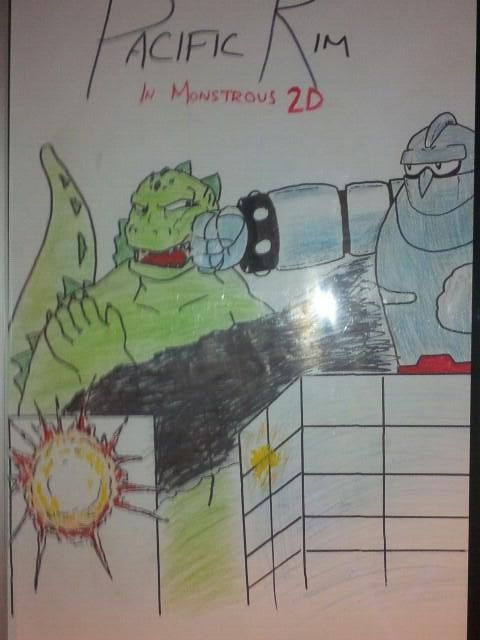
What’s this Pacific Rim movie about? I think it’s best summed up by this poster the North Hollywood Laemmle had up:

Actually, the only way Pacific Rim could’ve been better is if it had featured Gigantor beating up Godzilla.

After Man of Steel, I was basically never wanting to see another big-budget CGI summer blockbuster ever again, but I love me some Guillermo del Toro and, despite bad box office, the buzz on the movie was very solid indeed.

Verdict? Well, it’s a movie about giant robots fighting giant monsters. And it’s about as good as a movie about giant robots fighting giant monster can be. Which ain’t great—but also ain’t bad!

The premise is unapologetically Japanese Video Game-y, with the earth under assault by Kaiju, monsters who emerge from the ocean (via a gate to another dimension) to terrorize shore cities. In order to combat the Kaiju, earth’s governments band together to create Jaegers, giant robots which must be controlled by two psychically linked pilots.

The frequency, power and quantity of kaiju incursions is on a rapid increase, so level up Kaiju pilots!

Here’s what works in Pacific Rim:

  • The CGI is excellent, but it doesn’t seem to exist for its own sake. 

Think about that for a second: A movie about giant robots and monsters fighting—a movie that would not exist without CGI—actually shows tremendous restraint, and avoids the 20-minute-combat set pieces found in, say, Man of Steel.

  • The scope is global, but the drama is primarily personal.

Also kind of astounding, in a movie that sets up the “save the world” plot from scene 1 is actually focused primarily on the (melo)drama of the lead characters. The psychic link is a convenient shortcut for the sort of bonding you get in more realistic combat movies. This makes it more engaging than either Man of Steel and (most of) World War Z.

  • The plot has a few mild twists.

Nothing super-shocking, but not a straight shot from first punch to final boom.

  • It has a real “anyone can die at any moment” feel.

You don’t usually get any kind of surprise in a blockbuster as to who is going to live or die. But this was almost horror-movie-esque. (More on this in a moment.)

  • Ron Perlman!

More on this, after we cover the bad, too.

Here’s the bad:

  • The acting isn’t very compelling
Maybe it’s not the acting, exactly, but there’s not a lot of charisma on screen here. A movie like this needs a William Shatner or a Nic Cage even selling it. ‘cause, you know: silly. Suspension of disbelief hard-strained.
  • It’s magicky.

OK, this bugs me, though obviously, in a movie about giant monsters fighting giant robots, engineering isn’t a big deal. And there’s a typical (enjoyable) comic book logic that leads one to the path that says “Yes, giant robots are, of course, the way you’d fight giant monsters, because you couldn’t possibly deliver the same or far worse damaging payloads from long ranges with missile and plane attacks.”

That aside, the actual combat is about at the level of Toho’s Godzilla movies and, truth-be-told, most action movies these days: We have a fight until the plot necessitates some resolution, and the damage done is exactly what is called for at any moment.

I’m not complaining, in the sense that of course that’s the way it would play out. Why spend a few thousand dollars of your $200M budget to try to make sense? Whatever you came up with to tie things together with some semblance of coherence would get taken about in one of the draft processes any way.

But it does distance me. It’s not even that I object to being awkwardly manipulated, it’s that this stuff is so clumsy as to be completely ineffective manipulation.

Probably the worst thing is that this movie about giant monsters fighting giant robots isn’t even the worst offender of this variety.

Now, the neutral:

  • No all-star cast.

This aspect of the film was interesting. Ron Perlman was the only actor I could name in this film, and he’s typically B-movie fodder, though he played Hellboy, the beast in the ’80s “Beauty and the Beast” TV series, and a caveman in Quest for Fire.

He’s usually in makeup, in other words.

But this allowed them to make the results of the movie somewhat less predictable. It made the horror movie-esque aspect possible, or at least more likely. And it doubtless knocked $30-40M off the budget.

It may be why there was no really compelling charisma there. The Japanese girl, Rinko Kikuchi (who was in one of my favorite films a few years back, The Brothers Bloom) is a good mixture of vulnerability and moxie, and Charlie Hunnam (Children of Men) strikes the right notes as the humbled hero. Even Idris Elba (Prometheus, the black Norse God in Thor), whose role is the most egregiously clichéd, pulls it off.

I don’t know if it’s the acting per se, really. But there’s a lot more genuine chemistry in del Toro’s Hellboy movies. This may be one place where the scale actually did hurt: There’s too much space for the camaraderie to fill. Also, the characters end up dying at an alarming rate, long before you can care much for them.

Weirdly, this might need a four hour director’s cut.

Anyway, The Boy, who hates this kind of stuff really and truly enjoyed it. I mean, he saw the original Transformers movie when he was about 10, and hates it to this day, and leans against the big, dumb action flicks that are aimed primarily at his demographic. But this won him over, I think due to a general lack of pretentiousness, and a degree of respect for the audience.

It’s bombed here in the U.S., looking like it might just barely clear $100M, but it’s earned twice that overseas, such that we might actually get a sequel.

So, I guess the recommendation is: If you can like a movie about giant monsters and robots fighting, this is probably a movie you can like.

Our Nixon

A documentary! About Nixon! This is gonna be…

Well, let’s be honest, it’s going to be hideously biased about Richard Milhouse Nixon, right? Ain’t nobody actually objective making documentaries any more. If we’re lucky, they’re like Morgan Spurlock and state their biases up front. (Well, Spurlock did that in Supersize Me, but went far less honest in later works.)

The premise here is that a bunch of Dick lovers, Ehrlichman, Haldeman and Dwight Chapin, took a bunch of Super 8 “home movies” of the various shenanigans going on in the White House from 1968-1974ish, which have been recently declassified or somehow or other made public domain, and enterprising filmmaker Penny Lane has edited from the many, many hours of doubtless stultifying footage and selected presumably the least dull footage, over which snippets of the legendary tapes are played.

The Boy was not engaged, especially, though he came out feeling kinda sorry for Tricky Dick, which he felt was probably not the filmmaker’s intent.

I was rather more, since I knew a bit more about the times and people involved.

The best parts of this are the truly documentarian parts, which is to say, there’s a lot here that reflects well on Nixon and poorly on the press, which was by-and-large quite obviously out to get him.

Then there are a couple of parts that seem gratuitous: Nixon fretting over Kissinger’s seduction techniques, which apparently involved taking total credit for the China trip. Nixon asking for help from Haldeman (or Ehrlichman, I can’t recall) after he’d had to resign in disgrace. And worst of all, an anti-gay diatribe.

Nixon didn’t care for the gays. And upon viewing a pro-gay episode of “All In The Family”, he vented on the subject. And he vented in a way that was pretty normal for the time, if a bit bombastic. And not just that time, but just about every time in the past 1,500-2,000 years.

That felt agenda-y, but I assured The Boy that he probably could’ve heard similar diatribes from all previous Presidents, and if not making them, then they almost surely heard uncritically such things. MLK didn’t embrace homosexuality, unsurprisingly, although squabbling over his corpse is done to speculate on how he would have evolved. (I can only assume he would’ve evolved out of being a Republican, too, by that light.)

Anyway, the real problem here is that the tapes are the interesting part. The actual film is what you’d expect from home movies: Shots of scenery and taking pix of someone else holding a camera who’s taking pix of you. It might add some depth if you viewed these guys as monsters, I guess. I dunno.

It’s short but feels a little too long. Director Lane has a cute trick of calling herself the “co-director”, with the CREEPers being the other directors, one presumes.

Mud

I think I was thinking this Matthew McConaughey Mud had some anti-government messaging in it, as a follow-up to the previous day’s scathing attack on bureaucracy, Still Mine, but on reflection I’m not really sure it is, particularly.

It’s somewhat reminiscent of my favorite movie of last year Beasts of the Southern Wild, in which the government was an implacable, overbearing force, in that it’s a coming-of-age story that takes place in the south (Arkansas, not Louisiana), where the river and water represent freedom and joy in living. And also where a government decree is going to end that life, so I guess it is to that extent.

This movie, written and directed by Jeff Nichols (Take Shelter) is about a couple of pubescent boys who gambol around the delta and run across a fugitive named Mud (McConaughey) who’s hiding out from the law, waiting for his girl, Juniper (Reese Witherspoon), and needs some help keeping out of sight and escaping from the dragnet that’s out for him.

Now, Mud isn’t the main character. He’s just the catalyst for the story and the lens through which the actual main character, Ellis (Tye Sheridan) views his impending adulthood.

Basically, Mud is about love. Romantic love. Mud is a guy who epitomizes Ellis’ idea of love. He’s on the run because he killed a man who beat his darling Juniper. That’s love, right? Not like his squabbling parents, who are on the verge of divorce. But maybe like May Pearl (Bonnie Sturdivant), this girl he’s sweet on.

But probably not.

It’s fair to say women do not come off well in this flick, which, interestingly (for all the war on men) talk, has been an undercurrent in several movies we’ve seen lately.

Mud adores Juniper, but she in no way behaves like a woman who deserves to be fought for so fiercely. (I’m not a big fan, but Witherspoon is great in this role.) His mom, Mary Lee (Sarah Paulson of Serenity, “Deadwood” and Martha Marcy May Marlene) seems to be perfectly willing to destroy the family on the basis of, well, her husband’s just not up to what she figures she deserves. May Pearl is a teen girl who has no concept (or interest) in Ellis’ intensity.

But there’s nothing about this movie that’s simple.

We can certainly believe Juniper when she says Mud isn’t all he’s cracked up to be, and Ellis’ dad is kind of a mope, and Ellis certainly went overboard in his affections toward May Pearl.

Life ain’t simple. It’s messy.

Through it, you can count on your friends, or so you hope. In this film, Ellis’ companion is the steadfast Neckbone (Jacob Lofland), but Mud also has a father-figure/friend in Tom Blankeship (Sam Shepard). It’s only poor old dad (Ray McKinnon, also of “Deadwood”) who doesn’t seem to have a friend to fall back on, in fact. And he’s not doing too well.

Oh, and Michael Shannon (Take Shelter) is Neckbone’s older brother who has a small but significant role as someone who follows a kind of Man Code in dealing (and not dealing) with Ellis, Neckbone and Mud.

This was kind of weird. Shannon was totally normal in this. I don’t think I’ve ever seen him not play a prophet, psycho, drug addict or hit man before.

Anyway, an excellent film that I think reaches the greatness that Take Shelter narrowly missed. Barely cracked the top ten at the box office, I think.

The Boy also really enjoyed it, while picking up on another theme: Honesty. The movie had a lot of plot points revolving around how people handled situations, truthfully or otherwise.

Unlike a lot of films that, when you think them over, they get worse and worse, this one gets richer and richer.

Oh! And Joe Don Baker was in it! I had to explain to The Boy why I called out Mitchell! when he came on screen.

Still Mine

It was unusual to see what seemed to be two small-government oriented films in as many days, and quadruply for one of those films, Still Mine, to be Canadian.

James Cromwell and Genevieve Bujold play Craig and Irene, a married couple in their late 80s (! they’re both actually in their early 70s) who are starting to have a little trouble fitting in to the modern world.

By the way, the fact that they’re Canadian is never actually mentioned. They could be Midwestern. I suspect they figured that’d be better for the American box office. (The movie’s made about $300K domestically so far, so I don’t know if that’s right or not.)

Anyway, Irene is losing her mind, and Craig’s solution is to take some of their land (the portion with a better view) and build a new, smaller, more manageable house.

And when I say “build a house,” I mean personally build a house.

Awesome, right? I mean, just a 70-year-old building a house would be pretty cool. An 87-year-old even moreso. And of course he finds that building the house is therapeutic and rejuvenating and gives him a purpose and direction and vision he hasn’t had in a while.

Of course, the government wants to stop him. He’s got to have permits and inspections and licensing, and a whole lot of stuff he can’t afford because we live in a Nanny State. Doesn’t even matter that it’s Canada. It’d be the same anywhere in the Western world no doubt.

The movie never fails to show us the difference between the way we live today, and how these relics from the past live and have lived: Shunning debt, living simple lives without a lot of electronic gewgaws, being self-reliant, but also generous and supportive. Indeed, the couple’s history throughout decades results in support from a variety of corners when it is most needed.

James Cromwell is great, of course, who manages to play Craig without resorting to stereotypes. He’s good without being saintly. He’s crusty, even rough, and not always quick to apologize. He gets frustrated with Irene, but he can’t live without her.

Genevieve Bujold—well, what can I say? I’ve never been a fan. Never especially noticed her. She was amazingly photogenic, I guess, back in the day, but never really drew me in the movies. (I mean, if you go look at a still photo of her from her youth, she’s flawless, but I saw her in bunches of movies without even noticing her.) Until now.

She was completely charming in this. Dementia is a tricky thing to play, momentarily there and gone again. She was believable, sympathetic, vulnerable yet still with a kind of strength that made her plausible as a once self-sufficient farmer’s wife. (Well, at least the Hollywood version of one.)

Director Michael McGowan keeps it low key but lively, much like his 2004 film Saint Ralph. The Boy and The Flower both liked it, too. I think the key to that being that Cromwell is very likable and we all can relate to not liking to be told what to do by bureaucrats.

It’s not really political per se and it’s hard to imagine the people involved being anything less than die-hard leftists, but it’s hard (for me, at least) not to see a strong message about independence that’s anti-government.

World War Z

Zombies. Love ‘em or hate ’em, they’re here to stay, apparently. I mean, think about it. This latest binge-of-the-undead started in 2002 with Danny Boyle’s excellent 28 Days Later. (Resident Evil was also that year, but it was more of a Matrix rip-off than a traditional zombie flick.)

Now, eleven years later we have World War Z, which is about as far from Night of the Living Dead in concept and execution to make one question whether it’s even the same genre. And it’s not. NotLD is a horror picture. This (like the Resident Evil series) is an action flick with zombies.

And, as far as action-based zombie flicks go, this isn’t a bad one. In fact, it starts off pretty smart. Brad Pitt is passable as some sort of retired spook whose actions once he realizes something is afoot seem reasonably plausible (if improbably lucky) and the action is fairly well choreographed. Marc Forster (Machine Gun Preacher, Finding Neverland) has a sure hand and moves the proceedings along at a good pace.

When Pitt is rescued by his military buddies and taken to an aircraft carrier (also smart!) things take a turn for the silly. Despite having seen two big eastern seaboard cities wiped out by zombies, when The Company (I don’t remember what actual agency it was, if any was mentioned) tells Pitt they need him back out in the field to try to get to the bottom of these spooky hijinx, he has a heart-to-heart with his wife (Mireille Enos, “Big Love”) that goes something like this:

Brad: They want me to go out and save the world.
Mireille: No, you can’t!
Brad: I don’t want to. I have to.
Mireille: I’ve seen what this job did to you.

Wait a tick. What?

This is one of my biggest pet peeves about post-apocalyptic stuff: The idea that the trivial concerns of yesterday matter. “Falling Skies” and “Walking Dead” do this all the time. On one of those shows, when a young boy wants to learn to shoot a gun (reasonable and necessary in both circumstances) the parent says something like “He deserves to have a childhood.”

Sorry, you’re not surviving the apocalypse, buddy.

It takes a further turn into silliness when Pitt visits Israel. In a conspiracy reminiscent of 9/11, the Jews knew all along! Actually, the truth as a revealed makes a lot of sense and Israel would be pretty well suited to surviving an apocalypse of this sort, but what actually happens on screen is kinda dopey. Kinda way dopey.

There’s some other very serendipitous stuff past that, but ultimately the movie isn’t weighed down by the silliness, and there are yet many good parts mixed in with the typical dopiness. There also wasn’t a ton of look-at-me-CGI; there’s a fair amount of CGI but it doesn’t drag the movie down much.

The Boy and I recommend, if not wildly enthusiastically.

Star Trek Into Darkness

So, yeah, another Star Trek movie. We tend to see the blockbusters semi-reluctantly, and usually after they’ve gone to the bargain theater, you may have noticed and, well, this is one of ‘em.

This one continues the reboot from the 2009 version, and it’s much like that one, and kind of curiously references the second Star Trek movie, The Wrath of Khan. JJ Abrams again directs, and the cast, which is probably the strongest aspect of both films, is back, spreading the thin screen time between them.

The reboot also continues the tradition of taking elements of the original and doing whatever the hell it feels like with them.

Chris Pine and Zach Quinto are reprising their roles as the original slash-fic duo, with Karl Urban continuing his marvelous homage to DeForest Kelly. Simon Pegg is great, of course, as Scotty and Anton Yelchin and Harold and Kumar’s better half are barely there as Chekov and Sulu, respectively.

One of the strong points of the movie is maintaining the hookup between Uhura and Spock, with Zoe Saldana adding a lot of fire and excitement to what’s otherwise basically a sausage-fest. Benedict Cumberbatch rounds out the cast as the mysterious and menacing…uh…menace.

So, the cast is good, and the story is reasonably interesting, in its semi-recycled way. The action is also pretty good, though the big action set piece at the end gets old before it’s over. I dunno, I pretty much forgot it right after seeing it.

My companions enjoyed it, more than I, and I’ve never been into the Trek thing, so take that into account. But right after seeing this, I heard tell of this book, Save The Cat, and how the Bigs are using it to map out movies to the beat.

It certainly explains a lot. It’s not so much the obvious cliches, like the heroes moment of darkness at the end of act 2—that’s all pretty standard stuff—as it is these long action set pieces that grind the story to a halt, and are at least as predictable as any old Oater serial.

Basically, I think you have good moviemakers (and Abrams knows what he’s doing) breaking the rhythms of their films up to conform to this external idea. I don’t even think I object to the sameness of it; it’s just the whole putting-stuff-in-where-it-doesn’t-belong that gets to me.

As the Boy commented after one of the summer blockbusters, the action set piece is to modern films what the sex scene was to films of the ’70s: Mandatory, pointless and kinda dumb.

Any way Into Darkness wasn’t bad, as far as these things go, it’s just that these things aren’t going very far these days.

20 Feet From Stardom

OK, I’m going to start by telling you how wonderful this documentary about backup singers is, but then I’m going to wrap it up by taking a dump all over it. Just be forewarned.

This is the story of the black choral singers who emerged from during the rock ‘n’ roll years and provided a lot of the character and finer qualities of music of the past 55 years.

The movie starts by describing the transition from the all-white backup singers predating rock ‘n’ roll, and then how the kind of gospel, preacher sings/choir answers format began to permeate popular music and become the in thing.

The primary focus of the film is on Claudia Linnear and Darlene Love, who were big in the ’60s and ’70s before musical tastes changed and their careers petered out, and secondarily on Judith Hill, an up-and-coming singer who has to struggle between doing backup and establishing herself as a solo artist.

There are many others mentioned and features but, perhaps fittingly, I’ve forgotten their names (though not their voices).

The anecdotes are punctuated with interviews with many of the stars who used their talents over the years, like Mick Jagger, Sheryl Crow and Sting, who comes the closest to truth by admitting to being somewhat befuddled by what makes success. Destiny, he says, and perhaps that’s a good word for it.

After all, you must be gifted, as these people all were, and you must work hard, as these people all did (and do). Then you must also be lucky, and in many ways, they all were. But last, you must really want to be a star, to the point where, perhaps, you sacrifice your soul in the process. (Not that you have to sacrifice it, but an unwillingness to do so is going to be a barrier.)

So, what did we learn? Phil Spector was apparently a psycho long before he murdered Lana Clarkson. Darlene Love, who got screwed by Spector over a Christmas song (that he released under a different girl band’s name because, you know, it was really a Spector album anyway), took a few years off to clean houses, then came back (to a degree) to sing on Letterman every Christmas and to take a supporting role in the original Lethal Weapon.

Oh, what was cool was that I had just tweeted, prior to seeing this, this great clip from The Concert For Bangla Desh where Leon Russell does a medley of “Jumpin’ Jack Flash” and “Youngblood” and I said, “Listen to the call/answer between Russell and the backup singer"—and said backup singer turned out to be Claudia Lennear!

(I’d link the clip here, but it’s been pulled by Apple Corps, which I’m sure is exactly what The Beatles had in mind when they started that label.)

You can’t say enough good things about Lennear’s singing ability. It is otherworldly. It’s Barbra Streisand quality, except I never wanted to punch Lennear.

This is a bit of a hagiography, of course, and that’s fine. The closest that it comes to challenging anyone is when Lennear says she never set out to be a sex symbol and they point out that she posed for Playboy. She just laughs and blushes a little. (Lennear was known as "Brown Sugar, and consorted with both Jagger and Bowie back in the day. And she really epitomized the "black is beautiful” aesthetic of the ’70s.)

The weakness there is that we don’t get much insight into things. It’s great as a stroll down memory lane—even for a guy like me, who doesn’t know much of the music—and it’s entertaining in itself, as both The Flower and The Boy enjoyed it, and they knew maybe one or two of the songs. (The Flower knew “Thriller” and presumably The Boy kinda-sorta knows it.)

But when they stroll through the list of ’70s backup singers who had solo albums (that all flopped) there’s very little discussion or insight into why. (That’s when Sting floats the “destiny” idea.) Though as they were panning over the albums playing clips, it didn’t strike me as surprising: There was nothing memorable, musically, in any of it.

The ’70s was a peak for generic music that rewarded image more than musical skill. Modern day is probably much worse, with the autotuning and all that. Which leads me into my rant.

First, the film features an actual damnable “critical race theory” professor from USC, and he’s there to talk about sticking it to The Man, as needed. The White Man, of course. This is always unpleasant at best, and grossly hypocritical at worst.

Merry Clayton sang backup on Lynyrd Skynrd’s “Sweet Home Alabama” and this was framed as showing the White Man how great and indispensable these backup singers were, something which, I would guess Lynyrd Skynyrd knew, given that he asked for her in the first place.

You did it because it was a paying gig, and Skynyrd wasn’t racist. Or they were racist and you’re awful. Pick one. Don’t pretend to be making a statement.

The elephant in the room, however, is this: The movie begins with a triumphal celebration of all these black gospel singers crowding out the white girls who had come before. The black girls couldn’t read music, but they could spontaneously harmonize and riff, which was more suited to the music of the time.

Then, the movie ends with a lamentation about autotuning and how the industry doesn’t respect talent any more. You suppose any of those white girls in the ’50s had talent? Or were the impulses of a youth-driven culture more important than, say, the ability to read music?

In other words, it’s completely un-self-aware, like most Baby Boomer-oriented stuff. History began in the late ’50s, the culture of the ’60s and ’70s was the best, and any deviation from that is just horrible.

Yeah, I sound grumpy, because the message is one I’m tired of hearing. But it’s not a hard thing to look past, and I recommend you do. It’s a good movie.

The Purge

I was of two minds regarding The Purge, the new thriller flick about people in an idyllic future who endure one night a year where all law is suspended. If it were predominately science-fiction, I probably wouldn’t have gone to see a movie with such an amazingly stupid premise. But as a horror flick, it had a lot of potential, since the premise is barely significant against the execution.

And I nailed it, which I guess is some comfort, given that the movie is a really fine action/horror/thriller stuffed into the most preposterous and ill-considered science-fiction premise since In Time.

As a result, the Boy and I were somewhat split, with him really liking it (better able to overlook the silliness) and me thinking it collapsed at a couple of points under its own absurdities.

The good stuff is really quite good. Ethan Hawk plays James, a well-to-do suburbanite who sells defense systems for The Purge, including discovering on the day of The Purge that he’s the #1 sales guy at his company. The movie avoids making him a villain, or even much of a jerk, except insofar as the whole system is corrupt and he’s part of it.

Lena Heady plays his wife, Mary, and she does more acting in the first fifteen minutes than everyone else combined. Not, like, BIG acting, just that she goes from being the concerned mother/beleaguered wife/concerned mother within just a few beats, and her carriage and demeanor and speech all changes slightly depending on whom she’s interacting with. She ends up showing a lot of range by the time the movie’s out.

Adelaide Kane plays Zoey, the bitchy teen daughter with the bad boy boyfriend who sneaks around to see her behind the folks’ back, and who can’t get enough busting her dad’s chops.

The son, Charlie, is played by Max Burkholder who recalls a young Christina Ricci. (I say this without snark; there’s a similar dark complexion and roundness to the face.) Charlie is the one who has the most doubts about the whole affair, and who endangers the family by letting in someone being hunted by group of Purge maniacs.

So, these relationships are well done and not portrayed cartoonishly. This is good.

There were a lot of ways this could have gone, and the movie doesn’t always take the unexpected way out, but there were a few good twists all through. Also, in the more by-the-numbers part of the movie, there is a great deal of suspense, mixed in with some jump scares, and a truly fine fight scene that impressed both The Boy and I.

In other words, The Purge doesn’t pick a technique or style and stick with it: It switches from dystopia to haunted-house to home-invasion, and so on, in a manner that keeps the proceedings feeling fresh.

The problem is that when it switches into sci-fi dystopia, it’s not just silly, it’s stupid and really virulently anti-American in a way only a Chomsky fan could love.

The premise is that ten years in the future “The New Founding Fathers” have instituted this purge and it made the country a dramatically better place. There’s no crime, except this one night. Unemployment is 1%. Poverty is eliminated. All at the cost of this one night.

Well, much like Minority Report or Demolition Man, if we’re to believe the narrative, that’s a pretty good tradeoff, even though the movie clearly wants us to eschew the premise by telling us that “the poor” suffer the most on this night because they can’t afford protection.

Well, wait, did this eliminate poverty or not?

And if you asked poor people if they could live their lives unharassed for 364.5 days out of the year in exchange for having to defend themselves for twelve hours, would they not agree? Hell, everyone would.

Of course, this is silliness. A substantial portion of crime is poor impulse control. Both short term, as in wanting to kick someone’s ass who badly needs it, and long term, as in not planning ahead for one’s needs and having to find shortcuts to get out of messes.

The follow-through is also dumb: If  you know that one night a year, everything goes, do you build yourself an entirely defensive structure (as they do in this movie) or do you get some serious ordnance to take out anyone who threatens you? Nothing in this defense system is electrified, fortified with guns or explosives, no boiling oil nor even crenels from which to shoot the variety of guns the family owns.

Also, it’s clear that The Founding Fathers are some sort of nod at the Tea Party. The Emergency Broadcast System actually ends with something like “May God be with us all.” Right.

And the MacGuffin in this film is a homeless guy. But, as I pointed out to The Boy as the movie showed B-roll of The Purging, all those people rioting and killing? They all gotta be at work the next day! (1% unemployment!)

And who the Hell manages to be homeless in a world with 1% unemployment. I mean, homeless, and also clean, well-spoken and ethical, as the guy turns out to be.

The villains are, of course, rich people. All of them. They’re all villainous and they’re all rich. There’s not even a middle class bad guy in the lot. And poor people are only victims, never perpetrators in this imagining.

On the one hand, you want to give writer/director James DeMonaco for recognizing that you can’t completely will away people’s dark sides, no matter how cheerfully the government decrees it to be so. (Though as I’ve mentioned, the very acknowledgement underscores the fact that the premise is stupid.)

But on the other hand, it’s gross bigotry to suggest that pretty much ALL rich people would engage in violence if they had a free pass. (Violence, as I’ve noted many times, is not like sex. It’s seldom very much fun, it’s messy, it’s dangerous and people aren’t really all that inclined to be violent.)

Sometimes this failure to grasp basic human nature, this ham-handed demonization of The Other (even though you know DeMonaco is rich by 99% of the population’s standards) results in some unintentional comedy. (The audience laughed. Loudly.)

Tough time recommending it just as is. (Note that some critics felt it wasn’t preachy ENOUGH.)

And, as noted, this is a rip off of an episode of the original “Star Trek” series, “Return of the Archons”. But there, a computer was mind-controlling everyone. Eh. I’d have a hard time recommending that episode, too.

Only God Forgives

So, having left the last pic without really feeling our Gosling needs were satisfied, we trundled on down to the Encino Laemmle to see Only God Forgives, Nicholas Winding Refn’s follow up to Drive. Though they are not related.

Though you couldn’t be blamed for thinking they might be, given the whole Ryan Gosling underworld thing.

On the other hand, that covers most of Ryan Gosling except Crazy, Stupid Love. (Wait, what did he do in that movie? Boost jewelry stores?)

I digress. However, that’s nothing compared to this movie. They’re calling it Lynchian, and I suppose there’s something to that. The Flower had a hard time following it. The Boy followed it all right but thought they overdid it with the artsy stuff.

I could see that, though I like that sort of thing. My reaction was more akin to my reaction to watching “The Evil Dead”. Parts of it you just think “Wait, are they serious?”

This is basically a tribute to Asian revenge flicks, as it concerns the Muay Thai-training Julian (Gosling) whose brother rapes (and possibly kills, I can’t recall) a girl, only to be killed by the girl’s father. The father, in turn, gets a visit from the otherwordly Chang (Vithaya Pansringarm, the priest in the last scene of The Hangover II) a detective (I guess) who extracts a penalty from the father as a reminder to the father that he has three other girls he has to take care of.

Life lessons are tough. Especially when you’re a parent.

That’s the set up. The movie starts in earnest when Julian’s insanely evil mother (Kristin Scott Thomas) shows up wanting the father dead, and expecting Julian to wreak havoc all around.

KST is worth the price of admission alone. I have to say. When she’s not threatening Julian with murder, she’s coming on to him or maybe just waxing nostalgic over the size of his late brother’s member. Julian hires his favorite hooker (the flawless Yayaying Rhatha Phongham) to play his girlfriend and the result is something like Wes Craven directing an episode of “Dynasty”.

This is all building up to a confrontation between Chang and Julian, though there’s no doubt how it’s going to turn out. The two are psychically linked, and the scene of their confrontation is played out in Julian’s head several times in the movie. To the point where it finally happens, you’re sort of not sure it actually happened this time.

Gorgeously shot, though about the 15th time someone was framed between a high vertical boundaries (doorway, long hall) I was kind of thinking “OK, I get it, I get it! We’re all…uh…squeezed? Between something? OK, I don’t get it, but enough already!”

Chang does Karaoke.

I don’t know. It meant something. He was kind of an angel. An angel of death.

He could draw a Thai “dha” (sword) from behind his back when clearly there was no sword in the previous scenes. (This is deliberate, not a continuity error, I have no doubt.) Also, he floats around (The Boy observed he did not swing his arms when he walked) with a couple of beat cops who watch him slice people up.

Well, look, the theater was so packed, the only three seats were in the first row, and they were not together. So this guy has some fans.

Leaving the theater, I noted that virtually all of them were 20-something males, with a few girlfriends thrown in here and there. (And treat yourself to the Lifetime channel, or whatever, for being such good girlfriends, ladies.)

I dunno. It’s self-consciously artsy. One thing about Lynch is that I never felt like he was trying to be weird. He just is. He’s trying to tell a story using the conventional trappings but it’s not the story indicated by those trappings. (Best illustrated by the “Who killed Laura Palmer?” craze of “Twin Peaks”, as if that was meant to be a murder mystery.)

I wouldn’t knock it. It’s short, it’s an interesting effort, it’s memorable. Was it entirely effective? Not for me, and certainly not for the kids.

Gosling himself? I dunno. This is a part that calls for a pretty tight lid on any emotions. So he does a lot of vacant staring.

But there it is. I don’t expect it to be a huge hit. This was, apparently, to meet some sort of requirement for award season. (I thought Oscar, but I also didn’t think Oscar’s requirements were anything other than “shown in a theater in L.A. in the year nominated”.)

It’s not a critical smash so I doubt it’s going to be up for much.

The Place Beyond The Pines

“We should go see the last Ryan Gosling underworld-y flick before we see the new one tomorrow!”

And so it was that we journeyed to finally see The Place Beyond The Pines (before hitting Only God Forgives the next day) in its limited run at the local(ish) discount theater.

TPBTP was favorably received, the latest effort by writer/director Derek Cianfrance, who did 2010’s well-received (if wholly depressing sounding) Blue Valentine also with Gosling. Critics and moviegoers ranked it around 80% on Rotten Tomatoes, e.g.

We would tend to disagree.

This movie is, in fact, three different (and sequential) stories, only the first of which is with Ryan Gosling. The Flower leaned in and whispered “Bait and switch!” (She also earlier spotted a motorbike-mounted-camera shot and said “Evil Dead rip-off!” I’m so proud.)

This is a really hard to thing to do successfully in a film. I was trying to give the kids some examples of it working and came up empty. There are anthologies that work. There are movies with disparate stories that are only thematically connected that work. There are movies with separate stories where the stories ultimately tie in together—that’s pretty common.

But a movie where the stories are both causally and casually related? They don’t leap to my mind. (I couldn’t think of it at the time, but American Pop works pretty well, up to the ‘60s/’70s.) I think there’s a reason for that.

The first story here is about Ryan Gosling who discovers that last year’s fling has produced offspring and who takes it on himself to provide for the youngster the only way he can: through crime and violence. (And a theme that I think carries over from Blue Valentine: Baby Mama Eva Mendes is perfectly happy to hook up with him again behind the back of her stable beta provider, Mahershala Ali.)

This is a kind of compelling story, in the vein of Dead End, in that Gosling’s sole noble motivation is the care of his child and (to a lesser extent) the child’s mother. He’s basically a murderous thug apart from that. There’s really only so far you can go with that.

The movie takes that to its logical conclusion and gives us Bradley Cooper, the ambitious lawyercop who stops Gosling’s reign of terror (mostly through dumb luck) and catapults himself into a DA position.

Then, after that plays out, we flash forward fifteen years (most of the movie takes place in the late ’90s) when Gosling’s kid and Cooper’s kid (mostly through dumb luck) meet and befriend each other.

Yeah, there’s a whole lot of coincidence here. And, I guess, thematically, this is about the sins of the fathers being visited upon the sons. The problem we had was that we didn’t care. The characters reveal themselves through their actions, which is generally a good thing, unless those actions don’t make sense to the audience. Then it’s just stuff that happens.

That’s how we felt. All three of us.

The other thing was that when the Gosling story ended, the momentum of that story stopped, and the movie stopped with it, dead in its tracks. The next story doesn’t ever build the same momentum, but what little is built is killed. The last story never really builds much momentum as the two kids seem virtually interchangeable.

Which kind of bugged me. The DA’s son had the same thuggish marble-mouthed manner of speaking as the bank robber’s son. And since the bank robber’s son was raised by nice, middle class people who enunciated clearly, it didn’t even make sense for him to talk like that.

A minor point. It’s not that we hated it, but we felt it lost momentum at the end of act one, and just got slower after the end of act two. Really, we were debating whether the third act was the longest. (I think it was the shortest but felt the longest.)

Anyway, another day, another Ryan Gosling underworld picture, and the next one would be flat out weird.

An Unfinished Song

Around these parts, Terence Stamp is best known for uttering the immortal words “Kneel before Zod!” Indeed, wherever he turns up, whether it be The Devil his ownself (Company of Wolves) or a murderous alien businessman (Alien Nation), he seems to be, well, a less-than-chipper fellow.

So seeing him as a crusty old septuagenarian who snarles at his dying wife (noted communist Vanessa Redgrave) is a natural. As this is a story of redemption, by far the most alarming thing is seeing Mr. Stamp actually smile. I’m pretty sure I’ve never seen him do that in an unironic fashion.

I guess I wasn’t supposed to like this film, written and directed by Paul Andrew Williams (The Cottage), with its sentimentality and testimony to the power of love, but I did. (Just as I loved the documentary that was the clear inspiration for it.)

At one point, Arthur (Stamp) says to Marion (Redgrave), “You know how I feel about enjoying things.”

And it’s clear she does. And always has. And it’s equally clear that he is similarly devoted, even if he’s limited in expression to grumpiness.

His son (Christopher Eccleston, of the first season Dr. Who reboot) is less understanding, understandably and has picked up some of dad’s grumpiness. I liked this part of the story as well, as Arthur is split between wanting to have a relationship with his son (and adoring his granddaughter) and thinking maybe they’re better off—maybe the world is better off—if he just keeps to himself.

A less likely relationship is that of Arthur with the young choir teacher (Gemma Atherton, Pirate Radio, Clash of the Titans, Prince of Persia, Hansel and Gretel), who has some of Marion’s ability to see past Arthur’s bitter introvertedness. Unlikely, perhaps, but necessary to the story.

The Boy and I liked it. The Flower demurred on the basis of “old people singing,” but she would’ve liked it. The music is considerably more sentimental than “Young @ Heart” which featured hard rock almost exclusively, but largely well chosen and appropriately performed.

I recommend, unless you’re a bitter old crank. Well, bitterer and crankier than Terence Stamp, anyway.

The Attack

I don’t think I’ve reviewed Paradise Now here, although I mentioned it in reference to Traitor, but that’s okay because I can now review The Attack. Now, the movies actually don’t share writers, directors, just an executive producer (Amir Harel) and an actor (Ali Suliman), and yet this new movie feels almost identical to the previous one.

The main difference is that Paradise Now showed nothing but unchallenged Palestinian POVs that blamed Jews for everything where The Attack shows Israelis in a relatively positive light, at first, anyway, but ultimately gives the Palestinian POV last word.

The story of The Attack is that a celebrated Palestinian surgeon discovers that his wife was present at a bombing in a local café, and the authorities are accusing his wife of being the one with the bomb, and of him being in on it.

This isn’t a mystery: Even in the trailer, it’s clear that his wife did do it, and the movie is about the surgeon’s journey from denial, to acceptance, to understanding.

Just like Paradise Now, this is a good movie. But also just like Paradise Now, that last step is a doozie. In Paradise Now, you’re just assumed to have drunk the Kool-Aid. In this movie, there’s an attempt to make you understand the plight of the Palestinians through the surgeon’s journey. In the end, you still have to drink it, though.

And there’s where I have trouble: I believe both movies present highly idealized representations of terrorists, which makes them more sympathetic, but makes that final step impossible to contemplate.

I mean, seriously, no normal person says “Hey, you know what would improve things? Me strapping a bomb to myself and blowing up people at random.” That’s beyond “not normal,” it’s insane or just outright evil.

The movie excuses itself from showing this by having the surgeon investigate and come across bits-and-pieces of the picture which, I’m sorry, still don’t add up to “Ima blow myself and lots of other folks up.”

Also, the surgeon’s wife is Christian, which is pretty freaking rare in Palestine, working with Christian terrorists which I won’t, without a lot more independent evidence, accept, except as an attempt to pretend there is a Palestinian people independent of Islam, and thereby justify (as if it did) atrocities.

The movie also curiously and explicitly undermines its exploration of the wife’s motives in terms of the usual motivation for female terrorist (having brought dishonor to the family). I assume that’s, again, to justify atrocities as legitimate and self-originated, rather than pressure from an oppressive society.

Sorry, folks, if you don’t make your case clearly in your movie, I get to interpret it.

The Boy and I both looked at it like “Yeah, that’s interesting…but, huh?” Approach with caution.

A Hijacking

Look, I’m an American. If negotiations for a hijacking on any boat I’m on take longer than two hours and exceed $200, I fully expect some marines (or ex-marines) to come in and take care of matters, in their time honored tradition.

Hell, if you say “It’s a story of a ship that gets hijacked that’s focused on the chef,” I’m thinking that chef had better be Steven Seagal and Erika Eleniak had better be getting geared up to take her kit off for Under Siege 3.

A Hijacking is a Danish film, however (Kapringen)—and our Danish friends have fallen a long way from their Viking days. This is about an hour-and-a-half of a very realistic-seeming sequence of events involving the pirates, the hostages on the ship, and the corporation the hostages worked for.

It’s a little unfocused, but rather refreshingly, the main character is the head of the corporation, who decides it’s his responsibility to handle the negotiations. He’s a noble, if somewhat pigheaded character, who doesn’t make a complete mess of things.

Didn’t really expect that from a Scandinavian socialist paradise.

The scenes on the boat are grueling and intense. At times, you can almost smell it, as the hostages aren’t allowed to use the bathroom and are stuck out in the still, hot air of the Indian Ocean. (At the same time, they’re part of what holds the story back, because the hostages are truly helpless.

Although they are able to maintain their bodyfat after four months at sea with limited rations. Heh. Lazy Danish actors.

The negotiating scenes are even more intense, because offers are made, rejected, back-and-forth, with days and weeks between them. The normally perfectly coiffed, hard-ass CEO gets more and more frazzled and you’re wondering how long he can go on under the stress he’s under.

We liked it. It was not a “high-octane adrenaline-fueled thrill ride,” but we weren’t really expecting that. Glad it wasn’t any longer, though.

Detention of the Dead

A stoner, a geek, a princess, a criminal and a jock—and then another jock, but he doesn’t last long—are serving detention when a zombie breakout occurs in the new indie flick Detention of the Dead.

So, yeah, The Breakfast Club by way of…uh…I dunno, some zombie flick. It’s cute, quirky, beyond campy, and light-as-a-feather, coming in comfortably under 90 minutes. It’s not just Breakfast Club, it also references Sixteen Candles, The Faculty, Night of the Living Dead (duh), and, well, a bunch of the other flicks the kids hadn’t seen.

There’s even a scene directly lifted from the ‘80s sitcom “Square Pegs”, though whether that’s properly a reference or just plain-old plagiarism, I cannot say. (The kids were impressed when I said the lines in advance, though.)

The opening scene is cut in Edgar Wright’s trademark styling (from Shaun of the Dead and the “Spaced!” TV show) but only that one scene. I gotta believe that’s due to the expense and effort to do sequences like that, but it’s kind of a shame because even a rip-off of Wright is funnier and more entertaining than the otherwise flat, stagey style that’s ostensibly original to Alex Craig Mann.

We all liked (but not loved) it. There are some good yuks and it’s lively enough, though it has the problem of occasionally becoming what it parodies. The basic dramatic tension, such as it is, comes from nerd guy lusting after cheerleader girl while ignoring goth girl, leading to goth girl delivering a climactic speech on how nerd-guy is just as big a jerk and sheeple as everyone else.

I’d say there was some biting commentary in a goth delivering messages about conformity, but this particular moment seemed completely sincere.

The original music was pretty good for the most part, but there were about two too many pop-song montages padding out the film.

Christa B. Allen, who plays the cheerleader, Janet—all the characters are named after famous horror characters, Brad, Janet and Eddie (from Rocky Horror Picture Show) as well as Willow and Ash from “Buffy, The Vampire Slayer” and Evil Dead respectively—was a standout, in part because her character was somehow the least cliched. She brought a lot of energy to the role.

She was also standing outside the theater when we got there, which was kind of cool, though the kids didn’t notice.

I could point out many more flaws, but that would seem to be overthinking it. It’s fun. Don’t expect too much. Enjoy the references and energy. You could do worse, and this summer, you almost certainly will.

Man Of Steel

The human being cannot resist giving himself an edge. This leads to what I like to call “institutionalized unethicalness”. For example, although there are alternate explanations as for why, I can’t help but believe that the reason a 2×4 isn’t 2×4, is because somebody started skimming off the edges, and soon everyone did, and finally a standard was created to stop the shenanigans.

And if it’s not true for 2x4s it’s most certainly true for hard disk sizes. One kilobyte is 1024 bytes. A megabyte should be 1024×1024, but various hard-drive manufacturers used 1000×1024, since it made the drives look more capacious in advertising. And so, today, if you buy a terabyte drive you end up with more like 900 gigabytes (because OSes report the actual size).

It’s not just true for trades and crafts, though. It’s also true for art. In music, the standard A-over-middle-C pitch is 440 cycles, which was a standard adopted in the 20th century. In the 19th century, it was closer to 420 cycles. Why? Because being a little bit sharp allows you stand out from everyone else.

The ultimate classic interpretation of this is Nigel Tuffnel’s amplifier that goes to eleven. (One louder than ten!)

I provide this historical diversion because Zach Snyder/Chris Nolan’s Man of Steel goes to eleven, and this seems to be what most people take from it, like or not.

If it’s not global, it’s cosmic in importance. It’s not enough to punch a guy through a building, you gotta punch him through twelve buildings and the streets and, you know, through a tanker of gas or something.

The Boy did not care for it. He didn’t hate it, exactly. It was not In Time, but he made the observation (rephrased slightly here to eliminate cuss words) that they just fought and fought and fought and no one actually got hurt. These are literally pointless battle scenes.

And they do go on. (And on. And on.) Like most modern superhero movies, the battle scenes seem to go on with no grounding or point, just the billionaire’s equivalent of playing with dolls.

I also did not hate it, and I’m sort of inured to the length, pointless battle scenes, especially if the rest of the movie is good (I also watch porn for the plot!) but I did have some serious issues with their artistic choices, a good many of which can probably be laid at producer Nolan’s feet.

First, Batman is not Superman. Actually, even before that, we should note that Batman isn’t even Batman, as he’s been portrayed popularly in recent years. Batman has a dark side. He isn’t completely dark all the time, at least not traditionally. There’s an element of hope in Batman, as there must be in all heroes.

But Superman? He’s invulnerable, omnipotent and possibly immortal. He’s the ultimate power fantasy, and the ultimate hopeful retort to the notion that “power corrupts” that every young boy believes in. (“If I were all-powerful, I’d use that power to fight bad guys!”)

I am the first to admit, this makes traditional dramatic structure challenging. But there are plenty of good movies that don’t have character arcs. (Sorry, Syd Fields.) And, look, you took this job, so give us Superman, already, and not Batman-in-blue.

There were some very good choices made: Having Lois Lane (Amy Adams, looking lovely even when filmed in washed-out-make-me-look-tired-lighting) be in on the whole Clark Kent/Superman thing from the ground floor was good.

Having Clark’s powers grow over time, due to atmospheric differences, and making the development of his powers sort of autism-like was kind of interesting, and provided a good story hook later on.

Some of the choices were neutral: There is no kryptonite in this movie. “Kryptonian atmosphere” serves the exact same purpose, though. There’s a mess of back story on Krypton which goes on way too long but has a purpose, at least.

The real problem (for me) was that the bad choices were catastrophically bad. I mentioned earlier that Superman is dramatically problematic because he’s basically perfect. So the usual gambit for creating a story with him is to rob him of his powers in some fashion. (Sam Raimi used this gag twice or maybe three times, come to think of it, in the Spider-Man movies.)

Typically this is done with kryptonite. This movie does it, at first, by saying Supes’ powers are acquired, possibly slowly. Then, that he doesn’t know their limits, he has to be instructed. All good, so far.

But the real limit on his powers? Pa Kent. Pa says “Hey, don’t use those or people will find out you’re an alien. And, doesn’t matter if people are gonna die, maybe don’t save them.”

SPOILER

“It doesn’t matter if I’m going to die, don’t save me, even.” Now, traditionally, Pa Kent (and sometimes Ma!) dies of natural causes, which demonstrate the limits of even Superman’s power: He’s not God.

This is lame. The movie keeps Supes hobbled by saying “Hey, maybe you can’t trust humans.”

This is kind of a pet peeve of mine. The net effect of people being made aware of alien life would be about zero. In reality, 80% of the population still wouldn’t believe, and the 20% who did believe it already believed in aliens.

Early on, too, Superman abuses his power by destroying a working man’s truck. Very un-Superman. Even if the guy deserved a little payback.

The movie’s climax is the least Superman thing of all.

SPOILER

The climax of the movie has Superman killing a guy. So, Nolan makes it through three Batman movies testing that “never kill anyone” premise to the limit—beyond logic and reason, even, but Superman can’t figure out some way to handle things without resorting to justifiable homicide? Weak.

This was probably done for shock value, except that people really can’t be shocked without first being immersed in the pro-America, good-guy power fantasy to begin with.

Of course, it’s competently directed by Snyder, and the cast includes Larry Fishburne as Perry White, Kevin Costener as Pa Kent and Russell Crow as Jor El. Diane Lane stands out as Ma Kent, as does Chris Meloni, who plays a military guy. Michael Shannon was an interesting choice to play General Zod but I liked him.

Superman is played by Henry Cavill, who was in the lamentably forgettable (forgettably lamentable?) Immortals and he does a good job, even in the few moments where he is actually Superman and not a Kryptonian Batman. (One thing Chris Reeve nailed in the ‘70s movies was the Superman persona, which was probably only allowed for potential camp value.)

The Flower thought it was okay, though she expressed the (correct) belief that if she knew anything at all about Superman, it would’ve pissed her off. (My kids are not comic book geeks.)

Even so, I can’t really recommend it, unless you’re a fan of the whole “going to eleven” thing.

Much Ado About Nothing

The Flower was wildly enthusiastic about seeing this film. What? No, “William who? It’s Joss Whedon, dad!”

Sigh. Parental fail.

The Flower took a shine to “Buffy” and “Angel”, and really loved Cabin in the Woods and The Avengers, so, yeah, this was a must-see, given that the cast consists primarily (or entirely) of Whedon-regulars.

She couldn’t get into “Firefly”, though. She is, somehow, not a nerd.

This is the (slightly abridged) “Much Ado About Nothing” filmed in 12 days and shot, you know, at Whedon’s house in Brentwood, and using money that would otherwise have been used to take a vacation celebrating Whedon’s 20th anniversary. (That suggestion made by Mrs. Whedon, Kai Cole, who must surely be in the running for “Best Wife Ever”.)

Like most Shakespeare plays it took me about 20 minutes to get used to the patter, and I was sweating a little that the kids were having trouble following along. But about that point, it starts getting hilarious. Really, really, really funny.

Slapstick, cutting wit, clever wordplay, just what you’d expect from Shakespeare, but also delightfully juxtaposed in modern settings. The story gets a little dark toward the end (before rebouding, ‘cause it’s a “comedy” and not a “tragedy”) but mostly it’s just non-stop funny lovingly shot in black-and-white with a gorgeous cast of great actors.

It’s both got a “let’s put on a show” feel and “God damn, we are some talented and beautiful mofos” simultaneously.

The two leads, Beatrice and Benedick are played by Amy Acker and Alex Denisof. I didn’t watch much “Angel” and none of the “Dollhouse” so I didn’t really know her. Denisof played the nebbishy Wesley on “Buffy”. The Flower mocked me for not recognizing him, but he is quite the actor, playing the swaggering, em, Sicilian soldier (in that Shakesperean way) quite convincingly. And at 47, he can move pretty damn well, too.

The secondary couple, Hero and Claudio, played by the delicately beautiful newcomer Jillian Morgese and Fran Kranz (the stoner from Cabin In The Woods). There’s actually a kind of Pride and Prejudice vibe to this story which makes me wonder how far back the good-and-sweet-lovers contrasting with the nasty-and-cutting-lovers trope goes.

A ways, I’d guess.

Nathon Fillon plays the awesomely named Dogberry, a sort of dimwitted cop with a fragile sense of honor.

The actress that was driving me nuts was the ophidian (The Flower’s description) Riki Lindhome, who plays Conrade. The intimate confrere of the piece’s villain Don John, Whedon has cast her as a female and Don John’s lover.

But I just couldn’t remember that she is “Garfunkel” to Katie “Oates” Micucci in the gag girl group “Garfunkel and Oates”. She does an excellent job with her small role, by the way.

As does everyone, really. This seems to have been that rare combination of “labor of love” and “bunch of friends getting together having fun”. The former gets you Reds, while the latter gets you all those awful Hal Needham movies with Burt Reynolds and Dom Deluise.

Unqualified and enthusiastic endorsements from The Flower and The Boy, and me for that matter.

Evil Dead

Modern horror movie remakes tend to follow a particular pattern: They have better production values, often ridiculously better acting, sound editing, music and special effects.

And with all that, they also almost universally lack the energy and shock value of the original, trading visceral horror for slickness and a sometimes a PG-13 rating. As such they’re often more fun, more generally accessible, while being completely cinematically forgettable.

The original Evil Dead, the product of a young Sam Raimi, Bruce Campbell and Rob Tapert (with an assist from the Coen brothers) is a dizzying all-out fun-house, done in complete sincerity for $90,000 back in 1979. When I first saw it, I thought, contra Stephen King (“fiercely original”), that it wasn’t very original at all: Five college kids trapped in a cabin as an evil force possesses one-by-one them and torments them till dawn.

But I was looking at the story, which was traditional, if not tired, back in 1979. From a production and story-line development standpoint, it’s absolutely inspired. Raimi hung from the rafters, strapped the camera to a motorbike, and never did a single boring shot in 85 minutes. Not only did he shoot some great angles, they were often tied together thematically.

So with all that, it’s no big surprise if I say that the 2013 version of The Evil Dead in no way occupies the same cultural niche that the original did, and that is (like most remakes) more accessible and certainly slicker than the original.

But this movie works way better than most horror remakes: It is immensely respectful of the original (perhaps because Raimi, Campbell and Tapert are producers) and doesn’t try to recapture Bruce Campbell’s Ash, so you don’t really know who’s going to survive, if anyone. The story is patched in certain ways that make the narrative more coherent: For example, the original features two couples and Ash’s sister, who is the first to experience the Evil Dead, but the other four don’t believe her.

This really didn’t make sense in the original. In this movie, the four friends have gathered in the wood to help the sister dry out. Since she’s flipping out, they at least have a reason to not believe her and to insist on staying in the woods.

By the way, in the original, the sister’s first encounter with the Evil Dead is to be raped by a tree, in a truly unpleasant scene that Sam Raimi has expressed regret over. I was a little surprised to see the scene re-done here, but it isn’t nearly as awful and has a greater connection with the actual story.

Also, one of Raimi’s trademark shots in the original was kind of a cheat—basically a fast-moving POV when nothing is is there to have the POV—and this movie uses that shot more carefully.

It’s slick and enjoyable without being completely antiseptic. We all enjoyed it, even The Flower, who isn’t much of a horror fan. She said “It kept you guessing.” And that’s probably what it had in common with the original: The fun-house feel. The Boy even liked it, and I didn’t hear any griping about cliches. (The ending of Raimi’s own recent effort Drag Me To Hell pissed him off, e.g.)

Another interesting aspect is that a Big Baddie is threatened, giving a greater motivation (I guess) to stop the Evil Dead. I think this was sort of implied in the original, but not very clearly. (The original was not filmed in one shoot, but in pieces, as low-budget movies that run out of budget often are.) This gives the narrative a better shape and less ambiguous ending.

This, by the way, is the second remake of Evil Dead. The first remake was called…Evil Dead 2!

The Croods

I don’t wanna get off on a rant here—oh, who am I kidding? Of course, I wanna get off on a rant here. That’s why I’m blogging while the rest of the world has gone to Twitter!

Anyway, this pseudo-prehistoric movie, The Croods features an all-star cast: Nicolas Cage as Grug, leader of his primitive family, Catherine Keener as Ugga, his wife, Ryan Reynolds as Guy, the smarter homo sapiens sapiens who is wooing daughter Eep, played by Emma Stone. Also, Grug’s mother-in-law is voiced by Cloris Leachman. This last threw me off because it didn’t sound like Betty White, and yet it seemed like it just had to be.

My gripe? This was completely unnecessary. Except (marginally) for Nicolas Cage, there was no reason to cast face actors in these roles. It could’ve been ten times better with any two random voice actors (one male, one female). And a few voice actors could’ve done all the roles, and made this more interesting.

But, yeah: Frank Welker and Tara Strong, or Billy West and Gray DeLisle, or Maurice Le Marche and E.G. Daly…seriously.

And all this because Robin Williams’ schtick worked particularly well when some animators got a hold of it 20 years ago.

Again, not saying they were bad or anything, just…meh. Voice actors excel at what they do, that’s why they do it. (A few prominent stars also have amazing vocal range, of course, but not many.

So, what about this movie? Well, The Barbarienne loved it, which is probably all you need to know. (Though she didn’t rank it as highly as Oz due, apparently, to the lack of flying monkeys.)

It’s not the Flintstones at all, so it’s got that going for it. I was somewhat concerned about that, not being a Flintstones fan and being a fan of originality. It’s possibly dumber, though maybe not offensively so.

The premise is that Grug’s family lives alone in a cave that they hide in every night. Their motto is “never not be afraid”. And they eke out a living from the difficult landscape, which is something like a terrestrialized version of underwater (e.g., there are underwater creatures, like whales, walking around on Darwinian legs).

The balance is upset with the presence of Guy, who seems a little more evolved (physically and mentally), and who is alone and a master of fire. He’s fleeing the end of the world, as he calls it, and ends up leading Grug’s family on a long journey.

The tension comes from Grug feeling emasculated by Guy’s cleverness, and the movie is basically a struggle between the two of them over Eep, the rebellious daughter.

It’s entertaining enough if you don’t think about it at all. Some of the sequences are pretty good and there are a few amusing moments. The Boy didn’t hate it.

I didn’t either, though I went from semi-pleased that Grug seemed to be a reasonably competent father figure (of which there are few these days) to sort of annoyed that he was such a lunkhead, to sort of indifferent about the whole affair.

More annoying to me was: Where did these people come from? What was the plan for Eep and the son? How does a nuclear family make it in prehistoric times? And Guy’s family is all killed so…he wanders around?

OK, but no. No thinking. Kiddie movie. Lots of bright colors. Only a little annoying 3D crap. Not awful. Go see. Or not. But if do, think like caveman. It help.

Now You See Me

Four magicians are summoned together to form a group magical Super Friends in the new caper flick Now You See Me, the latest pop hash from French director Louis Leterrier (Transporter 2, Clash of the Titans).

This movie begins winningly enough, showing Woody Harrelson as a blackmailing mentalist, Jesse Eisenberg as a street magician, Isla Fisher as an escape artist, and the other guy as a pickpocketing con artist. (The Other Guy, as it turns out is Dave Franco, James Franco’s younger brother. I guess that’s a thing now.)

All four are called together by a mysterious puppet-master, and when we get past the intro, it’s been a year and they’ve formed an uber-magic-team in Las Vegas, whose grand trick is going to be robbing a bank on stage.

This part is entertaining enough, although a kind-of ersatz Oceans 11, that tells you right off the bat that the movie is going to be able to pull off anything because, you know, the characters planned everything so far in advance.

But that’s okay, that’s pretty standard fare for a caper flick. Less okay is that our four character pretty much vanish at this point as characters, as the movie switches to focus on determined, if not too bright, FBI detective Mark Ruffalo. He’s watching Internet celebrity Morgan Freeman, who makes a living revealing magic secrets, but he’s none too keen on billionaire Michael Caine either, who the four celebrate as their “benefactor”.

Also, French beauty Melanie Laurent (Inglorious Basterds, Beginners) is an Interpol agent because, why not?

In other words, there’s a whole lotta plot getting in the way of the story here, which would’ve been fine if the film didn’t also turn into an action flick at the end of the second act. Actually, you can tell there’s going to be trouble early on in the first act, when Ruffalo is grilling the four magicians. In a Gilligan’s Island-style “…and the rest” moment, we only see him grilling Eisenberg and Harrelson, with Fisher and Franco apparently not having anything interesting to say.

What this means is, by the end of the third act, you barely remember who the four characters are and you can’t really much care. The resolution is preposterous of course, and the denouement both needlessly mystical and a clear set-up for a television series, but I did not guess it.

Although I guessed the motive tying all the crimes together instantly, I did not guess the perpetrator. Actually, my guess was slightly less preposterous than what they actually went with but, like a bad mystery, they could’ve used my ending (and might have had it in mind at one point) without actually having to change a damn thing in the movie (apart from the reveal, of course).

The Flower liked it quite a bit, which doesn’t surprise me. It was entertaining and the twists-and-turns were relatively fresh for her. The Boy and I also liked it, he less than I, though we had similar problems with it.

Two issues grated on me: At one point, an electronic bank heist is done, moving money between accounts (through magic I guess). But that’s just silly. You can physically rob a bank because money has no intrinsic ownership record. There’s no difference between the $20 bill you earn and the $20 you steal, which is how all robberies work.

You can’t do that electronically. You. Just. Can’t. All you’ve done is make work for people in the bank’s IT department, as they roll back transactions. Guaran-damn-teed, banks do this every day.

I think this was my big issue because it suggests that the writers and audiences are content to take a “well, it’s magic” view of the world they actually live in. It’s that kind of thinking that leads to “Let’s make a trillion dollar coin!”

The other thing is a long standing pet peeve that was more an annoyance for me (though it irked Boy something fierce). If you’ve ever seen a classic “Scooby Doo” cartoon, the set up was always the same: Something spooky was happening which, at the end, was shown to be the application of ordinary technology.

But, even as a five-year-old, I was unwilling to buy the idea that a movie projector could make a ghost convincing enough to fool anyone. It’s a big ol’ cheat.

This movie “Scooby Doo"s it by injecting CGI into the magicians’ tricks. Unnecessary and completely fake looking. Plenty of great magicians could’ve pulled off effects similar to what was wanted, and at times it just felt lazy.

That was my main gripe. The Boy, on the other hand, felt his suspension of disbelief kept getting disrupted by the increasingly preposterous situations we’re expected to believe in order to pretend this is something other than "movie magic” (vs. the stage kind).

There were other annoyances, too, but I can’t get into them without spoilers and I’ve already bitched enough. It’s not bad. It just seems like movies are demanding that we switch off our brains more and more and for longer and longer periods.

Hannah Arendt

If there’s one semi-comforting thing we can take from the movie Hannah Arendt, about the 20th century philosopher who used the phrase “the banality of evil” to characterize Nazi-ism, it’s that people have always reacted to ideas they don’t like with hysterical over-reaction.

Arendt was a philosopher and one-time lover of Heidegger who wrangled an assignment to cover the Eichmann trial for The New Yorker magazine. Many months, and 300 pages later, she wrote a philosophical treatise which really pissed a lot of people off.

The two main objections, at least per the movie, were her assertion that Eichmann was less a monster and more the sort of bureaucrat certain societies were bound to produce, and that the Jewish leaders could’ve somewhat mitigated the Holocaust had they been less cooperative.

The movie takes place ca. 1960 and at first focuses on Arendt’s personal relationships, which is the very definition of banal, really. She runs with a very European crowd, apparently has some sort of open-ish marriage with her husband that seems in no way to diminish their fondness for each other, and her students love her.

When the stuff surrounding Eichmann’s trial starts, things get a lot more interesting. In fact, the actual footage of Eichmann’s trial and her reflections on it are so much more engaging than the typical biopic stuff, I suspect that the director (Margarethe von Trotte—really!) showed all that stuff less because it was interesting and more because it rebutted the number one criticism of Arendt: That she was cold.

I liked it, and more than the kids who had a little hard time following it. It’s 90% in German, and 100% Existentialist, so the subtitles fly past with some fairly dense content.

I had some problems with it, though, and they may have had to do with the limitations of the form or actual weaknesses in Arendt’s philosophy. For example, it never seems to occur to Arendt that Eichmann is just lying.

No doubt his trial was political, and it surprises me not at all that there wasn’t a ton of evidence of his personal, actual crimes. Furthermore, you don’t need to convince me that large organizations, particularly governments, enable people to do the most horrifying things without taking any responsibility for them.

At the same time, if the righteous racial anger of the Jews were wholly focused on former Nazi me, I’d be lying so hard even I believed it. And who’d be around to contradict me? (And while I’m no expert on the matter, I’m pretty sure Eichmann’s role in the Holocaust was hardly that of a mere functionary.)

So, while there was certainly a great deal of soulless government bureaucracy at work, Eichmann probably wasn’t the best example of that. (Again, talking about the movie, not the actual work that I haven’t read.)

Meanwhile, the other point (that Jewish leaders cooperated too much with the authorities) is valid, for sure, but it’s also the Grand Champion Hall of Fame Winner of Monday morning quarterbacking. It’s easy to say they should’ve done it different, but without something enlightening to add, it comes off as kind of glib.

I mean, who looks at the ruins of the most destructive war known to Man and says, “Well, that could’ve gone better?”

And let’s face it: She was cold. Not personally, but as a philosopher trying to reason something out, an unemotional approach is reasonable and even admirable. At the same time, her complete inability to predict how people would react to what she wrote doesn’t speak volumes for her understanding of the humanity she hoped to improve.

Barbara Sukowa gives an Oscar-worthy performance. Janet McTeer (Albert Nobbs) does a good job, too. I especially liked Megan Gay as the catty New Yorker editor who’s dubious about having Arendt write for them.

Arena of the Street Fighter

There are so many ways to look at Arena of the Street Fighter, East German stuntman Mike Möller’s martial arts flick. Though, come to think of it, I could probably stop with “East German stuntman Mike Möller’s martial arts flick.”

But what fun would that be?

This movie reminds me of a lot of things. “Enter the Dragon”. My days at the dojo. Ed Wood.

Had you, in my youth, handed me a camera and said “Make a movie,” this is probably the movie I would’ve made. Except for the camerawork, which is highly professional, this looks like Möller’s got his training partners together to do Karate demo.

The movie’s in English, we’re pretty sure, though they may have shot it in both German and English. At first I thought the audio was “location sound” (versus the more typical-of-today overdubbing everything) because it sounded like everyone was in a cave, but at one point (a fight in an empty pool) they cranked the reverb up so high, it was clear to me someone just thought it was cool to have everything echo a lot. (And if a little is good, a whole lot must be awesome.)

It made it hard to understand. The thick German accents also made it hard to understand. That unique patois that I dubbed “Germanglish” (when I was writing for the German “Toolbox” magazine back in the ‘90s) makes it even harder to parse even when you can make out the words. Then there’s the fact that Germans all kinda look alike to make things hard to track.

Fortunately, there is nothing here that needs comprehension. This movie is straight outta the ’80s. (Even the music sounds like someone dusted off their old DX7s.)

The plot, insofar as I could discern it is this: The city (time and location uncertain) run by an evil gang, that does, you know, whatever it wants, including putting on fights to determine who the best fighter is. The good dojo just wants to, like, train and stuff, and gives the bad guys a wide berth until one day, the bad guys kill one of their members.

I wasn’t sure who was killed. By a head count, I didn’t notice any fewer people on screen. (The movie recycles a lot of its actors for the action scenes, and at least one actress who is doubtless of very fun, very game stuntwoman.) I thought initially it was the dojo’s master, but that seems to be Möller.

So, somebody got killed, and it was someone they cared about. Not enough to have a funeral or change in any appreciable way, but still. The “kid” (I think he was supposed to be young) decides to enter the arena of the street fighter to exact his revenge (though I’m unclear on how that would’ve helped) but loses and—well, you’d sort of expect him to die at this point, right?

He doesn’t though. He’s just kinda embarrassed and down about it, even though everyone seems reasonably nice at the arena, vis a vis him losing.

Eventually, though, Möller has to get involved, on or about the 3rd (of four or five!) times that the bad guys walk into their dojo and rough them up. This follows the ’80s tradition of being able to discern the good guys in a martial arts by the fact that they’re the least competent at actual martial arts (cf. Macchio, Ralph).

If you can’t fight guys, at least put a lock on the front door.

So, yeah, Möller gets involved and fights a bunch of guys in…well, it’s not an arena so much as a room. Nobody watches. There seems to be no reward or significance, although thanks to some spiffy exposition, we learn that the bad guys’ gang is in charge of the city because they win the championship.

This is due to the evil Skyline corporation (no, seriously) that uses the gang for its nefarious ends and…I dunno, may replace them with Nice Guy Dojo if they lose the match? Because martial arts street gangs are the best way to do that sort of thing, I guess.

Anyway, the whole tale is told in flashback with Möller in jail—this confused the hell out of me for the first third of the movie—by a guy with a very low-brow Scottish(?) accent who, from what I could gather, runs the evil Skyline corporation.

Also, there’s some parkour.

Actually, if one of you guys could see this and explain it to me, I’d be grateful.

Best East German martial arts movie I’ve seen this year. The Boy loved it, of course.

Plimpton! Starring George Plimpton as Himself

There’s a tall thin man standing in the shadows
When he calls your name his voice is strong and clear
It’s a dark and smoky place, so you can’t quite see his face
He pulls you close and whispers in your ear

And he tells you he was born into some money
But it didn’t mean he had to sit around
And he knows a thing or two about the things that you should do
If you don’t want to take life lying down

So, here’s a documentary about George Plimpton, the New England patrician who made a name for himself interviewing the greatest writers of the 20th century, and parlayed that into a Sports Illustrated gig where he, himself, took part in the sports and activities he wrote about.

The lyrics posted above are to Jonathan Coulton’s “A Talk With George”, which he wrote after reading a bio about him that he has credited with inspiring him to strike out on his singing/songwriting career. And it encapsulates neatly a lot of the fascination in the form of advice:

First of all hang out a lot with Hemingway
Spend some time fighting bulls in Spain
You should go three rounds with Archie Moore and Sugar Ray
So damn scary you won’t mind the pain

The premise of Plimpton! is that George was born into this New England blueblood family and the pressure on him was so great to uphold the honor of the family and make a name, and George really bought into this but, apparently, wasn’t really clear on the connection between work and success. It’s almost like he’d been told “Well, this must happen” and interpreted that to mean that it would happen, and he needed only to be their to receive the bounty.

And when that proved to be a failure, he ended up kicking around in England, not doing much of anything until a friend called on him to edit the Paris Review. He introduced the idea of interviewing writers about writing, rather than just reviewing materials, and this resulted in him becoming close with a lot of great writers.

And they were all gaga about Hemmingway back then, so the big victory was that George managed to get Papa to actually like him, even if he remained reticent about discussing craft to the very end.

Be ringside at the Rumble in the Jungle
Make friends with Hunter S. and Jackie O.
And when they shoot poor Bobby down, you wrestle Sirhan to the ground
Love your friends and miss them when they go

You should write a book or two and start a magazine
Even if it never makes a dime
You should swing out by your feet above the circus ring
At the very least throw parties all the time

The Paris Review led to the Sports Illustrated gig, where George lit upon the idea of “participatory journalism”. He hadn’t invented it, but he took it to new heights, becoming famous for boxing Archie Moore, and then especially for playing with the Detroit Lions.

He was not good at this stuff. But he was good at writing about it.

Time and tide will never care
Not so far from here to there
Just go

The movie spends most of its time talking about George’s accomplishments, with a lesser emphasis on his family life, full of spontaneous parties and a late-in-life second marriage complete with twins. Happily it doesn’t spend much time on his critics, who consist of people who say he would’ve been taken more seriously had he written serious stuff and stayed away from the celebrity talk show circuit and product endorsements.

The product endorsements, by the way, were how he kept the Paris Review afloat after decades of unprofitability. And kind of amazing: New England Patrician isn’t something you could expect to move a lot of product, especially not beer or garage door openers, but it did, and he came across as eminently likable, even when speaking with an accent probably best identified with Thurston Howell III.

So enjoy yourself, do the things that matter
Cause there isn’t time and space to do it all
Love the things you try, drink a cocktail, wear a tie
Show a little grace if you should fall

Don’t live another day unless you make it count
There’s someone else that you’re supposed to be
Something deep inside of you that still wants out
And shame on you if you don’t set it free

This is a fun documentary, for the history, for the good-natured-ness, and not least for the man who, for all his flaws, lived an amazing life, pursued passion, and even pursued failure as means of communicating how skilled people make the impossible look easy. Hard not to recommend, unless you’re a sourpuss.

Bonus: Toward the end of the movie, we get to see his last stint (as a hockey player) and he does really well at it. (There’s also a fun stinger of the trapeze.)

Drinking Buddies

Luke and Kate are drinking buddies, and a little bit more. In contrast to Frances Ha, this is a story about male/female best buddies whose attraction seems to put their relationships in constant peril.

Kate’s with a somewhat older dude, Chris, but she’s not that into him, something he senses pretty readily. Luke’s been with Jill for years, but he keeps putting off The Wedding Talk, which makes Jill insecure and unsure that he’s really into her.

They get together for a weekend at Chris’s cabin in the woods, and even here, it’s clear that Luke and Kate are more comfortable and suited to each other than they are with Jill and Chris. Jill and Chris share a surreptitious kiss, in fact, which makes you think that this is going to play out in the traditional  rom-com or rom-dram fashion with a little partner swapping.

The movie plays with those expectations quite a lot, while never giving you what you expect. This makes it more interesting than it would’ve been had they played it by the numbers, and it’s a solid little effort from writer/director Joe Swanberg (LOL, V/H/S).

“New Girl”’s Jake Johnson plays Luke. Olivia Wilde does a good job as the loose, lost Kate. Anna Kendrick is delightful, as always. Ron Livingston, forever cast as a guy who does nothing, is Chris.

We liked it well enough. Somehow, it’s sort of hard to care about…anyone. Also, toying with the expectations of the audience and not delivering on those is one thing, but not having anything of equal-or-greater dramatic (or comedic) value makes it hard to achieve greatness.

Oz: The Great And Powerful

Theory: Producer Joe Roth decided he could make a Tim Burton/Johnny Depp movie without either Tim Burton or Johnny Depp and it would be just as good.

Conclusion: Tragically, he was right.

Neither The Boy nor The Flower wanted to see this, but The Barb, being seven, was primarily concerned about whether the flying monkeys would be too scary. The Flower wobbled, almost heading out with us at the last second, but got cold feet and bailed.

The Boy yelled “YOLO!” and ended realizing the shortcomings of that philosophy. I said no fewer than six times afterwards “You didn’t have to come with us!”

The Barb declared it the greatest movie EVER!

Oz is directed by Sam Raimi, which is why I wanted to go see it. Raimi’s movies are almost always interesting. The Quick and the Dead, for example, is highly watchable for all its flaws. Spiderman 3 is the only movie of his which I would dread watching again. I figured it would be a plodding fantasy like, say, Jack The Giant Slayer or Roth’s Alice In Wonderland, but Snow White and the Huntsman is more on the mark.

It’s not that it’s plodding; it has that going for it. It’s just that some of the artistic choices are so staggeringly bad, the movie never fully recovers.

James Franco is no Johnny Depp. I generally like Franco, whether he’s trapped under a rock or being assassinated by a hitman, but while handsome, he doesn’t have the raw charisma needed for the part. He’s a carnival magician who flits from town-to-town and woman-to-woman, and while he’s believable enough as a womanizer (is there any chance he could not be in real life?), he just doesn’t have the raw charisma, stage presence or the voice to play a great huckster.

He always seems like a decent guy, which may be the problem. Honestly, I’d have a hard time thinking of who could do this role these days. Johnny Depp’s a little old. That would make him 70 when Dorothy Shows up. (Frank Morgan was around 50 in the original.) Jack Black, too. Actually, even Franco’s a bit old.

I dunno. Channing Tatum? Seriously, I have no clue what 30-ish male actor has the necessary stage presence. Depp 20 years ago was just developing that presence. In fact, Depp’s portrayal of Ed Wood is closer to the mark than Franco here.

Sorry to harp on it but in a movie about Oz, the portrayal of Oz himself is pretty important.

Even so, the opening black-and-white in Kansas is one of the stronger parts of the movie. The backstory was okay, even if a bit eye-roll inducing. The story introduces Dorothy’s mother as Annie, the love of Oz’s life, whom he can’t commit to because he’s got greater ambitions…that…uh…she wants him to live up to but he can’t. Or something.

The need to connect the stories struck me as cheesy, but I’m not 100% sure that’s not from the books. L. Frank Baum was the honey badger of retconning. First book? The Emerald City isn’t emerald at all. It’s a normal city where everyone is required to wear green lenses. Second book? It’s emerald.

When we get to Oz, the second staggering artistic failure emerges: The Whimsy Woods (I think) are a garish nightmare of CGI, completely devoid of any verisimilitude. The Boy pointed out astutely that this kind of splashy, garish, and completely unnecessary sequence is akin to the mandatory sex scene in movies of the ‘70s/’80s.

It’s really and truly awful. And the 3D is irritating. (We saw it 2D, so it was stupid as well as irritating.)

Then we’re hit with the next big casting disaster: Mila Kunis. We generally receive Miss Kunis favorably here at the ‘strom, having occupied the niche of “World’s Coolest Girlfriend” in a number of movies, but when we first hear her (offscreen), she sounds like she’s off the set of “That ’70s Show”. The makeup is troweled on so thick (or maybe it’s CGI), she looks completely artificial. She does a little better later on.

Then we’re introduced to Frank, a friendly flying monkey (Zach Braff) who becomes Oz’s companion. I was cringing at this point but…this actually works out okay. It’s not great, but given the capacity for “Frank” to turn into another Jar Jar or Ewok or other cutesy irritating sidekick, it’s sort of amazing that I didn’t want to “Fluffy and Uranus” Frank by the end.

Similarly, China Girl (a girl literally made of china) should’ve been both creepy and cloying, but Raimi very deftly handles this.

Apparently, he eschewed motion capture and had the actors do their parts, which were filmed and then rendered independently by real-live animators. This was a solid choice.

Next we get Rachel Weisz who’s been growing on me of late. She’s all right.

The cast is rounded out with Michelle Williams, who is the brightest spot in the cast. I was not a huge fan of her Marilyn, you may recall, but she imbues her portrayal of Glinda with a purity that recalls Billie Burke (who was 56 at the time of the 1939 flick!) without a trace of camp or irony.

After the initial shocks, the movie actually works pretty well because of its absolute sincerity. Raimi is a true believer and his earnestness is precisely what pulls iffy premises like The Quick and the Dead into the watchable category, and comic book flicks like Spider-Man 2 into greatness.

The Oz books are dubious in a lot of ways: They’re not surreal, like Wonderland, but they’re not fantasy-realist, like Middle Earth or Narnia. I can’t recall if they were actually violent—violence in kidlit being a non-issue back then—but if memory serves there were occasional outbursts, with the overall inclination being to resolve things via absurdity and bluff rather than actual conflict.

Raimi deftly handles The Battle for Emerald City without turning it into Minas Tirith, although the resemblances to Army of Darkness are unavoidable. Oz in Oz is much like Ash in the 13th century. Still there’s less violence and more chicanery, which is really keeping with Baum.

Yeah, we hated it. We really couldn’t get over the initial awfulness. The Boy was really turned off by Kunis, though he was somewhat more favorable toward Franco than I. We both conceded that we didn’t not care at the end, which is an accomplishment, really.

And, again the seven-year-old thought it was the greatest movie ever! (And wasn’t scared, which has been a real issue for her.)

Music by Danny Elfman. In case the Burton-y-ness of it wasn’t obvious enough.

Fill The Void

So, the Internet Movie Database has a capsule of the movie Fill The Void from the Sundance Film Festival:

A devout 18-year-old Israeli is pressured to marry the husband of her late sister. Declaring her independence is not an option in Tel Aviv’s ultra-Orthodox Hasidic community, where religious law, tradition and the rabbi’s word are absolute.

This is a truly awful synopsis, which, after the first sentence gets it completely wrong.

When we meet Shira, she’s sneaking into a grocery store with an older woman who’s pointing out a boy to her. This is the boy she’s going to marry, and she’s very excited, as she feels like he’s the right one for her.

So, right off the bat, you can see that she’s not just okay with the arranged marriage, she’s happy about it. She’s looking forward to it. She wants to take her place in society. She’s actually envious of her older sister who married a decade earlier and is perfect in every way (at least in Shira’s eyes).

You can see why the bien pensants at Sundance would have to affix a female oppression narrative over this.

Anyway, as noted, Esther dies in childbirth and it falls to Shira and her mother to take care of the child while the father, Yochay, grieves. (He might be working, too, I don’t know. It’s unclear to me what anyone does for a living here.)

After about six months, pressure begins to mount for Yochay to remarry. I’m not exactly sure why he’s such a hot ticket, but a Belgian family wants to marry him off to their daughter. Shira’s mom hates the idea of losing her grandson (the movie takes place in Tel Aviv) and so comes up with the idea that Shira should marry Yochay. (The rabbi doesn’t enter into it, as you see, until much later, and at no point is his word law. Actually, quite the contrary, he susses out Shira’s unhappiness and insists she not marry out of obligation.)

There’s also a sad creature named Frieda running around that nobody seems to want to marry. (Although, again, I’m not sure why.) She kind of cocks things up by suggesting Esther wanted her to marry Yochay.

So the story here, really, is how Shira interacts with Yochay, and her journey from girl to woman as she decides what she wants, and whether that can be reconciled with what society wants from her.

Remarkable film.

Culture (more than religion per se) permeates every frame. There are customs for grieving, for expressing “sorry you’re not married yet”, for expressing disagreement, and on and on. You quickly learn the right way to behave, and when people break the customs—when they let their individual desires override manners—it’s both embarrassing and causes trouble, sometimes serious.

At the same time, the strict code creates a lot of the problems in the first place.

Even then, when a happy ending is suggested, and everything seems to have shaken out for the best, the stinger tells us “Oh, no, this is not a ‘happily ever after’, but a beginning, fraught with all new challenges.”

It reminded me a bit of God’s Neighbors, though there was much less actual religion/theology, and much more “How in the world do we all get along?” It seemed like a non-judgmental view of a society that is very unorthodox (ha!) in today’s world, which made it worthwhile on its own.

The Boy and the Flower liked it, though not as much as I. This will probably be one of my favorites for the year.

Becoming Traviata

OK, I’m gonna get artsy-fartsy on you. We saw this documentary Becoming Traviata, on the staging of Verdi’s opera for a new performance at the Aix-en-Provence Festival and I loved it.

If you’re into opera or stagecraft, this would make a great double-feature with Wagner’s Dream, even as, in some ways, the two films are polar opposites. Where Dream was centered around an amazing piece of technology used in the staging, Becoming Traviata is almost entirely focused on the performances, especially the dramatic development of Natalie Dessay as she and the director Jean-Francois Sivadier work their way through understanding Violetta.

Ultimately, I enjoyed this more than Dream, even though Dream is very impressive. First, it’s very intimate. Dessay is a captivating soprano coloratura and, while obviously very kick-ass, positively humble seeming as she approaches this iconic role.

This leads to everything seeming very relaxed. Partly, I’m sure, this is because there is no 45-ton apparatus (and equivalent budget) at stake. But culturally, occupationally, artistically, there is as much at stake in a “low-budget” performance, if not more. It’s naked talent, raw performance, and nobody’s going to care if a backdrop doesn’t quite unfurl perfectly. No excuses.

Second, I like Verdi more than Wagner. Not that I listen to either regularly but this is like Michael Bay versus Steven Soderbergh. I can respect the bombast but I enjoy the style of music more. The singing in Wagner tends to be almost bellowing, with vibratos large enough to drive a fat viking chick through. Verdi’s sound is a purer, more subtly stylized kind of singing.

Although the documentary slips into overdubbing at points (essentially montages), most of the time ambient sound recording is used and I pointed out to The Boy that the singing he was hearing was just singing, filling the entire room.

You don’t get that a lot these days.

Breezily directed by Philippe Béziat and seamlessly edited by Cyril Leuthy, the documentary uses artistic advancement to propel things forward. We see later-and-later rehearsals as the movie progresses, and see how things have evolved. One of the very last things they address is how to handle Violetta’s passing—they go with falling to the stage, but with the lights cutting out before she hits the ground.

And then, as the credits start to roll, we see a montage of Dessay working with another woman (a stunt woman?) on how to fall, falling over and over again.

Very charming. I liked it more than The Boy (who liked it all right), and probably more than most of you will. Upon reflection I can’t say why I found it so winning, except that all the inflections on how things can be performed and how they shape the audience’s viewing interests me.

Yeah, might be a little too “inside baseball” for the masses. I could watch it again.

What Maisie Knew

As any modestly educated, half-literate 21st century citizen knows, What Maisie Knew is a novel written by Victorian luminary Henry James that—what? No, I’d never heard of it either. Yeah, my knowledge of James is limited to “Turn of the Screw” and Portrait of a Lady.

Anyway, Maisie, published in 1897 but updated for cinematic purposes, is the story of a young girl whose awful, awful, AWFUL parents are divorced and use her in their ongoing battle to be the Most Awful Person Ever.

Julianne Moore plays rock star mom, who throws inappropriate parties at inappropriate times, letting numerous strange musician-types wander around. Not-So-Successful Dad, Steve (“We Leave At Dawn”) Coogan, looks like he might have a scrap of decency at one point but, no, no he doesn’t. You were quite mistaken.

Shortly after their divorce, mom and dad quickly remarry, for the sole purpose having someone to take care of their kid. Former nanny (Scottish actress Joanna Vanderham) ends up caring for Maisie predominately, except for when bartender-cum-cougar-bait Alexander Skarsgard (of the Stockholm Skarsgards) takes her (‘cause, you know, mom’s on tour or whatever).

Nanny and bartender end up hooking up and forming a semi-stable family unit when Maisie’s parents abandon her in increasingly careless ways.

The movie ends more romantically than the book.

Maisie is played by the suitably winsome Onata Aprile.

We liked it, though it had a surreal quality to it. It’s hard to believe, in this day and age, in a story like this because the government never really gets involved. I gotta believe, in modern times, the state would swoop in and end this charade (though hardly for the better).

Directed by Scott McGehee and David Seigel of Bee Season, Uncertainty and several other films I avoided seeing, this movie is not unpleasant to watch, despite/because of the sort of fairy-tale-ish quality.

The kids also found it unobjectionable though they were not overly impressed.

Really fine performances. Moore especially punchable in this one.

I confess was thinking, at first, “OMG! Is that Maisie Lebwoski?!” Of course, if it were, Maisie would be 17, not nine. And Jeff Bridges would be in the Steve Coogan role. It just wouldn’t have been the same.

Stories We Tell

Well, this is something different. OK, wait, actually, it’s very much mundane. And yet. Also very different. It’s like this:

If I said to you “This is a documentary about a woman who had an affair, and then got pregnant, and her husband raised the child without knowing till after she died,” you might rightly say that this is an everyday tale. A tale old when Chaucer told it seven-hundred years ago.

What if I said, though, that it was the child who had made the documentary, and this is not just the story of old love affairs, but more the long journey of how those affairs affect living people, how they discover the truth, indeed even if they discover the truth—much less us, the viewer, watching a documentary on the topic.

The documentarian is Sarah Polley, a nearly aborted child (you can imagine the relevance) who has gone on to act and direct, and who at one point describes the internal process that lead from the discovery to filming of the people and events involved. At the same time, she’s far from the center of the film. (You could even argue she’s hiding, or hasn’t quite confronted her feelings.)

The film is framed, nearly narrated, even, by the man who raised her, Michael Polley. Her mother, Dianne died in 1990, when Sarah was 11. Her siblings are older, and so Michael and Sarah became close in the years following Dianne’s death. But the family joke, weirdly enough, was the question of Sarah’s paternity (ostensibly because she doesn’t look like Michael).

This “joke” leads her on a journey. And I’m not going to say too much about it, because the journey is the point. And what Polley does is present you a picture of her mother, then another picture, then another picture. and while from many different angles the facts remain unshakable, Polley is constantly throwing more into the mix; she’s daring you to think you can really understand her mother.

There’s even a stinger, though I called it early on and The Boy also saw it coming.

Just as an example, Polley’s real father thinks the whole story should be about him and Dianne, and since Dianne is dead, basically about him. He thinks his story is the important one, the only true one. But the truth is, he’s the least important aspect of the story. Even Dianne herself is less important than the impact of her actions, on this child she had, and the children she’d had before.

By the way, Michael and Dianne’s relationship is classic: They’re both actors and Dianne falls in love with Michael when he’s playing a tough guy alpha role. They end up acting together and again Michael has an alpha role, sealing the deal with Dianne.

In real life, Michael’s an introverted beta, and Dianne is incredibly frustrated by his lack of ambition. His unwillingness, she reportedly says, to use his amazing talents as a writer (in particular). For his part, he seems happy enough to let her believe what she wants to land her in the first place.

How could this not end up the way it did? In that sense, each of the reveals is more or less predictable. Overall, though, this is a captivating presentation. The Boy and the Flower did not fidget during the nearly two hour runtime.

Frances Ha

I spent most of the movie Frances Ha trying to figure out where I know Greta Gerwig from. After it was over I realized she was in Damsels in Distress, which I did not see, but which they ran ads for for months.

Phew!

Oh, the movie? Well, it’s from Noah Baumbach, beloved of critics and less beloved of audiences, who helmed the autobiographical The Squid and the Whale and the presumably less autobiographical Greenberg (which I did not see but which also featured Gerwig), and who is a frequent co-conspirator of Wes Anderson, having written The Fantastic Mr. Fox, The Life Aquatic with Steve Zissou and Madagascar 3. (One of these things is not like the other, eh, what?)

Gerwig co-writes the story of a no-longer-quite-young dancer who’s an apprentice with a local dance company and sort-of couch surfing as she tries to find a way to support herself in New York City.

When we begin the movie, she’s living with her BFF, and way more into that relationship than she is with her boyfriend. Said boyfriend asks her to move in with him, she demurs, citing her lease with her BFF, and the two break up.

Honestly, I thought during this scene, “Well, no, obviously he’s gay, so you’re not his type,” but I realized later that these guys aren’t gay, exactly, but hipsters. More salient to the story, I guess, is that most everyone in Frances’ circle is rich. Not her, of course, so while everyone is kind of laying around doing nothing and making the sorts of decisions that would probably haunt them later in life if they weren’t rich, Frances is kind of awkwardly trying to fit in, or avoid having to fit in, or convince them that, no, for her a week in Paris isn’t a reality.

There’s a little bit of a Sara Rue vibe here. Where Rue was more adorable-but-occasionally-awful, Gerwig is more of a not-quite-sure-if-she’s-cute deadpan. As I said to The Boy upon exiting the theater: “If you ever act like any of the people in this movie, I will have to punch you in the stomach.”

I said that to The Flower as well, but she passed on seeing the film (described as “a woman pursues her dreams with increasing vigor even as they seem less and less likely”) because she said it sounded less funny than awful.

It’s simultaneously funny and awful. Like Larry David for the college set.

Even with the odds stacked against it—oh, Woody Allen’s Manhattan is a big inspiration here, with the film being in black-and-white—we actually did enjoy it.

The real premise here is “Frances grows up.” Reluctantly, for sure. But without a doubt. Her character is presented with ruin, or modification of certain aspects of her lifestyle, and how to reconcile her dreams with reality. She’s surrounded by narcissists, but she is one herself. At least up until she realizes she can’t afford it.

I think we were kind of annoyed by the movie’s reluctance to portray reality in some ways. For example, Frances is a dancer and is an apprentice (at 27, mind you). She’s also a self-admitted klutz and Gerwig seems really ungainly. (I don’t know the reality but Gerwig is least dance-y actress I can think of. Maybe Cybill Shepard but Shepard was an uncontested beauty. So maybe you wouldn’t notice. But I digress.)

At the same time, it’s not impossible for someone to be ungainly in regular life and graceful on stage. And the dance company direct her compliments her on her dancing at one point. But is she just being nice? She also encourages Frances to choreograph, but not in a way that says “You can’t dance. Do something else.”

Actually, the dance company director was very hard to process, as she’s seems completely sincere and good-hearted in her dealings with Frances. A grown up, but a “good guy”.

So, I guess what makes this work for me is that if these be hipsters, and Baumbach and Gerwig (a couple, by the way) are certainly beloved by hipsters, they are not glamorizing it. The process of growing up means getting some skin in the game, making some hard choices, and trying to find fulfillment (even at the risk of failure). And certainly not worrying too hard about how others perceive you.

Under 90 minutes. Vulgar in parts, as  you’d expect, but dialogue-wise only. The most graphic language is front-loaded, probably to grab the audience’s attention.

Gerwig works as does bestie Mickey Sumner (whom you know best from…from…well, from being Sting and Trudie’s kid, I guess). To say that the guys all ran together is to demean things that run together. Not so much the actors’ faults, I would say, as the script, which is really about Frances, and Frances’ relationship with Sophie (Sumner).

Tony-award winning Charlotte d’Amboise is a standout as the dance company director, and since her part is relatively small, this is interesting. I don’t know if it’s the fact that her character is sincere, or she’s just got stage presence that the other, younger, non-stage actors don’t have.

Anyway, nice little film overall. Not for everyone, obviously.

Jurassic Park

“Let’s go see that documentary for your birthday. The one about the dinosaurs.”
Jurassic Park?”
“Yeah, that’s the one.”
“Huh.”
“Well, it’s either that, or the French one about the girl who gets hypnotized. At least this way, you’ll get all references to it in the shows you watch.”

And so it came to pass that The Flower and The Boy and I went to see the 1994 classic Spielberg pic, Jurassic Park. In 3D.

I enjoyed the movie when it came out 20 years ago. How does it hold up? Pretty well, all things considered. A big part of the “wow” factor was the dinosaurs they cloned and bred for the purposes of shooting the film. Beyond that, it’s a solid, but not really great film.

And, here’s the thing: The 3D-ization is just awful. I mean, it looks 3D and all, no arguing that. But the 3D rather detracts from the film. A classic Spielberg angle is to have some object in the foreground framing the subject of the shot. You know, like filming the character through a fence.

Well, when you 3D-ize that, the fence, which you’re completely and totally NOT supposed to focused on, is in  your face, all 3D style. It draws your eye. Dumb. It’s the modern form of colorization, as if the only thing that makes a black-and-white film black-and-white is an absence of color.

Also unfortunate is that the 3d-ization makes everything look fake, I presume because they must re-composite the shots somehow to get the depth. So, while the dinosaurs (which are a mixture of CGI and puppetry, I believe) hold up pretty well technologically, there’s a weird kind of glow—presumably a computerized attempt to emulate a light source at different angles, I’d guess—that really makes it look like the actors were in front of a green screen.

The kids liked it but they weren’t particularly wowed. Non-3D would’ve been better but they probably still wouldn’t have been bowled over. As I said, while it’s a fun movie, its impact was largely technological—and ironically, the 3D-ization process not only diminishes that, it’s a constant reminder of how even a great technological achievement quickly becomes a yawn.

The Iceman

Michael Shannon sure is creepy. If you know who he is, of course, you knew that. (See Take Shelter, Revolutionary Road, Bug, to name a few.) I mean, as a person, he’s probably very normal and a sweetheart, but as an actor, he plays ominous weirdos. And he does so quite well, bringing empathy to often unlikable characters.

In this case, the character he’s bringing to life is the infamous “Iceman” Richard Kuklinski, a man who killed over a hundred people for fun and profit over many decades.

The story is that Kuklinski is an amateur murderer. The movie does not show his early work torturing animals but does give us a taste of how a barroom argument that seems to have been resolved peacefully results in him slitting a throat later on.

Not what any conventional narrative would call a “good guy”.

His paying job in the ‘60s as a porn bootlegger (I guess, though I thought the porn was made by the mafia in the first place, but maybe that was a ’70s thing) leads to him hooking up with a small-time crime boss Roy Demeo (Ray Liotta) and lackey Josh Rosenthal (David Schwimmer, who shows some nice range), for whom he does many profitable murders.

Rosenthal is a screw-up, though, and ends up getting Demeo in trouble, at which time he has to furlough Kuklinski and lay low.

Now, a lot of people are critiquing this movie for not getting deeper into Kuklinski’s psyche. To which I say “meh”. I’m not sure what calculus says “Hey, this guy kills people for fun and profit, he must be really deep.”

But at this point, Kuklinski gets a little nutty (nuttier than previously presented in the film) and I was unclear on whether it was just financial troubles or whether he just really loved his job. So, yeah, maybe a little more depth at this point would’ve been nice, but (in fairness) it would’ve required expository material from Shannon, and the Iceman wasn’t much of a talker, I guess. (Well, late in life, maybe.)

So he hooks up with Captain America (Chris Evans, basically unrecognizable from his CA incarnation), whom he met previously on a job to kill the Hobgoblin (James Franco, that is, who’s always James Franco-looking).

Winona Ryder plays Mrs. Iceman, who never seems to have a clue what her husband does. He’s in money, or something. And, let’s not let that pass. Winona Ryder landed an acting gig! I mean, I guess she’s been in stuff, like she was a voice in Frankenweenie and Spock’s (presumably now dead) mom in the Star Trek reboot, but I can’t remember her as a leading lady since the execrable Adam Sandler remake of Mr. Deeds. And before that, what, Alien: Resurrection? This has gotta be an uptick in the ol’ career arc.

So, there’s that. (She’s fine. She looks…odd.)

Robert Davi plays a heavy, natch.

So, overall an engaging movie, if not exactly compelling the way Bug and Take Shelter were. They threaded the needle between making their protagonist watchable without making him exactly sympathetic.

The Boy and I liked it.

Love Is All You Need

One of my tweeps, @JulesLaLaLand asked for my opinion on the new Susanne Biers movie Love Is All You Need so when it came to the local Laemmle, The Boy and I hauled off to see a matinee, pretty much blind. I mean, you got Pierce Brosnan, so what more do you need?

Later she told me it was intended as a romantic-comedy, which was a mild surprise. Although funny, and interesting, it was not really light-hearted enough to identify as part of the genre.

Here’s the premise, which sounds sort of like a Danish “Mamma Mia!”, without the music: Patrick and Astrid are getting married and having a big wedding at the abandoned family home on the sort of gorgeous Italian island that makes you think “Someone wanted to hang out in Italy so they made up this movie.”

Astrid’s brother is going off to war, while Astrid’s mom and dad, Ida and Leif, are, well, let’s say “having a difficult time”. Meanwhile, Patrick’s dad, Philip (Brosnan) is a jerk. His wife died long ago, and he’s buried himself in his work, leaving Patrick to be raised by his execrable sister-in-law, Beneditke.

Right off the bat, you know something is wrong: Patrick isn’t all over Astrid, in the manner of fiancees, e.g. Also, no matter how comical the circumstances, you don’t show infidelity (in a romcom) with any degree of graphicness. Actually, you don’t show sex much at all, lest your romcom turn into a sex farce. (I’m guessing Mamma Mia! didn’t have a bunch of graphic sex scenes between Streep, Brosnan and the other two dudes, but maybe I’m wrong.)

In this case, the lead character of the movie is Ida (played by the lovely Trine Dyrholm, of the director’s previous work, Hævnen), who has just finished up her chemo—maybe this is considered a “light touch” in Denmark—and who ends up running into (literally) Philip, thus setting up the movie’s real intended romance.

Director Susanne Bier, who also directed such thigh slappers as Things We Lost In The Fire and After The Wedding, seems to have taken the “wacky misunderstanding” staple of the genre and interpreted it in a unique way: Almost every single character in the movie, when they speak, is speaking in a completely self-absorbed way, from his or her own perspective, with no concern or regard for others’ points-of-view.

The exceptions become Ida and Philip, which is the only thing that makes the romance aspect of the movie possible or plausible. But even they start out more or less self-absorbed.

Now, this is funny. It’s dark humor, to be sure. Often, in fact, I was the only one laughing. Beneditke (played by the beautiful Paprika Stevens looking absolutely hideous) delivers this wonderful, horrible speech, not about the bride and groom, as you might expect, but to Philip. Except, it’s not even to or about him, it’s about how her sister stole him away, and her own divorce, and so on.

As I said, we enjoyed it. I more than The Boy. Although he did find it hilarious at one point, because of this awful joke he heard somewhere on the Internet:

Q. What kind of cave does a homosexual man live in?
A. A gayve!

It applies here.

It’s an interesting effort, and I can see why critics liked it and why audiences (perhaps, you know, expecting a romantic comedy) might be disappointed.

Kon-Tiki

Finally, a movie based on the documentary based on the book based on the adventure of Kon-Tiki! You’ve been waiting your whole life for this!

Maybe not. But it is fun.

Back in the ‘40s, wacky Norwegian ethnologists Thor Heyerdahl decided to prove his theory that pre-Columbian Incans crossed the ocean to settle in Polynesia by drifting on a wooden raft from Peru to the Tumatou Islands.

The poster shows a picture of the raft with a picture of Pal Sverre Hagen (who plays Thor) and Agnes Kittelsen (who plays his wife) smooching over it, like she’s there with him on the raft. The trailers are edited to make it look like she’s there, too.

She’s not. It’s a total sausage-fest. Though Thor’s wife Liv is apparently with him on early adventures, by the time the Kon-Tiki adventure rolls around, they have two kids, and he’s tramping around NYC looking to get backing for his theories while she’s stuck in Norway raising their two boys and worrying he’s gonna get himself killed.

It’s a fun adventure flick, very pure, like a throwback to the ’50s. Thor is religiously devoted to his idea, which every other scientific mind in the world disagrees with, even when there are sharks and killer whales and the raft is rotting and the all-pre-Columbian twine is starting to unravel, etc. etc. etc.

Oh, and the storms and the deadly reefs and giant waves and so on.

Apart from Thor and the nebbishy Herman Watzinger, portrayed here as a faint-hearted soul who undermines the reason for the trip on a number of occasions, the other characters didn’t really stand out for me. That might’ve also been because, you know, Scandi: They all look alike.

Like I said, fun. Oscar-nominated, much like the other raft-based entertainment this year, Life of Pi. Without any complex or pseudo-complex religious or philosophical overtones.

From a theoretical standpoint, I remain dubious about the science of the project. Just because you make your raft out of the materials (you think) pre-Columbians had—and God bless you for believing primitive cultures could undertake stuff that took more “advanced” cultures centuries longer—you don’t really know what technology they had. If they were making trips like this, they were probably far better sailors, fishers, and they might have even had ways of, oh, I don’t know, water-proofing the logs for their rafts.

There’s something to be said for showing that a bunch of amateurs, essentially, could make the trip, of course. It’s certainly not impossible.

But on the other side, your point is that the currents flow from South America to the South Pacific, ergo perhaps migration went that way? Possible, sure, but the South Pacific peoples might have been very skilled sailors what with living on a bunch of islands who could work the currents going both ways.

Anyway: We liked it. Some beautiful cinematography. The acting worked for us. (You never know with subtitles, if the actors are really badly misemphasizing their words, right?) I’ve heard the script is actually very unnatural, dialogue-wise, but subtitles save the day for foreigners. Two hour flick, but it flies by briskly.

If you don’t like subtitles, the dubbed version of this would probably be fine. It’s not really about the dialogue.

Aftershock

“Jews weren’t meant to suffer. We don’t handle it well.” This is probably the most amazing thing about Aftershock, a movie about a Chilean earthquake and the aftermath.

Aftershock is an Eli Roth film, which is really all you need to know about it. No, he didn’t direct it, but he wrote it and stars in it (and speaks the above line). In fact, and if you’ve seen Cabin Fever or the Hostel Movies,  you know exactly what to expect.

The story concerns a group of revelers floating around Chile’s underground dance scene. About half-way into the movie (yep, half-way) there’s an earthquake, and a bunch of them die. The survivors then must escape the city without being crushed, shot, raped, stabbed or otherwise maimed.

Needless to say, they don’t make it. This is not a spoiler. While Aftershock might seem like a disaster movie, about five minutes after the earthquake scene, you realize it’s not (if you were naive enough to think it was in the first place). This is a slasher. Everyone’s gonna die, except maybe the last little Indian, probably a female, and probably a virgin (or at least not a slut).

Yeah, I even saw the “twist ending” coming about five minutes after the earthquake hit.

It may seem like I’m down on this horrible flick, but I’m not. It was exactly as I expected it to be. Can’t hardly complain about going into an Eli Roth flick and getting exactly what he delivers, every time, right?

So, if you’re not familiar with Roth’s work: He develops fairly decent characters, and you don’t generally want them to die (which is a common horror movie tactic: make the victims insufferable) even if there are some jerks among them (there always are). There’s gonna be plenty of T&A, often contrasted with really awful violence.

Although he’s no stranger to gore, awfulness is his specialty. Typically, one of his characters will suffer some horrible thing: loss of limb, maiming, or say torture or humiliation, but something which seems permanently disfiguring and scarring. Then, after the awfulness is fully soaked in, with feeble attempts by the other characters to mitigate, the character is fully killed off, often in an unrelated way. (Because, honestly, you can’t really do much with someone hobbling around with one foot and one eye.)

I’ve expounded on “torture porn” before and how I think it’s a term that can apply fairly accurately to parts of Hostel II, but in this movie, it’s less about enjoying the suffering of others as maybe (he says guardedly) exploiting it.

In other words, Roth’s characters are pretty well crafted, as noted. You don’t want them to die but at the same time, there’s a curious detachment. An almost mechanical sort of “Well, the characters have to die, so let’s do it in the worst way possible.” Sometimes there’s something revealing in the mechanism of their death, but usually not. And even when there is, the empathy for the victims is very shallow.

It’s a tough gig, really, which is probably why I don’t hate these movies. You want to create strong characters, but you have to make them suffer, but when you do make them suffer, if the audience invests too heavily, the movie stops being fun and becomes, well, horrible.

Which, as I said, is how Roth’s movies usually are. It’s not a value judgment. They’re very well made, smartly crafted horrible flicks.

You know if it’s the sort of thing you like before you walk in, and, really, you probably don’t.

Erased

It’s become a thing, you know? The “bad father/secret service agent rescues daughter” genre, sparked into (modern) being by Liam Neeson’s Taken movies. And so we have Aaron Eckhart in the Neeson role, and Belgium in the France role.

That is, the trouble begins in Antwerp, the other Belgian city you’ve heard of. Eckhart plays a security engineer who finds weaknesses in devices, ostensibly so the company he’s working on can improve their devices.

When he’s not being a kickass security dude with mysterious keloidal scars on his back, Eckhart’s being a bad father to his daughter (played well by Liana Liberato). The backstory seems to be that Eckhart and his wife split, and then she died, meaning that the daughter had to accompany him to Europe.

How bad a dad is he? Well, on the opening scene’s day, he gives her a cookie, not aware that she’s allergic to peanuts and they end up spending the night in the hospital. Next day, when he goes into work, the office is gone. When he goes to track down what happened, he finds he’s been erased!

Well, not really. He finds out he wasn’t really working for who he thought he was (like a spy guy is gonna research a company that hires him? c’mon, they’re a trusting lot) but who, how and why?

I gotta be honest: I saw this movie Tuesday and I’ve almost completely forgotten it by now. I mean, it’s an action/thriller type movie, and pretty good at it. Eckhart is no Neeson (wait, what?) but he gets the job done.

The father/daughter stuff starts out excellent. Liberato pulls off being pissed, and a teenager and a girl (yeesh) but also likable. Usually, these kinds of things are pretty awful—the first Taken wasn’t the worst of the genre, but even so, Maggie Grace’s character is pretty insufferable. Erased has a kind of troubled warmth. People are upset, we don’t know why, but it isn’t histrionic.

By the end, though, it starts to feel a little Lifetime-y. Inappropriate, even. You’re on the verge of being murdered, repeatedly. Heart-to-hearts (not done in a kind of ‘80s action style, but sincerely) are hard to pull off without both seeming treacly, contrived and killing the momentum.

I think fleeing the police and hordes of mysterious thugs would be a bonding enough experience that you’d put the other stuff aside till it was over. And even then, you might be assuaged by laying down your lives for each other to need any lengthy emotional expositions.

Just sayin’.

Anyway, the hate on this movie (22/37% RT) seems outsized. It’s really not bad. I guess it’s on a par with Taken 2, though, which was probably a bit better. Note that Arnold Schwarzenegger’s “classic” Commando scores 65/69% on RT which says something about something.

Plot don’t make a lick of sense. Predictably, the villain is an Evil Corporation With A Name Suspiciously Close To Halliburton. But since they get what they want almost right off the bat, the whole erasure thing (which involves mass murder) seems gratuitous.

Also, the MacGuffin is documents. You know, photos, typed things, etc. Apparently there are no Kinko’s in Belgium.

We didn’t dislike it, and if you’re an Aaron Eckhart (or Liana Liberato) fan, well, why not, right? Olga Kurylenko (from back when we did cheesecake here, remember?) is also in this, acting well enough but looking kinda rough for a 33 year old. (So, if you’re an Olga fan, maybe just watch Quantum of Solace again or something.)

In The House

We followed up one French movie (Paris-Manhattan) with another one, In The House, a twisted little tale of a bored literature teacher who becomes taken with the one alert and talented student in his class, and in the process of mentoring ends up going down a dark path. (It’s been compared to Election, and there are some similarities, though the teacher isn’t out to get his student and, even though the consequences are fairly dire, the whole affair comes off much more congenial and less misanthropic than Alexander Payne’s flick.)

The story is that Germain, the teacher (Fabrice Luchini) gives a “what I did this weekend?” assignment to his barely literate class, and gets back the literary equivalent of grunts and farts, except for one student, Claude (Ernst Umhauer).

Claude tells an engaging story of how he finagled an invitation to a classmate’s house. A perfect house with a perfect family (implicitly unlike Claude’s own) that Claude writes sneeringly about, in particular the mom (the perennially delicious Emmanuelle Seigner) and her trivial, bourgeois concerns.

Germain encourages Claude to write and offers his advice, while chiding him for his tone (knowing that a great writer empathizes with all his characters). Claude continues to write, becoming more and more intimately involved with his classmate’s family, and as you might expect, his relationship with them begins to change.

Germain, on the other hand, persistently treats the story as complete fiction even as Claude insists otherwise, and develops an attraction to his classmate’s mother. Germain keeps pushing him to “write” more without consideration of the consequences thereof. Also, the teacher—and his wife (played by perennially delicious Kristin Scott-Thomas)—have become addicted to the story that Claude is writing/living and so can’t bring themselves to stop him.

The movie does a few interesting tricks to indicate fictitious events from actual ones, so it doesn’t play too hard on the “is it real? or not?” trope (thankfully). The characters evolve nicely, particularly Claude, although at the denouement he does some intentional harm which seemed out-of-character, at least to me.

It’s an entertaining film, if a little distant given the topic matter, but actually far less creepy and malignant than the commercials make it out to be. It’s low-key, clever and amusing and, while French, not in the usual “How French!” way that I usually remark.

Pulp Fiction

We dragged ourselves out for a late night showing of Pulp Fiction, Quentin Tarantino’s, despite generally being unimpressed by QT’s films, and downright despising Inglorious Basterds. (In fact, as that movie left us sympathetic to Nazis, we were rather afraid to go see Django Unchained.)

Why? Well, that’s a good question. I guess because I feel like I should like QT and he wouldn’t be the first director who went off the rails as he went along; indeed, increasing self-indulgence is the hallmark of our great modern directors (which is why they’re not as great as they might be).

And, it’s a funny thing: Pulp Fiction contains all the hallmarks of QT’s quirkiness, and yet, somehow, it all kind of works. The Boy loved it and I did not hate it.

Roughly, this is the story of two hitmen going about their day, with some tangents involving a gangster’s moll, a down-and-out boxer, and the hitman’s boss. If I were to bullet-point it (and I shall, just watch me):

  • It features QT’s signature “long, pointless and inappropriate” dialogues. But these dialogues are genuinely amusing or at least engaging.
  • It features QT’s foot fetish, though rather obliquely.
  • The actresses are odd looking. That’s kind of endearing, I think.
  • It’s long, but it moves briskly.
  • There is a contrived chase that ends up with the characters jeopardized by a random third party. This has a point, even though it is silly.
  • QT himself is in the film, but this actually isn’t an irritant. (At least it wasn’t to me; I know fans of his films who hate his presence on screen.) And he actually doesn’t look awful.
  • No bad-ass chick fights. (I’m sort neutral on this but it does see to be a trademark.)
Enjoyable flick overall. And remarked upon occasionally historically significant, though that I can’t quite figure out. 
Also, if you don’t like QT films, I’m not sure I’d recommend it. I can’t quite put my finger on why this one worked for me while I’m meh about his other films. Your distaste would have to be similar to mine, if that makes sense.
But, once again, The Boy loved it, and he probably hated the other QT movies more than I did, so go figure.

Paris-Manhattan

This is now officially my favorite Woody Allen movie.
“But Blake!” you say, “Paris-Manhattan isn’t even a Woody Allen movie!”
“Exactly!”

So, Paris-Manhattan is a French romcom about a…mmmmm…35 year old pharmacist who’s looking for love and meaning in life, and has tragically turned to Woody Allen movies as inspiration. OK, it’s not supposed to be tragic, but in real life, it pretty much would have to be, right?

The story is basically that Alice (Alice Taglioni) meets the guy of her dreams, Pierre (Louis-not-gonna-even-try-to-spell-his-name), and when it looks like they’re going to hit it off in a big way, he spies Alice’s sister, Helene (Marine Delterme) and before you know it, Pierre and Helene are getting married and 15 or 20 years have passed and they have a teen daughter, while Alice is a spinster taking over their father’s drug store.

The story gets going when, after years of Alice being unsuccessfully fixed up with every available bachelor in Paris, it turns out that Pierre has a brother (either actually or metaphorically) who is perfect in every way (and recently single) and takes a shine to Alice. He is, of course, a red herring, as the unassuming, far-from-perfect Victor (Patrick Bruel) shows up to install an alarm in the pharmacy.

We all know how this has to play out, of course, but the point of the romcom is the journey.

And the journey is pretty cute, in its own French way. There’s a clever device where Alice asks questions of the giant Woody Allen poster in her room, and the answers come from dialog from Allen’s movies (sort of Play it Again, Sam! style) and the plot features references to Allen films (like an incompetent robber) that bring a smile, even if you don’t know the movies.

I know this because the kids enjoyed it, and the only Allen movie The Boy has seen is Midnight In Paris and the only thing the Flower knows about Woody Allen is that “he married his daughter” (as reported by Peggy Hill in an episode of “King of the Hill”).

The sub-plots are entertaining as well, such as a goofy investigation in an effort to discover whether Pierre is cheating on Helene, and Helene’s anxiety over her daughter’s mysterious boyfriend.

It’s silly, of course. They don’t bother to make the women look particularly young for their college years, e.g. And Delterme is beautiful, of course, but so is Taglioni. They didn’t put glasses on her and have her hair in a bun, in the style of Hollywood “ugly”, so her unappealingness seems to come from, I guess, a slightly abrasive manner? Wearing flats instead of heels? Wait, I remember: She wears loose fitting shirts and snug fitting jeans.

I sincerely think it’s the last one now that I think about it. Someone in the movie made a comment about her wearing a dress or something.

Anyway, all the women are beautiful, including Margaux Chatalier, who plays the daughter, and Marie-Christine Adam, who plays the mom.

We enjoyed it, as I said. Cute cameo by Allen himself.

It’s being distributed with a short Woody Allen documentary called “Woody Before Allen” which is also pretty adorable.

So, yeah, I think his strength is not actually making movies but having movies made about him, or at least tangentially so.

Dark Skies

Despite being virtually interchangeable with hauntings, alien abductions are a relatively rare device for a horror film. Aliens can cause scary noises, weird object stacking, vanishings, and just about anything poltergeists can cause. So why not use them more often?

My guess is, in part, that there’s no plausible escape from aliens. If a house is haunted, you leave the house. If you’re possessed, you have and exorcism. Monsters can be slain and demons banished.

If the aliens are out to abduct you, though? You’re well and truly boned. All of the same technology that allows them to do the haunted-house stuff virtually excludes any rationale by which you can escape them.

Not that Dark Skies doesn’t come up with an acceptable hook to give a glimmer of hope.

Dark Skies is the latest movie from VFX stalwart Scott Stewart, and pretty clearly his best work (excluding, perhaps the new Sci-Fi series Defiance). But his previous two films (Legion and Priest) were just awful, bad enough to where any talent in direction might have been swamped.

This is very competently directed, with genuine suspense and good characterization, with some competent misdirection and a few staggeringly bad choices avoided. I got a few chills; it wasn’t so much a rapid-fire shock machine, but that’s okay.

It establishes early on that aliens are the culprit. None of this “is it or isn’t it?” crap. Although it sets up the premise that the aliens can control what their victims can experience, this is used sparingly, not in a “or did I dream it?” style. In fact, a few situations where you think that might have happened are quickly dispelled: That awful thing you thought you dreamed was real.

The Boy liked it, though I think I liked it more. On the way home, I described Whitley Streiber’s Communion to him and he said that was scarier than the movie, which is hard to argue with. The creators of Dark Skies did their homework, though, so if you’re familiar with the phenomenon, the movie is probably going to be more effective.

Good acting from Keri Russell and Josh Hamilton, but Hamilton’s character actually crystallized a major gripe I have with horror movies. Hamilton plays the skeptical father looking for non-alien answers to his problems, which becomes a significant plot point when he ends up assaulting a neighborhood kid whom he blames.

The thing is, skepticism is believable. Even skepticism in the face of what should be overwhelming evidence. A degree of stupidity is necessary for most horror films to play out, but it’s also not necessarily a stretch: people don’t want to believe what they don’t want to believe.

However, this really only works well when there’s a good potential simple story. It’s one thing to believe that a neighborhood kid has been messing with your kid; it’s an entirely different thing to pursue that belief while ignoring: object stacking in your house, alarm system in your house going crazy, flocks of birds killing themselves flying into your house, every one in your family being remotely controlled somehow, etc.

It was annoying here. And kind of lazy, I think. People are capable of making crazy connections to keep rationalizations alive, but it’s just not plausible when they isolate one thing and ignore all the really wild, implausible stuff—the stuff that is really upsetting.

Anyway, that aside, the atmosphere, direction, acting and characterization make for an above-par fright fest.

Zaytoun

An Israeli fighter pilot is shot down over Lebanon during the 1982 conflict and finds himself in the hands of a group of very pissed off Palestinian refugees. Among the refugees is a young boy who recently lost his father in a bombing raid, and who has become a rabid future warrior for Palestine. But his father’s fondest wish was to plant a tree on the family land once Palestinians returned to Israel, and the fighter pilot is the only one who can help.

Can you say road trip/buddy movie?

Yeah. No joke: This is a buddy movie where the buddies are a young Palestinian would-be terrorist and an Israeli fighter pilot, and the road trip they’re on is to cross Lebanon into Israel during the war.

You just aren’t going to see this coming out of Hollywood. And it’s actually a very entertaining ride.

They, of course, must become buddies, however improbable. But the fate of the road trip, at least for young Fahed, is not certain. Even if they can get back to Israel, Fahed doesn’t really know where the old homestead was, and a lot of these places were not recorded on Israeli maps, apparently. Also, there’s the whole business of having a radicalized Palestinian running around Israel.

It’s maybe a little too pat, in the Hollywood style, but it’s still very winning, with Stephen Dorff (the only actor we knew of in the entire film festival) playing the pilot and Abdulla El Akal playing Fahed.  It manages to cram a little zaniness in the most unlikely spots, along with some real danger, genuine tragedy and the sort of impartial non-judgmentalism that’s characteristic of a lot of these Israel films (and probably isn’t super-warranted, frankly).

A good movie to close out the IFF with.

Sharqiya

A Bedouin who works as a security guard struggles to find a way to save his “village” in the Israel Film Festival entry Sharqiya. (His village is four shacks on a plot of land where his brother and sister raise goats hence the scare quotes around “village”.)

The Boy did not like this film and it’s not hard to see why: Kamel, our hero, engages on several avenues of approach to making change in his life, like going to the Office of Bedouin Affairs, trying to get stationed at the front gate of the mall instead of the back, and at one point even planting a fake bomb so he can become the hero, and thereby get media attention for his plight.

Spoiler alert: Nothing works. But, that’s okay, because ultimately the danger to the village is at worst a minor inconvenience.

I didn’t hate it. I thought the camerawork was pretty good. The characters are lightly developed, in the sense that you’re given a picture of them as being one way throughout the movie, and at the end the picture is slightly altered.

Kind of sad to think these are the people who kicked ass with Lawrence of Arabia, though.

Difficult to recommend.

The Angel’s Share

A bunch of low-life Scots decide to turn their lives around by nicking a few bottles of a uniquely rare winewhiskey in The Angel’s Share, a caper movie that’s really not at all like an American caper flick.

Oh, also awesome: The movie’s language is Scottish, with English subtitles. You know 90% of the words but can only make about 15% of them out.

Director Ken Loach (The Wind That Shakes The Barley) gives us a tale of a violent young man, Robbie, who starts the movie narrowly avoiding a lengthy prison sentence, with the clear message that even the slightest violation will send him back to jail (even though the judge concedes he didn’t instigate the violence). Since Robbie’s about to be a dad for the first time, he’s gotten serious about going straight.

Problem is, the people he was defending himself from before still want him dead. Oh, and they work for his father-in-law. (Or his baby mama’s dad, I’m not quite sure if they’re married.)

Just to add another wrinkle, we are forced to confront a chapter of our hero’s violent past, and it is seriously violent. However reformed Robbie is now, he was a menace at some point.

So, quite far from the sassy, suave, lovable rogue a la Clooney, the director gives us a taste of what this young thug was like and dares us to like him and root for him anyway. Which, of course, we do because it’s a movie and he can be handsome and brilliant and clever and good-hearted as well as a reformed thug.

(Yes, if I think about it for very long, I do have some mixed feelings, not the least of which are that this movie probably expects you to think about it, and societal privilege and what not. In the end, it’s still a caper movie—just a grittier one than we’re used to.)

The lad’s break comes in the form of an avuncular supervisor named Harry who runs his “payback” (community service) program. Harry takes a shine to Robbie, and introduces him to the art of hard whiskey appreciation. I don’t mean he gets him drinking, but takes him on a tour of a distillery.

Anyway, it is on this tour that they learn about the “angel’s share”, the small amount of whisky lost to evaporation, and also about a recently discovered, last-bottle-ever of booze, said to be worth as much as one million dollars.

The movie does a good job on making you care about and root for the characters, and we all enjoyed it. I think I felt the conceit of having such a violent lead character and gritty surroundings was sort of belied by a certain neatness to how things turned out. And it was crime, even if it was only committed against an American.

Thank God for subtitles, though.

No Place On Earth

We took a break from the Israel Film Festival to see No Place On Earth, a new documentary on Ukranian Jews who survived the Holocaust by living in caves.

Hey, whaddayawant? It’s Encino.

Anyway, we’d been looking forward to it, for reasons that are not entirely explicable. After all, we’d seen In Darkness, the excellent 2011 Polish film about Jews living in the sewers. What new twist was this going to bring to the extensive oeuvre of Holocaust films?

Not much, as it turns out. Except, maybe a reminder that the lessons and stories of the Holocaust don’t need much in the way of twists and embellishments. At least not for us popcorn eaters (RT 100%) even if the critics are more jaded (75%).

Director Janet Tobias frames the history with the tale of a Brooklyn-based spelunker (they call it “caving” now but I’ll never give up a word as awesome as “spelunking”) who stumbles across an otherwise forgotten cave wherein he finds extensive drawings and graffiti. Years of investigation yield nothing, except one snippet from a nearby village: Maybe some Jews used to live there.

Ultimately he does find a clue, but not in the Ukraine. (Like a New Yorker needs to go to the Ukraine to find a Jew.)

And then we get the story. And it’s a good one. The family matriarch is an iron woman. The young men are brave and a little reckless. The girls stay strong and endure months of darkness. There’s understandable betrayal from within and staggering betrayal of all stripes from without. (For me, the hardest part is how the war does absolutely nothing to reduce the anti-semitism.)

In the end, some of the survivors even go back to the old caves, with not just pride but even a little nostalgia. They not only survived, they thrived. And live to this day, which is pretty impressive given the traumas endured.

You have to be made of stone, or a film critic, to not be moved by that.

From Up On Poppy Hill

Japan’s greatest director—and let’s not mince words, here, that’s what Hayao Miyazaki is: Japan’s greatest director, animation, non-animation, living or dead—has been winding down for a decade or more, trying to cultivate new directors and animators for the next generation.

In the mid-‘90s, for example, he wrote, produced and storyboarded Yoshifumi Kondo’s premiere feature Whispers of the Heart, a romantic tale of a girl who discovers all the books she’s checked out of the library have already been checked out by a boy. Unfortunately, Kondo died shortly after (of overwork, it is believed) and so never took over the reins from Miyazaki.

And now we have From Up On Poppy Hill, a film directed by Goro Miyazaki, the great master’s son who, until relatively late in life stayed far away from animation projects precisely because of his father’s legendary status (it is said).

And this film is more along the lines of Whispers than Hayao’s own films, a literal (i.e., non-fantastic) film that takes place in the early ’60s, where the post-war generation is clashing with the modernization and recovery represented by the ’64 Tokyo Olympics.

The story concerns Umi, a 15-year-old girl who works in her grandmother’s boarding house before and after school, taking care of boarders and her family. Her mother is away in America, and her father is a navy man who is lost at sea. Every morning she raises the signal flags for him, though, and one day, one of the ships in the harbor signals back.

Meanwhile, at school, she builds an attraction with Shun, a spirited boy who is spearheading the effort to save the school “clubhouse” from being torn down and renovated. When we first meet him, he’s jumping from the roof of the house into a tiny pool as a publicity stunt that goes awry, at least in part because he’s distracted by Umi.

I read one review where the reviewer thought that he was jumping solely to impress her, which—like the rest of his review—missed the subtlety of the development of their relationship. Ghibli films usually are subtle and deeply Romantic, but they’re typically dressed in fantastic terms which are enjoyable on their own merit.

So,  yeah, none of this here. It’s a teen melodrama, and your enjoyment of it will be based on how much you like the characters. Which we did.

Also, the whole concept of the “clubhouse” is a wondrous artifact of an earlier time, which for me made the movie worth watching by itself. It’s basically an impossible tall house, in the Japanese style (duh), with a large open center, and each section of the house has been claimed by young men who are obsessed with a particular area of study.

Our hero is a literature/journalist-type, but there are chemists, archaeologists, anthropologists, and most amusingly a philosopher (voiced by Ron Howard!) who mix up in a melange of sweaty, smelly, academic boy nerdiness.

Can you imagine?

And then, to try to save the club house, they bring in the girls to clean up the place. They all work together, to clean and paint and repair, and there’s a wonderful transformation that takes place on a group level. Though we don’t know how it’s going to turn out till the end, any more than we know whether Shun and Yumi will get together. (The movie throws a couple of curve balls at you that would make them hooking up impossible.)

We enjoyed it. The Flower was positive about it, though perhaps the least so of the three of us. Intriguingly, The Boy completely adored it. Not would I have guessed, but there it is.

If you’re in the mood for a gentle, slice-of-life teen comedy-drama, this hits the spot.

By Summer’s End

OK, I’m gonna lay this one out for you, and you gather your impressions: By Summer’s End is the story of a woman, Michal, having a tough time with her daughter, her husband (he’s cheating on her and everyone knows it), and her depressed sister (her husband left her a single mom), when suddenly a creepy dude starts approaching her kids at the park. Said creepy dude turns out to be the father who abandoned them years ago, leaving their mother a wreck and making a shamble of their lives.

You could not be blamed for thinking “Lifetime movie of the week”.

And yet, this entry in the Israel Film Festival is not nearly so pat. It is low key, and modestly filmed, though there are some striking images created throughout, but a funny thing happens when you run what could be a hack story through a culture with different ideas of political correctness.

The main thing, at least if you’re not part of that culture, is that you get a film that’s far more interesting to watch.

The Boy’s impression coming out of this is that all the characters were crap. Which is probably what I would’ve thought at his age. I contended that they were flawed and he allowed that, although very flawed he insisted.

I wouldn’t argue.

What makes this movie watchable, at least for me, is almost that they are all jerks, kinda. (We all are, kinda.)

Why does this make things better? Because the inclination—the inevitability, I daresay—in an American film would be to paint the lead sister as a heroic victim (wait, what?) and all the men in her life as bastards. It’s not nearly so simple here.

The movie teases us a bit. Michal’s father offers an excuse: I tried to stay in touch, I wrote you every day, I bought you presents, but your mom kept me away. Michal desperately wants to believe this while her sister rejects it outright. Just when you think you’ve discovered Chaim (the father) really is an irremediable liar, the movie throws another curve at you to suggest you don’t have the whole story.

Michal alienates her husband with her moodiness, but hubby is reckless enough to be spotted canoodling by his daughter (Maya), confirming for us that this isn’t a rumor or something she’s imagining.

Maya develops a relationship with Chaim, her grandfather, who teaches her about gardening and figures out a clever way to help her to learn to read and write. The titular end of the summer refers to the readiness of the vegetables in the garden and Maya’s deadline for passing a test to go up a grade.

Maya, like all the other characters, is kind of a pill. She simply refuses to pay attention in school. Down to where, when she’s taking this test to see if she can move up a grade, she just doodles on the back of it

Lesson? People are difficult. And kind of a problem.

You gotta fish or cut bait.

And cutting bait has consequences.

Warm Bodies

We’ve seen it a million times: Boy meets girl, boy gets girl, boy eats girl’s brains. But have we seen it with—wait, what?

OK, so this isn’t like Shaun of the Dead, where a zombie outbreak forms a backdrop for a romantic comedy, in Warm Bodies (written and directed by 50/50’s Jonathan Levine) our hero actually is a zombie.

A zombie named Rrrrrrrrrr. Well, just R but you get the idea. Our hero (Nicholas Hoult again!) falls in love with Julie (Teresa Palmer, I Am Number Four) and saves her from his “friends” (a pack of ravening zombies, what else?) and takes her back to his airplane, where he has a collection of—well, stuff you wouldn’t expect a zombie to have.

In other words, we’re taking liberties with the zombie concept. But this is no sparkly vampire crap: the opening scenes contain some graphic zombie violence (in typical zombie-movie fashion, with evisceration and gore) which make a mockery of the PG-13 rating.

I mean, it didn’t bug me (or The Flower, for that matter), and I suppose they show that on TV now, but it was a little jarring. It’s both necessary and atonal, if you can imagine such a thing. The movie settles down after that without much “cannibalism” but the squeamish will want to be aware.

Anyway, it’s necessary because these zombies are more like disaffected, alienated humans, and the movie never misses a chance to draw a parallel between the teen romance and zombie-ism. Which is kind of awesome.

There are uber-zombies, as well. These are zombies that have gone full-ghoul: Flesh almost completely gone, high speed and driven to kill even regular zombies from time-to-time. By comparison, your regular zombies seem almost lovable.

So, with this as your premise you can pretty much play out your standard Romantic-Comedy tropes and, why, it almost writes itself. But it doesn’t necessarily write itself well (much less direct) and while perhaps not a classic, it is a solid, enjoyable film that does something different with the whole zombie thing, and the whole RomCom thing, and the whole teen movie thing. (I think that’s the big three.)

There are just a million ways it could’ve gone wrong and it avoids most of them fairly gracefully. In that respect, it reminds of 50/50, which was a more serious topic but had many of the same liabilities in terms of balancing horrible or sad things without bogging down.

The Boy, The Flower and I all approved.

Israel Film Festival: God’s Neighbors

The Israel Film Festival started last night in L.A. and The Boy and I trundled off—despite having seen No Place On Earth (review pending) the day before—to see God’s Neighbors, one of the more action-packed offerings in recent years.

Probably the first movie I saw in the IFF was Ha Ushpizin back in the mid-2000s, the delightful story of a rabbi and his wife and how their social struggles and religious ideals clashed. Not the sort of movie you’d see coming out of America.

Ha! Good Neighbors features, as protagonists, a lovable gang of religious zealots.

The hero of this film is Avi, a grocer’s son who goes around with his two pals enforcing respect for the neighborhood. The film opens with the three of them putting a beatdown on a rival…arab? secular Jew?…gang that deliberately sits in front of their apartments playing music too loud.

When Avi’s not making inspirational music, and smoking pot (and occasionally hash), he’s studying with his rabbi and working in his father’s grocery. When a cute girl (Miri) comes in he can only comment obliquely (but rudely) on her unchaste manner of dress (which is basically culottes and a tank top).

Later, he and his droogs pay her a visit admonishing her to dress more modestly and “respect the neighborhood”, to which suggestion she does not take kindly.

At the same time he likes her, and manages to get her to warm up to him only to blow it by menacing a local stylist who stayed open a little late on the Sabbath.

This creates a fairly typical dramatic tension: Avi likes Miri, and heeds what she says when she tells him what he’s doing is wrong, but he thinks he’s just doing God’s work. His friends are less philosophical, and perhaps more into the bullying aspect of their gang activities than anything, much like most of the other gangs running around the neighborhood.

But while the dramatic set up is typical, the tension is chiefly about Avi doing what he thinks God wants him to do. Unlike his pals, his belief is unquestionably sincere: When Miri connects with him about wanting to celebrate the Sabbath with him (which she hasn’t recently, she confesses), they share some romantic moments—during which Avi will not touch her, as that would be sinful.

Genuine spiritual struggle, presented sincerely, but without treacle and without glossing over the inherent difficulties in trying to live an ethical life in accordance with what God wants.

Pretty neat, actually. Like most of these Israeli films, you get the sense that the actors aren’t really acting so much as inhabiting real-life characters they know or (as in the case of Ha Ushpizin) actually are in real life.

Great start to the festival. Next up: By Summer’s End.

Leonie

Following in on our theme of moms who inspire their sons to, if nothing else, make movies abut them, this week brought Leonie, the story of a New York Gal who has Yellow Fever and just can’t keep her legs together.

I keed. Sorta.

This is a true story of a very intelligent woman who ends up editing the writing of a Japanese man at the end of the 19th century in New York City. The book the man is writing, The American Diary of a Japanese Girl (duping at least some of its readers into believing it was actually that), becomes a sensation of sorts, and in a fit of passion, Leonie and Japanese guy (Noguchi) hook up.

This being the 19th century, a woman had to have assurances, so Noguchi scrawls “Lenoie Gilmour is my lawful wife” on a piece of paper or some damn thing.

Look, they had hormones back then, just like now. (Good thing, too, or we wouldn’t be here blathering on the Internet.) Repeatedly but, thankfully, not on camera.

‘course, Noguchi is kind of a bastard and probably bisexual and vanishes for months at a time, and of course Leonie is pregnant. (You didn’t even need to know this was based on a biography of her son to know that was coming.) Leonie runs off to her mother’s place in Pasadena California (a farm, as Pasadena was back then) and has her baby au naturel. (Or, as they called it back then: “having a baby”.)

She gives birth to a child she doesn’t name (because the father should) that her mother names “Yosemite”, and finally decides to move to Japan so Noguchi can be a father to him.

So, yeah, a white woman with a half-Japanese baby moves to Japan at the start of the Russo-Japanese War. Say it with me:

What could possibly go wrong?

Actually, if a lot goes wrong at the social level, we don’t see too much of it. Noguchi is a jerk, of course. At first we think he’s come around a little, because he’s got her a nice house and pupils she can teach English to, and he cares enough to name his kid “Isamu” meaning “courageous” or “warrior”.

Then we learn that the pupils are basically favors (possibly paid) who all pretty much speak English. And Isamu’s main concern is having her edit his stuff. (I confess this is an approach to corralling a great editor I never considered before.) Oh, and he’s still vanishing for long stretches on account of his real (Japanese) wife.

So, she ends up leaving him—but staying in Japan. This wasn’t entirely credible, even if it did actually happen. But one thing leads to another and she gets pregnant again, and so moves again to avoid all those awkward questions.

I dunno. We liked this movie but I didn’t exactly admire her as a character. She had many admirable qualities and was likable enough, but she seemed pretty reckless regarding her kids. Something about that smelled wrong. As in, untrue.

Other parts of it smelled wrong, too: For instance, we’re treated to white kids bullying Asian kids in California during the Russo-Japanese war (which happened) but as racist as Americans surely were toward Asians a hundred years ago, it couldn’t possibly hold a candle to the Japanese were—ever.

But the movie never shows us any of the difficulty Leonie must have had, and Isamu and his sister in particular. Amerasian children? In Japan? In the first half of the 20th century?

It seems whitewashed. Or maybe a bit of a hagiography. The filmmakers want you to respect Leonie  (and Japan) so much they’re afraid to show anything that really challenges her. It’s great that Isamu grew up to be an internationally renowned artist and architect, but I found myself wondering what happened to his little sister.

Anyway, excellent cast. Emily Moritmer is perfect as the eponymous editor. Christina Hendricks has a small role as her prettier friend. (I’m not a big Hendricks fan but the chick can rock period garb, amirite? Anyway, she does well here as the woman beautiful and socially adept enough to marry very well but who is tantalized by Leonie’s abrasive intellectualism.) Mary Kay Place looks—well, actually kinda yummy, as Leonie’s organic, whole-grain mother. (They frumped her up a bit for “Big Love” and truthfully she looked far too good for the hard life she must have had, but whatevs.)

Place brings a lot of pathos to her role, as a mom who imbued her daughter with an independent spirit, then came to sort of regret it.

The Japanese cast does well, but you’ve never heard of them, and they’re all pretty minor roles. Leonie moves around a lot.

Eh, it’s not great. It’s not even all that good, really, but we didn’t find it boring. It’s a three-year-old flick, which probably tells you something about how it plays in Peoria. It does seem like a missed opportunity, somehow.

Shadow Dancer

“Wait, what did they say? Who are they after? Why did she do that?”

I would say that Shadow Dancer, the tale of IRA terrorists in the ‘90s and the MI5 agents out to get them, heralded my entrance into the world of senior citizenism, but The Boy had just a hard a time following it as I did.

It wasn’t the accents, especially. The brogue here isn’t as severe as it probably would be in real life, and nothing as extreme as, say, Billy Elliot. But it was one of those films where the ambient noise seems needlessly loud relative to the mumbly dialog.

Then you have a certain similarity between the look of certain characters. There were a couple of gingers and a couple of brown-haired dudes I kept getting mixed up.

The relationships were kind of murky, too: Since this is a movie about (essentially) a terrorist cell, it’s hard to tell who’s in charge, who’s reporting to whom, who the scariest ones are, etc.

Despite all this, we enjoyed it, which probably means if we could’ve figured out what was going on, we would’ve really liked it.

The premise, from what I could tell was this: Young Colette (Andrea Riseborough of Happy-Go-Lucky and Never Let Me Go) is part of a family of Irish terrorists, and as a child sees her young brother killed during a terrorist attack. The English are blamed, of course, which gives us an understanding of why, as an adult, she is riding through The Underground with a duffel bag full of explosives.

But instead of setting them off in a subway, she sets them down in a passageway where they’re guaranteed to be found, and flees, only to be caught by MI5. In custody, an agent known to her as “Mac” (who has been tracking her long enough to feel he knows her, and that she’s redeemable) gives her the option of life in jail, with her son going to whatever-they-call-child-protective-services-in-Britain, or to become a mole in her own home, spying on her own family.

This is kind of a double-reverse whammy, because there’s already a mole somewhere in her little terrorist cell.

Lotta good suspense and mystery in these parts, with some interesting twists coming in the form of Mac’s boss (played by Gillian Anderson) who seems to be using Mac and Colette for her own unknown purposes.

Mac is played by Clive “And just when everything was going so well” Owen.

Directed by James Marsh (director of the great documentary Man On Wire) who did well, except for maybe the sound recording choices, from a screenplay based on a book (both written by Tom Bradby).

There may have been an expectation of greater understanding of context from the audience. All I really know about IRA terrorism is that it was terrorism, and embarrassingly popular in the US for a couple of decades (prior to 9/11, of course).

The movie still works, though. The Boy has my lack of facility for identifying similar faces, and there are a bunch of pasty-faced micks in this thing. (I can say “micks”, I think, because I’m Irish. I think.) But we both liked the film, despite our (or its) various deficiencies.

Did not understand the ending. I mean, I know what happened and who was behind it, but I did not grasp enough of Colette’s character to understand her motivation. What I kind of think is going on is that the movie is playing with traditional narrative ideas about how protagonists act and should be, and telling us, no, you’re wrong, the facts don’t change because you spin them a different way.

But maybe I just missed the obvious. Either way, the fact that it’s something intriguing and engaging is a bonus.

The Sapphires

A black girl-group of singers make it big in the ‘60s singing R&B! Sure, we’ve seen it before, but have we seen it with aborigines? That’s the premise of the new film The Sapphires, a fun toe-tapping flick that touches on racism in a different way from your usual ’60s-based musical flick.

In this, a group of child singers (girls) in the outback are doing their country-and-western (with some local folk) music thing—which despite later ridicule, is actually quite lovely. Not fashionable, of course, but lovely in a square way.

We flash forward a decade or so, and they’re grown-up and living in their aboriginal squalor, one of them conspicuously missing, one kind of fat ‘n’ bossy, one with a kid and so on. But they still sing. Wonderfully.

The story involves them going to a talent show where they’re so much better than everyone else, only racism could keep them from winning (and it does). Not only that it leads to the MC losing his job for standing up for them.

This, in turn, leads to a harebrained scheme to audition to entertain the troops in Vietnam.

It’s nice. Even the not nice parts are pretty nice.

The music is nice, too. Most of it’s not the typical ’60s stuff you’ve heard beat into the ground, though it’s familiar enough. Good arrangements.

You also get some love stories, a little look into the amazingly racist history white Australia had with its aborigines (which I was aware of but I don’t know if most people know the extent), some True War stuff, and some fun characters to spend a little time with.

 There was a fair amount of clapping (and even some singing) along—far too much for The Boy’s taste, though he and the Flower both enjoyed the film quite a bit.

Fine acting from a bunch of people you’ve never heard of and probably never will again (especially the girls), even if you’re Australian, though you may know Chris O’Dowd as the sheriff with the inexplicable Aussie accent from Bridesmaids and Tory Kittles from “Sons of Anarchy” or Olympus Has Fallen.

Crowd-pleaser.

Inspired by the true story of one of the screenwriters.

Blancanieves

Well, here’s a novel idea, in the world of fairy-tale rehashes: Set “Snow White” in Spain. In the 1920s. And make it black-and-white. And silent. And have bullfighting. (I guess ya gotta have bullfighting, if you’re going to be in Spain in the ‘20s.)

It sure beats Tolkien-izing it.

In Blancanieves, we have the story of a great bullfighter who is nearly done in when an opportunistic paparazzo flashes a picture at just the wrong moment. The resultant trauma causes his wife, a beautiful singer, to prematurely into labor whereupon she dies giving birth to Carmen, the titular Blancanieves.

The distraught and crippled bullfighter is set upon by a greedy nurse, who marries him and keeps him a prisoner, away from his daughter, while she spends his money and has kinky dominatrix sex with the huntsman (only shown for laughs, a la Mel Brooks High Anxiety), in this case a chauffeur/aide/major domo.

And so it goes.

All done silent (not just no dialog, but no foleying) in the high melodramatic fashion of ’20s silent films. Except for film quality and camera movement, it’s very much of that era (cf. The Artist).

If you’ve read many of my reviews, you know I love this kind of stuff, and I really enjoyed this film. It manages to press the melodrama without veering into camp, sincere but not overly serious, original but not gratuitously or compulsively “different”, and touching on the Snow White themes without feeling like a rehash.

The last is probably the thing: Instead of using a well known fairy tale to launch into a remake of Lord of the Rings, it takes the broader story of greed, jealousy and love (with plenty of callbacks, even to the Disney cartoon) and gives us something both familiar and different.

Credit goes to (relatively) new director Pablo Berger, though he could not have done it without a deliciously over-the-top performance from Maribel Verdu (Pan’s Labyrinth) who is pure evil.

The actresses playing all the little Carmens (at different ages) are quite good and Daniel Gimenez Cacho (Come Out And Play) brings a winning warmth as the grieving father.

It’s not for everyone. The whole silent, black-and-white melodrama aside, one might have trouble with the ending. The Boy liked the ending, The Flower found it sad. For a movie based on a fairy tale, it’s a very un-fairytale ending.

But it is Romantic, as is the whole film.

Jack The Giant Slayer

Remember when Bryan Singer was challenging film narratives with The Usual Suspects or creating (with Sam Raimi) the modern superhero flick with X-Men and X-Men 2?

Good times.

He went off the rails with Superman Returns, I guess, though at least that’s different. He’s yet to find his way back on track and now has given us the latest in modern fairytale hash, Jack The Giant Slayer.

I couldn’t get The Boy interested in seeing this. “It looks so stupid,” he’d say. “But Bryan Singer,” I’d say. “The Usual Suspects!” He’d frown and say “but…stooopid…” I really had no argument—the posters do look stupid. (I read The Boy the entirety of Grimm’s tales when he was a youngster, and he still remembers the stories.)

By chance, however, I was up north visiting a friend of mine whose wife has similar views on entire genre of movies, and he wanted to see a film in one of those genres, which given our time constraints, left us with this movie—and in 3D. Ugh.

My buddy leaned in about 20 minutes into it and whispered, “This is better than I thought it was going to be.” I was pleased, because it was exactly as good as I thought it was going to be. Which is to say, not very. However, it was better than a lot of its peers.

The story isn’t “Jack The Giant Slayer” but a Tolkien-ized “Jack and the Beanstalk”, but I guess that’s a less cool title. (The Boy would’ve been more interested if it had been based on “The Valiant Little Tailor” which is another Jack-based-giant-slaying story famous for “seven with one blow”.)

Long ago, a magical beanstalk connected the human world with the cloud world where all the giants live. The giants came down and started wrecking up the place. The matter was resolved by crafting a crown out of giant-heart-metal (or whatever) which gives the wearer power over the giants, and also confiscating the magic beans.

Our story begins when an unscrupulous adviser (Stanley Tucci) to the king (Ian McShane) has exhumed these artifacts in a plot to use the giants to, you know, run stuff. He’s also managed to get the king to promise his daughter Isabelle (Eleanor Tomlinson) to him, so this a man with a lot of world-domination irons in the fire.

Meanwhile, our boy Jack (Nicholas Hoult, whom you may not recognize as the titular boy from About A Boy) has been instructed by his uncle (his parents are dead) to sell the family horse and cart, but en route, he encounters a monk who has managed to swipe the magic beans and is trying to get back to his monastery to hide them. Hence, Jack seems like less of an idiot, ending up with the beans as he does as a kind of collateral for the horse. (No one believes in giants or magic beans any more, of course.)

Well, you can see where this is going.

And it’s a fairly standard grind. The princess is feisty. Jack wants to be Royal Guard to defend the princess, but he can’t because you have to be of royal blood (huh?). Tucci is channeling Chris Guest’s Six-Fingered Man. Ian McShane is just bein’ Ian McShane. Come to think of it, if you were looking for a modern Princess Buttercup, Eleanor Tomlinson would do. (She has finer features than Robin Wright but there are similarities.)

The whole thing would’ve been better if they had gone more Valiant Tailor meets The Princess Bride come to think of it.

My friend and I were split on the CGI. He liked the giants, because he saw the dirt and coarseness, instead of (e.g.) a Toy Story kind of smoothness. I just saw that uncanny valley-esque plastic skin and  cartoonish exaggeration.

What we both agreed on was that it was relatively free of Jacksonian excesses and was much better for it. There are some improbable stunts involving a falling beanstalk, and a castle siege involving giants which didn’t bear much thought, but by-and-large it avoids the ridiculous-stunt-removing-all-tension pitfall. (And the castle siege had some novel and cool elements to it.)

It’s not just Jackson that’s doing this, of course, but his amazing success is driving the style.

Meanwhile, it also lacks the “young girl is special and magical” crap they throw in to pander to the Twilight audiences. The Princess here is somewhat adventurous but not a swordmaster/lycanthrope/sorceress.

So it manages to avoid a lot of irritating tropes of the modern big budget fairy tale. It just doesn’t rise much beyond that either. Ian McShane was actually sorta irritating. (Though there was a cute thing that he always wore armor and outfits that were outsized, to look bigger presumably.)

Best part of the movie is doubtless Ewan MacGregor as the captain of the Royal Guard. Although even that role is an awful cliché (recently twisted in Disney’s Tangled so that it’s the captain’s horse), MacGregor plays it with tremendous charm and the story allows for him to be heroic. There’s an element of The Valiant Tailor, in that Jack is pretty lucky, though he’s also quite brave. MacGregor’s character is more traditionally heroic, without any dumb competition with Jack.

I’d say this is one of those movies that doesn’t knock your socks off while you’re watching, but you do find things to admire about it upon reflection.

Oh, and I wasn’t in town, so I paid regular prices for tickets, which with the 3D glasses worked out to $28 for two tickets. If that’s what you people are paying, no wonder you don’t go to the movies more.

Dorfman in Love

Dorfman in Love is kind of an unusual flick. It had the kind of buzz you saw for (500) Days of Summer, a quirky rom-com making the indie circuit. Then when it came out, the critics excoriated it even though audiences were more receptive. It has the kind of Rotten Tomatoes split you expect from a Christian flick (15/64) although that may be at least partly because very, very few people have seen it indeed. (Fewer reviews tend to result in more severe scores.)

The basic plot is simple enough, Deb Dorfman (Sara Rue, remember her?) lives a life where she takes care of her cranky, recently widowed father (Elliot Gould), is taken advantage of by her “perfect” brother (Jonathan Chase), treated as a charity case by her sister-in-law (Keri Lynn Pratt), and used by  the ridiculously handsome and perfect Johann Urb, whom she’s been nursing a decade long crush on.

Her scheme, in this film, is to volunteer to take care of his cat while he’s off investigating things in Kabul, and while she’s in his loft, to unpack and decorate for him. Thus winning his love.

The wrinkle is that he has a sexy, womanizing next-door neighbor (Haaz Sleiman, The Visitor) who takes a shine to her, though as a friend, but we all know where this must ultimately lead.

Now, here’s the thing. We have a lively script by TV veteran Wendy Kout (“Mork and Mindy” and, one of my favorites, “Anything But Love”). There’s laffs-a-plenty to go along with the mostly competent direction by newcomer Brad Leong (though there are some rough spots as far as comedic timing goes). We have Sara Rue, who is mostly pretty appealing, though her character sometimes misses the mark between “appealingly rough around the edges” and “suddenly weirdly abrasive”. We’ve got Elliot Gould, who these days can carry a movie just being a crotchety old Jewish dude.

So, we liked it well enough. But there was something nagging at me, the further the movie went along.

There were little things, of course. Like, Deb lives in the Valley, but it’s only through moving into this downtown loft that the world opens up for her. Deb is “Hollywood chubby”, which is to say, not really chubby at all, and looks great when she’s shoehorned into a flattering dress. Actually, her makeover reminded me of her character in Idiocracy: “Brawndo has…what plants crave!”

They didn’t do a makeover montage, thank God, but—but…this isn’t really an indie rom-com at all. Deb reads romance novels, and about 30 minutes into it (I’m slow) I realized this is a romance novel. I haven’t read a romance novel since the ‘80s (when I was reading them in anticipation of writing them) but the whole plotline of the kinda frumpy (again, I know), kinda twitchy, kinda shy, unblossomed, unappreciated, etc., etc., woman with two hot, alpha male love interests?

Is this just basically some old school pandering?

Looking at some critical reviews, they mostly talk about it being “standard”, “formulaic”, “old ground” but that’s not really it. The romantic-comedy is one of the most well-defined genres, so much so that movies that don’t do certain things predictably can’t really be called rom-coms (cf. the aforementioned 500 Days or Kevin Smith’s Chasing Amy).

Not all the jokes work, and the timing (as mentioned) is off on occasion, but the thing I keep coming back to is: Would I be insulted if I were in the target demographic? Or would I just think it was a fluffy good time?

I truly do not know. And it matters, if you’re in that demo, because it’s the difference between a feel-good trifle and potentially murderous rage. But so far I haven’t been able to convince any women to see it.

My recommendation, therefore, is highly conditional: You have to like the formula and you have to promise not to kill me if it pisses you off.

Renoir

After seeing a French-Canadian movie made by and starring people we didn’t know, the next up was a French-French movie, made by and starring people we didn’t know: Renoir.

Pro tip for foreign countries: If you could limit your actors, writers and directors to about 10-12 people, we here in America would have a much better chance of recognizing them when their movies made it over here.

Anyway, this is the story of the painter Pierre-August Renoir and one of his sons, the film-make Jean Renoir. I was not particularly eager to see it, beloved as it was by critics and tepidly received, at best by audiences.

But it’s fine. Measured, maybe even slow. But it’s an interesting time period (WWI) full of interesting people engaged in situations, I can only assume, that were created out of whole cloth by the writer and director. I mean, I suppose they could’ve used Jean Renoir’s biography of his father as a starting point, but—well, it just seems awfully intimate and rich in detail no one could possibly know.

For something that must be so carefully constructed, it’s a little murky. It’s not clear who the main character is. I guess Jean Renoir. But he doesn’t go through much of a character arc. Pierre-August doesn’t either, really. Neither does the third leg in their triangle, the model/actress Andrée Heuschling.

Their relationships move through arcs, at least. Everything kind of comes together in something like an ending, though the stinger (discussing the fates of Jean and Andrée) feels sort of contradictory. We were not bored, somehow.

It’s beautifully shot, like a Renoir painting, of course. (Although moments reminded me more of Rembrandt.) And it’s kind of impressionistic: blobs of color, imagery, emotion, all forming to make a cohesive whole, even if it doesn’t quite gel as a traditional narrative.

I probably put it somewhere between the 56% the peeps gave it and the 80% the critics gave it.

I’d also note that Christa Theret looks good naked. This is no small matter, since she is naked a lot. Artistic naked, though, so it’s okay. More importantly, for me, is she looks era-appropriate. Unlike, for example, Bérénice Bejo in The Artist, she is lean without being hard, soft looking with a swayed lower back that makes her belly curve outward.

And Renoir paints her fat, which she doesn’t care for at all. Heh.

Anyway, I can’t blanket recommend it because I’m biased toward WWI stuff, movie stuff and art stuff in general, to say nothing of naked redheads, so you may not enjoy it as we did.

Starbuck

I was struggling to come up with a proper antyonym for misanthropic to describe this movie and basically coming up empty. It should be philanthropic, I guess, but that usually implies good words or deeds, as opposed to just a charitable spirit or attitude. I sometimes use the word malignant to describe movies, as well, and can’t really say benign here, since that’s more a neutral term.

Basically, Starbuck is a funny film that ultimately finds something good in everyone. You know that moment I have when I’m talking about French films where I describe something here and then say, “I know, French, right?” I did not have that here, because this isn’t a French film, it’s a French-Canadian film, remarkably free of angst and ennui. It’s even kind of morally conservative.

I know, weird, right?

Here’s the premise: Lovable loser David Wozniak (Patrick Huard) is a guy with a big heart who’s bad with money. Bad enough to owe some Bad Guys $80,000, and loser enough to think his way out of it is to grow lots of marijuana in his apartment. He works in his family’s abattoir but hasn’t ever gone beyond doing meat deliveries, which he does poorly.

Then, as it turns out, his girlfriend (gorgeous Julie LeBreton)—and he’s a bad boyfriend, too, apparently—is pregnant. But that’s not what this movie is about.

The movie starts in earnest when, as David starts to turn his life around to make himself worthy of fatherhood, he discovers that his sperm donations in college resulted in offspring. And those offspring want to know who he is.

Oh, and due to some glitch at the clinic, it turns out he has 533 children, and 142 of those have filed a lawsuit to find out their father’s true identity.

In a fit of newfound responsibility, David decides to find these kids incognito to see if he can’t make a little difference in their lives. (Public disapproval—"Starbuck" comes to be known popularly as El Masturbator—prevents him from coming forward. Also people seem to blame “Starbuck” for what happened, even though clearly it’s the clinic’s fault.)

Because this is a movie, a short period of stalking his children allows him to be there at critical moments in their lives, and to face some of the difficult choices of being a father. And he quickly becomes torn between the consequences of revealing who he is (the stakes of which are constantly upped) and a compelling passion to do the right thing.

This could have gone so wrong.

It could have gone zany, but stays close to its characters and treats the events of their lives seriously. It could have been glib, presenting him with no real difficulty or presenting him with insurmountable problems—but one of his kids is just plain irritating. It could’ve gone dark.

It just dances in and out of these areas, giving the characters a chance to be likable or relatable or someone, minimally, you’re can pull for. Even David’s kind of icky lawyer (Antoine Bertrand) whose kids ignore him and is apparently kind of a failure in life—you end up rooting for him as he struggles to help his friend out of his mess (and maybe do something a little bigger than he’s used to).

I can’t remember the last time I saw a film so kind. That’s worth a lot. It’s also funny. Which is worth a lot, too. And kind of an usual combination: A kind comedy.

I don’t think I’d call it a great movie, but it’s something I could watch again. Probably multiple times.

It’s so Canadian! Heh.

It’s also something I can recommend to anyone not completely jaded or cynical.

The Boy also enjoyed greatly.

Great Expectations (2013, London West End)

Well, it was stagey but not actually as stagey as Anna Karenina. So said we after witnessing the taped version of an actual stage play for Great Expectations. This was the culmination of a long tour chronicled here.

It was an odd experience which begins with ten minutes of interviews of the various people involved talking about how great it’s going to be, with a twenty minute intermission where many more people are interviewed as to how great it’s been so far, and how great the second act’s going to be.

And the actual play is, y’know, under two hours so there’s zero need for an intermission. I mean, Peter Jackson is a kiwi, but I assume news of the length of his movies has reached England.

Now, about the play: The executive summary is Charles Dickens meets Tim Burton. They reference this a couple of times, with hasty assurances that there is a long Gothic tradition to draw on, but let’s not pretend: This is the Weird One’s influence, down to closing music that sounds like Danny Elfman could have written it.

The next thing—and this seems to be a thing with plays of late—is that changing sets is hard so we’re just not gonna do it. I don’t disapprove. It puts a heavy burden on the actors, writer and director but if they’re up to it (and they are) it can work.

So it all takes place in Miss Havisham’s dining room, decayed wedding cake still on the table.

“What do you mean: M.O.A.?”

This, as noted, is stagey. But, hey, it’s a stage play. So, you know: appropriate.

The acting is, naturally, top notch. And the fact that scene transitions are basically done by using lights to shift focus from one area of the stage to another—without a lot of time-costly character entrance and exits, and moving furniture—means that things can go at a breakneck pace without actually feeling rushed.

A few things early on felt a little awkward but I wasn’t sure if that was me getting used to it, or the fact that it is a kind of awkward story, or there were just decisions about how to play things that didn’t quite work. Everyone’s made up like Tim Burton’s Alice In Wonderland but that, of course, has a different effect when you’re actually in the audience versus watching a filmed version with close-ups.

It’s good. It’s all done as a flashback, with the grown-up Pip observing the proceedings as his younger self moves through them—kind of an endurance trial for an actor, being on while almost never being the focus.

Except for the “Entertainment Tonight” style filler, we all liked it. Though The Flower couldn’t resist punning: “I had high hopes for this.”

Mama

It’s fair to say that Mama, the latest in the “Guillermo del Toro presents” series of horror movies is the saddest horror movie I’ve seen since the last horror movie in the GdTp series, El Orfanata. It’s actually even sadder.

I can’t remember a horror movie that had me on the verge of tears throughout most of it. Even The Boy admitted to tearing up at the end.

Because it’s amazingly fucking sad.

I’m not sorry for swearing because I want you to be prepared if you go see this film. It’s the story of a couple of girls (age 1 and 3) who are discovered by their uncle after being lost in the woods for five years, and who have gone feral. And, this is not a spoiler, they’ve been raised by a ghost they call “Mama”.

This setup for this is basically the movie opener, and the story of how the girls get out into the woods is, in itself, amazingly tragic.

From a genre perspective, this is an interesting tack that isn’t much taken, except (apparently) by Spaniards: I often talk about how horror movies can be fun, or not fun, but this is a rare type of horror movie that goes for, and achieves, poignancy.

There are no throwaway characters. The dialogue is not wince-inducing; it’s even smart. Even when certain aspects of the film are predictable, they are handled with more sensitivity and intelligence than you get in most horror movies, where you can tell the whole point of character X is for the boogen to have someone to kill.

For the classic case-in-point, at one point our heroes, portrayed by Jessica Chastain and Nikolaj Coster-Waldau (best known as the evil Jamie Lannister, here a straight up good guy) are trying to negotiate the girls away from their unpleasant aunt (played by Jane Moffat, who also does Mama’s voice, and is way more pleasant than she appears here), and manage to do so through the conniving of a psychiatrist played by Daniel Kash.

(The acting, I note, is rather good. Down to the little girls, who are beautiful and kind of haunting, but even when kind of creepily feral, just little girls and not demon-children.)

Anyway, the thing is, you know, in horror movie terms that both the Aunt and the Psych Must Die at Mama’s hands. The way this is usually done is to have them be cartoonishly evil (and the aunt kinda is, but her motivation is strong and pretty comprehensible). But The Psych in the horror movie is usually a double-whammy of cartooniness, because he’s both self-motivated and so smug about his sense of reality, that he never believes any evidence until he’s killed by the boogen.

Not what happens here. Kash plays a character who is ambitious and sees fame and fortune in the girls, but he’s also honest enough to recognize that something is going on. This does lead to him doing something almost inexplicably dumb, but, hey, it’s still a horror movie.

There are a lot of little surprises here and there, but ultimately we have a horror movie that rests on the strength of its characterizations. Sure, there are a few shocks, the atmosphere is great, and the story is satisfying, but this is in the end a movie that wants to use the supernatural as a way to rip your heart out and grind it into the dirt.

I mean, we’re talking the Brian’s Song of horror movies. It’s sad.

We liked it, and we liked it more and more, the more we discussed it. Great script by Andres and Barbara Muschetti, co-written with director Neil Cross. Tasteful CGI, for the most part; necessarily heavy at the end in a way that I suspect won’t age that well. Fernando Velasquez, who also did El Orfanata, score hits the spot.

I’m gonna give a special shout out to Chastain and her Joan Jett impersonation. This movie ultimately works because she is a character who goes from not wanting to be a mother, to doing what has to be done, to loving the little girls.

I don’t know why, but every time I see her in a movie I think “Oh, you’re not so great. Impress me.” And every time, she seems to do so. I mean, when was the last time you saw a horror movie and thought, “Wow, that’s a subtle, convincing performance of a complex character?”

Yeah. Wild, huh? So, recommended. If you don’t my crying your fucking eyes out.

Come Out And Play

There was a meme about a decade ago on the Internet: “How many five-year-olds could you take in a fight?” Rules were set up, calculations made, and a good time was had by all, at least in the Internet sense of “good times”.

It’s tempting to say that Makinov, the creator of the film Come Out And Play basically visualized that meme into a movie, but that would be incorrect. This is a remake of a well-regarded ‘70s Spanish horror flick “Who Can Kill A Child?”, based on the Spanish novel “El Juego de los Ninos”.

Other thoughts: This is The Birds, only with children instead of birds. Or, this is The Screwfly Solution, only with children instead of men. It’s The Walking Dead, only instead of poorly developed characters recklessly fleeing zombies, poorly developed characters are fleeing children.

Primarily, what it is, though, is unpleasant.

Horror, as I’ve noted many times, is hard. By definition, a successful horror movie is going to get pushback. Horror is an uncomfortable feeling, and difficult to sustain in a way that anyone would voluntarily subject themselves to. Horror literature does it by building atmosphere and dread, using suspense and tension, and selectively using the actual horror for brief, well-timed moments of frisson. (And even then, the tradition is steeped in nihilism, which is inherently ugly.)

Horror movies, on the other hand, are more likely to use atmosphere, shock, comedy, campiness, and action. Horror movies need a lot more lightness than literature: Reading is an entirely different experience from seeing and hearing. Just as sex must be dealt with more circumspectly, so must scenes of horror.

Of course, there are a lot of movies that don’t do any of these things, and you hunker down and hope they will be expertly executed enough to bear. “OK, so this movie isn’t going to be any fun but at least it might be good,” you hope.

Which brings us back to Come Out and Play. This is the story of Francis, a youngish father of two, who brings his 7-month pregnant wife out to look at a Caribbean island where he knows no one and struggles with the language (Spanish). For what reason, we’re never quite clear.

When they get there, they notice (eventually) that there are only children on the island. Surly children.

OK, so, horror movie: You know what this means. We’ve got a Children of the Corn thing going or maybe a “Miri” (episode of “Star Trek”). This is the movie of this couple discovering what happened (but never why or how) and then attempting to flee.

Really, the entire tension is based around reluctance to kill children. There are so many difficulties with this, it’s hard to enumerate them all. Much like in the zombie movies, where there’s always some character who looks at the soulless, lifeless eyes and says “Yeah, that’s my loved one, s/he won’t bite me.” You’ve gotta sell that stuff hard.

Likewise, if characters start going loopy. Or if a pregnant woman’s affinity for children generally is so great, it overwhelms her desire to protect her own unborn child. Or a man with a pregnant wife who seems to casually leave her alone for murky reasons. (You can see “The Walking Dead” parallels I was referring to earlier, I trust.)

Then, of course, even if you manage to sell all this stuff, you have a pregnant woman in peril, and ultimately gonna hafta bust some grade-schooler’s heads open. So what’s your payoff?

I presume there are people who don’t find this sort of thing so inherently objectionable that the standards of them buying it are much lower. On the other hand, The Boy’s comment was that he would’ve started busting toddler head much sooner, and he was mostly just bored.

There’s no explanation for how the situation starts, though by description and observation, it seems to be occult in nature. The Boy felt it would’ve been more interesting to have an overt demonic intelligence shown at work, because that would have at least papered over the fact that the children’s behavior isn’t consistent unto itself. In other words, certain things that come to pass pretty much strictly for the purpose of keeping the plot from derailing could at least have been justified or explained as part of a larger plan.

The movie credits “Makinov” with writing, directing, producing, cutting, shooting and doing the sound, so I guess it’s his baby all the way. It looks nice. The gore is restrained, thankfully. The music (I didn’t see any credits for) is ’80s era Moog stuff. Did the trick, even if it reminded me somewhat of someone sitting on a keyboard.

We actually went because we thought it would all be in Spanish. Horror-movie-wise, the best way to avoid those sad young males whose sole means of masculinity is to comment loudly on horror flicks, is to see foreign language horror flicks. However, this is mostly in English, with some Spanish (and some of that unevenly subtitled, and some not subtitled at all).

Tough to recommend, unless you’re really creepy kids (not your own). Or maybe just if you’re a film critic. This is one of those films that Rotten Tomatoes shows a high preference on the critical side (60% critic to 30% audience liking).

Bless Me Ultima

Carl Franklin is one of those guys who’s been around forever. His name sounds vaguely familiar, sure, but probably because it’s an All-American kind of name. And he’s one of those actors where you say “Oh, that guy!” because you saw him on “The Rockford Files” or “The A-Team” or maybe in his last acting roles on “Roseanne”. Then you wonder “Whatever happened to him?”

Well, he moved behind the camera and became a director, contributing to “Rome” and most recently “House of Cards”, but also doing some noteworthy (if low key) features like One True Thing and now Bless Me, Ultima.

Didn’t know what this was going in. The reviews were tepid (RT 71%/81%, audiences liking more than critics) and I actually thought it was a Spanish-language flick so I didn’t take The Flower (it was kind of late, too). A shame, perhaps, since I think she would’ve liked it.

They call it a “coming of age” film, but since the lead character goes from about 7 to 9, that seems a little young to actually, you know, age. But I guess it applies, because it’s the story of a boy, Antonio (Luke Ganalon) as he learns about sin, God, the Church, Good and Evil, and some general family turmoil mixed in as well.

The catalyst for these changes and observations is the titular Ultima, a curandera (shaman) who comes to stay with the family. It’s not really clear if she’s a relation or not. “Ultima” is also apparently a somewhat disrespectful (or perhaps socially dangerous) name, although I don’t know why, and she doesn’t seem to mind that Antonio calls her that.

It’s just after WWII in a small town in New Mexico, and he is the youngest of six with the next oldest being his pre-teen sisters, and the oldest being three brothers who come back from fighting the war. Antonio is about to go into the first grade, but he spends the last weeks of his summer gathering herbs with Ultima.

The action starts when a family sends for Ultima because their son is dying, and nothing seems to be helping. The curandera exists in a kind of gray area—the town is dominated by its Catholic church on one side (and its whorehouse on the other)—and in this WWII-era, she’s simultaneously dismissed, feared and respected.

In this case, the son was apparently wandering through the woods and came across three young girls (brujas) practicing witchcraft. Ultima offers to lift the curse, but warns that altering a man’s fate can have dire consequences. Of course, the family agrees.

What happens next is interesting: It’s a completely non-ironic, non-ambiguous curse removal, complete with sorta voodoo doll totems that saves the sick kid’s life.

I mention this because I have never ever seen such a thing in a non-horror film. Not just a non-horror film but what is primarily a realistic film.

I liked it.

This curse removal ends up rebounding back on the three witches, daughters of the town’s Bad Guy, Tenorio (Castulo Guerra), who sets out to destroy Ultima (and old time “witch tests” even come up!).

Meanwhile, Antonio does well in school, is respectful in church (but very confused as far as Ultima’s status under God), receives communion, and argues with his friends about God, at least in the fashion of grade school boys, which is to say shallowly and blasphemously, but not without insight. There are family troubles, a glimpse into puberty and mortality, and a multitude of examples of human frailty.

The Boy and I really liked it. Good, interesting characters acted well and believably, with a lot going on. I think a lot of the criticism is aimed at a lack of focus, but I consider that misplaced. The story is very much about all the things Antonio experiences that takes him out of the innocence (or perhaps ignorance) of childhood, with the over-arching battle between Tenorio and Ultima providing a backdrop for him to see a wide-range of good, evil, and good-but-flawed.

It was almost simple at points, but there are many layers to it. You could just watch it, or you could interpret it. Nicely done, Mr. Franklin. It’s also beautifully shot by Paula Huidobro. I also liked that the score (by Mark Killian) stayed away from the Mexican clichés.

This is an easy one to recommend.

Hava Nagila (The Movie)

The most iconic Jewish song of our lifetimes. But what does it mean? Where did come from? How old is it? Why the heck is it so popular? What’s the deal with the dancing?

This is the subject of a charming new documentary by Roberta Grossman (director) and writer/collaborator Sophie Sartain. An endearing narration by Rusty Schwimmer (late of The Sessions) and liberal use of video clips that can be reasonably inferred to be from the approximate times or approximately about the subjects being discussed, or at least a fun pop culture reference to Jews, make the 90 minute flick go by like a breeze.

Besides the archive footage, there are interviews with Harry Belafonte, Connie Francis, Regina Spektor and Glen Campbell (all of whom have recorded the song), Leonard Nimoy (who explains the Jewish origin of the Vulcan “Live Long And Prosper” hand sign) and a bunch of experts in various aspects of Jewish tradition.

There’s also a bunch of cool old people, including an 86-year-old woman who’s very light on her feet as she teaches people how to dance the hora, and an old man recalling the significance of the song in the early days of Israel.

Semi-spoiler: The music is from a religious chant that originated in the Ukraine in the late 19th/18th century, to which lyrics (based on Psalms) were put in the early 20th century, creating a “Happy Birthday”-type situation where descendants of the “songwriter” are eligible for royalties! Of course, there’s a dispute over who actually did it.

Before we went in, I had the kids guess how long into the movie before the Holocaust came up. (The Flower guessed closest, with the first reference being 26 minutes in.) But it’s a tricky thing: You’re dealing with a movie about the joyousness of a song, so how do you get genocide in there without killing the mood?

As it turns out, though, Hava’s cultural penetration (especially in the USA) is strongly tied to the Holocaust, or so this movie argues. The key word is “davka”: In spite of everything, the Jews can sing this joyous song of celebration.

And it’s kind of awesome how the song spreads to other cultures who only have a vague sense of what it means (and that only from intuiting). The movie didn’t draw this circle, but given that the music itself originates as a wordless chant, meant to be higher than regular prayers and a way to get closer to God, it seems fitting that an ignorant world would end up using it that way.

It’s also kind of awesome are the Hava haters, who generally despise the song for being too accessible (hipsters are everywhere) but also make the claim that it’s a “dead end” musically that keeps people from exploring the vast tapestry of Jewish music. But, as the movie points out, to learn about it is to open up a huge area of study.

Overall, it’s kind hard not to like this film. Over 50% of the 70-odd reviews on IMDB give this a one: I call shenanigans. The Boy and The Flower were both greatly entertained.

Texas Chainsaw Massacre 3D

There is an iconic and memorable shot in the 1974 splatter-fest Texas Chainsaw Massacre where Teri McMinn approaches the house where Leatherface has just murdered her boyfriend (the movie’s first kill). In some ways, the shot summarizes the genre: there’s the promise of both butt and gore. It’s eye-catching in the actual film (beyond the obvious) because it’s a low tracking shot that some real thought and effort must have gone into for such a low-budget flick.

How iconic is it? Well, I saw TCM once in the early/mid-‘80s. When the remake came around 20 years later, I knew exactly from that one shot what the trailer was a remake for. Walked in to the theater, saw Jessica Biel’s ass and said “Hey, they remade Texas Chainsaw Massacre!”

Seriously, take a look:

’70s era jean cutoffs
2003’s interpretation of ’70s jeans

These are the best two shots I could find, unfortunately. I would have sworn there was a similar shot of Marilyn Burns (who wore white pants more like Biel’s than McMinn’s red shorts) too but I may be mis-remembering.

Again, I’ve only seen the movie once, decades ago.

Why bring it up? Because I’m convinced after seeing Texas Chainsaw Massacre 3D that director John Luessenhop remembers this shot as vividly as I do, since about 80% of 3D is shot at butt level.

OK, that’s an exaggeration. But if I learned anything from this movie it’s that Alexandra Daddario has a nice butt. Also a nice belly. And breasts. They’re not completely uncovered at any point but revealed as part of a plot point. (Note to filmmakers: Making revealing the starlet’s cleavage necessary to the plot is not the same as providing justification for a character revealing same. Here, she’s just suddenly topless and there’s no explanation given.)

Primarily, though Ms. Daddario has amazing slate-blue eyes that are enormous and seem to retain copious amounts of non-running black mascara regardless of the travails she suffers.

Family reunions are always trying.
Thank you Maybelline®!

Tania Raymonde, the annoying little girl on “Malcolm In The Middle" who I guess was also in "Lost” is also still hot. And she’s playing a saucy little minx, like she did in Blue Like Jazz. I will probably always find this disturbing.

You may have noticed I haven’t said anything about the movie. This is not entirely fair, even though this be a gimmicky 3D sequel to the 1974 original film which I’m frankly kind of “meh” about. (It was an impressive achievement with some memorable moments, but like many movies of the era, I found it more unpleasant than thrilling.)

The premise is that after the iconic scene where Leatherface dances his chainsaw dance of rage on the highway as Marilyn Burns’ character escapes, the local sheriff shows up to arrest him. (Makes sense, right?) The family decides to give him up, but before they can a horde of rednecks show up to burn them to death in their house.

But…a child survives.

Flash forward 40 years, and Alexandra Daddario is that child. She looks great for a 40-year-old, I think we’d all agree. Actually, she’s not 40, she’s only 20-something as far as I can tell. And since everyone else in the flashback is still alive, and they only seem to have aged about 20 years (or in some cases not at all), I can only assume the years between 1980 and 2000 never actually occurred in the universe of this sequel.

Some people dispute that this movie is supposed to take place in 2012. I can only assume they didn’t read the headstone that indicates Grandma Verna (Marilyn Burns from the original, though not playing the same character!) died in 2012. The movie plays a little fast and loose with the date since our heroes/victims tool around in what looks like it might be a ’90s van, and none of them have cell phones or any electronic gadgetry whatever. But later in the film some very high-tech cell phones and computer trackers show up. (And Daddario’s half-shirt/jeans-with-shiny-belt outfit would’ve fit in the ’90s.)

I’m sure it was never considered, even for a moment, but the movie would’ve been way more interesting with a 40-year-old actress. Someone who’s been struggling in life because she had no sense of who she was, and because she was messed up from birth. Someone who was looking for familial connections.

But we have our formula, and that involves lots of long, low shots on scantily clad babes. And a pretty slavish recreation of the first part of the original film.

Anyway, Daddario’s character discovers her true identity when a lawyer finds her to tell her her Grandma Verna is dead, and she’s inherited the family estate. She and her boyfriend, and her girlfriend and her boyfriend end up taking a road trip where the executor tells her to read this letter Verna wrote, which will explain everything.

I was prepared to be bored, and I was pretty much through the first half of the film. A few things rescued this for me, sort of.

First, while it’s necessary (as in much horror) for the characters to act stupidly in order to keep the story moving, the stupidity in this movie is pretty plausible. They pick up a hitchhiker, for example, only to later leave him unattended in the newly acquired house. Stupid, but they’re kids. Later, they’re trying to escape the house (smart!) but try to crash through the gate instead of waiting for it to open. (Stupid, but understandable.)

Second, after the initial murders, the story moves from the house to the town proper, and there’s a little more suspense than just outright violence. The story, predictable from the opening scene, at least, you know, progresses to it’s dumb end at a serviceable pace.

Third, there are some nice homages to the original. The recreation of the ’74 movie is done with affection, with Gunnar Hansen (the original Leatherface) in a new role, the original grandpa playing grandpa again (and now closer to the right age), and Bill Moseley (who was in the intentionally very funny Texas Chainsaw Massacre 2) also in a new role.

Fourth, well, yeah, the girls are really cute.

Fifth? There isn’t really a fifth. I’m reaching. I think it’s more a matter of I thought it was just going to be really awful and halfway through, it seemed to be confirming that, but then there were a few things that were kind of interesting or funny.

The Boy predicted the plot and “twist” on the way to the theater. But he was also the one who wanted to go.

We didn’t see it 3D, but the 3D parts are goofy, as always, with a couple of exceptions. A chainsaw thrown at the screen was pretty duck-inducing, even in 2D.

Not really recommended, unless this sort of thing is your bag.

But if a previously unknown grandmother dies and leaves you her estate, make sure you read that letter she wrote first thing.

The Untouchables (1987)

I was a Brian De Palma fan before it was cool. No, wait, that can’t be right. I’m not that old. I was Brian De Palma fan in the long dry spells between his hits. And also in the twilight of his career. I was a fan right up until Redacted and his anti-American tirades got the spotlight during the second Iraq war.

Sort of a shame, since he could really use some fans about now, I’d guess. (And if you think he’s bad off, Joe Dante is in the same category for me, and it’s never been cool to like him.)

Is it possible to digress before you’ve even started on a path?

I should start doing ninja reviews, where I divert your attention and then bam! before you know it, you’ve gotten my take on things without even knowing it.

Anyway, in a career spanning some forty years, and ranging from films as diverse as Bonfire of the Vanities to Mission: Impossible,  The Untouchables is undoubtedly De Palma’s greatest film. (Some people will say his best film is Scarface. Those people are all cocaine addicts.)

The Untouchables is the story of Eliot Ness and his squad of soldiers dedicated to defeating the bootlegging gangsters who owned Chicago from judges down to beat cops.

You have to set your libertarian impulses to sleep, otherwise you get embroiled in the whole “Wait, prohibition is really stupid, and this is a good illustration of why.” And for all De Palma’s love of moral ambiguity in other contexts, The Untouchables is a pure story of good versus evil, which actually fits in really well with his style of cinematography.

He’d retired the split-screen trick, which is good, I think—I don’t think audiences focus well on two things at once. (Though he did bring it back again later for one of his ‘90s movies, I think. Snake Eyes or something.) One of his other characteristic shots, where he’s got a person in the foreground and one far in the background, but both are in sharp focus, is used sparingly.

Mainly, though, he’d internalized a lot of the lessons he’d learned from aping Hitchcock over the past 15 years, and gives us well integrated suspense scenes. The final set piece both hearkens to Hitch, and  the Battleship Potemkin and even The Wild Bunch.

Ennio Morricone’s lurid score recalls the TV series’ theme at points, with heaping helpings of trumpet-muted wah-wahs for the bad guy, and a good guy theme that would not have been out of place in Star Wars.

Have the actors ever been better? Kevin Costner as the good-hearted Ness. Charles Martin Smith as the nebbishy accountant who develops a love for busting heads. Andy Garcia? Well, he’s probably been better, but maybe never prettier. And Sean Connery as the Irish beat cop with a Scottish accent in what is probably his most iconic role outside of Bond. De Niro at his most evil. Patricia Clarkson at her most wholesome—even with her limited screen time, she radiates perfect wife and mother.

Billy Drago in the role he’d end up playing for the rest of his life. Though, in fairness, he was playing that role prior to that point. (I imagine that’s how he got the job.)

But when you think about it, De Palma has never had trouble getting good performances from his actors, even in challenging conditions. Style is something he oozes. So why is this a great movie, and not a jumbled mess?

I put the blame squarely on David Mamet. The visuals, the music, the action is all great, but it’s all held together with a script that is worthy of the struggle between good and evil. It’s not exactly Wizard of Oz as far as permeation into the culture, but can you go a day without hearing someone talk about “they pull a knife, you pull a gun”?

So, while the libertarian in me can’t help but notice that the situation is entirely the result of government meddling, the inevitable corruption that occurs when you try to outlaw vices, and a shocking abuse of police power that was ultimately unsuccessful, the moviegoer in me easily chokes the libertarian on popcorn and waterboards him with a 52 ounce cherry cola (unlimited refills!).

Wait, what?

I’m saying it’s a good, even great movie. One of The Boy’s favorites. This was The Flower’s first time seeing it, and she enjoyed it a lot, though it is a guy movie.

Check it out.

Genius On Hold

What’s a good progressive to do? You wanna make this compelling documentary about how a brilliant inventor was driven to a life of crime by a monopoly, but it was progressives who created the monopoly in the first place using the same argument they always do: Wise, good-hearted experts can serve the public better than the free market can, so it’s okay for the government to destroy business in the name of this noble goal.

Well, if you’re Gregory Marquette and the movie is Genius On Hold, you bookend your otherwise compelling documentary by editorializing about a tenuous connection to the current economic crisis in a way that emphasizes evil big corporations and every President from Reagan to W, making sure to omit Obama completely, except when you’re having the great Frank Langella narrate pleasing platitudes. (And, I’m not kidding, one of these glowing pix is with Obama and the late, unlamented Hugo Chavez.)

Eh. It’s not as irritating as it sounds because, by the end, the inescapable conclusion is that Big Business and Big Government work together to thwart freedom and justice.

In that sense, it’s kind of heartening. I don’t care if they ever admit they were wrong, as long as they eventually get to the right conclusion.

I’ve been meaning to review The Untouchables, as we just recently saw it, and as deliriously grand a movie as it is, I couldn’t help but noticing that the good guys were operating on behalf of an oppressive government and ultimately get the bad guy through an abuse of government power. I mention this here because this tells another side of the same story in an entirely different milieu.

This is the story of Walter Shaw. But to understand his story, you need to know the story of AT&T and how their monopoly came to be: By the turn of the 20th century, there were bunches of telephone companies all over the country because AT&T sucked.

Not bein’ snarky there. The initial monopoly (in the form of patents) granted Bell over the phone system ran out after 17 years, and he hadn’t exactly covered the nation in telephone lines. Little companies covering more sparsely populated areas that Bell didn’t deem profitable popped up—and were profitable. Bell having money, if nothing else, began to buy up those little services and consolidating.

But, you know, why bother with all that messy buying and selling, and dealing with recalcitrant little guys, and risking anti-trust lawsuits, when you can just get Congress to outlaw everyone else?

I wanted Marquette to draw a parallel with health care at this point, or at least with the damn post office. Too much to ask, of course, but it’s maddening to sit there and listen to the same wrong arguments from a hundred years ago being used today.

But this is all prologue to Walter Shaw. Shaw, a man with a 9th grade education, starts working as a lineman with AT&T, running cable and getting paid by the foot. But he has an aptitude for electronics, and AT&T discovers this, educates and employs him in the legendary Bell Labs where he produces amazing gizmos.

Shaw just gets better and better, and ultimately all he wants is credit and a piece of the action. AT&T is willing to give him status and more money, but not crazy patent money, and certainly not credit.

Morons. But, of course, monopolies make companies stupid, which is a lesson I don’t think any corporation has ever learned.

When they can’t reach an agreement, Shaw goes independent—but wait, he can’t! It’s against the freakin’ law to hook anything up to AT&T’s wires that AT&T doesn’t allow.

Let that sink in for a while, especially if you’re a youngster who thinks that the current company going by the name “AT&T” is any relation to this older one. The force of the US government was used to keep people from attaching devices to wires in their own homes even if those devices had no impact on AT&T’s services.

Unable to make a living, Shaw finds customers who have special needs and aren’t as sensitive to legalities as your average person. To wit, he invents call forwarding—which seems like an innocuous thing now, but was less so in this context: Making it so that when the cops smashed down the door to your bookmaking ring they found no one there.

That’s right: Call forwarding was first used to hide gangsters from cops.

This brings me back to The Untouchables: It rankles that the full force and power of the government is used to stop people from gambling, and to stop them from operating unauthorized phone equipment. At least the latter isn’t true any more.

It’s pretty outrageous, like getting four years for allegedly making four illegal toll-free calls. Remind you of current copyright cases where you can get fined a bazillion dollars for downloading a song? It should.

Making the story even more fascinating is that Shaw’s son (known as “Teal”) ends up really pissed both at his dad and society in general, and determines to make the world pay. Also, he’s grown up around mobsters.

Government creates crime and destroys lives. Extraordinary tale though this is, it’s repeated in smaller ways thousands of times over. The movie gives us a few examples of others who were destroyed AT&T acting irrationally, even to where they’d enlist government agencies to shut down their own customers if they felt those customers posed a threat.

Besides making companies stupid, monopolies make them senile.

The movie’s one cogent “big picture” idea is noting that Fascism, which was Italy’s take on socialism, is all about tying Big Government to Big Business. While it credits Reagan with the AT&T breakup, it also make sure that every time financial corporatism comes up, Bush and Cheney were on screen. And, of course, it doesn’t mention General Motors, General Electric or any other of the current President’s favorite cronies.

But I regard it as a quibble, even if it did make me gripe out loud at the time: If we can just get to the point where we agree that every time we sanctify a business or industry with legislation, corruption and loss of freedom will result, and stagnation will settle on that field like a death shroud, I’ll be a happy, happy camper.

The Boy and The Flower enjoyed the film, except probably the parts where I was griping, and it is not padded out much (apart from the aforementioned bookends). Definitely interesting and worthwhile.

Emperor

Tommy Lee Jones is MacArthur. Sorta. In the new movie Emperor from Peter Webber (Hannibal Rising, Girl With The Pearl Earring), Jones plays The Supreme Commander on a mission to save Emperor Hirohito from death and the world from the subsequent chaos that would occur should he be put on trial (much less found guilty and killed).

America wants the Emperor dead and Big Mac wants to be President, the chances of which are greatly diminished if the Emperor isn’t executed. So, he assigns Brigadier General Bonner Fellers (Matthew Fox, “Lost”) to the task of collecting the evidence needed to indict or exonerate Hirohito. The White House has given them ten days, unfortunately, and naturally the upper levels of Japanese are either suicidal or otherwise non-communicative, to say nothing of having their own agendas.

This, it must be confessed, is a pretty damn worthy basis for a movie.

Questions of truth, justice and the American Way vs. the Japanese Way emerge, with heaping helpings of honor, pride, humility mixed in. Fellers wants to find the Emperor to be a mere figurehead, not responsible for the atrocities Japan committed or the attack on Pearl Harbor. But he has a hard time finding anything at all, and his conscience won’t allow him to just dummy something up.

Alongside this plot is Fellers’ search for a lost love, Aya (Eriko Hatsune, Apartment 1303, Norwegian Wood) which shows through flashbacks what is really a common strain throughout many reminiscences of WWII: a whole lot of Americans and a whole lot of Japanese among the educated classes really didn’t want to go to war.

Aya meets Fellers in college, and when she later vanishes back to Japan, he gets himself assigned to Japan and looks for her, only to find out she’s been forbidden to associate with whitey by her father. Her uncle, a general of some renown, is actually somewhat more open to Fellers, perhaps sensing a martial kinship.

A lot of this stuff isn’t made clear, like, what exactly transpired to get him back to Japan, or why the general might take a shine to him, and one suspects that we’re in highly speculative territory indeed.

But it all kind of works and Fox gives a compelling performance, as does Hatsune and Toshiyuki Nishida as Uncle General Kajima. Another great performance comes from Maseyoshi Haneda, who plays Takahashi, Fellers’ assistant and translator. More than anyone, he understands the importance of Fellers’ mission, and seems desperate to keep anyone from screwing it up (including Fellers).

Great score by Alex Heffes. A lot of the critical dramatic scenes involve things like filling out paperwork! writing reports! and making up your mind about something! where the music has to carry the drama! My reaction to this was interesting to compare to Lincoln: In that movie, I kept wondering why? The only upshot to Ninja Abe not getting the 13th Amendment passed right away was…that it would be passed slightly later.

It just didn’t sell it to me. This movie, on the other hand, did. MacArthur maybe even oversold it a bit, by suggesting that the entire country would riot were the Emperor put on trial—but then again, maybe not. It can’t be repeated often enough that the reason we nuked Japan is because they were prepared to strap bombs to their kids and send them rolling under invading tanks, kind of like Islamofascists now, except the kids would be more likely to do it willingly.

And the reason we nuked them twice is because it took two times to convince them.

But the movie itself barely touches that aspect, and doesn’t really sell it as such. So I thought maybe I was bringing my own knowledge of history to bear, until The Flower commented on how the Japanese were teaching their children to hate foreigners. This is a scene in the movie, and a persuasive one to her at least.

So, yeah, the movie makes it seem like a Really Big Deal while also expressing the idea that it’s important to be truthful and perhaps justice should trump pragmatic considerations no matter how dire.

I got a little teary when Mac met the Emperor, I confess.

So this only leaves us with the problem of Tommy Lee Jones as MacArthur. I like Mr. Jones, going all the way back to The Eyes of Laura Mars. (Remember that oldie? He was very nearly pretty in that, if you can imagine.) And not to damn with faint praise, but he wasn’t nearly as bad as I thought he would be.

He got the mannerisms, the poses, the posture—but he still sounded like his ol’ Texan self and not really like an army brat born-and-bred to a Virgnian mother and a Massachussets father. His dialogue was also cruder than I think of MacArthur talking.

An iconic star like Jones is always going to have the problem of whether people will buy it if he radically changes his style, regardless of the context. (Kind of like Redford confusingly playing an American in Out Of Africa. Sure the entire movie ceases to make sense at that point but Redford with an accent? Impossible!) Gregory Peck already had a look and sound highly compatible with MacArthur so he didn’t have to change much.

Allowing that he could’ve played it more MacArthur-y, he strikes a good balance. He manages a great mixture of arrogance, empathy, intelligence, bluster and self-regard.

It’s getting iffy reviews. Critics seem to generally dislike it, while audiences generally seem to like it, with the former particularly reacting negatively to the romantic sub-plot. For me, I thought that sub-plot wasn’t about itself as much as it was a way to show the audience Japan from a Japanese viewpoint.

I wonder, at some level, if the movie doesn’t break a lot of narratives about evil America, and maybe that’s what’s really being reacted against. Americans and Japanese are shown as antagonists, rather than as oppressor and victim. I dunno, maybe.

I liked it a great deal. The Flower and The Boy also really liked it. The audience (packed house) also really seemed positive, from the rumblings in the lobby.

Koch

“You know who New York City really needed as a mayor?”
Pinochet?”
“Exactly!”

So The Boy and I decreed after watching the documentary on three-term mayor Ed Koch, who basically ruled New York City in the ‘80s and became a national fixture, immortalized in this Ghostbusters 3 snippet from “The Critic”:

The late Koch (who died only a few weeks ago) is predictably lionized, with some commentators blaming New York’s ’80s housing crisis on Reagan, while attributing the crime rebound—normally attributed to Giuliani’s “broken windows” policing policy—to Koch’s massive housing project (which ultimately would end his reign with its corruption).

But there’s not a ton of stuff like that, and Koch is a likable character, and even a refreshing one with a near classically liberal POV, at least as portrayed here. He fights the unions to keep NYC out of bankruptcy, he shuts down a hospital because it’s not profitable, he doesn’t really pander to ethnic groups (although one of the commentators insisted he pandered to whites), and he got his start apparently championing a pro-divorce/pro-choice/pro-sodomy platform.

He’s also challenged at one point for backing a pro-life candidate and he dismantles that challenge pretty handily by saying he wouldn’t ostracize someone for following their conscience. And then by pointing out that the questioner undoubtedly supports same-sex marriage, but wouldn’t throw the President (Obama) out because he doesn’t.

Stuff like that is nice.

An interesting bit involves a hospital in Harlem being shut down. Koch got one block of black votes enabling him to be mayor by supporting the hospital, but once in office, he felt like it was a waste of nine million precious medical dollars. Ironically, while his predecessors (Abe Beam and Lindsay, I think) had campaigned on shutting the hospital down and then backed off in fear of the backlash from the black community, Koch was the one who shut it down.

And the fascinating thing is that, in this documentary, Koch says he regrets having done it. Not because it was the wrong thing to do for the city, but because of the political fallout. It was such a strange moment I wish the director had spent a little more time and probed a little more on it.

I mean, presumably, if you’re shutting down a hospital to save healthcare dollars, you’re using those dollars to save lives elsewhere. If you regret that purely for political reasons, then  you must believe (unless you’re outright evil) that whatever lives you saved were better exchanged for future political ambitions.

And that may have been the case. Koch comes off as amazingly unassuming on the one hand, and so massively egotistical that he considers himself the owner of New York City. I don’t know enough about the situation to know if he ever went full Bloomberg (and really, that would’ve been impossible in the ’80s, even in NYC).

But the documentary glosses over most of the ramifications of his housing and renovation projects. I mean, they sort of say “Yay!” because they like the results—itself kind of interesting, since liberals are known to lament the so-called Disney-fication of Times Square, especially when they’re blaming that fascist, Giuliani—but of course they don’t really question whether government should actually have that power.

Of course, this is my bias: If things are crappy here and there, or if the rent’s too-damn-high, I’d probably first look at what the government is doing to create those situations (hello, high taxes and rent control!). To me, this whole housing project looked like mischief.

The movie has a little problem there, since it wants to praise the project, and shows blocks full of very nice looking, presumably low-income housing. At the same time, it was part and parcel of the scandal that brought him down. Though not mentioned in the film, Koch’s affirmative action policies also played a part in the corruption.

Of course, those aren’t things you want to tie together, because they’re inevitable result of big government schemes.

Koch, and the movie, make the case that he didn’t know about any of the corruption, and they make it pretty convincingly. Though if you’re parsing closely, what you hear is Koch saying he can’t stand the idea that people think he’s a crook, and that he’s one of the most honest people he knew, neither of which actually precludes him knowing about corruption.

Ultimately, I think he felt he was the best thing for the city, and since he couldn’t be in that position without the corrupt Democrat machine working for him, he just didn’t look at it. And of course it was the “extremely aggressive” Rudy Giuliani that took him down.

During the racial unrest in the late ’80s and early ’90s, the grievance-mongers got him back for the hospital by painting him as uncaring about the black community, which hurt his chances.

Also, the homosexuals got him, apparently because he caused AIDS and was gay himself but in the closet. (He has a special rejoinder to those who queried about his sexuality.) Actually, the gay thing is kind of interesting because as he was gaining popularity in his first mayoral race, Andrew Cuomo’s campaign started the “he’s gay” rumor—and it was effective in dragging him down.

He got himself a beard in the form of the first Jewish Miss America. (Without commenting on Koch’s sexuality, she was a beard because they were in no wise actually dating.) This was effective which, I guess, tells you something about the people of late ’70s NYC.

Anyway, it’s pretty fun, interesting and reasonably short, though padded out at the end with the octogenarian Koch wandering around the 2010 DNC shaking hands and what-not.

The Boy, The Flower and I all enjoyed it.

No

A shallow ad campaign paves the way for socialism to emerge in a previously economically free country!

Well, that’s one way to view No, the story of the Chilean referendum to oust Augusto Pinochet, the only dictator the Left can ever be bothered to criticize.

This is the story of how Pinochet lost his 1988 referendum to retain control of Chile, from the perspective of the ad man who constructed the winning campaign. It’s fairly interesting, if not exactly compelling viewing.

The hook is that René (the always charismatic Gael García Bernal) wants to get people to turn out for happiness. A lot of people disappear in Chile, a lot of people have grievances, and of course the communistssocialists are really pretty pissed off since their ruining the country is what allowed Pinochet to come into power and he actually managed unparalleled economic growth for South America.

‘course, people just would randomly vanish, and be tortured or killed. So it’s not all microwaves and color TVs, as we see René’s home with those modern conveniences.

From an atmospheric perspect, this was also interesting: In movies about Communism, there’s an oppression–a pall over everything done and said. If in a country like America, everyone is part of the militia (true once, anyway, maybe Switzerland is a better example now), in a Communist country, everyone’s a spy.

But in this portrayal of Chilean fascism, it’s a weird kind of normal, even happy, but punctuated with outbreaks of governmental insanity.

Another interesting thing is that while René is grudgingly pulled into the NO ad campaign, his boss ends up spearheading the YES side. And while they argue and there are even some threats, they’re actually more civil than a lot of left vs. right arguments I see on the ‘net.

In fact, the overall arc of the story—General takes control of a ruined country, rehabilitates it economically, allows a vote and wins it, then allows another, which he’s looking good to win because (as noted in the movie) things are actually pretty good, but when he loses it, he steps down—kind of undermines the dramatic punch.

I think it’s just taken that Pinochet was a monster, therefore the movie didn’t feel any need to back that up. There is plenty of creepy police presence on the one hand, but on the other (if you think about it) a lot of the people involved must have been advocating violent overthrow of the government.

René’s baby momma is an out-and-out violent Communist, whose revolutionary agitation means René is raising their son while she’s shacked up with another guy and on “the usual suspect” list any time there’s trouble. I know we’re supposed to empathize with her at least a little, because she’s routinely beaten by the cops, but again, if you think about it, you’re feeling sorry for someone who’s a victim of state violence whose preferred form of government results in the worst state violence known to history.

She’s also cynical and convinced the whole plebescite, as they call it, is a scam.

There are a few weird 1%er type bits of dialogue between René and his boss. I mean, there are points where the boss is basically encouraging René to join him on the dark side. This felt cartoonish. (Which isn’t to say it might not be based in reality. I am struck by what Ace of Spades noted the other day about Lena Dunham, and how many people don’t even understand they’re supposed to at least pretend to be fair-minded.)

Meanwhile the ad campaign, as envisioned by the hero, is pretty much substance free. I loved the concept of encouraging people to vote by suggesting they could make the country a better place. (You can’t fight fear with more fear, as is pointed out.) At the same time, I couldn’t help but note that Pinochet’s economic successes are the only thing that could make that kind of bubbly ’80s optimism seem plausible.

Understanding the dangers of economic freedom may be what ultimately kept the Communist countries away from those Friedman-esque ideas, and why they persisted longer than Pinochet’s fascism.

Anyway, it certainly piqued our interest, but mostly in a meta-sense. I wondered what really happened under Pinochet, and what has happened since they replaced him, and if there’s any way to find out that isn’t poisoned by the old Soviet propaganda machine (that informs so much of our modern dialogue without us even knowing it).

Given The Boy and I are devotees of the banana-republic-sim Tropico, we also had a lot of fun pointing out maneuvers that were done in the movie that help in the game.

“Papal visit! Religious faction bonus!”
“Ad campaign! Increased popularity with dumb people!”
“We’re losing by 10%? Arrange election fix!”
“Free market reform! Plus 10 with Capitalists, minus 10 with Communists!”

Heh.

Anyway, stars a bunch of people you haven’t heard of and written and directed by similarly unknown-to-you folk. (Since no one from Chile visits my blog, I’m comfortable with that generalization.) Written by Pablo Perriano, who wrote the quirky 2009 drama, The Maid, which this reminds me a bit of.

Jack Reacher

So, Jack Reacher is a thing. Not a thing I’m aware of, but one of those roles, like Anne Rice’s Lestat, that people care about and are pretty sure that Tom Cruise can’t do. Tom Cruise is kind of the honey badger of actors: He does what he wants.

And for the most part, from what I can tell about this Reacher character, he does pretty well. He doesn’t have the physical stature, of course, so if you’ve read the books, you might have a hard time dealing with that.

But he’s got the swag, so if you haven’t read the books, there’s really only one place (maybe two) where you’re likely to be nonplussed. Like when the cops are looking for suspects and ask a motel clerk which guest looks like they could kill a woman with one blow, there’s a situation where being 6’5" and well over 200 pounds would help.

Cruise has got the attitude but he is pretty, fine-featured and always kind of decent seeming. (None of which would necessarily rule out you killing someone with one blow, but visual media require visual proof, if that makes sense.)

It’s not fatal (at least not for us), and basically, what we have here is a competent little action-mystery flick. A sniper who’s not a real good guy is framed for shooting a bunch of people at random, beaten nearly to death by a bunch of cons (while cops look the other way), and as he slips into a coma tells his lawyer (Rosamund Pike) to “Get Jack Reacher”.

But you can’t get Jack Reacher. He has to get you. (Obviously he does, or we’d have no picture.) Yeah, he’s a bad-ass with a very strong sense of ethics that doesn’t always comport with The Law.

Despite this, it’s actually pretty good. Writer/Director Christopher McQuarrie (writer of Usual Suspects, writer/director of Way of the Gun) keeps things fast-paced (but not frantic) and the story breaks enough of the usual tropes to keep it fresh.

Richard Jenkins is the shifty D.A. Robert Duvall plays a gun range owner. Werner Herzog is the evil mastermind who ate his own fingers.

Solid. Won’t blow you away.

Bonus conversation on the way home:

“Tom Cruise is older than I am.”
“REALLY!?!?!”

Like Someone In Love

A prostitute reluctantly goes to a client rather than visiting her grandmother who is sitting in a train station waiting. The client turns out to be a respectable translator of some renown who has made her dinner, but she opts for just undressing and climbing into bed. He lets her sleep. The next day, he drives her to the university, meets her jealous boyfriend who thinks he’s her grandfather, and then a couple of other things happen, and then it’s been about two hours, and the movie ends.

That’s called Like Someone In Love, and it’s a Japanese film by the auteur Abbas Kiarostami, who’s apparently done better work.

This was one of those films where me and The Boy came out saying “Huh.” It’s the most static film I’ve seen since the wonderful Schulze Gets The Blues where the static camera was beautifully used to comic effect.

In this movie, it creates a kind of cinema verité without all the annoying shaky-cam stuff. People do things below the frame, or have conversations off-screen while we’re watching the main characters react. And they’re given lots of time to react.

They’re good actors, and there’s some interest to be had sussing out the story. Tadashi Okuno is likable enough to not seem creepy for hiring a hooker his granddaughter’s age. Rin Takanashi is beautiful in a sad, vulnerable way, which is good because, well, she’s a hooker and her boyfriend doesn’t know it but sorta suspects it.

So, good acting. Good characters. Nothing much happens. Ending is weird, not because it wasn’t completely predictable (in the sense of being the logical progression of events) but because it’s unclear what exactly happened. One of the characters was injured, probably, maybe killed? Dunno. What does any of it meaaaaan?

Nothing, I imagine. It’s just a little slice-of-life.

Didn’t hate it. Might go see another pic by this guy. Not everyone’s cuppa. Can’t quite figure out some of the extreme praise. There ya have it.

Hitler’s Children

If movies have taught me anything, it’s don’t be a Nazi. I mean, except for Intolerable CrueltyInglorius Basterds. I’m pretty sure that was about how the Jews were the bad guys in WWII. But Tarantino is an outlier. Most movies with Nazis portray them as bad guys. Well, okay, there’s Verhoeven’s Black Book, but if you keep throwing exceptions at me, we’ll never get to this latest documentary about what a bad things being a Nazi is.

Or in this case, what a bad thing it is to be the child of a Nazi. Or grandchild. Though, at least as far as this movie is concerned, it’s not that the children are bad but that they have to deal with some pretty impressive family baggage.

Nazis don’t make good parents, it turns out. Apparently, the sort of emotional states that allow one to kill thousands of innocent, defenseless people en masse are not conducive to the kind of nurturing that produces healthy children.

Color me shocked.

This is an interesting documentary but strange. A big part of it—and I’m going to struggle a bit here because I saw this a few weeks ago and am just now getting around to writing about it—involves a guy who’s going to see the house where his father grew up. A walled cottage that happened to abut a concentration camp. Maybe even the ovens.

So, yeah, freaky.

At the same time, I had a little difficulty absorbing the guilt. This poor fellow really felt, at some level, responsible for the actions of his grandparents. And, maybe even weirder, he’s accompanied by a Jewish journalist who’s a “third generation Holocaust survivor”.

I’ve never used an emoticon in a review, but maybe now’s the time:

:-/

It’s not that I doubt that that the Holocaust echoes down through the generations. And I whole-heartedly endorse efforts to keep awareness of it in the public light. The phrasing makes me a little queasy: You’re not a third generation survivor—you’re the grandchild of a survivor. If you applied the naming consistently to children of Hoess and Himmler, they’d be third generation genocidal maniacs. And that ain’t right.

That’s part of what makes this whole thing weird. The Holocaust happened. It’s great that a survivor can hug the grandchild of the Nazi who imprisoned him—and this was touching—but that changes none of the facts. They’ll always be descendants of Nazis and imprisoned Jews.

The third generation survivor accompanying the grandchild to the camp sort of underscored this. He escorts and narrates and records the journey, but receives no release from the adventure himself. I applaud the honesty, but it does punctuate the whole thing with a question mark.

And, of course, there’s a natural tendency to side with the ones going around and talking about it, or writing books against their more reticent siblings. On the one hand, you have those who are still kinda a little Nazi-ish. But on the other, you have to assume that there are those who just want to live their lives not in that shadow.

It held our interest, The Boy and I, but—well, thinking about it, America is a land where the people have no history. I have been at parties where there were relatives of survivors and relatives of Nazis. It’s just the sort of thing that happens here.

So, I don’t know. Interesting without being insightful, but maybe because there aren’t a lot of insights to be had.

Side Effects

Steven Soderbergh is back, this time with the tale of an evil pharmaceutical company whose evil drug has evil side-effects—or is it?

Well, actually, it isn’t, and what it is way more entertaining as a result.

Now, like Haywire, Contagion and even Magic Mike, this is a modest production. I’m sure the budget predominantly went to Jude Law, no-longer-dragon-tattooed Rooney Mara and Catherine Zeta-Jones. Oh, and Magic Mike himself, Channing Tatum.

The story begins with Tatum, former securities trader or some money-type deal, getting out of jail (for some money-type crime) and starting his life anew with his wife (Mara). Mara has anxieties and difficulty sleeping, however, and after many failed attempts, ends up on an Ambien-like drug.

Enter the titular “Side Effects”, as Mara behaves in increasingly bizarre ways, with her sleep/wake state being in question.

I don’t want to reveal too much about it because I really enjoyed the twists and turns, which start pretty early on. This is more of a psychological thriller than I expected. (I didn’t even know going in who the main character was going to be, given that all four leads are on the poster.)

All-in-all, pretty low-key, as Soderbergh is wont to be, without a lot of melodrama. The acting is serviceable. Jude Law is really growing on me, between this and Anna Karenina, and he shines in these low-key roles. He can convey a lot of emotions without needing to go big.

Tatum is fine; I liked Mara better in this than in Dragon Tattoo; and Zeta-Jones I can’t really judge rationally. She’s sort of imprinted on my brain from that five-year-window from Zorro to Intolerable Cruelty, and that’s probably where she’ll remain.

You know who looked really good? Polly Draper (best known for “30-something”). She has a small role as Mara’s boss. Kind of nice to see someone you haven’t seen for 20 years pop up looking good.

Anyway, psychological mind-twisting, with overall a kind of “Law and Order” feel. (Not that it’s about cops and lawyers, just the way the story unfolds reminded me of an early L&O.) We liked it, even if we weren’t talking about it for days afterward.

The Gatekeepers

A documentary about Shin Bet! Yay! Wait, who?

Shin Bet is something like the Israeli FBI which is the sort of comparison that invites recognition without noting scale. Shin Bet is something like the Israeli FBI, if America were outnumbered 100-to-1 by people wanting to destroy it.

Yeah, that’s more like it.

On the one hand, this is a fascinating look at people who have one of the hardest jobs in the world: maintaining the safety of a free state surrounded by enemies. This look is provided by a half-dozen former Shin Bet heads, talking about various incidents in Israeli history and how they were handled, for better or for worse.

But.

But.

But.

You’ll see people saying that this is a “balanced” movie because people on both sides felt it was biased in favor of the other side.

No.

There’s no moral equivalency here. Let’s take an example: the Bus 300 affair, where terrorists hijack a bus full of people, and are soon captured by Shin Bet and the army. The terrorists that survived were beaten to near death by the army, and then finished off by Shin Bet, with the head guy thinking “No live terrorists on trial.”

You can argue that the law should protect those in its custody, and therefore the beating and deaths of these terrorists was wrong. But it’s a minor crime compared to killing 41 innocent people, which is what was at stake.

There’s another incident where Shin Bet stops an internal Jewish terrorist group, plotting to blow the dome off the Temple Mount mosque. But it’s Shin Bet that stops them. The terrorists get off light—but they also don’t plot more terrorist activities, putting them way ahead of most of the Muslim terrorists who (e.g.) get out of Gitmo.

Even if you consider them equivalent, I note again they were caught by Shin Bet. When was the last time a Palestinian group caught a Palestinian terrorist group? Ever?

I kept telling myself, “Blake, these are the former heads of Shin Bet. They probably understand the situation a little better than you.” Yet it seemed like they were drawing equivalencies that are unconscionable.

Creative editing aside, I began to think of Colonel David Hackworth. “Hack” was a great colonel who died around the time of the second Iraq war. He was against it. Not on the basis of Saddam not being a bad guy who didn’t need to be taken out, but on the basis of not wanting to see WMDs used on our troops.

And then I thought back to all the opinions I’d ever heard him give, and they were universally on the side of “We shouldn’t do this because our troops will get killed.” And this was not the pacifist’s abstraction. It occurred to me that this is a guy who’d seen his boys killed over decades—from the time he was a boy (he joined the last days of WWII when he was 14). That has to take a toll.

Similarly, these guys running Shin Bet have had to do things nobody should have to do. Of course they want things to change!

I just can’t buy the premise that the Israelis are anything like equally responsible for the situation, as long as their enemies embrace terrorism.

So, while we liked the movie quite a bit, it also made us very suspicious. It was exactly the sort of thing you’d expect to see from the safety of Encino, if that makes sense.

Lore

At the close of World War II, a Nazi girl must lead her young siblings across a divided Germany to find safety in Hamburg—and her only hope lies in a recently liberated Jew she simultaneously loathes and desires.

Had this movie been made in Hollywood, it would be awful, wouldn’t it? The little Nazi girl would learn an important lesson about how Jews can be good people—the very best of people, even—and discard the world-view she’d been indoctrinated into for the past 14 years, experiencing the imprisonment and death of her parents as a mere road bump on the way to enlightenment.

So, you know, good thing it’d never be made in Hollywood. It’d end up being a WWII-themed Enemy Mine.

The bad news is that, well, it’s still not very good. It’s well done enough. And it may come as a shock to some that losing the war didn’t instantly change the German’s minds about Jews, so I guess there’s some value there.

Problem is, these are some seriously unlikable characters. Our heroic Jew isn’t much of a hero. His early intentions toward Lore are aggressively sexual, possibly even rape-y, and she’s about 14. What seems to hold him back is that she looks at him as sub-human, even while lusting toward him.

Once all is revealed, this is actually worse than it sounds.

In the end, Lore has a character arc that takes her from immature child to adult, I guess, though this culminates with a kind of temper tantrum.

I don’t know. Sure, it’s not a perspective you see a lot of in the movies—even with the hundreds of movies about WWII out there—but maybe that’s because it’s a mine field of unpleasantness that isn’t all that revealing about human nature.

The Boy and I were sort of “huh” about the whole thing. You know, where you say, “What did you think?” and the other person says “Huh.” In fact, I don’t think we asked each other. I think we just walked out saying “Huh.”

Other than that, it’s well shot, well acted, even well directed, although the dramatic tension suffers from the characters being kind of uninteresting and certainly unlikable. Hard to recommend, tho’.

A Good Day To Die Hard

In Soviet Russia, hards dye you. Or something. I’m not good with memes.

This is one of those movies that needs no reviewing, really. After 25 years and four previous films, you know more or less exactly what you’re going to see. Bruce Willis is gonna get into his tank top, fire some guns, and get beaten up for a couple of hours.

This time, with his son, played by Jai Courtney (Jack Reacher), rather than his daughter, although Mary Elizabeth Winstead is back as grown-up Lucy for a scene.

Well, it’s short. Only about 90 minutes, which is really short given that Die Hard pioneered the lengthy action flick, clocking in at over two hours at a time when action films tended to run about 100 minutes.

The opening action sequence is amazing, but also ridiculous, with McClane causing dozens of deaths and hundreds of injuries with little provocation. I mean, they don’t show it, but there’s no way for that series of events to occur without lots of civilians being hurt and killed.

It doesn’t really fit in with his character. It’s one thing for him to blunder into a situation, but another for him to just—well, it’s just silly and out of character.

The second action sequence is also over the top and really predictable.

On the third action scene, I was going to go to the bathroom, and I figured I’d wait until the scene was over, and then I realized this was going to be the closer.

The third sequence? Also way over the top.

The fourth movie in the series did this similar over-the-top action scenes, which really isn’t in the—well, I’d argue that the hallmark of the first film was the convincing manner in which John McClane survived a number of relatively intimate encounters with the bad guys. There are a couple of big scenes, but really, the way McClane survived was in the manner of a horror movie monster.

That is, he took the bad guys out in small numbers, which was the only thing that made the movie “plausible”, and gave it a semblance of suspense. (Joe Bob Briggs has a convincing argument that Die Hard follows the model of a horror movie more than an action flick.) It also lets the few big action sequences breathe.

But they really threw that out the window on Die Hard 2, and I haven’t really cared much since then. It’s just an action flick with Bruce Willis doin’ his Bruce Willis action thing. He’s always likable, and if you want to see him in something different, go see Moonrise Kingdom.

The kids liked it, but were far from overwhelmed.

The Boy is funny about Willis, though. When I talk about being old, he advises me to be like Bruce (who is substantially older). Time to shave my head and put on the wife-beater, I guess.

Chasing Mavericks

In our desperate gambit to avoid seeing Amour, we’ve been grasping at whatever movie might be passable entertainment, even if it’s not something we’re really into. (Because we’re really not into old French people dying.) Which brings us to this surfing movie, Chasing Mavericks.

“It’s a surfing movie” is about what we knew about it, and also that the critics didn’t like it much, but audiences seemed okay with it.

And? We liked it. It turns out to be a biopic of a surfer named Jay Moriarty (Johnny Weston), who latches on to a surfer bum, Frosty (Gerard Butler), and uses surfing to give his life direction, culminating in an ambition to ride the Mavericks, mythical waves of titanic proportions that only the most skilled surfers can survive.

Based on a true story, as noted, this takes place in 1994. And I remember this time. A surfer (not Moriarty) died at Mavericks. (My reaction at the time was to think they were stupid, but I’m less judgmental now.)

Curtis Hanson (L.A. Confidential) directs, though Michael Apted (56 Up) took over in the last few weeks as Hanson had to bow out for health issues.

As a cinematic experience, it starts out with a very After School Special feeling. Jay is a really, really good kid. His mom (Elizabeth Shue, House At The End Of The Street) is single (of course), alcoholic-y, and borrows money from him, even as he’s saving up for a surf radio. (It tells you where the big tides are.)

To top it off, he hangs around Frosty—who has the coolest wife in the world (played by Abigail Spencer) and has peer problems with his best bud, Blond (Devin Crittenden) and his potential girlfriend, Kim (Leven Rambin, “All My Children”).

So, yeah. It’s hard to escape that After School feel, but after a while, it settles into the surfing groove, and the character of Jay is one that’s hard not to like. He’s not perfect, but he radiates the kind of serenity that comes from dedication to a—well, in this case surfing, but any of the arts that promote that Zen state.

I tend to judge a movie like this based on how I feel about what the characters are pursuing. Like, I don’t call it The Perfect Storm, I call it Five Idiots In A Boat. Maybe it’s the storytelling, maybe it’s the characters, or maybe it’s that there’s a difference between risking your life for a paycheck versus doing it for a spiritual reason.

Normally, actually, I think I’d be more sympathetic toward the people making a living, and thinking the people risking their lives “for fun” are being irresponsible. In fact Frosty’s and his wife have a showdown over his responsibility to her and their children versus his desire to surf dangerous waves.

I dunno. It won me over. Made me wanna surf. Wasn’t sure how it was going to turn out, and if you don’t look up the guy beforehand (I didn’t), it can be pretty suspenseful.

The kids liked it, though The Boy did note that TV movie quality in the beginning. It won him over, too. Maybe we’ll do some surfing this summer.

Stand Up Guys

Al Pacino gets out of jail after a long stint, to be picked up by his only friend, Christopher Walken, who’s also contracted (after a fashion) to kill him. Over the course of 24 hours, they reminisce, party, fight, eat (and eat and eat), burgle, steal cars, rescue a girl, and save their old wheelman Alan Arkin from a boring nursing home.

What’s not to love?

Well, a lot according to the negative Rotten Tomatoes critical reviews and the tepid audience reactions. At least one person in our audience didn’t like it—but quite a few of the others applauded!

Go figger.

I went into it warily, and warned the kids not to expect much. And we all enjoyed the heck out of it.

The Boy spotted a bit of The Man Who Shook The Hand Of Vicente Fernandez, in that the early dialogue is halting, and a little awkward, like maybe they’re trying to remember lines. I don’t know how much of it was that, how much was director Fisher Stevens giving Walken his head, and how much was sloppy editing (often a bane of low budget films).

It didn’t bother me because the scene is supposed to be awkward. Walken is struggling with killing a guy for something that happened 25 years ago—that the guy didn’t even do. Sure, Pacino is obnoxious, crude and insulting, but he’s a stand-up guy.

Despite the gangster angle, this is basically an updated version of 1979’s Going In Style, where George Burns, Art Carney and Lee Strasberg decide to hold up a bank. It’s also in the “continuous timeframe” genre, taking place in about a 24-hour period where the characters don’t sleep.

The supporting cast is good, with Julianna Margulies as Arkin’s daughter, Mark Margolis as the gangster who wants revenge, Vanessa Ferlito as the wronged hooker, and Lucy Punch as an accommodating madam who gets more than she bargains for.

I dunno. It was just fun. I wasn’t inclined to clap at the end, but I didn’t feel the urge to walk out either. Your mileage may vary, of course.

56 Up

Nearly 50 years ago, a young Michael Apted filmed interviews with a group of seven-year-olds, asking about their dreams and aspirations, how they felt about the opposite sex and so on. Seven years later, he revisited them, filming and interviewing them again.

The resultant documentary was called Seven Plus Seven. But the cool thing is that he followed up at 21, 28, 35, 42, 49 and, now, 56 years. 56 Up is the first of the highly praised series I’ve seen.

The good news is that you don’t need to have seen any of the others in the series to get this. It doesn’t hurt to be English, I think—a lot of stuff went over our heads. Like, I gather the London’s East End is not a swank neighborhood.

The bad news is, I think that the praise heaped on this series comes from the filmmaker’s agenda to show how the class limitations you were born into basically govern the rest of your life. It’s all about class warfare, really.

Meh. England’s not America, I tell myself. It’s an issue there, I guess. There’s plenty of trashing of Thatcher from the folks. I guess she’s still responsible for all their problems, despite being out of office for 20 years.

I asked the Boy what he learned from the movie, and he said “You can’t trust government.” One of the women was on disability, and her heartbreaking story was that she worked—and she worked even when it hardly profited her to do so, with the welfare payouts being roughly equivalent to what she could get without doing anything. But her sense of ethics compelled her to work because she was able-bodied.

Until she wasn’t. So she had to take the welfare finally, at least with the comfort that she had earned it.

Until the government told her, no, she could work, and therefore couldn’t receive anything.

This was kind of hilarious (in a horrible way), particularly after reading about this able-bodied couple that seems to have no trouble collecting checks.

Smart boy.

The lesson I learned was this: getting old sucks. English people aren’t pretty to begin with, and they ain’t getting any prettier. Age is a harsh mistress. It makes you wrinkly and fat and crushes all your dreams.

I didn’t really need that lesson.

I’m snarking here, obviously, but it’s pretty good. They’re reasonably interesting people, and there’s a discussion at one point about how the snapshot you get gives you a very incomplete picture of who they are. (How else could it be, right? But these docs have made them somewhat famous back in old Albion, so it’s gotta be annoying to have people think they know you from 20 minutes every seven years.)

I also liked that the last person looked at in the show was Tony. A scrappy East Ender who drives a cab and has done quite well for himself (hurt though he’s been by the economic downturn). I think I liked him because he was the most “American”: He seems to live his life according to his passions, not worrying too much about whether it’s his “station” to do so.

Anyway, the kids liked it, though they weren’t agog.

Bullet To The Head

Our favorite theater is closing down—or more accurately, changing ownership from our local, indie-friendly chain, to monster conglomcinemaco AMC, and in our mourning, we’ve been casting about the local theaters looking for alternatives, and (at least for me) being reminded of why we don’t go to these theaters much any more.

Being plum out of the sort of weird fare we’re used to seeing, the kids opted for Bullet To The Head, the buddy pic about a hitman who teams up with a cop after their partners end up dead.

The big news surrounding this flick was that its star, one Michael Sylvester Gardenzio Stallone, came out mildly in favor of some controls on guns. It was the sort of blandly, vaguely statist sentiment that all bien-pensants are partial to these days, and might have served as a kind of indulgence for a guy who probably holds a record for most on camera kills.

However, I gotta believe that the sort of peeps who go to see these kinds of films have opinions on gun rights, a lotta of ‘em anyway. And a lot of those folks seem to be pretty cheesed at Hollywood right now.

For myself, I think a welcome response would be a cheerful: “This is all make-believe and escapism. Drawing real-world issues into it takes the fun out of it.” Sometimes I think they can’t do it ’cause they need realism to sell things. Dunno.

So it’s ironic in extremis how anti-gun control this movie is. In a lot of movies, you could imagine gun control themes going either way. The good guys, typically the cops, are outgunned by the bad guys, typically mob types, drug dealers and what-have-you. So you can base your preferred narrative on whatever you imagine the surrounding situation to be.

Not here. The story is that hitman James Bonomo (Stallone) does a successful hit with his partner and, while celebrating, ends up on the wrong side of a contract. His partner ends up dead, which sorta bugs Stallone in that tough-guy way. Meanwhile, Taylor Kwon (Sung Kang) flies in from L.A. Turns out it was his partner they hit. But he doesn’t care so much, since his partner was crooked.

He does care in the legal sense; he wants to team up with Bonomo and go after the guy who hired them, since they’re small fish (in the legal sense). So, you gotcher old, white, racist, tough thug paired up with your young, Asian, politically correct, tech savvy cop and we’re off to the races.

There aren’t a lot of surprises, as you might imagine. In fact, when we see Bonomo’s old wooden cabin on the water, I immediately said to myself “Self, that cabin’s gonna get blowed up.” Simple cinematic physics: The structure on the pier must be exploded.

Anyway, this movie takes place in a city that isn’t exactly New Orleans, though it imitates it in every fashion. I’m guessing they didn’t want to tar New Orleans’ police department, since Kwon is the only honest cop in the movie, and he’s from Los Angeles.

So, about the gun control aspect? Well, the instant Kwon comes to town—even though he’s a cop—the local police remind him he doesn’t have a carry permit for their city, so they disarm him. Not long after, they try to kill him, of course.

We never discover if Bonomo has a license. He’s got no shortage of weaponry, though, and he needs it all, to fight cops and criminals. Meanwhile, Kwon goes around trying to arrest people, in a naive fashion, but even he, by the end, realizes it’s kill-or-be-killed.

Ultimately, the individual’s judgment is superior to the state’s in all cases, and the only thing that clean up the gritty streets of Not New Orleans.

Walter Hill directs, and does a good job, keeping it all moving quickly, and not letting the plot get in the way of the story. It’s thin in parts, as you might imagine. There’s a romantic subplot with Sarah Shahi which isn’t bad for what it is, but definitely not well fleshed out.

As you might imagine, it largely avoids sentimentality, and despite having a very ’80s feel, mostly avoids feeling like a campy rehash of the movies of that decade. The kids liked it. As The Boy says, “There’s nothing there to hate.”

Which is true, unless you thought you were going to see Quartet or something.

Meanwhile, the outing cost twice as much as our usual theater-going visit, and the popcorn was sub-par. So AMC isn’t going to be on our list.

Sinister

From the makers of…some other horror movies that you may or may not have liked, nor even remember, comes Sinister, the tale of a true crime author who moves his family into a new house in order to get close to a ghastly murder that took place there not too long ago.

In a shocking twist, he researches the book without incident, publishes it and goes on to live a long and successful life.

Or maybe not. Some mayhem may have occurred.

Ethan Hawke plays the true-crime writer in question, who achieved success early on with a great true-crime book, but then followed it up with two apparently poorly researched and misleading tomes, causing local sheriff Fred Thompson to explain that they don’t want no trouble around these here parts.

Probably my favorite parts of this movie were Thompson’s sheriff and Vincent D’Onofrio Skype-ing it in as a professor of the occult. (It’s a classic low budget movie trick to bring in some name stars for near-cameos they can shoot in one day, and I always like spotting that.)

Anyway, Hawke moves his family into the scene of the crime without telling his wife that’s what it is—and as cliché as that is, the movie handles it very well, and in a fairly amusing fashion. Juliet Raylance plays the long-suffering wife appealingly, which gives the whole get-the-story/don’t-get-your-family-killed tension more life than it usually has.

The story has nice mystery overtones: The crime in question involves an entire family being killed (hanged from a tree) except for the youngest child who has gone missing. But Hawkes’ investigations lead to him tracking down a bunch of similar murders, taking place over decades, all with the same footprint: Family is killed (all at once), youngest child goes missing.

Toward the end of the second act, we learn a critical detail that’s brushed over, but which instantly told me how the movie was going to end. (Although I’m not a big “try to guess how it ends” guy, horror movies are kind of based on the whole “how can they ever survive?” tension, so sometimes the ends are obvious.)

I didn’t mind that aspect. There were only two things that really bugged me about this movie. One is that while children can be scary, just having them tilt their chins down while looking up (a la Stanley Kubrick) doesn’t really cut it.

More importantly, the catalyst for the movie is this: Hawke is rummaging around in the attic and comes across a bunch of home movies. Home movies of murders. Hawke immediately calls the cops, but hangs up before actually reporting this valuable cache of evidence.

So far, so good. It’s dodgy, at best, but he’s very ambitious and seems to think losing his shot at fame would be the worst thing imaginable.

But here’s the thing, at various points in the movie, the found films expand to include footage of him, in what are essentially impossible ways. At that point, the only logical conclusion is that: a) he’s being haunted by a very technologically savvy supernatural force; b) somebody has such good access to his house, they can mess with him with impunity.

Neither of those things logically prompts a reaction of “well, let’s just see how this plays out”, no matter how freakin’ ambitious you are. You can pull that kind of thing off if you have a Jack Torrance/Shining thing going on, where the guy is losing his mind, but it broke an otherwise carefully constructed sense of reality for me.

Also, there wasn’t any reason for them to move to the house at all, given he never left it. I mean, you’d move there if your plan was to go around and interview people about the crime, but he finds all he needs in the attic—something he straight up acknowledges is impossible. (The attic is completely empty except for this box of films.)

That’s really a minor point, another low budget movie convention. (You save a lot of money not bringing in a bunch of cast and locations.)

Actually, I could go on and on about the little things like that, but these Paranormal/Insidious type films aren’t about the logic. It’s good atmosphere, a few good shocks, a better than average plot, and probably slightly sub-par in terms of boogens. (That is, they’re not very scary, memorable or creepy.)

Not real violent. Gore is implicit. The film violence in particular shows little but is awful by implication. And the implications are very dark and well in the horror literature tradition for nihilism, so even if you like your horror movies spookier than gory, you may not like this. (Also: children are involved. That’s a no-no for a lot of folks.)

Otherwise, check it out.

Quartet

Dustin Hoffman directs! While this is a dubious omen, to be sure (“guy famous for low-key method acting moves behind the camera for the first time at age 75”), the topic of three classical singers famous for their rendition of a Verdi quartet living in an old age home whose life is thrown into hubbub when their estranged fourth appears was sure to be—

Ah, who’m I tryin’ to kid? We went to this somewhat concerned that it would be a slower, more low-key Best Exotic Marigold Hotel—and we were all pleasantly surprised at how lively and entertaining it was. It’s less about music than A Late Quartet, and could just as easily have been about an aged Shakespeare repertory company, or a Star Trek cast reunion, if those guys weren’t dead already.

It’s a simple story. Tom Courtenay (Dr. Zhivago, Leonard Part 6), Pauline Collins (“Upstairs/Downstairs”, “Dr. Who”, Shirley Valentine) and randy old Billy Connolly (Boondock Saints, Brave, “Pale Blue Scotsman”) are living out their final days in a gorgeous English retirement home for old classical musicians, where an annual benefit to raise money to keep the (ridiculously luxurious) place open is being coordinated by Richard Gambon (Professor Dumbledore!).

In between ministering to patients and fending off Connolly, sexy doc Sheridan Scott (whom I kept thinking was Martine McCutcheon from Love, Actually) is preparing to receive their biggest star, Miss Jean Brodie, herself, Maggie Smith. (Or maybe you know her as Minerva McGonnagal). Smith was the fourth in Courtenay, Collins, and Connolly’s quartet, and she was even married to Courtenay. But she ditched them (and him) for a solo career.

What plays out is a fairly standard drama, in terms of loves lost and redemption, but of course played out with some of the finest actors ever recorded on film. Hoffman, with the help of play/screenwriter Ronald Harwood (The Pianist, The Diving Bell and the Butterfly) keeps the proceedings light and avoids the pitfalls you might expect from an actor’s actor.

You might expect a lot of “big” scenes with a lot of ACTING, but mostly (much like Hoffman’s style) things are subtler. Lots of good quips and catty diva behavior to keep things rolling, and an inescapable poignancy about how our bodies ultimately fail us all, no matter how great our artistry in youth was.

If you’re a regular reader, you know how sour I can get this time of year, with all the cynical and nihilistic award-bating flicks, but, as The Boy says “There’s nothing here to hate.” The Flower was similarly entertained.

Life of Pi

So, on the one hand, I had iffy feelings about seeing the movie Life of Pi, due to a sort of New Age-y feel, while on the other, I had Sue SkyBluez saying I should read the book before seeing the movie. As a result, I waffled till it left theaters.

But then it came back. And, as always, during award season, potential winners persist. And persist. And persist. And I finally had to come to the realization that: a) I wasn’t going to read the book any time soon, if ever (I’m really a pre-1950 guy, literature-wise); b) I had kids who wanted to go to the movies.

And, to my delight, this turned out to be my kind of movie. Pi, the lead character, is an interesting fellow, very Indian in his pursuit of religion (while his father and brother are atheist), meeting God through Hinduism, then Christianity, then Buddhism. I get why this could annoy people but it’s not as squishy as it sounds.

The story really gets moving when Pi’s father has to relocate his zoo (long story), and after a wild storm, Pi ends up on a raft with an assortment of animals, most notably a tiger. Now, this seems rather improbable, and while I thought the tiger was going to reach an understanding with Pi, it pretty much wants to eat him for the rest of the movie.

So, on the one hand, you have a fabulous (in the sense of being a fable) situation, but on the other, there’s a literalness to the proceedings, as Pi struggles to keep the tiger, and himself fed. I really liked the way the film teases your perceptions of reality, essentially daring you to believe in it, but also fighting against sentimentalism that would cause you to dismiss it as pure fantasy.

At times, it reminded me of The Little Prince, but never for very long. I found the third act resolution satisfying, though it probably raised more questions than it answered.

As someone who has defended Ang Lee over some dubious movies (Crouching Tiger, Hidden Dragon and Hulk) but gave up around Brokeback Mountain even going to see his films, it’s good to see him tackle something that seems to be in his wheelhouse. He has the right touch for this subject matter, though at (fortunately brief) times the CGI is about at Hulk quality.

Always nice to see Irfan Khan, who plays the elder Pi here, in a flick. (You probably know him from such films as Slumdog Millionaire and Darjeeling Limited.) The beautiful Tabu (who was in The Namesake with Khan—there are only so many Indian actors with crossover appeal, I guess) plays Pi’s mother. Gerard Depardieu has what is essentially a cameo as a vulgar French cook.

This is the sort of movie that you can talk about a lot afterwards, as it invites you to challenge yourself about what you saw (or thought you saw), but doing so would be completely spoiler-rific, so I shan’t do that here. What’s cool is that it manages to be entertaining in the process, and  you can take it as literally as you like—the Flower’s preference—or turn over what things might mean.

In other words, there’s a lot here about knowledge, faith and the pursuit of understanding about God, but only if you want it. You could think of it as Cast Away, only with a tiger instead of a soccer ball, if you want.

A pleasant moviegoing experience. Not for young children, despite the whimsical presence of a tiger on a lifeboat, but The Flower (who’s eleven now) enjoyed it, as did The Boy.