Wreck-It Ralph

It’s not the most promising movie idea, really: A “Donkey Kong” era video game villain gets tired of being the baddie after 30 years and decides to become a hero by venturing into other, more modern video games.

But John Lasseter’s absorption of Disney animation can be considered complete with this. It has a lot of heart, and a lot of strong character development, and the weak spots are inundated with a boggling attention to detail.

Also, it’s prefaced by an absolutely charming “silent” short, “Paperman”.

And, truly, when I think about it, I think about how many wonderful choices were made in the process of making the film. For example, Ralph is an 8-bit character, though they make him a full 3D model inside the game (because it would be too hard to relate to him if he were that limited), his compatriots move like they would inside their game, with just a few frames of animation. This provides a lot of chuckles.

Then, in the first-person shooter alien invasion, the conceit is that the world is “real” and the player is represented by a monitor on wheels. (And that’s now a real thing!)

OK, so Ralph is shunned by his video game companions (that’s not really explained; the movie is fast and loose as far as the nature of the game, whether they’re real, or recognized as games, or more like movie roles), and becomes convinced that if he gets a medal, his co-game-people will let him in to their social circle.

A number of contrivances allow game characters to visit other games, though Ralph is constantly admonished to not “go Turbo” after a rogue video game character who invaded other games in pursuit of  his former glory. This ultimately leads him to a Candy Land racing game, where he clashes with a socially ostracized “glitch”—a character who was coded to be in a game, but then removed for release.

So, there’s your movie: Ralph wants respect in his own game while Vanellope (the Candy Land racer) wants it in hers, and circumstances are contriving to keep them from self-actualization (the theme of all Disney movies since The Little Mermaid).

It’s good. There’s one swooshy roller-coastery scene which is apparently mandatory in all kid movies these days that was really dull, but other than that the mix of characters, humor and convincingly sticky plot points carries through.

There’s a lot of video game humor, most of which I’m pretty sure I missed, though so did my kids, I think. I think it’s mostly based on later ‘80s and ’90s games which none of us know much about. The Flower likes MAME, so she’d played some games that The Boy and I didn’t know, and The Boy caught stuff that The Flower and I didn’t. But the movie didn’t really depend on it.

There’s a nice little bit about Fix-It Felix, the hero in Wreck-It Ralph’s game, being in some ways just as cursed as Ralph is. As Ralph cannot do anything but wreck stuff, Felix can’t wreck anything no matter how necessary it is. There’s some kind of an eastern thing there.

Rich Moore, of “Futurama”, “The Critic” and “The Simpson’s” fame, directs (and apparently wants to do a sequel).

Voices are done by John C. Reilly, who’s great as Ralph. Sarah Silverman is Vannelope and, honestly, without knowing it was her (whom I usually like), I found her performance grating and rather unlikable. Too much edge for the part—which was, I think, inspired by and written for her. Go figger.

Jack McBreyar (“30 Rock”) is fine as Felix, the carpenter who falls in love with Sergeant Calhoun (Jane Lynch, never sexier) from the first-person shooter. Alan Tudyk (Spamalot, Tucker and Dale vs. Evil, A Knight’s Tale, “Firelfly”) does a great Ed Wynn impression.

Cool is that Rich Moore brought along some voices you don’t normally hear in Disney movies, though you won’t recognize them, probably: Maurice LeMarche (The Brain, Kif), John DiMaggio (Bender, Jake the Dog), Kath Soucie (Qubert Farnsworth), and so on.

We enjoyed it. A lot of fun. And a lot of people liking it. I thought the Disney formula, while largely redeemed by the presence of Moore and Lasseter, was still pretty transparent and is still really tired. Award season is coming, of course, and I’d place Brave well above Frankenweenie, Paranorman, Pirates!  and this movie, but I’m not gonna, y’know, virtual rumble over it.

(Unlike others on the Internet.)

Rust and Bone

I am not a Marion Cotillard fan. There are many French women I love—the Isabelles (Huppert and Adjani), Audrey Tatou, Kristin Scott-Thomas—and Ms. Cotillard is not among them. I mostly don’t notice her (Big Fish, A Very Long Engagement) or register a “meh” (Inception, The Dark Knight Rises). I found La Vie En Rose pretty repugnant, though, and that’s the only movie I’ve seen that was basically a vehicle for her talents.

It didn’t keep me from watching Rust and Bone, however, an unusual French love story by Jacques Audiard about a tough guy pugilist named Alain (Matthias Schoenaerts) who has rescued/smuggled/kidnapped his son from an apparently abusive mother (who used him as a drug mule, maybe) and then promptly ignores, abuses or pawns him off on his sister while scrabbling for work in Antibes (which is just north of Cannes).

While bouncing in a club, he rescues marine biologist/leggy club tease Stephanie from some altercation where, I guess, someone didn’t appreciate her teasing. He takes her home and proceeds to humiliate her beta boyfriend, which seems to be something she does pretty regularly as well.

And scene.

Alain and Stephanie part, never to meet again.

No, of course not. What happens is Stephanie’s legs are eaten by a killer whale.

Occupational hazard for a marine biologist.

It’s never really explained why Stephanie thinks “I’ll call that club bouncer” nor why Alain responds to the call. But there’s your picture.

It’s not bad. They’re not very likable characters. They’re French. It’s very French, down to a plot point revolving around employers not having the right to surveil employees who may be stealing things.

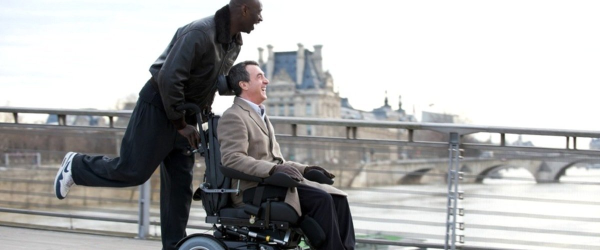
It has a lot of thematic similarities to The Intouchables though I don’t think it’s in the same league. It also reminded me a bit of Raging Bull, in the sense that the lead character was a moron whose stupidity and self-destructiveness led to negative consequences in his life.

It’s a pretty fast two hours, and I would say it’s a good movie. The Boy liked it okay (though he was puzzled about why it would be against the law to monitor your employees). I’ve noticed quite a few people are wild about (it lost the Golden Globe, along with Intouchables and A Royal Affair, to Haeneke’s Amour) but I had a few problems with the character arc that kept me from buying the ending.

I give Cotillard a pass on this one. She has a nice body, even legless, and you see a lot of it. (It’s pretty sexually graphic.) Schoenaerts is believable enough.

I wouldn’t recommend it enthusiastically, I guess because I had a problem with the implicit message of the film. This is one of those movies where you wouldn’t really want to try to figure out any message because it’s all so peculiar. But the character dynamics were so odd that it didn’t sit right with me. It seemed to me like French society is pretty dysfunctional, these were pretty dysfunctional people, and none of that really had any chance of being fixed, however happily the end is spun.

But maybe I’m just grumpy.

Red Dawn

The most important thing to remember going into the 2012 remake of Red Dawn is that the original, like so many classic action films of the ‘80s, isn’t very good.

What is was (like so many classic action films of the ’80s) was very, very American.

This was a big deal at the time. The styles of the ’60s and ’70s regarded films that celebrated America and American traditions as being in bad taste, and the Reagan era ushered in a spate of jingoistic movies. (Sylvester Stallone was a critic’s darling up until Rambo.)

So, a lot of these movies were highly enjoyable for cathartic reasons, if nothing else.

The key thing, then, is that no matter what goofiness occurred with this remake, it would be challenging to make it unAmerican. I mean, this movie is inevitably a paean to the Second Amendment. It’s all about Americans keeping and bearing arms, and how kick-ass that is!

So, I believe the studio screwed up in a couple of ways here. First of all, when they announced changing the Chinese villains to North Koreans, they should’ve pointed out that the enemies were a melange of menacing eastern countries. The Norks aren’t imagined to be the sole invaders of America, just the group that invaded the particular area, thus reducing (somewhat) the absurdity of the scenario.

The second error, I think, was taking the Chinese out in the first place. The rationale, apparently, was that they wouldn’t be able to release the movie in China. The simpler solution to that? Leave the Chinese in, and make an alternate ending where the Chinese win!

Win-win.

And then, ironically, it hasn’t even been released in China

All that aside, how is this remake? Probably better than the original. Chris Hemmingsworth (Thor) and Josh Peck (“Drake and Josh”) are in the late Patrick Swayze and even later Charlie Sheen roles, and they’re probably much better actors. (Both have had long running roles on TV and more movie credits than either Swayze or Sheen.)

They play out the fraternal drama well enough, with the only distraction being Peck’s odd and vaguely effeminate haircut.

Basically, though, this is a survival movie, akin to a zombie apocalypse or alien invasion, and so lives and dies on its action sequences and how the characters react to their new circumstances which are largely quite good. The Flower was entertained, but more importantly, The Boy was not pissed off.

It’s a short, peppy movie that zooms through its 90 minutes going from devil-may-care action scenes to touchingish emotionalish moments(ish) to character development moments—really, it’s not bad at all, all things considered. Very ’80s without any inclination to camp.

Surprisingly enjoyable!

The Impossible

While The Impossible is about a disaster—the terrible 2004 tsunami, to be specific—it is not, in fact, a disaster movie. That is to say, the genre tropes about different classes of people being thrown together as they struggle to (typically) get to some specific safe point, designed to teach us how (underneath it all) we’re all the same when the SHTF. Or something.

Also, there’s nothing campy or tongue-in-cheek about this deadly serious flick: Naomi Watts and Ewan MacGregor are vacationing with their three young sons in Thailand when they’re swept apart by a wave.

I don’t want to get into specifics because I enjoyed not knowing who lived and who died and what happened along the way. Suffice to say that they didn’t all die and the story follows the survivors as they try to reuinte and, you know, not die from tsunami-related injuries.

Of which there are some doozies.

Watts and MacGregor are great, as always. I somehow feel like I shouldn’t like Watts for some reason or another, but I don’t know why. She seems to bring class to most endeavors (King Kong, The Ring, she’s great in Tank Girl) and she does that acting thing those British ladies are so good at.

Anyway, acting is good. There’s some real suspense in here, along with no small amount of dread, gore, and bodybags (of all sizes). It’s harrowing and emotional, and you should stay away from the IMDB message boards unless you want to read pages of how racist it is, because it focuses on a rich, white family instead of a Thai or other…minority?

That’s kind of a puzzler since (even with all the European tourism), whites would be a minority in Thailand, where a Thai wouldn’t. But I guess it’s not so much about minorities as it is about white people being evil and self-involved. I’m sure any Thai movies made about the tsunami have or will have plots centered around British and American families.

Some people are truly sick with obsession. Which isn’t really relevant to the film.

It’s harrowing. I wouldn’t say I enjoyed it per se—this is why there is a disaster genre, so that we can enjoy cataclysmic destruction, as opposed to realistic depictions of such horrors. And I’m pretty sure it was toned down to boot, as awful as it was.

The Boy and The Flower liked it. I don’t think this sort of thing affects them much (as I would have been unaffected at their age). There were some interesting points where ethical considerations had to be weighed against survival considerations, and (with some exceptions), our central characters behaved intelligently (and doggedly) in their pursuits.

I guess I’m pointing that out because (however closely this hews to the real story) the actions of the characters were believable and not insanely stupid, which tends to drive The Boy and I nuts.

Summary: Good movie, good acting, not necessarily a good time, and not for everyone. Also, tsunamis suck.

Barbara

Barbara is a doctor in East Germany in 1980—which let me tell you, is as much fun as it sounds—in the eponymous movie from Germany’s Christian Petzold. She’s crossed the Stasi and as a result has been assigned to a backwater province where she must work to repay her debt to the “farmers and workers” who paid for her medical education.

Or, as we say in this country: You didn’t build that.
This is a movie in the mold of Das leben der anderen (The Lives of Others) and 4 months, 3 weeks, 2 days, which show us where socialism inevitably goes. It’s an atmosphere of paranoia, where the local secret police head (Rainer Bock of Inglorious BasterdsWar Horse, White Ribbon) visits Barbara every time she’s not accounted for for any length of time, tosses her house and does a cavity search. (Well, has it done. Has to be proper, after all.)
The local doctor, André (Ronald Zehrfield) is immediately taken by the blonde beauty (Nina Hoss, looking haggard), but she’s naturally stand-offish, given that he’s filling out regular reports on her activity to the Stasi. 
She also has a West German boyfriend (Mark Waschke) whom she sneaks off to canoodle with and perhaps plot her escape from that communist hellhole. 
Rounding out the story is the up-and-coming Jasna Fritzi Bauer, who plays Stella, a girl who has escaped from a local work camp, and is brought to the hospital when caught because she’s got some kind of weird disease. 
It’s actually a pretty tight little movie, with the tension coming largely from those four character, and even more centrally Barbara and André as two people in the worst of situations, trying to figure out the right thing to do and not really having any good options—and damn few bad ones, really.
I liked it greatly. The Boy and the Flower liked it okay but not as much. The whole Communist experience is a bit out of their awareness (so far), so the paranoid tension probably resolved to boredom after a while. 
This is the German entry for the Oscars for 2013.

Pitch Perfect

I admit when Darcysport told me her kid (a teen boy!) wanted to see Pitch Perfect I looked a little askance. This is a movie that screams GAY!! more than Any Day Now, A Single Man and Frisky Summer 4 put together—and that’s without any actual, expressed gayness anywhere in the film.

But then I realized the incredibly cute Anna Kendrick was in it. And she does this in it. So, Man Card un-revoked.

I had actually taken The Boy and The Flower to see Wreck-It Ralph but it was virtually sold out, so we ended up in this film instead.

Pitch Perfect is part Revenge Of The Nerds (if the nerds were music nerds and their antagonists were also music nerds), part Best in Show and part John Waters. And I guess (per The Flower) part Glee, though without the spontaneous musical-number biz.

The premise is that cranky disaffected wannabe DJ Kendrick is humoring her father by going to college, rather than running off to L.A. to fulfill her dreams, and ends up being recruited by the Bellas, one of the four campus a cappella groups. The Bellas’ arch-rivals are the Treblemakers—which is a seriously odd name for an all-male singing group—to whom they lost the last national championships.

The Bellas are run by a seriously uptight leader (Anna Camp) and her #2 (Brittany Snow) and after their leader tossed her cookies at the finals, can’t get anyone normal or decent to sign up. Instead, they have a slut (Alexis Knapp), the lesbian (Ester Dean), the mumbly (and quite possibly psychotic) Asian (Hana Mae Lee) and Rebel Wilson, as the too-cool-for-school Fat Amy.

Like I said, very “Revenge of the Nerds”. Although, it’s actually much better than RotN, for a variety of reasons (not the least of which is the absence of rape).

You can kind of get a sense of this melange from the trailer, which is one reason I hadn’t put this at the top of my list, but it all works much better than it should. Credit must go heavily to director Jason Moore, and perhaps even more to Kay Cannon for recognizing the hoariness of the premise required lots and lots of jokes to shore up.

A fair amount of credit also has to go to Elizabeth Banks, who is a producer on this film, and provides (with John Michael Higgins, who arranged the Main Street Singers vocals in A Mighty Wind) the inappropriate commentary (a la Fred Willard in Best In Show).

JMH: “What was the name of that group?”
EB: “The Menstrual Cycles, John.”
JMH: “That’s an unfortunate name.”

Also, this movie shares Best In Show’s fascination with a largely unknown examination of a fanatical  even bizarre, segment of society. (I say that as someone who loves and, yes, has even sung a cappella stuff.)

This is a tightly edited movie, too, with a good comedic rhythm that the trailer butchers. Rebel Wilson’s delivery, for example, breathes new life into the beaten-to-death (and vaguely offensive) cliché of the ridiculously over-confident fat chick.

And it’s not just Wilson: Alexis Knapp, as the oversexed hottie manages to combine that cliché with a comedic physical awkwardness/inappropriateness that transcends the cookie-cutter formula.

The whole script works this way: You think that the leader of the Belles, Aubrey and Chloe, are going to be your standard issue mean girls, but they’re just stressed, insecure and misguided. Even the putative antagonists in the TrebleMakers are not bad guys, with the exception of their leader, Bumper.

Bumper is played by Adam Devine, channeling Jack Black’s Tenacious D persona uncannily, and as awful as his character is, he’s still got a great deal of charisma (and talent) backing up his douchebaggery.

I’ve covered the Revenge of the Nerds and Best In Show aspects, but the John Waters feel is strong, too. The movie teeters on the edge of camp, Rebel Wilson reminds of Ricki Lake and other heavier-set Waters’ characters. Also, there is a formidable vomit scene. While I’m not a big fan of excretory function-based humor, the combination of, uh, tasteful (?) presentation and over-the-top goofiness sorta worked for me here. (But be warned.)

“Better than it ought to be” is pretty much how I’d sum this up.

The kids liked it, but less than I did, and The Boy less than The Flower.

Les Miserables

I had largely avoided the ‘80s phenomenon that was Les Miserables but as the title cards rolled on this movie version of the opera, I suddenly realized: Holy crap! This is why we got that abominable 1996 Disney version of The Hunchback of Notre Dame!

I mean, think about it: Why on earth would anyone say, “Let’s take this dark, cynical satire about 19th century French culture and make it into a children’s musical!”? Certainly, I wondered at the time, but I figured someone had seen that episode of “The Critic”.

Blame all your cares and woeses
On the one with scoliosis

Heh. Brilliant, underwatched show. It seems likely that this segment was inspired by Les Miz just as this classic scene from South Park: Bigger, Longer and Uncut was.

My kids have these moments all the time: “Oh, so that’s what that’s referencing.”

Anyway, Andrew Lloyd Weber managed to turn me off modern musicals with Evita (and truthfully, every song from every musical of his I’ve ever heard), and I regarded this film with suspicion, not just due to its vintage but its length and potential pomposity.

And?

Actually, I liked it. A great deal. As did The Boy and The Flower. Despite its length, it moved along at a breakneck pace. It is an opera—virtually, no spoken dialog at all—which The Flower finds more accessible than the traditional American musical form where people break into song and dance, but nobody really notices.

The only time the movie really stops is for the various emotional set pieces. And they are emotional. As Kurt Loder wrote, “I have to admit that I was sometimes moved to the verge of contemplating the possibility of tears.” (For myself, I did actually mist up at times, though some of that may have been due to just getting The Boy out of the hospital.)

Some have said that it is bombastic. I don’t think I’d disagree with that. But it worked for me, dealing as we are with epic archetypes.

Some have said that Hooper’s tactic of having the actors actually singing rather than lip-syncing didn’t work. I would strongly disagree with that. I often find lip-syncing distracting, even alienating.

Some have said Russell Crowe’s singing voice is not up to the task. I can only weakly argue against that by saying his parts were not especially tuneful, nor would they be assisted much by being so. I do agree that his denouement doesn’t come off as well as it should.

Hugh Jackman is amazing. Amanda Seyfried surprised the heck out of me. Anne Hathaway continues to win me over, despite my earlier resistance to just about everything Anne Hathaway. Samantha Barks practically steals the show in her short on-screen time. Sacha Baron Cohen and Helena Bonham Carter provide much needed comic relief with aplomb.

The music? For the most part, I wasn’t greatly impressed. It feels tightly constructed, and deliberately (I assume) reserved musically. However, it may be one of those things where I have to listen to the music multiple times to really get it. (Though I should note that while I adore Sweeney Todd, the music in the movie version didn’t do it for me, even though I was familiar with it.)

Parts weren’t reasonably catchy, but catchiness wasn’t the point. Not that there wasn’t someone sitting behind us who felt a need to hum along with the whole thing. (Mom? Is that you?)

So, I’d recommend, if you’re not allergic to opera. It is a great story, briskly told.

The Hobbit (or there)

Get it? Get it? See, the novel The Hobbit has an alternate title of “Or there and back again” but since this is going to be a trilogy, the first movie can only cover the “Or there”. (I assume the second movie is going to be “and” and the third will be “back again”.)

OK, it’s not a good joke, but I think it’s an original one.

If you want to go see this movie, you just have to understand that it’s not really the novel The Hobbit in movie form. It’s Lord of the Rings: Episode I: The Gollum Menace. Where The Hobbit is a charming child’s story about a bunch of dwarves going on a gold hunt, this is really just a ponderous exercise in milking a previously non-existent movie franchise.

Seriously, if anyone thinks there won’t be a third trilogy based on the remaining appendices of LOTR that weren’t used here, and the Silmarillion, well, you’re either high or basing it on the vagaries of the movie industry in general rather than, say, greed.

Let me say before beginning my bitch-fest that I didn’t hate it. I expected little relatable material and an exhausing amount of CGI with more love of excess than good taste, and I got what I expected. This movie really combines the worst aspects of Jackson’s LOTR and King Kong, and yet, I say, I did not hate it. Jackson would have had to find new ways to offend me, but he mostly stuck with all the old ways.

The Flower liked it, though she knows the book a little and while she didn’t like the deviations, she did like where it was true. The Boy also did not hate it, though he despises Jackson’s combat choreography.

As a movie, this is a largely well-produced, well-directed, well-acted and very bland action film. If you liked Battleship, you might like this, for example.

Instead of a, let’s say, Jeremy Renner or Daniel Craig as a super-agent, falling from some ridiculous height only to get back up and run off, you have Richard Armitrage as the least dwarfy-looking dwarf in history doing it. Only, instead of a ridiculous but marginally plausible 15 foot drop, you have a suspension-of-disbelief-shattering 300 foot drop.

Instead of calmly walking away from a mega-explosion, but being completely unaffected because you’re outside the fiery ball of flame (concussive wave? never heard of it!), you’re being smashed by stone giants, only completely unaffected because they didn’t directly crush you.

Jackson’s King Kong became a crashing bore because of the way the ape juggled around Fay WrayJessica LangeNaomi Watts. Lucas’ Clone Wars had similar problems as Annakin threw himself out of a moving flying vehicle from thousands of feet up (culminating in the hilarious “but I have the high ground!” conclusion in the third movie).

Jackson is capable of making some good (or at least comprehensible) choices, like reducing the length of the riddle game part of the book, or reducing the singing (there’s a song in nearly every chapter in the book)—and as much as I razzed this in advance, there’s one short dwarf song at the beginning that’s actually pretty good.

But mostly it’s all “Well, if one orc is good and scary, then one thousand will be a thousand times scarier!” Of course, that’s not true. One orc can’t be scary when your heroes are plowing through thousands of them like they’re blind and drunk Imperial Stormtroopers.

And “if being treed by wolf-riding orcs who set the trees on fire is awesome, just imagine how awesome it would be if the trees knocked each other over like dominos and the last tree is at the edge of a cliff that they’ll all fall off.”

I confess: I laughed. I’ve always considered myself a fan of excess. I had no idea what excess was. Ken Russell (Tommy, Altered States) called from the grave to say “Whoa. Dude.”

While this stuff is tasteless, it’s not really what bugs me. What bugs me is perhaps best illustrated by this “Rejected Pitches” sketch. In this presumedly comical video, three cretinous Hollywood types explain how Lord of the Rings couldn’t possibly get made because it stars a bunch of short, fat, hairy ugly leads.

That would be hilarious if the LOTR movies were actually about Frodo and Sam. On about the second movie, they became about the love story between Aragorn and only-a-footnote-in-the-book Arwen, and all the improbably and poorly choreographed human battles. By the third movie, they were all about the superheros, Aragorn, Legolas, Gimli, Gandalf with more momentum killing love scenes and even less coherent combat scenes.

The Hobbit doubles down by making it largely about the dwarves, particularly the leader, Thorin, whom I’ve mentioned is the least dwarf-y looking dwarf, having a minimum of facial hair and less exaggerated features than the others.

Did you know that Tarzan was about 38 years old through most of the books? Did you know that Conan the Barbarian was a bit over 6-feet tall and, as a teen, about 180 pounds? Did you know that Edgar Rice Burroughs was about 38 when he wrote the first Tarzan and Robert E. Howard was a bit over six feet tall and about 180 pounds?

Why is this important? Adventure stories tend to be power fantasies. They reflect the audience’s and significantly, the author’s desire to express themselves in a way that’s not socially acceptable.

While the geeks love the massive detail behind Tolkien’s fictitious world—and I’ve had Tolkien fans explain to me that the whole Arwen subplot was just super, being stuff explained in the appendices—the real magic in the stories is their diminutive heroes.

Hobbits aren’t just reluctant heroes, they’re incapable heroes. They can’t fight (too small). They can’t run fast (Bilbo must be carried by the dwarves at times in The Hobbit). They have no magic. They can be clever, but are not notably brilliant.

About all they’ve got going for them is that they’re small enough to go unnoticed sometimes, and can move very quietly. Bilbo Baggins is also credited by Gandalf as being very lucky, which is central to him finding the ring.

More than that, they’re completely disinclined toward adventure. They have as many meals as they can fit in in a day, they have their comforts and are happy with them, and they even, as a group, strongly disapprove of anything smacking of adventure.

In essence, they are modern man, at least as far as early-20th century English professors are concerned. Bilbo, like Tolkien, is a middle-aged man, comfortably padded, and vaguely remembering the adventures of his youth.

So, here we have Tolkien’s power fantasy: No super strength or agility or toughness. The hobbits are heroes because they endure (though seldom without complaint), and because they possess a certain degree of humility. They’re good, but not angelic—they are, in essence, humans, moreso than the actual humans of Middle Earth, who are often heroic.

This is what makes the latter LOTR movies and this Hobbit movie is so bland. The extraordinary humanizing qualities of the hobbits is replaced with standard sword and sorcery hijinks. And, look, I’ve read all of Tarzan, all of Conan, all of Fafhrd and Gray Mouser, all of Bran Mak Morn—I love standard S&S hijinks.

And this movie is…well, it’s okay S&S, but it’s actually held back by the source material, since there’s a whole lotta deus ex machina in the book undermining traditionally heroic story approaches.

The gravest injury to the narrative is the climax of the movie, which, while it was way too obvious for me to consider a spoiler, is sort of a spoiler, so if you don’t wanna be spoiled, stop reading here.

OK, stopped reading? Here goes: The book’s narrative of the dwarves’ general lack of faith in Bilbo is, in the movie, concentrated specifically in Thorin. This creates dramatic tension. Thorin can barely stand Bilbo. Since we know that can’t persist, we also know something will have to happen to change that.

In the book, Bilbo increases his stock with the dwarves bit-by-bit, with luck and pluck and even a little deception, at the same time increasing his faith in himself. Jackson replaces some of the luck of the book with Bilbo’s actions (meh, but okay, I guess), but in the final scene, Thorin is about to be killed by an orc when—

—Bilbo tackles the orc and slays him.

This completely perverts the central notion of hobbits. Now, instead of being brave little souls who try even though they’re not physically capable of surviving direct conflict, they’re kind of just cowardly jerks. Apparently, they’ve been able to fight orcs directly all along, and they’ve just been holding out.

Well, I guess Bilbo just packed a lot of heart. Which I guess would mean, he didn’t have any heart before.

Stupid. Self-defeating. Perverse, even. But hey, you got trolls blowing their noses on Bilbo.

Paranormal Activity 4: This Time, It’s Again

So, the joke running around about Paranormal Activity 4 goes something like “Isn’t the activity pretty normal by this point?” Haw haw haw haw! Let’s see how much you’re laughing when a demon-faced skank snaps your neck like a pretzel. Er whatever.

Actually, the tragedy of this movie isn’t in the paranormal so much as it is the activity. As in, they should’ve called Paranormal Inactivity. It’s slow, is what I’m getting at.

Now, the series has always been marked by long, atmosphere building set pieces where your eyes strain to pick out ghosts in the grainy video footage, punctuated by sudden sharp violence, made all the more convincing by its swift, bloodless finality. The previous movies were quite a feat, really: A whole lot made out of very little action, kind of like the old, dark house movies of yore.

But as I noted last time, the effects are getting kind of played out. (The horror effects, the movies still have few special effects.)

If the franchise were about the story of Katie and her witchy family, they could have continued their trek back in time to see how the whole thing began, ditching the video camera approach for a more traditionally cinematic one.

But, of course, it’s not. It’s really all about the technique, and audiences would probably reject something that expanded the story while using a different approach. At the same time, there has to be some connection, I guess, because audiences would probably reject a new story, too. (See Halloween 3. Or don’t, it’s awful.)

So, we have a similar story as in the previous movies, about an apparently completely unrelated family that happens to live next door to Katie Featherstone (last seen stalking around the movies as a demon) and happens to have an adopted son. No one will be seated during the shocking twist tipped in the first scene!

Nah, that’s not fair. There’s no twist here. Well, the stinger is sorta twist-ish, in the sense that it’s only vaguely alluded to and primarily references the previous film, but it’s more likely to create a “huh?” than a frisson.

The only really fresh thing here actually comes from Microsoft (ironically, since MS never does anything fresh except by accident). The family has a Kinect, which is a cool device that allows you to control things on the X-Box without using a controller. The way it works, apparently, is to throw out infrared beams and detect movement through those multitude of beams.

Using night-vision, these beams look like a green dots plastering the room, which provide great camouflage for ghosts. (Who knew?)

Anyway, we thought the couple of moments where scares were actually employed were reasonably effective. Just very few and far between.

Despite doing relatively poorly, there will be a fifth movie, of course, but no one will blame you for having bailed out after the second one.

Dredd

It would be damning with faint praise to say the new cinematic interpretation of the British superhero Judge Dredd was better than the old 1995 one but, you know, nothing like saying it was worse than Danny Cannon’s goofy, pre-strained bland disappointment.

It didn’t help that Stallone’s slide into self-parody had practically lapped itself by that point, and the successful action movie formulas of the ‘80s had distilled themselves into safe, boring pablum. And you have to be kidding yourself to think that a modern action movie is likely to be much (if any) better.

So, the good news is that this avoids the worst sins of the old film: Particularly Rob Schneider. Not that it was Schneider’s fault, but the whole story of a cop with a noob rookie chick partner, a comic relief sidekick, fighting against a corrupt system? Ugh.

And while there are bad judges, the system itself is portrayed as being overwhelmed rather than corrupt at the top. (This apparently maps to the comic book, where the top judge is incorruptible.)

And instead of a plucky Diane Lane (whose character makes little sense in Dredd’s dystopia), we have a sort of odd, ethereal Olivia Thirby, whom Dredd is supposed to “field test”. She doesn’t meet Judge criteria, but she’s psychic, which works out better than it sounds.

In a refreshing change from most of these modern comic book interpretations, we don’t take up 40 minutes with an origin story: Basically, there’s a dystopic future America with crime-ridden megalopolises peppered with giant towers where the poor peeps live. The Judges are one-man legal systems, catching the perps, sentencing them, and occasionally (when they resist arrest) executing them.

In this case, Drudge, played by Karl Urban, and Anderson (Thirby) track down some murdered drug dealers to a vicious drug kingpin MaMa (played with typical vigor by Lena Heady), who dominates a large tower in a particularly bad sector of town. For reasons I forget, MaMa decides that her best option is to kill the two Judges rather than let them go back and report their discoveries.

In service of this end, she gets the tower locked down into “war mode”, traps our two heroes inside and has her goons go after them, floor-by-floor. In essence, Anabasis, then. (Think more The Warriors than End of Watch.)

Actually, I’ve been playing this sorta non-game, and all I could think was “Wow, this is just a really dysfunctional Tiny Tower.) And then, "Wow, that would be a 10 times better game than the actual Tiny Tower.”

Karl Urban, once again manages to amaze, playing Dredd straight, with a touch of Sylvester Stallone and a fair amount of Peter-Weller-as-Robocop. It reminds me of his performance as Bones in Star Trek. Just enough DeForest Kelly to be appealing, without being parodic or campy.

So, acting is good, story is unpretentious, and the direction is mostly pretty crisp. Entertaining.

Flaws? Well, it’s violent. While that’s not so much a flaw as a prerequisite for this kind of film, and while it’s better than the kind of bloodless fare of the ’90s, the stuff here is gratuitously graphic, a la Killing Them Softly. Maybe more so. It’s also a bit over-the-top at times.

This is magnified by the “slo-mo” drug, which is the movie macguffin and causes the user to perceive things in extra slow-motion. Naturally, much of the violence that occurs is seen from the perspective of the drug-users. Since nothing is really from their perspective, this comes off as a cheap and transparent gimmick.

But that’s kind of a minor nitpick. If you don’t mind the gore, it’s a pretty good flick. Even The Boy liked it, and I doubt I could get him to sit down and watch the ’95 version.

Hitchcock

The Flower is at the age where she’s starting to get more cultural references (at least more outside juvenilia) and this naturally exciting development got her enthused to see Hitchcock, the biopic of the auteur centered around his making of the cinematic masterpiece that is Psycho.

We watched Psycho a few months ago; I also showed her Hitch’s little featurette, which she may have liked more. The trailer for the Hitchcock movie features a lot of similar humor, so she was quite excited. I even got a picture of her in the shower display, although she was stabbing out rather than being stabbed. (My kids.)

Hitchcock features Anthony Hopkins in the title role, and it is nice to see him do some acting after what seems like a decade of phoning it in. (Well, not quite a decade. He was great in 2005’s World’s Fastest Indian, an under-stated and under-rated gem.) Helen Mirren plays his wife Alma, and she’s good (of course) but the role is almost unbearably traditional, i.e., supportive and neglected wife.

Danny Huston (son of John) plays the stiff (heh) lothario that’s wooing Alma but perhaps entirely to get his material to Hitch, while working actor Michael Wincott plays Ed Gein, Hitch’s spiritual counselor throughout the movie.

Standouts include Ralph Macchio as the screenwriter, Joe Stefano, and James D’arcy, who seemed to actually channel Anthony Perkins, both in very brief scenes.

Jessica Biel plays Vera Miles, who Hitch loved and lost when she decided to take time out have a family. There’s a rumor going around Hollywood that Biel is upset over not getting the roles she wants. There’s another rumor that this is due to what’s called in the industry “not being very good”. The latter rumor is confirmed in this film, sadly. She’s not bad, exactly. She’s just not very good.

Actually, I kept thinking of that scene in Ed Wood where Sarah Jessica Parker (playing Dolores Fuller) is doing a line with Juliet Landau (playing her usurper on Bride of the Atom, Loretta King) reads a line across from her, and does it masterfully badly. It’s the sort of bad acting actors love to do, and there are hints of inappropriate anger and jealousy along with the overacting that comes with trying to upstage.

I kept thinking of that scene whenever Biel played against Scarlett Johansson’s Janet Leigh. Johannson is immensely appealing as Leigh, being cheerful and professional and cooperative without being intimidated by Hitch, a phenomenon at least partly explained by her previous movie having been with Orson Welles. Kinda surprised me. I sorta though Johannson peaked with Eight-Legged Freaks.

This is one of your typical end-of-the-year acting movies and it largely doesn’t disappoint. The fat suit Hopkins wears is a little bit distracting (some times more than a little) but sometimes he’s dead on.

The movie excels in a few areas: When covering the actual making of Psycho, showing Hitch in all his arrogant glory and passion for art, it’s very good indeed—if not exactly accurate. Hey, some of these stories are legendary, like Hitch getting the reaction he wanted out of Janet Leigh by using cold water, not by doing the stabbing himself in a particularly convincing manner. We know that Janet Leigh doesn’t blink after being killed, she breathes.

Or at least we think we know that. We also thought, for example, Leigh was never naked in the film, but she later claimed that the moleskin she was covering her modest with washed off on one occasion. And that the shower scene originally tested to laughs, before the music was added in, though some are say it wasn’t test audiences so much as the scene not working for Hitch and others “in post”.

Well, whatever: one shouldn’t expect a rigorous study from a pop film. It’s fun enough and close enough, however much people think Hitch should have been shown as a sadist, or bit players think they should’ve gotten more credit.

The story of the making of the movie is glued together with a melodrama about Hitch’s obsession with his leading ladies and Whitfield Cook’s (Huston) wooing of Alma, and also the great financial risk of making the movie (even though the movie defuses that by pointing out the vast amounts of money Hitch was getting from his TV series, thanks to his agent).

This stuff is almost laughably movie-of-the-week, reducing these great people to weird little neuroses and insecurities. I’m not saying they’re not accurate, mind you, because I don’t know. I mean, obviously it’s not accurate in a literal transcript sort of way, but over the decades Alma and Alfred doubtless suffered all sorts of marital problems so, hey, maybe there’s some accuracy here. (Apparently the Alma/Whitfield affair is a “thing”, pushed by…Alma Hitchcock scholars?)

But this stuff plods along. Except!

For quite a few scenes in this part, director Sacha Gervasi imposes over the Hitchcock’s marital tensions, classic Hitchcokian camera angles. Like at one point, while Alma is bitching about something with her back to Alfred, he’s looking at the back of her neck, the camera dollying in like Strangers On A Train.

I think, accuracy aside, Hitchcock himself would’ve approved of this kind of thing, as he would have the idea that Ed Gein was his sort-of Jiminy Cricket. It really reflected his brand of black comedy.

So, not a great movie, but some great moments therein. The Boy and The Flower both approved, The Flower being particularly excited that she got many of the references.

The Central Park Five

I had not known that the Central Park Five were black (and black-ish) until today. Nor did I hear that they had been exonerated ten years ago, which brings us to this latest Ken Burns (and Sarah Burns and David McMahon) documentary.

Let me say that this is, or should be, my kind of documentary. The premise of the movie is that the five kids were abused by the cops and framed for the rape and near murder of a woman jogging through Central Park. Wrongful accusations speak to me; they pique my sense of justice and outrage. (It’s one of the reasons I love Hitchcock.)

The strength of this movie comes from that: It’s pretty apparent that there was a gross miscarriage of justice here, and it has basically ruined these men’s lives. As an examination of police malfeasance, media malpractice and (kind of interestingly) a condemnation of the jury system, it’s top-notch.

And yet.

It’s far from a great documentary. It has a narrative, and it’s going to push that narrative at all costs. Let me explain:

Our story begins when five boys get together with 25 other boys to terrorize Central Park. To say this is glossed over in the movie is to be generous. What we’re told is that the five (who mostly didn’t know each other) were going out to play basketball and just happened to be around when the mob formed.

While they’re in this mob, they witness many crimes. They don’t, as far as we know, take part in them, but neither do they attempt to stop them, alert the authorities nor even have enough sense to stop going along with the mob.

And yet the movie actually has one of the five saying “It’s as if we were born guilty.”

When they’re arrested by the cops and subjected to lengthy interrogation and long periods without food or sleep, they—each of them—decide to go along with the cops’ plan to implicate one or more of the others (whom they still don’t know) in these heinous crimes.

“I just told them what they wanted so I could go home,” was the refrain. I guess the cops got the least streetwise five kids in Harlem, since they never lawyer up or exercise their right to remain silent. I’m not condemning them for this; they paid dearly for it, unlike all the others involved.

But it highlights the problem with the movie: It’s both absurdly one-sided and the narrative conveniently filled in by people who weren’t actually there, weren’t involved, and are casting this as condemnation of society in general, using the word “we” in the safe abstract, given that they weren’t actually involved.

Burns and Co. were unable to solicit a single interview from anyone on the law-and-order side of the story (perhaps understandable given Burns’ deeply leftist worldview), and this absence is used, naturally, to convict them all of unchecked ambition and corruption.

This is a shame, because while it’s not merely plausible but probably even true, we never get even a smidgen of insight as to why they picked these five kids to send up (in the complete absence of DNA evidence, and a contradictory timeline).

One of the chief investigators, in a newspaper interview quoted by the movie stands by the conviction, saying she thought the actual rapist was part of the mob who broke off to “complete the assualt”. The other one isn’t mentioned, though she also stands behind it, saying the truth will out.

See, I’m really hating this documentary now. I feel compelled to point out all these glaring flaws and irrelevancies, but in my heart I believe that even if the five were guilty there were plenty of abuses on the police side that should’ve short-circuited their prosecution. Why?

  • The movie draws a parallel between the 1989 case and a lynching from the ‘30s. But the case unfolds over two years, even if the cops made up their minds in 3-4 days, and the boys were duly convicted in two fair trials.  (A fair trial does not guarantee a correct outcome.) And they weren’t executed. I’ve noticed that any time black people are killed by whites, there’s an eagerness among some to call it a lynching, which I think is problematic given the frequency of whites killed by blacks.
  • It draws this parallel because it’s basically obsessed with race. This case, we are assured, matters to people because it was black and mixed-race kids raping a white woman. The media certainly loves white, female victims (their audience is white female victims, so that makes sense). But as I pointed out at the top, I never knew they were black! I thought the outrage/sensationalism came more from the fact they were kids, they were a mob, and gang-rape was one of their activities. 

Now, I’m not saying my perception is right, but I am saying that the race-obsession was hyped on both sides. The news was completely obsessed with this thing called wilding and blacks were sure that this was all about race.

  • To this point, the movie shows two groups protesting during the trial: Rev. Sharpton’s “it’s all about race” and a bunch of white chicks demanding the five be punished ’cause, you know, gang rape is not OK. What the movie doesn’t point out is that both groups would have been there regardless of the actual facts of the case.
  • So, while Rev. Al’s crusading is presented uncritically, despite his involvement around the same time fomenting antisemitism and orchestrating riots under false pretenses, the movie decides to show Donald Trump and a Pat Buchanan column in support of the death penalty, as proof apparently of their complicity in the madness of the times.
  • The focus on the death penalty is extraneous. Probably most people would say that raping and beating to death (the woman lived through sheer luck and toughness) is a pretty reasonable application of the death penalty. (I’m against the death penalty but extraneous is extraneous.)
  • Wait, back to Rev. Al, for a sec: The supporting (non-involved) players in this film are sanctimonious and condemning of society in general (from the safe vantage point of not being involved) and yet here’s a guy who inflames society’s worst aspects who is displayed without commentary. This is just galling.
  • It’s entirely possible that the two women detectives who led the case believed the confessions of the five, and their motivations had nothing to do with ambition, and we see a video of one of them asking over and over again “Are you just telling me what I want to hear?”
  • The one person in the film, other than the five, who was involved and is interviewed is one of the jurors. Apparently, he was a “Juror Number 8” type, insisting that the boys’ confessions didn’t make sense, and ultimately being browbeaten into voting guilty because (say it with me) “he wanted to go home”. That takes a lot of courage to admit, but I can’t help but wonder if part of the problem was that the confessions were actually pretty compelling.
  • Note that the jury contained many black people who found these guys guilty. That seems to have had no impact on the narrative.
  • One of the people interviewed is a writer for (I think) the New York Times suggesting that maybe the press dropped the ball, a little. Well, no, they created this mess. They flooded the zone with stories of “wilding”. How about interviewing one of the writers actually culpable and calling them out like they did the cops and prosecutors?
  • Given how (according to the movie) obviously innocent The Five were, a little more explanation of how the legal team managed to screw up the case would’ve been welcome. One of the defense lawyers was apparently literally asleep during the trial. One of the other defense lawyers pointed out that they didn’t want to use the “they couldn’t have been raping her because they were busy beating up someone else”, but the movie totally glosses over this point, preferring to stuff the movie full of “significance” and commentary on America.
  • Seriously, Sharpton appears on the side of the preferred narrative without commentary. The movie has plenty of commentary about “the system” when there are actual indictable bad actors involved.
Al effin’ Sharpton!

And that’s ultimately what this comes down to: The filmmakers are so eager to show America as an awful place, and generally condemn us all, rather than focus on the specifics of the case. 

I suspect this is indicative of how I’d react to any Ken Burns documentary (I believe this is the first I’ve ever seen): Positively at first, swayed by the presentation and general sympathy for the message, then slowly getting more pissed off as I realize how slanted the whole thing is.
That’s just a guess, though. The Boy liked it, but he probably won’t after I get done grousing about it.

Hell, I still don’t know if wilding is or was a thing. 

The Man Who Shook The Hand Of Vicente Fernandez

It’s a common fate of yesterday’s stars to end up, at the end of their lives, starring in low budget films. This can be tragic or exploitative, and a lot of great actors have a really crappy flick as their last. Sometimes, it can even lead to a career resurgence, or a second wind.

And so we come to the last film of one of the hardest working actors of the past 60 years: Ernest Borgnine as The Man Who Shook The Hand of Vicente Fernandez, a really wonderful close to a wonderful career. (Not that Borgnine wasn’t in a ton of schlock, but he was always enjoyable to watch.)

The 95-year-old goes out as “Ricochet” Rex Page, a former DJ who is obsessed with a role he didn’t get some 45 years ago in a low-budget Western  called The Good Man Who Died Bad.  He’s so obsessed that he watches an old video of the movie (the only one in existence, according to his daughter) over and over again, and his 10-year-old grand-daughter can recite the parts with him.

As it turns out, he flubs the closing monologue, probably at the time of the audition (though it’s not spelled out) and even now, decades later. Despite this, and despite being really old, ol’ Rex is on the phone with his agent (the same one from decades ago, apparently) and on the ball for the next big score.

The story starts when he has a stroke (I think that’s what it was) and ends up in the Rancho Park Assisted Living Center, which is run by one of its members (the great Barry Corbin, playing older) in the fashion of a bad-ass gunslinger in a one-horse town.

This is the movie’s central conceit, and it is adorable. Rex comes in as the man-with-no-name and is slowly won to the service of the Latino staff, to whom he becomes a hero when it’s discovered that, as a DJ, he once shook the hand of Vicente Fernando, a legendary musician the staff adores (and whose concert is a central plot point). Their faith in him fulfills a longstanding desire to be somebody and gives him strength to fight the evil Walker clan. (“Walkers”, get it?)

So, the whole movie is set up as a spaghetti western taking place in an old folks’ home. This conceit kept us laughing throughout most of the movie. It’s corny and overdone at points, but it’s still just really funny, thanks in no small part to Ernest’s earnestness.

The dramatic parts are also a little corny and ham-handed, but very good-natured and enjoyable nonetheless—and they ultimately work as a dramatic arc for a lovable curmudgeon.

Borgnine is remarkably vigorous for a 95-year-old. I wouldn’t say his performance is perfect. There are times when he stumbles over his lines in a way that suggests that, either for budget reasons or due to his age, they didn’t re-shoot. He’s comfortable as a crotchety character (a la McHale) but less so as an angry one, which he must be a couple of times here.

Perhaps he had less far to fall than Peter O’Toole, but his acting here was about what it was 30-35 years ago, and I could’ve easily believed he had another 5-10 years left in him. (Whereas I was surprised to see O’Toole still alive after 2006’s Venus.) This is more like Christopher Plummer in The Man In The Chair, who has followed up with several more great performances.

The movie itself is nicely filmed, jam-packed with shots recalling the old Westerns, with its low budget only showing up in a few obvious ways, such as close shots on crowd scenes. Ruy Folguera’s music, too, occasionally suffers. Sometimes it’s spot-on, but in a couple of already heavy-handed scenes, the dolorous and cloying celeste (or more likely the celeste setting on a synthesizer) is almost overpowering.

The movie’s strength is the Western parody/homage, because it ends up speaking to the nature of human dignity and desire for respect. The weakness is spelling it out. Nonetheless, we all enjoyed it.

It doesn’t seem to be getting a big roll out. Borgnine is not the box office draw he once was (or was he?) and the producers seem to be focusing on turning out the Latino community for this. But it’s a fun little romp, sweet, with a nice ending.

Check it out.

A Late Quartet

The real problem with the sort of award-baiting drama like A Late Quartet is that we’re most likely to end up wanting to strangle all the characters. That’s one reason this movie was low on the list of flicks to see. I mean, look: The story of a string quartet which is thrown into upset when the cello player announces he has Parkinson’s disease and the remaining three are juggling their ambitions and personal lives practically reeks of the potential for narcissism and neuroses.

It must be said that this movie manages to have you not want to strangle the characters, and actually kind of feel for them. And since there are a lot of the expected icky moments, that’s actually kind of a feat.

Christopher Walken plays Peter, the widowed cellist who discovers when the group gets together for a new season, that he can no longer play in time. Walken is such an icon, so easily parodied and so comfortable parodying himself, it’s almost surprising to see him play a role so straight, and so sensitively.

Philip Seymour-Hoffman plays Robert, the second violin, and classic beta male, who’s neglected by his wife and being wooed by a hot-‘n’-sexy flamenco dancer (Israeli actress Liraz Charhi) who thinks he should be more aggressive about playing the first violin.

Catherine Keener plays Juliette, the mother of a brilliant young violinist (played by the lovely English actress Imogen Poots) whose daughter is a bit miffed that she missed out on most of her childhood.

And, if you seen the trailers, the movie stars these three Oscar-winning-or-nominated actors, plus a fourth guy: Ukranian Mark Ivanir plays Daniel, the emotionless first violinist who uses the quartet as a vehicle for his own artistic expression, perhaps at the expense of others.

The relationships between Peter, Robert, Juliette and Daniel are more complex and deep than I’m letting on, not because they’re shocking twists but more because the story hints and reveals at its own pace, which is more enjoyable and less pretentious than I’m making it sound.

As regular readers know, my theory of film criticism is that most film critics have the same visceral like/dislike reaction to film that audiences have, and then they backfill their reviews with “reasons” why they liked or disliked it.

I mention this because, having noted that this is the sort of movie that makes me want to strangle the main characters, I didn’t here, and ended up liking the movie a lot. So, what follows are my justifications, which I (of course) think are legit.

The big thing, I think, is that while the story concerns the feelings, ambitions and neuroses of the characters, it’s not exactly about those things. It’s about the string quartet. It’s a world class quartet that all the members have sacrificed greatly to be part of and to cultivate over 25 years. So, the characters are not just responding to their internal issues, but what they would or wouldn’t give up to save the quartet.

And, in truth, musical groups, even in the classical world, often don’t last long. Back in school, my guitar teacher and his partner would win awards for their playing, which he maintained was less due to raw talent and more to the fact that they had been playing together for 10-15 years where most had only been playing together a year or two.

Each of the three (non-Walken) characters have their chances to destroy the quartet, and we get to see and know how and why they might do so.

Now, I specifically will rule out the acting as a reason I liked this. The acting was great, of course, but it always is in these films. I thought it was especially good here, but I think that’s more to do with the characters themselves.

Walken, as mentioned, but Hoffman also manages to heave his mottled body around convincingly. (Seriously, he jogs in this movie, and I always think, “I believe you do jog. I also believe it doesn’t seem to help much.”) He manages the beta male thing very well, without being too unlikable. (It was a little hard to figure out what the flamenco dancer saw in him. You know he’s a world-class musician but I’m not entirely sure he pulled off that combination of master performer/somewhat insecure man. I’m not sure he didn’t either.)

Keener’s character is interestingly thin. She plausibly inhabits the roles of wife, daughter, mother, lover and is often the sounding board off which the other characters play. It works, I think, because she’s neither wholly victim nor wholly villain. The movie doesn’t pander to the cliché of women who do no wrong.

Amusingly, I was particularly taken with Mark Ivanar’s performance. He’s a stereotypical cold Russian musician, obsessed with form and meticulous planning. (That’s a stereotype, right?) It sort of looks like they took the least actor and gave him the least challenging part—but in a lot of ways, his role was the most challenging and interesting, and his story ends up being heartbreaking, maybe especially so.

The music helps, too. Lotsa Beethoven.

I admit I teared up at the end. Not a wheezy sniveling cry, but a misty-eyed Mark Ivanar moment of poignancy.

Recommended. The Boy liked it, too.

Killing Them Softly

Some low-level thugs get the bright idea to knock over a card game run by some high-level thugs and are hunted down by the high level thugs.

Sure, we’ve seen it before. But have we seen it with the 2008 financial collapse?

Meh. Probably.

This was an okay movie to watch. Brad Pitt was the world-weary hit man just trying to get “the games” going again. The great Richard Jenkins is the middle-manager who contracts him out, but is squeamish about the whole killing thing. James Gandolfini is the past-his-prime hitman who can’t get his act together enough to do a simple job. Ray Liotta is the hapless card-game runner who gets framed, and must pay the price even though everyone knows he didn’t do it.

There are more than a few weaknesses here, though.

The Flower said, “Who was the main character?” It was Brad Pitt’s character, of course, but he doesn’t show up for about 15 minutes into the film and his character arc is non-existent.  James Gandolfini’s character is literally pointless. Arguably, he sets up the final confrontation between Jenkins and Pitt, but the character could’ve served that purpose without ever showing up on screen.

It’s sort of funny to suggest that a fairly short movie (about an hour and a half) could be padded, but it sort of is. Not just by Gandolfini’s character, but by scads of transitional scenes over which snippets of Bush and Obama’s speechifying are played.

Which gets to the film’s biggest weakness: It has all the subtlety of a chainsaw, and yet manages to be completely incoherent at the allegorical level it struts around at.

Y’see, the whole thing is a metaphor for America. The card game represents the business of America, and the low-level thugs who rip it off are, presumably Wall Street. Ray Liotta—I’m not sure who he’s supposed to be, but someone who’s ripped off the economy before but was innocent this time. Gandolfini is the fat, aging, undisciplined American middle-class and Richard Jenkins is the middle manager for ruthless corporate interests. Pitt is the hard-headed realists is calls it as he sees it, but who gets screwed over by the system. There’s a reference to “the street” which is probably meant to be the populace at large, that must be mollified if the games are to go on.

Then, in case you didn’t get the message, Pitt closes the movie with an “I hate America” rant about Thomas Jefferson sleeping with his slaves. (Which, frankly, I doubt.)

So, we’ve got sophomoric political ideology delivered clumsily combined with slow-mo gratuitous extreme violence.

I’d say it’s a heady mix if you’re a teenager but The Boy wasn’t particularly impressed.

The problem, of course, of taking a 1974 movie about thugs and grafting it to a 2008 political allegory is that all of the characters are scum, is that you end up with something completely nihilistic. To say nothing of confusing.

I mean, Pitt’s a scumbag. He’s likable, ‘cause he’s Brad Pitt, and he’s got something of a work ethic. But he’s a hit man, killing pretty harmless people. But if you’re meant to identify with him, well, he’s got nothing good to say about Obama either. (I’m presuming this is coming from the far left because of the TJ rant but it wouldn’t have to be.)

So, you know. It’s got some technical merit but I don’t think I’d recommend it for anyone who wasn’t an 18-25 year old leftist/nihilist, unless they were really in to slow motion gore.

This, by the way, is the follow-up film by Andrew Dominik, the writer/director of The Assassination of Jesse James by the Coward Robert Ford.

The Silver Linings Playbook

When I was deciding whether or not to bring The Flower to David O. Russell’s latest, The Silver Linings Playbook, I checked over at IMDB’s parental advisory. I’m just looking for the extreme over-the-line stuff, as when I took The Boy to Waltz With Bashir (an animated film which had a brief but suprisingly explicit oral sex scene).

Well. The summary there made it seem like a seething hothouse of explicit sex. This seemed a little unlikely to me, so I perused the entry more carefully and noticed it was full of things like "We hear that a character in a Hemingway novel is pregnant.“

So I took the chance. And she really enjoyed it.

And it’s not really very raunchy, though it is fairly adult.

The story is this: Pat (Bradley Cooper) is released from an institution to the custody of his parents (Robert De Niro, Jack Weaver of Five Year Engagement) after snapping when he caught his wife having sex with another man, whom he promptly beat to a bloody pulp.

Or as we like to call it, "Texas”.

I mean, seriously, my reaction is, “Yeah? Seems reasonable to me.” Although he apparently went way over the line when he snapped and this was only the most extreme example of the way he’d been behaving his whole life.

So. Yeah. A little unstable. Compounded by the fact that, upon escaping, he wants nothing more than to get back with his ex-wife, and seeks to do so through mutual friends (John Ortiz and Julia Stiles) who introduce them to a wayward younger sister, Tiffany (Jennifer Lawrence). Tiffany is also unstable, having recently lost her husband and gone a wild sex spree.

And so begins an unlikely Romantic-Comedy.

And, it’s good. For a movie with such a sordid backdrop, it’s really very sweet. (Indeed, that’s doubtless the point). There are some nice parallels between Pat’s bi-polar disorder and his father’s sport’s superstitiousness, bordering on OCD by itself, and becoming critical to the story’s resolution.

As you may know, The Boy is a fan of the Lawrence, whereas I’ve been wary of her, though swayed by The House at the End of the Street and worried she’d end up another Kristen Stewart, who just does the same sullen moping through every film.

Worries abated.

She’s great in this role, and it’s unlike any we’ve seen to date from her. By turns vulnerable, obnoxious, manipulative, sincere and sexy, she does what can only be called “acting”.

Speaking of which, Bradley Cooper can also act. This may be less of a surprise but after The Hangover movies and Limitless and probably the People Magazine’s Sexiest Man of the Year award, I hadn’t thought of him in terms of his thespian qualities in some time.

But, yeah, it’s a challenging role, always, playing the slightly crazy. Particularly bi-polar. The urge to ham it up must be tremendous, yet makes a mockery of serious mental illness. Cooper plays it subtle. His highs are high and his lows are low, sometimes even to comical effect to be sure, but the antics never swallow the character.

As such, we can sympathize with him not just because he’s been victimized, but because he’s willing to grow beyond that.

The Boy and The Flower both liked, as did I. I’d rate it the best of the burgeoning award season so far. It doesn’t strive to be “important” or “weighty” and instead manages to be very human.

Lincoln

Did you know that Abraham Lincoln was our first ninja President? (Our second, of course, being Grover Cleveland.) It’s true! As Steven Spielberg shows in his, uh, 4-month biopic of the 16th President, despite being nearly 8 inches taller than the average person and the most powerful person in the United States, Lincoln was able to sneak into a room unnoticed until he’d suddenly shock everyone with a real-life parable relevant to the crisis at hand.

Heh.

I read a pretty bitter review of Lincoln over at Breitbart, but it’s not that bad. And relative to last year’s War Horse and The Adventures of TinTin, it’s at least not a totally bizarre movie.

It is a little weird. There’s the ninja Lincoln thing, for example. And the fact that the movie eschews various iconic moments conspicuously. The Gettysburg Address is one example, but the more interesting one is that rather than showing Lincoln being shot in the Ford theater, they show the theater his son was at when they announce that Lincoln was shot.

Then there’s the whole story. This is, essentially, an American version of Amazing Grace, the under-rated English film with Ioan Gruffud as William Wilberforce, with the whole story focused on Lincoln’s efforts to get the 13th Amendment passed during a lame duck Congress.

The Boy, for whom Amazing Grace was his favorite picture at the time, liked this movie a great deal, and as a tale of parliamentary wranglings, I suppose it’s not bad. The Flower also liked it. Mah Mommah, who doesn’t see a bunch of movies, thought it was (literally) dark and talky (and it is).

Daniel Day-Lewis is, of course, brilliant. The movie is packed wall-to-wall with some great actors but they could’ve just had Day-Lewis doing the ninja thing and it would have worked just as well. The Breitbart review criticized Tommy Lee Jones for being Tommy Lee Jones, but I actually thought he had some nice subtleties and really wasn’t the usual character.

Sally Field was…well, let’s say that the parts of the movie surrounding Lincoln’s family were generally the weakest, especially the parts about Mary Todd. The ubiquitous Joseph Gordon-Levitt plays Lincoln’s older son, champing at the bit to go off to war, while Dark Shadows’ Gulliver McGrath plays the younger Lincoln boy—but the personal drama feels tacked on and doesn’t really go anywhere.

Meanwhile, the legal wrangling is engaging, but it raises more questions than it satisfactorily answers. The whole point of the corrupt exercises (and they are corrupt) is to get the 13th Amendment through the Congress before the Civil War’s end. The election has already happened and it’s a cinch that the Amendment will pass once the new Congress is in.

So…what’s the hurry?

The movie tells us that a court might undo the Emancipation Proclamation, which was a dubious thing based on an expansive interpretation of the Presidential war powers. I don’t know if this is true. It seems improbable to me that a nation, weary of war and angry at the losers (the South), would then expend resources toward rounding up formerly freed slaves.

Or, perhaps more importantly, that the Chief Executive couldn’t stop that, or get an amendment passed before anything could actually happen.

But maybe I just don’t get it. I also didn’t get why there would be any debate among the Republicans about ending slavery, given that that was the party’s raison d’être.

I guess what I’m getting at is that I think a better movie would’ve minimized the personal life aspect and focused entirely on the political, with some cinematic representations of the danger. The threat ends up being very abstract.

I don’t think it will age well. Here’s an illustration of why. This article picks apart the technical flaws, some of which it says were quite egregious and unfair, but then calls them “quibbles”. Why? Because while not “perfect” the film is “important”.

It’s all about Obama, you see. Our modern-day Lincoln.

As I said, though, it’s not bad. It is talky, so if that’s not your cuppa, give it a miss.

Flight

“This is your captain speaking. If you look out the right side of the plane, you’ll see we’re passing over the Grand Canyon.”

“This is your captain speaking. I’ve just turned off the No Smoking sign.”

“This is your captain speaking. The in-flight movie is Sleepless In Seattle, starring Meg Ryan and Tom Hanks.”

And so it goes for two-and-a-half hours in the riveting tale of a cross-country flight, with Denzel Washington as the low key pilot who lands the plane safely after no issues arise.

Well, no. Of course not. Can you imagine?

Flight is the story of a truly great airline pilot who manages to land a plane safely after a severe mechanical failure dooms it. The malfunction is based on a real life incident Alaska Airlines Flight 261, where all hands were lost despite the daring maneuver that Washington’s character, Whip Whitaker, pulls off in this film.

The catch is that Whip is stoned and drunk and sleep-deprived at the time. Really, I had no idea what this movie was about going in, but that’s it: It’s kind of in the Lost Weekend genre. And it’s the kind of story that director Robert “I Guess A Back To Future Part 4 Is Out Of The Question” Zemeckis proved to proficient with his last non-animated film, Cast Away.

It’s good. Denzel is good. Kelly Reilly, as his love interest, does a convincing American accent. Bruce Greenwood is the old pal trying to extricate Whip from the mess, and save the airline. Don Cheadle is the slick, cynical lawyer whom Whip manages to amaze. And the great John Goodman is Whip’s drug dealer.

Goodman is almost metaphysical in his appearances. Actually, before realizing it was a Lost Weekend, I thought maybe it was going to be a Steambath thing. When Whip and Nicole (Reilly) meet, it’s because they’ve gone to the stairwell to have a smoke, where they encounter a dying chemo patient (James Badge Dale). It’s all kind of surreal.

But, whatever the larger thematic implications were to be, it’s ultimately a literal scene in a literal movie.

Which brings me to the only real problem I had with it: It was ambiguous about religion, at best. Murky, is probably the word. For example, Whip’s co-pilot is a Jesus freak, and he panics when the plane is in trouble. Later, when he can fry Whip (and he has reason to) he prefers to have him pray with him.

This seems to be a matter of him being nuts and Whip cynically exploiting that. I wish we could say that this was just Whip’s POV but it’s really the movie’s.

There’s a similarly ambiguous treatment of some nearby baptists who flee the plane crash, but then pull people from the wreckage, and later still make something of a shrine out of the crash site. (This also contributed to the metaphysical feel the movie had at times.)

This faithlessness ultimately weakens the climactic moment of the film. I won’t elaborate to prevent spoilage, but there it is.

Still a good movie. Just not great.

A Royal Affair (En kongelig affære)

I don’t know about you but when I hear “royal Danish” I think of pastry, or possibly those cookies that aren’t great but are hard to stop eating. So you can imagine my surprise to discover that Danish is a real country (or was once) that has real royalty (or had once)!

Heh.

A Royal Affair is a Danish period piece centered around the story of the not-quite-stable King Christian VII, his neglected English wife, Caroline Mathilda (sister to George III), and the German doctor, Johann Fredrich Streunsee that ran Denmark and schtupped the queen for a while.

Basically, Christian VII is not much of a king, and his council is running the show, protecting all the necessary interests and downtroddening (new word!) all the peasants, until some courtly outsiders get the idea to bring in Streunsee as the royal doctor. Streunsee and Christian hit it off (throuh a shared love of Shakespeare, according to the film) and the German’s influence of the Dane grows slowly.

As does his attraction to the Queen, who is neglected in this film due to her not caring much for the King’s erratic ways (including his tendency to whore around in public), although (historically) rumors of his homosexuality also abounded. (Naturally. Are there any historical figures who aren’t gay?)

The Queen and the Doctor have a love for liberal philosophy. (Tragically, largely Rousseau.) The Danish council doesn’t have any interest in any of this reform nonsense, and blocks even the mildest sorts of reforms, like making it illegal to insulate the walls of your drafty old castle with peasant children.

The film is highly sympathetic to the Queen and to Streunsee, and their reforms and it’s a highly entertaining tale of—well, really, how thinking with one’s sexual organs can interfere with the noblest of agenda. So, I can recommend it on this basis. The Boy also liked.

That said, I couldn’t help but notice—help but wonder and dream—if only they had read more Smith instead of Rousseau. They enact ruling after ruling after ruling, changing the country dramatically overnight, or at least meaning to.

The ensuing chaos does not endear them much to The People, even if they quite like not being used as fiberglass. In fact, The People are all too happy to angrily mob it up at the service of the mean-old Council when it tries to get back in power. (Though the implication is that these are like those fake “grassroots protests" the unions are always putting on.)

I couldn’t help but notice, though, that all the money for their plans came from taxing the rich—which, if it were ever going to work, it would’ve been in the Enlightenment or earlier when the rich really did have all the money—and they were soon out of it.

They drained the coffers and made a lot of enemies. Soon, they had run out of other people’s money to spend. If they’d operated less from a viewpoint of condescension to the peasantry and more from a viewpoint of respect, a free market could have flourished—that they then could have taxed to fun their wacky schemes.

Well, as you can imagine, it all ends in tears, as these things always do. Everyone (everyone!) portrayed in this movie is dead now, letting it stand as a cautionary tale that no matter how good your intentions are, you will be dead 300 years from now.

Or maybe I missed the point. It happens.

(This film is Denmark’s submission to the Academy for best foreign language picture.)

Perks of Being a Wallflower

Ah. Teen angst. Where would cinema be without it? No John Hughes. No causeless rebels. Jungles of ordinary foliage rather than of blackboards…

But writer/director Stephen Chbosky (“Jericho”, Rent) goes Hughes one better: He wrote a novel called Perks of Being a Wallflower, which he then wrote the screenplay for and directed.

The story involves painfully shy Charlie (Logan Lerman, Percy Jackson in a former celluloid incarnation) who sort of accidentally makes a couple of friends at his new school Sam (Emma Watson) and Patrick (Ezra Miller, We Need To Talk About KevinCity Island). Actually, young Master Miller is possibly playing his most normal character here, as the out-and-flaming charismatic semi-leader of a bunch of oddballs and outcasts.

Dylan McDermott and Kate Walsh are the requisite clueless parents. Paul Rudd is the sensitive, role-model teacher. Tom Savini (of the special effects Savinis!) plays the belligerent shop class teacher.

The teenage rebel model of film, going back to James Dean, had kids rebelling against clueless adults, specifically parents. Teens were angry, see? For nothing in particular, back in the ‘50s. By the ’80s and ’90s, it was mostly not being understood, not wanting to live up to expectations, wanting to be meeeeeeeee. Whoever that was.

This is a different beast: The kids in this movie are more depressed than angry, and it’s mostly due to directly being abused by adults or other kids. That’s kind of refreshing. Sorta. I guess. World’s a messed up place, dude.

Anyway, the kids are likable. Good characters. Parents are peripheral, as always. The Boy liked it. And I guess he’s the demo. Or maybe 30-somethings are the demo, since the movie takes place 20 years ago. (I think John Hughes used to write about his own school days but dressed them up in modern trappings.)

I was confused because Sam and Patrick are obviously hip, even hipsters, some might say. But at one point Sam gets Charlie to dance with her to her favorite song, which turns out to be “Come on, Eileen”. I don’t know much about pop music but I wouldn’t have thought a song that was released in 1982 (and was hopelessly square by 1983) could be edgy or hip in 1991 or 1992.

It’d be like The Breakfast Club rockin’ out (unironically) to “Stayin’ Alive”.

But I have noticed pop culture these days comes less in waves than an avalanche.

I said after the movie that Emma Watson had to be least sexy starlet around. I had to explain Helen Hunt wasn’t a starlet at first. Then he said Kristen Stewart. I guess she’s a starlet, but she’s also outright unpleasant looking, at least to us. Watson is quite lovely. She’s just not sexy. (Not that she doesn’t have her moments in this movie.)

It’s apparently deliberate. And it’s kind of refreshing. She seems more believable in this movie, I think, than if she had vamped it up. Also, and this is a wild notion, she might be trying to succeed more on her acting ability than personal pulchritude. (Some young actresses might have balked at playing girl-next-door to Marilyn.)

Overall an entertaining film. Less whiny than the average teen angst flick. Worth a watch.

Frankenweenie

Tim Burton is back! Way back! All the way back to his original brief stint with Disney which, I think, began and ended with his short film Frankenweenie. If I recall the lore correctly, it was this film that reassured both him and Eisner’s Disney that Burton was not a good fit in the Magic Kingdom.

Well, 30 years brings a lot of change, not the worst of which is the general acceptance of corpse-based kiddie entertainment, and so we Burton returning to the fold with this full length stop-motion animated treatment of his previously career-killing professional short.

And?

Well, it’s cute. Very cute.

I really couldn’t take the Barb to see ParaNorman. Too scary. But she was fine during this movie which, if I’m not mistaken is the only full-length stop-motion animated feature to be in black-and-white. And possibly the first black-and-white kidflick (animated or otherwise) since color became cost-effective.

It’s got a nice look. The story takes place in the mythical city of New Holland (Burbank), which looks way less creepy than Edward Scissorhands’ pastel suburbia and recalls Ed Wood’s Baldwin Park home of Bela Lugosi.

In a cute twist, the townspeople of New Holland are normal, but their children are all escapees from old horror movies. Victor Frankenstein, the lead character, is the normal one. One of his classmates is a hunchback, another looks and dresses like Pugsley Adams. The class bully speaks like Boris Karloff and there’s a wide-eyed toe-headed girl who looks like she escaped from the Village of the Damned.

And then there’s Victor’s crush, his girl-next-door, who looks and sounds exactly like Lydia Deetz from Beetle Juice. And is voiced by Winona Ryder.

Victor’s favorite teacher looks exactly like Vincent Price—but sounds like Bela Lugosi from Ed Wood, probably because Price is dead and Martin Landau did the voice.

In a refreshing turn, Victor’s parents, while not fully getting him, are actually pretty supportive and cool.

If you don’t know the story, it’s basically about a kid whose dog gets hit by a car, and he uses his love of science (and his dog) to bring him back. It’s fleshed out a bit with the Vincent Price character hosting a science fair, so that soon all the kids are looking to Victor to help them with their science projects (which they mistakenly think his dog is).

It’s a cute device that allows them to pile on the references to the Universal horror classics, a little Toho, too, and it makes the 1:20 movie go by fast.

The Boy, The Flower and The Barb all liked it, even without catching most of the references. I enjoyed it but I wasn’t really impressed, beyond the look and the fact that the parents weren’t completely worthless. It’s kind of a desultory affair, moving from scene-to-scene without much drive.

In that sense, it’s sort of like Dark Shadows, which itself feels like a wan recapitulation of Edward Scissorhands. But it’s watchable and probably re-watchable even. And that ain’t bad.

ParaNorman

You get a lot more corpse-based comedy in the new stop-motion animated ParaNorman than you do in your average kid-flick. Storyboard artist Chris Butler (Coraline) writes and directs alongside Sam Fell (the British director of Flushed Away and The Tales of Desperaux) the tale of a creepy kid who sees dead people.

Basically, Norman is an outcast in his little town, which has a dark history of trouble with a witch. And it’s looking like Norman is following in the footsteps of his even creepier outcast crazy uncle, who seems to have some connection with the whole spooky business.

I won’t spoil it, though it’s not particularly surprising—except for the extent of the aforementioned corpse-based humor. It’s not as dark, nor as original as Coraline, and I thought Coraline was overrated. It’s fun. Pleasant. Better than Frankenweenie, or at least possessing more of a coherent, sensible story progression.

It’s about on a par with Monster House, better (at least to my taste) for being stop-motion rather than (uncanny valley) CGI-ish. And it’s a bit darker, where the older film deals with personal tragedy, this film is more about stupid, scared mobs.

A glance at the IMDB boards for this flick reveals discussion dominated by discussions of homosexuality and abortion. (The Internet is the sick, sad world.) Which I guess proves the movie’s point about mobs and conformity.

Honestly, I’d forgotten in the past week any references to homosexuality in the movie. Then I remembered, and a little surprised anybody reacted. Basically, there’s a gay character in the film. It’s obvious who it is. It’s one of the oldest gags in the book. Benny Hill would use this joke twice a week on his show. It’s the punchline to the “Call Me, Maybe?” video.

Seriously. The world is insane.

Uhhh…voices. There’s mostly a bunch of voices that’ll make you scratch your head and wonder “Is that someone famous?” I picked out John Goodman and Jeff Garlin easily enough, but Anna Kendrick (50/50, End Of Watch), Leslie Mann, Casey Affleck, Christopher (McLovin!) Mintz-Plasse, Tempestt Bledsoe and Alex Borstein were all just at that vaguely irritating level of recognizability.

I guess people do go to see these movies because some live actor is providing a voice, but I remain lightly annoyed by the practice.

They’re fine, though.

The Boy and the Flower both liked but were not particularly excited. I did not take the Barbarienne, because it would have been too scary for her.

President Evil: Redistribution

How could I pass up that title? And you gotta admit, it’s a lot scarier than anything to come out of the Resident Evil franchise, on which we are viewing number five in the series. And I have the dubious distinction of seeing all the films in the theaters, I think.

In a way, I’m responsible for the never-ending slow-mo car accident that these movies are.

I’m sorry.

Sorta.

The thing is, with Resident Evil: Retribution, the series has kind of lapped itself. The first movie heavily ripped off The Matrix, but with #5, the movie is now ripping off itself.

It’s an accomplishment of sorts. And it’s achieved by introducing clones. Clones first appeared at the end of the third movie, and were all killed at the beginning of the fourth, or so it seemed. Those were all clones of Alice, letting me overuse my favorite MST3K joke.

How much Jovovich is in this movie? A Milla Jovovich!

But the clones are back in number five, which allows director PWS Anderson to bring back characters long killed or missing, like Michelle Rodriguez (from #1), Oded Fehr (#2 and #3), Sienna Guillory (#2, #4), Boris Kodjoe (#4), Colin Salmon (#1) and even Mika Nakashima, who is in #4 as patient zero in Tokyo, and in this as a clone perpetually regenerated to simulate the infestation of Tokyo.

They couldn’t bring back Michaela Dicker to play the Red Queen, since that role is a perpetual child, and Ms. Dicker I think is currently married and expecting her first grandchildren. (See, that’s how long this series has been going. It’s a joke, get it?) The did bring back Shawn Roberts as Albert Wesker, super-powered evil CEO dude whom I’m pretty sure got hisself Jovoviched-with-extreme-prejudice in the last picture. But I guess he got better.

They did get the lovely young Aryana Engineer (the little sister in Orphan) to play Newt. I forget what her character name was, but she was Newt to Jovovich’s Ripley. I don’t mean, “Oh, here’s a similar plot point as seen in Aliens.” I mean, “Remember how Ripley risks her life to go among the alien pods to free Newt from her gooey fate? Yeah, they did that exactly, with no explanation as to what the zombie creature would be doing encasing people in goo.”

I swear Anderson makes movies by addressing the audience directly: “You remember that scene in The Thing? With the walking spider head? Wasn’t that great? Here, watch it again, bullet-time style!”

There’s a group of wise-cracking mercenaries whose sole purpose seems to be to let you know that Anderson saw The Expendables, and to make sure that Milla gets a break between fight scenes. Anderson has also seen The Day After Tomorrow, Reservoir Dogs and The Shining. Oh, and Westworld.

I’m not complaining. The Boy and I go into these with knowledge and awareness of what we’re about to see. This is the least coherent series since Friday The Thirteenth. And it’s kind of interesting how it’s all morphed over the past decade.

It started as a zombie-based Matrix rip-off. The second one, the only one not directed by Anderson seemed to try to base itself a little more on the actual game. The third one went back to the well that is the Matrix, giving Alice near-omnipotence.

That could have been as good an end to the series as one could hope for. But there’s still money to be made, so #4 took all those powers away, although to not much effect. The fourth went heavily into ripping off the Matrix: Revolutions, which was a dry well to begin with. In a movie series that’s never been what you might call “smart”, the fourth was offensively stupid.

The fifth takes all of this bundled up dumb and then—and I’m not sure how they managed this—removed all semblance of acting from the film. I felt especially bad for Guillory. I know most of the other actors’ work. So, when they’re bad—and they are—you know the blame falls on writing, directing and editing.

But Guillory is wrestling with all that, plus she’s mind controlled, walking around like she escaped Plan 9 from Outer Space.

Hilarity.

And the hilarity is compounded by the arbitrary physics of the Resident Evil universe. I’m not talking subtle or nerdy stuff either. In one scene, rockets are fired into a house and the target sees them coming, runs to the side and fires bullets into the floor enough to fall through the floor and be saved from the resultant blast.

It’s as if the slow-mo from the film translates to the physics.

We were giggling through the whole thing. (Of course, we paid $3 for tickets.)

When he’s not doing scenes from other movies, Anderson moves from set piece to set piece, with the sole logic seeming to be “I wanna flood New York.” or “I want Commie (Nazi?) zombies on motorcycles!” or “Have the tough guy say something funny.”

Or, by far the #1 thought: “Let’s do this in slow-mo!”

This was the weakest of the movies in the series at the box office, doing worse than the original, if you adjust for inflation, but you can bet your ass it set up a sequel, as all previous four movies did. Much like the movies themselves, the series won’t ever reach a conclusion, they’ll just stop when they run out of money.

Skyfall

Bond. Gold Bond. That’s what secret agents say when they go to the pharmacist for jock itch. Which is apropos of nothing but a lame intro to the latest 007 film Skyfall. On the 50th anniversary of the first flick, Dr. No, this 23rd (?) film in the series eschews most of the darkness of the Casino Royale reboot while not fully embracing the goofiness of the gadget-laden quipping Bonds of yore.

Upshot? Well, we liked it. The Flower had never seen a Bond movie had fun, though she liked the callbacks (the original Bond Aston-Martin, complete with machine-gun headlights and ejector seat) more than the simple radio and trigger-locked gun which comprised most of the film’s gadgets.

Plot? Well, the same plot as always. Bond flies to a remote and/or exotic location, where he finds a clue that leads him to another remote and/or exotic location. Some hot chicks get slept with and threatened and/or killed. (One of the creepier aspects of Bond, if you ask me.)

Craig is good as Bond. Dench is good as M. Javier Bardem is maybe a little closer at times to Dr. Evil or, what’s-his-name, Bernie Kopell when he was the head of K.A.O.S. on “Get Smart” than Dr. No than was entirely appropriate. Naomie Harris (28 Days Later) is cute as always. Bérénice Marlohe is suitably exotic but pretty disposable. Ralph Fiennes is the uptight suit who looks like he’s going to interfere with the MI6 (wait, MI5? Or are they up to MI7 now?). But is he?

Gratuitous Albert Finney.

Having said that we enjoyed it, I would add that there are a lot of things about this movie that are dopey, and even unlikable.

There’s a mockery of the Aston-Martin, for example, which I take as dissing the kind of now campy feeling of the old movies. But this movie is just as dopey as the old ones. At one point, Bond calls in the cavalry and you kinda think “Bond doesn’t usually do that but it makes sense that he would.” So, great, a blow for something a little more realistic than a laser pen.

Except that by doing it an hour earlier, it could have happened with a lot less bloodshed.

Likewise, the new Q is all tech-oriented, using computers instead of shoe-phones or whatever the spy gadgets are. But the villain has demonstrated superior hacking skills (a la Napoleon Dynamite) for the whole movie and what does Q do but hook the evil dude’s computer up to MI6’s secure computer network.

Is that any less dumb than an ejector seat? I don’t think so. An ejector seat is an engineering issue. Things like that, or being the head of the spy agency without enough sense to not wave your flashlight when you’re being pursued by the bad guys, are at least as goofy.

Then there’s the whole first part of the movie where Bond is sulking because M had him shot. What happened to the stiff-upper-lip thing? It wasn’t a gratuitous shooting. A whole bunch was at stake. (Though it doesn’t pass the technological laugh test if you think about it for five seconds, which you shouldn’t.)

That said, it’s a fun romp. We all liked it.

Probably the best hidden thing about this movie is that it’s directed by Mr. Kate Winslet himself, Sam Mendes. And that means that while he was doing this he wasn’t directing another angst-ridden “I hate suburbia” movie.

So, there’s that. And that’s something we can all be grateful for.

The Posession

What if, instead of centering around Roman Catholics, The Exorcist had centered around orthodox Judaism instead? If you’ve ever asked yourself that question (and I know I haven’t), Posession is the movie for you.

In this case, the demonic spirit comes to an unsuspecting young girl, Hannah (played by a very Lohan-esque looking Natasha Kalis) via a dybbuk box. You may remember a few years back, some wag put a dybbuk box up for sale, claiming to have suffered various ill effects from the spirits within. Well, Leslie Gornstein wrote an article about it for the L.A. Times, and Juliet Snowden and Stiles White turned it into the screenplay for this flick.

Based on a true story, right?

Anyway, Hannah’s parents (Jeffrey Dean Morgan and Kyra Sedgewick) have recently divorced and dad’s moved into a spooky new exurban tract home where most of the action takes place, even though it’s the girl and the box that are the issue. Unpopular with Hannah and her big sister (played by the impossibly-named Madison Davenport) is smarmy new guy, Grant Show (in a thankless role you know isn’t going to turn out well).

The exorcist is played by the “Hasidic Reggae Supertar” Matisyahu, whom I would’ve sworn was someone from the Apatow crowd with a long beard. But it’s a small role.

What we have here is an updated Exorcist, stripped of any theological depth, and of any special effects that might give it an R rating. It’s not quite the Hawaiian curse episode of “The Brady Bunch” but in steering away from most of the unpleasant aspects of possession, what you end up with is a movie that’s probably easier to watch, but more of a thriller than a horror flick. (Since the underpinning is still horror, though, it’s a thriller without any of the laws of physics or causality.)

It’s not bad. It’s just not very good, either. I got a small kick out of mentally cataloging all the similarities between this and The Exorcist, most of which weren’t really necessary. In the older, better movie, the divorce was critical to the story, for example. In this movie, it’s just a thing. For example, at one point the father is supposed to have hit the Hannah; this doesn’t really develop, though.

At one point, they go to the hospital for an MRI, like in the original. Only one thing comes of this, and then the movie ends up playing out in the hospital, with all kinds of chaos and heck breaking loose, but with absolutely no staff or other people around somehow.

There’s actually a lot of stuff like that in this movie: Ideas that are things but just sort of sit there. The dybbuk box itself starts out pretty strong and is critical to the movie, but for something that might have been used to create some suspense, it spends most of the middle of the movie feeling like a prop.

Dad is not around because he’s a sports coach, except when he is, which by the very structure of the movie is necessarily all the time—he’s basically the main character—so that whole angle doesn’t really pan out.

It’s just feels shallow and unambitious, which is an unfortunate thing to mix with “blatant clone of classic film”. It’s not horrible or anything and, much like House at the End of the Street, it could easily be on TV and you could watch it during dinner without worrying about being grossed out or even particularly jumpy.

Kyra Sedgwick was really good, though. She’d been playing “The Closer” for so long, I practically forgot she was playing a character. She plays a completely different sort of character here.

The Sessions

What’s a paralytic polio victim to do, once he’s hit 38 and wants to get some action?

I’m assuming here, the guy has no game, what with being in an iron lung most of his life.

Well, if he’s a poetic Catholic in Northern California in the late ‘80s, he might consult with his priest. And since it’s Northern California in the late ’80s, that priest is probably going to encourage him. And before you know it, he’s got a sex surrogate showing him the (heh) ins and outs of makin’ sweet love.

And who better to star as the sex surrogate than Helen Hunt, reprising the role she played 20 years in The Waterdance? And who better to replace Eric Stoltz than John Hawkes?

Nah, just kidding, the two movies aren’t really that close. Just paralysis and naked Helen Hunt.

So, this is a typical Hollywood glorification of sin and promiscuity, but it’s a pretty good movie for that.

John Hawkes plays Mark O’Brien, a sufferer of polio (based on a true story!) who finds himself yearning for a real romantic relationship, especially when he replaces his frumpy old caretaker (played the great character actress Rusty Schwimmer) with the hot young co-ed (Annika Marks).

This leads him to Moon Bloodgood (who is quite good in this, apparently surviving her brush with the mediocrity that is “Falling Skies”). Then Helen Hunt. And finally Robin Weigert. Lotta chicks end up liking this guy.

Earl W. Brown also has a role, by the way, making a mini-“Deadwood” reunion (Hawkes, Weigert and Brown).

So, the acting is top notch. Hawkes is great and consistently under-appreciated around award season.

The story—well, it’s touching. O’Brien wrestles with God and theology, and is genuinely concerned at the prospect of sinning. And you can’t help but root for him. He’s a sensitive, intelligent guy with normal drives that are utterly thwarted by his physical state.

It’s the sort of thing that the secular world just says “Screw theology. Go for it.” The fact that the movie never really gets deeper than that keeps the proceedings light and fluffy, but probably shortchanges Macy’s priest and O’Brien’s devout Catholic.

Eh. It’s impossible not to root for this guy and hope that his “sessions” don’t work out. But it’s shallow in the area of morality.

The story touches briefly on the general ickiness of sex surrogate-ness. Hunt has a kid and is married to a worthless “philosopher” (the always excellent Adam Arkin). And while it’s all supposed to be profesisonal, O’Brien’s desire for a normal, romantic relationship is seductive in its own way to a woman whose own husband doesn’t care enough about her to, you know, stop her from having sex with other guys for a living.

(Hey, that’s my interpretation. I’m sure more sensitive ones are available.)

So, fun, lively, heartwarming and incredibly graphic film of dubious moral proportions. View accordingly.

It’s impossible to discuss this film without discussing Helen Hunt’s looks. She’s in her late 40s, which is age appropriate for the role, and she’s also about as nude as you can be in an MPAA “R” rated flick. I’m reminded of the saying (attributed to Catherine Deneuve) that “after 30, an actress has to choose between her face and her ass”.

Well, Hunt’s ass is amazing. Actually, her whole body is. She’s lean and tight and there are plenty of women 20 or even 30 years younger who would kill to have her body.

Her face? Well, I’m not someone who ever thought Hunt was a great beauty. But her face is positively distracting in this film. Part of it can be attributed to really severe makeup in the styles of the ’80s. But not nearly enough. I suppose part of it can be attributed to knowing what she looked like 30 years ago, though The Boy thought she was odd looking, too.

So, whether it’s that she hasn’t gotten plastic surgery or that she has, it’s conspicuous. (It may be, per Deneuve, that the same leanness that makes her body look so tight also makes her face tight.) It’s a testament to her acting ability that she can overcome this, at least to a degree. She still can project a winning warmth and appeal.

But I can’t help but wonder if they’d gone a little less porny and had her put on 10-15 pounds, if that might not have better served the story.

House At The End Of The Street

I suspect The Boy has a little bit of a “thing” for Jennifer Lawrence, so when House At The End Of The Street came to the bargain theater at an opportune time, we shuttled out to see this movie, with it’s title reminiscent of so many ‘70s flicks.

This has a sort of ’70s feel to it, actually. Elissa (Lawrence) and her mom, Elizabeth Shue (whom I still know best as the actress who took over for Claudia Wells in the Back To The Future sequels, though she had a small role in Hope Springs) move to a rural town after—I dunno, something happened in Chicago or something.

Anyway, they take up in a lovely house (in the horror movie tradition) across from a house that they thought to be abandoned but in fact houses a boy a couple of years older than Elissa. The boy, Ryan (Max Thieriot), lives there alone because his parents were murdered, apparently by his sister, who ain’t raht-in-the-head.

Faster than you can say “all the high school boys are weenies”, Elissa has fallen for the troubled older boy. (Though the movie makes clear that Elissa is experienced, whereas Ryan appears to be not.)

Naturally, Mom’s not thrilled with this, which, just as naturally, encourages Elissa to get even more involved and keep it from her mother. All setting up an environment where the whole question of whether Ryan is entirely sane, or whether crazy little sis is running around in the woods and looking to kill Elissa, cannot be properly examined in a timely fashion.

Mayhem ensues.

OK, this is a pretty by-the-numbers affair. But it was utterly trashed by critics (11% on that tomato-based site), and even the audiences (51%) weren’t crazy about it. But it’s not bad for what it is. There are a few twists that, while far from shocking, do keep things moving.

It’s a little slow up front. There are points where Theo Green’s (Dread) music is called into service inappropriately, presumably to create some tension in early scenes where none actually exists. (Better choice would’ve been to eliminate those scenes.)

But it’s really not bad. One thing I was curious about was whether Lawrence would be able to pull off a damsel-in-distress role. In most of her parts, she plays a preternaturally strong young girl whose emotions are bubbling just under the surface. That’s cool and all, but it’s sorta what Kristen Stewart used to do—and never stopped doing.

And, hallelujah, she pulls it off! She’s feisty in this but not heroic, emotional but it gets to actually bubble through rather than just percolate, and she actually seems vulnerable in human ways.

So, that’s kinda cool. Kid might have some real chops.

So, there ya go: Middle-of-the-road thriller/horror. The camera, shall we say, enjoys Ms. Lawrence without leering at her (maybe that’s why the critics trashed it). The Boy was entertained, not finding it great but not understanding the trashing either.

Bully

I had wondered why I was seeing so much buzz for Bully, the documentary about school bullying and its consequences until it came to the local bargain theater and the credits rolled.

“Presented by the Weinstein Company”

Ohhhh. You may remember the Weinsteins from when they were Miramax. They gave us Kevin Smith and, more relevantly, used their massive PR machine to secure an Oscar for Shakespeare In Love. So I don’t think Dinesh D’Souza has to worry about writing that acceptance speech. We have a winner.

Snark and PR machine aside, Bully is the story of kids who were or have been bullied, beyond the typical shenanigans and well into abuse. Let me say up front that this is a pretty good documentary—I’ll discuss its weaknesses in a bit—and it’s hard not to feel for these kids.

Fortunately, we were the only ones in the theater, because I was exasperated enough to—well, be more expressive than is appropriate for a public viewing. The kids, of course, cope with the bullying the best they can. They’re naive, bitter, optimistic, depressed, playful—just trying for something that works.

But the adults are fucking clueless.

Swearing is appropriate here.

I went to good schools. Yet the one universal quality they all had was a near complete lack of ethics. We hear all the excuses I’ve heard adults give my whole life in this movie. Things like “let the kids sort it out for themselves” and “it takes two” and other clueless things.

If the purpose of schools is to prepare children for life as an adult, I could never figure out the logic behind letting lunch money be extorted, or turning a blind eye to physical assaults, or even the sort of coordinated social ostracization that happens so often.

I guess women (and sometimes men, too, though I think not as commonly) do the social ostracization thing even outside of school. But, of course, one can escape most social circumstances (unlike school, and prison).

But, last time I checked, robbery, burglary and assault were all crimes. The people who commit them go to jail. The people who defend themselves from it are heroic, and entitled to use deadly force to keep from becoming victims.

The adult perspective of “Well, it’s just kid stuff. It’s not that serious” imposes an adult viewpoint on a child who can’t possibly adopt it. A child doesn’t know if that other, bigger child with the mob of friends is going to kill him. And, as this movie shows, it’s often very, very serious.

I’m a laissez-faire parent in a lot of ways. But, as I’ve stated before, I’m suspicious of techniques for handling children that reinforce adults’ natural tendency to be lazy. And figuring out the ethics of a situation between kids can be very difficult indeed.

But that’s not what we’re dealing with here: There are tormentors. And there are the tormented. And neither are served.

Indeed, this is where this movie is the weakest: It alternates between a half-dozen kids, showing a nerdy boy and a black girl and a lesbian and friends of one who committed suicide and so on, and it’s probably between 25%-40% more than we need to see. Even my kids, who are pretty unfamiliar with bullying, got the idea in the first hour.

What would’ve made this movie great is spending some time with the bullies. I can get why this would be challenging but you only get half a story. It’s a tragedy with no villain, practically.

And not just bullies but everyone. Bullies are typically loners or small packs that pick on other loners or small packs. But they do so with the tacit (or overt) approval of the entire community.

What possible good comes out of an environment like that?

Yes, whether meaning to or not, this plays to my prejudices as a homeschooling parent. Because nobody seriously questions the academic superiority of homeschooling these days, the fallback is “But what about socialization?!” Yeah. Spare me. I’ve seen what passes for socialization in schools. It’s basically prison with evening furloughs.

So, overall a good documentary, powered a lot by the subjects, but not the best documentary we’ve seen this year, whatever the Academy Awards say. The Boy and The Flower both liked, even though they had limited experience with bullying. (The Boy has always been immune and The Flower is very cognizant of the jerkiness of some of her peers. She finds it disappointing but isn’t trapped enough to feel bullied.)

The Expendables 2

The Expendables are back! And this time they’re caaaaampy! Well, not really, but pretty much all the pretense of gritty seriousness—really, the low point of the first movie—is gone. Stallone turns directing duties over to Simon West this time and, while I’m not a fan, particularly (although I did sort of like Con Air and The General’s Daughter), the occasional breaks in reality really work to make this movie feel like a classic ‘80s CarolCo or Golan-Globus production.

Mickey Rourke is out this time, and Jet Li only has a small role, while Willis and Schwarzenegger have larger roles, and Jean-Claude does some serious van Damage as the bag-eyed baddie. Also, Nan Yu plays the kung-fu chick.

We didn’t need a chick at all last movie (except for a brief appearance by Charisma Carpenter, who is back again as the gal who can cheat on Jason Statham and get away with it), much less a kung-fu chick. I would’ve preferred Maggie Cheung or Michelle Yeoh, who are genuine action heroes from the ’80s and ’90s, but Nan Yu is fine.

The plot concerns…the plot is about…uh…the plot…

Lost my train of thought, there! I mostly remember explosions at this point, but as best I can figure JCvD is out to capture some old Soviet uranium to sell to the highest bidder, and it’s up to the American heroes (also Brit, Swedish and Chinese) to stop him.

The plot allows them to visit an old Soviet fake American town and rescue some Albanian villagers (presumably the ones who don’t have Liam Neeson’s family hostage). And encounter the Lone Wolf himself, Chuck Norris.

The screenplay is chock-full of ’80s action movie references, too. The scenes with Willis and Schwarzenegger are outright goofy. “Die Hard”, “Terminator”, “Total Recall”, “Lone Wolf McQuade” and many other movies are referenced. The action, however, is most reminiscent of Schwarzenegger movies like Commando, where the good guys can spray bullets wildly in the air and there’s always a bad guy’s body stop them.

Entire battalions are wiped out in less than two hours.

This is exactly what it says on the label: Good-natured, mindless action. The Boy had liked the first one, but like this one a lot better. The Flower had never seen a movie of this ilk, but she is a big Chuck Norris fan, and found the whole thing agreeable and fun.

Seven Psychopaths

The team that brought you In Bruges and The Guard is back, doin’ what they do best. (Basically, making you laugh at slightly awkward and/or totally inappropriate things.)

This time we’ve got Colin Farrell back, but no Brendan Gleason. Instead we have the incomparable Christopher Walken and the always amazing Sam Rockwell. Walken and Rockwell run a dog-napping scheme where Rockwell steals people’s dogs and then Walken returns them to collect the reward. (This is a real thing, by the way.)

Farrell is a drunken Irish writer with writer’s block. The movie is, of course, very aware that cliché which is the font of some humor and a significant plot point.

This is a typically fun flick—and you should know by now if this sort of thing is your sort of thing—where Rockwell ends up kidnapping a local mob boss’s (Woody Harrelson) dog and he really loves his dog!

A fun part of the movie is that it points out who the psychopaths are as you go along. And there is a mix of real and fictitious psychopaths (Farrell being a writer, after all) that keep  you guessing along the way. This ends up feeling a little like meta-humor, though it does so without being campy or cute (as, say, Joss Whedon).

I can’t really do much but spoil it, so I’ll keep this review short, and just say that it’s as good as (and similar in feel to) the McDonagh’s previous work.

The Boy was amused. He observed that it kept the humor going all the way through, whereas most comedies tend to have big starts and slow down quickly.

Loopoopoopooper

Time travel is tricky. Not the mechanics; those are impossible. The logic. This was best expressed in “Austin Powers: The Spy Who Shagged Me”:

“Oh, no, I’ve gone cross-eyed.”

And so we have Looper, in which Joseph Gordon-Levitt is some kind of organized crime thug whose job is killing people sent back from the future for execution. When the mob wants to end the contract, they send the looper back for his younger self to kill, “closing the loop”. Hence the title.

On the plus side, the older soon-to-be-dead guy comes back with a lotta gold strapped to his back, and the looper gets to live out the next thirty years, spending the gold and doin’ whatever.

In the case of Gordon-Levitt, he turns into Bruce Willis in 30 years. This is preposterous because we know what Willis looked like 30 years and it’s nothing like JGL. JGL wears a prosthetic chin and nose in this which is kinda cool, except we do know what JGL looks like now, and it’s not like what he looks like in this movie.

And that’s just one of many, many preposterous things in this film. For example, the whole business of sending people to the past to be executed, then using people to kill their older selves (an idea fraught with peril which would seem to have no value compared to the risk), and then the whole idea that killing yourself leads to your retirement, which 30 years later leads to the mob killing you.

I mean, what possible purpose could there be to killing loopers thirty years after they stopped working for you? They could pretty much do whatever damage they wanted in that time, so why are you antagonizing them?

The most surprising thing, though, is that the movie works. It’s very ‘70s sci-fi, dystopic with JGL and Willis as anti-heroes—and they are dark, with some quality action and a lively script that’s not overly predictable. Writer/director Rian Johnson, who directed one of my favorite films of 2009, The Brothers Bloom, is comfortable in his mildly futuristic, highly dystopic world.

JGL eerily mimics Willis’ iconic facial expressions and acting style, which is cool. Willis is dark and disturbed and driven and desperate and some other d-words, to boot. The Americaphobic Emily Blunt is really good, as usual. Paul Dano (Being Flynn) has a critical, sorta weaselly role. Piper Perabo (The Adventures of Rocky and Bullwinkle) plays a hooker/stripper with a heart of aluminum. Young Pierce Gagnon is believable as a very perceptive five(ish)-year-old.

Jeff Daniels rounds out the cast as the evil superboss from the future. He’s got a beard in this, so you know he’s bad. Or a college professor.

It’s fun, but it is dark, cynical—though not nihilistic—and parts are definitely unpleasant. The world is unpleasant, and there are some very unpleasant moments. There’s not much heroism in “Joe”, the character played by both Willis and Gordon-Leavitt, which is critical to the story but probably a deal killer for some of our more sensitive readers.

The Boy liked it a lot, as did the Flower.

Loving “Hating Breitbart”

Well, it was a 25 mile drive into the wilds of Burbank, but The Boy and I caught the documentary Hating Breitbart two weeks ago.

I haven’t written about Andrew since his passing in March, finding it almost as difficult to articulate my thoughts about him as about my father, who died last year, though the difficulties stem from entirely different sources. I used to tweet things like “I think @AndrewBreitbart is Batman” partly because I thought he was wealthy (he wasn’t) but mostly because he was heroic.

He would confront mobs of screaming lefty protestors. In one clip I saw him single-handedly drive off an entire crowd just by asking them questions. It wasn’t just challenging them about who was paying them—they often were paid—but just asking them what their signs meant and to give an example of what they were protesting.

The documentary shows a classic moment of an anti-Glenn Beck mob, where Breitbart challenges him to back up his “Beck Lies” sign with a single example. The guy sputters about hundreds, and Breitbart continues to persist to ask for a single specific example, until the guy just says “I’m not going to fall into your trap.”

Of course, it wasn’t exactly him, so much as it was the cameras that faced down the mob, which was Breitbart’s point. But he was critical to that happening, he was the face of all of  us who are tired of the manipulations and machinations of the radical left.

So, I was “there” for all of these shenanigans (in the sense of following them in real time on social media) and there is very little that’s actually new to me in this documentary. (Even the behind-the-scenes stuff reminds strongly of Breitbart on “Red Eye”.) I loved it anyway, of course, as I loved Breitbart.

From a technical standpoint, it’s a competent bit of documentary film-making. We get a little background and some interviews from pro- and anti-Breitbart people mixed in with the footage of him going to-and-from events, hanging out in hotels and so on.

The music by Chris Loesch does the job, mostly, although I thought the passage used during a scene of one of Andrew’s more playful moments was unnecessarily mawkish. I mean, I totally get it because I never even met the guy and get choked up thinking about him, so I can’t imagine how it must be for the Loesches. A minor quibble at best.

Without naming names, I can safely say that quite a few people are expert at taking flattering pictures for their avatars. Nobody looks very good in this. I mean, even when some seem to be okay looking, they usually don’t look very healthy. Including Andrew, sadly. Part of this is probably due to the impromptu nature of the footage—but not all of it. These are not people with “healthy outdoor lifestyles”.

Overall, it’s less slick than D’Souza’s 2016, but relatively fast-paced and of course more inspirational than terrifying (as D’Souza’s film is meant to be). Ultimately, Bretibart’s battle is the more important one.

A pivotal part of Frank Miller’s seminal graphic novel The Dark Knight Returns involves Batman training other people to be, in essence, Batman. He’s older, the corruption is out of hand, fighting crime is not a job one man can do any more (if it ever was).

Breitbarts hatred of the distortions and outright lies of mainstream media led him to exhort everyone to carry cameras with them, to record everything, to learn to be Batman, because Batman won’t be around forever, at least according to Miller’s book.

Of course, Batman being fictitious will always be around, unlike Breitbart. Which would seem to make it more incumbent on the rest of us to step up.

Yeah, I really can’t give up on the whole “Breitbart is Batman” thing. Down to hoping he faked his own death to better fight evil, as The Batman has done so often. When the credits rolled, someone in the audience is front of me said “We got your back, brother.”

The Boy, who hasn’t really followed this stuff closely, found it well worth watching.

Atlas Shrugged 2: The Shruggening

Is one obliged to see films that reinforce and promote their political and moral beliefs, no matter the quality of those films? I’ve seen that argument made a lot on conservative blogs. “Go see this, if you don’t like what Hollywood puts out.” I say “Nay.”

“Nay,” says I.

Though some of the best and most interesting movies of recent years have been conservative, Atlas Shrugged, Part I, was not really one of them. Though it was “interesting”, I wouldn’t really recommend it. But the Boy and I did go see Part 2.

Kind of interestingly in itself, we could both recommend it—even if you haven’t seen the first one. Maybe especially if you haven’t. The first interesting thing about it is: They replaced every single actor from the first movie. No one is back.

An older, warmer Dagny Taggert here, as Samantha Mathis (Princess Daisy from Super Mario Bros, also American Psycho) takes over for Taylor Schilling. An older, gravelier Jason Beghe replaces Grant Bowler as Henry Rearden. Esai Morales (“NYPD Blue”) replaces Jsu Garcia (Along Came Polly). And on and on. These changes are largely fine. I missed Michael Lerner as the evil Wesley Mouch, but it’s hard to complain too much about Paul McCrane (whom they had to drop a helicopter on to kill in “E.R.”).

But if the acting is improved, the actors are greatly aided by the screenplay, which lacks most of the awkward speechifying of the first. If I had to guess, I’d say that Brian Patrick O’Toole’s screenplay served as a starting point for this movie but producer John Agialoro is not credited on part 2, and two other writers (Duncan Scott and verteran TV writer Duke Sandefur) did some cutting out and punching up, as it were.

The awkward dialog is mostly gone, with only one kinda weird speech given at a party by Esai Morales. And tt’s primarily weird because of the context (a party). The whole thing is generally less stilted, which gives rise to a few more intended laughs than the last.

Chris Bacon’s music works better than Elia Cmiral’s did.

The story still sits uncomfortably between current day and its 60+ year old roots. The whole ore/steel/train thing is more than a little dated, and the central dramatic plot point revolves around the shame brought on by a woman who has an adulterous affair (even though she’s not married, and the guy, who is, is not really going to be affected by it).

I’m pretty sure today that sort of thing is empowering or something. (For women, anyway. You could even argue it would be reversed today.)

Overall, though, the whole thing works better. The Boy, who liked the first one, commented that this was a lot better. And, honestly, it’s not like you can’t figure it out without seeing the first one.

I can recommend this, if somewhat reservedly, but without reservation admit that I’ll feel a whole lot better about seeing part three—if they make it, which they might not, because I think this movie has flopped even more than the first one.

Taken 2

Liam Neeson is at it again, kicking ass in the Gray Unknown Taken Titan Wars 2! Er, wait. That’s not right. This is…uh…just plain ol’ Taken 2, a follow-up to the goofy fun action flick from the Luc Besson film factory. Director Olivier Megaton—that’s right, Megaton—takes over from Pierre Morel this time out and the results are pretty much exactly what you’d expect.

The Albanians are back, and they. Are. Pissed! Apparently, the bunches of people Liam killed in the first movie had families, and one of them is not a very nice man at all. And he decides to take his vengeance on the Mills family, conveniently vacationing in nearby Istanbul.

The twist in this case is that dad and mom (Famke Janssen) are captured first but the ever prepared Liam has a change to warn his daughter (Maggie Grace again) and give her tips on how to get them free. This is fun, if a little silly, as it involves chucking live grenades all over the city.

A constant, in the Taken universe, is the general lethargy and lack of alertness of the local gendarmerie.

It’s fun. There’s also a lengthy car chase. Lotsa punchy-shooty stuff. An overriding message of “violence begets violence—but what the hell can ya do?” that is de rigeur for the genre.

I’d say it’s as good as the first one. Very similar, indeed, though this felt faster paced and perhaps a little less intimate.

Check it out. I mean, if you liked the first one. Or just Liam Neeson.

The Boy approved. (During the movie, he got some large, thuggish looking gentlemen (who had snuck in) evicted for using their cell phones. So we were both on full Liam exiting into the parking lot.)

Searching For Sugar Man

So, back around 1970, labels were going nuts trying to find “New Bob Dylans”. Or, as Loudon Wainwright III sings it, in his “Talking New Bob Dylan” song:

Out of commission in a motorcycle wreck
Holed up at Woodstock with a broken neck
The labels were lookin’ for guys with guitars
Out to make millions lookin’ for stars…

Wandering around ol’ Detroit was a man known as Rodriguez who was spotted by a producer singing in a dive with his back to the audience. But who blew the producer away anyway.

Before you know it Rodrigquez has a record deal, and he records his revolutionary-ish folk music and puts out a record—that no one buys. Only slightly daunted, he puts out another record—that no one buys. In the midst of recording the third, he gets dropped by the label.

Sounding a lot like the ol’ Loudo, actually, except for two things: 1) He sort of vanishes. I say “sort of” because he’s not really known in the first place; 2) His records make their way over to South Africa, where he becomes a cultural icon; 3) He’s such an icon, and a voice of a generation opposed to apartheid, that 25 years later, his older fans decide to look for him, all convinced that he died in some spectacular fashion on-stage (immolation, shooting himself in the head).

I won’t tell you how it turns out (though the trailer spoils it, if you’re paying close attention) but I will say it’s a wonderful, charming story of a fascinating guy.

Did NOT care for the music.

Heh. No, it’s not bad. It’s very Dylan-esque, only moreso.

It’s very well presented, with photographs and film footage and animations subtly woven in-between the interviews, and a funny thing happens: The pseudo-revolutionary music of that era, which is fairly insufferable at best and at worst toxic, makes a whole lot more sense and works a whole lot better when it’s transplanted to a place with a genuine oppressive government.

Say, South Africa.

Living in a country that combined apartheid with sweeping control over basic freedoms of supposedly free whites, the revolutionary sound gains a little more relevance. It becomes a little less like armchair rabble-rousing (the most egregious being John Lennon’s Some Time In New York City, which made limousine liberals in Manhattan say, “Dude!”) and a little more like something—well, I as the white, middle-class South Africans put it, it was permission to rebel.

Not that the South African government didn’t try to stop it. Meanwhile, American record producers are collecting royalties that seem to vanish. (Living the stereotype, those record producers are!)

The portrayal of Rodriguez himself shows a man of authenticity as well. His producers tell of meeting him on street corners and in diners—they did not know where he lived, or if he lived anywhere. Singing and songwriting being a low paying gig, if it pays at all, Rodriguez did construction work, too.  He got involved, or tried to, in local government.

Anyway, it’s a fun show. The Boy liked it, and he thought it only dragged a little, which is about as high a mark as he ever gives a documentary.

I found it enjoyable the whole way through, and actually better and better as it went along. There are some great and surprisingly fun aspects to it. Definitely worth checking out.

Argo Eff Yourself

Ben Affleck is at it again, directing and starring in yet another interesting and entertaining picture, and proving that not only does he actually have some skill at a director, he gets a better performance out of himself than other directors!

Almost five years ago, one of this blog’s first movie reviews was Gone, Baby, Gone. The Town came out when I was working the three jobs and doing the weekend commute thing, so I don’t think I have a review of it here, but it was also solid.

Argo is probably the best work he’s done to date. And except for the opening narrative, which explains how the Iran hostage crisis was all our fault, and the closing voice-over from Jimmy Carter, it’s actually a pretty pro-America movie.

The story, for those of you who weren’t around in 1979, is centered around the Iranian hostage crisis, when terrorists stormed the American embassy and captured everyone and held them for 444 days. It probably didn’t cost Carter the election—he was going down hard anyway—but it sure didn’t help him to have Ted Koppel making his career and establishing “Nightline” as a serious news show by harping on it night after night.

Hell, Howard Hessman did a thing on it as his opening monologue on “Saturday Night Live”.

Yes, children, there was a time when the leftist media would criticize lefty politcians.

I digress. Argo concerns six Americans who weren’t in the embassy who found refuge in the Canadian Embassy, and the CIA planning to get them out. Ben Affleck plays Tony Mendez, master spy, whose specialty is extraction, and who quickly dismantles the proposed plans for getting the hapless Americans out of Iran.

The plan they hit on—and it helps to emphasize that this is based on a true story—is to pose as a Canadian film-making team in Iran to film a sci-fi epic called,  you guessed it, Argo!

This may offend or shock some of you but, in fact, Mr. Affleck takes some liberties with the truth. And there have been a lot of Monday-morning film-producers bitching about this. For example, the Canadians were far more active and important than the film shows.

But this is the sort of thing film-makers do all the time to create focus. (Steven Soderbergh probably wouldn’t have done that.) Similarly, the ending is a nail-biter race against the bad guys that never happened. But it’s a great climax.

Affleck gave Mendez personal and profesisonal problems he doesn’t seem to have had, which was probably gratuitous, but since it was his ass on the line, Affleck can be excused for making more time for ACTING. It’s not the strongest part of the flick but it would be churlish to begrudge him that.

The acting is wonderful: John Goodman plays makeup artist emeritus John Chambers, whom he strongly resembles; Alan Arkin is an archetypal (fictional) producer past his prime; Bryan Cranston, Clea DuVall, Tate Donovan, and lots of other hard-working actors who always seem to turn in good work and enliven a movie.

The hostages have plenty of drama to act out, of course, with Goodman and Arkin providing comic relief—and great chemistry—as Hollywood old-timers. Bonus: An abundance of porn-staches and feathered hair.

Double-secret-super-bonus: Adrienne Barbeau as a sexy space queen!

Adding to the fun, if you were there, is all the 1979 references, even if slightly discombobulated. Like, “Battlestar Galactica” had been canceled by the time of the hostage crisis, but there are Cylons on the movie lot. I guess, arguably, they could have been from the short-lived “Galactica ‘80” series but mostly, I think they were there to emphasize the popularity of sci-fi post-Star Wars. (Said presence is strongly felt, of course.)

They even matched the color scheme to ’70s. Not just interior design stuff, but the film itself had a bit of that ugly brown/yellow palette that was favored in the “realistic” movies of the day. (But without the ugliness, happily.) All that was missing was a score that was brass-heavy.

Anyway, overall, a thriller that manages to be tense and fun and warm. Quite an achievement really.

The Boy liked it a lot. The Flower liked it a lot. I liked it a lot.

I just wish they hadn’t tried to pin this whole thing on the USA. The narrative glibly refers to how the US and Britain interfered with a legitimately elected rule who “nationalized” the country’s oil wells, returning the oil to The People.

Seriously? “Nationalize” is just another word for “steal”. And after being “nationalized” wealth ends up being squandered. Damn little of it gets to the people. And I can’t help but think, from the spate of Iranian movies we’ve seen, that things haven’t been so rosy for Iran even though it’s been free of evil Brit and US control for over 30 years.

But, like I said, that only bugged me a little.

Lawrence of Arabia (50th Anniversary Restoration)

Is Lawrence of Arabia the greatest film by the greatest director who ever lived? No, probably not. But that occurred to me as I sat down to write this: As a technician, few directors get the kind of respect that David Lean did and Lawrence, arguably, next to Bridge On The River Kwai, may be his greatest film.

I had not seen it until the recent re-release. I was reluctant to go, as the movie clocks in at a startling four hours—brevity was not Mr. Lean’s thing, man—but @soquoted encouraged me, and The Boy has a new movie-going philosophy that got him worked up about it. (What? What philosophy is that, you ask? “Balls to the wall.” Yeah. Kids.)

I mix up Lawrence with The Man Who Would Be King so I really had no idea what to expect, other than sand—and lots of it. On the sand front, this movie does not disappoint. I’ve never seen so much sand. And I live on the beach. In a desert. (You wonder why I mix up those two movies? Because they were a common double-feature at revival houses when I was a kid, which I never went to, perhaps because of the six-hour total running time.)

Lawrence opens with the titular character riding a motorcycle in England, using shots that Sam Raimi liberally ripped off for his Evil Dead movies. So, that was kind of surprising. I expected to recognize influences on other films, just not that one. (It was a little like seeing a shower-head POV shot in an old Judy Garland musical.) Throughout the rest of the movie there were shots I was familiar with from a variety of other films, most notably Star Wars and the first Mummy movie.

My reaction to seeing this movie was “Hollywood should be ashamed. They could never make a movie like this now.”

And they couldn’t. Quite apart from being able to eschew the shaky-cam, to block the shots with casts of thousands, and to actually make a four hour movie interesting, this movie is way too politically incorrect.

Which is to say, it’s probably pretty accurate. The Brits are stubborn, principled, but also using the Arabs, while the Arabs are tribal, greedy, but also without pretense. There’s no kumbaya here.

Oh, the story is WWI North Africa, with the Brits trying to use the Arabs to defeat the Axis, but without really understanding the Arabs, and having no luck till a young intelligence officer is assigned to the area.

I barely recognized Peter O’Toole, so young and beautiful was he. I mean, I think the first movie I saw him in was The Stunt Man, and he was 47 by that point—and a pretty hard 47 at that. But his acting style was there, large and in-charge.

It’s odd. Lawrence is both possessed of British reserve in some regards, and wild and emotional in others. I’ve heard that Lawrence’s brother saw the film and didn’t recognize O’Toole, and I believe that, but it hardly matters.

At turns manic to the point of megalomania and depressive to near suicide, O’Toole barrels through desert, not quite able to “go native”, trying to bring British organization to Arab tribes, never really able to reconcile the two cultures.

Alec Guiness, Anthony Quinn, Jose Ferrer and a bunch of other non-Arabs play Arabs. Claude Rains, Arthur Kennedy and Jack Hawkins play white people. They’re all good and memorable. And familiar, too!

It’s a total sausage fest. There are some women in it, very briefly, and I don’t think they have any lines.

Maurice Jarré’s score is noteworthy for being simple but working for the whole four hours. If you’re not humming it during the intermission, you’re probably tone deaf.

Won seven (out of the ten) Oscars it was nominated for. Beat out The Longest Day, To Kill A Mockingbird and Mutiny on the Bounty (it’s said Brando turned down Lawrence to play Christian) and The Music Man. Ouch. What a year.

The Boy loved it.

Won’t Back Down

Okay, here’s the thing: I hate education movies. Hate them. Haaaaaaaaaaate them. Even the good ones. Even the ones I like, I hate. They’re always about the super-teacher who comes in and changes everyone’s life, and now, at last, Everything’s Gonna Be Okay!

And this is why I hate them.

For the entirety of my life, schools have been failing. No number of Jaime Escalantes or Joe Clarks or, uh, Robin Williamses or Michelle Pfeiffers—none of the dozens of movies or trillions of dollars has changed this.

They’re a big lie.

So, I didn’t have any real intention to see Won’t Back Down because, besides being an education movie, the trailers feature Maggie Gyllenhall being really obnoxious in that I-am-woman-hear-me-roar kind of way. I mean, why torture yourself, right?

Well, The Flower wanted to see a movie. And the thing about Won’t Back Down is that all the right people hate it. It’s supposedly anti-union. Well, I hate unions even more than I hate education movies. What a dilemma, right?

As always in these cases, popcorn is the tie-breaker, and there was good popcorn to be had.

And?

Well, I didn’t hate it. It isn’t really about a super-teacher, which is one of the main things that irritates me. It’s basically the story of a mom (Gyllenhall) and a teacher (Viola Davis) who set out to turn around a failing school in a poor area of Pittsburgh. They’re fought at every step by the union, city hall and parental apathy.

Fortunately, Gyllenhall’s most clunkily strident moments are in the trailer. And there are a few clunkers here.

But overall, this is a pretty solid movie. It’s ridiculously naive, of course: The movie’s climax necessarily revolves around the two heroines jumping through all the right hoops in time to get a hearing where they know the school council will use any excuse to reject their application. Of course, in real life, if they thought you were going to be trouble they’d approve you at the meeting, and find an excuse after everyone had gone home to reject you.

And then, of course, even if you managed to navigate the bureaucracy, the various lackeys of the bureaucracy (which you are forced to deal with) would sabotage you at every turn. Battles against The Machine are marathons, not sprints.

But sprints make better movies so that’s what we get here. And that’s good, because the underlying message is a positive one: That people can get off their own damn asses and get themselves a school that doesn’t suck.

Now, keeping in mind that I hate unions, I didn’t think this was particularly anti-union—said stance being the reason for the critic hate (32%/61% on Rotten Tomatoes), but union people are definitely villain in this. They resist, intimidate, smear, and use every dirty trick in the book to stop this from happening—obviously a complete fantasy, right? But at least half the teachers have to sign up in order for this to happen at all, and there’s a definite message that the vast majority of teachers are in it to teach (rather than the money). And core union figures/bureaucrats also have to support this in order for it to happen.

You don’t really know how it’s going to play out, which provides the primary dramatic tension for this film. There are personal things between Gyllenhaal and her daughter and Viola Davis and her husband and son, but these are not very strong. I can’t quite explain why, but when the personal sacrifices are more abstract, it’s actually more effective than when they’re played out on-screen.

And it is pretty devastating, even without much in the way of showing the worst of how these schools grind children down, because you can’t help but notice how many barriers there are to children actually learning. There are just so many reasons a kid has to sit in a class with a teacher who’s so bad, she’s been removed from six other schools. Teachers need fair pay, after all, right?

This is all the logical endpoint of the “people are entitled to” thought process. Instead of a buyer and seller engaging in a contract they both agree on, an arbitrary third party gets to decide what the “buyer” gets and insulate the “seller” from the consequences thereof.

But I digress. Like I said: I didn’t hate it. Neither did The Boy. We were generally positive toward it, perhaps because our expectations were low going in. The acting was pretty good: Primarily Gyllenhaal and Davis doing roles that seem well-worn for them, Holly Hunter, Rosie Perez (who seems to have taken some diction lessons) and youngster Emily Alyn Lind. Also some guys, but they’re not really integral to the story.

It’s already bombed, which isn’t really fair, but that’s showbiz for ya. I can’t really rave about it but you could do a lot worse.

Fred Won’t Move Out

Sometimes, we go to the movies because it’s time to go. And sometimes, ya gotta go in mostly blind because the alternatives (in this case Won’t Back Down) seem particularly unappealing.

And so it came to pass that we found ourselves watching the critically acclaimed Fred Won’t Move Out, starring the critically acclaimed Elliot Gould. It runs about an hour-and-ten and when it was over, we agreed that it wasn’t really a movie. It was about 2/3rds of a movie. Maybe 3/4s.

Now, what’s there is pretty good. Very low-key. But while it poses the problem (in the very title) and even gets to the critical point where it might become a very serious problem, or something (kinda), the movie ends.

Well, of course, there’s a reason that drama follows a particular narrative structure and you mess with that at your peril.

Anyway, this is a movie about an old couple (Elliot Gould, who’s only in his early 70s, and Judith Roberts) who live in their increasingly dilapidated house with only one helper (Mfonsio Udofia) to cook their meals and clean up, and to do a lot of caring for the wife, who has advanced Alzheimer’s. They’re visited by their children (Fred Melamed and Stephanie Haberle, amsuingly and perhaps coincidentally named “Bob” and “Carol”), who are distraught (and highly inconvenienced) by their parents’ country home, and want to move their mother into a home in the city.

And, there’s your movie.

The lead character is really Bob, and Melamed (who was the serious man in A Serious Man—not the lead, but the lead’s antagonist) plays him convincingly. He’s a struggling, wannabe moviemaker who sees echoes of himself in his father, in an old friend, in the doof who comes to his parents’ house and plays songs on a synthesizer so they can all sing (“music therapy”).

Well, let me rephrase that: we see those echos, but Bob is struggling hard not to see them. There are little vignettes throughout the film, but not one of them goes anywhere. There’s an emerald frog, a Christian jogger (the family is Jewish, though not practicing by all accounts). There’s a story of a box company that Fred tells, but we don’t know if it was his company, and if that’s the company that Bob now runs.

They sporadically call their parents “Fred” and “Susan” and sometimes “mom” and “dad” but we don’t ever know why. In the opening scenes it seems like Bob and Carol are husband and wife—I mean, it takes a while before you realize they’re brother and sister. (Took us a while anyway.) They call water “vodka”, I guess because they didn’t drink any more. Fred misses his cat, not remembering that it’s dead.

None of this stuff is explained. None of it goes anywhere. It’s a slice-of-life movie that shows a small window into some kids whose parents are near death.

There are certainly some touching moments here, but the characters seem small, and the movie itself highly exploitative. That is, it derives its emotional power not so much from involving character development that allows you to appreciate the suffering of the elderly, but more from a lot of the detailed nitty-gritty about advanced stages of Alzheimer’s.

Gould and Roberts play their roles well, but the effect is more gut-wrenching than anything.

I guess you could say we didn’t hate it, but we couldn’t really approve of it, either. Make of that what you will.

End Of Watch

David Ayer, the writer of such cop dramas as S.W.A.T. and Training Day (to say nothing having penned the original movie in The Fast And Furious franchise—hope you got royalties, buddy!) takes a turn at the helm for a new cop drama/buddy flick End Of Watch.

This is the story of a couple of cocky young cops who are out on the street, mixing it up with the locals, keepin’ it real (as the kids say) and ultimately crossing swords with some dangerous drug dealing organizations (Pfizer and Eli-Lilly).

Ha! I kid Big Pharma.

No, the larger villain in this piece is prohibition, the War on Drugs which, as helpfully pointed out by some graffiti, has cost us over a trillion dollars and fosters crime and abuses of civil liberties. Except for being literally spelled out for a brief moment, the movie doesn’t really talk about the really blatant stupidity of the whole enterprise, just portrays the lives of those who live and work in it.

So, what is there to say about this well-worn ground? Probably not much you haven’t heard before. It’s not really any fresher, say, than Trouble With The Curve with one notable exception: You never know who might die, or when.

Of course, it’s a police drama, so we gotta set aside that something like two LAPD officers have been shot in the past ten years. Way more LAPD officers have been shot in movies and television than in real life. (There have been about 200 total deaths in the entire history of the LAPD going back 140 years, probably only half of those throug shooting.)

I digress. Non-dramaticallly.

Anyway, this movie works, by-and-large. It’s engaging. It develops its characters well. It has a more vignette feel than a typical 3-act type structure, but the vignettes escalate nicely, and the characters change and grow over the time that passes.

The two leads, played by Jake Gyllenhall (Prince of Persia) and Michael Peña (The Lincoln Lawyer) are the leads, and they’re both appealing and have a good chemistry. Their girls, Natalie Martinez and Anna Kendrick (50/50) work well with them, and all four have a natural feel as a group, really feeling like buddies and their wives and girlfriends.

The other characters are less sharply drawn, maybe even a little stereotypical but the concentration on the two leads really pays off.

It would seem to be necessary to address the whole business of the movie’s camera work: It’s all shaky-cam. At first, this kind of annoyed me, because the pretext is that Gyllenhall is filming it all, and that there are cameras everywhere (the police cars have built-in cameras, the gangbangers have cameras, there are street cameras, etc. etc.) but it’s quickly apparent that plenty of the shots are done from angles that are completely impossible from a “natural” perspective.

So, that seemed needlessly artificial in the cause of being natural. But it did win me over eventually, especially as some of these shots were very effective. There were even a few “first person shooter” shots, reminiscent of the last few minutes of DOOM where the movie emulated the game. But this was effective in creating a real sense of danger, in the mold of that old “Shoot/Don’t Shoot” video from a few years back.

So, overall, it’s not unfair to say that this is like a particularly extreme version of “Adam 12”, but it’s also not unfair to say that it’s a particularly good episode of same. The Boy and I liked it.

Trouble With The Curve

It’s not impossible that critics (and some amateur reviewers) were unswayed by Eastwood’s speech to an empty chair at the RNC when reviewing Trouble With The Curve but I wouldn’t put any money on it. The criticism, raised also by The Boy, is that it’s “by the numbers”. And it’s true, there aren’t a lot of surprises in this film.

The Flower loved it. Doubtless because she’s an Eastwood fan (Gran Torino is the movie by which all others are measured) but also doubtless because it’s not stale for her.

However, I also loved it, and I’ll get to why after a quick capsule.

Trouble With The Curve is the story of a baseball scout (Eastwood) who’s losing his vision and being threatened by an up-and-coming geeky number cruncher (Matthew Lillard of Scooby-Doo). His longtime bud and team manager (John Goodman, The Artist) goes to bat for him with the Big Boss (Robert Patrick, Autopsy), but then asks his daughter (Amy Adams, Sunshine Cleaning Company) to tag along with him to North Carolina, where a hot young slugger is coming up from the minors. On the road, they meet a charming young scout (Justin Timberlake, In Time).

The father/daughter relationship is the key thing here. Widowed when his daughter was only six, Eastwood’s Gus dragged his daughter Mickey with him from state to state, and game to game, until deciding to send her to an aunt and uncle, then later to boarding school. Mickey’s still wrestling with the feelings from this, having gotten a law degree and spent seven years with 6-day-a-week-workweeks trying to get a partnership in a Big Law Firm.

As I said, there’s no real surprise here; it felt like an old school Hollywood film. Almost all the characters are likable and even the small parts are played by familiar faces like George Wyner and Chelcie Ross.

So, why did I like it so much? The relationship between Gus and Mickey is excellently done. First, big props to Amy Adams, who is by turns a tough lawyer, a vulnerable woman, a little girl, a sassy teen—she basically plays out a lifetime in this one role. Eastwood does a similar trick, by turns seeming like his old self (say, ca. 1980), imposing and sorta dangerous, but at other times frail and unbelievably old.

The brilliance of this movie is in the direction and camerawork that plays all these ages of Gus and Mickey against each other. Eastwood and Adams have a wonderful chemistry and, perhaps surprisingly for a Clint Eastwood movie, the film is a character study and an acting showcase, and it kept me captivated through the satisfyingly predictable story arc.

Timberlake is good, too. I feel like I have to mention that because every time I read a review of a movie with him in it, they say “Justin Timberlake is really talented, dammit!” (I guess the rancor is due to his early success as a teen heartthrob or his deflowering of Britney, but I think it’s time to let that go. Dude can act and is unsurprisingly convincing as a charming suitor.)

This is the first time at the helm for frequent Eastwood assistant director, Robert Lorenz, and it reminds a bit of The Thing From Another World, in the sense that the ‘50s sci-fi horror flick had Howard Hawks’ fingerprints all over it, just as this has many of Eastwood’s trademarks.

Not a bad thing, in either case.

I can’t say it’s for everyone because some people couldn’t care less about the character studies. But we all enjoyed it, even if the Boy felt it was slow in parts.

Arbitrage

An early entry in the Oscar race, Arbitrage is the story of a high finance dude who gets himself into a bit of a pickle. This makes an interesting comparison to last year’s Margin Call which was also heralded as an early Oscar possibility. (It received one—undeserved—nomination for writing.)

All the usual pitfalls and caveats apply: Do we have here a movie about high finance written by people who don’t know anything about high finance and created by people who are antagonistic to it, at least outside of what their own portfolios and money managers do for them?

Well, not exactly.

Much like Margin Call, the financial details are murky at best. Some of the buzz referenced a Vanity Fair article, which I presume was more elaborate, because this plot boils down to high finance dude embezzling—wait, I think since Corzine, we call it misplacing—$412 million, and trying to secure a deal that will cover it up before anyone discovers it.

Topical! 

This movie throws in a little crime drama and family sub-plot to boot, which is a mixed bag.

The crime drama part woke me up after the setup had kind of put me to sleep, steeped in cliché as it was. It gives the proceedings a needed urgency that at its best is Hitchcockian. The family drama—well, that doesn’t work as well. The crime drama plot resolves first and the family drama remains, but it hasn’t been developed well enough to have much of an impact. It’s not bad, just detached.

Overall, though, the movie works, mostly due to a mostly tight plot. You don’t really know how it’s gonna play out, and that holds interest.

It’s getting a lot of praise for the acting, so I should probably talk about that.

High-finance dude is played by Richard Gere and he’s getting praised up-and-down for it. But. It doesn’t work for me. Gere is too affable and way too mellow. The guys I’ve known in high finance are more like the intense, brooding King of Versailles.

And almost the whole cast, acting-wise felt a little off. Not bad, exactly. Just not quite fitting the roles. From Gere’s laid-back-yet-uber-powerful-finance-guy to Tim Roth’s police detective, it didn’t feel like a cohesive ensemble of people inhabiting their roles.

Susan Sarandon is the airhead (or is she?) wife, Britt Marling is the super-smart financially savvy daughter, Laetitia Casta is the sexy artiste and Nate Parker is the faithful friend. Actually, Stuart Margolin, staple of ‘70s shows like “Love American Style” and “The Rockford Files”, was probably my favorite player.

It was pretty good. The Boy enjoyed it okay. I wouldn’t put it front runner for Oscars, but they don’t ask me.

Brave

It’s probably enough to say Pixar? Brave? Redemption! to herald this latest animated feature, in which Pixar atones for the disastrous and tragic Cars 2. This time? The target is princesses.

The caterwauling that accompanied this movie’s announcement with movie sloths shunning it because “Pixar finally has their first female lead and she’s a princess!” was stupid. Not ineffective, necessarily, because the movie starts along the very, very well trod princess path.

The Boy said this hurt them somewhat, since it’s been done badly so many times before. And I confess to a degree of trepidation as we’re introduced to the fiery-headed princess, who’s more into archery and adventures than princess stuff.

OK, in a ‘90s Disney-style princess movie, you’d queue the self-discovery song, and the character would go on an  that would ultimately lead to her misguided parent(s) learning to accept her for who she is.

Kind of a pandering to the participation trophy generation, really.

This movie? Well, it takes a sharp left turn when you least expect it to, and becomes a movie about feisty young children learning to respect their elders and the responsibilities that come with who they are.

You know something’s up when the mother points out that by her actions, Princess Merida may have started a tribal war.

But that’s not really the sharp turn. And what’s extra cool is that the sharp turn is only barely hinted at in the trailer. You just never see it coming until it’s just about to happen.

Great voice cast, with Kelly MacDonald (“Boardwalk Empire”, No Country For Old Men—who the hell knew she was Scottish?) as Merida, Billy Connolly and Emma Thompson as her parents, and a bunch of other people from the Harry Potter movies rounding it out.

Visually stunning, naturally. Merida’s hair is a triumph. At the same time, Pixar manages to hit the sweet spot between photorealism and cartoon-ism. The characters are cartoon-y enough to avoid the Uncanny Valley while there is, for example, a fishing scene where the water and fish look absolutely real.

The most amazing stuff I can’t say without tipping off what the movie’s about.

Great score. Both The Flower and The Barbarienne loved while The Boy liked tremendously. He expressed some reservations, as I mentioned, about how tired and badly the tropes had been done, but even he got a little excited when we started talking about all the little sight gags and masterful touches we expect from Pixar.

We missed most of the opening short but it looked lovely, too.

Definitely worth checking out.

Wild Horse, Wild Ride

So, here’s the premise: Every year the government rounds up hundreds of horses, and the Mustang Heritage Foundation (I think) throws what it calls the Extreme Mustang Makeover, where people adopt the horses for ninety days, during which time they must thoroughly break them. At the end of the three months, they all get together and compete to see which horse is the best behaved.

Then all the horses are auctioned off to glue factories.

Wait, what?

No, I’ve never made any bones about my mistrust of horses. However, I’ve known and loved some horse people so I’ll keep my glue and dog food comments to a minimum.

Basically, this is a movie in the style of a reality show, only instead of people, it’s horses. Well, horses and people. Horses and horse people. Horses and their people have interesting relationships with each other, which this movie explores.

Here we have some old guys and some young guys and a coupla sassy chicks, struggling with their horses over the time period—although the struggles are very different one to the next. The old Indian guy can barely get on his horse in time, whereas the sassy cowgirl breaks hers—we don’t even see it—in three days.

This is an emotional time, at least for the humans. The horses…well, who knows? They’d eat you if they had sharp enough teeth.

Predictably, a great many of the humans fall in love with their horses by the end of the training period. Also predictably, the ones who had the greatest difficulties have the hardest time parting with them. And also predictably, the ones who seem to have the least emotional attachment are the ones who are the most successful.

Predictability aside, it’s a good movie. It’s a nice predictability that tells you good things about people. You kinda like these folks, mostly (the sassy cowgirl kinda annoyed me) and there’s just miles more competence and ability in them than in, say, a trashy “let’s be famous for acting badly” reality show.

And even an ol’ horse hater like myself couldn’t help but be a little bit moved.

The Boy also liked it, though he allowed as there was an awful lotta horse training. He thought it dragged a bit in the middle till it got to the competition. I don’t think he has any opinions on horses, but he’s certainly less sentimental than his old man.

The Apparition

I realize how trite this sounds – like the inevitable dog in the ghost story, which always growls before his master sees the sheeted figure…
—H. P. Lovecraft, The Rats In The Walls, 1923

As longtime, regular readers of the blog know—and I don’t know why I use that phrase so much, since there’s, like, three of you, but cut me some slack—The Boy and I are somewhat aficionados of the horror film.

The Boy is, just because I’ve dragged him to a lot of horror films. That’s what a weakness for popcorn will do to you.

And me? Well, I just am. There’s no explanation for it. I attended all four of the After Dark Horror Festivals and saw 29 of the 32 movies. And I’d do it again, if those bastards put up another one. (Actually, I walk by their address pretty regularly and I think it’s a vacant lot.)

Anyway, I got to jonesin’ for a bad horror flick after watching 2016, which is sort of a documentary on the bad horror flick we live in, and fortunately, I guess, there weren’t any good horror flicks. So, between The Possession, The Apparition and The Tall Man (which I think is more of a thriller anyway), I got confused and picked The Apparition.

This movie is the brain child of writer/director Todd Lincoln, and it is relentlessly mediocre. There were a million ways it could have provoked interest but it stayed the course, refusing at every turn to do something unpredictable. It’s beating on the already hoary clichés of the Paranormal series, mixed with a few elements that were old in 1923 when H. P. Lovecraft had the decency to use an agitated cat, instead of a dog (as is done in this movie).

This doesn’t have to suck. Woman In Black touched on almost every cliché and built up slowly. But the atmosphere worked and the characterization, while similarly clichéd—well, it existed.

The premise is this: There’s a seance in 1972 where some bad stuff goes down. The seance is repeated with some Ghostbusters style technology in current day and really bad stuff goes down, i.e., a girl is sucked into the impenetrable void, never to be seen again.

Then we cut to our two leads, Kelly and Ben (Ashley Greene and Sebastien Stan) who are a couple of kids moving into Kelly’s mom’s “investment house” in Palmdale (an exurb 40 miles north of Los Angeles). Level 1 Poltergeist activity starts happening immediately.

Weird mold appears all over the place. A brand new saguaro cactus abruptly dies.

At that point, I’m thinking: “Ghosts? There’s some kind of deadly mold issue (or maybe radon gas, remember that?) or something that kills cactii, the very plant you were just referring to as indestructible. This idea is reinforced by the fact that the two fall asleep on the couch and wake up in the middle of the night with every single door opened (though still locked) and the alarm not triggered (though still armed).

Maybe the most ironic thing here is that they’re surrounded by unsold and abandoned houses. People left their houses because they were slightly underwater, so ghost? Yeah, let’s stick around, maybe it improves the curb appeal.

Anyway, while this escalates in the predictable way, Ben decides it’d be best to keep his previous activities on the down-low, ‘cause, you know, why scare your girlfriend with the information that her continued association with you might get her killed. Even when your old seance pal Patrick (Harry Potter’s Tom Felton looking less like Malfoy than Harry here) keeps calling you and emailing you with subject headers like "YOU’RE TOTALLY SCREWED”!

Yeah, so Ben’s a complete tool. Even before it was clear he was being a tool, it wasn’t clear what Kelly, aspiring veterinarian, was doing with Ben, who’s basically on the Geek Squad and not doing a good job at that. He’s also a mope, and—did I mention that he opts for NOT saying, “Hey, honey, if you see anything strange, that might be due to the evil spirit I conjured a year or two back. You know, the one that took my LAST girlfriend”?

Kelly, on the other hand, is a go-getter and a hottie. In fact, it’s really clear early on that the filmmakers realized that their best assets are her best assets. She’s clad in tight clothes, or scant clothes, or (at the movie’s high point) scant, tight clothes.

I don’t like to rag on horror films, at least not new ones and especially not first efforts, but I felt sorry for the actors at times. At one point, after it’s clear that Patrick has screwed up again and made things worse, the naturally call him for help, and his plan is to reverse the polarity. That dead look Sebastien Stan had when he actually said those words (or something very close) in his eyes was in character, but I couldn’t help feeling that might have been the actor himself feeling that way.

The movie, presumably unintentionally, evokes Ghostbusters a lot. And Poltergeist. And a whole bunch of low-budget ’80s flicks filmed in the exurbs of L.A., where the music was one guy sitting on a Moog.

I think, like a lot of horror movie makers, Lincoln had a few good images he wanted to put on-screen. One is fairly original and a few of the others, while not original, are well-enough presented. But it’s not nearly enough to sustain the 80 minutes. (The Boy agreed with my “relenetlessly mediocre” sentiment but credited it for at least not being overlong.)

It also doesn’t make any sense. One schlocky scare comes when a little girl says “Your house killed my dog!”  There’s absolutely no reason or justification for her to know that. We’ve never seen her before and we never see her again. And it’s also not true. (This movie borrows the conceit most recently seen in Insidious, that it’s not the house but the person.)

(The schlocky thing isn’t meant as an insult. It’s not great, but it wakes you up. A lot of horror movies, when they have no point, message or structure, go for that fun-house approach of throwing a lot of inexplicable shocks and weird visuals at you. It can work.)

Then there’s the whole premise of the thing, which is that these people in the ’70s are trying to contact a recently deceased colleague and succeed. And then the later kids try, and succeed. Twice. And it seems to be the dead guy, though there’s no explanation of why he’s so pissed and according to Patrick, the expert, it’s actually a being “older than any ghost or demon” that they’ve actually dragged to this plane of existence.

Wait, what? So…was this their colleague then? He was a demon? And we do see the guy. So…huh?

As boring and nonsensical as it is, it goes completely to hell when Malfoy shows up like Egon Spengler and starts trying to convince us that there’s a logic and sense to it all. The exposition is painful. And even the fake-end is so thoroughly unconvincing and desultory, you just feel bad that you know the movie’s gonna have another ten minutes.

I have cracked the code on this movie, however: The main character is The Apparition itself. After all, in the traditional narrative arc, act one introduces the character and the element that disrupts the equilibrium while act two presents an insurmountable problem and act three shows the character’s growth and story resolution.

From the perspective of the living, human characters, that doesn’t really happen. It’s all act two. They never change.

From The Apparition’s perspective, the first act is when the two seances occur, which are aborted quickly after getting its attention. Kind of like a game of ding-dong ditch. In the second act, Malfoy—who has the capacity, apparently to create devices that are amplifiers of dickitude to the paranormal—tries to capture it, then (later on) tries to abjure it. In the final act, the Apparition learns to deal with his tormentors, and changes and grows as a spiritual entity.

This, by the way, is a way more interesting idea than the one they actually filmed.

2016: Obama’s America

I thought Dinesh D’Souza’s anti-colonialist theory of Obama’s actions was a classic case of over-thinking things when first I heard of it, and it’s not like I’m going to vote for the guy, so why see a documentary about it?

Peer pressure, I guess. A lot of my tweeps had seen it and liked it.

So, how is it?

Well, he makes a pretty strong case.

From a documentary standpoint, this is sort of the polar opposite of the Herzl bio. Where Herzl’s story is epic and tragic and heroic, the documentary is very dry. Obama’s story is really very pedestrian, but the documentary is engagingly presented.

Actually, I think D’Souza’s story—which we get glimpses of—is more interesting and inspiring.

The Left—and lots of libertarians—are christening Dinesh as the right’s Michael Moore, which is delicious in its irony. Most of what he says is factual, backed up by Obama’s own words, and not only not smears but not even anti-Obama.

When people say it’s “anti-Obama,” what they’re saying is “This hurts his chances for re-election.”

Well, sure, the truth about the President is very damaging when it gets out, whether he’s suggesting we “spread the wealth around” or “you didn’t built that” or “they get bitter” (and cling to guns and religion). It’s like saying he’s a socialist: The Left and some on the right get all wee-weed up about it, and so we can’t use that word, but if there’s a socialist policy he objects to, I’ve never heard him act in a way to support that.

Mostly, this documentary stays out of the weeds: No birtherism, no questioning when Obama actually met Ayers nor whether or not he actually wrote Dreams From My Father, and while D’Souza admits to copping some of Moore’s techniques, he left out Moore’s favorite of humiliating people who are kind to him because they disagree with his politics.

He does go off the rails a couple of times: For example, he brings in a psychologist to talk about kids with missing fathers. (Didn’t the Dems get a petition of 1,500 psychologists asserting the Barry Goldwater was crazy?) He lost me a little bit toward the end, too, when speculating on what 2016 would be like if Obama were re-elected.

I actually felt a little better about Obama when it was over. I’ve proceeded under the idea that (longtime readers will recall) Obama Is Stupid And Lazy. It’s actually somewhat reassuring to think that this destruction he’s wrought isn’t just slackerism and isn’t even really evil (at least from the perspective of those who old America to be the root of all evil in the world). I think I’m reassured.

I guess my overall take on this is kind of a big “So what?” Obama may very well be anti-neo-colonialism. In fact, I think we can pretty much guarantee it. But all of his mentors—as listed in the movie—were Americans. Davis, Ayers, Wright and his Harvard prof whose name I forget were all born-and-bred in the USA.

Ultimately, it wouldn’t matter if he were born in Kenya (I mean, apart from his mother being an American citizen) or that he was raised in Indonesia. Plenty of people believe what he believe right here at home. Hell, Clinton probably held most of the same ideas—he just wasn’t as intellectually lazy, and he was smart enough to see the writing on the wall. (And I’m actually curious to hear what he says at the DNC.)

The Boy didn’t have too much to say about it. He thought it was a little slow at first but picked up pretty well.  We weren’t at one of our usual theaters though, so the popcorn wasn’t up to snuff.

But that was probably Bush’s fault.

Lawless

I didn’t know this movie was a thing when I hauled The Boy to the theater to see it. But I guess director John Hillcoat (The Road) and writer Nick Cave (of Nick Cave and the Bad Seeds) have a following from working on a Western a few years ago called The Proposition, since everyone seems to be talking about that and comparing this to that.

The direction is solid as is the screenplay, based on the novel based on a true story based on stories from the novel-writer’s family.

Basically, the prohibition of alcohol turns the Virginian backwoods hillbillies—almost all of them, it seems—into moonshiners. Everything’s fine at first as the cops are just as happy to buy booze as anyone else, but then a special prosecutor from Chicago comes in and “clamps down”. Predictably, “clamping down” means making sure he gets a piece of the action. The Bondurants are too dumb and too indestructible (they believe they are unkillable) to give in to the new guy’s demands and meanwhile manage to piss off a big time gangster.

Violence ensues.

And there’s your movie!

Short summary is that The Boy and I liked it, though neither of us thought it was great. I kept thinking, “Boy, Prohibition sure was stupid. I’m glad we don’t do anything that dumb today.” But my sarcasm was lost on myself.

To get into the details: The acting was top notch across the board. The Bondurant brothers are played by Tom Hardy (fresh from his role as Bane in The Dark Knight Rises, also Inception), Jason Clarke (Public Enemies—he probably should just keep the Prohibition clothes in his closet) and Shia LeBeouf.

LeBeouf gets a lot of flack, I think mostly for the idea (that he probably didn’t float) that he could take over from Harrison Ford as Indiana Jones. But he’s really a fine actor, and he excels in roles like this: Where his two beefier brothers are all about brute strength and fearlessness, he’s a lot more cowardly, charming and probably not as smart as he thinks.

I mean, on the scale of wispy/wimpy modern actors, you got your Michael Cera at the bottom, followed by your Jesse Eisenberg, followed by your Anton Yelchin, followed by your Shia LeBeouf, followed by your Joseph Gordon-Levitt (who manages to play tough guys).

Anyway, LeBeouf is just small-framed, not really scrawny. He’s wiry, fast on his feet, and while easily intimidated (in this movie) relative to his brothers, the situations he finds himself in are ones most of us would find rather intimidated, if we’re being honest. LeBeouf takes a beating in this flick and is ostensibly the main character, though the movie’s really not that strongly focused on character evolution.

Tom Hardy, who grunts and shambles his way through the violence and danger, is oddly compelling. He keeps the film centered.

The acting is good all around: Jessica Chastain (The Help) as the city-girl-with-a-past; Mia Wasikowski (Alice In Wonderland) as the preacher’s daughter LeBeouf’s character has his eye on; Dane DeHaan (Chronicle) is the crippled-boy/mechanical genius.

Rounding out the cast are Gary Oldman and Guy Pearce. Oldman has a small role as a big-time gangster we wish we saw more of. (His story doesn’t really go anywhere.) . Pearce is the villain of the piece, and he’s wonderfully psychotic.

He’s lean and he looks effeminate, even, but he’s brutal and sadistic. The movie only intimates half the nasty crap this guy is in to.

Speaking of lean, man, these are some skinny people. Chastain and Wasikowski and DeHaan have found a millieu in which their emaciated physiques really fit in!

Seriously, though, guys: eat a sandwich. DeHaan needs to get to a gym, stat.

So, yeah, solid acting, directing, writing, lighting—the sound is mostly good, though the music is occasionally intrusive. It didn’t seem quite period-correct either. (I don’t know that that’s true, but it didn’t feel right to me at times.)

So, why isn’t it great? I think because there really isn’t much character development. The characters are interesting to start with but they don’t really change. There’s a lot of fine acting bits, and some good character reveals, but not really any change.

At one point, I began to wonder if it was a Michael Mann film, because it reminded me strongly of Public Enemies. But it was way more engaging to me than Mann films. Like I say, the characters are strongly drawn and even sympathetic, even when they’re doing brutal things. But they don’t change.

That’s my best guess, anyway. I’d probably recommend it, if you aren’t too squeamish.

Robot And Frank

This is one of those movies where the trailer seems to give away the whole thing, like Hope Springs.

In fact, if you haven’t seen the trailer, skip these next few paragraphs and go see the movie instead.

************SKIP***************
The story, as seen in the trailer: In the near future, crotchety old Frank (Frank Langella) walks to the library to check out books and the librarian (Susan Sarandon), taking the occasional call from his hippie-activist daughter (Liv Tyler) and harassing his son (James Marsden) who decides to get him a robot.

Frank hates the robot until he realizes he can teach it how to steal, and since Frank is a former cat burglar surrounded by rich hipster doofuses (he calls them “yuppies” ‘cause he’s old), this finally enlivens him. He begins to actually like the robot, which causes problems when he’s suspected for the crimes and the robot’s memory could be used to incriminate him.

That’s all in the trailer.
************STOP SKIPPING, YOU LOOK RIDICULOUS***************

But unlike Hope Springs, the trailer doesn’t come close to capturing either the humor or the depth of the movie. It makes you feel like you’ve seen the whole movie, which was amusing but maybe a little cutesy.

The actual movie, while funny, steers hard away from anything cute. The impetus, in part, for the son getting the robot is that Frank’s memory is fading. This sets up an interesting parallel that challenges our ideas of identity and existence.

And yet, the robot—charmingly blandly voiced by Peter Sarsgaard, and perfectly acted by Rachel Ma—never aspires to anything beyond itself. It insists that it does not exist, that it is nothing more than a program and set of memories, and feels nothing about its own continuation. Its selflessness and focus on getting Frank better is precisely what allows Frank to manipulate it.

That’s kind of a mind twister right there. The robot’s entirely artificial “humanity” allows the rather narcissistic and criminal Frank to twist it to his ends. Despite this dark under-pinning, it’s an essentially upbeat film.

The supporting cast is all wonderful—Jeremy Sisto has a small, charming role as the local sheriff—but, once again (and it’s been too long), what we really have is the Frank Langella show. It’s not quite the same as Frost/Nixon, in the sense that while Frank is a larger-than-life character, the supporting characters are all pretty easy to empathize with.  You get the idea that his long-suffering family would be justified in abandoning him.

Of course, Langella is totally plausible as someone who could pull this off. He’s charming. Even as a stooped-over old-man, he still towers over most of the cast. There is this terrific poignancy, too, as one gets a sense of human dignity and the beauty of humans living out their aspirations even when those aspirations aren’t necessarily noble.

Where films working the “cute old folk” angle tend to neuter them, or make them stereotypically feisty or crusty, but ultimately harmless, on a good day, Frank is self-absorbed, cunning and even criminal.

And this film makes you want him to go on, to get that next score.

This, of course, has a lot to do with Langella’s great performance. Newcomers Jake Schreir (director) and Christopher D. Ford (writer) have put together a solid film, with no wasted space and which teases a lot of interesting philosophical questions while keeping a funny, lively pace throughout. The music by “Francis and the Lights” is strongly reminiscent of Thomas Newman (Finding Nemo, The Green Mile) which I think was a very good choice.

The Boy and The Flower both enjoyed very much, though I think I enjoyed it more.

It Is No Dream: The Theodor Herzl Story

“If you will it, it is no dream.”
You’re fucking twenty minutes late, man. What the fuck is that?“
"Thedor Herzl?”
“Huh?”
“State of Israel. If you will it, Dude, it is no dream.”

Up until a few weeks ago, this bit of dialogue from The Big Lebowski was all I knew of Theodor Herzl, so when this documentary rolled around, I felt obliged, practically to go see it.

Well, as it turns out, Herzl is the architect of modern Zionism and the State of Israel. A playwright and journalist who sought artistic satisfaction, he ended up trying to solve “the Jewish problem”. And, sort of like Andy Garcia’s general in For Greater Glory, he ends up finding God trying to unite a people.

What turns him around is an episode where a Jewish French officer is railroaded and sent to Devil’s Island. But if that hadn’t done it, Lord knows there were a multitude of other anti-semitic events that could spur him on.

Watching this, I got all pissed off over Midnight in Paris again.

So, how is it?

Well, it’s an interesting subject, and Herzl was a fascinating guy. He could easily kissed up to the wealthy Jewish establishment that was perfectly comfortable where it was. But he felt for some strange reason that the Jews were not safe without a homeland.

The Brits are there to screw things up, of course, and put the kibosh on things until Hitler comes around and—well, you know how that goes. So, yeah, the whole Holocaust thing could’ve been ameliorated.

The documentary itself is a little dry, though. A lot dry, really. Herzl died in 1904, and there’s just not a lot of film footage to be found. The stock footage they used was suspect, to be charitable. And there’s only so many times you can pan over photos of old buildings while still retaining that sense of being there that draws a viewer in.

Also, there aren’t really many photos of Herzl himself, and he’s got the exact same expression in every one, and usually is in the same pose.

I liked it, was glad I saw it, and glad I know who the guy was now. I’d recommend it for someone interested in the topic. It’s not going to draw you in like, say, a great documentary on a veritably goofy topic.

The Bourne Legacy

A Bourne movie without Bourne? Sure, why not?

If we’re being honest, Bourne is the weakest part of the Bourne movies. Not Matt Damon, but the “character” of Bourne. By design, he doesn’t really have any character. He’s just a dude that does stuff.

In this case, the Bourne-like assassin is played by Jeremy Renner, late of Avenger’s Hawkeye, and his apparently mandatory female sidekick by Rachel Weisz. (I’ve never been a fan of Rachel Weisz’s looks, but she looked really good in this. I know it’s not supposed to be the case, but I think sometimes women get better looking as they good older.)

Renner’s character isn’t from Treadstone, like Bourne, he’s from a wussier program that leaves the subjects their emotions. He’s also “chemically enhanced” and the hook for this movie is that the CIA wants him dead (natch) and has cut him off from his meds (without which bad things will happen).

This movie takes place at more-or-less the same time as the previous ones, with Matt Damon’s face making an appearance on a newscast. I’m surprised they didn’t bill him like they did Joan Allen and Albert Finney, who have cameos in what looks like archival footage.

The baddie in this one is Edward Norton, with Donna Murphy and a very spud-like Stacy Keach in supporting roles.

Hell, I don’t really know what to say about this movie. I liked it. The Boy liked it more than the last Bourne movie (which is the only one he’s seen all the way through). We both liked the direction more, rather disliking the heavy use of the shaky-cam. We didn’t think it was great, but it was certainly entertaining.

The serious Bourne fans disliked this for a lot of the same reasons we liked it more. There’s a light sci-fi element here in the enhancement chemicals, which presumably detracts from the pure spy/training notion of Bourne, but that’s really a silly complaint. The Boy dislikes the super-soldier genre as a whole because, regardless of how you explain it, the hero is never really in jeopardy.

Renner’s emotional vulnerability and the personal-ness of his story actually makes him seem more real, in spite of the sci-fi aspect.

If you haven’t seen the previous trilogy, it doesn’t really matter. The formula is basically the same as the last three films.

This film (like the others) is similar to a horror movie, in that the monster is never really dead. In this series, the monster is the CIA, and after the requisite number of action scenes, the CIA cries “uncle”. At least until the next film.

So, if you’re not strongly inclined away from this genre, and not too strongly attached to the original series, it’s worth checking out.

Ted

It’s a two hour “Family Guy” episode. That’s all you need to know about Ted, Seth MacFarlane’s tale of a little boy who gets his wish for a real-live talking Teddy Bear, who then grows up to be a man-child still palling around with a childhood toy.

OK, it’s only an hour and forty-six minutes, but the last 20 minutes really drags.

But really, that’s all you need to know: It’s not much like, say, Mike Judge doing Office Space or Idiocracy, where you wouldn’t necessarily realize this is the guy who does “Beavis and Butthead” and “King of the Hill”.

Ted’s voice is Peter Griffin. (Even referenced at one point.) There are “Star Wars” jokes and constant references to ‘80s cultural icons, including special guest star Sam J. Jones (who played in 1980’s Flash Gordon) and fart jokes and sex jokes and penis jokes, as well as lack-of-penis jokes. And of course the extended comedy fight scene, and the Airplane! rip off.

I didn’t expect much, so I had a kind of mixed reaction to the film. On the one hand, it started strong. Lots of fast jokes that are familiar, sure, but still funny. Mark Wahlberg is appealing as the man-child, and Mila Kunis seems to have cornered the niche of world’s coolest girlfriend.

And since it’s Wahlberg and not, say, Seth Rogan or Jason Segel, it’s way more believable. Amirite, ladies? Even if he is 41, he plays a convincing 35 and doesn’t look like an anthropomorphous Pilsbury dough-boy.

The plot is unfortunately more formulaic than you would think a plot about a walking-talking teddy bear could be. The movie pivots on a scene where Kunis brings Wahlberg to a business party only to have him skip out because Sam J. Jones has shown up at a booze-and-drug filled party Ted is throwing.

But we’d already established how cool Kunis is. She knows Sam Jones is Wahlberg’s hero. There’s no reason for us to believe she’d be upset if he left, and particularly no reason for him to sneak out without telling her.

Worse, though, is the sub-plot that is required to tie everything together, featuring Givoanni Ribisi as a creep who kidnaps Ted—this is not a spoiler, it’s obvious from moment one that Ribisi is the villain and that’s what he’s going to do.

When that happens, of course Kunis and Wahlberg drop their relationship problems as if they’d never happened, and work together to save Ted.

Also, Ted beats the crap out of Wahlberg in one scene and in the next big sequence, Ribisi throws a bag over his head and he’s powerless to stop him.

Am I nitpicking a movie that’s about a talking teddy bear? Yeah. If you aren’t going to do it right, don’t do it all. As a series of funny random gags, it works pretty well. As a rom-com-thriller, the gags destroy any continuity and feel crudely manipulative. (Maybe that’s the ultimate ’80s homage.)

I actually rolled my eyes at one point when Ted is escaping and they played the Indiana Jones theme. There’s a “Family Guy” episode where a character says to Stewie “You are the weakest link. Good bye.” Stewie then proceeds to go on a five-minute rant about whether she has any other fresh material like stuff about the movie Titanic.

Using the Indiana Jones theme as a reference was tired within weeks of that movie coming out. And it’s just been beaten to death ever since. It hasn’t even had time to rest for a comeback, it’s such a cliché.

But you don’t go see this kind of thing because it’s fresh. You go see it because you like it.

Much like a “Family Guy” episode, I liked a lot of the gags, but some of them are positively naive for such an “edgy” show.

There was one way that the movie differed from the show, and that’s in trying to achieve a kind of emotional connection. (“Family Guy” always disrupts any kind of emotionalism with a really horrible joke.) So the very talented McFarlane may have a weakness after all.

Well, two weaknesses. One of his weaknesses is ripping off Airplane! exactly and in whole, I guess as an homage, but it always feels like “Dude, write your own jokes.” In this case, it’s the scene in Airplane! that parodies the scene in Saturday Night Fever.

I’m griping, and it really doesn’t matter much: You know if you like this sort of thing. Prepare to be unsurprised.

Killer Joe

William Friedkin is back, reprising his work with Bug playwright Tracy Letts, in this malignant little tumor of a film called Killer Joe.

Story: Chris is thrown out of his mother’s house (after she steals and sells his drugs), and he runs to his sister Dottie’s trailer, but she’s a little weird (momma may have caused some brain damage to her trying to smother her as a baby, or maybe that never happened) and sleeps heavy, so he goes next door to his dad Ansel’s trailer, where the well-worn Sharla snipes at him while he explains to his (broke) Dad that if he doesn’t come up with the money he’ll be killed by the drug dealers he owes.

Chris has a plan, however. He’s learned that his mother has an insurance policy and that Dottie is the beneficiary. And he knows of a guy named Killer Joe—a cop who has a sideline knocking people off for cash. Since they don’t have the money up front, Killer Joe’s gonna write ‘em off, until he gets a load of the winsome Dottie, whom he takes as a retainer.

So, what we have is a tightly constructed, excellently shot and acted movie about people with no redeeming characteristics whatsoever. It’s actually pretty funny, particularly at first. It gets increasingly violent and darker and darker as the story progresses, till the third act is utterly submerged in gore and sexual humiliation.

I kinda liked it.

The Boy said he felt they were trying to hard to be shocking and he just got bored toward the end.

It’s NC-17 and that’s actually warranted. Don’t believe people who say US censors are uptight.

Emile Hirsch and Juno Temple are great as the brother and sister, and I don’t really know them from anything else. (Hirsch apparently was Speed Racer but, seriously, who saw that?) Gina Gershon and Thomas Haden Church are also very good. But it’s Matthew McConnaughey drives the story forward as the psychotic, sexual deviant who passes for the movie’s hero.

Or maybe it’s Dottie who’s supposed to be the hero. This isn’t really a film about a character’s journey and personal growth.

I’ve heard that Ethan Coen liked this, which doesn’t surprise me, since it bears a striking resemblance to Blood Simple, the Coen brothers first film. And as a machine, it’s a well-oiled one. Also, like some of the Coen brothers’ flick, it’s a story about some profoundly stupid people.

But if the Coen brothers are accused of being cynical or detached from their characters, there’s positive revulsion in this movie. The only human characteristics these people have are parodic vestiges of familial obligation.

Also, the ending’s kind of a cop-out.

To say it’s not for everyone doesn’t do it justice. Much like Bug, it’s for hardly anyone. And Bug’s main characters were extremely sympathetic. Not so here. The movie disabuses you of any affection you might have for the characters quickly and often.

For Greater Glory

So, one of our greatest predictors of movie quality these days is the critic/viewer split. Movies like Machine Gun Preacher, Blue Like Jazz and Act of Valor are just a few of the movies that viewers (like us) enjoyed which critics excoriated.

The latest entry in this category is the 16/83% split For Greater Glory, starring Andy Garcia, Peter O’Toole (in his last-ish role! Thank God!) and Tron, himself, Mr. Bruce Greenwood. No, wait, Tron was Bruce Boxleitner. Never mind.

This is the true story of the Cristiada, the three year struggle of Christians which began with El Presidente de Mexico Calles basically outlawing Catholicism. Calles, an atheist and a totalitarian (funny how often those go together) didn’t care for the power of the Roman Catholic Church in his country, so he forbade its practice and rounded up and killed or deported its clergy.

If only people weren’t so religious, atheists wouldn’t have to keep killing them.

Well, that’s what I kept thinking during this, what with atheists constantly telling us how religion is the source of so much evil in the world. And yet, every time an atheist comes to power, his first order of business seems to be to kill religious people.

Well, anyway, with the heroic religious warriors fighting the oppresive state, the first miracle is that it got made at all, and the second one is that it managed to get a whole 16% from critics.

How is it, really? The Boy and I both liked it, but we had some reservations. For lack of a better word, it’s kind of square. Maybe it’s intended to appeal to people who don’t frequent movies often, but for the seasoned moviegoer, there’s a lot of setup and character development that’s sort of obvious.

It’s not exactly slow in these parts, mind you, just maybe in need of some tighter editing. Maybe.

Other than that, it’s nicely shot and acted. Oh, the music was a little square, too. A little on-the-nose, if you will. Not quite “Star Wars” on-the-nose but then stromtroopers going around killing priests is a little order 66.

The main attraction of this film is Andy Garcia, as the atheist generale who is lured into uniting the Cristeros, who are separate groups of fighters with no central command, into a real army. The movie portrays him as a man interested in freedom, and sort of puzzled by the devotion to God, but who slowly moves toward God through his association with the Cristeros and a boy who has fled his home town to help the rebels after government thugs shoot his priest in front of him.

The action scenes pop, though The Boy pointed out that it seemed like a few of them felt rushed, with some of the less necessary exposition being favored in lieu of drawing out the otherwise very good action scenes.

It reminded me a bit of Garcia’s non-pro-Castro Cuban Revolution flick The Lost City, though this actually is more enjoyable to watch. Overall, I’d recommend if you’re interested in any of the elements: Mexican history (though obviously this should not be your only source of information about the Cristiada), Man’s struggle with God, Man’s struggle with Totalitarianism, Andy Garcia.

I’d say first-time director Dean Wright and screenwriter Michael Love have made a solid flick here, if not exactly a masterpiece.

The Green Wave

Up next in our series of revolutions-by-Twitter documentary is The Green Wave, the story of the Iranian revolution, as told through interviews, some recorded footage, and animated segments of blog posts and tweets.

Unlike Never Sorry, there’s no plucky hero of this movie. You get a pretty good idea of the repression and just outright thuggery of the Iranian government. The Chinese government seems to have a certain smugness, a confidence that allows them to tolerate some dissent, while the Iranian government is either very insecure or just run by sadists.

But there’s so much not explained here. Clearly the 2009 elections, which should’ve unseated Ahmadinejad were badly and baldly rigged—but why? Given that the ruling clerics obviously run the show, why go through all the trouble? The challenger wasn’t really an outsider, either, so whose power was threatened?

On top of that, the whole “the challenger leads"—whoops, blackout!—"And Ahmadinejad wins by 70%!” is really pretty insulting. I mean, I know American politicians regard The People as stupid but this is just rubbing their noses in it.

And maybe that’s part of what leads to the protests.

A few days of protesting and things get surreal. The clerics send out their mooks, which are literally motorcycles ridden by two guys, where the guy on the back has a baseball bat or something.

They bash in some heads, they round up and brutally torture a few hundred people—no real rhyme or reason, just thuggery and terrorism and a kind of “Oh, yeah?! We’ll show you!” from the government.

In between the representations of the crackdown, they have various Iranians talking confidently how the regime can’t last, and so on, but it’s somewhat dispiriting to note that this stuff happened three years ago.

The Boy was in a dark mood after seeing this. Though the bureaucratic incompetence on display in both Iran and China is essentially the same beast, in Iran there appears to be no consideration for, say, world opinion. China wants to be respectable and a world leader, no matter how many people they have to crush to do it; Iran doesn’t care about respect, only fear, inside and out.

There’s no plucky artist dogging the mullahs in Iran, presumably because they’d just kill him and a whole bunch of random other people.

As a documentary it lacks the focus and backdrop of “Never Sorry” but it’s still a compelling story. I just wish it gave more reason for optimism.

Hope Springs

My dad hated Meryl Streep. He used to paraphrase Katharine Hepburn’s criticism, “Wind her up and she acts.” I mention this because he used to rant about her in the ‘80s—having ruined two of his favorite books (The French Lieutenant’s Woman and Sophie’s Choice)—long before I’d ever seen her in any movie, except Kramer vs. Kramer, which I really didn’t pay much attention to.

When I finally did see her in Silkwood (or maybe it was Still of the Night) I was inclined to agree. She’s acting. It’s very obvious. But I don’t know if this is one of those situations where the rest of the world is wrong (which happens so often) or I was prejudiced (which happens nearly as often). When she started doing comedy, I started enjoying her performances more. She-Devil, Postcards From The Edge, Death Becomes Her—they all seemed a lot more relaxed. (My favorite performance of hers remains her winningly playing herself in Stuck On You.)

I think she’s a sweetheart in real life.

I mention all this because I was drifting aimlessly this weekend and stumbled in to see Hope Springs, the senior-sex-comedy-romp (a completely inapt description) with Streep and perpetually crusty Tommy Lee Jones.

She acts a lot in this movie. Every detail is perfect. Her character is defined not just through dialogue but through every little mannerism and movement.

I just couldn’t stop noticing it.

So, that’s my caveat for this benign if odd tale of a couple in their 60s who haven’t touched each other for years and wind up at an “intensive couples therapy retreat” to try to save their marriage.

As long as I’m talking about acting, Jones is Jones and naturally great in this role. You can imagine it if you’ve ever seen him in anything post, say, The Eyes of Laura mars. Steve Carell is the therapist and manages to tread that fine line between sensitive and goofy. (Therapists seem to actually be goofy; it’s a fine line, indeed.)

 Jones and Streep have a plausible chemistry and the screenplay avoids a lot of the most obvious landmines, such as blaming the husband for everything (which is how it would’ve played out a few years ago). Things move along fairly briskly, with some laughs along the way. It’s not boring.

It is kinda weird, though.

It’s weird because there’s a lot of goofy humor mixed in with some severe pathos. It’s weird because there’s a constant reminder of the age of the participants, mixed with very explicit details. It’s weird because there’s a setup for a kind of dramatic reveal that—well, just never happens and doesn’t seem to matter.

Even Carell’s character is essentially superfluous (again, very much like a real therapist rim-shot).

So, reserved recommendation from me. (The kids weren’t with me: I mean, old people making out! Eww! Not that I asked. I really was drifting aimlessly.)

Oh, also, if you’ve seen the full-length trailer? You’ve seen the whole movie. The trailer hits every beat in the movie except two, almost every funny line, and the entire shape of the film, too. There are literally no surprises here.

There was a great preview for Frank Langella’s upcoming film Robot and Frank, which looks great, but it also gives away the entire movie. What happened to the tease?

Ai Weiwei: Never Sorry

Use the phrase “conceptual artist” around me and you’re likely to get an involuntary eye roll. It’s not that I think that there is no such thing, though I’d be hard-pressed to think of some concept art that I found really moving, it’s that “conceptual art” is most certainly a refuge for scoundrels.

You don’t need any particular talent, just “ideas” and people to actually carry them out. And in this documentary about Chinese artist “Ai Weiwei”, that’s exactly what he does: He takes his ideas and has his many minions execute them under his guidance.

But a funny thing happens when you take an ‘80s avant-garde hipster from the streets of New York and transplant him to China: All the ridiculous crap he’s spewing about “government oppression” and “freedom of expression” becomes not just true, but positively heroic.

Flipping off D.C.? Meh.

Flipping of Beijing? When you live in China? That’s a whole ‘nother kettle of fish.

Ai Weiwei is the son of Chinese Poet Ai Qing, who joined the Communist party and then got re-educated during one of those purges the Left is so fond of. Ai Weiwei bummed around New York through the ’80s and early ’90s, until he returned to China at the end of his father’s life.

Back in China, he started publishing underground art books. Now, in America, “underground” is kind of a quaint thing. It’s all rebellious and edgy without actually being dangerous. In China, it’s genuinely dangerous. You couldn’t buy these books in stores. Instead, people sort of lurked on street corners with a sort of “Hey, buddy, wanna buy some art?” come-ons.

Weiwei gained enough notoriety internationally to secure a place of prominence in the design of the Beijing Olympics, which he quickly denounced and distanced himself from. (And possibly shamed Spielberg into distancing himself from, as well.)

The documentary, while about the artist, is largely focused on Weiwei’s “citizen investigation” of the Sicuhuan earthquake, in which thousands of Chinese schoolchildren were killed, perhaps due to the shoddy “tofu” construction of the government schools. Beijing, of course, wanted to bury the story, literally and figuratively, and Weiwei sent people out to the villages to investigate and collect names of the dead.

It’s also about the government’s ham-fisted approach to silencing him.

Weiwei is a master of the blog and Twitter and he uses these media (especially Twitter @aiww) to communicate things the government would rather not have communicated. You can debate how dangerous the Chinese government is—the movie refers to other dissidents who simply vanish—but not really how dangerous the Chinese people think it is.

We see a meal eaten out in public, where fans sit down with Weiwei (knowing they’re being watched), disrupted by cops.We see cops bust into a hotel room where Weiwei is staying and hear a scuffle that seems to result in Ai Weiwei being physically struck in the head, enough to where a CAT scan done in Munich a week later reveals serious trauma.

We see the kind of comical stupidity of Chinese bureaucracy (bureaucracy is the same all over) as Weiwei goes through the approved channels to demonstrate how the system is broken, and the less comical (but still sort of laughable) brutality of a system that is at best indifferent to the thuggery within its ranks. And we finally see as the Chinese government makes Weiwei vanish for three months, only to justify this with a “tax evasion” accusation.

Of course, one never knows the full story, but one also isn’t inclined to give the Chinese government any benefit of the doubt (unless one is Tom Friedman). They are stupid to fight someone who is both very charming and also very self-effacing. (He’s dismissive of his own talents and bravery, and it seems very genuine.)

An interesting part of this story is that Ai Weiwei has a son. A very young boy that he had with “a friend”. The Brit interviewing him brings this up and says something to the effect of “Well, you’re an artist, so it’s okay.” And Weiwei allows that it’s not okay, that his wife isn’t cool with it, and is generally embarrassed by the situation—while also very clearly adoring his son.

He’s not looking for an excuse for his bad behavior. And now he has a son which, one speculates, gives the Chinese government leverage to use against him. He seems much cowed after his long stay with the officials.

But it doesn’t stick. Although he talks about not being able to talk, he’s still out there, tweeting and being a gadfly on the dragon’s ass.

And that’s an encouraging thing, as is the fact that when he’s hauled off, his followers continue his work. And they seem to be growing in numbers and boldness.

So, yeah, while “conceptual artist” may conjure up images of effete New York pantywaists and genuinely strange weirdos like Yoko Ono, in Ai Weiwei you have a rare example of conceptual artist bad-assery.

The Boy was impressed.

The Queen of Versailles

The theater had to put “DOC” next to The Queen of Versailles because a lot of people are apparently showing up thinking it’s the French historical drama Farewell, My Queen, about the last days of—well, from what I can tell, a woman who’s in love with Marie Antionette, while Antionette only has eyes for some other chick.

It’s not really on my list, but the kids were intrigued by the story of this ultra-wealthy family that is trying to finish their American inspired-by-Versailles 90,000 square foot mansion. Even after I told them this probably wouldn’t be as hilarious as they were imagining it.

The Boy had this whole Marx Brothers-style scenario imagined where Groucho’s taking a bath in a bathroom on one of the upper floors, where the bathroom was open to the wall, and doors that opened into nowhere or had no walls around them. And so on.

That’d be hilarious.

This movie is also hilarious, though unintentionally so, if not by design of the filmmaker then by accident of the Siegels, David and Jackie, whose marvelous excess deteriorates rapidly after the market meltdown of 2008.

My concern was that this documentary was going to be a denouncement of American excess, and perhaps it was planned that way. Perhaps, even, the filmmakers felt that way. But, in fact, there’s very little apparent judgment going on from what I can tell. (Of course they can, indeed must, edit in such a way as to craft some kind of narrative but if it was done here to grind an axe I couldn’t tell.) It’s not so much a denouncement, I think, as a cautionary tale—a subtle distinction, perhaps, but an important one.

I’ve seen the word “schadenfreude” used a lot in others’ reviews of this film and I frankly didn’t feel it. I didn’t feel like the filmmakers’ were gloating; I didn’t feel like gloating while watching it.

Siegel made his fortune from just a small parcel of orange grove land (admirable!) by selling timeshares (questionable!), and he latched on to his third wife, Jackie (a former Miss Florida), 30 years his junior, 20 years ago. When the story starts, maybe a year before the 2008 crash, we’re treated to visions of a life of astonishing excess.

The Siegels and their seven kids and adopted niece live in a 27,000 square foot mansion with their 12 dogs, and so much crap that they can’t really contain it in those meager confines. There’s a marvelous mishmash of high and low culture, with the Siegel’s massive Rolls limo parked outside the local McDonald’s, for example.

Neither of the Siegels came from money, but the unlimited tonnage of it they have has rendered them very nearly helpless and nigh incompetent at basic living skills. The extent to which you do not have to care—about anything!—is demonstrably debilitating, as their young niece (who went from living in a dirt-floor basement to moving into a mansion) fumbles with expressing on several occasions.

It’s all fun-and-games until the market dries up and Siegel’s business, which has been powered by loans, and which depends on people being able to get loans, has the rug pulled out from under it by the market crash.

There’s a kind of touching scene where Jackie talks about how she thought the point of the bail out was so that the money would come to…regular people, like her and David. I mean, it’s a laugh out loud moment because they’re not regular people—but it’s also true. The money given to the banks seems to have been used entirely to keep themselves solvent and done not a damn thing for the rest of us.

In a lot of ways, their massive wealth allowed the banks to screw them extra hard. In fact, it kind of looks like that was the plan: The bank sees a big pile of free money in Siegel’s Vegas timeshare, that he’s sunk $390 million into. He has the option of giving it up and maintaining his lifestyle or fighting for control and being ruined.

Poor David is just sure things are going to turn around any time now.

In the meantime, the family’s carefully nurtured incompetence shows up in the most awful ways. Apparently, none of these dogs they own are housebroken. The floors literally end up covered in dog excrement. The lizard dies because nobody feeds or waters it. The niece is supposed to, but she blames not being taken to the pet store (the lizard had no water, either). One of the sons wasn’t even aware they had a lizard.

In Fight Club, Tyler Durden says “The things you own end up owning you.” There’s a lot of truth to that, but in this case, there is so much stuff, they can’t even timeshare the owners. (See what I did there?)

For the most part, I didn’t feel like they were bad people—or, quite frankly, very different from most people. Most people who are worth a billion dollars are prone to some sort of excess. There are worse things than building ridiculously large mansions. People were employed to build it and to furnish it, and on and on and on.

I think a lot of the schadenfreude I’ve seen is rooted in envy and moral posturing, in other words, than any real superiority. “I wouldn’t do that if I had a billion dollars. I’d solve world hunger and stuff.” Yeah, right. (Though I should say, my dad made millions in his life and gave it all away while living in a 1,500 square foot house in a lower middle-class suburb. So there are people like that. He also never talked about it.)

Siegel himself comes off the worst in this movie. He talks about his contributions to society and how much he values his kids, but he’s kind of a hollow man. When he says he doesn’t  care about the stuff, you believe him because he exclusively demonstrates an interest in work (and status).

He doesn’t want to sell Versailles, not so much because he wants to live there, but because he wants to see it finished. He doesn’t want to give in to the bank on his Vegas timeshare because that’s his, he built it and he realizes he’s been played.

So at the film’s nadir, which is, sadly, toward the end of the film (and, one suspects, story), he has nothing. Jackie is highly flawed, but she tries to be a good wife to him, and he’ll have none of it. He’ll take no solace in her or his children—nothing matters but his business. He has no God, his connections with his community are tenuous: No one comes to bail him out, to save his work from the banks.

Jackie on the other hand, while she comes across spacey and disconnected, is actually a character of some depth. She was a small town girl who became an “engineer” (I’m guessing software) so she could go to work for IBM, which was the only shop in her town.

But one of her co-workers (or her boss, I forget which) showed her this program he’d written to countdown to the second when he was going to retire because that was when he was going to start living his life.

That sort of freaked her out and she left for Florida, became a model, became Miss Florida, married an abusive guy who she called the cops on and divorced, and hooked up with David. When she realized fecundity didn’t have to destroy her figure and also that she could have a bunch of other people taking care of her children, she had seven of them.

One gets the sense that being constantly spurned by her husband is a big factor in her compulsive shopping. She scales back as they get poorer, buying excessive amounts of cheap crap (at one point, she walks out of a Wal-Mart with three operation board games, e.g.) instead of scads of ginormous Faberge eggs.

The two are humiliated at the prospect their children might have to fend for themselves in the world, but it’s hard to see how that wouldn’t be the best thing for all of them.

None of this excess, this disconnection, this unreality made me hate these people or take joy in their suffering. None of it made me hate America (where the rich can’t be counted on to get richer, only the connected), though it made a good (and I’m sure deliberate) metaphor for America.

They just seemed human to me.

And to this day Versailles sits, stranded in limbo, not exactly being snapped up as a $75M “fixer”.

The Dark Knight Rises

It was a fair bet that the last movie in Chris Nolan’s Batman trilogy was not going to live up to the ridiculous hype of the second movie. But I think it’s fair to say that, while we don’t have a trilogy that measures up to only great trilogy in cinema history (Toy Story) we have a very solid finish to a very watchable trilogy.

Personally, this was probably my favorite of the three. If Nolan has a weakness—at least as far as I’m concerned—it’s that his movie can be clever intellectually while not really engaging the emotion. In some ways, Insomnia is one of my favorite films of his because you really get a sense of Pacino’s deterioration as the film goes on. (Plus I can relate to not having slept for long periods.)

But this was engaging on a lot of levels. There was tremendous layering and depth by a really top-notch crew of actors. The story begins several years after the last one ended with Batman having vanished, the scapegoat of the bad events of the previous film. Life is great now, with crime down and criminals being put away right-and-left thanks to the Dent act.

Gary Oldman does a fantastic job as Police Chief Gordon, who struggles every day with the lie he created for the greater good. New to this film is Nolan regular Joseph Gordon-Levitt, as the beat cop who believes in the Batman and knows what is afoot. Michael Caine’s Alfred has the depth of a adoptive father, worried for the safety of his ward, far from the comic relief his character is typically associated with.

It’s fair to say that, if these aren’t the definitive interpretations of these characters, they are interpretations which future reboots will be measured against.

Anne Hathaway’s Catwoman is particularly worthy of mention. In keeping with Nolan’s hyper-realistic approach, she never really suits up and dons the mantle of “Catwoman”. She’s just a jewel thief. She only wears a mask at a costume party. They do this very clever trick of giving her special glasses that, when she flips up, look like ears.

She looks amazing in the jump suit—kinda have to get that out of the way up front. But she’s shockingly convincing as a badass, delivering the occasional high kick and judo throw without ever getting camp.

She talks like an OWSer. I don’t think Nolan was trying to make any specific political points: He’s less about the OWS and more about the French Revolution, which is sort of what unfolds in Gotham during the course of the story. You can make your own parallels and draw your own conclusions; there’s no reason for him to do so.

At the same time, if she’s an OWSer, she’s an early one, one who is horrified by the eventual climax and denouement of the revolution, like many of the people who got behind OWS at first only to later be appalled by the most noxious elements. Again, it’s not necessarily an OWS commentary at all; these things happen all the time, and the OWS is just the most obvious recent similar example.

But travelling through the rubble of a once beautiful apartment, she picks up a photo and says “This was someone’s home once.” To which her female companion (Catwoman is totally bi, yo) replies “Now it’s everyone’s home.” Catwoman’s struggle is personal and profound, capturing the character’s struggle between her sense of justice and the nagging remains of her morality.

There’s an amazing sense of teamwork here, too. From Morgan Freeman’s Lucius Fox and Marion Cotillard’s Miranda down to Gordon and Blake (Levitt’s character), I haven’t mentioned the Batman his own self yet because he’s just one character in this ensemble. Well, he’s two: Batman and Bruce Wayne, and he’s the hub around which the action takes place, though this isn’t reflected all that much in screen time. (He’s absent in the beginning of the film and also at the start of the third act.)

What’s clear is that, unlike (especially) Burton, Nolan understands heroism. His Catwoman isn’t a victim (whatever she’s suffered), and each character gets a chance to be a hero, even the establishment-political-type-cop played by Matthew Modine.

Anyway, I should say Bale is beyond merely good as The Dark Knight. He seems comfortable—comfortable with the discomfort, you could say. He has less screen time in this than earlier films but he fills it well. I guess in part this is because in the earlier films, he was trading more on the past mythology of the Batman, whereas here we’re looking at what he’s done in the previous films, and the effect it’s had both on the city and his own personal state.

Actor-wise, there are some nice touches in the form of the reappearance of Liam Neeson (as Ra’s al Ghul) and Cillian Murphy (the Scarecrow). Heath Ledger’s Joker is missed, but the movie is pretty well crammed—close to three hours in length, so his absence is more of a nostalgic ache than a conspicuous plot hole.

This is just the acting and characterization, and there are many other excellent points this movie: Like, getting away a little bit from the stark realistic feel of the last movie, this one really captures the imagery of the best comic book art. The initial battle between Bane and Batman is tremendous, a thrilling and horrifying spectacle with one shot directly lifted from the comic book cover. There’s an excellent twist which would also be tipped if you knew your Batman—I only realized it after it happened.

Then there’s music, set design—the sound mix was a little off in places, I thought, and I wasn’t sure if it was deliberate, like, “It doesn’t matter what they’re saying.”

But the biggest flaws were in this struggle that Nolan has between the comic book and the reality. I had this problem in spades with the last flick: The Batman’s “no kill” code starts to look stupid in the face of the Joker’s wanton destruction. There was a little less of that in this one but there were many other similar problems.

Bruce Wayne has some serious health problems, but they don’t seem to stick. Like, he’s been limping for years, but when he gets back into the suit he’s fine. Now, they explain that with a little bit of mechanical assistance but it really just goes away, Bruce Wayne or Batman. And that’s just the most obvious instance of a physical malady seeming nigh unconquerable only to vanish later on.

Then there’s a little bit of comic-book-logic, which regular readers know that I love, but which is bizarrely out of place in Nolan’s Gotham. The central plot device hinges on Wayne having put half his fortune into this unlimited energy source which he then abandons upon completion because it can be used as a weapon. Upon seeing it, Cotillard’s Miranda exhales breathily, “Free energy for the entire city.” And Wayne responds “but it can be turned into a bomb”.

This is really beneath the Nolans (brother Jonathan co-wrote with Chris). First of all, we’ve already established it cost at least half the Wayne fortune variously figured at between $6 and $11 billion. And it completely renders the Wayne Corporation unprofitable. And Wayne’s not the only shareholder.

So… free energy?

And the weapon it can be turned into? Well, a 4 megaton bomb. So…yeah, what’s the point? It serves a certain dramatic purpose, to have the mistrustful Wayne turn over the keys to the bomb/fusion reactor to Miranda, but the setup struck me as kinda dopey. (Current nuclear plants are actually pretty safe from precisely this sort of thing.)

There’s a prison in a remote region of—I think it’s Tibet, recalling the first movie—but people seem to be able to get there and back pretty easily. Also, to be able to get a satellite cable hookup with big screen TV. Heh. How about that service call?

The Boy was particularly bothered by the street fight where everyone seems to forget they have guns. It’s a thing with him.

I’m scratching the surface here. Point is, in some ways, it’s not tight.

On the other hand, I could see going to see it again. There’s a lot there. The drama is above par. The broad strokes are so right I can overlook the little stuff. A lot of satisfying wrapping up here, too. It’s a good way to go out.

Anyway, nicely done, Nolans.

The Intouchables

A French movie about a quadriplegic who hires a thuggish black dude to take care of him. What could possibly go wrong? Seriously, if you encapsulated this film, I would rank it just slightly below their new Marie Antoinette film (Farewell, My Queen) on films I wouldn’t want to see.

And  yet, this is a delight.

2012 humor

Driss yells at Philippe for taking him to see “The Watch”.

Quadriplegia wouldn’t seem like a great topic for movies but it has always treated me pretty well. Murderball, The Sea Inside are two of the best movies of their respective years. The Diving Bell and the Butterfly was a critical success, and was a very well done film, though it reeked of Boomer sensibilities.

This isn’t quite Murderball but it has the same kind of insouciance.

Francois Cluzet (whom I last saw in the noir Tell No One) plays the wealthy wheelchair-bound man who, after interviewing caretakers in a long string of compassionate weenies, hires a thuggish ghetto criminal who was just pretending to interview so he could get his “benefit”.

This movie is about the friendship that forms between the two of them, and what’s remarkable is how many ways this story could go wrong. Not only does this film never strike a false note, it glides easily through the story as if there weren’t any ways to go wrong.

This might be because it’s inspired by a true story. (I mean, “true story” isn’t always just a marketing gimmick.)

Wheelchairs are fun!

“Wheeeeeee!”

Behind the buddy story is the dual tales of redemption. Driss (Omar Sy) is a lowlife and thief whose own mother (er, stepmother? adoptive mother? I couldn’t figure it out) kicks him out of the project apartment he lives in with his innumerable siblings. On his interview with Philippe (Cluzet) he steals a Fabergé egg.

Philippe is understandably suicidal, though as we find out, it was this tendency that put him in the wheelchair. And what’s interesting is that it’s not Driss’s “keepin’ it real” attitude that reaches him, it’s Driss’ complete inability to comprehend and empathize with Philippe’s disability.

This probably medically contraindicated.

There are also some interesting “field trips”.

He doesn’t load Philippe into the handicap-accessible hybrid minivan-like thing, he throws the wheelchair in the back of the Maserati (or whatever) and Philippe in the passenger seat, and screams around Paris at unsafe speeds.

He’s squeamish about cleaning Philippe off, and he’s interested in Philippe’s potential for enjoying physical relationships. He has nothing much to lose, really, so he never has the deference toward this very wealthy man that everyone else around him does.

There’s a little bit of the “culture clash” stuff, where Driss is mocking the modern art and classical music that Philippe enjoys, and Driss brings in a lot of ‘70s disco to liven up the soundtrack, but this is done without condescension—in both directions. In other words, the movie offers art high and low for what it’s worth, without any apparent judgment.

Crap.

Driss DEFINITELY has a point, tho’.

There is a great bit with Driss deciding he can paint modern art and Philippe trying to sell it for an outrageous price. And a running story of Driss trying to seduce Philippe’s haughty assistant (the haughty hottie Audrey Fleurot). But as a whole it doesn’t engage in class warfare.

That’s kind of remarkable, really.

This movie features love, lust, friendship, loss and success. It reminds of that quote attributed to Mae West, W.C. Fields and others: “I’ve been poor and I’ve been rich. Rich is better.” At the same time, it can’t help but show how money isn’t everything.

In the end, you get some pics and data on the real people who these characters represent, which is a nice touch.

He has it coming.

I think this is right before she slaps Driss.

Beasts of the Southern Wild

OK, I loved this movie about the little girl growing up in “The Bathtub”, a fictional island off the southern coast of Louisiana which is hit by a storm that puts it underwater. Moonrise Kingdom this ain’t. The Flower liked it, but didn’t really get it. The Boy didn’t like it at first, but after we talked about it for a while, he sort of allowed that he had approached it the wrong way. (When The Boy and I disagree, it doesn’t usually result in either of us changing our opinion in a broad sweep, but sometimes it happens.)

If there’s a secret to this critic’s darling, it’s that it’s an apocalyptic thriller. This movie is about the end of the world, as seen through the eyes of Hushpuppy, a 5/6-year-old girl who lives in her own little trailer in the swamp not far from her dad’s complex of corrugated metal and wreckage. Her mom makes fleeting appearances in memories and dreams, as a mythical figure of beauty and mystery, who was so overwhelmed by Hushpuppy when she was born that she simply sailed off.

The Bathtub is as ramshackle as the Hushpuppy’s dwelling, but also cohesive, as the inhabitants share a collective ethic: They are free, they survive off the land, and they take care of their own. And a great many of them stay in the face of a large storm (inspired by Hurricane Gustav)—one which puts the island under water.

Worse than the end of the world, Hushpuppy’s father is obviously gravely ill. At one point, she punches him in anger and he appears to fall down dead. (He gets better.)

Oh, and a herd of rampaging prehistoric man-eating cattle called aurochs have been released due to melting ice sheets in the arctic (antarctic?) and they’re headed right for us!

If you think of this as an adult you’ll probably miss the point; this is about how a little girl sees the world, and the importance of her home, her parents and her fears. Hushpuppy is an impressive little girl, and her relationship with her father is complicated and touching. He’s hard on her, abusive, at least how we would describe it today, but primarily because he knows he’s in trouble and he won’t be around forever. She has to be able to survive without him.

When you see how the movie is told from Hushpuppy’s point-of-view, you see a crystal clear picture of the struggle between cause-and-effect the child’s mind has to overcome. (Somewhat reminiscent of Ray Bradbury’s “The Miracles of Jamie”.) Huhspuppy thinks she’s struck her father dead, she talks to a light on the water as her mother—and even goes to look for it—and she experiences a rescue team and clean, institutional shelter as a terrible prison.

Which it is, really. I actually heard some old ladies clucking about the horrible destitution of The Bathtub and how its residents couldn’t bear to face anything else so they’d do anything to get back there. I was watching a free community happily living how it wanted to live away from the “social safety net"—and not coincidentally, a community that was actually very well prepared for real catastrophe.

As I said, I loved it. It’s not a child’s movie, but it reminds of both Hayao Miyazaki and James and the Giant Peach. The two leads, (New Orleans Bakery Owner) Dwight Henry and especially young Quvenzhané Wallis are compelling and well-drawn characters. Young Wallis could almost be accused of carrying the film on her tiny shoulders but writer/director/composer Benh Zeitlin built the machine that she powered with her performance.

This is the kind of movie that delivers the things we go to the movies for: interesting characters in different lands living unusual lives.

Spider-man again? Amazing!

When your eleven-year-old responds to a reboot with “Already?!” then that may be a sign that said reboot is a bit premature.

Frankly, I didn’t think it was such a big deal. When they reboot Batman three years from now, I’ll be thinking that’s more than enough, probably, but it’s not like we’re steeped in Spider-Man stories.

To clarify, I didn’t think that going in. Actually watching the movie, however, my opinion shifted a little. This movie was in such a panic to jam everything about Spider-man into the movie, it comes off a little jarring and silly at times.

Overall, it’s an okay flick. Uneven. I did find myself constantly comparing it to Raimi’s version. The CGI in this is light years better. I mean, it’s really good, and I was greatly concerned about it. There are a few fakey moments but to a degree it’s good enough that the problem comes down to the source material: i.e., some things portrayed in comic books are going to look goofy when you try to translate them to real life.

The costume is great, though utterly unexplainable both in terms of how our hero acquires it and how it seems to have no seams for the hood, yet the hood pulls off easily. Heh.

Andrew Garfield doesn’t look anything like Peter Parker, but the near 30-year-old can play a nerdy teen convincingly—entirely differently from Tobey Maguire—and is occasionally much better as the hero.

Sally Fields is pretty awful as Aunt May, but Martin Sheen is even worse as Uncle Ben. Where Rosemary Harris and Cliff Robertson owned those roles, Sheen (who was so good recently in The Way) seems like a naggy killjoy. Actually, the whole Uncle Ben story arc, which starts out promising, just goes horribly awry.

I mean, he dies because, I guess, he must, but not much comes of it. I mean, there’s no funeral. There’s no mourning. Life goes on its chirpy way until a few scenes later, when Fields allows how she’s a little put out by the whole husband-getting-killed thing.

I’m willing to blame the Uncle Ben thing on the director, but Sally Fields still has the same hair color she had 40 years ago. It’s weirdly distracting. You’re playing an old lady, Sally, embrace it or just don’t take the part. I dunno. It didn’t work for me at all.

It threw me off that Dennis Leary was in this movie, because he looks and sounds quite a bit like Willem Dafoe, who played The Green Goblin in the original. But he was pretty good as chief of police and Gwen Stacey’s father. Though his story arc is also a little weird.

Emma Stone, once again playing the parts no one will hire Lindsay Lohan for any more, is typically excellent as Gwen Stacey.

The sound mix is occasionally awful and the music sometimes made me go “Huh?” but the real problems with this film have to do with its inability to find its tone.

For example, Raimi’s Spider-man was a cheerful, fun action flick with the requisite amounts of melodrama and a tight lid on the camp. Nolan’s Batman is dark and heavily realistic.

Marc Webb’s (500 Days Of Summer) Spider-man can’t seem to make up its mind. There’s death and destruction everywhere that’s somewhat reminiscent of Nolan’s Dark Knight, but Spider-man’s always been kind of a smartass, so he’ll drop a snarky comment—and it jangles like car keys in the back of a piano. Or something.

It’s not just verbal either. The movie commendably embraces comic book logic at some points while at others just drops all logic and then swivels back to a kind of gritty realism. The movie tries to create emotional impacts but then rushes past them in a hurry to jam as much of the myth into the allotted 2.5 hours as it possibly can.

The movie’s villain is both menacing and sorta goofy looking, and at times evil-seeming while at others mostly just muddled.

Oh, here’s a good example: Peter Parker realizes that he needs to wear the costume to protect his loved ones, but then he leaves a camera with his name and address on it in a conspicuous location. And the movie throws a bunch of crap out that doesn’t resolve so,  you know, sequel(s).

We enjoyed it, to varying degrees. The Boy spotted the tonal problems and The Flower just wasn’t bowled over but it’s not a bad popcorn movie. It’s just an inauspicious start for a series that wants to fill the shoes of the previous (however flawed) trilogy.

The Matchmaker

From Israel (and two years ago, sheesh, way to distribute, peoples) comes a charming tale of coming-of-age in the summer of 1968 in Israel. Young Arik and his smartass pals encounter a strange matchmaker, and ends up directing him toward his non-existent web-fingered sister. But as it turns out, the Matchmaker, Yankele Bride was friends with his father before the war.

Though the mother is suspicious of this old…well, I’m not sure if he’s actually a gypsy, but I think he’s a Romanian, the father suggests that Arik work for Yankele in his matchmaking(/black market) business.

And, because this is a coming-of-age summer story, Arik’s pal has a wild American cousin, Tamara, who’s coming to stay for the summer.

The Boy and I agreed this was typical of the Israeli films we’d seen: The characters are strongly, sharply and interestingly drawn, to the point where you don’t necessarily worry about much else. Still, the movie is excellently shot and the plot unfolds in some fascinating ways.

Yankele’s a little shady, but it turns out there’s a good reason for it, and not surprisingly, it goes back to the Holocaust. He has a good heart, trying to fix up difficult Israelis with a spouse that will make them happy for life. And they are difficult. His spiel goes something like:

“Let’s say I get you Robert Redford, and on the way to the honeymoon, you’re in a terrible car accident and his face is disfigured. Do you divorce him? Of course not…”

There are many touching moments, as Yankele tries (and fails repeatedly) to hook up the diminutive owner of the local cinema (the beautiful Bat-el Papura), to suss out the true character of a girl whose family is trying to marry her off to a prominent family, and to help out the timid librarian (Dror Keren) of Arik’s school.

It is in these missions that Arik helps Yankele out, in between Yankele teaching him how to observe people. Arik gets the idea to help Meier the Librarian which exposes us to Yankele’s confederate, Clara (Maya Dagan), who gently and gracefully coaxes timid men out of their shells. There’s an obvious thing between Yankele and Clara, but also something very dark they share from their experiences in the camps.

One thing that struck me is that, at one point, government officials get involved, and the complete lack of sensitivity toward Holocaust survivors who might be a little skittish about ham-handed police action is a good reminder that governments are stupid, dangerous beasts, regardless of the context.

A minor point, I suppose but it stuck out to me.

Anyway, The Boy and I heartily approved. Engaging, well-crafted light drama.

Safety Not Guaranteed

The Duplass brothers seem to be everywhere lately, with Jeff, Who Lives At Home and Mark showing up in Your Sister’s Sister, People Like Us as well as both being writer/director on the upcoming Do-Deca-Pentathlon. So I guess I shouldn’t have been surprised to see them as producers of this odd little film based on the infamous classified ad:

“Wanted: Somebody to go back in time with me. This is not a joke. You’ll get paid after we get back. Must bring your own weapons. I have only done this once before. Safety not guaranteed.”

The premise worked up around this is that three reporters, a debauched 40-year-old cynic, a virginal nerd looking for college credit, and a morose and virginal young woman, are sent to discover the story behind the ad. This actually being a pretext for the older guy, Jeff (played by Jake M. Johnson, who’s a bit young for it) to revisit his high-school honey.

Which he does, while sending out the girl, Darius and boy, Arnau to stake out the PO Box and wait for the poster. Seizing the opportunity, Darius ends up spotting the guy and following him around for a bit. (Arnau is too timid to join her.)

And so…we end up with a kind of romantic-comedy. Darius (played by Aubrey Plaza) is interviewing the putative time-traveler (Mark Duplass) by way of pretending to want to join him on his journey, and she clicks with his morose, paranoid style (because she is, too, a little morose and paranoid).

This movie is done in a starkly real fashion, so you never really take the possibility seriously that Kenneth isn’t just crazy—until it turns out that he is being followed by government agents, and he really does steal mysterious equipment from high-tech labs.

There is a real delicate balance here between whimsy and seriousness, and the kind of tonal shifting that we saw in the Duplass’ Baghead, Cyrus and Jeff—but the Boy and I agreed that this film works better than all those.

We couldn’t quite put our finger on why, exactly. It was funnier. Its view of humanity was somewhat more benign, with even Jeff becoming more humanized and likable by the end. (He has his own competing story arc, which is also a reflection on the desire to time-travel.)

It felt a little freer, a little less constrained by the kind of drabness that marks this genre of filmmaking. There is no truly malignant character. And there’s a fascinating thematic interaction between time-travel and, well, creative remembering (a.k.a. lying) that raises a bunch of interesting questions at the end.

The Flower was pleased, too.

Magic Mike

So, why would a couple of strapping, heterosexual guys, a father and son, no less, go see a movie about male strippers? Wrong question. The right question is why wouldn’t a couple of strapping, heterosexual guys go see a movie about male strippers?

Particularly when directed by Steven Soderbergh, late of Contagion and HaywireSoderbergh is kind of the honey badger of film directors. He doesn’t seem to give a, em, hoot and just does what he wants. So, if he directed a movie about male strippers, there’s probably more here than just glistening pecs. 

And this is true. This is kind of a fun movie, and not a chick flick at all. In fact, this is a movie that objectifies women way more than it does men. (Is that ironic? I’m not sure. Somebody call Alanis.) It is amazingly sleazy, too, and not entirely in a good way.

The story? In the words of Speaker Pelosi: Are you serious? OK, the plot is, basically, the same plot of every ‘30s musical, where the young ingenue comes to The City to be discovered, and finds herself understudy to The Star, only to be lured into a life of debauchery, and to maybe or maybe not get her big break when The Star is killed by drug dealers…wait, I’m getting off track.

Anyway, it’s that plot, only instead of a female singer/dancer/actress, it’s a male stripper. And instead of “playing the Palace”, the troupe is trying to get to Miami.

It was the pictures that got small, as someone said.

Also, this is more about the established Star, the pecular (see what I did there?) Magic Mike, rather than the Ingenue, who’s been on the exciting, whirlwind life of debauchery and is feeling a little over-the-hill at 30. (I guess some dudes, like the 50-year-old “Tarzan” character are destined to be strippers till they’re using walkers.)

Mike’s a guy with a lot of marginally successful, non-stripping, gigs but his heart is in furniture crafting. He’s saved a few bucks and is trying to leverage that into a bank loan to get it started. Tragically, he has poor credit, and his multiple ventures make him look rather flaky. He’s also dopey enough to think piling out cash onto a banker’s desk is going to give him more credibility.

One has to overlook the silliness here. I guess we can assume that Mike pissed away his 20s and blew all his cash, because he only has about $15K, even though he’s a single dude who’s got to be pulling down at least $50K a year, all cash. So that aspect of the story is not explained.

We also have to believe he’s tired of the lifestyle, and really yearns to be taken seriously by his grad-student sorta girlfriend he shares women with (Olivia Munn). Or maybe by the square-jawed flat-chested-so-you-know-she’s-not-a-bimbo sister (Cody Horn) as the ingenue who manages to resist his charms.

Which, let’s be honest, are considerable. Channing Tatum, as Magic Mike, looks like Brad Pitt, if only Brad Pitt had taken working out more seriously. And I think he’s probably a better actor, too. He’s almost certainly a better dancer. He was so good, I forgot it was him, and wondered where they found this male stripper who could act.

Which, given Tatum’s history as a stripper, upon which this story is loosely based, is really what happened.

So, yeah, this is a sex, drugs and rock ‘n’ roll fun-time romp, that actually goes out of its way to not glamorize the lifestyle, and shows that, even in a movie about male strippers, the men are objectifying women like crazy.

I did feel like this whole male stripper thing is just fundamentally wrong. I’m not into the female stripping thing, particularly, either, but there are certain truths with men. Like, a lot of them can’t get a woman (any woman) without paying. Men know that it’s sleazy and something to hide. On some level, a man going to strip club represents a failure on his part. The Game guys scoff at them.

Women don’t have any of that. A woman can pretty much always get some poor sap interested. And where men huddle in the shadows, women hoot and holler and get involved in the routines in a way that would get any man arrested. It’s empowering for a woman to let a stripper pretend-ravage her on a stage.

Anyway, it’s not like you can blame Magic Mike for that. But it is really gross. And it feels like the end of Western Civilization.

Soderbergh keeps the proceedings natural (which some people mistake for bad acting), inserts a lot of sly humor. Matthew McConaughey—well, he looks pretty ragged for a 42-year-old, to me, but he’s definitely cut. And mostly naked, if that’s your sort of thing.

If the sleaziness and the collapse of the Western World doesn’t bother you, it’s a fun little flick.

The Boy said, “They’re God-damned American heroes.”

People Like Us

There’s a pretty sharp divide between people who like People Like Us and critics, who largely don’t. Not as severe as with the Christian-themed movies, like Machine Gun Preacher and Blue Like Jazz, but still pretty distinctive.

Given my cynicism, I’m inclined to believe that this is because the characters in People Like Us are generally pretty likable, decent people, though people with some major character flaws.

Chris Pine plays Sam, who’s a barter broker (this is presented as shady, though I don’t know why it would necessarily be so) living in New York City, having a rough time at his job, though he does have a hot girlfriend, Hannah (played by Olivia Wilde).

And then his dad dies.

Sam’s reaction is not one of grief, but rather avoidance. He doesn’t want to go back to Los Angeles for the funeral, and only does so to avoid having to explain to Hannah why he doesn’t want to go back.

The standard dysfunctional family fare takes a turn when Sam discovers that his father has left him a wad of money—not for himself, but for some woman (Elizabeth Banks) living in the Valley (gasp!). The story unfolds around Sam’s investigation into who she is, and his own struggling with whether or not to keep this money, which he could desperately use.

Good acting all around, especially from good looking women who never actually seem to be asked to act: Banks, Wilde, and (as Sam’s mom) Michelle Pfeiffer. Youngster Michael Hall D’Addario also does a credible job. Pine has to carry the movie, and I thought he did a very fine job, indeed (far removed from his Captain Kirk persona).

Mark Duplass, he of the Duplass brothers-who-seem-to-be-everywhere-these-days, has a small but amusing role as Banks’ neighbor that she basically takes advantage of via hotness.

As a drama/comedy, The Boy thought that this was a little light on the comedy. I pointed out that drama/comedy almost always is—and, actually, given some of the heavy topics addressed by the movie, the funny parts were really funny, in an organic way. The Flower enjoyed it quite a bit, too.

I guess this is already officially a flop, having not made back its meager $16M budget but that seems unwarranted. It’s not much of a summer movie, but it’s an entertaining two hours.

A bonus for me was that the exterior shots were all my stomping grounds. At one point, Sam takes the Highland off-ramp and turns right on Fountain, which is practically my daily commute. (They follow it up with a shot of a hotel that’s not on that route, of course.) The record store, the church, the penthouse are all places that I know.

Hilariously, the ostensibly bad neighborhood Banks lives in is an apartment less than a mile from here that I probably was in when I was first looking for an apartments. We drive past it all the time when visiting grandma (they just stripped the first two numbers from the address).

Obviously,  you’re unlikely to enjoy that, but it’s still a pretty decent flick.

Follow Me: The Yoni Netanyahu Story

Benzion Netanyahu died a few months back which prompted some interest in me about the Netanyahu family, whose three sons include the current Prime Minister of Israel, a doctor/playwright, and a commando who died during the Entebbe Raid in 1976. So, when I saw “Follow Me” playing at the nearly local art house, I dragged the kids down to see it.

And by dragged I mean I told them I was going to see it and they could come along and eat popcorn if they wanted to. The Flower liked it, but The Boy was unmoved. He didn’t dislike it but it didn’t engage him. Which I understand. This was 35 years ago, and he gets the context even less than I do.

I found this to be an interesting documentary about an interesting guy. There’s a bit of paean to it, of course. Yoni Netanyahu finished 13th on a list of “most important Israeli” survey, so you know they love this guy.

He was handsome, smart, charismatic and, perhaps most interestingly to me, if not a natural leader, a leader out of necessity. Israel needed leaders for its impossible experiment. They needed to kick some Arab ass, and kick it decisively, and even when Yoni didn’t want to be that guy, Israel needed that guy and he stepped up.

Actually, he stepped up again and again, until he paid the ultimate price.

Some of his writings, say during his teen years in America, struck me as self-important and naive—but then again he was a teen, coming form an embattled land and immersed in the triviality of an American high school in the ‘60s, where the radical chic must’ve been sardonically amusing for a guy born in a country locked in an existential struggle from the moment of its creation.

And, too, whatever else you can say about him, you can’t say he didn’t put up. If he wasn’t a natural leader, he was much less a natural soldier, yearning for a more scholarly life. He just had the misfortune to come of age in a time of war, and Israel had the good fortune to have someone whose philosophy didn’t allow him to hide.

The movie itself is constructed with two parallel streams, alternating timelines: one from the time of Yoni’s birth, and the other in the days leading up to the raid, until they merge at the end of the movie. This gives things a kind of tragic and urgent feel.

I found it quite engaging and touching, especially to see Bibi Netanyahu talk about his big brother, in terms both reverential and melancholic. Benzion is in there, too, and it’s impossible to avoid the pathos that comes from any family that suffers a tragic loss.

The movie shies away from any controversy, which I think is good, but I couldn’t help but wonder about some aspects of the final raid. At the same time, Yoni was the kind of guy who’d be first on to the plane, so it’s not surprising that this is how he met his end.

Still, amazing guy.

The Grand Illusion (1937)

The Grand Illusion is a 75-year-old French movie by Jean Renoir that finds its parallel in American movies like Stalag 17 and The Great Escape. Woody Allen alleges it to be his favorite film, and he is not alone in his regard.

And what is “The Grand Illusion”? It’s never explained in the film, but back in 1913, a book called “The Great Illusion” explained to its European audience how war in Europe would be a futile exercise, since the price of conquest to the interdependent European economies would be greater than anything that could be acquired.

This book was re-released in 1933.

So, I guess it was more advisory versus prophetic. But it won the author, Norman Angell a Nobel Prize.

Anyway, this movie takes place during World War I, among various French Air Force officers who were shot down and taken prisoner by the Germans. Officers were relatively well treated, with many of them friends from college days, from their aristocratic circles, or even just extended family.

They had to try to escape, of course, just as their erstwhile pals had to shoot them. Dreadful business, what, but nothing personal: Just duty.

It’s a fairly lively film, beautifully shot and blocked, and you can see why it’s popular among cinephiles. It’s eminently watchable still, although it drags a bit in the third act, when a successful escape is made, and the surviving characters are followed to a bucolic setting in the heart of enemy territory. Not that this section is without its moments of tension and pathos, but it literally takes months of story time, with action largely suspended.

It’s like a different movie, almost.

A lot of the themes that Renoir touches on don’t resonate today like they would have in ‘37: There is this theme of the death of the aristocracy, for example, whereas by now, all the good aspects of aristocracy (manners, class, restraint—or at least discretion) are long gone.

The poignancy of the whole “futility of war” theme may even be lost on us today. We’re in the middle of The Great Peace—and Angell may have been right! It may be the very economic interdependence which keeps the world peaceful. (Which is a good reason in and of itself to promote healthy economies worldwide.)

There’s an ingrained anti-semitism and even a little (very little) old-fashioned white-on-black racism. What’s interesting is where a film like Joyeaux Noel tells us that the schoolchildren were all being taught about the inferiority of other nations (and isn’t this at the heart of all war?) this movie, which is considerably closer to the time in question evinces almost no actual serious -ism.

That is, everyone’s aware of their German, Brit, or French status, but the sort of tribal slurs that were common in the propaganda of the day (the HUN will EAT your BABY!) don’t show up anywhere in the film. (They don’t actually show up in Joyeaux Noel, either, if memory serves, after the begining of the film. I think wars are not so much caused by mis-education of the masses as much as the fever dreams of the elite.)

At times—say, when the French dudes weren’t dressing up in drag and puttin’ on a musical revue—the movie seemed less French than American. I realized, however, that what it was was a general kind of patriotism with an overall pro-Western feel.

I guess French popular cinema had not yet given up on existence. There’s a refreshing lack of ennui, a distinct lack of nihilism, and even a bon vivant feel to the proceedings which make most of the 2 hours seem barely long enough. Great, concise character development, and lively dialogue (that switches breezily between languages) make the experience enjoyable.

You know, it’s a sense of adventure that’s there. Like those great prison camp movies of post-War America: War is hell, life is hard, but this is the hand you’re dealt so you might as well pick your chin up and whistle a happy tune while you’re digging your tunnel. Even if it does use your oxygen up more quickly.

Maybe because the audience knew the hell of war—director included, since Jean Gabin is wearing Jean Renoir’s flight jacket—the filmmakers didn’t feel the need to pound them over the head with how awful it is.

On a final note, the new print that is circulating around is wonderful. Clear as a bell, except for one out-of-focus shot. It may not be the best movie ever made, but it’s certainly one of the best in theaters right now.

Cabin In The Woods

“It’s so totally meta!” has become The Flower’s watch phrase since seeing the Joss Whedon horror-comedy Cabin In The Woods. And it is. At least, this movie is, with Whedon’s trademarked (seriously! I think he has a trademark for Whedonesque) genre awareness that skirts the border between hip and camp


The core premise is simple, and familiar to the point of being not just tired, but exhausted, drained of all vitality, a veritable walking dead of a movie plot: Five college kids plan to spend a week in a cabin in the woods and—well, something bad is going to happen, to kill them off one-by-one.


Our characters are a kind of alpha couple, their more reserved friends they’ve set up as a blind date, and the stoner. 


But wait, there’s more. In fact, there’s a larger, overarching plot (that reminds strongly of the later years “Buffy The Vampire Slayer” and “Angel”) involving a mysterious group of secret government office workers who are orchestrating the events of the week.


Now, it was pretty obvious to this old horror watcher what was going on, but it didn’t matter really. The meta-story allows Whedon to deal briefly with the traditional trappings of the teen-slasher flick (which he does well enough) in such a way that explains some of the stupider aspects of said genre.


And, he gets to contrast that with the banality of a cruel bureaucracy that exploits the hapless youngsters’ plights for yuks, thrills and voyeuristic frisson. And he puts the audience in a weird kind of situation where we almost have to root for the kids to die, too.


That’s kind of meta, too: When you go to a slasher flick, you’re enjoying the characters being slashed, presumably, but Whedon challenges you to actively root for them to die. This should be nihilistic, I suppose, but it’s all in good fun.


He even pulls out a decent ending.


The kids loved it. 


I should note that the third act is an absolute bloodbath. It’s so over-the-top at that point, that it’s impossible not to laugh at it, but you may not want your delicate little 11-year-old girl watching that stuff. (My 11-year-old girl isn’t that delicate, on the other hand.)


Also: Sigourney Weaver.

Definitely recommended if you don’t mind some good-natured gore and are into meta.

Prometheus

The opening scene of Prometheus features an alien landing on a lifeless earth, drinking some black goo, and then dissolving into a cloud of life-granting DNA.

I missed that scene.

The movie makes a lot more sense without it.

Prometheus is a prequel to the seminal 1979 sci-fi horror flick Alien, directed by Ridley Scott. It’s not a “side-quel” as originally suggested, it’s a straight-up prequel that explains how the alien-infested ship in the first movie came into being.

Sort of.

Prometheus can only marginally be said to explain anything. Well, that’s not fair: It actually does explain Alien. It does so in such a way that raises a whole bunch of other questions that it can’t possibly answer.

New franchise anyone?

The Red Letter guys did a bit where the one guy (who plays “Plinkett”, I think, in the mega-star-wars-hooker-killing reviews) just fired off a series of things that don’t make sense for about five minutes while the other guy sat there dumbfounded.

I thought one of the questions missed something pretty obvious, and a few others were deliberately raised, but there were a bunch of illogical things in the film, and a few of them bugged me. There’s a couple of twists toward the end that are so obvious from the beginning that they’re silly.

Actually, if the movie suffers from anything, it’s the number of well-established sci-fi/horror tropes it hits—which it then feels the need to spell out. Not often in great detail or anything, but it has been over 30 years since the original Alien and we all know the drill by this point.

That said, I confess I liked this movie. I guess a lot of people had higher expectations because they were thinking “Ooh, Alien! By the original director! And the guy who did Blade Runner!” And maybe a few were thinking Gladiator, too. But, of course, those are three films over a 35 year career. And, if you think about it, it’s really H.R. Giger’s alien design in Alien—and a whole mess of visionary artists in Blade Runner—that make those films so iconic.

Not to minimize Scott’s contributions to those movies in any way, but it’s remarkable lightning struck twice in his career, and that shouldn’t be confused with an ability to call lightning at will.

But I do tend to like his films, and I include this one with it. Noomi Rapace, the formerly dragon-tattooed girl, shows another side of herself: Sigourney Weaver’s Ripley character is split between her, on the softer side, and Charlize Theron, whose character seems to have been almost entirely transplanted from Snow White and the Huntsman. Irdis Elbra reprises a character close enough to Al Matthews’ Sgt. Apone in Aliens to where I started to wonder why they didn’t just call him Sgt. Apone, Sr.

Other than that, there’s Guy Pearce in ridiculous old-age makeup. As I mentioned in my review of J. Edgar, old-age makeup is always bad and that doesn’t usually bother me. In this case, it called to mind an episode of “The Brady Bunch” where Peter (I think) plays Benedict Arnold on his deathbed. He’s supposed to look like he’s only got a few days to live, besides being 112-years-old or something.

The other characters are alien-fodder. The attempts at characterization clearly buckle under the larger need to put said characters in jeopardy.

The other thing that I really enjoyed about the film was the way it referenced and set up the original. The original, if anyone were to think about it, makes no sense either. How does it happen that a bunch of creatures on a forsaken planet are waiting there—completely untended—for untold time for compatible biological life to come along? It don’t make no sense.

This, at least points to a connection that, if not plausible, is still way more plausible than any aspect of the “Star Wars” prequels. But there were nice directorial touches, shots and moments that pleasantly recalled the original.

You could say, in fact, this is one of the better Alien rip-offs. That’s damning with faint praise, of course.

The Boy was fairly “meh” about it. Not too impressed, and a little insulted by the lampshade hanging, I think. Well, not really lampshade hanging but maybe more Narrating The Obvious. Ridley Scott hasn’t directed a sci-fi or fantasy movie in over 25 years, but I am beginning to suspect he hasn’t seen one in at least as long.

But, look, if you go in with modest expectations and a high proficiency at belief suspension, you’ll see an expertly shot movie that moves almost fast enough to escape it’s own illogic. Well, okay, not really, but you might not care.

Moonrise Kingdom

“I don’t care what you guys say; I think the new Wes Anderson movie is gonna be quirky.” So tweeted the imitably dry Andy Levy about Moonrise Kingdom-or really any Wes Anderson, which of course is the point. 


The Flower, who enjoyed The Fantastic Mr. Fox was eager to see this. The Boy, who didn’t care much for Fox and wasn’t all that keen on The Darjeeling Limited was less eager. I enjoy Anderson, but I keep my expectations mild. I expect his movies to be lightweight but a little dark, funny but not often laugh-out-loud funny.


Too, Anderson’s films co-written with Noah Baumbach are darker, broodier, less comic than his early work co-written with Owen Wilson. In this film he teams up again with Roman Coppola, who co-wrote The Darjeeling Limited, and the two manage to hit the sweet spot.


Moonrise is a funny, whimsical film set in a 1965 New England island town about a pair of alienated 12-year-olds who plot over a year’s time to run away together. It has a dark undercurrent, of course, but not an overpowering one. In addition to the typical sweeping set shots and the excellent blocking and other Anderson trademarks—though the Flower pointed out that he didn’t do his lean-behind shot, where a character in close is talking to someone you can’t see, until they lean to one side and appear behind the character in front—there’s a story of purity and love that is quite winning.

If you like Anderson movies, you’ll like this. (Well, maybe. People who like Wes Anderson films are unpredictable.) But even if you don’t like them, you might just like this anyway. (I’m working on creating the most meaningless recommendation ever…)


I had this thought while watching it that it’s sort of the anti-“Blue Lagoon”. In that story, the absence of adults leads to children having sex, because “it’s natural"—basically, a thin cover for ephebophilia. The camera leers. The audience is invited to be titillated. And those who object are prudes and unnatural.

In this story, the presence of adults drives the kids away, and while they’re in love and experimenting with kissing and so on, the movie never gets creepy. The kids are awkward, timid, and manages to have 12-year-old Kara Hayward running around in a vintage 1965 mini-dress without ever ogling or inviting prurience. (Jared Gilman is Sam, who is Anderson’s stock male character: An odd combination of bravado and neuroses.)

The kids draw a sharp contrast with the adults, who are by turns self-involved, officious, dull-witted, dull-emotioned—in fact, in writing this, it seems like Moonrise Kingdom feels more like a Roald Dahl story than Anderson’s Fantastic Mr. Fox did.


The adult cast is populated by actors who’ve either been in Anderson’s movies before, or make you sort of think they have, Bill Murray, Jason Schwartzman, of course, Frances McDormand, Edward Norton, Bruce Willis, Tilda Swinton, Harvey Keitel and, acting as a narrator of sorts, Bob Balaban.


They’re all perfect, except for being 10-20 years too old. Seriously, Suzy (Hayward) is supposed to be the oldest child (of four) to Murray and McDormand’s characters. Characters in their late ‘30s/early ’40s would have made more sense. 


Tilda Swinton is still playing the White Witch, but I guess she’s been doing that since before Narnia. In this, she plays "Social Services”, an implacable force of bureaucracy determined to take Sam to detention.


From a narrative standpoint, the movie starts to careen out of control toward the end, though the pace is fast enough to help you overlook the occasional breaks in continuity. It makes an emotional sense, even if the details don’t quite hang together.


The Flower and The Boy both liked it a lot, finding it very funny and not boring at all.

The Secret World of Arrietty

I never read The Borrowers, only the Scholastic rip-off books, The Littles. At least, I’m guessing that was the impetus behind The Littles, which has only rated a cheap SatAM series, versus the two series and two features devoted to The Borrowers.

This is a propos of nothing. My mind wanders.

The Secret World of Arrietty is the latest Studio Ghibli movie to make it to these shores, and through the deal with Disney to receive a limited distribution and minimal advertising.

Well, that’s not fair. Disney used to give the Ghibli movies short-shrift, but since John Lasseter (of Pixar) took over, they do a good job of dubbing in English and released this to over 1,500 theaters. Nobody really went to see it, because we’re stupid Americans who don’t go see stuff that comes from England (like The Pirates) much less stuff from Japan.

But I digress. Again.

The Borrowers is the story of a family of little people who belong to a race of parasites who live off of normal-sized people. I mean, they call themselves borrowers but do they ever return anything? No, they do not. They justify their theft by saying they only take stuff no one will miss.

They probably download a lot of MP3s illegally, too.

Can you tell I’m having trouble focusing? It’s not the movie. The movie is very good. It follows the story of Arrietty, who strikes up a friendship with a sick young boy who lives in the house, and in doing so forces the whole family to move, since they’re not safe if the large people know about them.

It’s a charming film. More serious than most kids’ films, with the little people’s survival genuinely at stake, and a kind of bizarre antagonist in the form of an old lady who’s obsessed with the little people, to the extent of destroying them. I mean, seriously, she seems motivated by trying to prove they exist so people won’t think she’s crazy, but everyone pretty much knows they do.

It’s less serious than the books, though, where the boy is sent away to India.

This appears to be Hayao Miayzaki’s transition down from being a director. He wrote the script based on the novel with animator Hiromasa Yonebayashi at the helm. The overall impression is very reminiscent of the classic My Neighbor Totoro, though less fantastical than that film.

The Flower, the Boy and the Barb all approved, warmly.

First Position

The Boy turned 17 and on his birthday we celebrated by eating, shooting a scoped rifle and going to see a documentary about ballet dancers.

The Boy enjoys contrasts. He’s a brony—or he was, before creator Lauren Faust left at the end of the first season—who pumps iron. He sings Justin Beiber songs in the voice of Christian Bale’s Batman while fragging people on line. He’s just funny that way.

Anyway, what he has to say about First Position is that “I didn’t really know about the subject, or care about, but I did by the end of the film.”

That’s about as high a praise as you can give a documentary. The Flower was similarly positive.

First Position is the story of six kids—well, seven, really—who are seriously into ballet. I probably don’t need to elaborate on what, in the words of our esteemed Vice President, a big effin’ deal that is. Training is always interesting, but the action is shaped by progression toward winning a major competition that determines their future in ballet.

The seven kids come from different backgrounds: Aran is the son of a military man stationed in Italy; Jules and Miko are upper middle class siblings in California; Gaya’s an Israeli girl who suffered an injury only to be inspired by Aran; Michaela is a Sierra Leonine whose parents were killed in the civil war, who was then adopted by a New Jersey couple that struggles to keep her in tutus; Joan is a boy from Colombia who immigrates to New York, since the Cali, Colombia doesn’t have a flourishing ballet culture; and Rebecca, a beautiful blonde princess who perfectly fits the stereotype of a Prima ballerina.

The dedication is impressive, of course. Except for Jules, Miko’s little brother. He’s a pretty typical ten-year-old boy, except for being incredibly talented, but he doesn’t seem to care much about ballet and drives his instructor nuts. (When it’s showtime, he lights up, though.) And of course, their families carry a huge burden in trying to support them.

Aran is a picture of confidence. He’s 11 but his command of the stage is unquestionable. Gaya clearly adores him, even though they don’t speak a common language. Joan is constantly in contact with his parents, who are quick to remind him that the entire family is counting on him being successful, so he’d better succeed in this very narrow window of time. Michaela’s relative poverty, horrific history and even skin color work against her, as does an injury she suffers close to competition time.

Jules and Miko seem to have the easiest time. Jules seems to train on a lark, but that’s kind of a weight on Miko who’s devotion is calm and steady. Their mom comes off as seriously stressed, as though she had the weight of her children’s future on her shoulders, and their failures are hers. (I think this attitude is a luxury we develop from having so few children.)

Rebecca was fascinating for seeming so normal in a lot of ways. She has a boyfriend and claims to eat normal food, goes to school, and with her lithe, delicate figure is blessed with genetics that, e.g., Michaela is not. At the same time, at 17, she’s at the do-or-die portion of her career. If she doesn’t win, she’s basically out.

Michaela’s struggle is also interesting. There aren’t a lot of black ballerinas. Michaela reminded me of Debi Thomas, the black figure skater, in that the sport is predominately white, and black female skaters are said to develop athleticism over artistry. While that’s a mixed bag in figure skating, it’s mostly downside in figure skating, and Michaela was devoted to graceful performance. Then her injury leads to a serious contemplation of whether it would be better to skip the year instead of risking permanent injury.

The whole thing is quite compelling, the characters likable, the struggles both real and surreal. And it doesn’t drag out—it’s a perfect length.

This is getting consistently strong notes and may even break the million dollar box-office barrier (heh). If you like documentaries at all, you’ll probably like this.

The Lorax

“I am the Geisel! Everyone speaks for me!” There’s a good reason you’re only seeing Dr. Seuss movies now that he’s dead. The crusty old bugger was very particular about how his stories were used. And so we  have The Lorax, the latest interpretation of his short works blown up into a feature-length film.

The problem with turning these stories into features is that there’s not enough content, and so the proceedings must be padded out. This can be disastrous, as in The Cat in the Hat and particularly How The Grinch Stole Christmas, where the pure-of-heart Whos were twisted into service to make the Grinch a victim. Horton Hears A Who! worked by preserving the essential character of Horton and his Who pals, and padding mostly through entertaining comic bits.

But Geisel’s genius was largely that he told simple stories based on the purest of truths. Horton and his fidelity, the power of “something more” in The Grinch, the status seeking Sneetches, the stubborn Zaxs—they all run the risk of being corrupted by “nuance”. I can’t even watch the live action Grinch, it’s such a perversion of the original.

It’s probably not fair to say that Seuss was never making a political statement. It’s difficult to imagine that The Butter Battle Book, published in 1984, isn’t about the arms race. But if it is, it’s a terrible, nihilistic story where the slavery of Communism is no different from a free-market society. As a story of people fighting to utter annihilation over a trivial difference, however, it holds up very well indeed.

“A person’s a person no matter  how small” makes a great slogan for pro-life—but Geisel got lawyery when a group tried to use it that way. And if Thidwick, The Big-Hearted Moose isn’t a story about the Occupy movement, I don’t know what is. (I don’t care if it was written 60 years ago.)

The point of all this being that, if you want to make a good Dr. Seuss movie, stay far away from any political statement and focus heavily on the characters—the depiction of human nature.

Which brings us roundabout to The Lorax, which takes a very faithful adaptation of an uncharacteristically soft-headed Geisel book, and wraps it thick in a bizarre anti-consumerist, wake-up-sheeple dystopia.

The Lorax speaks for the trees, y’see. He’s a mystical character and that’s what he does. We don’t know by what authority he does this, but he does, and that’s about the extent of his power. Again, even as not one of Seuss’s stronger stories, what’s presented is very reasonable: In a landscape bereft of trees, maybe it’s not a good idea cut the few trees you have down.

The movie double-downs on this: The trees don’t even need to be cut down. Their tufts can be harvested to make the prized thneeds that give the Once-ler his wealth. So, the Once-ler, a largely sympathetic character, gets so greedy he gives the okay to kill his golden goose.

Not that this doesn’t happen from time-to-time, but it tends to be a tragedy-of-the-commons thing more than a big business thing. I’m pretty sure the lumber industry plants trees like crazy. Big agriculture farms re-fertilize the soil. Etc.

This strained tale would probably be a little too one-sided to ever be very good, but the producers wrapped the story in a bizarre, Wall-E-esque dystopia, where the Once-ler has robbed the world of its clean air, and another character (looking like Edna Mole from The Incredibles) became successful selling people clean air, ultimately encasing the entire city of Thneedville in a protective dome.

This uber-plot goes completely off the rails. The movie is actually the story of a boy who wants to find one of these truffula trees to impress a girl, and in doing so he escapes his Logan’s Run-esque world and discovers the Once-ler and the story of the Lorax.

Never explained is how the citizens of Thneedville came to be okay with this guy closing their city up and having apparently limitless power over things. There’s no government to speak of, so this is all an evil corporatocracy in which every one seems happy and satisfied—except of course they’re not really.

This is an aspect of anti-bourgeois evangelism that’s difficult to overlook. If Wall-E is a warning or a parody of what we might become, The Lorax is a condemnation of what we are. We only think we’re happy or are forced to pretend we’re happy because of peer pressure or something.

This isn’t a child’s movie, made by parents, so much as a teenage fantasy about what things are really like, man.

Sigh.

It’s clunky, too. The music is occasionally awful (which is weird, because John Powell is typically quite good, having done Chicken Run, Evolution, Kung Fu Panda and dozens more). It occasionally makes you go “Huhhh?” Betty freakin’ White plays the freakin’ fesity grandmother. Jenny Slate, as the protagonist’s mother, inexplicably seems Jewish. (I can’t remember why I think that, whether she affected a Yiddish or what it was, but it seemed tired.)

The animation is okay. There are some good extrapolations on Seussian visual motifs.

The Barbarienne liked it. It was colorful and there was popcorn.

But they missed the point. And, in fairness, so did Dr. Seuss. Had they not put propaganda over telling a story, The Lorax would be a classic.

The real story should have been the Once-ler’s. His redemption. In the book and movie, the Once-ler holds on to the last Truffler seed, and lives in regret—and he never takes a single step to repair what he’s done. But why? Well, that’s the propaganda part: The kids have to do it. And the kids never say “Do it your own damn self, you made this mess in the first place.”

And…hey, then the Once-ler could’ve kept his thneed business going and there’d be more tuffler trees than ever and—well, crap, there goes the narrative. Of course, it’d be a better story.

So I started out talking about the dangers of extending Dr. Seuss stories and ended up saying it’d have been an improvement if they did just that, only differently.

Hey, if the movie doesn’t have to make sense, neither do I.

Snow White and the Huntsman

I love a fairy tale. Fairy tales are the new zombies, I guess, with “Grimm” and “Once Upon A Time” and Mirror, Mirror and now Snow White and the Huntsman, the previously untold story of the man sent by the evil queen to cut out Snow White’s heart.

Well, sorta.

But before we get into that, we have to address The Elephant in the Room. The anemic, wan, extremely skinny elephant that is Kristen Stewart. What’s up with this chick? Why are people hiring her to do all these big budget extravaganzas? I mean, sure, she was great as the boy in Panic Room (stole that from Red Eye’s Bill Shulz) and she was appropriately cast in Adventureland, but it does seem like the young lass is playing the same character over and over again.

Is it because she’s very girl next door? (If the girl next door is a brooding goth chick?)

I thought she was a pretty good actress—and maybe she is, but she seems to be doing the same thing over and over and over again. Brood. Sulk. Pout. (And, you know, at some angles, she’s very off-putting to look at, even.)

I can’t say she was bad in this but I can say I don’t get it. Though the movie twists the “fairest of them all” idea into a literal use of magic, Stewart in no wise is a threat to the 15-years-older Charlize Theron, who (appropriately) chews the scenery as the wicked witch-cum-stepmother whose evil plans are far more overt than a poison apple.

Even so, her character seems somewhat muted and generic, as does everyone’s in this movie. The hot—explicably hot, in my opinion—Chris Hemsworth (Thor) plays the hunstman, a drunken broken-hearted fellow who becomes Snow White’s reluctant (of course) protector after Prince Charming (well, he’s called William here) is separated from her during the Queen’s insurrection.

Muted is probably the best way to describe the entire proceedings. I felt like, when watching this, everyone was acutely conscious of the potential for campiness and steered away so hard from it that the whole thing seems kind of matter-of-fact. Banal. Drab, even.

It’s a little “Game of Throne”-y, in the sense that it substitutes a more “realistic” tale of conquest for fairy tale treachery, but it can’t really create GOT’s atmosphere of enlightened disbelief (which is what makes the occasions of magic or monster sort of shocking) and the sudden appearance of (e.g.) a troll is less thrilling than the appearance of Rodents Of Unusual Size in The Princess Bride.

Also, there are dwarves. ‘cause, sure, why not. And while we’re at it, let’s put the very best (or at least most interesting) actors on tiny bodies, like Ian McShane, Toby Jones, Brian Gleeson, Nick Frost and Bob Hoskins. (Eddie Marsan and Johnny Harris round out the seven, in case you’re counting.)

There are some faeries, too, though they don’t amount to anything. And just as the regular (and even plus) sized actors were put on tiny bodies, the roles could’ve been played just as well by regular sized people.

They pissed off some little people doing that. These guys were probably the most interesting part of the movie, but I’d have liked to see Warwick Davis, Ed Gale and Jordan Prentice (who did end up in Mirror, Mirror) and all those other hard-working guys. Hell, they could’ve gotten Tony Cox and had a persistent black character in the movie.

In one of the movies weirdest parts, they have a black guy who’s a badass who is dispatched so quickly you almost laugh.

Yeah, tonally it’s a bit weird. It’s not just derivative of the Snow White story, as you’d expect, it’s derivative of a lot of things. Legend, Lord of the Rings, of course, and two scenes are just directly lifted from Hayao Miyazake’s Princess Mononoke, and they don’t serve any purpose here. Well, I guess they show how gosh-darn special Snow White is.

Also in that category is a throwaway battle shot where she dispatches a fully armored solder with a casual side-swipe with her little knife. Gratuitous, and suggestive to me that the filmmakers had that same sinking feeling that their main character didn’t seem to actually demonstrate any of her inborn specialness.

The whole “chosen one” thing is dubious to begin with, and it’s pretty damn tired at this point but it does at least tie into the plot and climax of the film. It makes a kind of sense. I give the movie some props for that. There’s a lot of fluff and filler and by-the-numbers fantasy crap but it does hang together.

On top of all that, they ran the whole thing through the color processor to turn the whole thing gray and dull brown.

The Boy gave it a “meh” but The Flower liked it, because she felt it hewed pretty closely to the spirit of the original. She preferred Kristen Stewart to Lily Collins of Mirror, Mirror (at least in looks). She didn’t care for the evil queen being blonde instead of having long, evil-looking black hair.

I didn’t hate it. It just seemed mired in a mediocrity. Maybe the inevitable sequel will be better.

John Carter and A Princess of Mars

This movie might as well have been called “Don’t Go See This. You Don’t Even Know What It’s About. It’s Just More CGI Crap.” for all the marketing campaign did for it.

And that’s tragic.

This is a really, really good movie. Almost great.

It’s a bit long. But that works because it’s epic in scope.

Despite the material having been plundered over a century (from the original), John Carter feels amazingly fresh. From the story A Princess of Mars, Edgar Rice Burroughs first book in his Barsoom series, the story is that of a former confederate soldier who ends up on Mars, and in the middle of a planetary civil war.

Because of the lesser gravity—and pre-dating Superman by 20 years—Carter is able to leap tall buildings in a single bound and able to withstand what is, in Martian terms, tremendous damage. Circumstances arising from his super-strength result in him becoming an accidental hero of the barbarous six-limbed Tharks.

The Tharks are occasional players in the Martian civil war, which primarily concerns the efforts of the jerky Sab Thon to conquer Mars, a task in which he is aided by the creepy Thern, a super-advanced race who manipulate Martian life to their liking.

The Thern have managed to coerce a wedding of Sab Thon to the titular Princess of Mars, Dejah Thoris, who is, like, totally not interested. Also, she soon develops a thing for the super-Martian John Carter.

Classic pulp, which while it includes elements of the first three Barsoom novels, is very true to the Burroughs spirit.

I was prepared to be bored. I figured there’d be a lot of cheesy CGI—the commercials really make it look generic. But the CGI is as close to flawless as I’ve ever seen. (Though we’ll see if it holds up.)

Well, look, The Boy loved it. And he hates this kind of crap. The Flower, too.

I expect critics to hate this kind of story. They hated the novels—everything Burroughs ever wrote, really. (I lived next door to Tarzana growing up and it was commonly said that you couldn’t find a Tarzan book at the Tarzana library.) As for audiences, there are a lot of reasons why this wouldn’t catch fire.

  • The marketing is awful. The title says nothing—means nothing to most people these days. The trailers were boring and murky and put the focus on some not very interesting special effects.
Well, I won’t dwell on this point much more except to say The Flower came up with the title mentioned here (“John Carter and a Princess of Mars”), which we think would have been a more interesting title. (“John Carter? You mean that doctor from ‘E.R.’? Wait, is this about that ‘Falling Skies’ show?”)
I nearly had to drag the kids to see this.
  • The movie had a rep before it came out. It was expensive. People love to see expensive things fail. For example, Ishtar was not, on the merits, utterly flopworthy. Worthy of a tepid reception? Sure. But a great big heaping helping of schadenfreude can drag a film down.
I think a lot of people are blindingly envious of Pixar’s success and chortle in glee at any mis-step by the studio or its talent. I have no doubt that many eager to see Director Andrew Stanton (A Bug’s Life, Wall-E, Finding Nemo) fail spread some poison about this.
There was so much talk of Stanton reshooting scenes, as if he were unaware of the difference between an animated feature and a live action one, it strains credibility. But you know what? The cinematography in this movie is flawless.
  • It doesn’t try to be cool. This is an old school swashbuckling adventure, and even Carter’s jaundiced view of war ultimately gives way to the fact that there are good guys and they are worth fighting for.

The last is sad but it’s true that Burroughs’ stories were square before I was born, and our love of “cool"—dispassionate, uninvolved, apathetic, anti-enthusiasm "cool” has only grown since then, at least in some circles.

I suppose it’s possible that people looked at a lot of this stuff and said, “Eh. Saw it in Star Wars.” but I find that a little hard to believe. These movies have no Jar Jar. There is a story, and character development and all the other things that go into making a good movie.

So, why would I hesitate to call it “great”? I’m not entirely sure. The pacing may be a little off. It’s kind of breakneck. Some people complained about the non-action scenes but I thought they had a real depth and kind of naturalness we didn’t get in Star Wars. I suspect because the people making it were familiar with all eleven books in the series.

I know that I won’t hesitate to watch it again more closely.

Dark Shadows

The phrase “hot mess” comes to mind when viewing Dark Shadows. A lot.

But really, Tim Burton should be happy to have “hot” anywhere near one of his movies these days.

My mother tells me I loved the “Dark Shadows” TV show. I have a pretty good memory. I remember nursery school (which I started at 21 months) and lying in my crib and our first TV (my dad hated the things so we never had one till we got it as a gift). But I don’t remember watching that show.

Which is probably just as well, because this really doesn’t have much to do with it, except that it concerns the exploits of a vampire in modern times. Where modern times is the ‘70s, anyway. (I look at The Boy and do the math: A movie about ’72 is as modern for him as a movie about WWII was for me at his age. Chew on that for a while.)

The premise is lifted from Thorne Smith’s last screenplay I Married A Witch (later the inspiration for Bell, Book and Candle and "Bewitched"), in that Barnabas Collins is cursed when he spurns a witch’s love. Only in this case, instead of being doomed to unhappy romances in all his subsequent incarnations, he’s turned into a vampire. And if that’s not bad enough (and by gosh don’t you think it oughtta be?) he’s buried for 400 years until uncovered in an excavation.

Whereupon he murders nine construction workers in a rather horrific display.

That would be our hero.

Then it’s camp time! The bloodied, archaic Johnny Depp—whose makeup through the whole thing is campy in its awful obviousnessness—wanders around the ’70s for a while until he finds his old estate where his listless descendants live, their riches drained by the same evil witch (Eva Green, Casino Royale) whose desire for destruction didn’t stop with him.

You know, it’s always a mistake for Burton to try to do a hero story. Barnabas is supposed to be the hero, but he’s killing people right and left. Innocent people. And his only excuse is that it’s the witch’s curse. Not his fault.

There is some humor found in here. It’s not the boring mess that Alice In Wonderland was, at least not until the end when it devolves into a kind of low-rent-Superhero-meets-Beetlejuice set piece. But tonally, it doesn’t know what it wants to be, and undermines the heroic narrative, and the comedy narrative is undermined by the graphic horror, with the drama undermined by the comedy, and the whole thing undermined by some really bad special effects.

The Flower picked it as her birthday movie and was not disappointed. So, y’know. If you’re an eleven-year-old girl, maybe. The Boy didn’t hate it but he thought it just didn’t work on most levels.

I really didn’t hate it either. I was expecting much worse.

It’s been almost 20 years since Tim Burton and Johnny Depp collaborated on Ed Wood, which is a great, great film where Burton’s quirks fit perfectly in with the romantic retelling of a bizarre artist’s life. I’m beginning to suspect them of milking my good feelings of that film at this point.

The Best Exotic Marigold Hotel For The Elderly And Beautiful

Buncha ol’ Brits go to India to retire. Things don’t turn out how they planned. The end.

Heh.

The Best Exotic Marigold Hotel For The Elderly And The Beautiful is the tale of, lessee, Tom Wilkinson, Maggie Smith, Judi Dench, Bill Nighy, Penelope Wilton, Ronald Pickup and Celia Imrie who end up at the misleadingly named (and Photoshopped) hotel.

This isn’t a zany comedy so there really isn’t much wrong with the hotel. It’s missing a door here and there and the phones don’t work, but the main tension comes from these Brits adapting to their decidedly foreign surroundings.

And, actually, if they were the sorts of whiners that complained for a whole movie, it would be quite unpleasant indeed. In fact, Penelope Wilton’s character is exactly that sort of person and is entirely unpleasant for the whole movie. (I know Wilton best from her wonderful turn in Shaun of the Dead as Shaun’s mom, in which she was also married to Bill Nighy!)

Wilkinson is the fish out of the–er…in the most water? He’s the least out of water? That is to say, he’s the mot at home in India, since he lived there many years ago. He’s returned to look for a lost love.

Celia Imrie and the aptly named Ronald Pickup are there to find new love. Well, Imrie to lure a rich husband and Pickup to have one last memorable fling.

Judi Dench is there because she’s newly widowed who has discovered her husband had blown all their money. Rather than burden her children she opts to find a new job in India. I’d say she’s probably the main character.

Nighy and Wilton are there because after a lifetime of civil service, the retirement home is basically chock full of assistive devices for their decline. (They’re a little young for this but I would imagine their retirement homes, like the civil service are all one-size-fits-all.) They’re lured to India by the promise of something better.

Maggies Smith’s situation is kind of interesting. She’s a lovable racist who ends up in India because the National Health Service is outsourcing some surgeries.

Tena Desae and Dev Patel provide the love interest, as the young lovers whose dreams are being crossed by Patel’s mother (Lilette Dubey), who’s also trying to put the kosh on the hotel.

The film is directed by John Madden, whose ridiculously feted Shakespeare in Love earned him the enmity of a nation and proved how powerful Miramax’s PR department was, keeps a similarly light touch on the proceedings, making the two hours breeze by rather quickly.

This is not a high-octane adrenaline-fueled thrill-ride, of course. My mother referred to it as “nice” in a way that suggested she was bored. But The Flower and The Boy both ranked it in the “ok, pretty good” strata.

I seem to have enjoyed it more than they did. It was predictable in the way that these movies tend to be. I mean, it’s clear from the trailers who is going to hook up with whom. And you know one of them is going to die; the movie even acknowledges that with “Well, you get a bunch of old people together and…” although, really, in modern terms, they’re not that old. Dench is the oldest, at 77 and Celia Imrie is a virtual spring chicken who will turn 60 this year.

But I think that’s okay: To complain about it is akin to complaining about a romantic comedy where the couple get together at the end. The execution is skillful and the cast is top-notch.

Bernie

I try not to use the phrase “pitch-perfect” too much but I can’t think of a better way to describe the casting of Bernie, the true story of the world’s nicest man and his encounter with the world’s meanest woman.

Jack Black plays Bernie, the guy-of-indeterminate-sexual-orientation who manages to befriend Shirley MacLaine’s Marjorie, with Matthew McConnaughey as Danny Buck, the politically ambitious DA who wants to see Bernie hang when Marjorie goes missing.

Richard Linklater’s (Before Sunrise, Before Sunset, School of Rock) film feels a bit like a Chris Guest mockumentary, with parts of the story being told in retrospect by the townspeople whose appearance and cadences seem to genuine to be actors.

But this isn’t a comedy. It’s funny in parts. Darkly funny in others. Funny weird in still others. And it’s provocatively philosophical in a very deep way.

Bernie’s a successful guy on most observable levels. He’s an assistant funeral home director who is a master at…uh…corpse preparation. (Makeup and clothing,) But once working in this small town mortuary, he also brings a more religious tone to the business. And when things get awkward or slow during a funeral, he’s there to smooth it out, or to lead the people in song.

Because he has a lovely singing voice. Lovely enough that he’s soon performing in the town’s community theater. And not long after that, he’s directing the plays (musicals, natch).

Wherever you look, he’s there helping out. And people might have some doubts about certain aspects of his personality, nobody seems to care too much.

Why, when an old man in the town dies, he’s at the widow’s house the next day with flowers and condolences, making sure she’s feeling okay.

And that’s where the trouble begins.

It’s in this way that he meets Marjorie, a rich old woman married to a mean old man who dies, revealing that however mean he was, she is even worse. But now she’s all alone. She’s estranged from her family, which has tried to sue her to get her money. She has no friends, although there are a few people who sort of tolerate her, like her business manager.

But to Bernie, why, this just means she’s even more in need of a friend than anyone.

 There’s a reason the cast has to be perfect for this story. Bernie is just very good with people. He upsells them on caskets—but he does it because he truly and genuinely believes it’s respectful to the dead. He’s devout. He’s sincere. He’s generous.

His only serious flaw is that he’s a compulsive shopper, but even there he just gives everything away.

Very, very few actors could make this work. Just the slightest hint of unctuousness and you could end up despising Bernie faster than a California hillside catches fire. (Er, maybe a Texas one, since this takes place in Texas. Do they have hills there?)

But that wouldn’t be very interesting at all. If Bernie were just a greasy hustler on the make, this would be a horrible tale barely worth telling. But Bernie is good. At every turn, given the opportunity to do something good or right, he’ll do the right thing.

Well, almost. Which is what raises deep, and moving, questions.

This isn’t going to be a blockbuster hit, of course. It’s not exactly escapist, though its picture of a small town like one not many of us live in any more. It’s not a comedy, either; really, it’s a tragedy. A light tragedy, if such a thing is possible.

The Boy and The Flower both enjoyed it as well, though I think not as much as I did.

The Road

If I turned this review over to the Boy, the page would be filled with expletives. First things first, though, this is a review of The Road. Not the 2009 Viggo Mortensen post-apocalyptic flick, but a new Filipino horror about an out-of-the-way-road that everyone seems to take a shortcut on their way home from school or shopping, or just whenever.

The story is about a young cop who gets some kind of award and promotion, and is approached by a woman whose daughters have been missing for several years. There are then three vignettes, each ten years earlier than the last, showing the history of The Road and its victims.

We didn’t know it was Filipino going in. The last Filipino movies I watched were when Eddie Romero’s “Blood Island” movies aired on TV all the time. They were popular with me and my buddies to riff on.

This movie isn’t in that tradition, though. There aren’t any Yankees to shore up the box office and it’s not dubbed in English, which is probably why it ended up at our art theater. (Although we do have a sizable Filipino population here, it’s not a common thing to get their movies.)

This is more in the Japanese tradition. Ghosts of unspecified power and conflicting motivations pop up suddenly, sometimes visible, sometimes not, and it’s not clear as to who can see them when, and never really why. It’s actually not really clear who’s doing the killing in some cases since there is a living, human agent around, too.

Japanese (and Korean) films in this genre get away with this with atmosphere, shock, dread and the best ones also manage suspense and a kind of aesthetic logic that transcends the need to actually make sense. The Ring (Ringu) is probably the main impetus for (and maybe best example of) the genre which plays at your expectation for one kind of logic and substitutes another kind at the last moment.

Despite the relatively high ratings on some review sites, this movie misses the shock and suspense mark by a wide degree, and is aggressively incoherent. The final vignette, which is meant to explain motivations, is dopey, but the “twist” is even dopier, essentially destroying the characterization set up by the vignette.

There may have been a double-twist, too, actually, that the apparently human agent wasn’t really human after all. I dunno. It’s murky.

I thought the atmosphere was okay, but the Boy immediately spotted and disliked the shot-on-video look, and when I compared it to the lesser “After Dark” movies, he didn’t think it was even at that (low) level.

The editing had the mark of a low-budget film, with certain scenes being incoherent since key shots were too expensive to film. This seemed particularly true of the few action scenes.

I though the acting was all right but again The Boy hated it. This might be because it was bad (hey, I never claimed to be an expert on acting) or it might be because they spoke a heavily accented English sometimes that had an unfortunate cadence to the native ear. You know, like, if a character’s name was “Bobby”, they would yell “BahBEE!”.

It had a baby-ish sound to it. I just regarded it as just coincidental to English but it was jarring.

The Road is pitched as a mystery, but it’s not that mysterious. Even the twist—the one that didn’t make sense and was actively undermined by the rest of the movie—was obvious from the get-go. (We both saw it coming, though we were wrong in one detail.)

It’s pitched as a horror but it’s so low key and laid back it manages to produce the sort of effect you get from going on “The Haunted Mansion” ride for the 40th time. Today. It’s like seeing the animatronic ghoul’s head pop out from the grave in predictable rhythm and slow motion, so you can analyze exactly what the director is trying to do without ever being engaged by it.

The Boy would probably class it as one of the worst movies he’s ever seen and—well, I’ve seen a lot more movies, but I couldn’t really recommend it. Except maybe to a native. (The subtitles contained spelling and other translation errors. So maybe not needing them would have helped. But not that much.)

The Highest Pass

An American man goes to India in search of a guru and finds one, in the form of a handsome young man who is prophesied to die. They decide to go on a motorcycle ride with five others over the highest motorable road in the world, deep in to the Himalayas. This is the premise of The Highest Pass, a documentary by John Fitzgerald and written by one of the journeyers, Adam Schomer.

Well, actually, I assume that Fitzgerald was one of the journeyers, too, since the whole thing was shot presumably live at the time. (You can read about it here, in fact, if you’re interested.) There were many times when it didn’t make sense for the camera to be there, kind of like a reality show: Our hero is traipsing through the jungle alone, can he possibly make it through this thick bramble? Meanwhile, the camera’s shooting from the other side of the thick bramble, so you know it’s do-able. And been done, actually.

The interstitials also give it a reality show feel, as people talk about what happened in-between the actual footage of it happening.

Let me say that I enjoyed this movie, I really did. The Boy liked it even more than I did. All caveats included, this is an amazing journey of seven people motorbiking up to—I forget how high up they are at the highest point, whether 4 or 5 miles—and even if they didn’t all bike all the way, they all seemed to challenge themselves in a way that I can accept as spiritually beneficial.

They’re both likable and admirable, I think, for daring to do it.

You can tell there are some caveats coming, though, can’t you? Some observations? Maybe even some reservations?

By far my biggest problem with the flick is that the guru talks way too much. I don’t believe you can talk someone into enlightenment. The things that are enlightening are, by their very essence, stupid. That is to say, we are basically simple creatures who get mired in complexity, and who are occasional touched by epiphanies that are as meaningful to us as they are stupidly obvious.

Enlgihtenment is a bumper sticker. Let Go and Let God. Do unto others. Be Kind, Rewind. (Wait, strike that last one.) Not to single out Christianity, either, since Buddhism and Hinduism too are all about simple, obvious things. That’s why when you talk to someone who’s excited about some revelation, they always sound like an idiot.

“And, yeah, then I realized, that, you know, if I just stopped treating people like crap, they’d think I was less of an asshole!”

I’m not setting myself apart from this either. It’s just the nature of the beast: Enlightenment is personal and, yes, dumb, for all of us, because we’re unwinding the complexities we’ve created for ourselves.

This is a long way to travel (as it were) to just point out that the Himalayas are, by themselves, an amazing, uplifting thing that could bring a lot of enlightenment to people just seeing them—"You know, these mountains aren’t gonna crumble if I don’t have that paper in on Friday.“—versus having a guru telling you how amazing they are.

I figure since the writer was the one who follows the guru, we got way more talk than was helpful.

My other observations are more of a puckish nature,. For instance, arguably the most dangerous part of their journey was driving through the Indian city (I forget which one). They almost lost a couple of people there. ‘course, Indians do that every day.

The next most dangerous part comes when they push through the trail before it’s cleared of snow. (The thaw is late this year. Thanks Global Warming!) They can’t breathe and they’re freezing and the snow plows are having trouble and there are avalanche dangers everywhere, but they finally get through to a Buddhist temple. Where, of course, lots of Buddhist monks live every day.

Then there’s the guru himself who, according to prophesy is to die that year. So, if he doesn’t die, has he beaten the prophesy? Or maybe people can’t really see into the future all the well, even in India.

And the mind-bending question is: Does it matter?

Ultimately, I don’t think it does. Our experiences are relative. If he believed the prophesy, then it was a bold move to spit in its face and do something borderline reckless. Sure, lots of people live ever day in the climate that our protagonists were struggling through, but that doesn’t the struggle any less real.

Insofar as there’s a message one could carry away, it would probably be that: Are you going to sit there passively and let the universe happen to you or are you going to spit in The Fates’ eye?

Well?

The Avengers

I am actually getting pretty tired of all these superhero movies. Most of ‘em are Marvel, for one thing, which was never my thing. Since the lead time is so long on these suckers and one bad apple can kill a franchise, nearly every damn one of ’em has an “origin story”. They tend to rely on dodgy and homogenizing special effects. Also, the tropes of the genre have infected most other genres, turning up where you wouldn’t expect, like in Dark Shadows.

Et cetera.

But they’re also often the best movies made in the year, however, so there ya are. Or rather, there I am, with The Flower and The Boy watching the latest smash ’em up directed by no less a figure than Joss Whedon (“Buffy The Vampire Slayer”, “Firefly”).

Well, it’s good.

Very good.

I’d say that The Dark Knight Rises has got its work cut out for it to be the comic book movie of the year, but I’m not sure Dark Knight is even really a superhero movie. (Batman’s not a superhero, and Nolan seems increasingly determined to avoid most of the tropes of the superhero genre, in something akin to irony.)

This really is.

The story doesn’t really matter. The world is imperiled and earth’s mightiest heroes must come together to save it. Well, the mightiest heroes in the Marvel universe that aren’t already licensed out to other studios. Which is why the whole thing is kind of odd, from a marketing perspective: Iron Man, Captain America, The Hulk and Thor aren’t the A-List. Black Widow and Hawkeye aren’t even on the B-List!

But Whedon does an excellent job delineating the characters. Granted, these guys are drawn in broad strokes and have long histories, but there’s a scene where the slutty chick from “How I Met Your Mother” says something to Captain America about Thor being a god, and Captain America says, “There’s only one God, ma’am, and he doesn’t look like that.”

Nice.

Because, you know, that’s what Captain America, frozen in time in WWII, would say.  There’s a somewhat meta-reference to the fish-out-of-water thing as Captain America and Thor seem to be competing vis a vis who’s more out of the cultural loop.

And the movie is filled with nice touches like that, that aren’t really touches but maintaining continuity of character, in a knowing but respectful way that makes the movie lively, upbeat entertainment.

There’s no doubt that he’s behind the strength of the two human heroes, Hawkeye and Black Widow. They would’ve been disposable in just about any other writer/director’s hands, but their relationship is central and Black Widow in particular has a number of pivotal roles and surprising turns.

Whedon also fully embraces the insanity of comic book logic, much in the way Sam Raimi did with his Spider-Man movies (particularly the second one).

The Boy, who isn’t inclined toward these things, said he didn’t think it could’ve been any better, and not in a backhanded way. The Flower loved it. You can’t really ask much more of an action movie than that it makes you care enough about the characters to make the action interesting, and this mostly does.

With eight big characters (the six heroes, Nick Fury and Loki), you’re going to be pressed for time. All the actors from the previous movies are back, with the exception of The Hulk being played not by Edward Norton but by Mark Ruffalo, who is possibly the only better guy for the role of the wan Bruce Banner. The new character, Hawkeye, is played ably by Jeremy Renner (of The Hurt Locker and The Town).

It’s said that this movie started as an in-joke as the stinger for Iron Man, but on the strengths of the movies about the other three heroes became a reality and it’s something of a minor miracle that it paid off at all, to say nothing of this well.

So, tired as I am, I’d go see Avengers 2, if Whedon directs.

The Five-Year Engagement

Nicholas Stoller and Jason Segel are together again (for the second time) in the new romantic-comedy The Five-Year Engagement, the story of an up-and-coming chef (Segel) and his Psychology grad student fiancee (played by Emily Blunt) whose plans to marry are derailed after she gets accepted for post-grad work at the University of Michigan. (Go Fighting Hedgehogs!)

Stoller and Segel’s previous collaboration was the delightfully raunchy Forgetting Sarah Marshall and you’ll find much of the same tone here (although, somewhat sweetly, a bone of contention is an errant drunk kiss rather than—the more graphic stuff in Marshall).

I and The Boy liked this movie quite a lot. It was pretty consistently chuckle-worthy, if not uproarious, and its extended length (two hours) didn’t feel padded, though you are really ready for it to end when it finally does. That’s kind of a cute cinematic trick, to convey the sense of a lengthened engagement so literally and, frankly, I liked it, but I could see others’ complaints in this regard.

The strength of this movie is in its characters, perhaps more so than Marshall, which fell back on some fairly standard character types. (That probably allowed it to be funnier, though.) Segel’s character is as ambitious, at least, as Blunt’s—kind of refreshing in these days of slacker men—but he sacrifices for her opportunity.

Obviously, this isn’t going to go well, or we wouldn’t have a picture.

But what’s interesting (and enjoyable) is this old-school romcom feel where the conflict comes from having two basically strong characters butt heads. Tom gives up the chance of lifetime for Violet, but he never tells her that. And as he slowly disintegrates, unable to maintain his identity in this new context, he’s as supportive as he can be—which is increasingly less supportive, since he’s becoming a basket case.

It evokes, with less wackiness, Michael Keaton and Teri Garr in Mr. Mom. You know from the moment you lay eyes on him that Violet’s supervisor George (aptly played by Jim Piddock, Catherine O’Hara’s urniary-incontinence mogul husband in A Mighty Wind) is going to go after her. At the same time, this movie gives him a lot more depth than the sleazy caricature Martin Mull depicts in Mr. Mom.

No, much as in Marshall, while the characters have problems, they tend to come from being stubborn, or just too fixed in how they view themselves and others. This basic truism lends a lot of strength to the tale, rather than making it a story of good guys and bad guys.

Perhaps the most interesting side-facet of the movie comes in the form of Alex and Suzie, his and her best buds, who end up drunkenly hooking up at the engagement party. Alex (Chris Pratt, Moneyball) is a pig, a neanderthal, a complete throwback and, if not a loser, a modestly ambitious and somewhat shortsighted person while Suzie (Alsion Brie, “Mad Men”) is a more modern, feminist woman who is completely embarrassed by the hookup—and who ends up pregnant.

 The movie relishes the irony of demonstrating the mismatched couple living their lives over the five year period in a reasonably happy and responsible way while the perfect pair we’re rooting for go utterly to pieces. “You’re over-thinking it,” the movie seems to say. Or perhaps, in the parlance of our times, “You’re doing it wrong.”

Jason Segel, pioneer in the modern “full-frontal comedy” lets us down a little bit by only featuring an apron with a picture of a penis rather than the real thing, but he’s getting up there in years to be waving that thing around. (What the hell am I saying?)

Anyway, The Boy and I both enjoyed it, and while we agreed it ran a bit long, it was hard to see a lot of opportunities for cutting that wouldn’t undermine the story they were telling.

Chronicle

Movies about teenagers with superpowers, they suck, right? No, seriously, I’m asking because I haven’t seen I Am Number Four or Blink or any of those other films. I saw The Craft, but that has more to do with knee socks.

It’s just not a very interesting topic. I mean, it could be, but the odds are against it. It just lends itself to pandering power fantasy. And not to me, so, why should I care?

What’s more, the reviews that accompany these movies usually reflect an abysmal character, and they don’t seem to do much at the box office, so you kinda gotta wonder why they keep making them.

But they do, which brings us to Chronicle, the first super-teen movie in 35 years that doesn’t suck! I’m evoking, somewhat reservedly, Brian De Palma’s The Fury which, well, maybe that’s not a great example.

Anyway, this is the story of three kids who find themselves with telekinesis, the ability to move things with their minds. It starts out slow, with our three protagonists—one a moderately well-liked philosopher, one a class leader and one an outcast—going about their lives in the manner of high-school students.

Sure, it’s all fun and games until somebody loses an eye, usually from telekinesis-related hemorrhages.

The story is told from the POV of the outcast, who has video-recorded the events Blair Witch-style. This might make you roll your eyes at first, but there are some really clever exploitations of this conceit. At first you get a little bit of the shaky-cam but mostly a static POV as someone sets the camera down and the scene unfolds in that frame.

But then, later, well, hey, they’re telekinetic—so the camera can be moved completely independently of being held by a character in the movie.

Another interesting side-effect is that very mundane special effects tend to have a little more impact, at least at first. You’re surprised to see simple levitation in this cinema verité style. It sort of wears off a bit toward the end when all hell breaks loose.

The movie unfolds relatively slowly as well, allowing the characters some time to develop, even if they’re drawn from some pretty well-worn high-school archetypes.

It does hit some wll-worn grooves by the end, but overall it was an entertaining take on a genre which is usually tiresome. The Boy and The Flower were entertained, if not enthused.

My Way (Mai Wei)

Although the US’s post-war plan for Japan could be considered very humane, it’s sort of interesting to note that WWII-era Japan was monstrous, and now they can’t even be bothered to reproduce. I mean, they’re so goofy on so many cultural levels, we forget that they were comparable to Nazi Germany in their atrocities, perhaps killing as many as ten million people.

I mention this because, as you might imagine, Imperial Japan’s victims in Korea, China and Russia haven’t forgotten.

Which brings us to this epic war film, the Korean movie My Way. The Boy loved this film, and he asked me what I thought of it, because I was laughing through parts of it that weren’t especially funny. But it wasn’t a mocking laughter, but kind of a sardonic one, mixed with a kind of incredulity.

This is just a balls-out patriotic war movie taking one of the oldest storylines in the book and creating a sweeping fable that is appropriately anti-war but not punishingly so. In other words, where modern war movies all have to remind us how awful war is, they often can’t stop preaching long enough to relish the chaos, destruction and gore in the manner of a boy playing with toy soldiers (which, after all, is what a war movie is, sans pretensions).

We’re not being lectured or shamed for enjoying the movie, which is nice.

The story concerns a Japanese boy who comes with his family to rule over a Korean prefecture (I think that’s the right one) and discovers they are served by a Korean family with a boy of their own, who loves to run and is famed for being the best in the city. The Japanese boy, convinced of Japanese superiority immediately competes, and we flash forward to the two as young adults, still racing in bigger and bigger races, and trading off wins.

Though the Korean wins slightly more. ‘cause, hey, Korean movie.

Also, the Korean man, Jun-shik, wins the Olympic trials—even over the Japanese trying to trip him up with dirty tricks—but the Japanese judges disqualify him. This leads to a riot and Jun-shik and all his friends being sent to the Mongolian front to fight for the Japanese. The Japanese man, Tatsuo, is there leading the troops, and he’s just gotten meaner and crazier.

The Japanese guy—he’s way over-the-top evil. Looks evil. Acts like a maniac.

Korean movie.

But! Remember: The Japanese were maniacs. They did really crazy, evil stuff. A lot of it to Koreans.

Anyway, the battle goes bad and our two heroes get captured by the Soviets, and are pressed into service…fighting the Germans! But now the shoe’s on another foot, and Tatsuo is no longer the boss. And when he’s being treated like he treated his own men, well, he doesn’t like it one bit.

Well, pretty soon, they’re captured by the Germans. And before you know it, they’re at Normandy.

It’s definitely a credit to this movie that I’m still rooting for these guys, even though by this point, it’s American soldiers they’re fighting. The war left them long ago, and they’re ten thousand miles from home, just trying not to get killed.

Subtlety is not in the director’s vocabulary, at least not here, but I’d rather watch this movie than Saving Private Ryan, for an example of another less-than-subtle war movie.

The music is similarly on-the-nose.

The two-hours and twenty minutes whiz by, and hit nearly every cliché you’d find in American war movies of the ’40s and ’50s, and it seems kind of tragic we couldn’t do this sort of thing here and now. Still, it’s fun to see the Koreans do it.

And it’s done with big budget effects (only a little goofy with the CGI blood).

Tragically, this was as big a bomb in Korea as (I think) an American version would be here. So I doubt we’ll be seeing many more like it.

Monsieur Lazhar

I am sort of becoming convinced that the field for “foreign language” Oscar encompasses at least one film for each of the 6,909 known living languages—and possibly a few more like Elvish, Klingon, Esperanto or Aramaic.

And so it came to pass that the Boy and I ventured to see a movie in a strange, obscure language called “French”, in an even obscurer dialect of “French-Canadian”, called Monsieur Lazhar. “Monsieur” being the male honorific in this esoteric culture, similar to “Mr.” or “Sir, With Love” here in the US of A.

I keed.

Quebec, or as I like to call it “French-Canada”, is the location of this tale about an Algerian refugee who finds employment after one of the teachers hangs herself. We actually didn’t know, going in, that it was a Canadian film, but the constant snow was sort of a tip off.

This movie is really a scathing indictment of the Canadian educational system, though I don’t know if the moviemakers are aware of that. It’s somewhat reminiscent of The Barbarian Invasions, where the crusty old socialist hippies die at the hands of the horrible medical system they insisted on foisting on their country, while all the time lamenting the attempts of the titular barbarians to bring it down.

Ostensibly, this is a movie about how we deal with grief and loss, and from that perspective, it’s a tale well told. Mohammed Fellag, as the ironically named Bashir Lazhar (“bearer of good news”, “lucky”) is a very natural performer, apparently known in France for his stand-up routines. (Groucho Marx rightly pointed out once that comedy required dramatic chops in a way that drama does not require comedic chops, QED.)

But the more interesting aspect of the movie is the fish-out-of-water tale of a 60-year-old Algerian man trying to teach a class of Canadian kids in a modern school of political correctness.

Lazhar gets the job by claiming to have been a teacher in Algeria (though we quickly learn it’s not true) and he immediately sets to schooling the kids the way he was schooled. They’re used to sitting in a semi-circle, he puts them in columns and rows. He has them “take dictation” by reading from Balzac, which is way out of their league. (N.B., that wouldn’t have been the case 50 years earlier when he was in school.)

At one point, one of the kids says something cruel to another, and he swats him on the back of the head and demands he apologizes. Later, he’s called into the principal’s office and accused of hitting a child, which he insists he never did. Truthfully, I think, since he doesn’t regard a swat on the back of the head a “hit”.

It’s not really a “Dangerous Minds” kind of thing, in other words, where the teacher swoops in to save some underprivileged or racially correct kids. It’s not really about pedagogy at all. But Lazahr is basically the only man around, except for two custodial staff.

The school has no concept of how to deal with boys. About the most horrible thing in the world to them is violence. When the boys play king of the hill, a teacher stops them. Another boy has dark, violent moods, and they talk about expelling him. Indeed, if there’s an emotion running through this school, it’s fear. (And how well does that describe public schools in general?)

But if there’s one thing worse than violent contact, it’s non-violent contact. Teachers are not allowed, at any time, to touch the children. And the teacher who committed suicide, it turns out, had been accused by one of the kids of giving him an unwanted kiss. (The movie does get around to pointing out that a child does not cause an adult’s suicide, and that the adult in question was troubled to begin with, but it doesn’t explore nearly enough the system’s influence.)

As a result, Lazhar is the fish-out-of-water because he acts like a normal human being—an adult, who takes his responsibilities seriously and acts with both common sense and a normal respect for human dignity. Something only someone not immersed in modern pedagogical theory could do.

The Boy liked it all right, but he felt it was over-rated. (It has near perfect reviews on Rotten Tomatoes.) I liked it a good deal more, but The Boy only went to a couple of small private schools for a few years (and even then, he got exposed to the paranoiac fear of violence) so I think that was a factor.

Next up? A Korean war movie! (No, not a movie about the Korean War, but a movie from Korea about war.)

The Kid With A Bike

In contrast to recent flicks with low critical scores and high moviegoer ratings, this week went to see The Kid With A Bike, a Belgian film by the Dardenne brothers, who’ve brought you such films as…ah, who am I kidding? You’ve never seen any of their films, you cretin.

This movie is the story of Cyril, who lives in an orphanage in…well, Belgium…some place. Not Brussels. His dad has dropped him off for a bit while he takes care of something or other, and when the movie opens Cyril is having it explained to him that his father is gone, no forwarding address, not so much as a “by your leave”.

But since this is a movie, rather than slipping into a life of despair, Cyril flees the orphanarium and seeks out his father in his old apartment (where, sure enough, the father no longer lives). In the process of flailing about, he attaches (literally!) to Samantha (played by the lovely Cécile De France, seen in Clint Eastwood’s Hereafter) who offers to foster him on the weekend.

For Cyril, this just means more time to find his father, in which quest Samantha helps him. Actually, she finds him early on, and Guy (Cyril’s dad) turns out to be an abject coward who just wants to “start over” and a son gets in the way of that ambition.

This segues into other issues, Samantha’s maternal issues, Cyril’s trust issues, a local Fagin who sees Cyril as a useful tool, and so on. This all builds to a very low-key climax and a denouement that provokes some thought but doesn’t seem to have any dramatic purpose.

So, what’s it all mean? I dunno. The acting is good, although the kind of flat affect Thomas Doret has, while doubtless being in character, is anti-dramatic. The direction is pretty crisp, though there’s one shot of Cyril riding his bike that seems to go on for a minute or more, from the same angle. It’s technically kind of a cool shot but it seems to have no purpose.

Which, you could say about the whole movie. Good acting, not particularly boring, technically competent, but seemingly without a point. The 96% critic rating on Rotten Tomatoes reinforced The Boy’s notion that critics have terrible taste.

It’s not bad, but we tended to agree more with the 77% moviegoer rating.

Blue Like Jazz

A pattern has begun to develop at Casa ‘Strom: If a movie is reviled by critics, but loved by audiences, it’s probably a go. Last year’s Machine Gun Preacher (29/61), and Act Of Valor (25/80)—though we didn’t know the split when we went to see it—and now, Blue Like Jazz (45/93).

This is the odd tale of Don Miller, a Southern Baptist from deep-in-the-heart-of Texas who has a crisis of faith shortly before leaving for a Christian college, and ends up at Reed College in Portland, Oregon. Reed is a Godless, heathen cauldron of bubbling decadence—I mean, moreso than even your average university.

Don is quickly advised by Lauryn, a neo-Lesbian who unabashedly uses the unisex bathroom—the urinal, even—while he’s in there, that he needs to get in the Christian closet if he expects to survive the year. As a white, Christian male, he is the source of all the world’s problems.

What follows is a year of sly conformity, a friendship with the Reed College “pope”, and the pursuit of a devoted activist, a comely, chaste blonde named Penny who is no dilettante when it comes to fighting for a cause she believes in.

The quirky characters and antics keep the movie entertaining, but unlike your average “coming of age” college story, there’s some serious meat under here. Don struggles with what it means to be a Christian, when so many Christians are major-league jerks. Ultimately he struggles with the concepts of Jesus and God, and the very essence of religiosity.

This is not a preachy movie, however. There is a ton of debauchery (though no explicit sex or graphic drug use), which has upset some Christians, and one of the things Don has to wrestle with is that he’s sometimes embarrassed by others of his faith. (Which probably also may have cost it some popular support.)

But, seriously, how different is any of it from missionaries going out among the savages a thousand years ago? Not at all, really.

I was really pleasantly surprised with how the movie ended; in many ways, it’s a perfect resolution to Don’s character arc. The Boy decreed, after seeing this, “Critics are dumb. And they have bad taste.”

I had a kind of eerie feeling throughout the proceedings. British directory Lindsay Anderson directed a trilogy of films: If… (1968), O Lucky Man! (1973) and Britannia Hospital (1982) with Malcolm MacDowell as a hapless naif who stumbles his way through degenerate British society—and this was a kind of late ’60s/’70s thing, this genre of counter-culture movies design to show the wickedness of society while celebrating various other kinds of wickedness.

This reminded me so strongly of that kind of movie, with the weird vignettes of Portlandia, only from the other side. Twenty to thirty years after these guys won the war, the society that they’ve created is a bad parody of the parodies they ushered in the revolution with. The ignorance, amorality and just general pagan-ness of the proceedings—well, I think these are scarcely exaggerated. Kids are now being taught by teachers who were taught by teachers who had no interest in the truth.

The movie wisely steers clear of any expounding on these topics, just preferring to observe them. In a way, it presents this decadence as a failure of religion, and that’s a fair cop. Even if we are sympathetic to the assault religion has undergone in the last century, on principle, you can’t control something you won’t take responsibility for. And the movie has an interesting response to that.

This is a really fine, solid film, that was saved by Kickstarter funding when traditional means of funding fell through. And unless you’re completely allergic to Christianity, it’s very watchable.

Act of Valor

“It’s propaganda…but I liked it. A lot.” So sayeth The Boy regarding Act of Valor, the special ops action movie featuring actual special ops guys.

It is propaganda, of the sort Hollywood used to turn out pretty regularly: Pro-America movies about our kick-ass soldiers saving the world from the bad guys.

It’s also the coolest movie in I don’t know how long. As someone who could see the US go back to not having a standing army, it still was amazing to see all the cool hardware our troops have. The action is cooler than the other side of the pillow (I’m bringing the ‘90s back, one tired expression at a time!)

It’s also the most macho movie I’ve seen in a long time, including The Expendables. There’s actually a fair amount of emotion in it, with the guys going to do the stuff they have to do, even if it means possibly widowing their wives and leaving their children without fathers.

But the entertainment factor is the attention to detail as the special forces guys go off to save a victim of torture or to stop a madman from releasing splodeydopes into the US. There’s all kinds of stuff you just don’t see in your regular action flick.

This has gotten some negative buzz: It’s a little clunky in some of the scenes, especially the ones showing “the guys” hanging out and talking natural. It was weird, because the dialog sounded realistic enough, and the delivery was pretty natural. But “natural” sounds weird unless the sound editing is really crisp, and the mix is a little off here at times.

The characters were hard for me to keep track of, as well, but I felt like it really didn’t matter. The whole thing has a feeling of it being about the job, and the traditional narrative approach of informing the audience about this character or that so that they feel the drama more when tragedy strikes—although that’s used here, it’s superfluous.

Why? Because they’re all human beings. They’re all heroes. One getting wounded or killed is a loss and a tragedy, whether you know his “back story” or not. They could’ve left the back story out completely, I think.

But maybe that’s just me.

On the other hand, when you hear negative press about this, consider the Rotten Tomatoes rating: Critics, 25%. Moviegoers, 80%. Critics couldn’t possibly love this film: It’s an action film, it’s fiercely pro-American (though nobody expounds on American superiority, it’s kinda self-evident), the villains are largely Muslim, etc.

We enjoyed the hell out of it. And our admiration tended to grow over time. It’s easily re-watchable, to boot.

The Gray, er Grey

Liam Neeson’s kind of freaking me out lately. It’s not that he’s decided to go full-on action hero in his 50s. That’s cool. Gives me something to look forward to. No, it’s that his recent movies all seem to feature him grieving over a lost or deceased wife.

It’s a little weird. In the case of The Grey, particularly because he’s in the snow. Fortunately, this has nothing to do with the wife he’s pining for. (But from the commercials, it’s hard to know that.)

This movie was sort of a surprise to the Boy and I, actually. We were expecting more of a spy-like action thriller, like Unknown or Taken. In fact, this is a Ten Little Indians story, where the cast is plucked off one-by-one. Not by a mad slasher, but by The Wild. Particularly, but not exclusively, wolves. Not all of whom are grey.

Really didn’t see that coming.

The basic idea is that Liam works for an oil company up in Alaska, where his role is to shoot any animals that threaten the workers. Particularly, but not exclusively, wolves. On a flight into town with a bunch of these oil-drillin’ miscreants, the plane crashes, and the survivors—well, they’re basically screwed. Alaska’s a big ol’ place without a lot of Howard Johnson’s on a per-square-foot basis.

Any idea of huddling up by the wreckage—which Liam assures them is simply waiting for death, since there’s no way they’re going to be found—is cut short by the appearance of Very Large Wolves. The wolves aren’t even that hungry, apparently, indicating their aggression is due to the presence of interlopers in their territory.

In the weakest part of the movie, plot-wise, Liam suggests moving as quickly as possible to a forest barely visible on the horizon. (Because wolves hate forests?)

Anyway, the misfit group of survivors trudge across the tundra while Forces of Nature pick them off. It’s quite gripping really. Director and co-writer Joe Carnahan keeps things moving while his script (with Ian Jeffers) manages to feel fresh. It’s not really a horror movie, but it basically follows Joe Bob’s rule of great horror movies: “Anyone can die at any time.”

Except Liam, of course.

Anyway, we were pleasantly surprised.

Footnote

“I’ve been seeing all these movies I think are going to be funny, and they’re not,” quoth The Boy in the lobby after Footnote, the Israeli film about a competitive father and son who are Talmudic scholars, and who face a crisis when the father is informed he has received an award that was actually meant for the son.

OK, that’s probably my fault, but hear me out: The trailers look whimsical. They use a lot of pizzicato, which is the universal sign of cartoon whimsy.

Well, I guess not universal, apparently stopping at the West Bank.

Like the many other Israeli films we’ve seen lately, Footnote draws strong characters and sets them in motion against each other, like American movies used to in the ‘30s and ’40s. The movie opens with the son receiving an award, but the camera is on the father. He’s despondent, sluggish, unhappy, even as his son relates a story meant to flatter him.

We subsequently learn the true story is much less flattering than the way the son makes it out.

When the father is called and told he has won the Israel prize, he changes. Comes alive. His life’s work (thwarted by a twist of fate) has not gone unrecognized. So when the son finds out the truth, he can’t bring himself to let the father find out.

And while it is funny in parts, and oddly so sometimes (as when the son is discussing the matter with the prize committee in a room that doesn’t really fit them all), this is a movie about what’s true versus what’s nice, and ultimately what is right.

Which, at least in this movie, is kind of a heavy topic.

The Boy liked it all right; I liked it more but I wasn’t expecting an out-and-out comedy (and I’m pretty good about adapting to cinematic shifts in tone). I guess father/son competition is common, but I assured The Boy that he could exceed me in every fashion and I would be pleased. (Not that he could. *kaff*)

Anyway, I really did like this movie and the whole question of truth versus nice versus ethics was well done. (I think if I were going to take a message it would be that we should favor true over nice because nice may lead to very many not nice things whereas truth, however difficult, is at least simple.)

But I think writer/director Joseph Cedar (Beaufort) copped out at the end. There’s a point where all the main characters have figured out exactly what has gone on, and the movie…just ends. I mean, I get that. There’s a danger of getting cheesy, or melodramatic, or…well, there’s just a lot of pitfalls.

What we got instead was no resolution, which if one follows the implication through, suggest that everyone has sold themselves out and just left things as they were forever after.

So…no. Didn’t like the ending. Felt we deserved to see the characters handle their situations. But otherwise, I’d give this a thumbs up.

Nominated for the foreign language movie Oscar.

Jeff, Who Lives At Home

The affable Jason Segel, who graced us with his penis in his Forgetting Sarah Marshall, plays a shiftless 30-year-old man-child who—

Wait, I gotta stop this review for a moment. Does it seem to anyone else like all the movies these days center around shiftless young men? Or at least, all the movies centered around young men are either feature them as fantasy heroes—or shiftless layabouts?

Don’t men go out in the world to seek their fortune, overcome obstacles and find love any more? I mean, I know there’s a trend, of sorts, of young people living at home but The Boy is talking about moving out when he turns 18 next year! (I hope he hangs out a bit but far be it from me to stand in his way.)

I digress.

In Jeff, Who Lives At Home, Segel (as the eponymous Jeff) is a 30-year-old man-child who’s puffing it up in the basement when he gets a call from an angry guy looking for Kevin. Jeff is a big fan of M. Night Shyamalan’s Signs, and also a heavy pot-smoker, so he’s sure this means something.

He then gets a call from his irritated mother (Susan Sarandon). It’s her birthday and she wants him to get some wood glue, so that he can fix the slat on a closet door. That’s all she wants out of him, but it’s clear she doesn’t think he’s up to even that minor task.

Reluctantly, Jeff meanders onto the bus, but he’s immediately side-tracked by a kid wearing a basketball jersey with the name “Kevin” on the back.

And so goes the story.

Jeff’s journey takes him all over the place, as he crosses paths with his (relatively) high-powered paint-store employee older brother (Ed Helms, playing a high-strung asshole, rather than a high-strung nebbish, as in Hangover and Cedar Rapids) and his brother’s wife (Judy Greer, The Descendants), as well as his mother and her friend (Rae Dawn Chong).

Somehow, in defiance of stereotypes and melanin, in this movie the 51-year-old Rae Dawn Chong looks older than 65-year-old Susan Sarandon. Not sure how that happened, since Susan Sarandon always looked a little older than her age.

Anyway, the whole Chong/Sarandon part of the story-arc is ridiculously obvious from the get-go.

There are actually quite a few really obvious parts to this movie, which didn’t really bug me.

I actually didn’t see much in the way of trailers for this film so I don’t know how they’re pitching it. It’s not really whimsical; it’s really a bit too heavy for that. It’s funny, but The Boy complained it wasn’t funny enough, and I noted that it’s not really a comedy.

It’s really a “light” dysfunctional family film. Trying to think of a film this was most like, atmosphere-wise, Cyrus came to mind. Which, upon reflection, makes sense, given that the Duplass brothers wrote and directed both movies (and Baghead, which also had a similar feel).

So, these guys have a style. You probably know whether you like it. The Boy and The Flower both liked it, though The Boy wanted more humor, as noted. However, you might not like Jeff. Or his brother. Or his mother. (They are listless. Low-key. Irritable. Aimless.)

In which case, you probably won’t like this film.

I did, though, because I felt like they were trying, and the movie gives you a reason to hope.

Hunger Games

In a dystopic future, random citizens are pulled from the populous to die for the entertainment of others in The Hunger Games.

Fresh!


People don’t know this but the original title of this movie was Escape From The Dangerous Naked Apocalyptic Roller Maiden Logan And The Soylent Thunder Death Race Running Killer Cyborg Idiocracy 2020AD. True story!

OK, so, this is the story of a future (technologically advanced) world where a strong central government district basically enslaves 12 subordinate districts, and shows its metaphorical pimp hand by annually plucking two random teenagers (one boy, one girl) out of the population and forcing them to serve in the titular games.

Said games involving fighting to the death. Not even the last pair: Either one girl or one boy survives.

Movies like this (and there have been oh, so many) can be weighted in several different ways: Social commentary, commentary on human nature, and, of course, action. For example, all the ‘80s Road Warrior knock-offs were basically just Enter The Dragon in a post-apocalyptic millieu. They barely commented on human nature, much less made an attempt at relevent social commentary. The ’70s Rollerball, which is probably over-rated at least in part because of the execrable remake, was heavy with the typical nihilism-laden commentary of that era.

In fact, if there’s a problem with this sort of movie, it’s that the desire to be relevant and meaningful is often just an dime-store philosophical icing on top of a doughnut of action. Whether that doughnut is stale or not, the icing ain’t gonna help. (Hunger Games, see? Food metaphors? Not doing it for you?)

So, let’s look at the initial setup for the movie first: The concept of an oppressive central government. That’s some fine social commentary there. And the beauty of it is that, a la Scrotie McBoogerballs, it doesn’t matter where you fall politically: You can support your feeble platform here, given the complete lack of information as to how the central government became powerful in the first place.

Though not well detailed in the movie, it feels real enough. Central governments have been known to leech off their colonies, and oppress said colonies. So, sure. Why not. Good social commentary.

Now, I’m of the opinion that the social commentary is less relevant than the commentary on human nature. And here, frankly, I find the movie wanting. I mean, it’s all very well to show the oppressed people how oppressed they are by you, but if you’re going to do it by killing their children in a spectacular television extravaganza you’d better REALLY have them pinned down.


You know what I mean? Child killing is a real rabble-rouser. It’s an awesome humiliation, for sure, but you gotta be able to pull it off or you’ll get riots. And, in fact, they do at one point, which one could charitably attribute to a weakening of the central power. That is, perhaps these games started when the central power was stronger and this story takes place as the power is collapsing.

The more realistic view is that a young adult novel should feature young adults as the main characters. I’m not gonna fault that (much).

There are actually quite a few places where you can either take a charitable view or not. I was inclined to be charitable: I understand the books filled in the blanks, and it didn’t feel like the movie was just making stuff up as it went along but rather skipping the unimportant details.

Finally, there’s the action. And it’s solid. A nice mix of hand-to-hand, running and hiding, traps, cleverness, and so on. What’s more, you get some pretty strong characters.

Jennifer Lawrence (as Katniss) is typically compelling. Tough by nature, and also socially awkward, the sense that there’s a wildly emotional teenage girl underneath is overpowering. Not unlike her roles in Winter’s Bone and as Mystique in X-Men: First Class. That she has a certain star quality is apparent at this point.

That said, I actually liked her boy counterpart, Peeta, better. Ably played by Josh Hutcherson, Peeta is the baker’s son, who lacks the athletic skills the others have, but manages to be resourceful and simply strong in ways that others aren’t.

Woody Harrelson reprises his role from Kingpin, or really Bill Murray’s role from Kingpin. He didn’t quite work for me. I really didn’t recongize Elizabeth Banks or Wes Bentley. Donald Sutherland is wonderful, of course, but his moonbatty conviction doesn’t carry the fact that his expository dialog makes the least sense (at least to me).

Stanley Tucci steals every scene he’s in, becoming an oddly charismatic and repulsive mixture of Richard Dawson, Monty Python and Satan. As a character and a caricature (of entertainment media personalities), he’s uncomfortably real feeling.

Also a mixture of uncomfortable caricature and realistic depiction are the audiences, which have to echo strongly with the viewers of certain reality shows.

So, what’s the verdict? Well, I’ll tell you: I think this movie separates the boys (and girls) from the old folks. The number of times I thought of another movie while watching this is literally uncountable, and the movie gives what has to be knowing nods to classic dystopic films. This film could have been made in 1974 for the way it looks and feels.

Except! It lacks the characteristic despair of that era. Which, frankly, is welcome in its absence.

This being my millieu, I got a few smiles, especially in the Capitol, where I felt like the director, costumer and set designers were all winking at me. And, really? The movies that this borrows from really weren’t that good. So, yeah, I liked it.

The Flower and the Boy both liked it. The Flower in a simple fashion, as befits her ten-year-old nature. The Boy’s reaction was more of pleasant surprise. He felt like the 2+ hours passed in a subjective 90 minute way.

Most of the negative reviews I’ve seen are from the older set, and I can understand this, but I would say: Yes, it’s been done many, many times. But has it been done better? In a lot of ways, I think the “young adult” nature of the story (like last year’s The Eagle) keeps it out of the weeds more “adult” presentations tend to wallow in.

Jiro Dreams of Sushi

Sure, you could go see Hunger Games, but why see a movie about hungry people when you could see a movie that makes you hungry? We were going to go see Hunger Games, in fact, but, well, it’s like two-and-a-half hours long and it was opening weekend. (The Boy likes a sparse audience.)

Instead, we saw this David Gelb documentary about a Japanese sushi maker, Jiro Ono, who has been making sushi for (he says) 75 years. He has a little sushi bar in Tokyo that serves only sushi. (As Jiro explains at one point, when they served other things, people would order drinks and appetizers and be too full to eat more than a few pieces of sushi.)

Although it’s not a religious movie, a Buddhist sensibility pervades: Jiro lives his life like it’s a meditative chant. Every day he does the exact same thing, even down to passing through the same turnstile at the subway. But it’s not a rote thing. It’s immersion in the moment.

And it’s not unthinking. While he has a routine, Jiro is always looking to improve every aspect of the sushi-making process. In this movie’s short (80 minute) run, we see how the best fish at the market goes to Jiro’s place, how there’s a special rice that the seller doesn’t even let others have (because they won’t cook it right), and how apprentices serve out their ten year apprenticeship.

The pursuit of perfection and love of work so permeates this documentary that when we see an exchange with Jiro’s older son, Yoshikazu, and a grocer who wants to retire, it’s sort of shocking. Jiro knows well that retirement will lead to a quick death, and he’s passed that sentiment on to his two sons.

Yoshikazu is in a sticky situation. He, at 50, is expected to take over for his father—well, about 20 years ago! And about 15 years ago, Jiro had a heart attack. So, he stopped going to the fish market, leaving that to his older son. But in the past 15 years, and he’s still waiting.

But it’ll be a mixed bag when that day finally comes, because Jiro has become an institution. His little ten-seat sushi-only bar is one of the few Michelin 3-star-rated places in Tokyo. Even though Jiro makes it clear that 95% of the sushi prep is done before he touches it, and even though it was Yoshikazu who prepared the sushi for the Michelin critics, it’s assumed that Jiro’s departure will result in the perception of reduced quality.

The younger brother has a paradoxically better situation, by virtue of being kicked out by Jiro to start his own place. He has to charge less, but it’s less stressful for his patrons, since they’re not in the presence of the Great Jiro.

We get all kinds of interesting glimpses of the man’s life, too. His father’s business failed and he was forced to find his own way at the age of nine. He had some role in WWII, though I’m not really sure what it was. We see something like a grade school reunion—Japanese people live a long time!—and find out he was a bit of a rebellious bully.

Overall, it’s an incredibly charming film about and joy, and even if you don’t like sushi, you’ll want some after watching this. The Boy and I both heartily approved.

Little Simico’s Big Fantasy

The thing that separates these Israeli films from your average American film is charm. The budgets are small by our standards. There are no special effects. It’s almost as if these films know that they need to keep your attention by having likable, engaging characters. Never perfect characters, mind you. Often they’re annoying, petty, selfish or mean—but always very endearingly human.

It’s sort of fitting that we saw Little Simico’s Big Fantasy on the last day of the Israeli Film Festival. This is the story of a young Israeli man who works in his uncle’s (?) hummus shop and becomes struck with inspiration to make a movie.

Simico goes to a bachelor party at a strip club and would rather talk to the girls about why they strip than have them rub up against them. After he gets them all thrown out, he comes up with an idea about a down-on-his-luck guy who falls in love with a stripper/hooker whose pimp then tries to kill him. (Rather cutely saying, “it’s never been done!” But maybe ‘90s B-movies haven’t made it there yet.)

The movie then becomes the story of Simico’s struggle to get his movie made. He auditions for actors and everyone in the village, it seems, comes for a part, no matter how appropriate. His buddies angle for scenes where they get to rub up against the girls, and he’s all to happy to lead them on to get them on the crew, to get money from them, or to use their shops as locations—but like any great auteur, he’s not to keen on taking instructions from them.

And everyone, of course, has ideas.

This is a pretty standard genre, of course: The creative, artistic guy in a world of stodgy workaday folk, and this is a fun movie that doesn’t pander (as is common) to the creative side. Simico is admirable in a lot of ways, but his obsession is all-consuming and causes him to treat his friends badly sometimes. Meanwhile his friends abandon him when things get rough, or when they figure there’s nothing in it for them personally.

The acting is wonderful, to where you forget that these are actors, playing parts. The movie has an organic feel, like you’re actually watching the events unfold as they happen. Not like with a shaky-cam/reality-show aspect, but with non-intrusive film-making.

The Boy and I both approved. You probably won’t have a chance to see this, any more than any of the other Israeli films, but if you do, it’s worth checking out.

The Man Without A Cell Phone

The Israeli Film Festival is back in town! And that means…well, interesting stuff. Israel is a weird place, at least according to its movies. Much like the USA, it is infected with self-loathing—but there’s a distinct lack of abstraction to the threats to Israel’s existence.

For example, this film, The Man Without A Cell Phone is about a happy-go-lucky Palestinian (which, I guess, is what they call the non-Jews in Israel, even though prior to the formation of the state, it was the Israelis who were called Palestianians, go figger) named Jawdat.

Jawdat—like all young men today the world over, apparently—is kind of a slacker. He’s a cheerful, optimistic fellow, though, with a lot of romantic interests. He’s nominally Muslim though we never see him worship and his uncle has a liquor store (vandalized, presumably by Muslim fanatics). Also, the first girlfriend of his we meet is a Christian, and he breezily explains to her parents that religion won’t be a problem, since the first child can be Muslim and the second be Christian. (Or the other way around, he’s reasonable!)

He works with his buddy pouring cement, and his father wants to bequeath the family olive trees to him, but Jawdat has bigger ideas. He wants to go to the university but it requires a Hebrew test he doesn’t take very seriously (and so fails repeatedly). But all his plans are thwarted, even one to escape to the West Bank.

Adding to the stress is his father’s constant harping over a cell phone radio tower, said tower Jawdat makes it his mission to get taken down.

Israel is an oppressive force in this (basically light-hearted) comedy. It’s hard, if you’ve never seen an Israeli film, to get how severe the security is in Israel and yet how in stride they’re able to take it. Even when machine guns are being wielded and scary intelligence officers harass Jawdat, the film maintains its light tone.

I have to assume there’s a fairly dramatic difference in how people experience this film. Like, I felt for Jawdat that he was being harassed despite his innocent intentions. At the same time, it’s not like Israelis can trust Palestinians to not,  you know, blow people and stuff up. And there’s a weird mentality that I’ve seen in a number of these films, where the Jews are these powerful oppressors whose actions are completely out-of-the-blue.

The other funny thing is that everyone in this Palestinian village has a cell phone. They’re used as the primary means of communication. When the tower is burned at one point, the village is basically crippled. But the Palestinians become obsessed with taking it down. And their understanding is about at the level of a caveman: Every glitch, every mystery, every emotional outburst ends up being focused on this tower—not as a symbol but as a literal cause of bad things (due to “radiation”).

If this were an American movie, of course, the protagonists would come up with the clever scheme to blow the tower up, thus striking a blow against an evil corporation. In this case, the government owns the tower and blowing stuff isn’t a fun abstraction—it makes a completely different statement there from what it would in American movie.

We liked it. It was fun, interesting (and short).

Being Flynn

Based on the award winning memoir Good Lord, My Life Is A Crap-Fest, Being Flynn tells the tale of a rudderless 20-something who’s plagued by guilt over his mother and stressed by his megalomaniacal father, who has suddenly reappeared in his life after a two decade absence.

The actual title of the source material is Another Bullshit Night in Suck City: A Memoir. I was trying to tone it down ‘cause I run a family blog.

Anyway, the story features Paul Dano as Nick Flynn, who starts out…uh…you know, honestly, I don’t remember. This is kind of logical consequence of the story. He’s drifting. He’s got a place, but he moves into a different one–oh, wait, that’s right. The movie starts out with him cheating on his girlfriend and getting thrown out.

It’s particularly unappealing. He’s not a charming rogue, he’s just an asshole. Sort of a half-hearted one, too. As if ennui were propelling him toward the only actions he is capable of, which aren’t much.

But in the new place, he meets a new girl. A new, confusing girl. And then to add to the confusion, his father suddenly calls him after eighteen years because he needs help moving. He gets his new roommates (one black, one gay) to help him move his father. His racist, homophobic father, played well by Robert De Niro.

Actually, the racism and homophobia seemed kind of gratuitous to me. I mean, in the area of paternal suckitude, De Niro is such a major league sociopath, his prejudices seemed almost quaint by comparison.

This is a really dark movie, but it’s not nihilistic. I think this is largely because family history is offered as exposition rather than explanation. One never gets the idea that Flynn expects to be forgiven for his transgressions merely because he had a (phenomenally) horrid childhood. And Nick is constantly being confronted—nay, dared—by his father to give a rat’s ass about him.

This is a dark movie, as I said, but it’s also comic. The movie actually opens with Nick’s father Jonathan narrating that America has only produced three great writers: “Mark Twain, J.D. Salinger and me.” Jonathan’s self-assurance never wanes, and so the light chuckle at the beginning of the movie quickly turns to a guffaw and then a dark chortle and finally an almost sentimental sigh.

I sort of thought this would be a more whimsical movie, with Paul Weitz (American Pie, About A Boy) at the helm. But it’s dark. Though I think the story is inherently affirming, I also think Weitz’s touch keeps it from being even darker than it might’ve been.

Supporting cast includes Julianne Moore as Nick’s mother and the adorable Olivia Thirby (Juno) as Nick’s girlfriend. Lily Taylor was the other famous face I recognized and, while she’s supposed to be on the way down in the movie (or shortly after), I actually thought she looked really good. Better than Julianne Moore. Go figger.

Obviously this sort of thing isn’t for everyone. It’s a decidedly adult film, though not containing a lot of sex (some), drug use (a little more) or violence (hardly any). Despite the words “family” and “fun” appearing in the phrase “family dysfunction”, it’s just not something to take the kids to.

’cause it’s dark.

Did I mention that? If that doesn’t bother you, it’s worth the journey. The Boy and I both approved.

Woman In Black

Eight movies over a decade acting like a wan, clueless orphan in over his head has prepared young Daniel Ratcliffe well. Now that he’s matured as an actor his latest adventure, Woman In Black, features him as a wan, clueless widower in over his head.

Watch out for that typecasting, Master Radcliffe.

Woman in Black is a classic “old dark house” movie, complete with angry villagers, belligerent poltergeists, creepy kids and supernaturally aware dogs. Before the campy 1931 film Old Dark House, these tropes of the haunted house story had been used sincerely and effectively since the beginning of the novel, with Horace Walpole’s Castle of Otranto and Mrs. Radcliffe (no relation), even when the latter was parodied so effectively by Jane Austen in her first novel Northanger Abbey.

Whoops. Sorry. Slipped into PBS mode there for a second.

So, the story is that our young widower must execute the papers of some estate, apparently on the premises, where his presence disturbs an extremely nasty filicidal spirit. I don’t want to spoil it, but the cool thing about a movie like this is that you really can’t spoil it much. It’s all hoary old tropes and plot devices, but executed both very competently and very sincerely.

It’s non-ironic.

Director James Watkins has a sure hand on all the proceedings, building from a slow start (which will be too slow for some) and then cutting loose about half-way in but without a lot of splashy CGI. It reminded me favorably of the old George C. Scott horror The Changeling.

I understand Radcliffe took some flak for being “too young” for the part but, of course, he’s not. The movie takes place one hundred years ago and he’s the exact right age for the time. As already noted, he’s a pro at looking haggard.

The supporting cast is quite good, as you’d expect, with Ciaran Hinds (of The Debt) and Janet McTeer (whom I didn’t recognize from Albert Nobbs), and lotsa spooky looking kids.

The music was spot on as well, and well done. Not over-loud but tending to sneak up on you and making tense moments.

Anyway, you know if you want to see this one: It’s a non-gory, reasonably scary haunted house flick in the gothic tradition. If you like this sort of thing, this is the sort of thing you’ll like.

Pina

“Is it bad that I understand this?” The Boy leaned in and asked halfway through Wim Wender’s Pina.

“Probably,” I said.


Pina was nominated for a documentary Oscar—what else could they do, really—but it’s not really a documentary; it’s a showcase/tribute to the late Pina Bausch, a choreographer who ran an avant-garde dance company in…well, I guess, Germany?

I mean, it sounded German. Wuppertal Danz Theater or somehin’.

You can kinda tell from the vagueness on the big strokes that this isn’t really a documentary failing, as it does, to document even the most general info about Pina.

Fine with me, really. A person is about their work and the impact they make on others, right? So what better way to pay tribute (if not actually document) than by showing a bunch of stuff they’ve done and letting others describe how they felt about the subject—in interpretive dance!


Heh.

From what I could gather, this film is basically numbers choreographed by Pina interspersed with numbers by her dancers, inspired by or in tribute to Pina. And Wenders himself is a presence, cleverly transitioning between the numbers, and interspersing them with live landscape, moving trains, whatever.

Now, frankly, this probably tells you almost all you need to know about whether or not you want to see it. As interpretive dance movies go, this is one.

The Boy and I are basically clueless on the subject. I liked Bob Fosse. Debbie Allen gives me hives. And that’s way more than The Boy knows.

Still, he leaned in and—there was no reason to whisper as we were alone in the theater—"I get about 90% of this. This shit is grim.“

It is, too. There are a few moments of joy, mostly short-lived in this film about dance. Mostly the numbers seem to emphasize longing, rejection, terror, isolation—even cynicism, I would say. It opens with an interpretation of Rite of Spring (one of my favorite pieces) and presents a theme of sexual desperation/frantic-ness, which doesn’t quite jibe with how I hear and see that work.

Also, a lot of the guys looked a little unconvincing lusting after the girls. Heh.

Yes, for all the scantily clad women, there’s very little here that’s actually erotic. The women are gaunt as ballet-types tend to be, but to the point where, if the camera adds ten pounds, I’m pretty sure a couple of them were clinically dead.

We’re down with this stuff, though. It was different. It suffers a little bit in that it’s somewhat shapeless, which means it’s hard to know if it’s going to go on for 5 minutes or 2 hours. Wenders cleverly uses a dance number repetitively Spring, Summer, Autumn, Winter throughout to give us a sense of the passage of time to minimize it.

Technically, I’m pretty sure a lot of what the dancers did was impossible, and they made it look effortless. So, really, this is a dancer’s movie. Even if you hated it, it’d hold your attention.

For us, it was an interesting experience.

Ranchero

“So, there’s a Mexploitation flick playing at the Encino Laemmle.”
“A what?”
“Mexploitation. It’s like Blaxploitation, only with Mexicans.”

Then, somewhat embarrassingly, I had to explain Blaxploitation to The Boy. Long ago, in the ‘70s, when movies sucked….

“So, it’s Mexploitation, but it’s at the Laemmle. So it’s probably Mexploitation without the exploitation.”
“Ookayyy.”

And, indeed, that’s exactly what Ranchero is: A simple story of a heroic ranchero who comes to Los Angeles to make his fortune, and encounters drugs, poverty and, scariest of all, Danny Trejo. But there’s no nudity or sex, and little drug use and violence actually shown.

The Boy really liked this film. He thought it was a good presentation of a simple story.

I liked it as well, but I found it exceedingly naive. This is kind of amusing to me, because blaxploitation and mexploitation have always tended to be naive, and I sort of thought the indie/art credential that came from being at our local art house would imply greater sophistication. (Greater sophistication offering plausible deniability that the sleaze had artistic merit.)

The hero, Jesse, played by Roger Gutierrez, is supposed to be unsophisticated but he’s so straightforward and unassuming, it’s like he’s never seen television. I mean, it’s one thing to have worked on a farm your whole life, and another to be 38 and unaware that there are drugs, crime, gangs and other immoral things in downtown Los Angeles.

I mean, he sees his best bud dealing drugs in a vacant lot, and doesn’t seem to get past a mild suspicion that something might be afoot. I wonder if this guy I haven’t seen in ten years has changed at all? And why is he sweating and shaking all the time? His pupils are larger than I recall, too!

Or…Van Nuys.

OK, I’m not gonna harp (much) on the geography, but the scene transitions were shots of traffic near the 101 Silver Lake exit (by the famous Western Exterminator building) and Normandie, which are addresses in the hundreds, while the apartment address was 6363, which would either be West L.A. (near the tar pits) or North Hollywood/Van Nuys in the Valley. It really looked like the Valley.

Yeah. The mean streets of my youth, baby!

Still, there’s plenty of crime there, I guess. Enough for a movie. And, really, the only criminal we see is Danny Trejo, so maybe he’s our gangsta out here. (Side note: Danny and I fought over shrimp cocktail at my best bud’s wedding and he didn’t knife me.)

The movie is well shot, and actually doesn’t look all that low-budget, though there are some classic tell-tale signs. Like, there’s an ambulance at one point, but we only see the flashing red light. Danny Trejo is only in two scenes, one of which he’s not even visible, so you know they shot those in one afternoon.

Classic low-budget, let’s-get-a-star-for-the-DVD-case tactic.

All that stuff is fine. There is some padding, too. There are a whole bunch of slow scene transitions. I suspect that’s because, tightly edited, the film would be just over an hour. Or, really tightly edited, it would be the trailer. Heh.

I liked the actors, but there’s a soap opera quality to the dialog—once again a matter of editing—that gives it a clunky, stagy feeling at points.

And…did I mention naive? Like, Jesse doing an “I love you, let’s run away” speech to a girl he’s known for…I dunno, a few hours? OK, it was probably a couple of weeks, movie time, but it still seems so sudden.

Anyway, props to director Richard Kaponas and screenwriter Brian Eric Johnson, who also snagged himself the best role as Tom, Jesse’s strung out best friend from childhood, the charismatic Roger Gutierrez and Cristina Woods for sincere and even moving performances, and the whole crew for managing to raise the million bucks it took to make this. Shout out to the cinematographer, Michael Bratkowski, and no special blame to the editor Don Burton. (Since the editing is technically fine, and you never know who made the artistic choices.)

This flick was made in 2008 and barely released, so you probably won’t have a chance to see it, which is a shame, considering the amount of high budget crap you will see that doesn’t have half the heart.

In Darkness

The last, I swear, of the Academy Award movies that The Boy and I are going to see for 2011 is the Polish film In Darkness, the story of a Polish sewer inspector who hides Jews in the nooks and crannies of the sewers he knows so well.

I mean, during WWII. From the Nazis. It’s not like Jew-caching is some kind of weird hobby for him.

That’d be a hell of a movie right there. I picture Will Ferrell shoving Ben Stiller into tiny alcoves while Stiller protests ineffectively and, I dunno, finds a civilization of sewer gnomes who torment him at first but eventually he becomes their hero as he saves them from The Great Flush.

But I digress.

This is a serious movie, and it’s a damn good one that’s been rather harshly reviewed.

The lead character is a Pole, who is anti-semitic and greedy, and in fact a thief. The movie opens with him robbing from the houses of Jews who have been sent away by the Nazis. He negotiates with a wealthy family of Jews to hide them—for a price. When the kał hits the fan, and he ends up with a bunch more Jews than he bargained for, and he shows no particular generosity.

He’s also constantly being challenged as far as the money goes. Given what he risks, he has to constantly re-evaluate whether it’s worth the money, whether he can possibly get more out of them, whether he should just rip them off and turn them in and, as I said, you don’t really know which way he’s going to go.

Also, as secluded as the sewers are, they’re not all that well insulated. Noise travels upward and outward. And the Jews themselves are not a happy group.

This particular aspect felt really true to life (and this is based on actual events, and a biography written by one of the survivors). There is snobbery and class-ism, cowardice, pride, licentiousness, and so on. They don’t know how bad the camps are, and so they don’t realize that this is the end of the world for them.

How bad are the camps? At one point, a guy who’s been living in a sewer for nine months sneaks out with the intent of infiltrating the nearby camp and finding a missing family member, only to be spotted by a Nazi who says he’s too healthy to have come from the camps.

That’s bad.

Another great thing is that the lead character’s wife is a fascinating creature by herself. A plump woman who blows everyone’s mind by telling them Jesus was Jewish (this made me laugh a lot, because they would all say “Really?”) and who chides her husband for his greed and bad behavior on the other hand hardly embraces his scheme.

She’s a wildcard.

This is a long movie, but even The Boy didn’t object. “It was immersive,” he said. And it’s true; it’s an expert piece of film-making that manages to convey a tremendous claustrophobia and fear. I guess the New York Times criticized it for being a perfect story that’s already been told before, but I think the fact that it works—and despite my snark at the start of this post—without exciting yawns or ridicule is indicative of how effective a film this is.

Maybe I’m wrong, but it seems like the WWII films getting more attention these days are films where the Nazis are more sympathetic (like The Reader). While there’s enough veniality to go around, there’s no doubt who the villains are in this film. And this is done without making the villainy cartoonish.

No, it all feels very real, and we both liked it greatly. I actually prefer it to the Academy Award winner, A Separation, because it was more gripping, but I’d note that these were two of the best films of 2011, and way better than the nine English-language films nominated for Best Picture.

It’s also, despite my swearing, probably not the last of the 2011 Oscar noms, since the other foreign films probably won’t make it to theaters for another couple months.