
The story of the disrupted award ceremony was funny before I saw the movie I Swear, but after having seen it? It’s hilarious.
This is a movie about a kid who comes down with Tourette’s Syndrome at 13, in 1983. Now, look, Quincy had an episode on Tourette’s in 1981, and I thought we all “got it” at that point. But apparently news hadn’t reached Scotland, 1983, or the BAFTAs in 2026. I mean, seriously:
“Instantly and forever marred.” Remember, folks, your genuine neurological and medical issues do not trump the grievance-mongers grievances. Poor John Davidson is lucky they didn’t beat him up after the show.
For those of you who are Scottish or award-winning privileged untouchable movie jerks, Tourette’s Syndrome is a neurological disorder which can include saying the most inappropriate thing for the moment (coprolalia) and even doing the most horrible thing—like hitting your future boss’s dog.
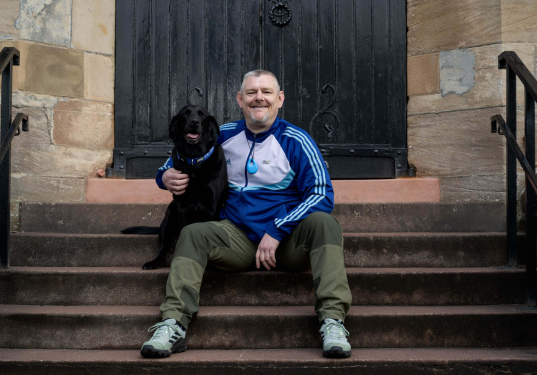
The actual Davidson with his dog, who is smarter than the average actor.
I Swear is the story of John Davidson, who gets the crap beaten out of him for 15 years for precisely this medical condition. The first act is about him as a high-functioning, promising football player, and how his condition causes him to get beaten up by his classmates, tortured by his principal, kicked out of school, abandoned by his father, and boxed in by his mother who, God bless her, is trying but completely unable to handle him other than boxing him in a perpetual juvenile state.
I’m generally not a fan of biopics. They tend to be by-the-books, and to reduce their subject matter to two-dimensional cartoons. They’re nakedly manipulative. I Swear manages to avoid most of the pitfalls. After his initial tragic presentation of Tourette’s, the movie’s act one, the rest of the movie is him trying to get his life together, and succeeding with setbacks that feel more in-line with the way life happens (rather than how movies happen). In a particularly rare but interesting twist, there’s a device—worn on the wrist!—that mitigates Tourette’s for a lot of sufferers.
I guess the “outburst” at the BAFTAs goes to show it’s not 100%. But this points to the underlying truth of the movie: People won’t understand it, not in any meaningful way. Not in 2026.
First of all, this movie is rated “R”. Why? Because of all the swearing, dummy.
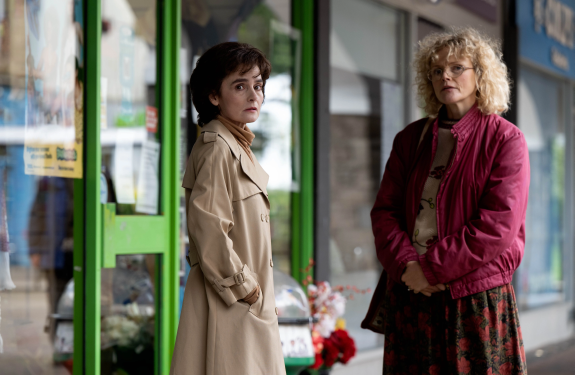
Mom and surrogate Mom.
The trailers attached to the film were for The Sheep Detectives (which I hope is good) and the Snowpierecer-in-Drag movie (Stop! That! Train!) we got nothing but hardcore R movies, like the re-release of Trainspotting, and the new teen-homosexuality-to-school-shooter flick, Our Hero, Balthazar.
By content, this is a G-rated film. It’s a heart-warming, uplifting story of a man who struggles with a disability (which he’ll never admit is a disability) and overcomes it to become an inspiration to thousands. But the words! The terrible, terrible words!
The point that this movie makes is that whatever the resources spent on curing it, however many tax- and charity-dollars are spent, the main thing required is understanding. Yes, the guy says a lot of forbidden words, at the worst possible time (though even the movie didn’t dare drop the hard-R, though it suggested strongly he used it) but the words are literally meaningless. There is no intention behind them.
If the censors understood the film, it would be rated G. If the people at the BAFTAs, and writing about the BAFTAs understood it, this would be something we all chuckled about. Yep, that’s the condition for ya.
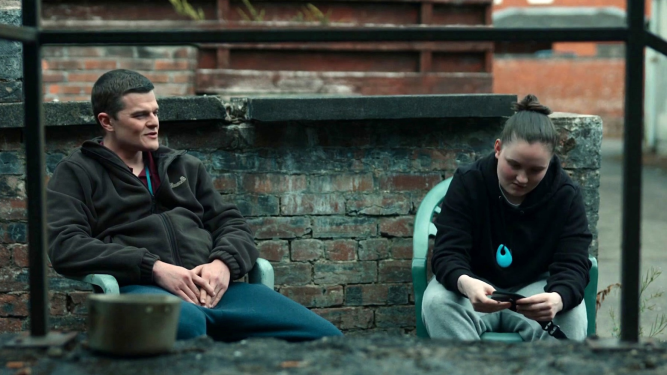
Counselling others with Tourette’s.
But this is literally impossible: In 2026, words have power, and a lot of people rely on that power. Trillions are spent because of words, and this film is the ultimate Emperor-Has-No-Clothes moment. It directly challenges the mindset of the self-proclaimed compassionate ones and they are shown to be completely without any sympathy.
Good film. Good acting from Robert Aramayo (as Davidson) and Maxine Peak (as the nurse who rescues him from his mom) and legendary toilet ghost Shirley Henderson, a really fine actress, bringing a wonderful depth to a challenging role as the mother who wants to help but is completely lacking in support and imagination. Unsentimental direction from Kirk Jones (Waking Ned Devine, Nanny McPhee) keeps the movie from being mawkish while not stifling the emotional power of the story.
The lighting reminds me so much of Hokum that I’m beginning to think it isn’t horror movie lighting, it’s just Ireland and Scotland.
This is a general recommendation for anyone not triggered by words.
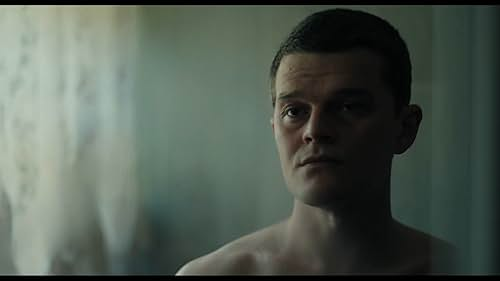
The sunniest day in Scotland.