
Rather embarrassingly for a moviegique, I had mistaken Lumière for Méliès, but in either case this was a must-see documentary. Georges Méliès was the special effects pioneer who is most famous for the image of The Man In The Moon with a rocket in his eye. The Lumière brothers are, more or less, the inventors of film as we recognize it today. Edison was pimping kinetoscopes (where an individual looks into a box) and wouldn’t get around to projection technology till about 1905.
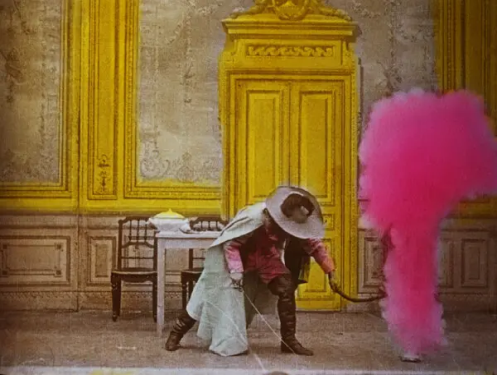
The one (?) case where Lumiere made a film like Méliès.
This didn’t stop him from having the Lumières thrown out of New York City by the Pinkertons, of course.
This documentary is a hundred or so of Louis’ films (brother Auguste only made one) compiled by French film critic and Lumière fanatique Thierry Frémaux, whose previous efforts (The Lumière Brothers’ First Films, Lumière and Lumière, The Adventure Continues) suggest a pattern if not actual monomania. This particular doc doesn’t even appear on his IMDB page, despite having been shot in 2025.
The films are 50 seconds long—that was how much they could record at once—and largely scenes of life in 1895. Some are more staged than others, many are the wrong length for the material. As in, the scene planned came off in less than 50 seconds, and the players involved sort of reset and get out of character—or the scene cuts off right before the important point.
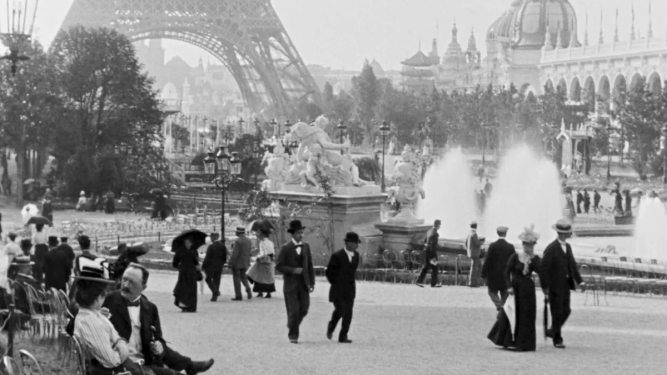
Paris used to be quite beautiful.
The narration, which is a little bombastic, calling the Lumières the last inventors and the first moviemakers, highlights how these vignettes reflect future filmmaking. This one looks like Jean Renoir, that one John Ford, and so on. It fetishizes “reality” a bit—sniffing rather disdainfully at Méliès’ fanciful storytelling approach—which is sort of ironic as Frémaux overlays music by Fauré over these films.
Fauré is great, don’t get me wrong. It’s just that by adding the music, he’s added an artificiality to the vignettes. And, again, I don’t have a problem with that, but for his thesis about the naturalness (the naturalness even in unnaturalness, as when 19th century people keep staring at the camera) and the purity of the process. For example, he chose a particularly dolorous theme to go over the only tracking shot in the film, a drive down a French street which actually looked pretty cheerful to me.
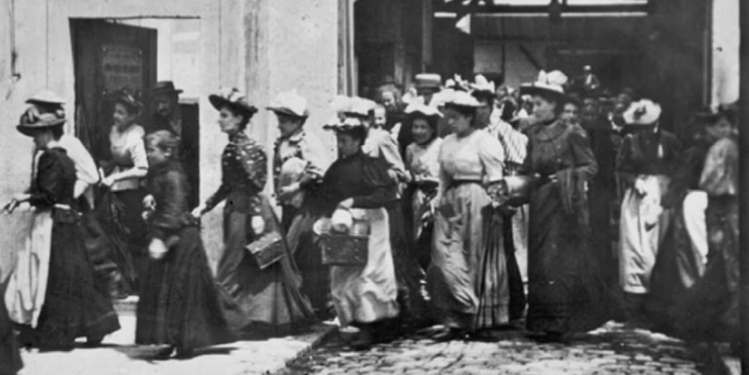
Women, not yet liberated, leaving the factory.
Look, that’s just nitpicking. It is, as I said, a “must-see” if you’re any kind of movie buff. It’s a perfect length, 108 minutes, which gives us enough time to see Paris, Lyon, Algiers, New York City (very briefly), Japan, Italy, Germany. The brothers sent teams with cameras all over the world. There are lots of shots of armies, trains, boats, and bits and pieces of Vaudeville-era stuff, like plate-spinners and acrobats, families and children, and it’s all very charming, really.
The lighting was often…well, let’s call it natural, which gave some of the people almost Finchian looks. Almost everyone is dressed incredibly formal by modern standards. A blacksmith, before being filmed, put on a white shirt and tie. Other things I found interesting:
The first film ever shown (1895) was a movie of people leaving the Lumière factory, and there were many women, maybe half of who we see.
There appeared to be a couple of black people in France. I’d always known this was a thing, as dark-skinned people turn up occasionally in the arts scene in France as early as the 18th century.
Paris women? A little on the pudgy side! Most everybody is skinny in most every scene, so it was surprising to see well-fed Parisians.

Look at these chonkers and their spoon drama!
On the Moviegique 3-point-documentary scale.
- The topic is important, at least to movie historians. These guys invented cinema, including the first “words” of cinematic language.
- Presentation: Well, it’s just their movies. You can’t get more straightforward than that, except for the music selection (which was fine, but not neutral) and the actual text.
- Slant: The brothers invented cinema but, c’mon, they weren’t the last inventors. To say that is to suggest that the Wright Brothers were the last inventors in aerospace.
I don’t mind the slant. Ya gotta have a thesis, and you might as well make it provocative. While I liked listening to the French narration, I think the movie would’ve better serve non-French speakers with a dub. Frémaux talks a lot and it was hard to focus on the images and what he was saying at the same time.
The Boy also liked it, and we were both glad we went.
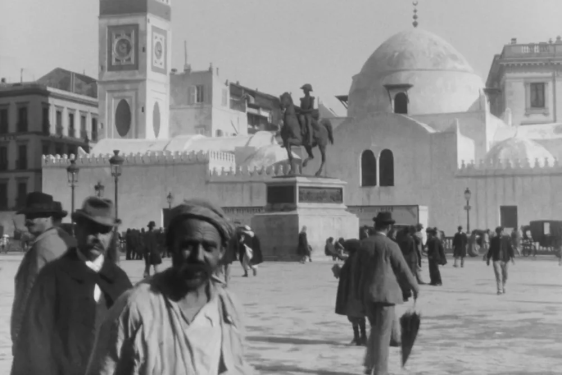
The Algerians seem a litlte menacing. Good thing they don’t live in France.