
On the website-formerly-known-as-Twitter the other day, engagement bait was centered around the question “What director had the best three-movie streak?” Among the obvious answers (Lean, Hitch, Nolan, Scorsese) were those who referenced William Friedkin’s three-fer: The French Connection, The Exorcist and Sorcerer.
Sorcerer has achieved cult status in this century after a troubled production and disastrous first run. There were more people in the audience for this than for 5-time Oscar winner The French Connection. (Though this may have had to do with a podcast tie-in.) I told The Boy that this movie was good evidence that the people who were successful in the ’70s had no idea why they were successful.
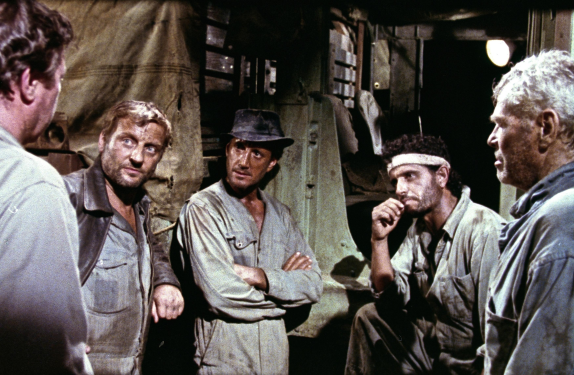
“I’m not saying adding a shark won’t sell more tickets, I just can’t figure out how we fit the damn thing in the cab.”
The French original is longer, and to my mind, more enjoyable but this is a solid film: Four men on the run from the law find themselves in a perpetually impoverished Latin American country where the only work is provided by a ruthless oil company (probably Gulf & Western, who owned Paramount at the time and whose chairman* is pictured on the wall while the executives are deciding who lives and who dies), when a well is sabotaged and one of them perpetual oil fires start.
The only way to stop the fire is with dynamite but the dynamite has been neglected and now can’t be moved two feet without blowing up, much less the 250 miles to the fire. Unless it’s on trucks moving very slowly and smoothly. Our four desperados are the only ones capable of doing the job. Maybe.
Only one box of dynamite is needed but two trucks are sent, each with three boxes. One of the trucks isn’t going to make it, probably. And after about an hour of setup, you get an hour of suspense as the two trucks creep across the godforsaken jungle encountering roadblocks, rickety bridges, storms, and so on.
It’s a good movie. The Boy liked it more than I but he felt it was a little choppy. The editing is abrupt in places.
I never noticed it but Roy Scheider in profile looks like the Jack on a playing card. (Maybe the King in All That Jazz.) His nose is the hypotenuse in an increasingly obtuse triangle.

I mean, seriously.
Another thing the Boy noticed is that, even though this movie gives you the four protagonists’ backstories, it feels like you know their character less than in the French version. I think that’s correct: The backstories are all action, which isn’t boring, but the only thing it tells you about the characters is that they’re trash.
The #1 rule of writing, they say, is “Show, don’t tell.” This is wrong, in my experience, and this movie shows exactly how such a thing can go wrong. In the French version, we know our men are bad guys or they wouldn’t be where they are. Here we see their crimes: An assassination, a terrorist attack (blowing up a building), a massive embezzlement combined with driving a man to suicide, and knocking over a church for its bingo money and killing a priest in the process.
There are actually five men able to do the drive, with the assassin on the outs. So the assassin kills the competition, forcing the other three to let him make the drive.
Go team?
Jack or no, Scheider called this 15 years later, saying the audience had no one to root for. This from a director whose last movie was literally Good vs. Evil. And having just seen The French Connection, Popeye Doyle isn’t much of an anti-hero. He’s meant to be, to be sure, but in the context of police procedural, his crimes are pretty minor, and Hackman’s in full charm-offensive mode.
By not showing us their backstories, the French film makes the redemption arcs much more palatable. Friedkin wanted to make the action stand for the characters, a great aesthetic idea, theoretically, but maybe a little hard to pull of in your movie about driving trucks full of explosives over rickety bridges.
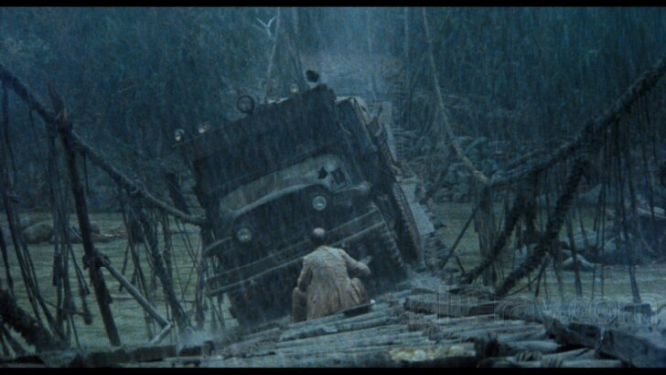
“We’re gonna need a bigger truck. No, wait, smaller! SMALLER truck! Dammit, Roy!”
Good looking film, of course, with the caveat that it’s Friedkin’s trademark squalor. He wants to make sure you experience every awful aspect of this—every graffitied wall, every starving child, every burnt body, down to the making the love interest an old indio woman. (The original French film had the odd but not unlovely Vera Clouzot. Earlier, this film gives us the drop-dead gorgeous Anne-Marie Deschodt—but only for about five minutes before her husband runs off.)
Tangerine Dream began their reign of terror with this film, which peters out around 1988 with house favorite Miracle Mile. Actually, where this is most pronounced is a pre-trip montage with all the guys working over the trucks in the night, ending with a backlit shot of the truck named Sorcerer. It’s so John Carpenter, I half-wondered if he’d somehow been commissioned to do that music.
It’s a good movie. But I’m not the least surprised it flopped. After the insane successes of his previous two films, Friedkin was out of control. And while the typical anti-hero movie could at least say “the lesser of two evils defeats the greater of two evils,” this is “some pretty bad evils in the service of what the filmmaker wants us to see as an even greater evil.”
And it was released on June 25th, 1977. What was number 1 at the box office on June 25, 1977?
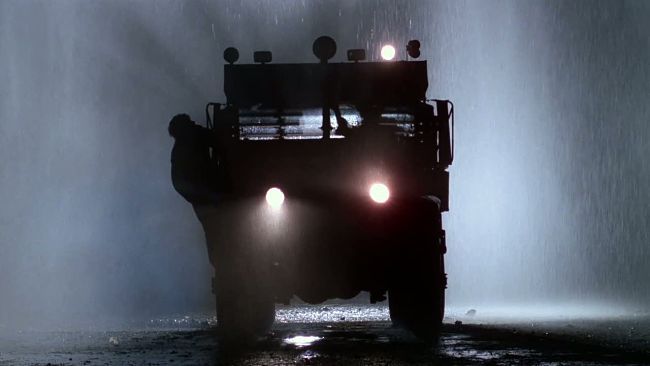
“That’s no moon.”
A movie that gave us good versus evil without the slightest bit of ambiguity. A movie that actually had floated along at #2 at first, because it was struggling against The Greatest (Muhammed Ali as Muhammaed Ali in the Muhammed Ali story) and Smokey and the Bandit, but would claim the #1 crown that very weekend and hold on to it until December of that year, and then go on to capture it again all the way into the summer of the following year, and then just for good measure, capture the #1 spot a couple more times in the summer of 1979! (This was all a single release, too. The 1982 rerelease would bring in tens of millions more dollars, but it would not recapture the #1 slot again until 1997.)
That’s right. I’m talking about Hundreds of Beavers.
No, of course not. Don’t be silly. The movie is, of course, Star Wars. And what is often neglected (because filmmakers don’t want this to be true) is that stories of good versus evil are extremely popular. The same mindset that creates a Sorceror, when dominant, makes space for something like Star Wars to be ridiculously popular all out of proportion to its actual quality.
The equivalent today is something like Project Hail Mary, where a couple of space-bros save the world and become good buddies—without any tedious lecturing about the communist topics du jour. Hollywood learned its lesson in the 1970s. I’m not sure it can today.
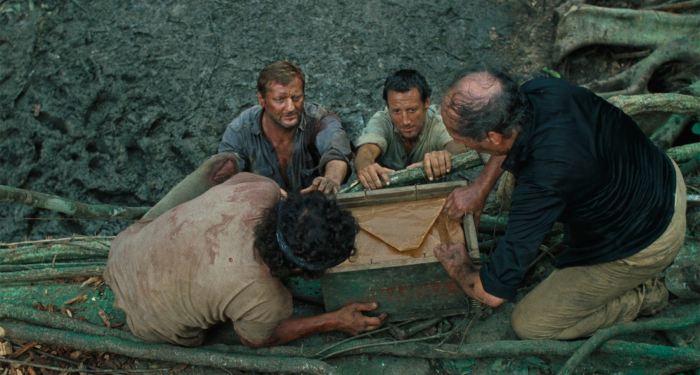
“Look, it’s an extra box. Nobody’s gonna miss it. How do you smoke dynamite, again?”
* “Fun” fact: I worked in the Bluhdorn building on the Paramount lot for a summer back in the day. Bluhdorn was the G&W President pictured.