
French auteur Jacques Tati made four films featuring his affably chaotic character, Monsieur Hulot, of which the second and third films are generally regarded as the best. The Boy and I had seen Mon Oncle a few weeks ago and enjoyed it greatly, and so rather enthusiastically caught this 10AM showing of Playtime, the most ambitious film in the series.
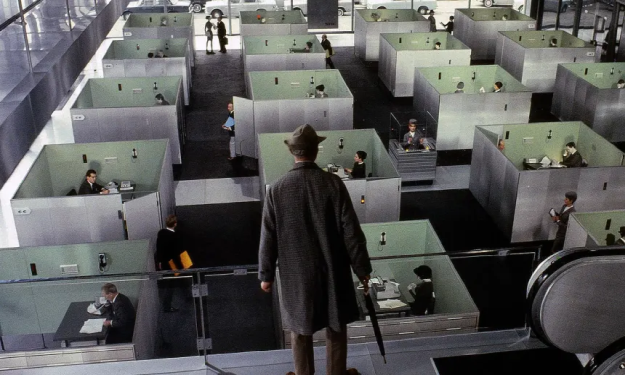
Les cubicles.
Mon Oncle (1956) is a fun satirical look at “modern” life, which despite being made in 1956 has remarkable relevance to today. It’s a charming, wistful love song to the old Paris which, at the time, was being bulldozed to make way for “modern” Paris. I tell people to think of the opening of Up: Not the sadness of it, but the montage quality.
Playtime is not as focused or funny, but what it lacks in humor, it makes up for in scope and aesthetics. In a series of vignettes, we see Monsieur Hulot (who is not in this film as much, as the aging Jacques Tati felt less comfortable playing) trying to meet someone in an office. The office is a series of cubicles that resemble mazes, and the large panes of clear glass make it seem like you’re very close to someone who is still unreachable. Doors, elevators and, of course, modern machinery all serve as foils to this seemingly simple task.
Meanwhile, a busload of American tourists have arrived at the incredibly bland Orly airport, and after fighting their way around a perpetually clogged roundabout, find their way to an exhibition of “the Modern”.
The Eiffel Tower, Sacré-Cœur Basilica and the Arc de Triomphe are seen—but only in the reflected glass of the modern buildings.
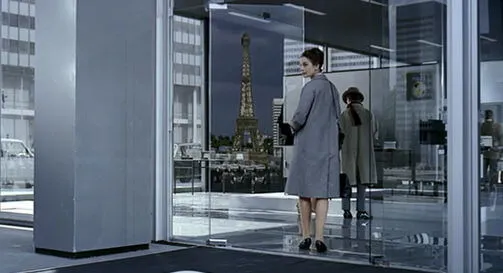
How touristy. Wanting to see the Eiffel Tower.
One gag is in a tourist agency where posters exhort the viewer to see foreign countries like Spain, Brazil and so on. But all of the classic imagery associated with the locations is obscured by a giant, modern hotel filling most of the poster and identical between every location.
That felt extremely relevant.
Ultimately, it isn’t as gag-oriented and it’s far harder to know where you’re supposed to be looking than previous films. Tati (who plays Hulot as well as directing and writing) felt that close-ups were crude. And anyway, the set is the star of the movie, really.
There is an all-night dance party at a fancy but dysfunctional restaruant that is falling down around everyone’s ears. And Hulot becomes fond of a beautiful American tourist (who can play the piano at a critical juncture) named Barbara. If you look at the charming Barbara’s IMDB credits, you’ll find that she (like many other players in the film) has precisely one credit.
Tati liked to use amateurs.
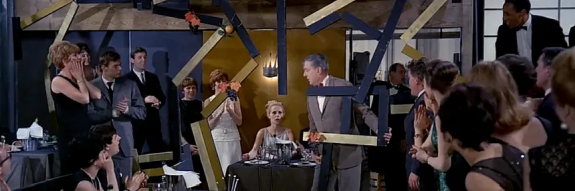
Even the chaos is carefully constructed and beautiful.
The Boy and I really enjoyed it, but I personally realized I would have to adjust my expectations. I realized as the movie played out that the comedy was intrinsic, without the steady big laughs of the previous film. The aesthetic was the point, which is kind of ironic because—for all its satirizing of modernity—there’s a look here that favorably recalls Hopper’s Nighthawks.
The apartment living rooms that have giant windows facing the street provide a great set up for gags as the occupants of one apartment look like they’re reacting to things going on in the other. But the whole scene is very cool, and a great many of the negative overtones we might associate with this style of architecture are overwhelmed by the gentility and manners of the French people. (No, really!)
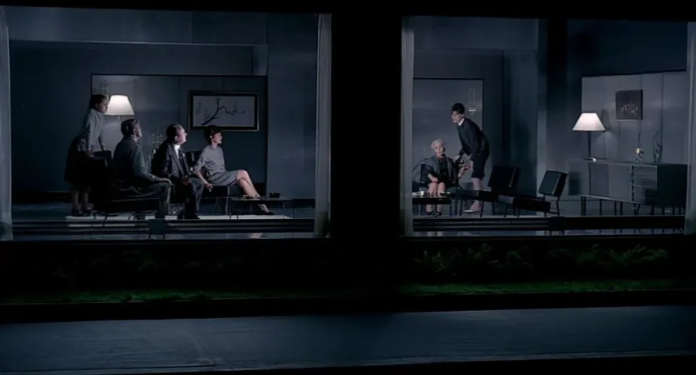
Nighthawks: The Living Room edition.
Originally shot in 70mm, Tati refused to provide 35mm prints, limiting his box office prospect (which were already hurt by the relative absence of M. Hulot). To say nothing of its original runtime of two hours and thirty-five minutes. Many cuts were made and Tati shuffled things around trying to find just the right mix. Our version clocked in at two hours and five minutes.
Of all his films, Tati said this one was truly his. He did what he wanted, with his terms, without being pressured by studios.
I don’t have to tell you, probably, that this flopped.
Also, knowing he could never get an airport or city block to let him take over for the weeks needed to shoot this, he built his own. “Tativille” was an ambitious project that Tati meant to be used over and over again. Alas, it was “razed to the ground” when this movie flopped and bankrupted him.
While I was a little disappointed when I realized how different this movie would be, I could easily go see it again now. There is a lot to get here, and I missed out on a lot.


