Joe Bob's Halloween Spooktacular 2: Waxwork (1988)
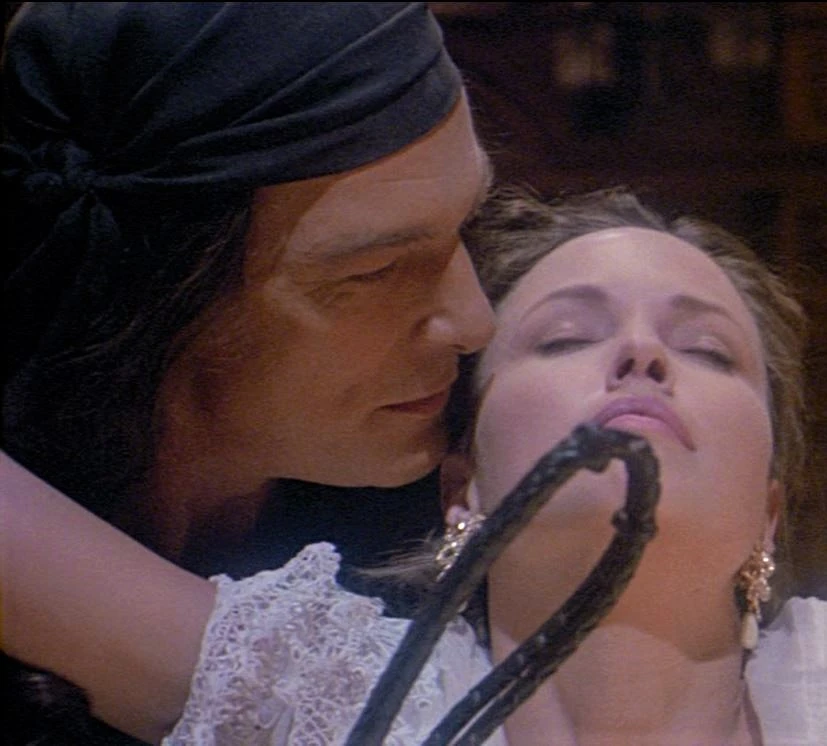
The fifth and final flick of Joe Bob's Spooktacular was one I was sure I hadn't seen before, a 1988 flop by Anthony Hickox called Waxwork. It did not earn its budget back, whether that was $3.5M or $1.5M—but it did come on strong in video rentals later, and got a sequel with such luminaries as Bruce Campbell, Marina Sirtis and Stanley Sheff (who hosted our recent Orson Welles series)!
Quite often these days when we look back on the throwaways of yesteryear, we discover gems—diamonds in the rough we were too jaded to even consider that the time.
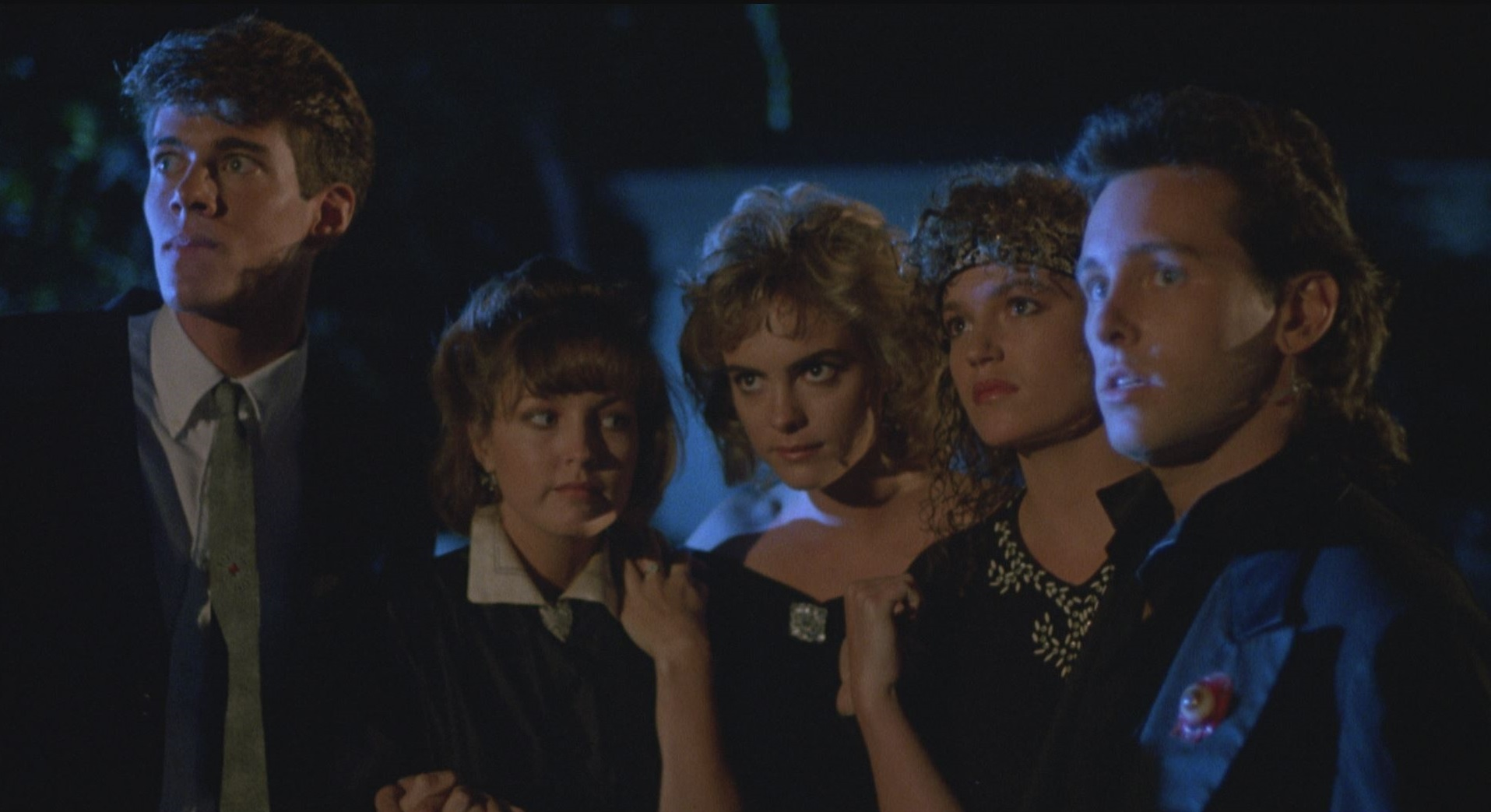
This ain't that, Jack. The two stars JB gave this originally is more on-point then the four stars he gave it last night.
And yet.
OK, in all seriousness, you probably don't want to host a bunch of films and grade each of them beforehand with some harshly critical curve. All the movies last night were four-stars because all the movies last night were four stars. We had fun watching them in a way you probably can't duplicate at home.
This movie has lots of style over a dumb, incoherent plot. The late, lamented David Warner owns a wax museum, called a "Waxwork" (and identified as "Waxwork") over the door of the residential house used as its location, because Hickox was British. American college kids in 1988 were not referring to wax museums as "waxworks"—they weren't referring to wax museums at all, really, unless they were watching "Vinnie the P" House of Wax (in 3D) on "Elvira".
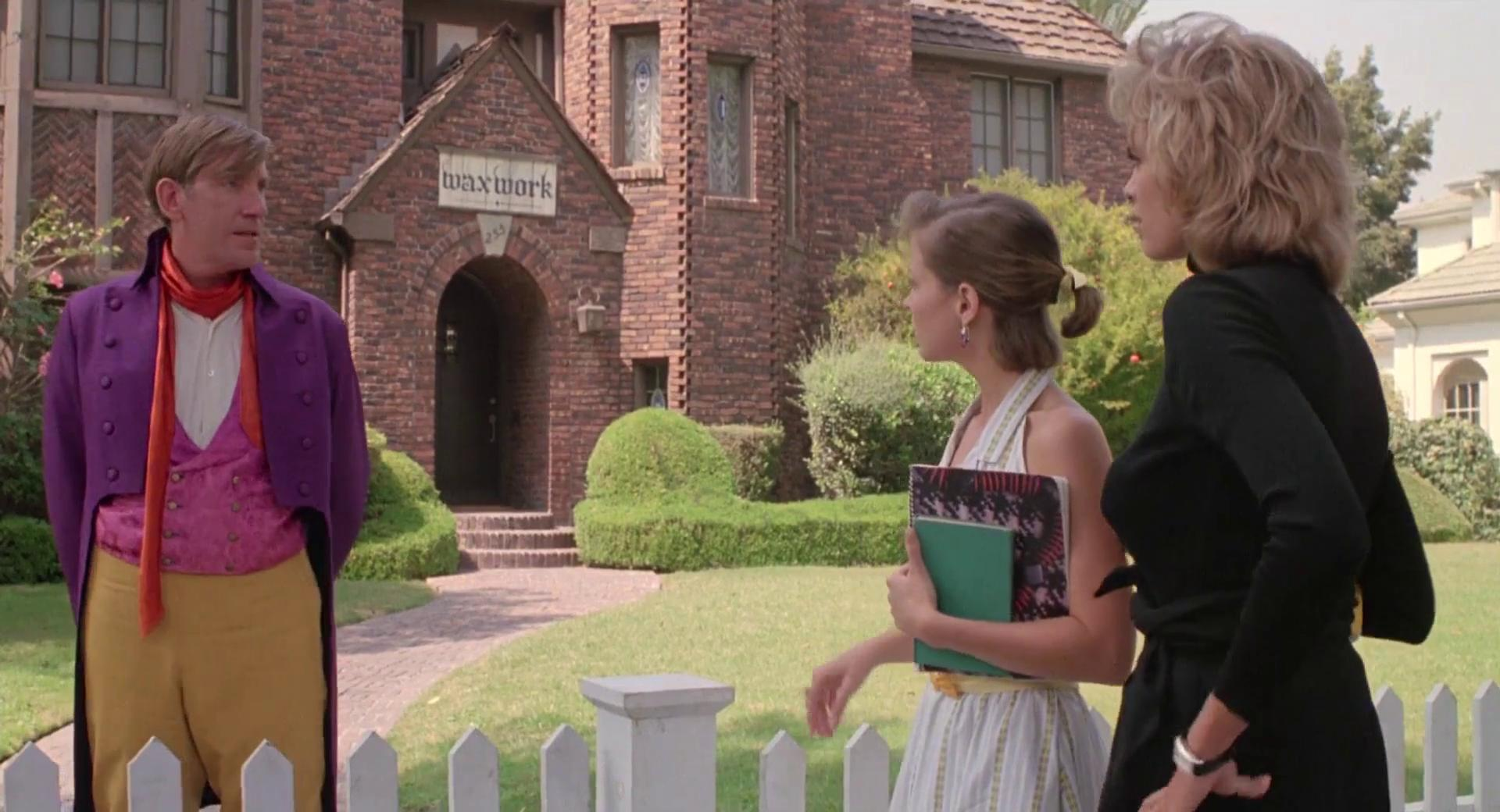
For reasons unexplained, Warner and his pals are immortal, and this immortality is sustained by feeding people to the wax museum exhibits. Joe Bob called this an anthology film and asked "Does anyone like anthology films?" Loud hoots of support went up. Funnily enough, I had been chatting moments earlier with a woman where I said "Anthology films usually suck" and she agreed.
I thought this was common knowledge: Anthology films are, in most cases, one good story that's not long enough for a feature, and padded out with filler stories to get it over the 70 minute mark. JB did call out some of the rare good examples, like the Amicus anthologies of the '60s and '70s. And Wild Tales is genuinely excellent.
This isn't an anthology film, but that doesn't mean it's good.
In an anthology, the stories should potentially be able to stand alone, while the framing story should not. There is, of course, wiggle room but Waxwork is clearly about the wax museum itself. Granted, this is just an excuse for a dog's breakfast of homages, but still, there's a climactic battle scene! In the Waxwork! The whole arc of the movie is the "museum".
What it does have are many vignettes which are themselves not complete or satisfying narratively. We start with Dana Ashbrook who—you know, this movie is kind of a "Who Was Who" of 1988, but Ashbrook worked pretty steadily for the next three decades, including being on most of the "Twin Peaks" show.
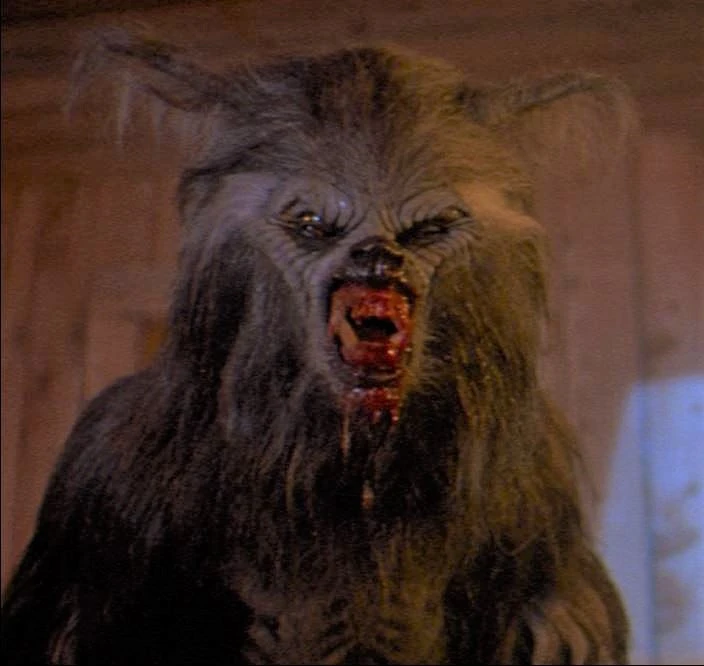
Well, here, he walks into a werewolf scenario and is immediately bitten, then killed with a silver bullet by the world's slowest rifleman, who brought precisely three silver bullets to a werewolf fight and didn't bother to pre-load.
Point is, tho', it's just an end of a story. The climax and denouement.
Next up is Michelle Johnson as China, the slut—I mean, playing the slut! this is a stock '80s character type, don't get mad at me—who ends up in a Dracula story where Dracula is played by a lot of keefe. (How much keefe? Miles O' Keefe!)
Anyway, she has a dinner of not-steak-tartare and ends up discovering later that night she was actually eating the leg of her fiancé. Well, her character's character's fiancé. OK, it's like this: Johnson plays a nasty girl named China who's emotionally abusing Zach Galligan, and when China goes past the red-rope barrier into the Dracula exhibit 'cause she's hot for Miles, she becomes a different character, and this character has a fiancé who it turns out was the sole menu item the previous night.
It's somewhat less confusing in the movie but look, I was up all night.
Also, they didn't need to eat the whole guy. They only ate his left leg up to the knee. Which makes "long pig" one of your better food values. Six vampires could feed on one guy for a week!
In the movie, his legless, tied-down-to-table state is largely played for laughs as Johnson and O'Keefe do the cross-the-table lunge over him, frequently landing on one-and-a-half-leg Louis. In the end, China is vampirified and becomes part of the exhibit, just like Dana, though with all these dead ringers for actual missing people, you'd think they'd be caught instantly.
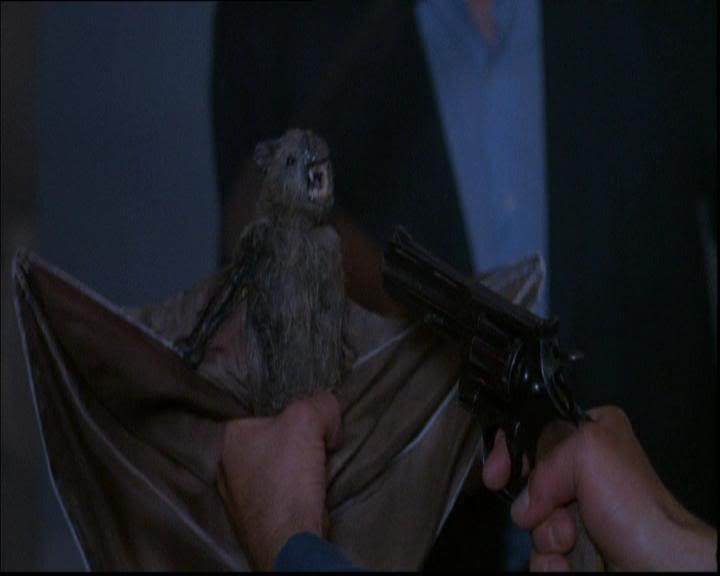
In fairness, this is how the cop puts it together, eventually, but one wonders what the plan was here. Is Warner going to open his waxwork to the public? He can't because he'd be instantly caught. I guess he just needs six sacrifices and then...I think...he was going to abscond with the souls, so he was never going to open. So the big sign (on the residential house) is...bait?
Another vignette is a '30s-inspired "The Mummy", and another is a black-and-white Night of the Living Dead homage.
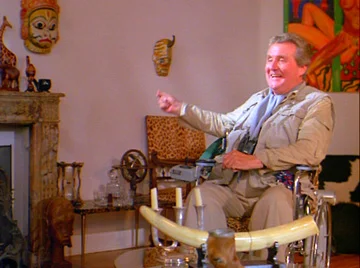
None of these are actually stories. They're just scenes. And they're not very interesting. By-and-large, the acting is the sort of acting you get with a dumb script. David Warner and Patrick Macnee (as Galligan's uncle) could read the phone book and make it compelling, which is good.
An exception here is Deborah Foreman. The perky good-girl plays...the perky good-girl, Sarah. But she has an actual arc where apparently she's fascinated by the Marquis De Sade, and she has an arc of being seduced by him, realizing what's going on, and coming around to kick some ass at the end. Yet another very thin vignette. She makes the most out of it.
Ultimately, though, this movie is an excuse to reference a lot of better, more memorable films. It absolutely has style and this sort of style is something missing from a lot of films today. There are a lot of good elements to it overall, and it is not boring until the very end, which makes it more watchable than I would've thought. These are the sort of things that would win you over in the world of Home Video, too.
The ending is just a disaster. Apparently, Hickox had a four day shoot planned for it, and the bonding company said "You're too far over budget, you've got one day." (Important lesson: Shoot your big set pieces first.) So Hickox just said, essentially, "Go for it. I'll fix it in post." Actually, worse, he said something more like "Go for it and I'll get the coverage I need."
It's overlong, confusing and arbitrary. There's a good bit with Galligan and soap-opera mainstay J. Kenneth Campbell as de Sade doing some old-style fencing, but it is seriously hemmed in, shot on a single small landing. I believe Macnee sacrifices himself, though this poses no barrier to him turning up in the sequel.
It was fun to watch but unless you're in a theater full of mutants at 4AM, not a strong recommend from the 'gique.
Comments
No comments yet.