Gift of Fire
The thing is, we like going to movies, The Boy and I. I'd say we're not fussy, though Hollywood has a hell of a bar to clear these days just to get us in the theater. And the lockdowns have meant the movies that aren't the Big Ticket items for the majors are fighting for very limited space—this also means they're crowding out the Korean movies in the Korean theaters. So if you don't want to see an awful James Bond movie, or an awful Marvel superhero movie, or the new animated movie from the new animation studio that looks like every other freakin' 3D cartoon that comes out, you're pretty limited. The local chain was showing some interesting-looking documentaries and a Russian film in the two theaters that require vaccine passports, so that was out, but the dumb rules are only being enforced in dumb places and we are blessed with a highly fragmented municipality.
Actually, a delightful bit of dumbness applied to our local AMC when we went to see High Society: They were not (are not?) aware that they are in the Dumb City and believe themselves only to be in the Dumb County, where the Dumb Rules do not apply. I will happily use dumbness to fight fascism.
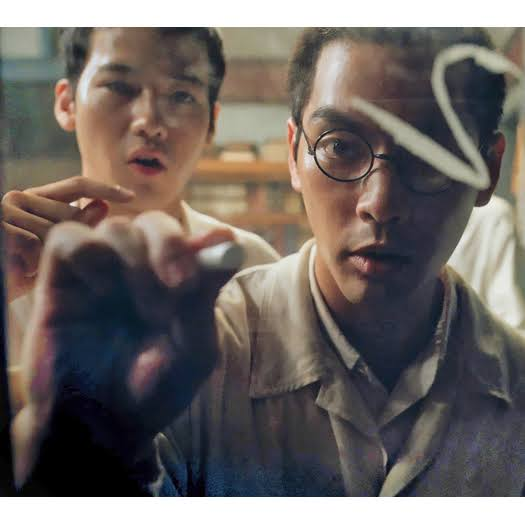
The upshot of this is we had to drive an extra six miles to see this Japanese film about their race to create an atomic bomb. I liked it more than the Boy but we both agreed it was an acceptable film experience, and the movie had a lot of really fine aspects.
It is unsettling, as an American, to go see movies like The Wind Rises and In This Corner of the World, and realize you're being asked to sympathize with the people who were working to kill you, or your parents or grandparents, especially when we are well indoctrinated into the Pearl Harbor narrative and view ourselves as completely innocent victims. The history is more complex of course, and if you boil it down to "governments are rotten, and societies tend to be rotten to the degree they go along with a rotten government" and becomes much easier to sympathize with the actions of individuals who are trying to work within the parameters of freedom they can see.
I did have to remind the Boy that dropping an atom bomb on San Francisco in 1945 would've been bad.
But, honestly, they weren't close. A dozen or so people, most of them students, working on building a centrifuge fast enough to refine the plutonium which they flat-out don't have—they secure their meagre experimental amounts from a pottery thrower who uses it in his paint—and all of them struggling with different issues of morality and ethics.
Their sensei basically follows the line of logic that people fight over energy, and if there's unlimited energy there's no war. But he knows that they're nowhere close to success, that if they were, their work would be used as a bomb, and it's all kind of a front for him to keep these very bright students from being thrown into the Japanese War Machine. At least one of the students feels so guilty about it that he enlists anyway.
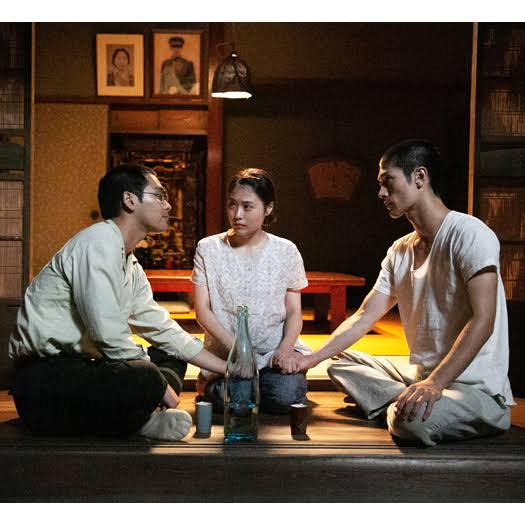
Our protagonist is an interesting character: He's almost "special ed" level amongst all these mathematical geniuses who's there because his real genius is experimentation. Although he can't do the simplest (to his peers, not to thee or me) math problems, he comes up with the ideas on how to keep the centrifuge together. He's really driven by the problem, not the reward of solving the problem; this is his purpose. His brother meanwhile comes back for a short vacation from the front—this is when the Japanese were planning their all-out defense of the homeland—and he's wrestling with the fact that he is alive when his fellow soldiers are all dead.
The neighborhood girl has come to stay with them, with her grandfather, after her house has been torn down prophylactically, to reduce the fire caused by the bombing, and she's wrestling with what comes next: How do they get Japan going again when so many have been lost? Radically, she plans to get a job as a teacher.
It's a dark time in any society when it loses a war, and especially so for one as steeped in the mythology the Japanese created for themselves around the turn of the 20th century. Ultimately, though, it's not a dark film. Our hero has a nice arc involving his attitude toward humanity that gives one a little hope.
It probably won't knock your socks off, but it's interesting and well shot, and it does what I like foreign movies to do: Give a perspective we're not used to seeing.
Comments
No comments yet.